
A drone that can resolve individual leaves on a tree from 200 feet up changes how you frame a landscape. That level of detail is what a true 4K sensor delivers — not upscaled marketing numbers, but real pixel-level sharpness that holds up on a 55‑inch screen. The difference between a drone that just says “4K” and one that actually captures 3840×2160 lines of resolvable detail shows up the moment you punch into your footage on a timeline. It is the single specification that separates a toy from a tool you can charge a client for.
I’m Min — the co-founder and writer behind Gadgets Feed. Over the last decade I’ve analyzed the sensor stacks, bitrates, gimbal architectures, and transmission protocols of hundreds of camera drones, breaking down what the spec sheet actually means for the footage you bring home. (And Homer 🐱 supervised every range test from the warm spot on my backpack while I checked signal bars).
Finding the right balance of resolution, stabilization, flight time, and transmission range takes more than scanning megapixel counts. This guide breaks down the nine best models on the market today to help you pick the 4k resolution drone that matches your skill level, budget, and creative goals.
How To Choose The Best 4K Resolution Drone
A 4K camera is only as good as the platform carrying it. If the gimbal can’t hold a steady horizon, the sensor doesn’t capture enough light, or the bitrate is too low to retain shadow detail, the resolution on the spec sheet becomes a lie. Here are the three pillars to evaluate before you commit.
Gimbal Type: Mechanical vs. Electronic Stabilization
A 3‑axis mechanical gimbal physically counter-rolls, pitches, and yaws the camera to cancel out drone movement. This is the gold standard because it preserves full sensor resolution without cropping the frame or introducing the jelly-wobble effect common to electronic image stabilization (EIS). Drones that rely solely on EIS — or worse, a 2‑axis gimbal — tend to produce usable footage only in near-calm conditions. Look for at least a 2‑axis mechanical gimbal; 3‑axis is the default for serious 4K capture.
Sensor Size and Bitrate
A 1/2.3-inch CMOS sensor is the baseline in consumer 4K drones. Larger sensors — 1/1.3-inch or the 1-inch sensor in premium models — gather significantly more light, which reduces noise in shadows and extends the usable shooting window into twilight. Pair that with a video bitrate of at least 60 Mbps to avoid macro-blocking in complex scenes like trees or grass. Bitrate is the spec most shoppers ignore; it directly determines how much detail survives compression.
Transmission System and Range
Wi‑Fi-based video links are range-limited and prone to interference, especially in areas with congested 2.4 GHz bands. Digital transmission systems — often proprietary — use wired relay connections or dedicated frequencies to maintain a clear, low-latency feed at distances beyond a mile. A rated range of 10,000 feet or more with a digital link gives you confidence to explore scenery without losing your real-time viewfinder. If you fly in urban environments, look for tri-band support (2.4 GHz / 5.8 GHz / 900 MHz) for automatic frequency hopping.
Quick Comparison
On smaller screens, swipe sideways to see the full table.
| Model | Category | Best For | Key Spec | Amazon |
|---|---|---|---|---|
| Autel EVO 2 Pro V3 | Premium | Professional cinematography | 1-inch CMOS, 6K video | Amazon |
| DJI Flip (RC-N3) | Mid-Range | Beginner cinematic flying | 1/1.3-inch CMOS, 4K/60fps | Amazon |
| Holy Stone Sentinel HS600D | Mid-Range | Long range capture | 3-axis gimbal, 20,000ft range | Amazon |
| Bwine F7MINI 4K(RC3) | Mid-Range | Travel vlogging | 64-min flight, built-in screen | Amazon |
| Bwine F7GB2 Pro | Value | Extended flight sessions | 75-min total flight (3 batt) | Amazon |
| Ruko 4K UHD Drone | Value | New pilots wanting 3-axis stability | 96-min flight, 3-axis gimbal | Amazon |
| Holy Stone HS600 | Budget-Friendly | Rangy exploration on a budget | 20,000ft range, EIS | Amazon |
| DJI Neo 2 | Budget-Friendly | Selfie content creation | 151g, omnidirectional sensing | Amazon |
| HOVERAir X1 | Compact | Action sports, hands-free follow | 125g, 32GB internal storage | Amazon |
In‑Depth Reviews
1. Autel EVO 2 Pro V3

The Autel EVO 2 Pro V3 occupies a class of its own with a true 1-inch Sony CMOS sensor that captures 6K HDR video, far exceeding the typical 1/2.3-inch sensors found in most consumer 4K drones. The adjustable aperture — f/2.8 to f/11 — gives you exposure control that is rare at any price point, allowing precise depth-of-field management and the ability to hold shutter speed in bright conditions without neutral-density filters. This matters when you need 12-bit A-Log color space for grading in post-production, a feature that puts it on the same playing field as cinema-grade aircraft.
The 360-degree omnidirectional obstacle avoidance system uses 12 computer vision sensors and two sonar sensors, wrapping the aircraft in a collision-sensing shell that lets you fly confidently through tight canyon runs or around complex structures. The Skylink 2.0 transmission system delivers a 15-kilometer range on tri-band frequencies with automatic frequency hopping — meaning you can push out to two miles in a congested urban environment without dropping the live feed. The 7,100 mAh battery yields 40 minutes of forward flight, and the included Smart Controller SE eliminates the need for a phone, sporting a 6.4-inch OLED touchscreen that stays readable in direct sunlight.
One of the most debated features among pilots is the absence of geofencing in no-fly zones — Autel leaves regulatory compliance to the operator, which gives maximum flexibility for professional use but demands personal responsibility. The package includes a hard plastic case, three batteries (two in the combo), a 32GB SD card, and spare propellers right out of the box. If your work requires raw sensor data, 12-bit post-production latitude, or obstacle avoidance that actively tracks subjects while dodging obstacles, this is the drone that will not hold you back.
Why it’s great
- 1-inch CMOS captures 6K HDR with 12-bit A-Log for professional grading
- 12-sensor 360° obstacle avoidance enables confident navigation through complex environments
- Smart Controller SE with 6.4-inch OLED screen eliminates phone-dependency in bright light
- Interchangeable camera gimbal supports IR and 8K modules for specialized workflows
Good to know
- No geofencing in no-fly zones — full regulatory burden falls on the pilot
- Weighs 1,191 grams, requiring FAA registration and limiting ultraportable travel
- Controls feel more sensitive than DJI models, requiring a short adaptation period
2. DJI Flip (RC-N3)

The DJI Flip is built around a 1/1.3-inch CMOS sensor that records 4K video at 60 frames per second with HDR, a sensor size that pulls in significantly more light than the 1/2.3-inch chips found in most entry-level 4K drones. This translates to cleaner shadow detail and better dynamic range when shooting at golden hour — the exact time most hobbyist flyers want to capture. Full-coverage carbon fiber propeller guards wrap the aircraft, making it one of the safest options for learning without the constant fear of damaging props on a wall or tree branch.
Weighing under 249 grams, the Flip qualifies for relaxed FAA registration rules, and the 31-minute maximum flight time — measured in near-windless conditions at a steady forward speed — gives you enough airtime to scout a location and set up multiple shots on a single battery. The subject tracking feature keeps a person centered in the frame during hiking or party capture, and the palm takeoff and landing function means you never need to find a flat landing surface. The RC-N3 remote controller connects via USB to your phone for the live view, or you can fly entirely through the DJI Fly app using your phone’s touchscreen for full manual control.
Keep in mind that 4K at 60 fps is only available when using the included remote controller; the phone-only and voice-control modes cap at lower resolutions and frame rates. Obstacle sensing is front-only, so reversing or sideways movement requires visual line-of-sight awareness. The kit includes one battery and the RC-N3 controller; you will want to budget for an extra battery and a carrying case if you plan to shoot for extended sessions. For a beginner who wants genuine 4K/60 quality without jumping to a pro-grade system, the Flip is the most accessible entry point from a brand with the deepest ecosystem of accessories and community support.
Why it’s great
- 1/1.3-inch sensor outperforms typical entry-level 1/2.3-inch CMOS for low-light capture
- Under 249g weight avoids FAA registration while retaining full 4K/60fps capability
- Full-coverage carbon fiber guards protect the drone and people during indoor or close-proximity flying
Good to know
- 4K/60fps is locked to remote controller use — phone-only mode drops resolution and frame rate
- Obstacle sensing covers only the front direction; lateral and rear collisions are unprotected
- Single battery included in the base kit — additional batteries are a recommended investment
3. Holy Stone Sentinel HS600D

The Holy Stone Sentinel HS600D pairs a high-performance 1/2-inch Sony CMOS sensor with a 3-axis brushless gimbal and electronic image stabilization, producing 4K HDR video and 48-megapixel photos at a price point that undercuts most DJI equivalents. The f/1.8 aperture lets in enough light to keep shutter speeds reasonable during twilight flights, and the combination of mechanical and electronic stabilization smooths out the vibrations that typically cause micro-jitters in less robust drones. The 603-gram reinforced frame and powerful motors yield Level-6 wind resistance, meaning sustained gusts up to 45 km/h won’t turn your footage into a seasick experience.
The 20,000-foot digital image transmission system uses a wired relay connection between the remote and your phone, replacing the unstable Wi-Fi links common at this tier. This translates to a low-latency, interference-resistant HD feed that holds its signal even when flying behind tree lines or around buildings. Two 3,500 mAh intelligent batteries deliver a combined 80 minutes of flight time — each battery running roughly 40 minutes in a hover and 34 to 35 minutes under forward flight. The intelligent beginner mode sets automatic altitude limits and one-button takeoff-and-return for rookie pilots, while the advanced GPS modes — Follow Me, Smart Tracking, Time-Lapse, and Panorama — give experienced creators cinematic flight paths without manual stick inputs.
Some pilots report that the camera has no manual ISO or exposure control, which limits tweaking in fully automatic mode, and the 8K photo resolution is interpolated rather than native sensor-readout. The return-to-home function lands within a few feet of the takeoff point but not always dead center, so leave a margin on your launch pad. Despite those minor caveats, the HS600D delivers a gimbal-stabilized 4K HDR image with a transmission range that typically costs twice as much from legacy brands. It is a serious contender for anyone who wants professional-grade stability and range without a professional-grade price tag.
Why it’s great
- 3-axis brushless gimbal plus EIS eliminates micro-jitter even in Level-6 wind conditions
- 20,000ft wired-relay transmission avoids Wi-Fi dropouts and interference
- Dual 3,500mAh batteries provide one of the longest flight times in the mid-range category
Good to know
- Camera lacks manual ISO and exposure controls — auto-only limits creative flexibility
- 8K photo is interpolated, not native sensor resolution; 4K video is the true deliverable
- Return-to-home lands near but not exactly on the takeoff point; a wide landing pad is safer
4. Bwine F7MINI 4K(RC3)
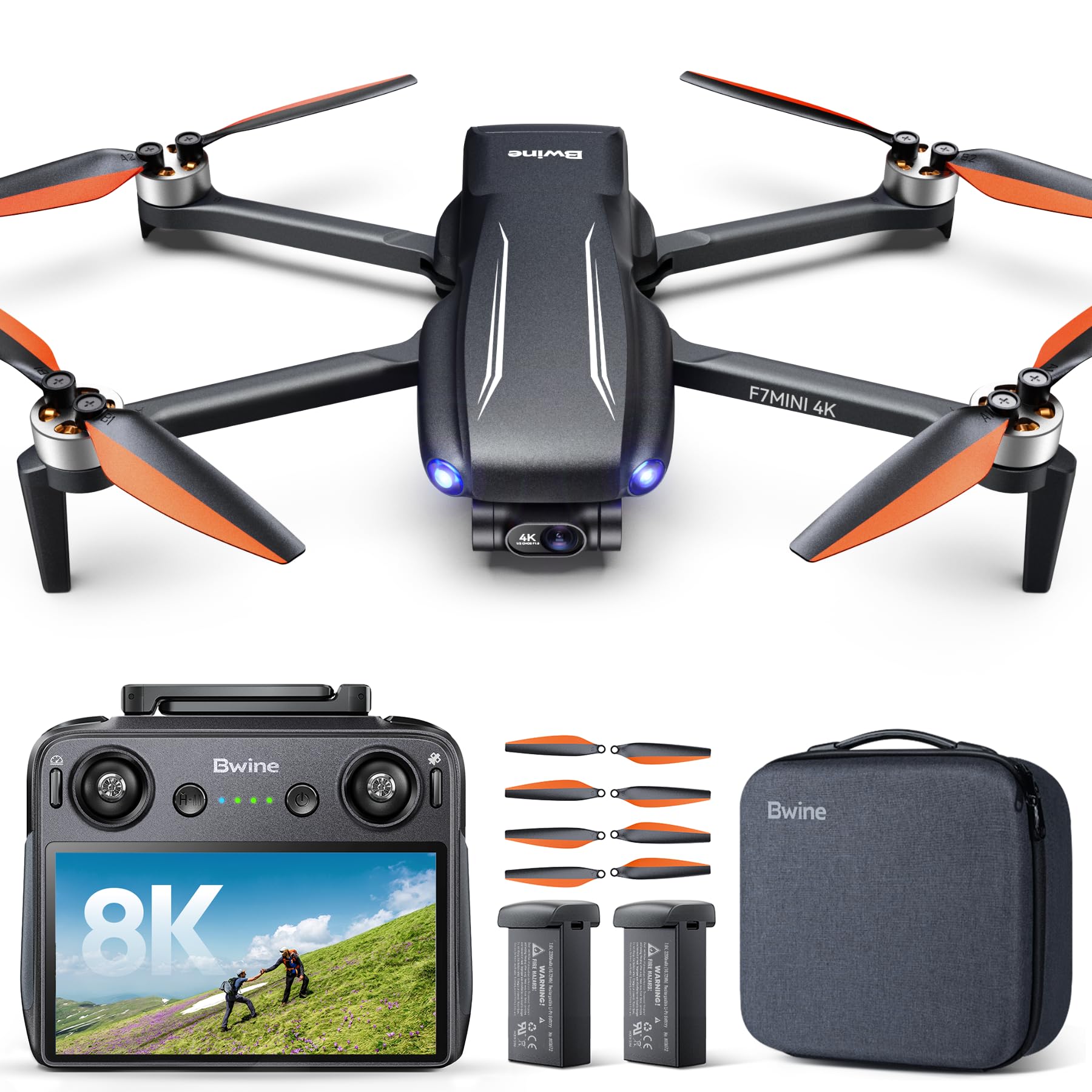
The Bwine F7MINI 4K(RC3) solves one of the most persistent annoyances in drone flying: fumbling with a phone mount in bright sunlight. The included remote controller features a 5.5-inch 1080P screen with 500 nits of brightness, so the live camera feed is always visible without needing to connect your smartphone. The 3-axis brushless gimbal paired with EIS keeps the 4K UHD video locked steady even during gusty flights, and the 48-megapixel sensor with f/1.8 aperture pulls in enough light to maintain clarity in overcast conditions. Weighing under 249 grams, it dodges FAA registration while still packing a serious camera payload.
The transmission range reaches 20,000 feet on the proprietary digital link, and the latency stays around 0.1 seconds in open terrain, making it suitable for scouting large properties or surveying ranch land without losing the visual feed. Two 2,200 mAh batteries provide a combined 64-minute flight time, and they support PD 3.0 fast charging — a 65W charger can top them up in roughly 1.5 hours. The GPS system integrates active track, waypoint planning, orbit mode, and a dynamic home point that updates the return-to-home location based on where you are standing with the controller. If the drone does go down, the built-in 120 dB buzzer can be triggered from the app to pinpoint its location in tall grass or brush.
The controller runs a customized Android system, which means you can install third-party apps or save screenshots to the 32 GB of internal storage without connecting a phone. However, the Wi-Fi-based connection between the drone and the controller, while stable for the rated distance, can be subject to interference in dense urban centers with overlapping 2.4 GHz channels. The included carrying shell case holds the drone, controller, and both batteries snugly, making this a grab-and-go kit for travel vloggers who want a built-in screen, professional-grade 4K, and sub-250-gram portability in one package.
Why it’s great
- 5.5-inch 1080P built-in screen eliminates the need for a phone mount in bright conditions
- Under 249g with full 4K capability avoids FAA registration and packs small for travel
- PD 3.0 fast charging cuts recharge time to roughly 1.5 hours per battery
Good to know
- Wi-Fi-based transmission can face interference in dense urban 2.4 GHz environments
- Media downloads to the phone are slower than direct USB transfers to a computer
- Dedicated SD card not included for the remote’s 32GB internal storage
5. Bwine F7GB2 Pro

The Bwine F7GB2 Pro distinguishes itself with three 2,600 mAh intelligent batteries that combine for 75 minutes of total flight time — a figure that lets you cover extended real estate surveys, long trail runs, or multi-location photo sessions without returning to base to swap packs. The detachable 4K camera rides on a 3-axis gimbal with 5x digital zoom, and the larger CMOS sensor handles low-light environments like twilight or overcast days better than the smaller chips in similarly priced drones. Level-6 wind resistance and a 2,000-meter altitude ceiling mean you can fly from mountaintop lookouts without performance degradation.
The 10,000-foot transmission range (rated 9,800 to 10,000 feet in ideal conditions) uses a Wi-Fi relay built into the controller, which provides a stable link in suburban and rural settings. The precision GPS system features one-key return, lost-signal return, and low-battery return — all of which activated reliably in customer-reported flights, including one instance where the aircraft lost signal at 2,900 feet away and flew back autonomously. The F7GB2 Pro also includes a 120° FOV lens, and the app offers in-editor filters and background music for quick social-media sharing without moving files to a desktop computer.
The remote controller’s screen is difficult to read in direct sunlight, so you will want to rely on your phone’s brighter display for critical framing in outdoor conditions. The camera’s video exhibits slight image distortion during sharp yaw turns, a characteristic of the EIS system having to catch up with sudden rotation. The included hard shell carrying case holds the drone, three batteries, controller, and spare parts in a single compact unit, making it easy to grab for weekend trips. For pilots who prioritize raw flight time over compact form factor or brand recognition, this bundle delivers the most minutes per dollar in the mid-range bracket.
Why it’s great
- Three batteries deliver 75 minutes aggregate flight time without landing to recharge
- 3-axis gimbal and Level-6 wind resistance enable stable footage from mountaintop launch points
- Detachable camera with 120° FOV lens opens easy maintenance and upgrade paths
Good to know
- Remote screen washes out in direct sunlight — phone display is more reliable for outdoor framing
- Video shows minor distortion during sharp yaw maneuvers due to EIS settling time
- SD card compatibility can be picky; Samsung EVO 128GB is confirmed to work reliably
6. Ruko 4K UHD Drone

The Ruko 4K UHD Drone undercuts nearly every competitor in its class by delivering a genuine 3-axis brushless gimbal with EIS at a price that usually buys you a 2-axis or no-gimbal model. The 1/2-inch 48-megapixel CMOS sensor records 4K UHD video at 30 frames per second with enough color depth to produce publishable landscape shots without heavy post-processing. Weighing under 249 grams, it sidesteps FAA registration while still fitting a 3-axis stabilization system that cancels out the low-frequency drone vibrations that ruin most sub-250-gram footage. The triple intelligent positioning — GPS, barometric altitude hold, and optical flow — locks the hover tight enough to frame precise compositions even in light breeze.
The 20,000-foot digital feed eliminates the Wi-Fi interference lottery, relying on a dedicated R2 digital system that maintains a smooth real-time view with lower latency than typical 2.4 GHz connections. Three 2,200 mAh batteries pack into the kit for a combined 96 minutes of flight time — the highest aggregate figure in this guide — making it an excellent choice for road trips or vacation documentation where you don’t want to stop every 20 minutes to swap and charge. The AI takeoff and landing system automatically handles launch and retrieval, and the built-in beeper helps locate the drone even after a forced landing in dense vegetation.
Customer-reported experiences note that the joysticks are sensitive, so new pilots should start in beginner mode to avoid jerky control inputs while they develop muscle memory. The 8K photo resolution is interpolated from the 48-megapixel sensor, meaning true pixel detail caps at 4K video levels. Ruko provides standout customer service — several users reported receiving replacement units quickly after battery or propeller failures. For a budget-conscious buyer who refuses to sacrifice a 3-axis gimbal, this is the strongest value proposition in the current market.
Why it’s great
- 3-axis brushless gimbal at a price point where 2-axis gimbals are the norm
- Three batteries deliver the highest aggregate flight time (96 min) in this guide
- AI takeoff and landing plus quadruple positioning make it beginner-friendly without sacrificing stability
Good to know
- 8K photo resolution is software-interpolated; native video detail is true 4K
- Joysticks are sensitive — new pilots should train in beginner mode initially
- No dedicated remote screen; relies entirely on phone app for the live feed
7. Holy Stone HS600

The Holy Stone HS600 provides a 20,000-foot transmission range — one of the longest in the sub- segment — through a Wi-Fi repeater embedded in the remote controller, allowing you to explore expansive rural landscapes without losing the live camera feed. The 2-axis gimbal paired with electronic image stabilization delivers 4K video at 30 frames per second that stays acceptably smooth in moderate wind, though the lack of a third gimbal axis means you cannot tilt the camera independently of the drone’s yaw movement during complex flight paths. The Sony sensor-enhanced camera produces 8.29-megapixel still photos that look crisp on social media but show their interpolation limits when viewed at full screen.
The built-in FAA-compliant Remote ID module eliminates the need for an add-on transmitter, so you can fly legally in areas where Remote ID is required without carrying extra hardware. Level-6 wind resistance keeps the 541-gram frame steady in up to 45 km/h gusts, and the brushless motors provide enough torque to climb fast when you need to clear obstacles. The GPS intelligent return-to-home function triggers automatically on low battery or signal loss — a feature that proved reliable in customer flights where the drone returned autonomously from nearly 3,000 feet away. The one-key takeoff and landing, follow-me mode, and waypoint flight mode round out a feature set that competes well with drones costing double.
The battery delivers roughly 28 to 34 minutes of real-world flight per charge, which is competitive but not class-leading. The camera has no manual ISO or exposure control and does not record RAW stills, so serious photographers may find the auto-exposure system struggles in high-contrast scenes. The power-on sequence matters here: drone first, then remote controller, then phone Wi-Fi — skipping the order can cause compass interference, especially if you are near metal surfaces. For a budget-friendly entry point into long-range 4K flying with the peace of mind of built-in Remote ID, the HS600 is a sensible pick.
Why it’s great
- 20,000ft transmission range at a budget-friendly price unlocks exploration of wide landscapes
- Built-in FAA-compliant Remote ID eliminates need for an external transmitter module
- Level-6 wind resistance keeps the flight stable in conditions that would ground lighter competitors
Good to know
- 2-axis gimbal cannot independently tilt the camera during yaw movement; 3-axis is smoother
- No manual ISO or exposure control — auto-exposure may blow out highlights in high-contrast scenes
- Power-on order must be followed strictly to avoid compass interference from nearby metal
8. DJI Neo 2
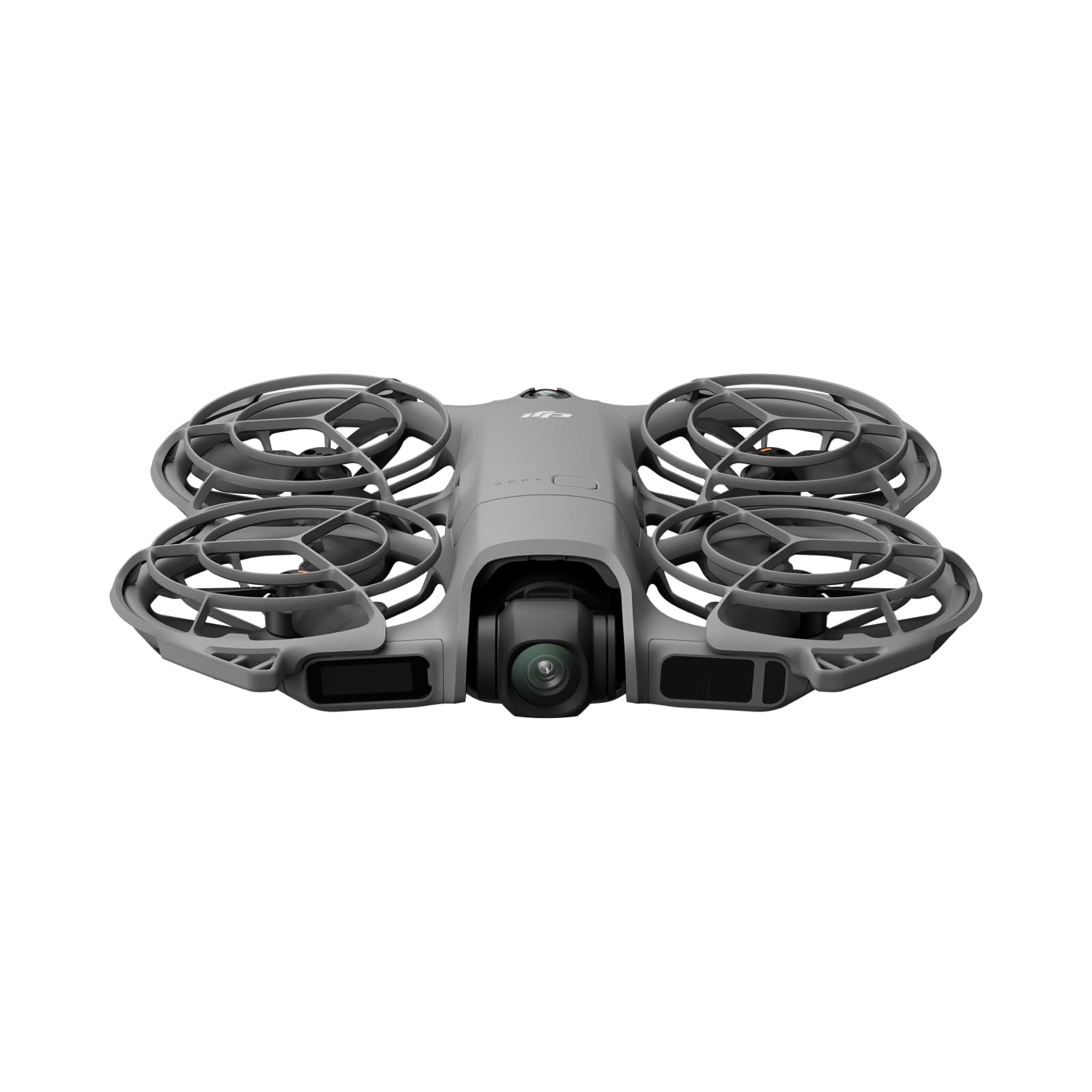
The DJI Neo 2 is the lightest true 4K drone in this lineup at 151 grams, small enough to slip into a jacket pocket and launch from your palm without needing a flat surface. The 12-megapixel effective still resolution feeds a 4K imaging pipeline that produces crisp, vibrant footage — a clear improvement over the original Neo’s softer output — while the omnidirectional obstacle sensing wraps the aircraft in a safety net that makes indoor flying and close-proximity shooting far less stressful. Gesture controls let you start recording, take a photo, or land without touching a phone, which is the entire point of a selfie drone: keeping your hands free and your attention on the moment.
ActiveTrack keeps the subject centered in the frame, and the Apple Watch integration lets you view the live feed and trigger tracking via voice control — a genuinely useful feature for solo runners, cyclists, or hikers who want a third-person perspective without carrying a controller. The C0 safety certification and full-coverage propeller guards allow operation in more restricted environments than larger drones, and the foldable design (the Neo 2 folds smaller than a smartphone) means it disappears into a small bag compartment. The 18- to 19-minute real-world flight time is short compared to larger drones, but for quick social-media capture sessions the trade-off in portability is worth it.
The DJI Fly app has been removed from Google Play, so you must download it directly from the DJI website — a minor inconvenience the first time you set it up. There is no included remote controller in the base kit, meaning you rely entirely on the phone app and gesture controls for flying, which limits manual control precision in windy conditions. Battery life is the main compromise: at roughly 18 minutes, you will want at least one spare battery for a full outing. For a travel-first content creator who prioritizes pocketability and hands-free operation over flight endurance, the Neo 2 is the most compact 4K drone that still carries the DJI ecosystem’s reliability.
Why it’s great
- 151g weight and palm-launch design make it the most portable true 4K drone available
- Omnidirectional obstacle sensing enables safe indoor and close-proximity flying
- Gesture control and Apple Watch integration allow completely hands-free self-capture
Good to know
- 18-minute flight time is short relative to larger drones; a spare battery is essential
- No included remote controller in the base kit — phone-only control limits manual precision in wind
- DJI Fly app must be downloaded from the DJI website, not Google Play
9. HOVERAir X1

The HOVERAir X1 redefines what a 4K drone can be: it weighs just 125 grams — lighter than most smartphones — and its fully enclosed propeller guards make it safe enough to catch out of the air by hand. The camera records 2.7K video at 30 fps with HDR, which is a step below native 4K but still delivers sufficient resolution for vertical social-media posts and keeps the file sizes manageable for the 32 GB of internal storage. The triple stabilization system (EIS with gimbal-like algorithms) keeps footage smooth during the 15-mph follow-me speed, making it a credible action-sports companion for cycling, skateboarding, and trail running.
Pre-programmed flight paths — Hover, Follow, Zoom Out, Orbit, Bird’s Eye — execute autonomously with one button press, eliminating the learning curve of manual control for new pilots. The X1 launches from and lands on your palm without any app intervention, and the foldable design stows flat into a supplied storage bag that occupies less space than a water bottle. Battery life is 11 minutes per charge, supporting roughly 20 intelligent flight paths before the pack runs dry, and the charging hub can top up multiple batteries in sequence. The 1080P HDR video mode provides additional flexibility for slower-paced shots where resolution is less critical than dynamic range.
The video preview in the Hover X1 App shows high-speed, low-resolution thumbnails — full-quality footage is only visible after downloading it to your phone or computer. The drone does not fly over water reliably; the optical flow sensor loses reference on reflective surfaces, causing the craft to descend into the water. The app interface is simpler than competing control apps, which some users find liberating and others find limiting. For adventurers who want a completely hands-free flying camera that prioritizes safety, portability, and automatic operation over specification sheet numbers, the HOVERAir X1 is a unique proposition that no other drone fills.
Why it’s great
- 125g weight with fully enclosed guards makes it the safest drone to hand-catch and fly indoors
- One-button autonomous flight paths eliminate the piloting learning curve entirely
- 32 GB internal storage with no SD card requirement simplifies the content workflow
Good to know
- 2.7K maximum video resolution is below native 4K — detail is capped for large-screen viewing
- Cannot fly over water — optical flow sensor loses reference on reflective surfaces
- 11-minute battery life is the shortest in this guide; multiple batteries are mandatory for any real session
FAQ
What is the real difference between 4K and 2.7K on a drone?
Why do some sub-250g drones claim 4K but produce soft footage?
How important is a 3-axis gimbal for 4K drone footage?
Final Thoughts: The Verdict
For most users, the 4k resolution drone winner is the DJI Flip (RC-N3) because it combines a generous 1/1.3-inch sensor with 4K/60fps HDR capture, sub-250g portability, and full-coverage guards in a package that grows with you from beginner to confident pilot. If you need professional-grade sensor clarity and obstacle avoidance that works in all directions, the Autel EVO 2 Pro V3 is the only choice with a 1-inch sensor and 360-degree sensing. And for extended shoot days without stopping to charge, the Ruko 4K UHD Drone delivers 96 minutes of aggregate flight time with a true 3-axis gimbal at the most accessible price in the mid-range bracket.