
Our readers keep the lights on and my morning glass full of iced black tea. As an Amazon Associate, I earn from qualifying purchases.
Specs are compiled from manufacturer listings and verified buyer reviews and can change over time — please confirm the key details on the product page before buying.
Flat, muddy footage usually isn’t the camera’s fault—it’s because you’re lighting with a single overhead source. A proper 3 point lighting kit splits the job across three heads: one key light for the main exposure, a fill light to soften shadows, and a rim or hair light to separate your subject from the background. The result is a look with depth and dimension that instantly reads as “professional.”
I’m Min — the founder and writer behind Gadgets Feed. This guide is built by comparing the manufacturers’ published specifications and the patterns across verified customer reviews, so you get each pick’s real strengths and trade-offs instead of marketing spin.
You want a 3 point lighting kit that makes you look good on camera, but you also need it to survive your space. The real decision depends on three things: how bright the lights are, how accurate the colors look, and whether the stands can handle your room.
Our Picks at a Glance


How To Choose The Best 3 Point Lighting Kit
Before you compare brands, understand that a 3 point kit is a system—the lights, stands, and modifiers must work together. Your goal is even, controllable light, so start by checking the color accuracy and dimming range of the heads themselves.
Color Accuracy: The CRI Number
Look for a high Color Rendering Index (CRI)—a scale from 0 to 100 that measures how faithfully a light reproduces colors. A CRI of 85 means skin tones will look reasonably natural; a CRI of 97 or 98 will make your subject’s true colors pop without a magenta or green cast. The higher the number, the better your footage will look straight out of camera.
Power and Output: Brightness You Control
Wattage is only part of the story. You need lights you can dim continuously, ideally from 1% to 100%, so you can balance the key, fill, and rim lights against each other. Look for a wide Kelvin range too—like 2700K to 6500K—so you can match warm indoor bulbs or cooler daylight windows.
Build and Stands: The Hidden Weak Point
Read the reviews and you will see a pattern: the light heads are often fine, but the tripod stands are where kits get cheap. Check for metal stands with solid locking collars, and be ready to add sandbags if you are shooting at full height with a softbox attached.
Quick Comparison
| Model | Best For | Light Type | Max Height | Color Accuracy | Amazon |
|---|---|---|---|---|---|
| EMART Kit★ Best Overall | Beginners with backdrops | 50W LED | 8.5 ft | CRI 80 | Amazon |
| ShowMaven 45WBest Value | Budget bi-color work | 45W LED | 6.5 ft | CRI 85 | Amazon |
| ePhoto 2400WHigh Output | Small indoor studios | Fluorescent | 6.5 ft | — | Amazon |
| Andoer 85W | Remote-controlled setups | 85W LED | 6.5 ft | CRI 80 | Amazon |
| Skytex 3Pack | Podcasts and streams | 85W LED | 6.5 ft | CRI 80 | Amazon |
| GVM 480 App | Location video work | LED Panel | — | CRI 97+ | Amazon |
| GVM 800D RGB | Creative scene effects | RGB LED | — | CRI 97+ | Amazon |
| GVM 672S | Precise color control | LED Panel | — | CRI 97+ | Amazon |
| Godox LE300Bi | Serious COB power | COB LED | — | CRI/TLCI 98 | Amazon |
In‑Depth Reviews
1. EMART Photography Lighting Kit
Our pick — over 4.5★ from 1,500+ verified ratings; the strongest balance of quality and price.
The complete studio starter that bundles lights, backdrops, and stands into one genuinely useful kit.
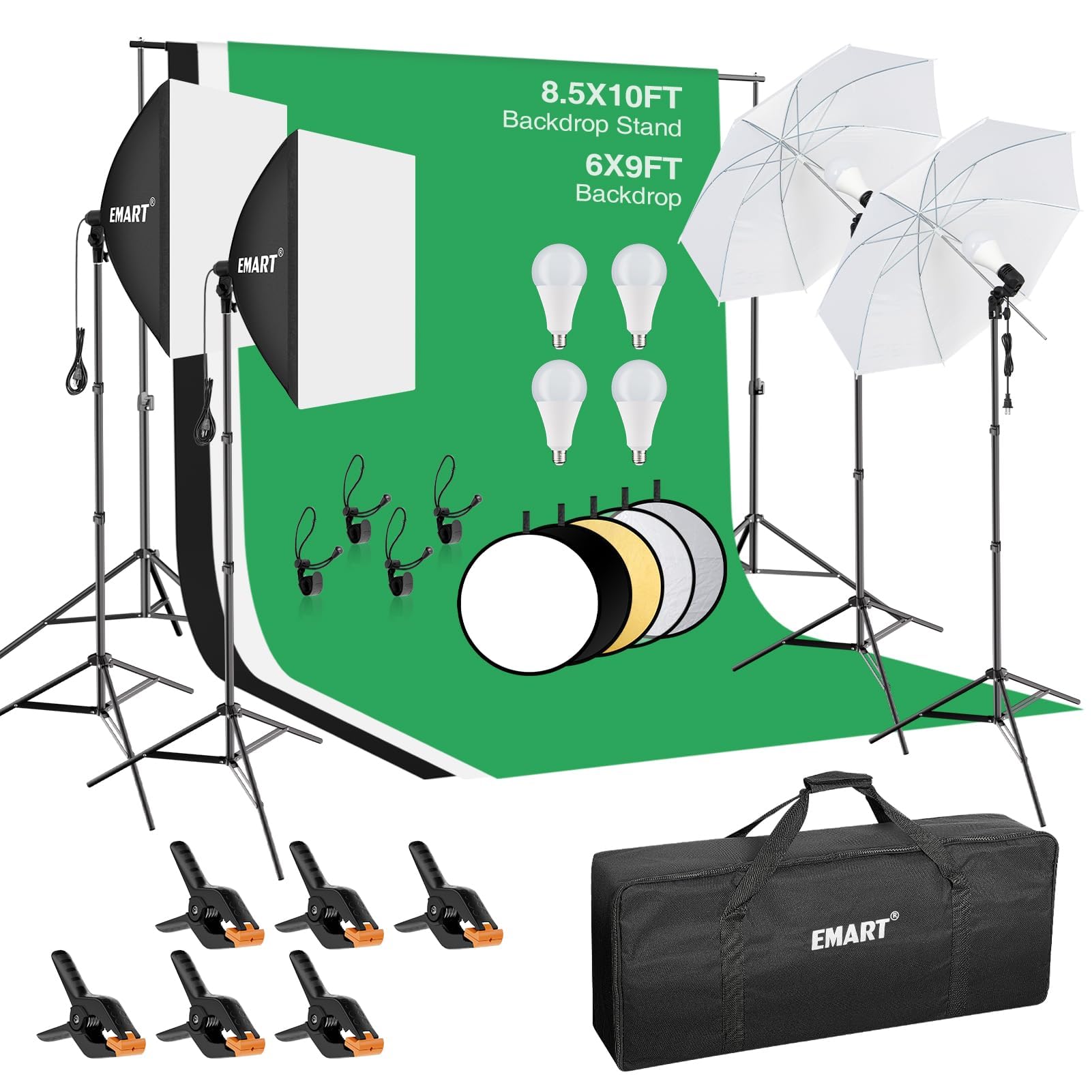
This kit solves your light and your background in one box. You get three 6x9ft muslin backdrops (black, white, and green) plus a support stand that extends from 2.6ft up to 8.5ft and widens from 5ft to 10ft. That means you can frame a full-body portrait or a tight product shot without buying extra gear. Buyers report the lights are “bright and evenly balanced which made getting clean professional looking shots easy.”
On the lighting side you get two 50W 5500K LED bulbs in softboxes plus two more 50W bulbs in white umbrellas, giving you four usable heads across four 7ft stands. The 24″x24″ softboxes feature a silver interior lining to boost output and eliminate harsh shadows. At a maximum height of 8.5 feet, this stand tops the ShowMaven kit by a full 2 feet, which matters when you are lighting a standing subject with a hair light.
The crowd favorite—nearly two thousand owners—leans on the quality and the sheer value of what is in the bag. The biggest mixed note is sturdiness: some rigs tip over and an occasional box arrives with damage, so treat the stands as studio gear, not furniture. If you want one box that turns a spare room into a functional portrait studio, this is the one.
What Wins People Over
- Complete bundle: 2 softboxes, 2 umbrellas, 4 stands, 3 backdrops, reflector, and a carrying bag
- Backdrop stand reaches 8.5ft—enough for full-body shots
- 100% cotton muslin backdrops absorb light and kill reflections
What to Watch
- Sturdiness gets mixed feedback—rigs can tip over
- Wrinkles in the muslin need steaming before first use
- CRI of 80 means colors are decent, not pinpoint perfect
Reach for this if: you are starting from zero and want lights, stands, and a backdrop system in a single purchase.
Think twice if: you need a rig that travels daily—the included bag is for storage, not heavy road cases.
2. ShowMaven 45W Dimmable LED Kit
A budget bi-color trio that fixes your color temperature without breaking your wallet.
If your main problem is warm indoor light fighting your camera’s white balance, this kit gives you a fix for less than most single softboxes cost. Each of the three 20×28 inch softboxes holds an E27 dimmable LED bulb that switches between 2700K (warm) and 5500K (daylight), with brightness adjustable from 1% to 100% via knobs on the back of the head. That dual-color control is the standout feature at this price.
The package includes one boom stand and sandbag combo plus two height-adjustable stands that extend to 6.5 feet. At 45W per head, these put out less raw punch than the 50W EMART bulbs, and the CRI of 85 beats the EMART’s 80—so you get slightly truer skin tones, just a touch less raw brightness. The trade-off is a larger gap in total reach: this rig maxes out 2 feet shorter than the EMART’s 8.5-foot backdrop stand.
Assembly is the recurring headache here, with several owners calling the instructions vague and the plastic receptacles fragile. The sandbag arrives empty, so bring your own weight. And one lingering gripe: early units shipped with cheap potentiometers that caused “drastic flicker at mid-settings,” though replacements were swapped in and have held up for weeks. Owners mention the assembled stands feel stable, which is the part that usually fails on budget kits.
Honest take: the cheapest real 3-point bi-color setup you can trust, with the caveat that you should be patient during the first assembly.
Pick it for: budget-conscious beginners who need warm-to-cool color control and portable stands.
Look elsewhere if: you refuse to assemble gear without clear directions—this one tests your patience.
3. ePhoto 2400 Watt Softbox Kit
A fluorescent workhorse that floods a small room with even, shadow-free light.
This kit solves a different problem than the LED crowd: it is built for output, not color finesse. Each of the three 16″ x 24″ softboxes holds four 45W 5500K daylight fluorescent bulbs, for a total of 12 bulbs and a system rated at 2400W equivalent. That is a mountain of soft light for a portrait studio, and owners consistently report impressive results in small indoor spaces.
The three stands extend to 6.5 feet, and the heads have dual switches so you can run 2 or 4 bulbs per softbox—a simple way to halve your output when you need less punch. Customers note the stands stay stable after two months of use, which is solid for the price tier. Just plan to transport this one assembled, because the softbox frames are not built for constant breakdown.
The honest catch is the hardware. Assembly directions are nearly useless—one owner called it “a science project”—and the large softboxes feel flimsy in the hand. There is also real variance in the bulbs; one unlucky unit had globes that exploded on power-up. This is a “you get what you pay for” middle-ground pick: great light, forgiving hardware.
Bottom line: if you need maximum soft light for a fixed home studio and can handle some DIY assembly, this delivers serious output for the money.
Best for: small indoor studios where you will leave the rig standing.
Not for: traveling shooters or anyone who wants a tool-free, 5-minute setup.
4. Andoer 85W Bi-Color Softbox Kit

Three bright 85W heads you can dim and re-color from across the room.
For a one-person content setup, walking over to a light to tweak it kills your flow. That is why this kit ships with three dedicated remote controls—one per light—so you can adjust brightness and color temperature without leaving your seat. Each LED head packs 140 LEDs at 85W, with three modes (cold, warm, and a blend) spanning 2800K to 5700K and dimming from 1% to 100%.
The 20″ x 28″ softboxes rotate 210° for flexible angles, and the aluminum alloy stands extend from 26 inches to 78 inches. The remote controls earn the strongest praise in the owner feedback, with buyers highlighting how easy it is to shift color and brightness mid-shoot. The tripods are the weak link—several owners swapped them for sturdier aftermarket stands—so budget for that if you shoot at full height often.
The one functional quirk to know: the remotes use line-of-sight infrared, and they control all three lights at once rather than individually. For a solo streamer that is rarely a problem, but if you need to dial each head separately, you will be walking to the knobs anyway.
Why It Stands Out
- 3 dedicated remotes for brightness and color control
- 85W per head—noticeably brighter than 45W budget kits
- 3 light modes and 210° softbox rotation
Know Before You Buy
- Stands are not the sturdiest—owners replace them
- Remotes control all lights simultaneously, not each separately
Grab it if: you shoot alone and want to adjust lighting from your desk or camera position.
skip it if: you need per-light independent control—this kit runs all heads together.
5. Skytex 3Pack Softbox Kit with Octa

A podcast-ready trio that pairs two rectangular softboxes with a round octa for softer top light.
Podcasters and streamers need flattering light on faces, not cinematic shadows—and this kit is built for exactly that. You get two 20″ x 28″ rectangular softboxes plus one 28-inch octa softbox, each running an 85W 2700-6400K LED bulb with a built-in diffuser. Owners who used it for podcast recording called it “a big difference” in their video quality, noting it was bright enough and easy to assemble.
The real upgrade here is the four-legged stand design. Instead of the wobbly tripod bases most kits use, each of the three stands has four legs that spread the load across a wider footprint, and they adjust from 26 inches up to 79 inches. The kit also throws in a boom arm and an extra-long 11.5-foot power cable per light, so you have real flexibility in where you place your key and rim lights.
Treat the hardware with care: a lighting professional’s review called the stands thin and the plastic knobs delicate, and one owner needed tape reinforcement to hold the top section. The value debate splits opinion—some call it a great deal, others feel the stand quality does not match the price. What nobody disputes is that the light itself is beautiful, with a color that flatters skin tones straight from the start.
The verdict: gorgeous, soft, adjustable light for home studios, wrapped in hardware you should handle gently.
Choose this for: podcasting, live streaming, and interviews where flattering face light is the priority.
Reconsider if: you need heavy-duty stands for constant travel—these are home-studio lightweights.
6. GVM 480 LED Video Light Kit

Compact panel lights with a color-accurate 97+ CRI and app control for location shoots.
When you leave the softbox world and step into panel lights, you trade sheer softness for portability and precision. The GVM 480 kit gives you three LED panels, each packing 480 LEDs in an aerospace aluminum alloy housing, with a color temperature range from 2300K all the way to 6800K. The CRI of 97+ means the colors you see on your monitor are the colors your camera captures—no post-production color correction roulette.
These panels are built for the road. Each one runs on AC power or an optional Sony F970/F750 battery (not included), which is the key feature for shooters who work on location without wall outlets. The included padded case fits everything, and one traveler even took it as a carry-on item on flights.
The recurring trade-off is the stands—they work fine but are not heavy-duty, and the barn doors attach slowly with 12 screws. The brightness is excellent for its size, though adding the diffusers softens the output meaningfully. This is the kit to grab when you need accurate, controllable light that fits in a bag.
The Strong Points
- CRI 97+ and TLCI 97+ for true, natural color
- AC or Sony battery power for location work
- Digital display with 10%-100% brightness control
The Trade-Offs
- Stands are adequate, not heavy-duty
- Barn doors attach slowly with 12 screws each
- Short power cords limit placement options
Reach for it if: you shoot video on location and need true-to-life color in a portable panel.
Look past it if: you want giant soft sources—panels this compact cannot match a large softbox’s wraparound light.
7. GVM 800D RGB LED Video Light Kit
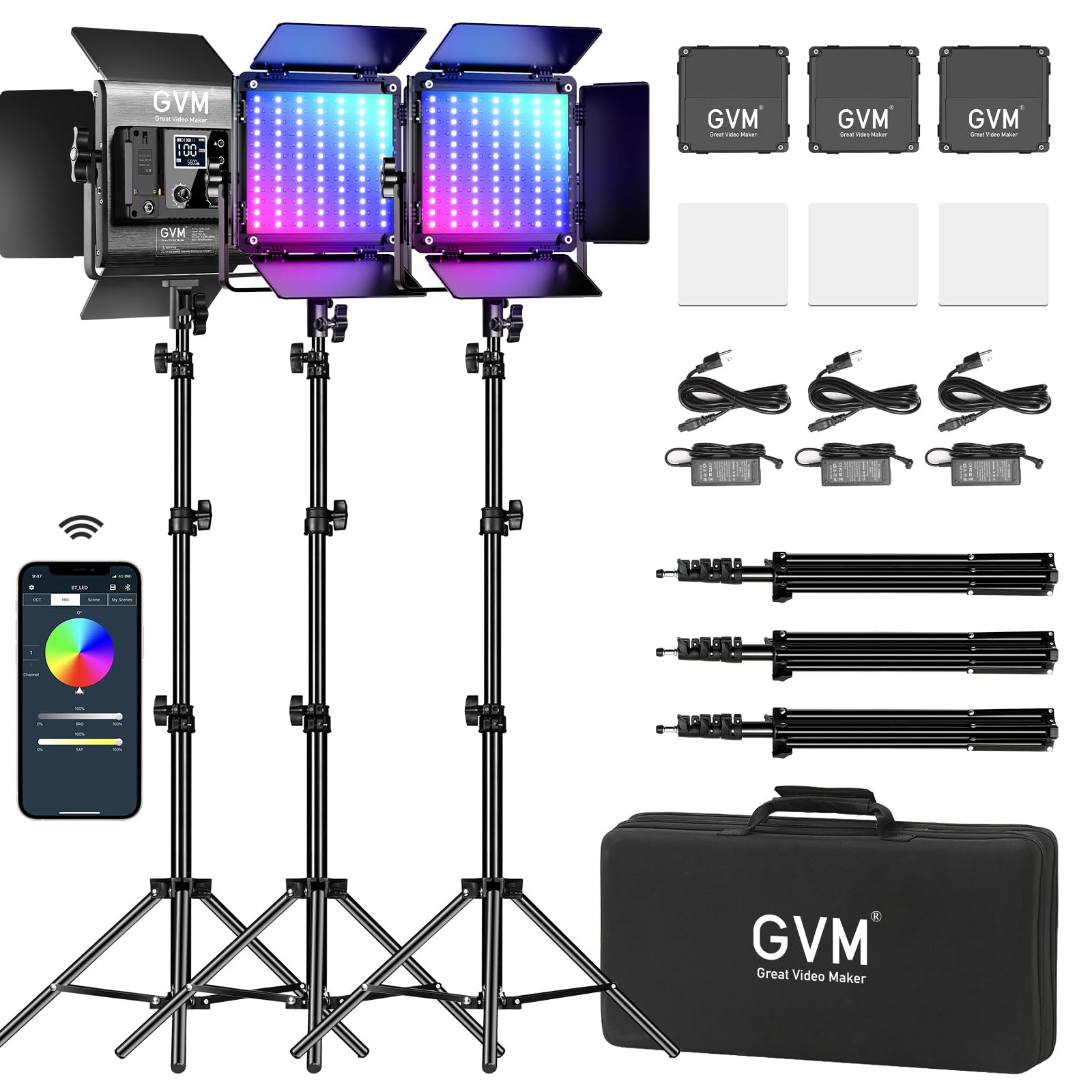
Three panels that do far more than white light—full RGB color plus eight built-in scene effects.
Most 3 point kits only give you shades of white. This one throws in the entire color wheel. Each 800D panel runs dual modes: a standard bi-color mode from 3200K to 5600K, and a full RGB mode where you adjust red, green, and blue hue and saturation from 0% to 100%. On top of that, there are eight scene effects—TV, candle, police car, lightning, paparazzi, disco, party, and bad light bulb—that let you fake an environment instead of just lighting one.
The panels are powered by AC or two NP-F970 batteries (sold separately), and everything packs into a single carry bag that owners say travels well. The app control via Bluetooth gets mostly positive feedback, though some users hit connection delays, and the manual knobs on the panel itself are the more reliable fallback. At CRI 97+, the quality of the white light is genuinely high, not an afterthought to the color party tricks.
The honest gripes are about the rigging, not the light. The tripod yokes creak, the panels are not the brightest in their class, and you need sandbags if you open the barn doors at full height in any breeze. None of that stops it from being among the most versatile 3 point kits you can own for creative work.
What it earns: the most creative freedom per dollar—white light for interviews, color for music videos, effects for atmosphere.
Best for: creators who want one kit for clean interviews and wild color effects.
Not ideal if: you only ever shoot natural white light—the RGB modes and effects would go unused.
8. GVM 672S LED Video Light Kit

A beefy, precise panel where exact color temperature is the whole point.
Some shooters need to match the exact color of a room’s practical lights—a tricky scenario where a cheap kit shows its limits. The GVM 672S is built for that precision work, with a CRI of 97+ and a TLCI of 97+ that owners describe as “precise white balance” in practice. The bi-color range spans 3200K to 5600K, and the dials and LCD display let you dial in the exact temperature rather than guessing.
It delivers a strong 22,000 lux of output, and the three-panel kit includes stands, barn doors, soft filters, and a bag that holds everything. Owners call the build quality beefy and praise how well the lights work for remote interviews and product shoots, with the 3200K setting drawing specific compliments for its natural look. AC power or two NP-F4400mAh batteries (not included) keep it flexible.
The caveats are consistent with GVM’s other kits: the stands are compact but light-duty, so treat the spreader legs with care, and the barn doors are tedious to mount. One owner summed up the standing advice neatly—”treat with extreme care” for the stands. The light quality itself earns no such warnings; it is the standout feature here.
The read: a pro-grade light engine wrapped in economy stands—protect the hardware and the output is superb.
Choose this if: accurate color temperature for interviews and product work is your top priority.
Think twice if: you need rugged stands that take a beating—these demand gentle handling.
9. Godox Litemons LE300Bi 3-Pack
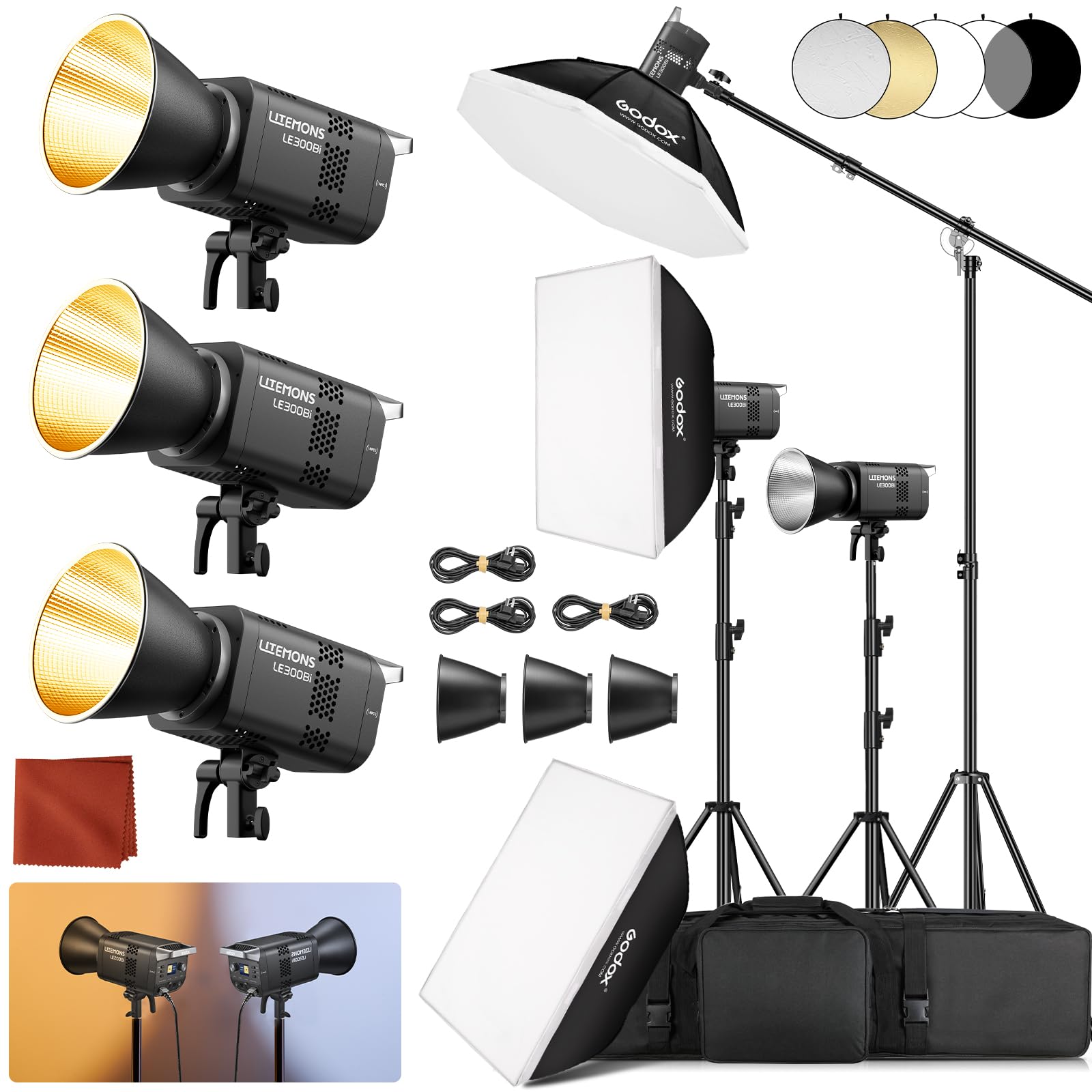
A serious COB light with 58,900 lux of output and a CRI/TLCI of 98 for demanding shoots.
When a softbox is not enough and you need hard, punchy output that can overpower ambient light, this is the kit. Each LE300Bi is a 300W COB (chip-on-board) LED with a maximum output of 58,900 lux at 1 meter—a number that dwarfs the panel lights in this list and explains why owners call it dependable for weddings and live streams. The color temperature spans 2800K to 6500K with 0% to 100% dimming, and the CRI/TLCI of 98 is the best color accuracy in this entire guide.
The Bowens mount on the front is the professional’s secret weapon. It clicks onto a vast ecosystem of softboxes, snoots, and beauty dishes, and it even has a socket that holds an umbrella and reflector simultaneously. The integrated power supply means no bulky external adapter hanging off the stand, and the ultra-quiet cooling fan keeps it running through long shoots without noise.
Control is equally pro-grade: wired DMX, CRMX with TimoLink RX, and wireless Bluetooth via the Godox Light App, plus NFC for fast pairing. The single honest complaint in the feedback was brightness in a specific scenario—one photographer found it dim at f2.8 for still portraits at 6 feet inside a softbox. For video, interviews, and live events, the overwhelming consensus is that this light is a professional tool at a fair price.
The Pro Case
- 58,900 lux at 1m—the brightest output in this guide
- CRI/TLCI 98 for flawless color reproduction
- Bowens mount fits a huge range of modifiers
- Quiet fan and integrated power supply
The Cost of Pro
- Premium price tier—this is an investment, not an impulse buy
- Some owners find it less punchy for still portraits in a softbox
- More setup complexity than a plug-and-play panel kit
Buy it for: professional video work, weddings, and streams where output and color fidelity are non-negotiable.
Pass on it if: you are a casual beginner—this kit’s power and price are overkill until your shoots demand them.
Understanding the Specs
Color Temperature (Kelvin)
This number tells you the “warmth” or “coolness” of the light. A lower number like 2700K is warm and orange, matching household bulbs. A higher number like 6500K is cool and blue, matching daylight. A kit that spans both lets you match whatever ambient light you are shooting in, so your subject does not look yellow or blue.
CRI and TLCI
These are the two ratings that tell you how honestly a light reproduces color. CRI (Color Rendering Index) measures how true colors look under the light, while TLCI is the video-specific version. A score of 90 or above is excellent; a score of 95+ is what professionals demand. Anything below 80 risks making skin tones look flat or slightly off.
LED Wattage vs. Output
Wattage is how much power a light draws, but it does not always translate to perceived brightness—that depends on the LED efficiency and lens design. Compare the manufacturer’s lux rating (light intensity at a set distance) or the actual wattage per head, not the misleading “equivalent” wattage numbers some budget kits advertise.
Stand Quality and Height
The stand is the most-likely-to-fail part of any kit. Look for metal construction and a maximum height of at least 6.5 feet, which lets you position the light above your subject’s head for a natural downward angle. Budget kits often have wobbly tripods; professional kits use air-cushioned or four-legged designs for stability.
FAQ
What is the difference between a 2-light and a 3-point lighting kit?
Which is better for video, LED or fluorescent lights?
What does CRI 80 versus CRI 97 actually look like in photos?
How much space do I need for a 3-point lighting setup?
Do I need softboxes or can I use bare bulbs?
How do I position the three lights in a classic 3-point setup?
Can I use a 3-point lighting kit for live streaming?
Are there any ongoing costs after buying a kit?
What is the difference between a softbox and an octa softbox?
Is it worth paying more for a kit with app control?
Final Thoughts: The Verdict
The clear winner for most buyers is the EMART kit, because it bundles the lights, stands, and a full backdrop system into one complete studio package—the crowd favorite at 4.6 stars across nearly two thousand owners. If your priority is budget-friendly bi-color control, the ShowMaven delivers surprising color accuracy for less. And when you need true professional output with the best color fidelity on this list, the Godox LE300Bi is the one to reach for—the only kit here that pairs a 98 CRI with the punch to match.
How We Picked
We do not accept paid placement. Every pick is matched to a real buyer and a real use-case; we do not hands-on test units.
Sources & Methodology
Specifications: manufacturer listings and product documentation. Review insights: verified customer reviews, as of August 2026. Pricing: not shown on this page (it changes often); check the current price via the retailer link.
As an Amazon Associate, Gadgets Feed earns from qualifying purchases. This does not affect which products we feature.