
Our readers keep the lights on and my morning glass full of iced black tea. As an Amazon Associate, I earn from qualifying purchases.
Specs are compiled from manufacturer listings and verified buyer reviews and can change over time — please confirm the key details on the product page before buying.
When the power blinks out, the internet shouldn’t have to go with it. A battery backup for your WiFi router keeps your network online during outages, so you stay connected and avoid resetting devices when power returns. This guide covers compact mini UPS units for modems and full-sized towers for entire desk setups.
I’m Min — the founder and writer behind Gadgets Feed. This guide is built by comparing the manufacturers’ published specifications and the patterns across verified customer reviews, so you get each pick’s real strengths and trade-offs instead of marketing spin.
Here’s how to find the perfect battery backup for wifi router that matches your setup and outage needs without overpaying for power you’ll never use.
Our Picks at a Glance


How To Choose The Best Battery Backup For WiFi Router
Choosing a backup isn’t about the biggest battery—it’s about matching power to your router’s needs. Match the power supply to your modem and router’s exact requirements to boost runtime per dollar.
Match the Voltage and Connector First
Routers don’t run on standard wall power — they use a separate power adapter that converts AC to DC (direct current, the type of power batteries store). Most routers need 5V, 9V, or 12V DC. A mini UPS with matching DC barrel outputs lets you plug the router straight in, bypassing its bulky transformer, which cuts power waste and keeps things tidy.
Calculate Your Runtime Needs
Consider your area’s typical outage duration to pick the right capacity. A compact 10000mAh unit handles a quick 30-minute blip easily, while a larger 27000mAh pack can keep a modest setup running through a long evening. The combined wattage of your router and modem dictates battery drain speed.
Decide Between DC Mini UPS and Full AC UPS
For a router and modem, a mini DC UPS is smaller, silent, and powers devices directly—the cleaner choice. A full AC UPS with wall outlets suits setups needing to keep a computer, monitor, or NAS alive for safe shutdown.
Quick Comparison
| Model | Best For | Battery Capacity | Input Voltage | Key Outputs | Amazon |
|---|---|---|---|---|---|
| APC BE600M1★ Best Overall | Whole-desk AC backup | 600VA / 330W | 120V AC | 7 Outlets + USB | Amazon |
| Shanqiu Mini UPSMost Versatile | Multi-device DC power | 10000mAh (37Wh) | 240V AC | 5V/9V/12V DC + USB | Amazon |
| Yuuki Power 10400mAhCompact Pick | Compact LCD display | 10400mAh (38Wh) | — | 5V/9V/12V DC + USB | Amazon |
| APC BE425M | Compact wall-mount AC | 425VA / 225W | 120V AC | 6 Outlets | Amazon |
| Marsriva KP3 | Silent 0ms switchover | 10000mAh (36Wh) | — | USB-A 3x DC | Amazon |
| TalentCell 27000mAh | Longest DC runtime | 27000mAh (97.2Wh) | 12.6V DC | 5x DC + 2x USB | Amazon |
| SKE DC20000 Plus | Travel-friendly backup | 20000mAh | 12V DC | 5V/9V/12V + USB-C | Amazon |
| Yuuki Power 18000mAh | CCTV & PoE setups | 18000mAh (56Wh) | — | 5V/9V/12V + PoE | Amazon |
| SKE SK425 | Server & PC protection | 425VA / 240W | 120V AC | 6 Outlets + LCD | Amazon |
In‑Depth Reviews
1. APC UPS 600VA/330W (BE600M1)
Our pick — 4.5★ from 29,000+ verified ratings; the strongest balance of quality and price.
The dependable tower that keeps your whole desk running through an outage, not just the router.
If you want one device that protects your router, modem, computer, and monitor all at once, this APC is the definition of set-and-forget reliability. It delivers 23 minutes of runtime at a 100W load, which for a typical router and modem translates to keeping your network alive for 30–45 minutes during an outage, as buyers report. The 7 outlets are the star here — 5 offer full battery backup plus surge protection, and 2 are surge-only for less critical gear like a lamp or printer.
The built-in 1.5A USB port keeps your phone charging even when the wall is dead, a small touch that matters more than you’d think. The 10-hour charge time is the trade-off for its lead-acid battery, but you rarely notice since it’s always topped up. This is the crowd favorite — 4.5 stars across 29,000+ owners — and the thing everyone raves about is the build quality, backed by a 3-year warranty and equipment protection.
The recurring gripe is the beep — it alerts you loudly when it switches to battery, and some find it intrusive. Buyers also mention the battery can age out after a few years, which is why the user-replaceable design (using APC battery APCRBC154) is such a smart feature. Simply swap the internal battery in minutes instead of buying a whole new unit.
Why It Wins
- 7 outlets cover every device on your desk
- User-replaceable battery keeps costs low long-term
- USB port charges your phone during outages
The Trade-Offs
- 10-hour recharge after a full drain
- Audible beeping that can’t be fully silenced
Reach for this if: you want a single, trusted box protecting your entire home office setup.
Look elsewhere if: you only need to keep a tiny router alive and want something out of sight.
2. Shanqiu Mini UPS (37Wh)
A metal-bodied mini UPS that feeds nearly any DC device and moonlights as a power bank.
This one earns its versatility badge with a 37Wh lithium polymer battery and four output options: 5V USB at 2A, plus 5V, 9V, and 12V DC at 2A each. That covers routers, modems, security cameras, LED strips, even a fingerprint recorder. The aluminum housing feels far more premium than the plastic rivals, and owners mention it eliminated their wall warts entirely — it powers a TP-Link Deco M4 and an IKEA hub for about 4 hours on battery alone.
The 240-volt input rating means it’s built to handle international power standards, so it’s a safe bet if you’re outside North America. It recharges quickly at just 2 hours, a 5x improvement over the APC’s 10 hours, which matters when you need it ready again fast. You can also detach it and use it as a standard power bank — the built-in 10000mAh capacity holds plenty for phone top-ups.
Battery longevity is the honest concern here. One buyer in an area with frequent outages watched it “completely stopped working” after 5–6 months, though it held their router on for up to 4–5 hours before that. Treat it as a reliable short-term companion rather than a decade-long investment.
Smart Protections: Built-in short circuit, overcharge, over-discharge, and temperature protection make this safe to leave plugged in.
Best fit: A multi-device DC setup like a router plus a couple of cameras or smart home hubs.
3. Yuuki Power Mini UPS (10400mAh)
A featherweight 0.9 lb backup with a live LCD readout of your battery status.
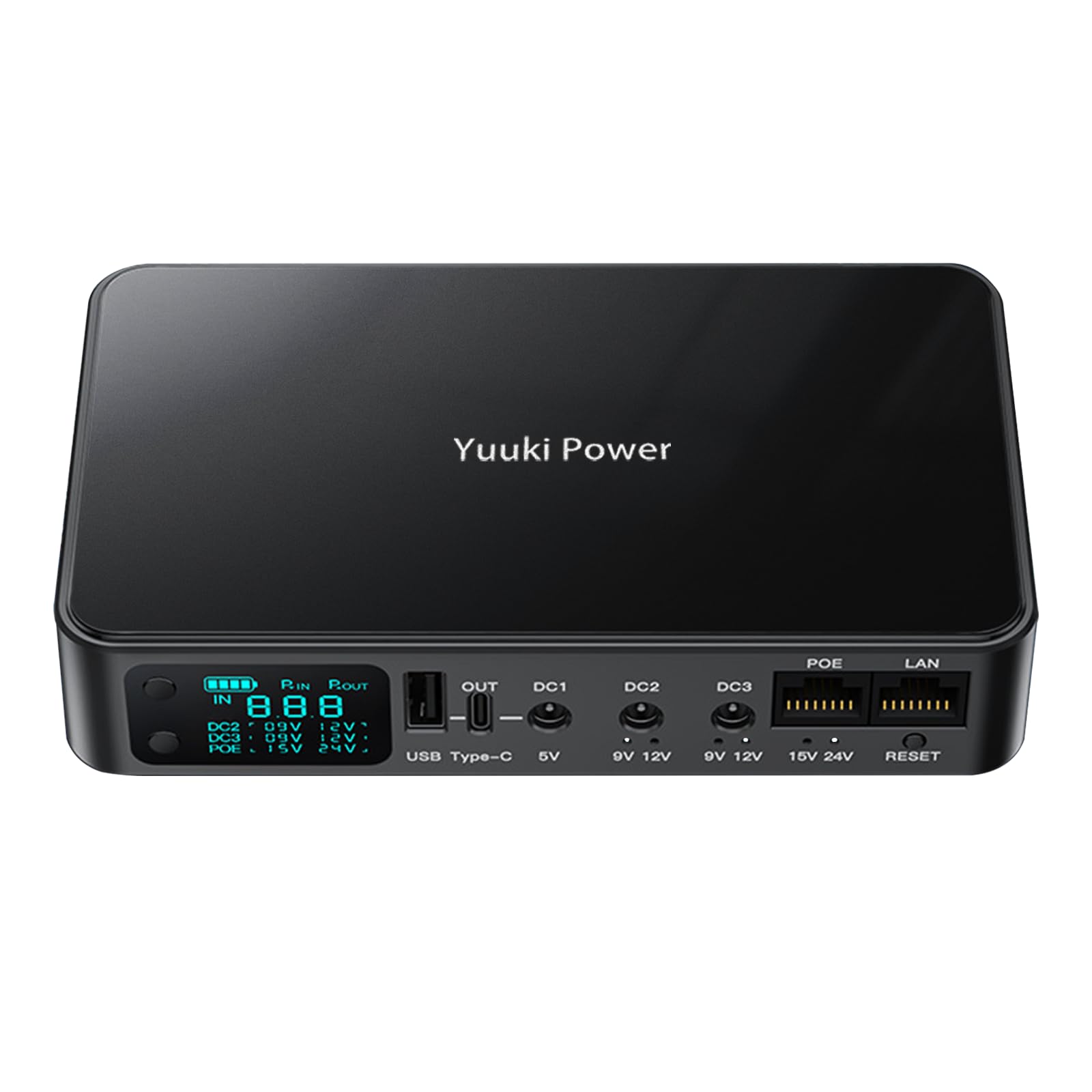
The defining feature here is the clear LCD screen showing real-time status — you always know exactly how much backup you have left, which most rivals hide behind vague LED bars. Inside is a 10400mAh (38Wh) lithium ion pack with a maximum 24W total output, plenty for a standard router and modem drawing about 15–20W combined. Customers note it delivers roughly 18 minutes of backup for a typical modem/router pair, so it’s built for blips, not marathon outages.
It includes a barrel connector to bypass the router’s transformer, a thoughtful touch that streamlines your cabling. It recharges via USB-C but slowly on a standard 15W charger, so plan for an overnight top-up.
The honest caveat is compatibility. One reviewer noted it was incompatible with an Amazon Eero 6+ and fried the router due to confusing cables. The batteries are also soldered in, making replacement hard when they eventually age.
What Shines
- Real-time LCD battery percentage
- Featherweight at just 0.9 lb
Watch Out For
- Soldered batteries make replacement difficult
- Slow recharge on a 15W charger
Grab it for: a small-space setup where you want to glance at remaining power and don’t mind a techy learning curve.
skip it if: you have an Eero mesh system — pick a unit with confirmed compatibility instead.
4. APC UPS 425VA/225W (BE425M)
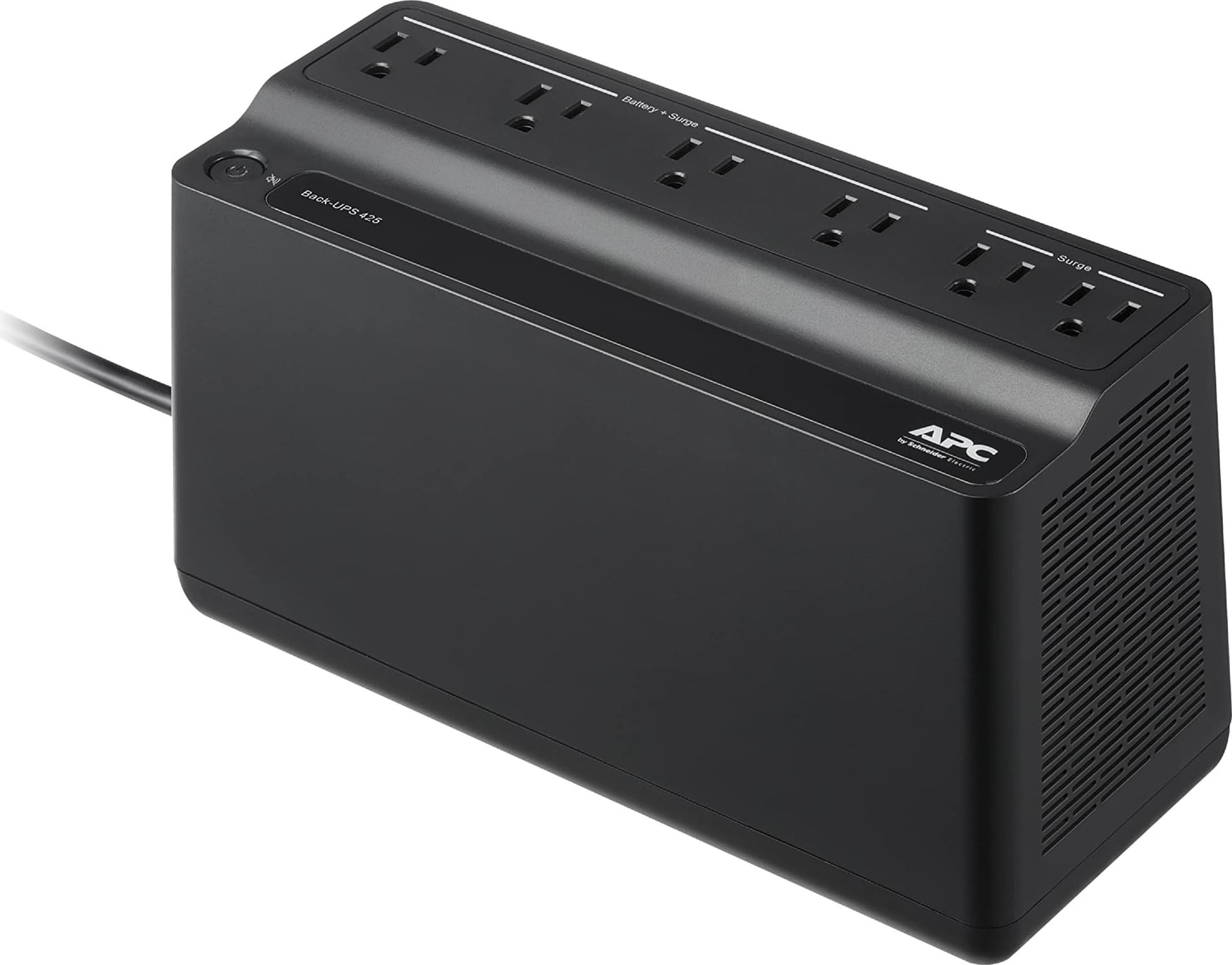
A smaller, wall-mountable APC that delivers the same trusted protection with a gentler price.
You get the same trusted APC protection as our Best Overall pick, but in a smaller, wall-mountable tower that saves desk space in apartments and dorms. It delivers 15 minutes of runtime at a 100W load, 6 well-spaced outlets (4 with battery backup plus surge protection, 2 surge-only), and a 3-year warranty with equipment protection.
The 8-hour charge time is quicker than the larger BE600M1’s 10 hours, making it slightly more convenient for repeated short outages. It’s ideal for low-wattage gear — a modem, router, ONT (the fiber optic terminal box), and a monitor — which is exactly the use case buyers praise it for. One owner called it “small but mighty” for simple power glitches, though it lacks the auto-shutdown software of pricier units.
Battery life gets mixed feedback, with some reporting it lasts up to 6 hours on light loads while others saw it stop after 2 years. The audible beeping on battery mode is the most-cited annoyance. Match its capacity to your actual needs and this is a genuinely smart buy.
balance: You get a famous brand at a friendlier size and price — the best value-to-trust ratio in this lineup.
Not for: high-end gaming desktops that need more wattage headroom than 225W provides.
5. Marsriva KP3 Mini UPS
A silent guardian with instant 0ms switchover so your network never even blinks.
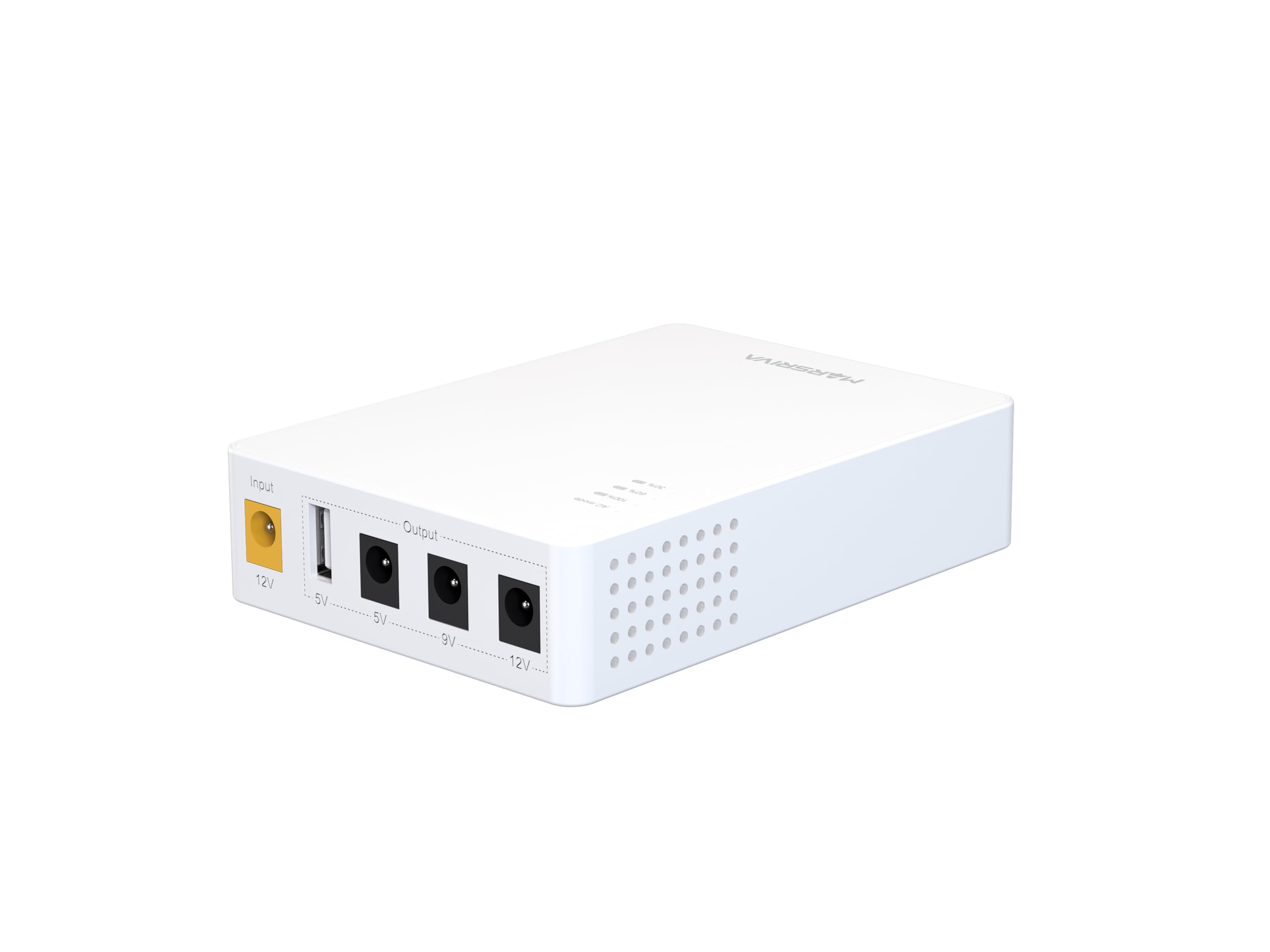
When the grid drops, your router keeps running without a single hiccup thanks to 0ms smooth power transfer — no reboot, no reconnect delay, no dropped VPN. The 10000mAh (36Wh) lithium ion battery and 18W maximum output are built for routers, modems, ONU devices, and CCTV cameras. At just 10.56 ounces, it’s one of the lightest full-featured options, and reviewers point out it handles an unmanaged network switch without breaking a sweat.
The port layout offers one USB-A at 5V plus three barrel outputs at 5V, 9V, and 12V. The catch, as shoppers say, is that these voltage-specific ports aren’t universal — each one powers a single device at its rated voltage, so you can’t daisy-chain. There’s no USB-C smart output or AC outlet, keeping it strictly in the DC-device lane. It also lacks a battery percentage readout, only a simple LED display.
Where it truly shines is simplicity. The included cables make setup genuinely plug-and-play, and the built-in protections — overcurrent, short circuit, overcharge, deep discharge, and thermal management — make it safe to leave on 24/7. For a cellular modem in a remote area, buyers call it decent insurance against outages.
Instant Switchover: 0ms transfer means zero reconnection lag for sensitive gear.
Limited Scope: Voltage-specific ports restrict you to one device per output — plan your wiring before you buy.
6. TalentCell Mini UPS (27000mAh)

A powerhouse 97.2Wh battery that keeps a full network stack alive for hours, not minutes.
This is the runtime king of the DC mini UPS category. The 27000mAh (97.2Wh) lithium ion pack, built from 12 cells, delivers a tested 5.5+ hours on a 10.5W load in discharge tests — buyers have seen 24 hours running just a router and a backup phone. It outputs through 4 DC 12V ports (voltage range 9–12.6V), 1 DC 9V port, and 2 USB 5V ports, plus 18W USB-A and USB-C PD for fast phone charging. The input is 12.6V at 2A.
Buyers frequently call it a “compact powerhouse” that replaces bulky lead-acid UPS units entirely. It consolidated five separate wall adapters into one box for several owners, cutting power waste and cable clutter. It’s ideal for powering a mini-PC, a fiber ONT, network switches, and a Raspberry Pi through long outages. The 5.5mm x 2.1mm DC barrel ports are standard, so most router cables will fit directly.
The honest downside is reliability over time. One teardown after warranty found 11 of 12 cells dead, with a poorly soldered BMS (battery management system — the circuit that protects the battery) joint. Another buyer received a used unit that couldn’t keep up with a 4-device load. The LEDs also lack a precise percentage readout. It can’t continuously power devices over 37W without draining fast.
Why It’s a Champ
- Massive 27000mAh capacity for multi-hour runtime
- Five DC outputs power an entire network stack
- Replaces multiple wall adapters to cut clutter
The Reality Check
- Quality control varies — some units fail within a year
- No precise battery percentage indicator
Choose this for: extended outages where hours of uptime matter more than compact size.
Think twice if: you want a strict set-and-forget device — sample units have shown premature cell failure.
7. SKE DC20000 Plus Altair

A slim 20000mAh slab that powers your network at home and slides into a bag for travel.
The SKE DC20000 Plus fits easily near routers or in media cabinets, and it’s portable enough for travel or temporary workspaces. Its 20000mAh battery supports 5V, 9V, and 12V DC devices plus USB and Type-C charging, so you can power routers, cameras, tablets, and phones. Buyers report it ran a router for 8+ hours without draining the battery, and a single unit survived a real energy outage smoothly.
Buyers describe the build as “solid feeling” and “heavy,” suggesting a sturdy internal design. It arrives pre-charged and includes the cables you need in the box. The internal AC-DC converter means you plug it straight into the wall and it trickle-charges while powering your gear. Wall-mountable with ports facing up or down, it adapts to tight spaces.
The LED indicators are very bright green, which one buyer flagged as a nuisance in bedrooms. Build quality opinions split, with some calling it cheaply made. And one unit stopped charging after just 5 months, with no response from support. The 7-hour average battery life depends heavily on the load you attach.
Portable Power: The rare mini UPS designed for both permanent desk duty and travel bags.
Bright Lights: Those green LEDs are eye-catching at night — not ideal for bedroom installations.
8. Yuuki Power Mini UPS (18000mAh)
A 56Wh workhorse with PoE outputs that keeps your security cameras and access points alive.
This bigger sibling to the Yuuki Power 10400mAh adds serious muscle for security setups. The 18000mAh (56Wh) battery powers DC devices at 5V 3.6A, 9V 2A, and 12V 2A, but the real differentiator is PoE support — 15V at 1.3A or 24V at 0.8A — so you can keep CCTV cameras and power-over-ethernet access points running through outages. It also offers USB-A and USB-C ports with PD fast charging for phones and tablets.
Owners mention it runs a modem and router for about 5 hours solid, with one owner’s modem (12V, 1.5A draw) lasting more than 10 hours thanks to low idle consumption. The 24W maximum output handles multiple small devices simultaneously, and the included DC barrel adapters plus a 12V 3A US charger cover most setups from the start.
The 1.1 lb weight makes it slightly heavier than the 10400mAh version, but that’s the price of going from 10400mAh to 18000mAh. The LCD screen gives real-time status just like its sibling. One buyer’s only complaint was that the barrel cables could be longer. Recharge is slow — roughly 20 hours for a full top-up — so keep it plugged in whenever the grid is up.
Security Focused
- PoE outputs at 15V and 24V for cameras and APs
- 5+ hours of runtime for a typical modem and router
- Clear LCD status display
Keep In Mind
- Long 20-hour recharge cycle
- Barrel cables are on the short side
Best for: homeowners with PoE cameras or mesh nodes who need the whole security network to stay up.
Not ideal if: you need a quick recharge between frequent outages.
9. SKE SK425 425VA/240W

A metal-tower UPS with a full LCD dashboard and voltage regulation for serious home labs.
If your network stack includes a NAS (network-attached storage) or a home server, this SKE model is built for you. The 425VA/240W capacity feeds 6 outlets — 4 with battery backup plus surge protection and 2 surge-only — while the intelligent LCD shows input voltage, output voltage, battery capacity, and load level in real time. The Automatic Voltage Regulation (AVR, which smooths out fluctuating wall power) keeps your gear safe even before the battery kicks in.
Buyers praise it for keeping internet connections alive during outages, and one even uses it as battery backup for a power reclining sofa. The included management software enables safe system shutdown and power monitoring, a feature the smaller APC lacks. The metal enclosure and 8.8 lb weight signal a more industrial build aimed at permanent installation.
The 60 Hz frequency range and 120V AC input make it strictly a North American unit. Some customers note it trips off frequently during power spikes, wishing for lower sensitivity — though that’s the surge protection doing its job. Installation gets mixed feedback, and the power output is noted as modest, so it’s not for high-draw gaming rigs. There’s also some noise reported from the unit itself.
Lab Ready: AVR regulation plus software management make this the pick for NAS and server protection.
Sensitive Trigger: It may switch to battery more often than you’d like during minor voltage dips.
Understanding the Specs
Battery Capacity (mAh & Wh)
Milliamp-hours (mAh) tells you the raw charge, while watt-hours (Wh) tells you the actual energy available. For routers, Wh matters more — a 10000mAh unit at 37Wh holds less usable power than a 27000mAh unit at 97.2Wh. Higher capacity means longer runtime, but also more weight and slower recharge.
Voltage Matching
Routers need DC (direct current) power, usually at 5V, 9V, or 12V. A mini UPS with matching barrel outputs powers the router directly, bypassing its transformer. Full AC UPS units output standard 120V wall power, so you still use the router’s original adapter plugged into the UPS outlet. Getting the voltage wrong can damage equipment, so check your router’s label first.
FAQ
How long will a battery backup keep my WiFi router running?
Do I need a DC mini UPS or a full AC UPS?
Will a battery backup work with my fiber optic modem?
How do I know what voltage my router needs?
What does 0ms transfer time mean and why does it matter?
Can a mini UPS also charge my phone?
How long does it take to recharge a router battery backup?
Is it safe to leave a mini UPS plugged in 24/7?
Final Thoughts: The Verdict
For most buyers, the battery backup for wifi router winner is the APC BE600M1 because it’s the crowd favorite at 4.5 stars across tens of thousands of owners, protecting your entire desk with 7 outlets and a user-replaceable battery. If you want the longest DC runtime for a multi-hour outage, grab the TalentCell 27000mAh. And for a compact, travel-friendly option that keeps a single router alive, the SKE DC20000 Plus is the one to reach for.
How We Picked
We do not accept paid placement. Every pick is matched to a real buyer and a real use-case; we do not hands-on test units.
Sources & Methodology
Specifications: manufacturer listings and product documentation. Review insights: verified customer reviews, as of August 2026. Pricing: not shown on this page (it changes often); check the current price via the retailer link.
As an Amazon Associate, Gadgets Feed earns from qualifying purchases. This does not affect which products we feature.