
Our readers keep the lights on and my morning glass full of iced black tea. As an Amazon Associate, I earn from qualifying purchases.
Specs are compiled from manufacturer listings and verified buyer reviews and can change over time — please confirm the key details on the product page before buying.
You want a full gym in your garage corner without the gym membership cost, but picking the wrong all-in-one power rack means wasting money on a frame that wobbles under your heaviest squats. The real question is which combo of squat rack, cable crossover, and pull-up station fits your space and strength goals—and won’t wreck your back during assembly.
I’m Min — the founder and writer behind Gadgets Feed. This guide is built by comparing the manufacturers’ published specifications and the patterns across verified customer reviews, so you get each pick’s real strengths and trade-offs instead of marketing spin.
You’ll see how weight capacity, pulley systems, and included attachments separate a true home-gym centerpiece from a compromise, and which all-in-one power rack actually delivers on its promises for serious lifters.
Our Picks at a Glance

How To Choose The Best All-In-One Power Rack
Before you fall for a huge weight-capacity number, remember that a rack’s job is to keep you safe under a loaded barbell and give you multiple ways to train. The best pick for you balances your ceiling height, floor space, and the exercises you actually do—not the ones a spec sheet lists.
Frame strength and steel thickness
Thicker steel in the frame reduces wobble during heavy sets. Look for commercial-grade steel in the 14-gauge range or thicker, and check whether the uprights are 2×2-inch or 2×3-inch—the latter resists twisting better under off-center loads like landmine presses.
Pulley systems and ratios
Cable systems vary in pulley ratios, affecting resistance and smoothness. A 1:1 ratio (meaning the weight you load is exactly what you lift) gives you full resistance, while a 2:1 ratio (halving the effective resistance) makes the motion smoother and easier on your joints—many racks let you switch between both for different exercises.
Attachments and accessories
Count the included attachments before comparing prices, because a good bundle saves you hundreds versus buying J-hooks, safety arms, and a lat pulldown bar separately. Prioritize racks that include dip bars, a landmine, and weight storage pins—these turn a cage into a complete workout station rather than just a place to squat.
Quick Comparison
| Model | Best For | Weight Capacity | Pulley Ratio | Footprint (W x D) | Amazon |
|---|---|---|---|---|---|
| Mikolo F4 2.0 Elite★ Best Overall | Built-in weight stack | 1200 lbs | — | 45″ x 54″ | Amazon |
| JEEKEE H12Best Value | Independent dual pulleys | 2000 lbs | — | 46.85″ x 60.24″ | Amazon |
| ARMAC ARVC-01Compact Pick | Compact full-body training | 1500 lbs | — | 46.9″ x 53.5″ | Amazon |
| Mikolo K6 | Beginners needing safety | 1500 lbs | 2:1 low row | 56.5″ x 67.5″ | Amazon |
| Eonfit E2 | 360° rotating arms | 1200 lbs | 1:1 / 2:1 | 62.5″ x 61″ | Amazon |
| Roygym Smith | Smith machine + cables | — | 1:1 | 65.7″ x 57″ | Amazon |
| MAJOR FITNESS Drone3 | High capacity + quiet | 2500 lbs | 1:1 / 2:1 | 69.5″ x 45.9″ | Amazon |
| MAJOR FITNESS F22 | Partner workouts | 1600 lbs | 2:1 | 68.9″ x 82.5″ | Amazon |
| pooboo P43 | Everything-included bundle | 2000 lbs | — | 43.3″ x 62.9″ | Amazon |
| RitFit M1 Pro | Smith machine versatility | 1850 lbs | — | 68.1″ x 64.5″ | Amazon |
In-Depth Reviews
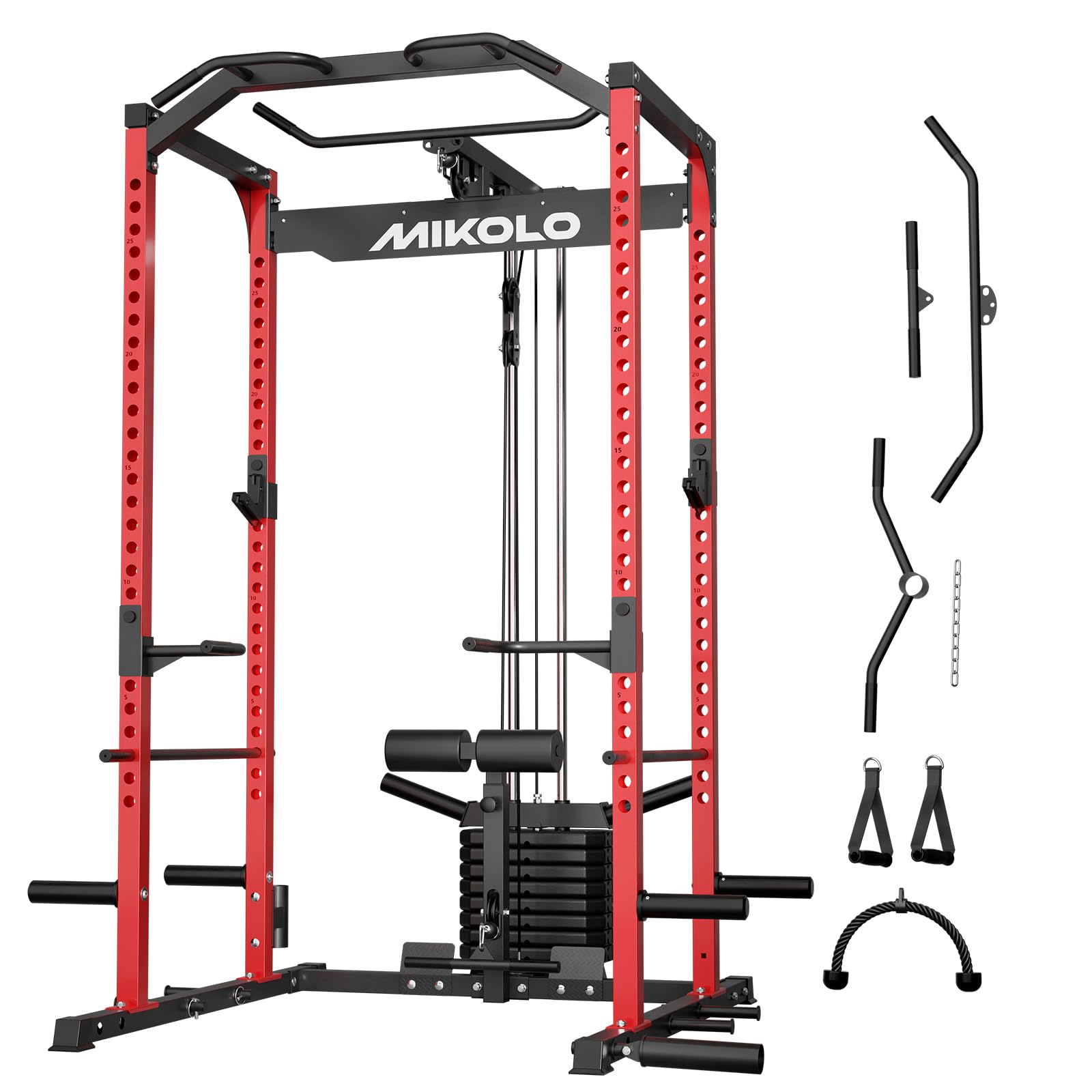
1. Mikolo F4 2.0 Elite Power Cage
Our pick — over 4.5★ from 300+ verified ratings; the strongest balance of quality and price.
The rare rack that skips loose plates with a built-in 100LB stack, ready the moment you bolt it together.
Most racks at this level force you to buy separate weight plates just to use the pulley system, which quietly adds hundreds to the real cost. The Mikolo F4 2.0 Elite sidesteps that entirely with a 100LB integrated weight stack—uncommon in this price range—so cable exercises work right after assembly with a quick pin-select adjustment between loads.
Buyers report the cage handling weighted pull-ups and 300lb squats without wobble, and the numbered holes plus 2×2 attachments make setup and future customization straightforward. The review pages sum it up: owners call it “the best value for the money,” frequently noting it replaced other equipment entirely. A compact 54″D x 45″W x 80″H footprint means it fits spaces where full commercial racks won’t.
The trade-offs are honest ones: spotter arms are rated 200lb each and can tilt under heavy racking, carabiners stick when loaded near the stack’s max, and at 6’1″ you’ll fold your knees slightly on the pull-up bar. Assembly runs under 3 hours solo with a 17mm socket wrench, and a YouTube walkthrough solves the few confusing steps.
Built-in advantages
- Integrated 100LB weight stack skips loose-plate costs
- Fits standard 1″ and Olympic 2″ plates
- Compact footprint suits tight home gyms
Out-of-the-box caveats
- Spotter arms rated 200lb each can tilt under load
- Short stature means knee bend on pull-ups for taller lifters
- Carabiners stick near max cable weight
Reach for this if: you want cable training without buying a separate plate set, and your lifting stays under 300 pounds on the bar.
Keep in mind: the 1200 lbs capacity is for the frame; the 200lb-rated spotter arms ask for sensible racking, not max-load drops.
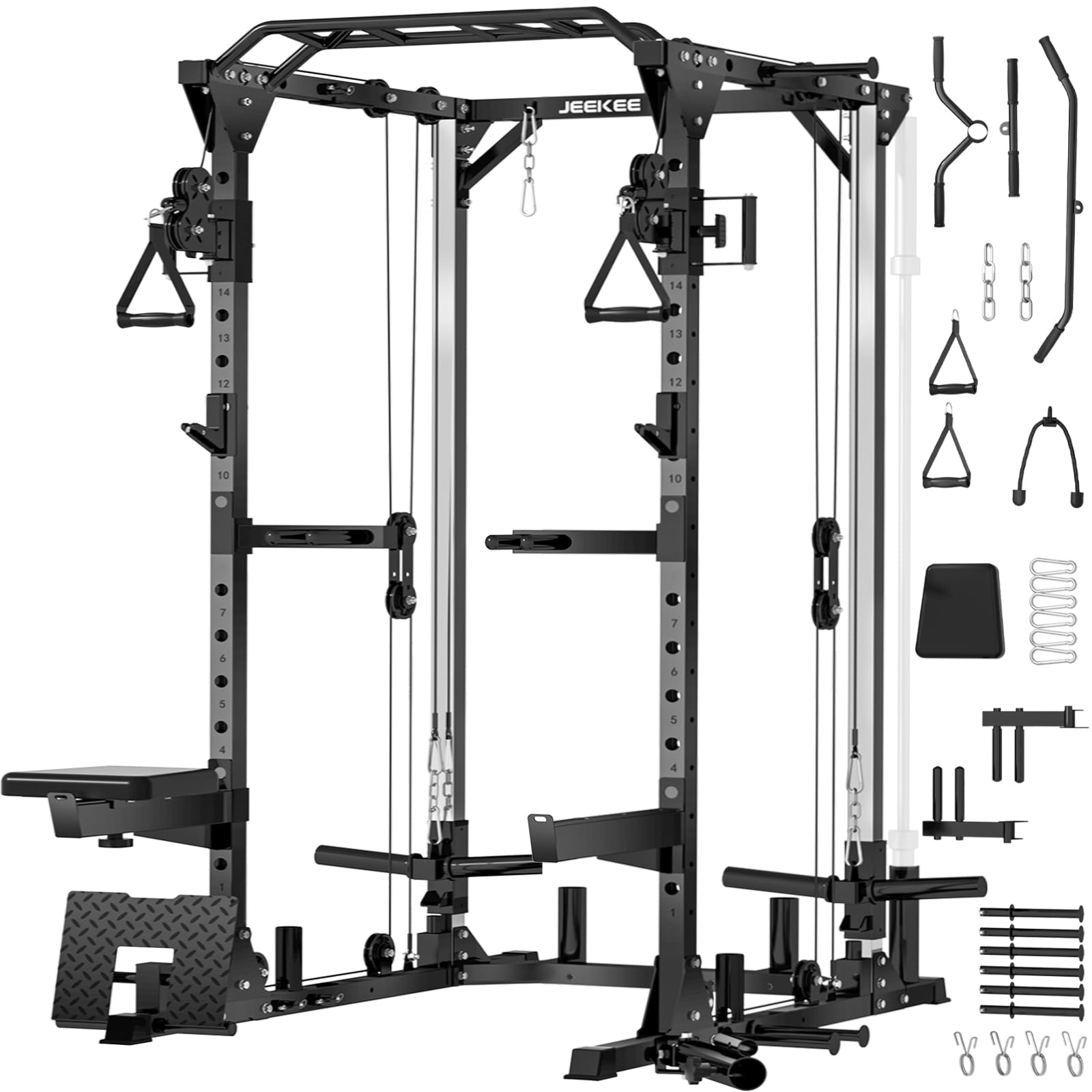
2. JEEKEE H12 Power Cage
A 2000-lb frame with independent twin pulleys—the budget pick that punches far above its tier.
Ten connection tabs and triangular stabilizing bars keep it planted during aggressive cable work.
The headline feature is the independent dual pulley system—each side moves on its own, so you can run supersets, drop sets, and cable crossovers without the trolleys fighting each other. A removable, adjustable seat cushion mounts to the safety arms, giving you a stable lat pulldown position that stops your body from swinging. The pulley system rides on precision bearings and supports up to 500 lbs for smooth, quiet operation.
Assembly is the one mixed note: some owners find it easy and did most of it solo, while others call it painful—expect to need help when installing the top bars. The 20+ attachments (J-hooks, safety arms, dip bars, tricep rope, band pegs) mean you won’t buy accessories separately. At 60.24″L x 46.85″W x 86″H, it’s spacious enough that multiple family members can train at once.
Heavy-lifter headroom
- 2000 lbs weight capacity on a 50x50mm steel frame
- Independent dual pulleys enable true crossover work
- Seat cushion on safety arms steadies lat pulldowns
Build-day honesty
- Top-bar installation needs a second pair of hands
- Assembly feedback is split between easy and painful
- Weights sold separately—bring your own plates
Your move if: you’re a strong lifter who wants 2000 lbs of frame headroom and true independent cables without paying premium prices.
Look elsewhere if: you need a rack that assembles solo in under an hour—this one rewards patience.
3. ARMAC Power Cage
Half a gym squeezed into 17 square feet, with a 1500-lb frame and 20+ pieces included.
If you want one cage that acts like half a gym, the ARMAC delivers: it packs a weight cage, lat pulldown station, pull-up bar, parallel bar station, seated rowing station, and T-row into a footprint of just 53.5″L x 46.9″W x 83.5″H. That compact size lets multiple family members train at once—rare for a rack this small.
Build quality is the thing owners praise most—the frame is commercial-grade carbon steel at 2mm thickness, supporting up to 1500 pounds with multiple welded reinforcement points so there’s no wobble mid-squat. The upgraded cable system uses 7 steel cables with thickened silent pulleys and a dual setup that rotates a full 180°, which keeps chest flys and high pull-downs buttery even when you’re switching angles mid-set.
The catch is assembly: 16 adjustable height options across J-hooks, long and short safety rods, dips, and pull rope height mean lots of parts to sort, and instructions get mixed reviews—though detailed installation videos and labeled bolts per step help. Owners note front pulleys could sit 2″ higher and the cable pull isn’t the smoothest at the extremes, so think of this as excellent for non-elite lifters rather than a powerlifting station.
Space-maximizing wins
- 17 sq ft footprint fits most homes
- 2mm carbon steel supports 1500 lbs
- 20+ free accessories including 360° landmine
Setup realities
- 16 height options mean a longer build
- Instructions are hit-or-miss; video is essential
- Cable pull not the smoothest at full extension
Grab this for: a small-space home gym that still wants lat pulldowns, rows, dips, and landmine work in one station.
Think twice if: you’re an elite powerlifter—owners suggest keeping loads under 500 lbs for cable smoothness.
4. Mikolo K6 Power Cage
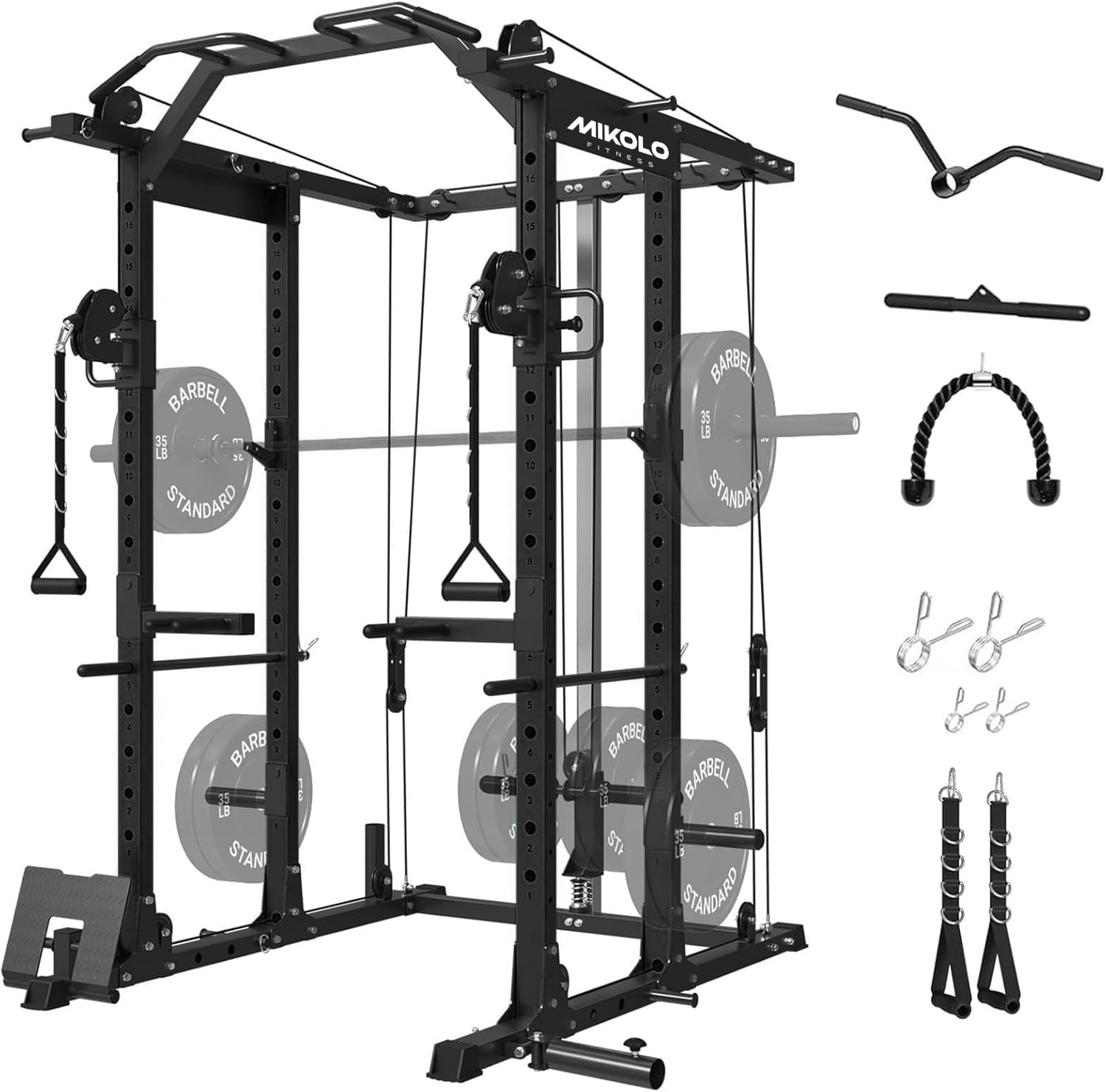
An 8-in-1 starter rack whose true cage design keeps beginners safe while they learn heavy lifts.
Safety is the Mikolo K6’s main draw: it’s a true cage, not an open rack, with internal dimensions of 41″ x 60″ that fit almost any bench, so you can squat and bench press inside the frame where spotter arms catch a failed rep. That’s why it’s a favorite first rack—owners rate it a great starter that’s simple to put together with excellent instructions.
It bundles 8 functions: power rack, cable crossover, lat pulldown, a 2:1 ratio low row station with footplate, chin-up, dip, core trainer, and resistance station. The upgraded pulley system uses four white rollers that glide along the riser, protecting it from wear while keeping motion smooth. At 220 lbs with eight reinforcing tabs, it stays firm during dips and pull-ups—the stability is the second-most-praised aspect after overall quality.
The honest limitation: the 2:1 pulley system halves the weight you feel, and the trolley bars are too short for thick bumper plates (max around 135 lbs of pull). Owners who want heavier cable work use slim cast iron plates, which makes the 1,500-lb capacity somewhat optimistic for the pulleys. Minor paint chips on uprights and occasional pulley sticking on the washer-spring are recurring but small complaints.
Safety-first design
- True in-cage squats and bench press protection
- 8-in-1 functions in a 56.5″ x 67.5″ footprint
- Eight reinforcing tabs keep it stable
Pulley trade-offs
- 2:1 ratio halves effective cable weight
- Trolley bars too short for thick bumpers
- Occasional pulley sticking needs a nudge
Choose this when: you’re new to lifting and want in-cage safety plus a huge variety of exercises to explore.
Move on if: you plan heavy cable work with bumper plates—slim iron plates are the workaround.
5. Eonfit E2 Power Rack

Pivot arms that rotate 360° turn this 1200-lb cage into 100-plus exercises without moving a trolley.
The Eonfit E2 breaks the fixed-trolley mold with 360° rotating pivot arms you can position anywhere: outwards for a stretched chest fly, inwards so weight hangs directly beneath you for shrugs, or overhead for lat pulldowns. That single design choice open up more than 100 exercises, which is why owners call it the best value for a complete power cage with cables.
The frame is 14-gauge 2″x2″ steel with 1-inch holes on 3-inch spacing, weighing nearly 220 lbs and rated to 1200 lbs. Owners mention it rock-solid—stable at a 210lb bench and 180lb squat—with a premium feel and zero wobble even after months of heavy use. Cables can run 1:1 or 2:1, giving you both heavy rows and smooth high-rep sets from the same system.
Assembly is the price of that versatility: plan 5-6 hours solo, and the manual has gaps—owners advise routing the cable through the 90mm center pulley (it’s missing from the manual) and orienting the pivot arms correctly before tightening. Some note the left/right arms aren’t labeled, causing rework, and plastic pulleys can be noisy (an aluminum upgrade is worth considering). At 61″W x 62.5″L x 85″H, it’s clearly built for a garage or larger spare room.
Exercise freedom
- 360° rotating arms enable 100+ movements
- 1:1 and 2:1 cable ratios for any rep scheme
- 14-gauge steel stable at 210lb bench
Build-day friction
- 5-6 hour assembly with manual gaps
- Plastic pulleys noisy; aluminum upgrade advised
- Arms not labeled left/right causes rework
Pick this for: lifters who want maximum exercise variety from rotating arms and don’t mind a longer build session.
Be ready for: a manual that skips a key pulley step—watch the YouTube build videos first.
6. Roygym Smith Machine Home Gym
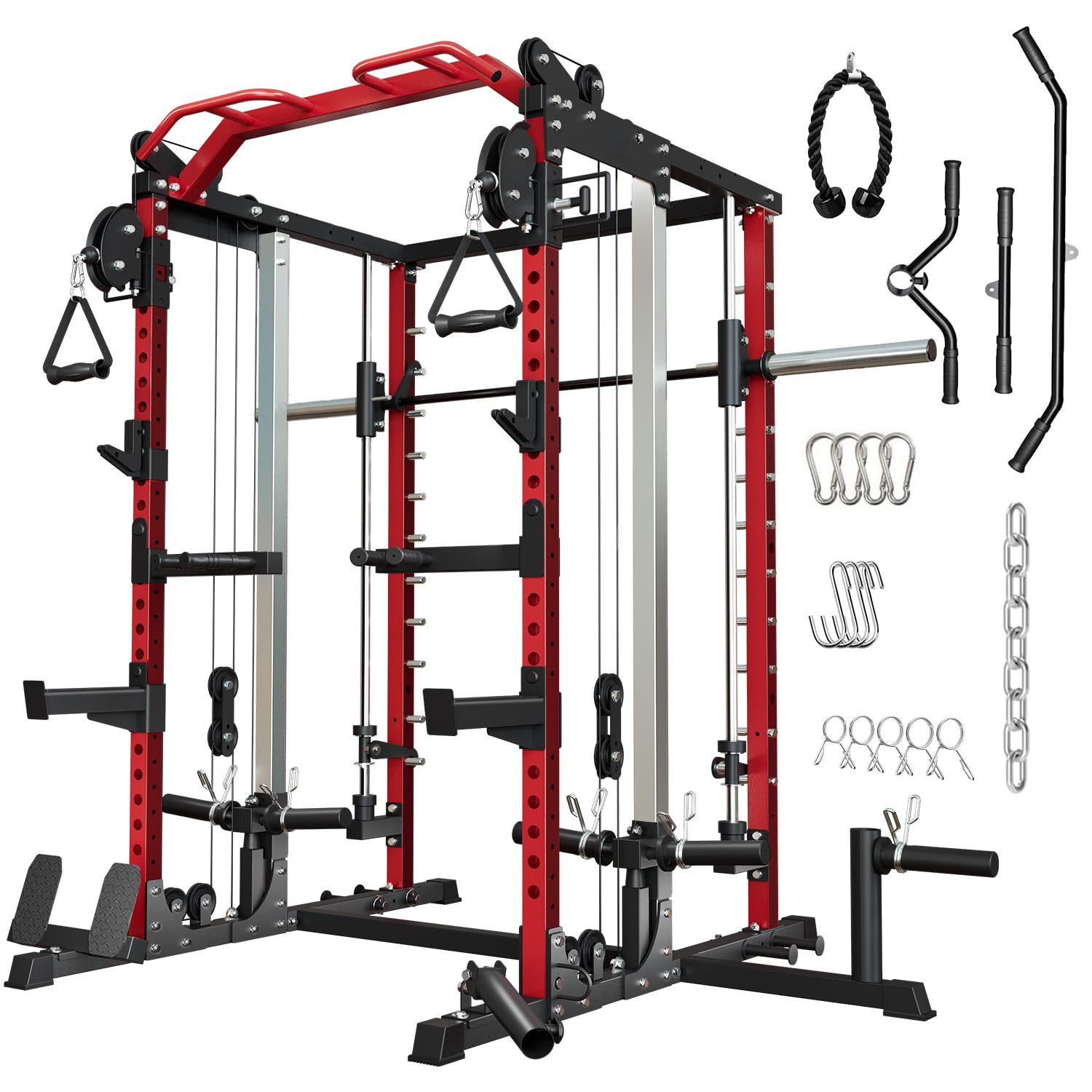
A Smith-guided bar with 9 safety stops plus independent cables, all in an 18.3-square-foot powerhouse.
If you want the guided safety of a Smith machine but still want free-weight cable work, the Roygym fits. The Smith bar glides on premium linear bearings with 9 adjustable height positions and built-in safety stops, so you can push heavy squats and presses solo and simply rack the bar when a rep fails—a huge confidence boost for home training.
Its independent dual pulley system runs a 1:1 ratio, meaning the weight you load is exactly what you lift, and the 20 adjustable positions plus cable crossover cover everything from chest flys to tricep pushdowns. Owners praise the independent cables for unilateral rehab work and the full rack’s safety catches for confident solo training.
The trade-off is sheer size and weight: at 283.7 lbs and 57″D x 65.7″W x 87.4″H, this is a permanent fixture, not a weekend setup. Assembly runs 2.5 to 6 hours depending on your pace, and owners advise stretching the cables before install to prevent pulley twist, plus using 17mm ratchets. The pulley sliding sleeves start stiff but loosen with use, and the Smith bar itself runs about 30 lbs before you add plates.
Guided confidence: the Smith bar’s 9 safety stops and linear bearings let you train heavy alone—owners call it easier on joints than free weights and gym-quality overall.
Space commitment: a 283.7-lb frame covering 18.3 sq ft means you need permanent floor space; it’s a centerpiece, not a fold-away.
Ideal if: you want Smith-machine safety plus independent 1:1 cables for rehabilitative or unilateral training at home.
Consider first: your floor space—this is one of the heavier, larger picks here and rewards a dedicated corner.
7. MAJOR FITNESS Drone3 Power Rack
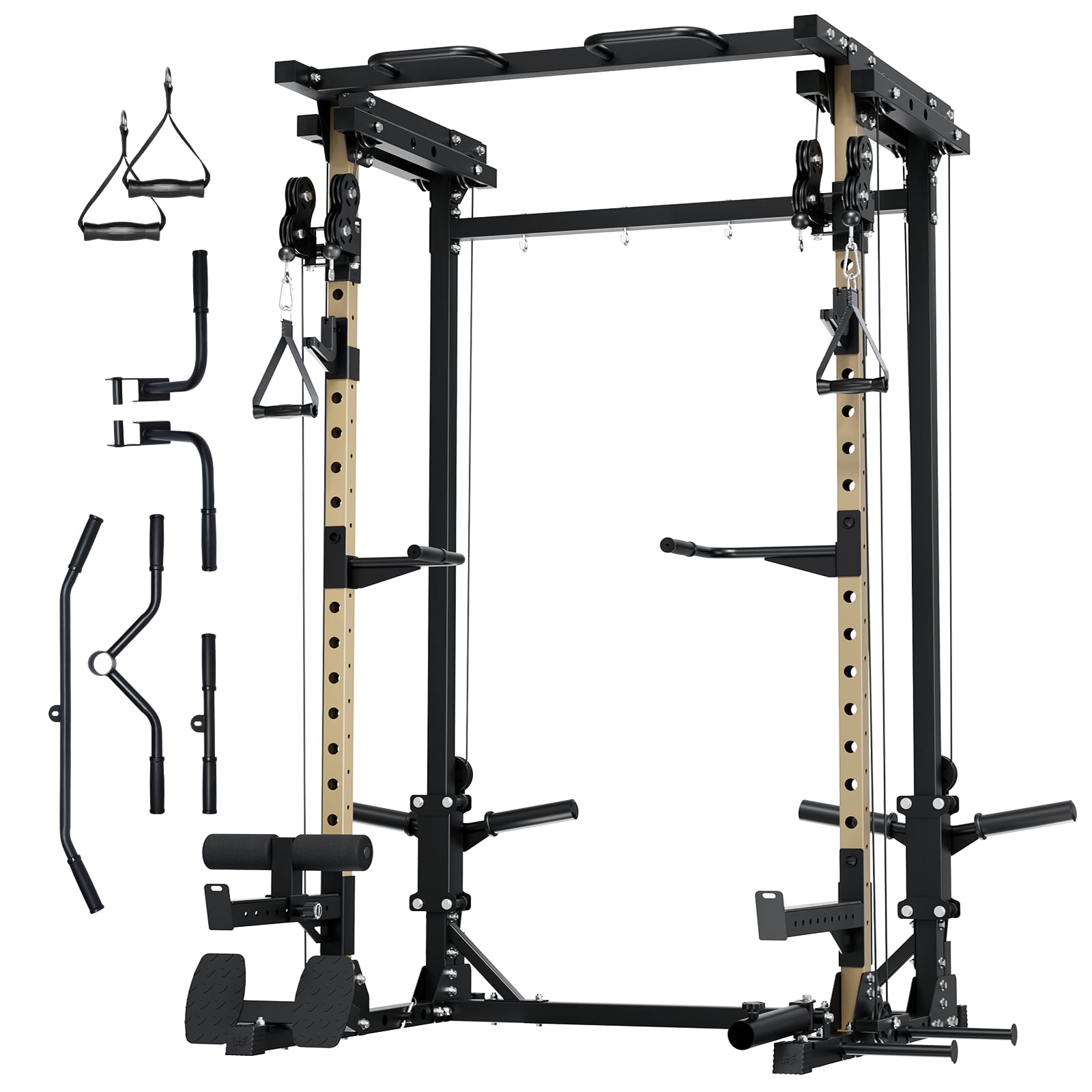
A 2500-lb rated frame with a whisper-quiet dual pulley system—the strongest, smoothest cage here.
The Drone3 leads this list on raw specs: 2×2-inch commercial-grade steel supporting a massive 2,500-lb capacity, with a linear bearing system that moves the bar with zero friction and a professional spring system for safety. Nineteen precise height settings mean the J-hooks land exactly where your lift needs them, whether you’re 5’2″ or 6’4″.
Owners consistently call it quiet—a rarity for cable racks—noting no shaking on pull-ups and smooth operation under 50 lbs. The dual-pulley system switches between 2:1 for high-rep endurance sets and 1:1 for heavy strength work, adapting to whatever goal you’re chasing. Its compact footprint of 69.5″W x 45.9″D x 85″H fits garages and even small spare rooms, with built-in storage keeping plates and attachments organized.
The honest caveat: owners describe the frame as light and movable, recommending it for kettlebell and ancillary work rather than >500 lbs powerlifting. Some make personal mods—adding foam so the pulley doesn’t contact the frame during pec flys, or a deck board under the bumper to reduce cable tension at rest. Assembly is doable but time-consuming; the impact driver recommendation suggests 3-8 hours depending on your pace.
Strength and silence
- 2500 lbs capacity on 2×2 commercial steel
- Quiet pulley system—no shaking on pull-ups
- 19 height settings for any lifter
Reality checks
- Frame moves easily; not for 500+ lb powerlifting
- Pulley may contact frame during deep flys—foam mod helps
- Assembly rewards an impact driver
Choose for: a quiet, high-capacity rack that fits a garage or spare bedroom and handles most home lifters’ needs with room to spare.
Skip if: you’re a raw powerlifter pushing beyond 500 lbs on the bar—this wants a heavier, bolted-down frame.
8. MAJOR FITNESS F22 Power Rack
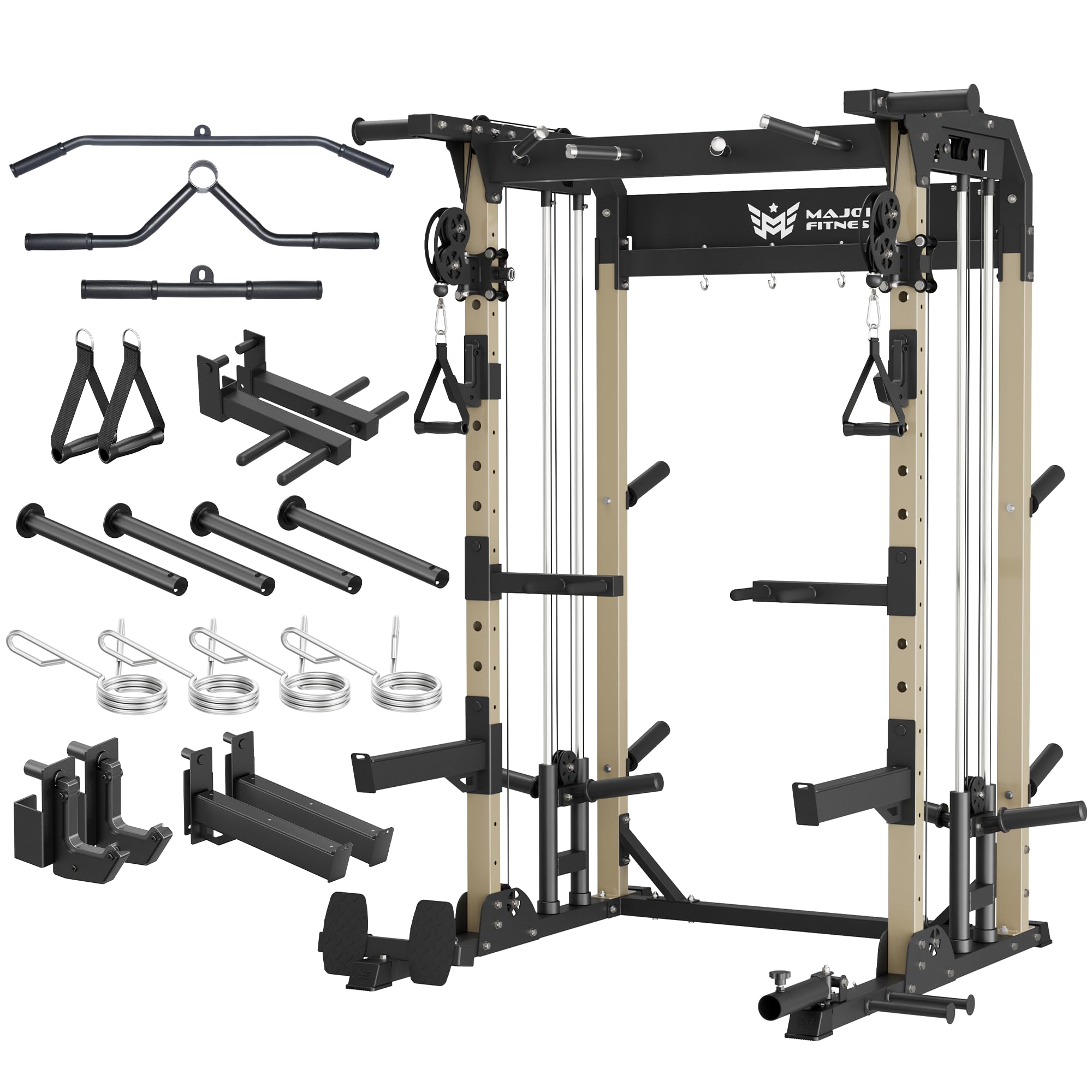
A 2×3-inch steel frame with independent dual trolleys built for two people training at once.
The F22 earns its premium spot with a beefier 2″x3″ commercial-grade 14-gauge steel frame (0.08″ thick) supporting a 1600lb static capacity—the thicker uprights resist twisting better than 2×2 racks when you’re doing off-center landmine presses or rack pulls. The dual-triangle base increases floor contact for a grounded feel, and owners confirm it’s rock solid with no wobble, even holding more weight than they could lift.
The a neat extra is genuinely simultaneous multi-user training: the independent dual-pulley system with a 2:1 ratio lets two people train at once without cable interference, making supersets with a partner smooth. Owners who skip the rear plate holders save about 8 inches of depth—helpful if you’re squeezing into a tight garage—and the 82.5″D x 68.9″W x 82.5″H footprint fits under low ceilings with just 94″ of clearance. The low height is a standout for finished basements.
Customers note straightforward assembly at roughly 3 hours, with one minor gripe about a lat bar that’s a bit narrow and attachments that aren’t commercial-grade. Owners recommend greasing the pulleys occasionally to keep them gliding, though they start smooth. The dip bar handles at 1.25″ diameter can hurt hands on long sets—a small fit issue, not a structural one.
Two-at-once design: independent 2:1 trolleys let you and a partner superset without tangling cables—a rare feature that keeps workouts moving.
Ceiling-friendly: at 82.5″ tall, it slides under an 8-foot ceiling where taller racks won’t, making it the pick for finished basements.
Reach for it if: you train with a partner, have a low ceiling, or want the extra torsional stiffness of a 2×3-inch frame.
Note before buying: the narrow lat bar and thin dip handles are the two comfort compromises owners flag most.
9. pooboo P43 Power Cage
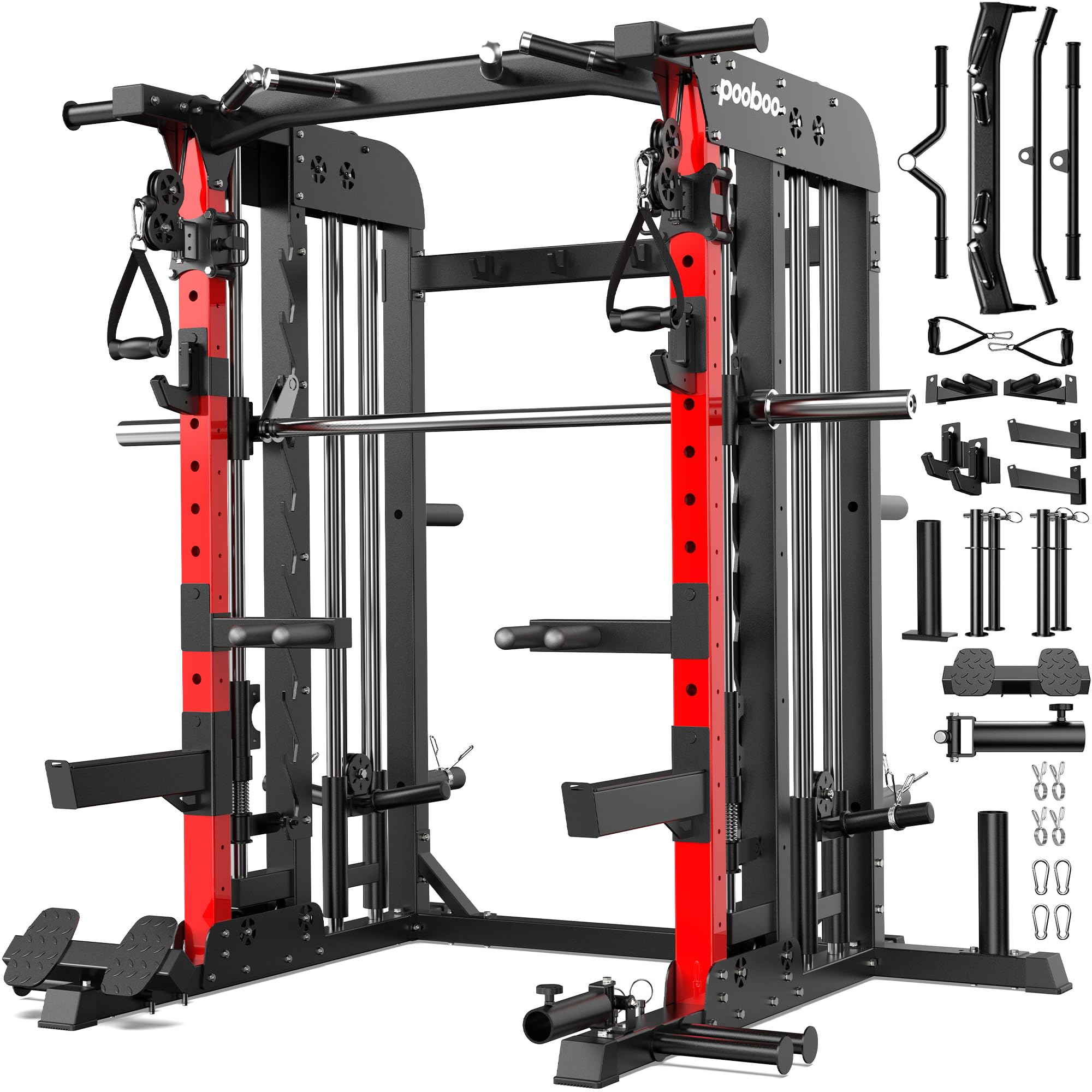
A 2,000-lb Smith-equipped cage with 26 included pieces—the most complete bundle in this lineup.
The pooboo P43 is the closest thing to a whole gym in one shipping crate, pairing a 2,000-lb rated heavy-duty steel frame with a Smith bar that has welded safety latches. That’s a significant combination: you get the guided bar for safe solo squats and presses, plus a full cable crossover system for flys and pulldowns, all in one unit measuring 62.9″D x 43.3″W x 82.6″H.
The 26 free attachments are the real story—2 J-hooks, 2 safety spotter arms, 2 dip bars, 2 cable grip handles, a lat pulldown bar, a row bar, a 360° landmine, a Smith bar, 4 plate storage pins, 4 weight holders, and 4 band pegs. The upgraded P43-Pro adds LAT training handles with 5 grips, a free Olympic bar, a barbell pad, a double-ended triceps rope, and an ankle strap. Owners say it supports heavy weights easily and that the pulley system is super smooth.
Assembly is a marathon, not a sprint: reviewers point out 10 hours over several days, partly because the instructions and hardware ship in box D rather than box A, creating some early clutter. But the payoff is a commercial-gym feel at home—owners note it matches commercial gyms for sturdiness and say it saves money on memberships. At 417 lbs, this is a permanent anchor that requires real floor space and patience to build.
Everything included
- 26 attachments cover full-body training from the start
- 2,000-lb capacity with Smith bar safety latches
- Super smooth pulley system, per owners
Build commitment
- Assembly runs ~10 hours over multiple sessions
- Hardware ships in box D, not box A
- 417-lb frame needs permanent floor space
This is your rack if: you want a Smith machine plus cables plus every attachment imaginable, so you never buy accessories again.
Clear the calendar for: a weekend-long assembly project—and make sure your floor can anchor a 417-lb frame.
10. RitFit M1 Pro Smith Machine
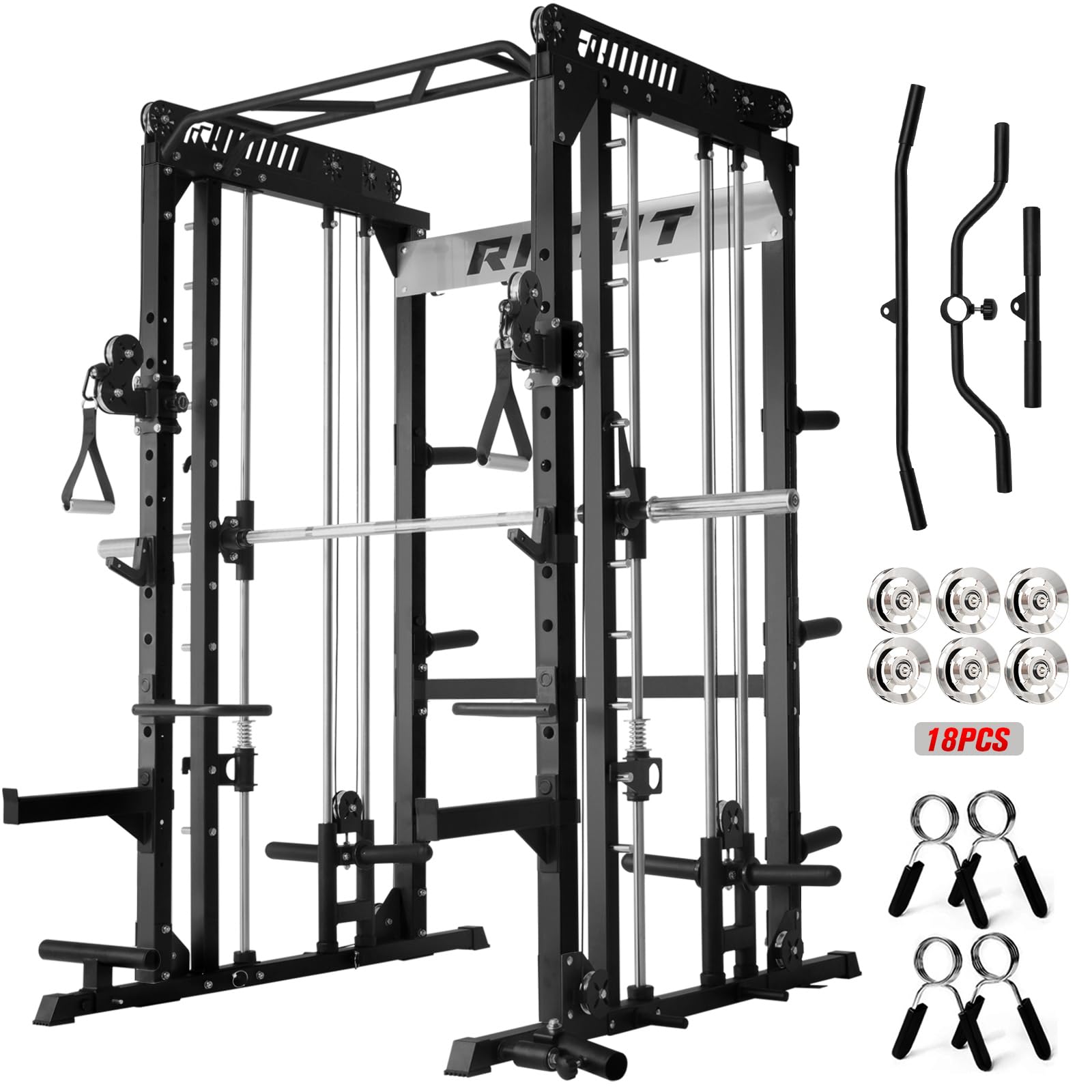
A premium 1850-lb Smith machine with dual 360° cables and a 36-month frame warranty for the serious home gym.
The RitFit M1 Pro earns its premium spot: heavy-duty 2″x2″ steel uprights support up to 1850 lbs, with a linear bearing design on the Smith bar plus a bottom spring shock absorption system and 11 selectable heights. That combination gives you the safety of a guided bar with the feel of a commercial machine—owners describe the pulley operation as butter-like and the construction as sturdy enough to feel high-end.
The dual 360° cables run on a dual slide rail structure with aluminum pulleys and rubber cable balls, offering low, mid, and high crossover positions plus chest press, rows, and overhead triceps extensions. The storage system is genuinely thoughtful—4 top rear hooks, a central storage crossbeam, and 6 weight plate holders keep your plates organized so the rack stays clutter-free. At 47.8″L x 63″W x 85.2″H, it’s a full-size machine that needs real space.
Where this rack splits opinion is delivery condition: the most-discussed negative is arriving with chipped uprights, dented parts, or missing hardware—a shipping-integrity issue rather than a design flaw, and customer service resolves most cases. Assembly is tricky mainly around the cables (plan 5 hours with a YouTube video), and owners are honest that it suits 95% of home lifters but not pros pushing >250 lb squats or benches. The 36-month frame warranty plus 12 months on accessories is the best coverage here.
Premium feel
- 1850 lbs capacity with linear bearing Smith bar
- Butter-smooth 360° cable pulleys
- 36-month frame warranty—best in this list
Delivery roulette
- Dented or chipped parts reported on arrival
- Cable routing is the hardest assembly step
- Not for pros lifting beyond 250 lb on the bar
Invest here if: you want a premium-feeling Smith machine with dual 360° cables and the strongest warranty in the lineup.
Inspect on delivery: check every box for transit damage before you start the 5-hour build, and lean on customer service for replacement parts.
Understanding the Specs
Weight capacity vs. real-world load
A frame’s rated capacity (like 2,000 lbs) tells you the static strength of the steel, not what you should load for routine training. Your body weight, the barbell, and the plates all count toward that number, and safety arms, J-hooks, and pulley systems each have their own lower ratings. Unless you’re a powerlifter, anything above 1,200 lbs of frame capacity gives you plenty of headroom.
Pulley ratio: 1:1 vs. 2:1
The pulley ratio determines how the weight feels in your hands. A 1:1 ratio delivers full resistance—a 50-lb plate feels like 50 lbs—for honest strength work. A 2:1 ratio halves resistance to 25 lbs but smooths cable travel, easing joints for high-rep, rehab, or beginner work. The best racks let you switch between both ratios.
FAQ
How much ceiling height do I need for a power rack?
Can two people use one of these racks at the same time?
Do I need to bolt the rack to the floor?
How long does assembly actually take?
Will my existing barbell and plates fit?
Is a Smith machine better than a free-weight cage?
What does the 2:1 pulley ratio do to my lifts?
How much floor space do these racks really need?
How do I protect my floor from heavy drops?
What’s the difference between a power rack and a squat stand?
Are the included attachments actually useful?
Final Thoughts: The Verdict
Across the board, the all-in-one power rack winner is the Mikolo F4 2.0 Elite because its built-in 100LB weight stack eliminates the hidden cost of buying separate pulley plates—the most common budget trap in this category. If you want a Smith machine with the strongest warranty, grab the RitFit M1 Pro with its 36-month frame coverage. And for low-ceiling basements or partner training, the MAJOR FITNESS F22 is the one to reach for—its 82.5″ height and independent dual trolleys make it uniquely fit for those spaces.
How We Picked
We do not accept paid placement. Every pick is matched to a real buyer and a real use-case; we do not hands-on test units.
Sources & Methodology
Specifications: manufacturer listings and product documentation. Review insights: verified customer reviews, as of August 2026. Pricing: not shown on this page (it changes often); check the current price via the retailer link.
As an Amazon Associate, Gadgets Feed earns from qualifying purchases. This does not affect which products we feature.