
Our readers keep the lights on and my morning glass full of iced black tea. As an Amazon Associate, I earn from qualifying purchases.
Specs are compiled from manufacturer listings and verified buyer reviews and can change over time — please confirm the key details on the product page before buying.
If your TV picture freezes into blocks or drops channels every time someone walks past the antenna, the fix is often a simple inline signal booster. But here’s the catch that confuses most buyers: an amplifier only helps a signal that’s already there. If you’re pointing an antenna at nothing, no amount of gain will invent channels out of thin air.
I’m Min — the founder and writer behind Gadgets Feed. This guide is built by comparing the manufacturers’ published specifications and the patterns across verified customer reviews, so you get each pick’s real strengths and trade-offs instead of marketing spin.
If your TV picture freezes or drops channels, an indoor antenna amplifier (a small device that boosts the signal from your antenna) can fix it. This guide sorts the boosters that actually save your signal from the ones that just sit there.
Quick Picks
- McDuory Smart HD Antenna Pre-Amplifier — Best Overall
- DTB TECH Digital Indoor TV Antenna — Best Value
- Antennas Direct ClearStream Flex — Top Performer
- Antennas Direct Jolt Switch USB Amplifier — Compact Pick
- Antop Smart Boost Dual Output Amplifier — Most Versatile
- Nippon America 36 DB Distribution Amplifier — Premium Pick
- PBD HDTV Preamplifier — Best Value
- Philips Elite Channel Finder Antenna — Design Pick
- Mohu Leaf Supreme Pro — Smart Pick
How To Choose The Best Indoor Antenna Amplifier
You need to know whether your problem is a weak signal or a lost signal. An amplifier fixes the first but makes the second worse. If you have a decent antenna that struggles after a long cable run or a splitter, a booster is your answer. If your antenna barely finds anything on its own, you need a better antenna first.
Match the amplifier to your antenna type
Most preamps only work with passive antennas — that means a plain non-amplified Yagi or a flat panel without its own booster. Pairing a preamp with an already-amplified antenna creates a feedback loop that ruins reception. Check your antenna’s specs before buying a booster.
Understand gain and filters
Gain, measured in decibels (dB), tells you how much the amplifier increases the signal strength. Look for a unit that boosts VHF and UHF separately, like a 16dB gain for VHF and 25dB for UHF. A built-in 4G LTE filter is important because it blocks the cellular frequencies that cause picture pixelation.
Count your outputs
If you want to feed two televisions or an FM radio from one antenna, you need an amplifier with dual outputs. Most basic boosters have a single output, which means you’d need to add a splitter and lose signal strength in the process.
Quick Comparison
| Model | Best For | VHF/UHF Gain | Outputs | Type | Amazon |
|---|---|---|---|---|---|
| Smart HD Pre-Amplifier | Passive Yagi antennas | 16dB / 25dB | Dual | Preamp | Amazon |
| Digital Indoor TV Antenna | All-in-one urban setup | — | Single | Amplified Antenna | Amazon |
| ClearStream Flex | Multi-directional indoor | — | Single | Amplified Antenna | Amazon |
| Jolt Switch USB Amp | Quick real-time boost | — | Single | Inline Amp | Amazon |
| Antop Smart Boost | 2 TVs + FM radio | — | Dual | Distribution Amp | Amazon |
| 36 DB Booster | Long cable runs | — | Single | Distribution Amp | Amazon |
| PBD Preamplifier | Pixelation fixes | — | Single | Preamp | Amazon |
| Philips Elite | Signal finding | — | Single | Amplified Antenna | Amazon |
| Mohu Leaf Supreme Pro | Flat wall mounting | — | Single | Amplified Antenna | Amazon |
In-Depth Reviews
1. McDuory Smart HD Antenna Pre-Amplifier
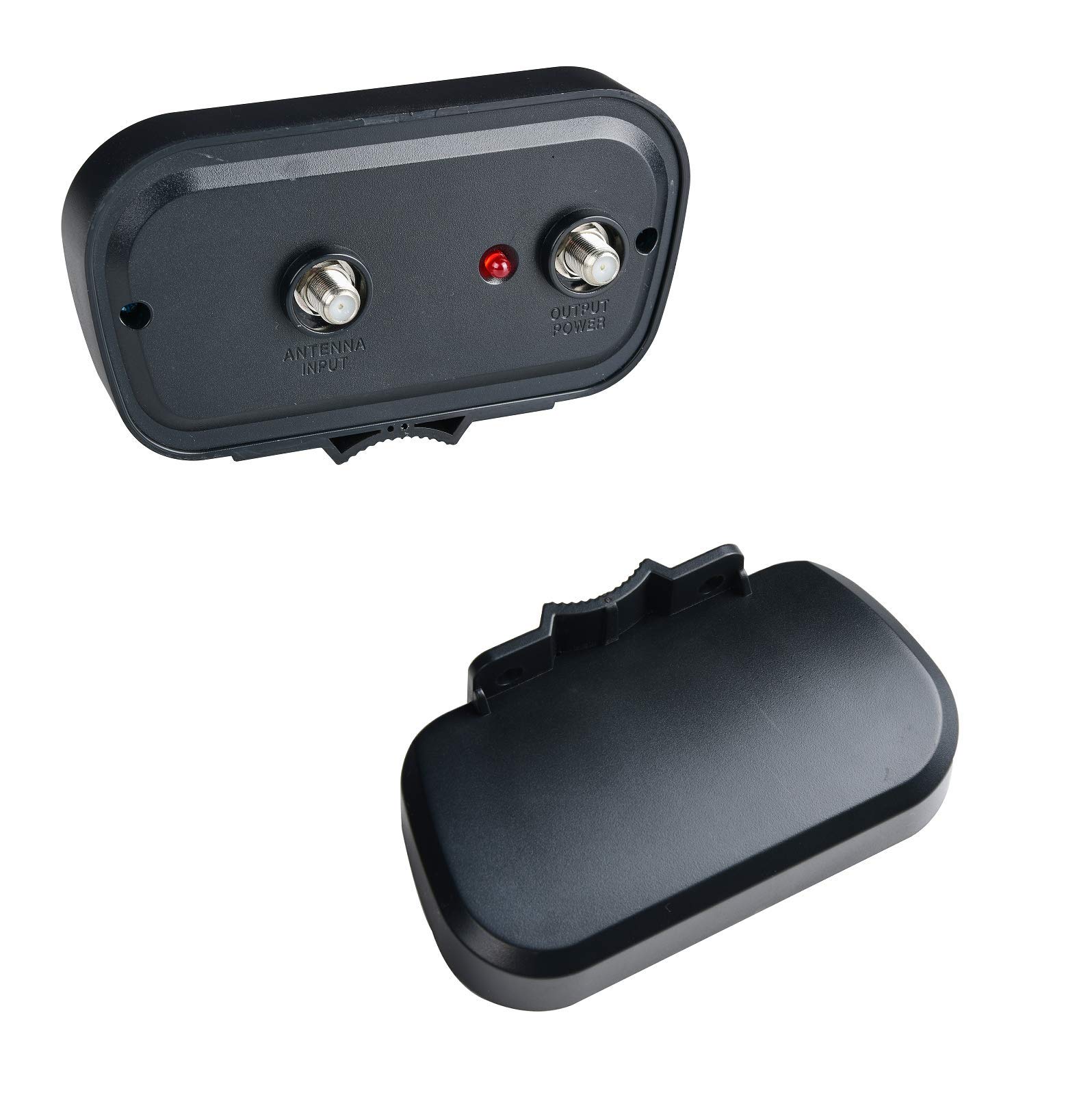
The inline preamp that finally tames weak VHF stations without drowning out the strong ones.
For anyone with a passive Yagi or a homemade antenna, this booster delivers a 16dB gain on VHF signals and a full 25dB gain on UHF, which is exactly the recipe for pulling distant channels into range. The built-in 4G LTE filter cuts down the cell-tower interference that shows up as picture pixelation, so you’re not just amplifying noise.
Owners running home-built antennas report it works well for weaker stations without overdriving the strong ones — a balance cheaper amps often miss. It ships with a 3FT RG6 cable, a USB adapter, and mounting hardware. The catch: it only works with passive antennas, so if your antenna already has its own amplifier, this unit will fight it.
One buyer testing it on an LG TV with a Yagi in the attic measured 76-82% signal with the amp both on and off, concluding the booster added no benefit for their strong-signal setup. That’s expected — this is a tool for marginal signals, not a miracle for dead zones. The warranty support gets high marks, with failed units replaced quickly even after months of use.
Signal Strengths
- Strong 25dB UHF gain for distant stations
- 4G LTE filter reduces pixelation
- Dual outputs feed two devices
Watch Outs
- Passive antenna only, no amplified panels
- No benefit if your signal is already strong
Grab this for: anyone with a non-amplified Yagi or DIY antenna chasing distant VHF and UHF channels.
Look elsewhere if: your antenna already has a built-in booster or your reception is already solid.
2. DTB TECH Digital Indoor TV Antenna
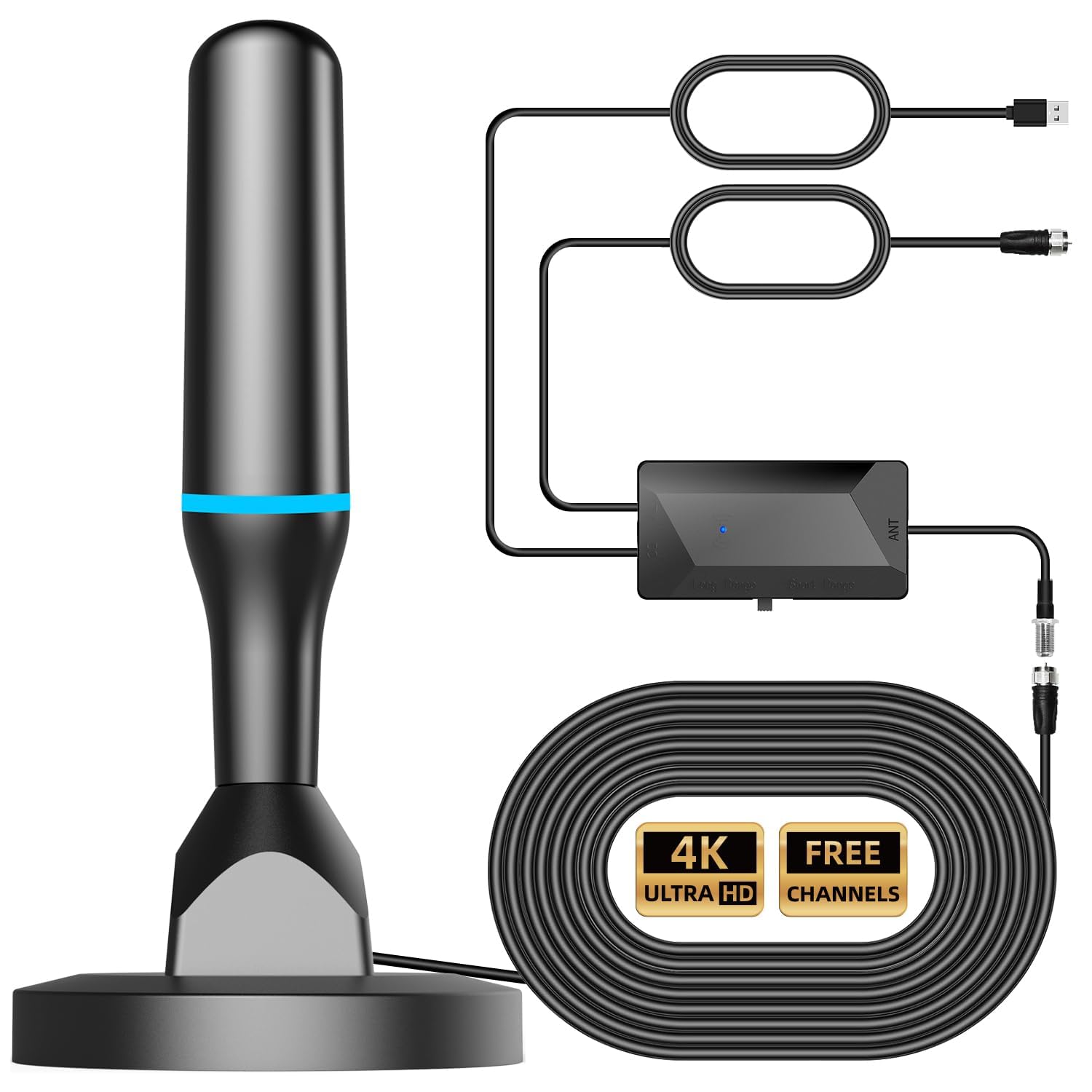
A magnetic flat panel that claims 120-mile range and actually lets you swap the amplifier out when you don’t need it.
This one is a complete antenna-and-amplifier kit rather than a bare booster, and it’s built for apartment dwellers who want free local news, sports, and weather without a cable bill. The 360° reception is handled by a magnetic base that snaps onto metal TV stands or window frames, and the included 10ft cable gives you freedom to position it high on a wall.
The smart chip filters cellular and FM interference to keep a stable 4K 1080P picture in high-density areas. What makes it flexible is the removable amplifier — if you’re close to broadcast towers and already get a clean signal, you can run the antenna passively. Buyers praise the small footprint and strong magnet, noting it finds more channels than a pricier antenna they owned before.
But there’s a sharp divide in experiences: some buyers report it needs constant repositioning to access channels, and one buyer scanning multiple times found zero channels before returning it. The honest read is that a 120-mile claim is optimistic for most real-world locations — check dtv.gov/maps before buying to see what’s actually available near you.
Bottom line: A versatile amplified flat panel that’s ideal for urban and suburban homes, but its range claim demands a realistic signal in your area.
Choose it if: you want a complete plug-and-play kit with a magnetic mount and the option to remove the amp.
Pass if: you live in a weak-signal valley or a metal-sided building where signals are heavily blocked.
3. Antennas Direct ClearStream Flex

The paper-thin loop with a Jolt Switch that gives you real-time control over your signal boost.
At just 12″ H x 16″ W and 0.04″ deep, this antenna disappears against a wall while its multi-directional elements pull in UHF and Hi-VHF stations from multiple directions. The defining feature is the Jolt Switch — an in-line amplifier you can toggle on or off depending on whether your TV signals need a boost at any given moment.
Performance is the thing that wins people over here, with owners reporting up to 100 channels including major local networks and signal strength that rivals cable. The coaxial cable is detachable, which means you can upgrade to a better RG-6 cable and improve your signal further. One owner found the amp and cable worked so well they used them with their existing stronger antenna instead.
Reception depends heavily on your distance to towers and obstructions like trees or building materials — the 50-mile range is a ceiling, not a guarantee. One reviewer noted that accepting the boost means finding a spot where the paper-thin panel doesn’t stand out, which is minor given the reliable channel gain over a previous setup with separate antenna and booster.
Why It Wins
- Reversible black/white thin design
- Jolt Switch provides on-demand boosting
- Detachable coax allows RG-6 upgrades
Keep In Mind
- 50-mile range depends on line-of-sight
- Needs a spot where it doesn’t stand out
Reach for it if: you want a multi-directional flat antenna with a controllable amplifier for urban or suburban use.
skip it if: you’re beyond 50 miles from towers or in heavy-wood construction.
4. Antennas Direct Jolt Switch USB Amplifier

A tiny 1.9-inch inline amp you toggle on only when your picture needs it — powered by any USB port.
If you already own a passive antenna and just need a removable boost, this is the cleanest option. The Jolt Switch measures just 1″ H x 1.9″ W x 0.6″ D, so it tucks behind the TV or along the cable run without adding bulk. The USB power adapter means you can power it from the TV’s own USB port or a wall plug.
The switch gives you real-time control: turn it on for clearer, enhanced reception and better picture and sound, sometimes tuning in channels beyond your antenna’s standard range. Turn it off when not needed, and you still benefit from the RF signal filtering that blocks interference. An electrician buyer summed it up neatly: it won’t take a very weak signal and make it usable, but it will take a fringe signal and make it detectable.
Real-world results are honest about physics. One owner gained 5 channels, going from 30 to 35, while another reported the inline amp actually reduced their channel count in a weak-signal area. The recurring theme: this helps marginal signals but can’t overcome an insurmountable signal deficit — so check your location’s actual signal strength before counting on a big jump.
Fit note: The 23 reception mentions split between praise and disappointment, which is exactly the profile of an amp that helps fringe signals but fails where no signal exists.
Best for: viewers with a decent passive antenna who need a small, adjustable push on iffy channels.
Not for: anyone expecting a weak or nonexistent signal to become watchable — no amp can beat physics.
5. Antop Smart Boost Dual Output Amplifier
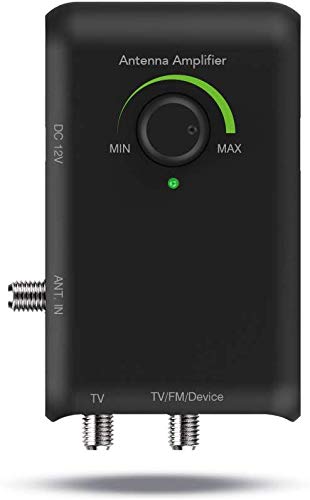
The only booster here with an adjustment dial and dual outputs, so one antenna can feed two TVs and an FM radio.
Most amplifiers are set-and-forget, but this one has a smart boost system with a built-in adjustment dial that lets you tune the reception balance to your exact location. That’s genuinely useful if you live somewhere between strong and weak coverage, since you can dial back the gain to avoid overdriving close stations while still boosting distant ones.
You can run one antenna to two devices at once — the 2-way amplifier feeds a second TV, an FM stereo, or any OTA-ready streaming device through its secondary output. A professional 4G LTE filter (a circuit that blocks cellular signals) stops 3G and 4G interference, so your picture stays clean, and it also boosts FM reception for your favorite radio stations on the same setup.
Your results depend on where you live, just like any amp in this class. One buyer 50-60 miles from a major city went from 19 to 36 clean channels, but another saw their count fall from 63 to 16. The key is your baseline signal — if a local channel is already weak, no dial setting will make it strong.
Flex Points
- Adjustable gain dial tailors boost to location
- Dual outputs feed 2 TVs or an FM stereo
- 3G/4G LTE filter reduces pixelation
Trade-Offs
- Mixed reports — depends on your signal
- Can weaken reception if over-amplified
Pick this for: homes wiring one antenna to multiple devices, especially where an adjustable gain dial helps fine-tune.
Think twice if: your local channels are already borderline — boosting might push them over the edge instead of helping.
6. Nippon America 36 DB Distribution Amplifier

The workhorse distribution amp built to compensate for signal loss from splitters and long cable runs.
This is a different tool from the preamps above — a distribution amplifier meant to sit inline in your cable run and make up for the signal you lose when splitting to multiple TVs or running long coax. The 36dB gain is substantial, and the unit is designed to amplify UHF, VHF, and FM signals across the board.
It’s a favorite for its longevity. One buyer has had theirs working fine for six years and bought another for a second home, while a reviewer describes it as the go-to fix for signal loss caused by cable length or splitters. The FCC-certified design keeps it from causing interference with other sensitive RF equipment, which is a real concern with cheaper boosters.
The manufacturer is upfront about limits: this will not boost a bad or weak signal — it only compensates for losses. Owners mention mixed results when expecting it to rescue a genuinely weak station, with one noting they couldn’t see consistent improvement even at full gain. That’s not a defect, it’s the physics of amplification: it boosts everything, including nearby strong stations that can cover up weaker ones.
Best use: Install it near your television for a single set, or at the splitter when feeding multiple TVs, to recover lost signal strength.
Reach for this if: you have splitters or long coax runs bleeding your signal dry.
Look elsewhere if: your raw antenna signal is already too weak to work — this can’t fix that.
7. PBD HDTV Preamplifier

The preamp that turns a so-so antenna array into a reliable 71-channel setup, pixelation gone.
For anyone with a passive antenna, this booster enhances any non-amplified antenna and delivers a clearer signal, more range, and more available channels. The 4G 5G LTE filter is the standout — it blocks modern cellular interference that shows up as picture pixelation and dropouts, which is increasingly important as 5G towers spread.
The real-world results are impressive. One owner saw their channel count jump from 65 to 71 after adding this preamp, with previously pixelated Spanish-language channels coming in clean, and split across four TVs without issue. Another reported 39 clear channels in all weather over two weeks in Eastern Iowa, solving years of intermittent reception. The consensus: reception is what wins people over, with 118 owners praising it.
The honest caveat is durability. Several owners note that the plastic cases are fragile — one cracked the coax connector when snugging it with a wrench — and some units reportedly last about two years before needing replacement. The included 3FT RG6 cable is thin, and swapping in a quality RG6 cable helped one buyer whose included jumper was kinked. Treat the fittings gently and plan for a possible replacement cycle.
Signal Wins
- 4G 5G LTE filter eliminates pixelation
- Clear reception across 4 TVs
- Easy installation with included hardware
Durability Notes
- Plastic cases crack if over-tightened
- Some units last about two years
Best for: passive antenna owners fighting pixelation and dropouts who want a proven channel count boost.
Skip if: you need a rugged, weatherproof unit — this one demands a gentle hand.
8. Philips Elite Channel Finder Antenna

The amplified flat panel with a built-in LED meter that literally lights up where your signal is strongest.
Finding the right spot for an indoor antenna is often the hardest part, which is why this one has a patented signal finder LED meter that visually displays signal strength as you move it around. You walk the antenna across the room, watch the meter, and stop when it peaks — no more guessing or rescanning repeatedly. It reaches 60 miles from the broadcast signal and can be placed almost anywhere in your home.
It receives uncompressed 1080p on both VHF and UHF with what Philips calls Pure Amp Technology, which increases signal strength while reducing dropouts. The 10 ft. coax cable is included, and the black flat design is meant to blend into home decor rather than look like a piece of equipment. It’s backed by a limited lifetime warranty, which is rare in this category.
Experiences split along location lines. A satisfied cord-cutter reports getting all local channels with a picture that looks better than their previous fiber service. Others in weak-signal areas found it no better than a non-amplified antenna and returned it. As one buyer mentioned, it’s a good option for selected areas — great for a guest room or exercise room where you don’t need hundreds of channels.
What stands out: No other pick here helps you find the optimal placement — this one does it with a visual meter, which removes the guesswork.
Choose it if: you’re new to antennas and want a guided way to find the best signal spot.
Pass if: you already know your best placement and just need a raw booster for an existing antenna.
9. Mohu Leaf Supreme Pro
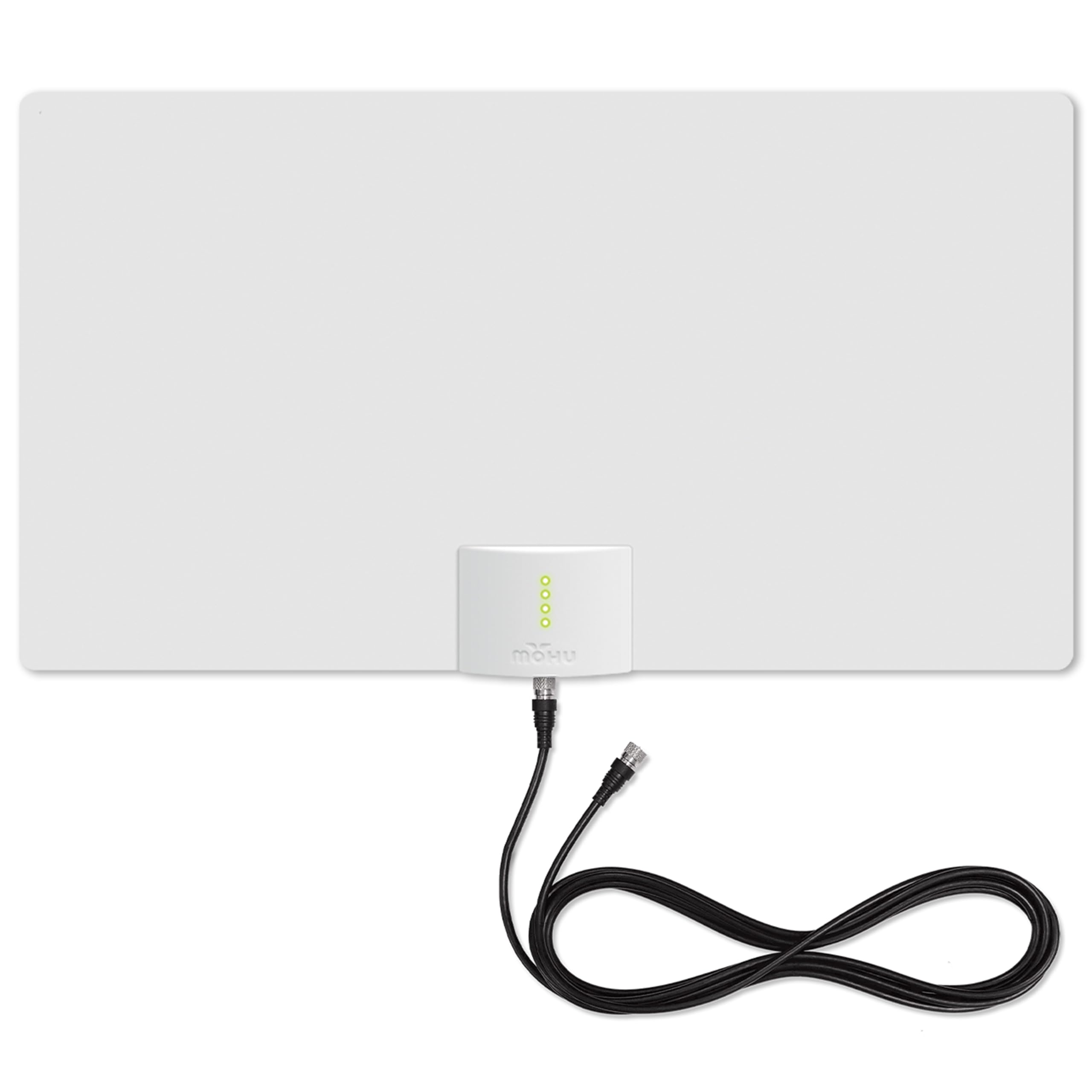
The amplified wall-hugging leaf with a signal indicator LED that tells you exactly where to hang it.
This is a top-selling indoor antenna, and the Supreme Pro version boosts the signal right at the base with FirstStage amplification, reaching up to 65 miles. It’s ultra-thin at 12″H x 21.5″W and 0.04″ deep, flips between white and black, and you can paint it to match your wall — the flexible 12 ft. detachable cable lets you place it anywhere near your TV.
The integrated LED signal indicator illuminates where TV signals are strongest, so you can adjust placement in real time to find the optimal spot. It pulls in multi-directional UHF and Hi-VHF signals from both sides and handles OTA broadcasts in Full HD 1080p, 4K, 8K UHD, and NEXTGEN TV depending on your coverage area. One city buyer in Boston replaced a cheap antenna and jumped from 40+ to 68 channels with no repositioning needed.
The major caveat is geographic. Mountain or valley locations report zero network reception despite nearby towers, and the antenna is larger than square panels — it takes significant wall space. The included hook & loop tabs and push pins are weak, with owners recommending finish nails instead. Consider your local topography and transmitter distance before buying, and note that it needs a USB port for power since no adapter ships in the box.
City Strong
- Signal indicator finds best placement
- Reversible white/black, paint-friendly
- FirstStage amp boosts weak signals
Location Limits
- Fails in mountains and valleys
- Weak mounting pins need replacing
Ideal for: urban and suburban homes with clear line-of-sight to towers, especially where wall space allows a wider panel.
Avoid if: you’re in a valley, surrounded by hills, or live in a metal-sided building.
Understanding the Specs
Gain in dB
Gain, measured in decibels (dB), tells you how much an amplifier strengthens your TV signal. A unit with 16dB gain on VHF and 25dB on UHF is boosting weak distant stations into a watchable range. Higher numbers mean more amplification, but over-amplifying a strong signal can cause pixelation — balance matters more than raw power.
4G LTE Filter
A built-in 4G LTE filter blocks the cellular frequencies that leak into your TV signal and cause picture pixelation. Without it, your phone’s data connection or a nearby cell tower can create static that looks like signal problems. This is increasingly important as 5G towers spread into residential areas.
Passive vs. Amplified Antennas
Passive antennas have no built-in electronics and rely on an external amplifier. Amplified antennas have a booster built into the panel. Most preamps work only with passive antennas — adding one to an already-amplified antenna creates feedback that ruins reception.
Dual Outputs
An amplifier with dual outputs lets you feed a second TV, an FM stereo, or a streaming device from the same antenna. If you only have one TV, a single-output amp is all you need. If you want to split to multiple rooms, dual outputs save you from adding signal-draining splitters.
FAQ
Will an indoor antenna amplifier work with any antenna I already own?
Why is my TV picture pixelated even with an amplifier?
Will a 120-mile antenna amplifier really pull channels from 120 miles away?
What’s the difference between a preamplifier and a distribution amplifier?
Can one antenna amplifier feed two televisions?
How long do TV antenna amplifiers last?
Why did my channel count drop after adding an amplifier?
Can an indoor antenna amplifier work in a basement or metal building?
Final Thoughts: The Verdict
For most people, the indoor antenna amplifier winner is the McDuory Smart HD Pre-Amplifier — it delivers a strong 25dB UHF gain (a measure of signal boost), a 4G LTE filter, and dual outputs, making it the most complete booster for passive antennas. If you want a ready-to-go antenna-and-amplifier kit with a magnetic mount, pick the DTB TECH Digital Indoor TV Antenna. And if you need to wire one antenna to several devices and fine-tune strength with a dial, the Antop Smart Boost is your best bet.
How We Picked
We do not accept paid placement. Every pick is matched to a real buyer and a real use-case; we do not hands-on test units.
Sources & Methodology
Specifications: manufacturer listings and product documentation. Review insights: verified customer reviews, as of August 2026. Pricing: not shown on this page (it changes often); check the current price via the retailer link.
As an Amazon Associate, Gadgets Feed earns from qualifying purchases. This does not affect which products we feature.