
Our readers keep the lights on and my morning glass full of iced black tea. As an Amazon Associate, I earn from qualifying purchases.
Specs are compiled from manufacturer listings and verified buyer reviews and can change over time — please confirm the key details on the product page before buying.
You want to see far, but the more magnification you dial in, the more your own heartbeat shakes the view. At 10x or 12x, a distant hawk can turn into a blurry bounce. This guide ranks the models that actually fix that — from image-stabilized tech to big light-collecting lenses — so you can pick the one that keeps your target steady and sharp.
I’m Min — the founder and writer behind Gadgets Feed. This guide is built by comparing the manufacturers’ published specifications and the patterns across verified customer reviews, so you get each pick’s real strengths and trade-offs instead of marketing spin.
Whether you are tracking warblers at dawn, scanning ridgelines on a hunt, or counting Jupiter’s moons from the backyard, the right binoculars will transform a shaky blur into a steady, crisp view that stays with you for decades.
Our Picks at a Glance


How To Choose The Best Binoculars
The first number on any binocular — like 10×42 — indicates magnification, while the second number is the objective lens diameter in millimeters. The first number magnifies, but the second governs brightness. Beginners often over-prioritize magnification, but the objective lens diameter controls low-light brightness.
Match the glass to your hands and your quarry
Magnification above 10x amplifies hand shake, so a tripod or image stabilization becomes necessary. If you are glassing a field while standing, anything above 10x will magnify your heartbeat along with the target. For handheld birding and hiking, a 10x or 8x model with a wide field of view wins. For astronomy or long-range scanning, plan on a tripod from day one.
Waterproofing is a promise, not a feature
Nitrogen purging and O-ring seals keep internal fog from forming when you move between cold and warm air. For wet or humid conditions, prioritize a waterproof and fogproof body over a cheaper unsealed model.
Quick Comparison
| Model | Best For | Magnification | Objective Lens | Eye Relief | Amazon |
|---|---|---|---|---|---|
| Vortex Viper HD 12×50★ Best Overall | Low-light hunting | 12x | 50mm | 16mm | Amazon |
| Bushnell H2O 10×42Wet Weather Pick | Boating and wet weather | 10x | 42mm | 15.6mm | Amazon |
| Vortex Vanquish 10×26Ultralight Pick | Travel and backpacking | 10x | 26mm | 16mm | Amazon |
| Nikon PROSTAFF P3 10×42 | All-around birding | 10x | 42mm | 15.7mm | Amazon |
| Celestron SkyMaster Pro 20×80 | Dedicated stargazing | 20x | 80mm | 15.5mm | Amazon |
| Nikon Monarch M5 8×42 | Wide-field tracking | 8x | 42mm | 19.5mm | Amazon |
| Celestron SkyMaster 25×100 | Deep-sky astronomy | 25x | 100mm | 15mm | Amazon |
| ZEISS Terra ED 10×42 | Premium compact clarity | 10x | 42mm | 18mm | Amazon |
| Canon 12×36 IS III | Handheld high power | 12x | 36mm | 14.5mm | Amazon |
In‑Depth Reviews
1. Vortex Viper HD 12×50
Our pick — over 4.5★ from 450+ verified ratings; the strongest balance of quality and price.
The low-light hunter’s dream that turns twilight into a readable landscape.
If you glass at dawn or dusk, this pick ends the argument. The 12x magnification (versus a standard 10x model) and the 50mm objective lenses (26mm on the compact Vanquish below) pull in enough light to keep details visible when the sun drops. Owners describe the image as crisp with excellent low-light performance, and the crowd consensus backs them: quality and clarity are the two traits this model is praised for most.
The body is built for sustained use. Argon purging and o-ring seals make it waterproof and fogproof for life, while the scratch-resistant Armortek coating shields the exterior lenses from dirt, oil, and scuffs. A locking right-eye diopter lets you fine-tune each barrel to your vision, and the twist-up eyecups give 16mm of eye relief so eyeglass wearers can still see the full field.
It ships with the GlassPak Chest Harness, which spreads the weight across your torso for all-day carry without neck strain. The honest trade-off is heft — 12×50 glass is physically larger than a compact travel pair, and a few owners note the weight when it hangs on a strap for hours. That is the price of gathering that much light.
Why it wins
- 12x power with 50mm light grasp for low-light clarity
- Locking diopter tailors focus barrel-by-barrel
- Argon purged and o-ring sealed, waterproof and fogproof
- Included GlassPak harness for strain-free all-day carry
Who should pass
- Noticeably heavier and larger than compact travel models
- 12x magnification amplifies hand shake without a rest
Grab these if: you hunt or bird at first and last light and want the clearest low-light image this list offers.
Think twice if: you plan to glass all day from a neck strap — the weight will wear on you.
2. Bushnell H2O 10×42
The salt-spray survivor that shrugs off a dunk in the drink.
Built for the water, this 10×42 gets its name honestly. The O-ring sealed body is rated IPX7, which means it survives accidental submersion up to 30 minutes, and nitrogen purging keeps internal fog from forming when the weather turns. That is the exact scenario that kills cheaper sealed bins, making this the confident choice for boaters and coastal hikers.
Optically it holds its own against pricier competition. An all-glass, fully multi-coated system with BAK-4 prisms delivers sharp resolution and bright views, while the 4.2mm exit pupil matches the larger Viper HD above for solid low-light performance. The 5.84-degree apparent angle of view, compared to the Viper HD’s 5.5 degrees, makes tracking moving birds feel less restrictive.
The non-slip rubber housing and updated lightweight aluminum chassis make it comfortable for a full day out. Owners call the optics “very good” and note they work easily with prescription glasses. The occasional complaint is the diopter adjustment mechanism feeling finicky, but the overwhelming sentiment is that these deliver far more than their price suggests.
Built for the brine: IPX7 waterproofing and fogproof nitrogen purging make this the go-to for any wet environment, from a kayak to a rainy ridgeline.
Reach for these if: your binoculars will see spray, rain, or an accidental drop overboard.
Look elsewhere if: you need maximum magnification for long-range scanning — 10x is the sensible handheld ceiling here.
3. Vortex Vanquish 10×26
The pocket-size powerhouse that disappears into a pack until you need it.
The Vanquish is Vortex’s smallest, lightest, and most compact binocular, and that portability is the whole point. A 10x magnification in a body with just 26mm objective lenses means you get real reach without the bulk of a full-size unit. Owners call it perfect for travel, and its clarity at distance — with particular praise for performance out to 500 yards — punches well above its compact frame.
The compact form does cost some light. Its 2.6mm exit pupil (Bushnell H2O has 4.2mm) means in deep twilight this is not the brightest glass on the list. You give up some low-light performance to gain the freedom of a binocular that slips into a jacket pocket. Fully multi-coated lenses work to boost what light the smaller objective does capture.
It is nitrogen purged and O-ring sealed for lifetime waterproof and fogproof performance, and the fully rubber-armored body provides a non-slip grip. A true 2-meter close focus lets you study a spider at arm’s length, and the 16mm eye relief is generous for a compact unit. The VIP Warranty — unlimited, unconditional, and fully transferable — backs it for life.
Take-anywhere optics: the lightest, most portable pick here with a 10x reach that still resolves detail at 500 yards.
Best for: hikers, travelers, and anyone who wants a binocular they will actually carry every day.
Not for: dawn and dusk glassing, where the small 26mm objective limits brightness.
4. Nikon PROSTAFF P3 10×42

The 42mm all-rounder that makes premium Nikon glass feel affordable.
This is the highest-value balance in the lineup. A 10x magnification with 42mm objectives and multilayer-coated lenses gathers abundant light for sharp images even at dawn or dusk. The silver-alloy prism coating delivers vivid, lifelike color across the visible spectrum, and the wide 367-foot field of view makes tracking fast-moving birds far easier. Owners consistently praise its quality and clarity, calling it a great value for the money.
The body is built for comfort over long sessions. Fiberglass-reinforced polycarbonate with rubber armor gives a secure, non-slip grip while staying lightweight enough for all-day use. With 15.7mm of eye relief and turn-and-slide eyecups, viewing with or without glasses is genuinely comfortable.
It is O-ring sealed and nitrogen purged, so rain, snow, and humidity will not fog the internal lenses. Owners mention the lens covers are the weak point — a minor gripe easily solved with a pair of aftermarket caps. For a first serious pair or an upgrade, this delivers where it counts without demanding a premium budget.
The strengths
- Wide 367-foot field of view for easy target tracking
- Lightweight rubber-armored body for all-day comfort
- Nitrogen filled, fog and waterproof construction
- Sharp edge-to-edge clarity in a full-size body
The small gripes
- Stock lens covers are fiddly and easily lost
- Not a low-light specialist like a 50mm objective model
Pick this for: a do-everything binocular that excels at birding, hiking, and sports without overspending.
skip it if: you need the absolute brightest twilight image — step up to the 50mm Viper HD.
5. Celestron SkyMaster Pro 20×80

The tripod-bound stargazer that pulls in the moon and Jupiter’s moons.
This is where binoculars cross into telescope territory. With 20x magnification and massive 80mm objective lenses, the SkyMaster Pro gathers enough light to reveal Jupiter’s four bright moons and crisp views of the moon’s surface. Buyers report views that rival beginner telescopes, all in a package that is faster to set up and easier to focus than a scope on a mount.
The unique detachable RSR rail lets you mount an optional red dot finderscope, making it dramatically easier to point at faint astronomical targets. Fully multi-coated XLT optics on every lens surface boost brightness and contrast in dim conditions, and BaK-4 prisms round out the light path.
Here is the honest catch: this is heavy. Owners consistently say it is difficult to hold without a tripod, and the tripod is not included. The huge 80mm objectives feed a 4mm exit pupil, which is fine for dark skies but demands a stable platform. Focus quality gets mixed feedback, with some owners noting chromatic aberration around the moon’s edge. Budget for a sturdy tripod and a bit of patience dialing in the individual focus, and this rewards you with views that justify its place on this list.
A tripod-first purchase: this is not a grab-and-go binocular; it is a tabletop observatory that needs a stable mount to shine.
Best for: astronomy newcomers who want telescope-level views without telescope-level cost and setup.
Pass if: you refuse to carry a tripod — the weight makes handheld use genuinely frustrating.
6. Nikon Monarch M5 8×42
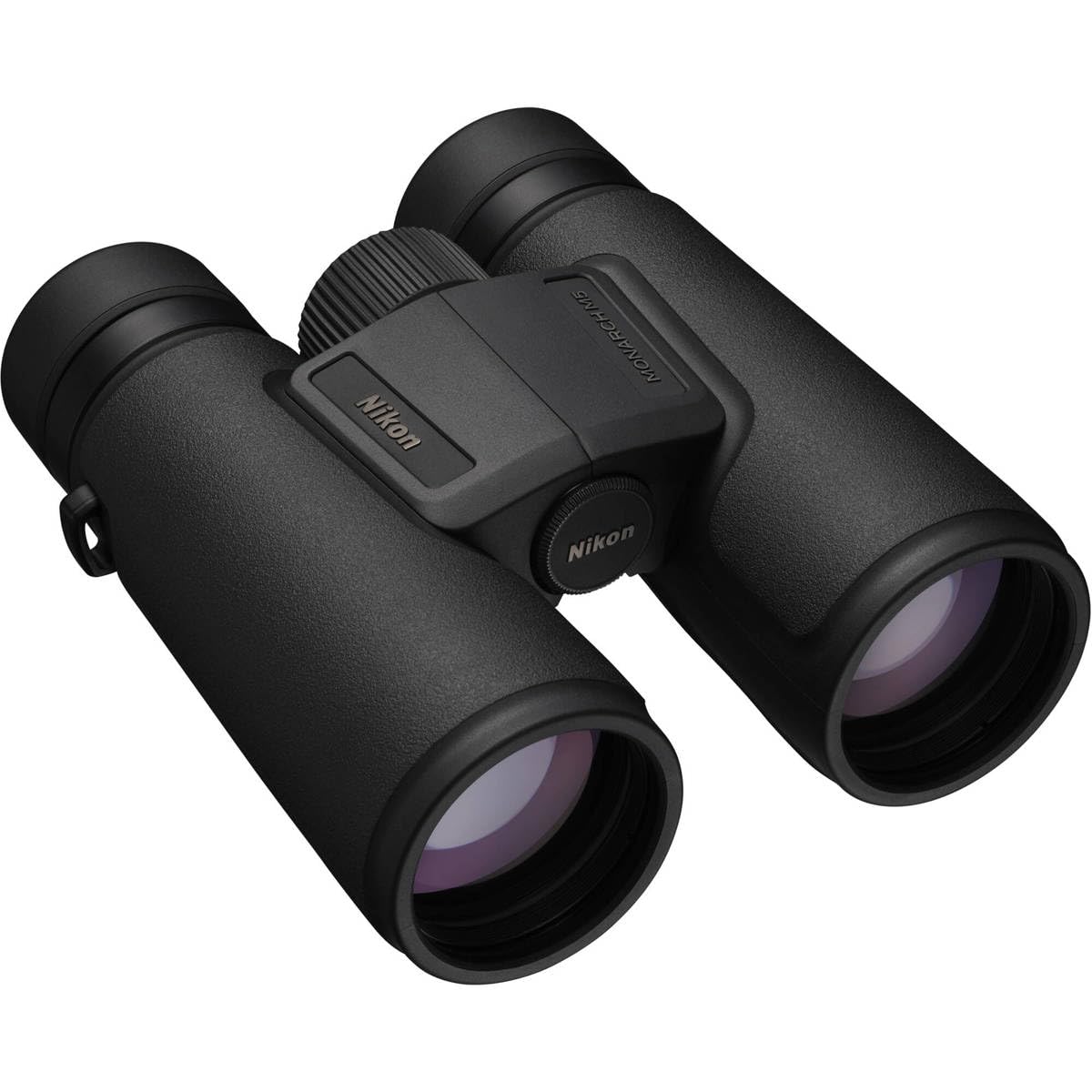
The 8x specialist whose broad field catches wildlife before it bolts.
If your problem is finding the animal before you can focus on it, this is the answer. The Monarch M5 in 8×42 offers the broadest field of view in its class, making it exceptional for tracking birds in flight and wildlife moving through dense brush. Extra-low Dispersion (ED) glass minimizes chromatic aberration (color fringing at edges), delivering crisp, high-resolution images with true-to-life color accuracy.
The dielectric high-reflective multilayer prism coatings enhance light transmission, producing brighter, more natural colors in shaded forests and low-light dawns. With 19.5mm of eye relief — the longest on this list — eyeglass wearers get a full, comfortable view. The large, smooth central focus knob allows precise adjustments, and close-focus capability down to 8.2 feet reveals intricate detail on nearby subjects.
Owners find it sharper than the PROSTAFF P3, with tactile eyecups and a sturdy build that feels more premium than its price. The narrower field of view is its one noted weakness compared to even wider options, and it runs slightly larger and heavier than expected. For a birder who values an rich, stable, all-day view, this is the standout.
Made for movers: the widest field of view here means you spot the bird first, then bring the 8x focus to bear.
Choose this if: you birdwatch or track fast wildlife and want edge-to-edge clarity with a forgiving 8x image.
Pass if: you need long-distance reach — 8x caps out sooner than the 10x and 12x models.
7. Celestron SkyMaster 25×100
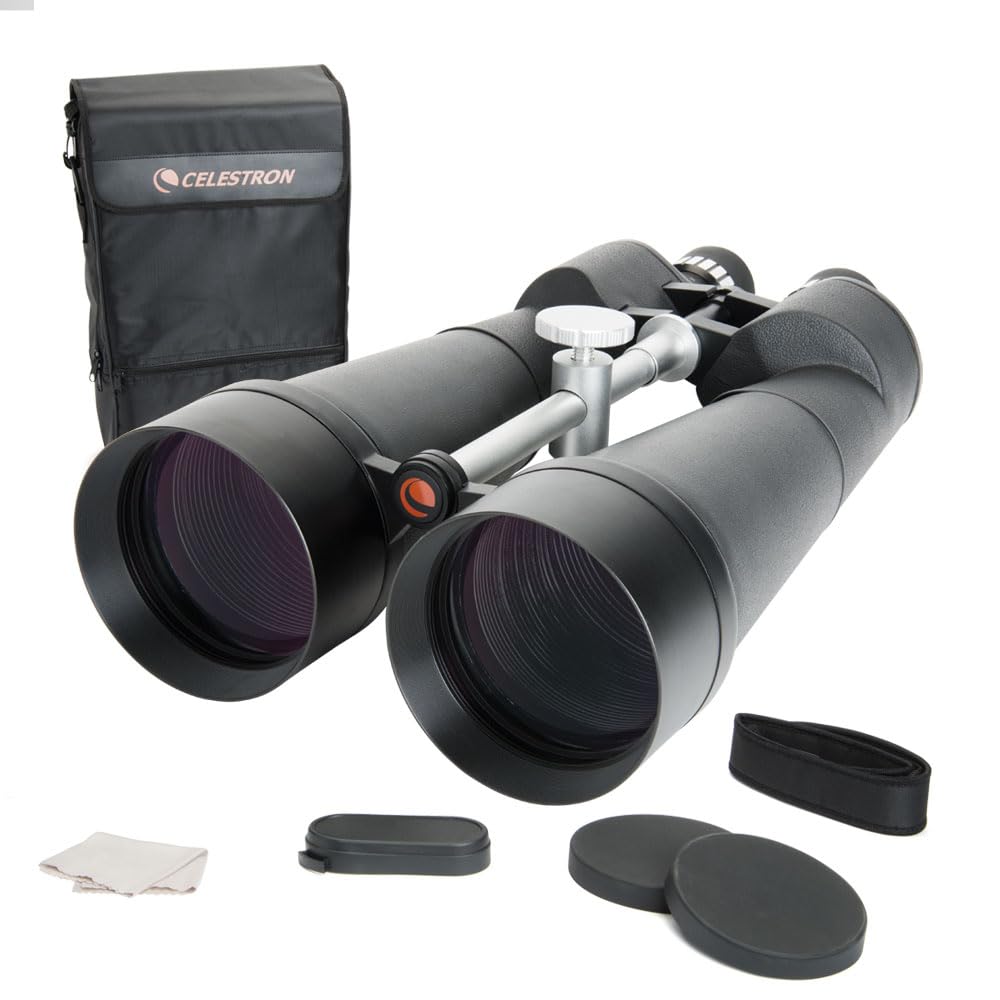
The giant 100mm light bucket that turns the night sky into a map.
This is the largest tripod-mounted binocular on the list, and it exists for one purpose: deep-sky astronomy. With massive 100mm objective lenses and 25x magnification, it reveals galaxies, nebulae, and constellations in stunning detail. Owners mention seeing 100mm views that show roughly 80 stars where the naked eye sees just three, making it a legitimate deep-space tool for hobbyists.
The BaK-4 prisms boost light throughput to your eye, delivering brighter, more detailed images in dim conditions near dawn and dusk. A built-in quarter-inch-20 adapter mounts to most photo tripods in seconds, though the included recommendation is a firm one: this is far too heavy for handheld use, and owners consistently describe it as super bulky.
The honest reality is that optical quality gets mixed feedback across the review base. While many praise the excellent views, some report double images and alignment issues that point to a QC lottery. The individual eye focus is preferred by many for astronomy. This is a niche, heavy tool best suited to a patient hobbyist with a sturdy tripod and realistic expectations about quality control at this scale.
Why it thrills
- 100mm objectives gather enormous light for deep-space objects
- 25x magnification reveals detail beyond any handheld glass
- BaK-4 prisms boost brightness to your eye
The heavy truth
- Extremely heavy — mandatory sturdy tripod, not included
- Quality control on alignment and collimation is inconsistent
- Individual focus requires fiddling on both barrels
For: the dedicated stargazer with a solid tripod who wants the most light grasp for the money.
Avoid if: you plan any handheld use or want a grab-and-go experience — this demands a permanent mount setup.
8. ZEISS Terra ED 10×42
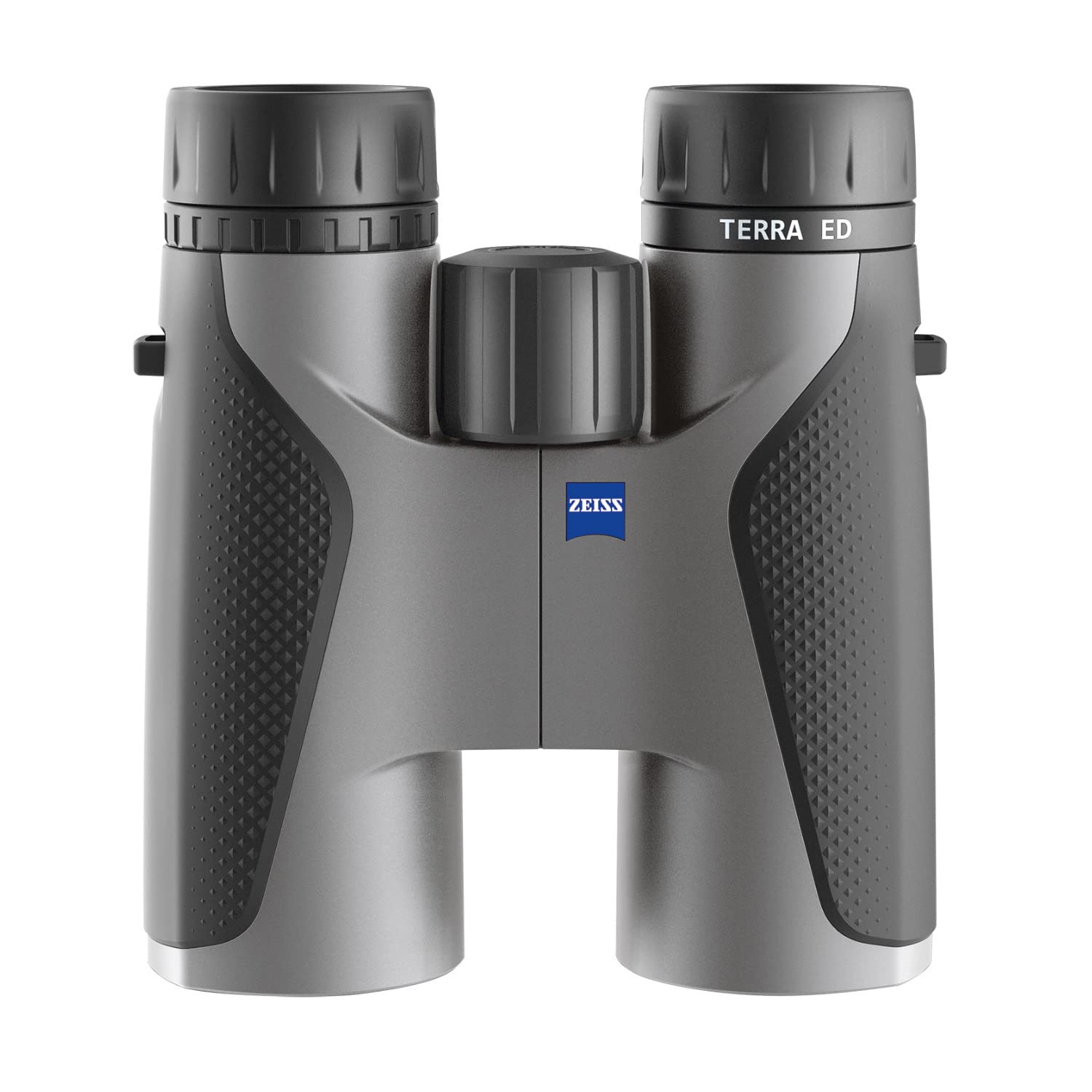
German-engineered glass that delivers 88% light transmission in a compact, fast-focusing body.
This is the gatekeeper to the premium tier, and it earns its reputation. The Schmidt-Pechan ED glass with a hydrophobic multi-coating achieves 88% light transmission, delivering exceptional clarity and precision in all conditions. The ZEISS anti-reflective coating guarantees brilliant, high-contrast images, particularly in adverse light and twilight. Owners call the clarity “amazing” and note the outstanding depth of field separation.
The large, easy-grip focus wheel sits so your index finger naturally lands on it, ready for sudden action. A waterproof, fiberglass-reinforced casing makes it sturdy enough for any bag and nearly indestructible in the field. With 18mm of eye relief (the distance from the lens to your eye), eyeglass wearers get a comfortable, full field of view.
Owners praise its lightweight feel and perfect grip, calling it a great mid-level upgrade. The 330-foot field of view and fast focus make it ideal for bird photography and hunting alike. The only real complaint is that the neck strap does not fit neatly into the case. For a premium compact that disappears into your kit but delivers flagship-level glass, this is the one.
Optical brilliance: the hydrophobic coating sheds water for clear views in wet weather, while the ED glass kills color fringing.
Worth it for: anyone who wants that last 10% of optical purity and a compact body that rides in any bag.
Not necessary if: you are happy with the PROSTAFF P3’s clarity — the ZEISS edge is real but incremental.
9. Canon 12×36 IS III

The 12x that holds steady in your bare hands, no tripod required.
This is the solution to the oldest problem in binoculars: hand shake. Canon’s Image Stabilization technology — borrowed from its EF camera lenses — steadies the view so dramatically that owners describe it as looking through a tripod while holding the unit freely. At 12x magnification, that stabilization is transformative, revealing fine details like a bird’s leg or an airline logo that would otherwise be a trembling blur.
The 36mm objective lenses gather enough light for clear, bright images, and the Porro II prisms minimize light loss. A doublet field-flattener provides sharp, virtually distortion-free images edge-to-edge. Long eye relief of 14.5mm helps ensure comfort, especially for those with glasses.
The trade-off is the mechanics. The stabilization button must be held continuously — there is no lock — which some owners find annoying on long glassing sessions. There are no tethered objective caps, so consider aftermarket ones. Battery consumption is improved, and customers note great battery life. For astronomy and birdwatching where handheld stability matters most, this is a genuinely different tool.
The magic
- Image stabilization delivers tripod-steady views in hand
- 12x magnification with sharp, distortion-free optics
- Lightweight and compact for an IS model
- Porro II prisms minimize light loss
The friction
- Must hold the IS button continuously — no lock
- No tethered objective lens caps included
- 36mm objective limits low-light brightness vs 42mm models
Choose this if: you want 12x reach without the burden of a tripod, especially for astronomy and distant birding.
Pass if: the continuous button press would annoy you, or you demand maximum twilight brightness from a 42mm objective.
Understanding the Specs
Magnification vs. Objective Lens
The first number (10x, 12x, 20x) tells you how many times closer an object appears. The second number (42mm, 50mm, 80mm) is the diameter of the front lens in millimeters. A larger objective gathers more light, which directly translates to brighter images in low-light conditions. The trade-off is size and weight — bigger lenses mean a bulkier, heavier binocular that is harder to hold steady.
Eye Relief and Exit Pupil
Eye relief is the distance in millimeters between your eye and the eyepiece where you can still see the full image. Longer eye relief (16mm or more) is essential if you wear glasses. The exit pupil is the beam of light that exits the eyepiece, calculated by dividing the objective size by the magnification. A larger exit pupil, like 4.2mm, means a brighter image that is more forgiving in dim conditions.
FAQ
What does 10×42 mean on a binocular?
Is 8x or 10x better for birdwatching?
Do I need a tripod for high-magnification binoculars?
What is eye relief and why does it matter for glasses wearers?
What is the difference between roof prism and porro prism binoculars?
How long do binoculars last with regular use?
Can I use high-magnification binoculars for stargazing?
What does waterproof and fogproof actually mean?
What is a fully multi-coated lens?
What is the best all-around magnification for general use?
Final Thoughts: The Verdict
If you want one dependable pick, the best binoculars pick is the Vortex Viper HD 12×50 because it pairs high magnification with genuine low-light clarity and a lifetime warranty. If you want the best value for a first serious pair, grab the Nikon PROSTAFF P3 10×42. And for the ultimate handheld reach without a tripod, the Canon 12×36 IS III is the one to reach for.
How We Picked
We do not accept paid placement. Every pick is matched to a real buyer and a real use-case; we do not hands-on test units.
Sources & Methodology
Specifications: manufacturer listings and product documentation. Review insights: verified customer reviews, as of August 2026. Pricing: not shown on this page (it changes often); check the current price via the retailer link.
As an Amazon Associate, Gadgets Feed earns from qualifying purchases. This does not affect which products we feature.