
When the condenser fan seizes in the middle of a heatwave, every minute of downtime feels like an eternity. Replacing that motor isn’t just about restoring cold air — it’s about matching horsepower, speed, rotation, frame size, and bearing type to your specific outdoor unit. Get it wrong, and the compressor overheats or the whole system short-cycles.
I’m Min — the co-founder and writer behind Gadgets Feed. I spend my days cross-referencing OEM specs against aftermarket replacements and analyzing customer longevity data to find the exact motor that keeps a 3.5-ton unit running efficiently through a July peak.
Whether you’re a weekend DIYer or a seasoned HVAC tech, matching the right frame, shaft diameter, and capacitor value is non-negotiable. This guide ranks the top seven replacements on the market today, all evaluated on fit, durability, and real-world performance, to help you choose the best ac condenser fan motor for your repair.
How To Choose The Best Condenser Fan Motor
Replacing a condenser fan motor is more nuanced than matching a part number. You need to verify horsepower, RPM, voltage, frame dimensions, shaft size, rotation direction, and bearing type against the original motor’s nameplate. The wrong combination can overload the capacitor, overheat the windings, or leave the fan blade at the wrong height inside the shroud.
Horsepower and RPM: The Torque Match
Most residential condensers use 1/4 HP or 1/3 HP motors spinning at 1075 RPM. A 1/5 HP motor will spin the blade but may lack the torque to push air through a dirty coil during peak load. Conversely, a 1/2 HP motor on a small unit moves too much air, causing the head pressure to drop and the compressor to short-cycle. Always match the OEM horsepower exactly — one step up or down changes the system’s pressure balance.
Frame Size, Shaft Diameter, and Mounting Holes
Condenser motors typically use a 48- or 56-frame. The 48Y frame has a 5-5/8-inch body diameter and a 1/2-inch shaft, while the 56-frame is slightly larger. Measure the centre-to-centre distance of mounting holes on the existing studs; a mismatch means drilling new holes or using a universal base. Extra-long shafts can be cut with a hacksaw, but a shaft that’s too short won’t engage the fan blade hub.
Sleeve Bearings vs Ball Bearings
Sleeve bearings are quiet and cheap but wear faster in hot, dusty environments. Ball bearings handle higher ambient temperatures (up to 70°C) and last years longer, especially on units mounted on dark roofs with no shade. The trade-off is slightly higher noise at startup. For a unit that sits on the ground in a mild climate, sleeve bearings are fine. For a rooftop or a unit exposed to direct afternoon sun, ball bearings are worth the extra cost.
Quick Comparison
On smaller screens, swipe sideways to see the full table.
| Model | Category | Best For | Key Spec | Amazon |
|---|---|---|---|---|
| A.O. Smith ORM5458 | Premium | Reliable long-term replacement | 1/3-1/6 HP, 1075 RPM, 2A | Amazon |
| MARS 10728 | Premium | USA-made quality | 1/4 HP, 1075 RPM, 1.8A | Amazon |
| Fasco D7909 | Premium | Ball bearing for hot conditions | 1/4 HP, 1075 RPM, 1.8A | Amazon |
| OEM Carrier 5KCP39BGS069S | Mid-Range | Direct fit for Carrier/Payne | 1/10 HP, 1100 RPM, 0.75A | Amazon |
| VEVOR 1/4 HP | Mid-Range | Budget-friendly with capacitor | 1/4 HP, 1100 RPM, 1.4A | Amazon |
| VEVOR 1/5 HP | Budget | Entry-level replacement | 1/5 HP, 1075 RPM, 1.3A | Amazon |
| Century GF2054 | Budget | Blower motor, not condenser | 1/2 HP, 1725 RPM, 7.2A | Amazon |
In‑Depth Reviews
1. A.O. Smith ORM5458

The A.O. Smith ORM5458 is the gold standard for contractors who need a motor that fits a wide range of units. Its dual horsepower rating (1/3 to 1/6 HP) gives you flexibility when the OEM spec is ambiguous, and the 1075 RPM speed matches the vast majority of residential condensers. The 48Y frame with a 1/2-inch shaft drops into Carrier, Trane, Lennox, and Goodman units with minimal modifications.
Installation feedback consistently praises the copper windings and the inclusion of both clockwise and counterclockwise wiring diagrams on the label. Several users noted the shaft required shortening by about 2 inches, which is standard for a universal replacement, and that the mounting holes aligned perfectly with factory studs. The sleeve bearings operate quietly and have held up well in moderate climates.
The only recurring note is that the motor does not include a capacitor — you need a POC7.5 or equivalent 7.5 µF run capacitor, sold separately. Also, the through bolts on some mounts require grinding down the backs. For a motor that consistently delivers trouble-free operation past the two-year mark, this is the closest you’ll get to a drop-in OEM experience without paying dealership prices.
Why it’s great
- Dual HP rating adds compatibility across multiple brands
- Verified long-term reliability beyond 24 months
- Easy wiring with diagram printed on the label
Good to know
- Capacitor not included (requires POC7.5 or 7.5 µF)
- Shaft may need cutting to fit shorter hubs
- Through bolts may require grinding on some mounts
2. MARS 10728

The MARS 10728 is manufactured in the United States, and the build quality reflects that — the windings are well potted, the casing has a thick powder-coat finish, and the reversible rotation feature works by simply swapping two wires. It replaces the old GE/Genteq 3905 models seamlessly and is often cited as a higher-quality alternative to the OEM Carrier HC39GE237 motor.
Users report that the 1075 RPM speed runs slightly faster than some original motors (about 1110 RPM measured on a tach) but that the extra 30-40 RPM does not affect head pressure enough to cause concern. The extra-long shaft is a welcome feature, allowing you to position the fan blade exactly where it needs to sit. The wiring is straightforward: yellow to contactor, black to common, brown to the fan terminal on the dual run capacitor.
The only downside is the wire exit location — it sits at a 45-degree angle from the typical 3 o’clock position, which may require bending the conduit a bit. Also, the supplied hardware includes mounting bolts that are slightly smaller than the original 10-32 thread on some units. If you’re looking for a motor that will outlast the condenser itself, the MARS 10728 is a strong contender.
Why it’s great
- USA-made with excellent winding protection
- Extra-long shaft allows custom fan blade placement
- Reversible rotation via simple wire swap
Good to know
- Wire exit at 45 degrees may require raceway adjustment
- Mounting bolts smaller than OEM 10-32 on some units
- Slightly higher RPM than spec
3. Fasco D7909
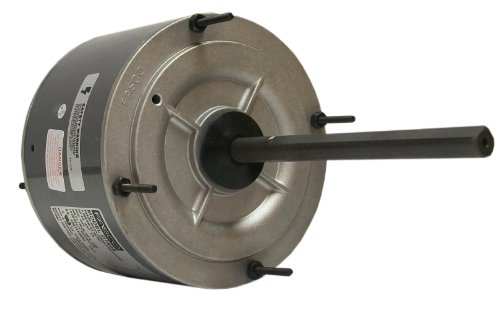
The Fasco D7909 stands apart because it uses ball bearings instead of the sleeve bearings found on most budget and mid-range motors. Ball bearings handle higher ambient temperatures and are the correct choice for condensers mounted on black tar roofs or in direct afternoon sun. The 5.6-inch body diameter fits snugly into the mounting band, and the reversible rotation allows it to work on both Carrier-style and Trane-style systems.
Several users measured a power consumption drop from 4.3 kWh to 3.4 kWh after replacing their old GE motor with this one, likely due to the more efficient windings and lower friction bearings. The 1/4 HP output at 1075 RPM is the standard for residential 3- to 5-ton units. The shaft is slightly longer than some competitors, giving you room to position the fan blade properly.
The main complaint is the wire length — at roughly 24 inches, they are about a foot shorter than most installers would prefer. This often requires splicing in an extension or repositioning the wiring harness. Also, the motor runs with a slightly audible hum compared to sleeve-bearing motors, though it is still quieter than the condenser’s compressor. Verified reports of running for 2.5 years and beyond make this a durable choice.
Why it’s great
- Ball bearings last longer in hot rooftop conditions
- Lower power draw measured in real-world installs
- Long shaft allows precise fan blade adjustment
Good to know
- Wires are short (~24 in) and often need extension
- Runs slightly louder than sleeve-bearing motors
- Separate capacitor purchase required for 4-wire setup
4. Regal Beloit OEM Carrier 5KCP39BGS069S
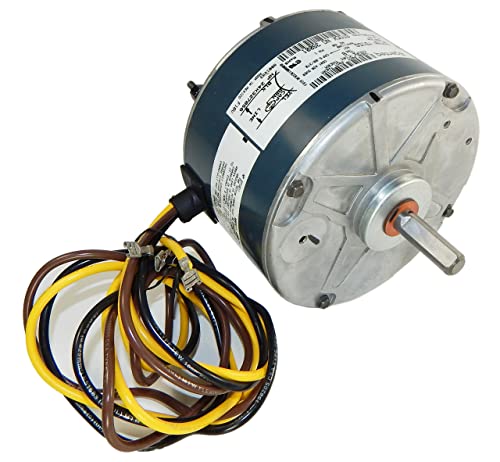
This is the actual OEM replacement motor for Carrier and Payne condenser units, manufactured by Regal Beloit. It is a 1/10 HP motor spinning at 1100 RPM with a fixed counterclockwise rotation (CCWSE). The 5-5/8-inch body diameter and 1/2-inch shaft are the exact dimensions used in Carrier residential units, so it drops in without any modification to the mounting bracket.
The 0.75-amp draw is very low, which makes this motor a good match for older Carrier units where the contactor and capacitor are already undersized. The sleeve bearings are designed for an ambient temperature of 40°C, which is adequate for shaded ground-level installations. Users report installation times under 30 minutes, including pulling the old motor and wiring the four colour-coded leads.
The shaft is 1.5 inches long — shorter than most universal replacements — so it won’t work if your fan blade hub is thicker than that. Also, the motor does not include a capacitor; you need the original 5 µF run capacitor from the existing unit. For a no-headache, direct-fit replacement on a Carrier, this is the one to buy. Just verify your model number matches the 5KCP39BGS069S pattern.
Why it’s great
- Exact OEM fit for Carrier and Payne condensers
- Very low amp draw preserves existing contactor
- Fast installation under 30 minutes
Good to know
- Shaft length only 1.5 inches — not universal
- Capacitor not included
- 40°C ambient limit — not for hot roofs
5. VEVOR 1/4 HP Upgraded Condenser Fan Motor

The VEVOR 1/4 HP motor delivers solid mid-range performance at a price that undercuts most branded competitors by a significant margin. It replaces the common Genteq 3905, Carrier HC39GE237, and Dayton 6DLL0 models. The 1.4-amp draw is slightly lower than the MARS 1.8-amp rating, which means less thermal stress on the wiring and contactor.
The 47-inch extra-long wire is a standout feature — it gives you the freedom to route the harness exactly where you need it without splicing. The included CBB65 5 µF explosion-proof capacitor saves you a second purchase. The reversible rotation works via an auto-overload protection mechanism that simply needs the correct wire pair to be swapped.
Some users reported that the mounting bolts are smaller (8-32 instead of 10-32) and that the motor lacks weep holes on the shaft side, which could trap condensation over time. A few experienced thermal protection tripping after 10 months in continuous use. For a repair that needs to last two to three years before the whole unit is replaced, this is a fantastic value. For a 10-year system, you may want to spend more on the A.O. Smith or MARS.
Why it’s great
- 47-inch wire eliminates the need for splicing
- Capacitor included in the box
- Very competitive price for the HP
Good to know
- No weep holes — condensation may be trapped
- Mounting bolts smaller than OEM standard
- Long-term thermal protection concern reported
6. VEVOR 1/5 HP Upgraded Condenser Fan Motor

The 1/5 HP VEVOR is an entry-level replacement designed for older condensers where investing in a premium motor doesn’t make financial sense. It replaces the Emerson K55HXJKL-2918 and GE 51-23055-11 models. The 1.3-amp draw at 208-230V makes it suitable for standard split-system condensers up to about 3.5 tons.
The included 5 µF capacitor is the same standard value used on most single-speed condensers, and the 47-inch wire length again solves the common problem of short leads. The motor is reversible and comes with overload protection set at 60°C ambient. Users who needed a cheap fix for a seized motor reported it ran quietly and was a drop-in replacement.
On the downside, the 1/5 HP rating is at the low end of the torque curve. On a heavily clogged coil or a unit with a larger fan blade, the motor may struggle to maintain full air velocity. One verified review noted that after 10 months, the motor’s thermal protection would trip during extended runtime in the hottest part of the day. For a temporary fix or a low-cost rental property repair, this motor does the job.
Why it’s great
- Lowest-cost option in the guide
- Capacitor and long wire included
- Quiet operation at the correct RPM
Good to know
- May lack torque for dirty coils or large blades
- Thermal protection reported to trip in extended heat
- Not suitable as a permanent long-term replacement
7. Century GF2054 (Blower Motor — Not a Condenser Fit)
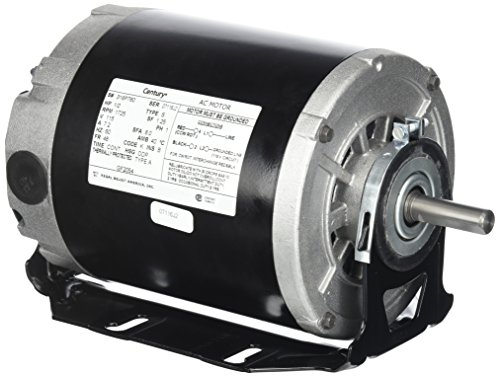
This Century GF2054 is not a condenser fan motor — it is a 1/2 HP, 1725 RPM resilient-base split-phase blower motor designed for furnace fans, belt-drive applications, and whole-house attic ventilators. The 48/56 frame, 1/2-inch shaft, and 7.2-amp draw are all wrong for a condenser application. Including it here serves as a critical warning: do not buy this motor for your condenser.
The 1725 RPM is far too fast for a condenser fan blade. Running a condenser blade at that speed would cause catastrophic air over the coil, likely popping the contactor and potentially vibrating the fan blade apart. The open drip-proof (ODP) enclosure is also unsuitable for outdoor exposure — it would allow moisture into the windings.
If you are replacing a furnace blower motor, this unit works well and is a direct replacement for the original A.O. Smith 323P948. For a condenser fan, you need a motor running at 1075 or 1100 RPM with a totally enclosed air-over (TEAO) rating. Double-check your application before ordering.
Why it’s great
- Strong 1/2 HP for belt-drive furnace blowers
- Reversible rotation for correct air direction
- Automatic overload protection
Good to know
- Not designed for condenser use — wrong RPM and enclosure
- Shaft height and frame may not fit condenser bracket
- One user reported thermal switch failure at 2 months
FAQ
Can I use a 1/3 HP motor to replace a 1/4 HP condenser fan motor?
Do I need to replace the capacitor when I replace the condenser fan motor?
Final Thoughts: The Verdict
For most users, the best ac condenser fan motor winner is the A.O. Smith ORM5458 because it offers the best blend of compatibility, proven longevity, and quiet operation — it fits 90 percent of residential condensers with minimal modification. If you need ball bearings for a hot rooftop install, grab the Fasco D7909. And for a budget-minded repair on an aging unit, the VEVOR 1/4 HP delivers surprising value with the capacitor and long wires included.