
Our readers keep the lights on and my morning glass full of iced black tea. As an Amazon Associate, I earn from qualifying purchases.
Specs are compiled from manufacturer listings and verified buyer reviews and can change over time — please confirm the key details on the product page before buying.
When you shop for a breathing exerciser, you are likely dealing with one of two problems: you want to cough up stubborn mucus when congested, or you want stronger lungs for sports, singing, or daily energy. The market splits into two camps — flutter-valve devices that vibrate mucus loose, and resistance trainers that work your breathing muscles like a gym for your diaphragm. Knowing which camp fits you is the key decision, and this guide covers the best of both.
I’m Min — the founder and writer behind Gadgets Feed. This guide is built by comparing the manufacturers’ published specifications and the patterns across verified customer reviews, so you get each pick’s real strengths and trade-offs instead of marketing spin.
if you need mucus clearance or athletic endurance, the right breathing exerciser turns a few minutes of daily effort into noticeably easier breathing and stronger lungs over several weeks.
Our Picks at a Glance


How To Choose The Best Breathing Exerciser
Breathing exercisers are not one-size-fits-all gadgets. The right choice depends entirely on your goal: clearing mucus from a cold, bronchitis, or a chronic condition like COPD, versus building respiratory strength for athletics, singing, or general fitness. Matching the device’s mechanism to your goal is the whole game.
Flutter Valve Versus Resistance Training
A flutter-valve device creates a vibrating positive pressure as you exhale, which helps loosen sticky mucus sitting in your airways so you can cough it out more easily. A resistance trainer, by contrast, makes your breathing muscles work harder — like lifting a weight with your diaphragm — which builds strength and endurance over weeks of consistent use. Some buyers with congestion benefit from both approaches at different times.
Why Adjustable Resistance Is a Must-Have
Almost every serious exerciser on this list offers some way to change the effort level, and that is not an accident. You want to start easy and gradually increase the load as your lungs get stronger; a fixed-resistance device caps your progress. Look for steel balls of different sizes, a pressure knob, or numbered resistance settings — the more granular the adjustment, the smoother your progression curve.
Cleaning and Material Matters More Than You Think
You will be breathing through this device daily, so it must come apart for proper cleaning. Medical-grade or food-grade materials resist wear and are safe for regular washing. A transparent design helps you track the flutter ball’s movement, which is both encouraging and useful for confirming you are using it correctly.
Quick Comparison
| Model | Best For | Mechanism | Resistance | Weight | Amazon |
|---|---|---|---|---|---|
| Flutter Valve (NebuAksol)★ Best Overall | Mucus clearance & lung strength | Flutter valve | 3 steel balls | 5.61 oz | Amazon |
| MILLSTEPSBest Value | Budget mucus relief | Flutter valve | 16/18/20 mm balls | 5.61 oz | Amazon |
| Nemstar CompactAthlete Pick | Athletes & runners | Air resistance | Adjustable knob | 14.2 g | Amazon |
| Virth Mucus Relief | Daily lung cleanse routine | OPEP oscillation | Positive pressure | 2.4 oz | Amazon |
| Expand-A-Lung (3 Pack) | Inhale & exhale training | Dual-way airflow | Single knob | 0.22 kg | Amazon |
| TRAININGMASK 2.0 | Simulated altitude workouts | Flux valve mask | 36 levels | Medium | Amazon |
| The Breather Pink | Gentle all-levels training | Resistance tube | 6 levels | 0.1 kg | Amazon |
| The Breather Voice | Singers & vocalists | Dual-direction resistance | Adjustable | — | Amazon |
| POWERbreathe Medium | Clinically-minded athletes | Inspiratory resistance | Fixed (1 level) | 200 g | Amazon |
In‑Depth Reviews
1. Flutter Valve Breathing Exercise Device (NebuAksol)
Our pick — over 4.5★ from 250+ verified ratings; the strongest balance of quality and price.
The mucus-busting flutter valve that owners credit with easing bronchitis and clearing sticky congestion.
The defining feature here is the trio of differently-sized steel balls that let you dial in your own exhalation effort, so a beginner can start gentle and a seasoned user can push harder. The vibration the flutter valve sends into your throat is exactly what loosens stubborn lung mucus, and the transparent, shatter-resistant medical-grade PC body lets you watch the ball work. No batteries, no refills — just a compact unit that slips into a carry-on for travel.
Effectiveness is the thing owners rave about most, and the stories back it up: a 7 a.m. session has been described as loosening sticky congestion on the very first use at level 5, with some crediting it with preventing bronchitis from taking hold. It is consistently described as easy to use and easy to clean, which matters because daily mucus clearance only works if you actually keep up the routine. Several owner accounts mention doctor recommendations, adding confidence for a medical-adjacent purchase.
The honest caveat is that it takes some adjustment when you first start — you have to find your rhythm and your resistance level before it clicks. And at 4 x 2.5 x 3.66 inches with a 5.61-ounce weight, it is a bit bulkier than the pocket-sized MILLSTEPS at 3.14 x 2.36 x 3.93 inches, so it is more of a carry-on companion than a keychain buddy.
What Wins People Over
- Three steel balls give real progression for lung training
- Medical-grade PC stands up to regular cleaning
- Compact enough for home, work, or travel
What To Know
- Initial session needs a short learning curve
- Slightly larger footprint than slimmer rivals
Reach for this if: you want the most trusted balance of mucus clearance and lung strengthening, backed by a crowd of positive owner experiences.
Look elsewhere if: you need something truly pocket-sized and do not mind a shorter track record — the MILLSTEPS is more compact.
2. MILLSTEPS Breathing Exercise Device
A pocket-sized flutter valve that clears stubborn phlegm in just a few breaths, at a friendly entry price.
What makes this one special is the quick-start simplicity combined with real results — buyers report coughing up stubborn phlegm within 3-4 breaths, often using the small ball for the gentlest start. The 16/18/20 mm steel balls give you the same kind of adjustable resistance as pricier rivals, with the larger balls producing a stronger vibration for when you want more work. It is the kind of compact device that disappears into a pocket, which matches the mixed-verdict note that breathability takes some getting used to.
The applications are unusually wide for the price tier: it suits not just people with breathing concerns but also smokers, athletes, swimmers, deep-sea divers, singers, and brass musicians. The recommended routine is a manageable 5-10 minutes, twice daily, with the noted caveat that consistent use over several weeks is what drives noticeable improvement. A pulmonologist-recommended mention in the reviews adds credibility for COPD or post-illness congestion relief.
The most-discussed trade-off is breathability — some owners find the airflow resistance surprising at first, so easing in with the small ball is the smart move. Its 3.14 x 2.36 x 3.93-inch frame makes it the more travel-friendly choice next to the bulkier NebuAksol, though the NebuAksol edges ahead on overall owner enthusiasm.
Best value pick: it delivers flutter-valve mucus clearance and adjustable resistance at a budget-friendly price, with a surprisingly broad user base from COPD patients to athletes.
The fixture note: expect a short adaptation period as you find the right ball size and exhalation rhythm for your lungs.
3. Nemstar Compact Breathing Exercise Device
The featherweight trainer that doubles as an ab toner for athletes chasing endurance gains.
Weighing just 14.2 grams, this is the lightest device in the lineup by a wide margin, and it is built around a completely different goal than the flutter valves above: strengthening respiratory muscles for athletic performance rather than clearing mucus. The adjustable pressure knob lets you find a resistance level that suits you and gradually increase it as you progress, which is exactly the progression serious runners and fitness enthusiasts want. Owners describe it as inducing a meditative, relaxed state while deepening breath control.
The dual-purpose pitch is real — it trains your breathing muscles and tones your core simultaneously, which explains why it shows up in Bas Rutten exercise routines. The consensus is that it works well for improving breathing depth and capacity, with a harder exhale feel than some pricier O2 trainers. A common tip for first-timers: expand your lungs fully before starting, begin with full airflow, and inhale deeply through the mouth while exhaling through the nose to avoid an initial drowning sensation.
The recurring gripe is the adjustment valve — owners note it lacks fine-grained control and there is no scale to mark repeatable settings, so tracking your progress is guesswork. Tighten the unit fully before taking it apart to clean, or you risk bending the screw. As a -class intro breather for athletes, it beats the Expand-A-Lung on portability but falls short on adjustment precision.
Why Athletes Like It
- 14.2 g weight disappears in a pocket or gym bag
- Air-resistance knob scales from easy to challenging
- Trains core and breathing muscles in one session
The Shortfalls
- No resistance scale for tracking progress
- Requires careful tightening before disassembly
Best for: runners and fitness fans who want a featherweight trainer with adjustable effort and do not need mucus clearance.
Not for: congestion relief — this device strengthens muscles, it will not vibrate mucus loose.
4. Mucus Relief Device by Virth

A positive-pressure oscillator that some owners find shockingly effective on the first or second breath.
This one leans on OPEP technology — a therapy that applies resistance to your exhalation at the mouth while airway vibrations travel upstream to free mucus from the airway walls. The result, per owner reports, is often immediate: a satisfying vibration followed by coughing up phlegm, sometimes described as working on the very first breath. The easy 3-piece design with a twist-off cap makes cleaning straightforward, and at 2.4 ounces it is the lightest mucus-focused option here after the Nemstar.
the balance for this device is consistency — it is built for regular users who commit to 5-10 minutes once or twice a day, and it needs no batteries or refills, just your breath. Some owners with asthma found it a cheaper alternative to pricier oscillating devices, though the first session can be ineffective until you learn the extended-exhale technique that produces the best results. One honest account noted that it did not work for them at all, so individual results genuinely vary here.
The most-discussed trade-off is value: while some owners consider it worth the money, others feel it is not worth the price tag. The learning curve also deserves respect — the second session is often when the intense coughing that expels large phlegm lumps kicks in, so patient practice is required, not just a single casual try.
Comfort-designed: the oscillation feels like a throat massage rather than forced effort, and the 3-piece build cleans up in seconds.
The honest catches: results depend heavily on learning the right exhale rhythm, and value opinions split down the middle among owners.
5. Expand-A-Lung (3 Pack)
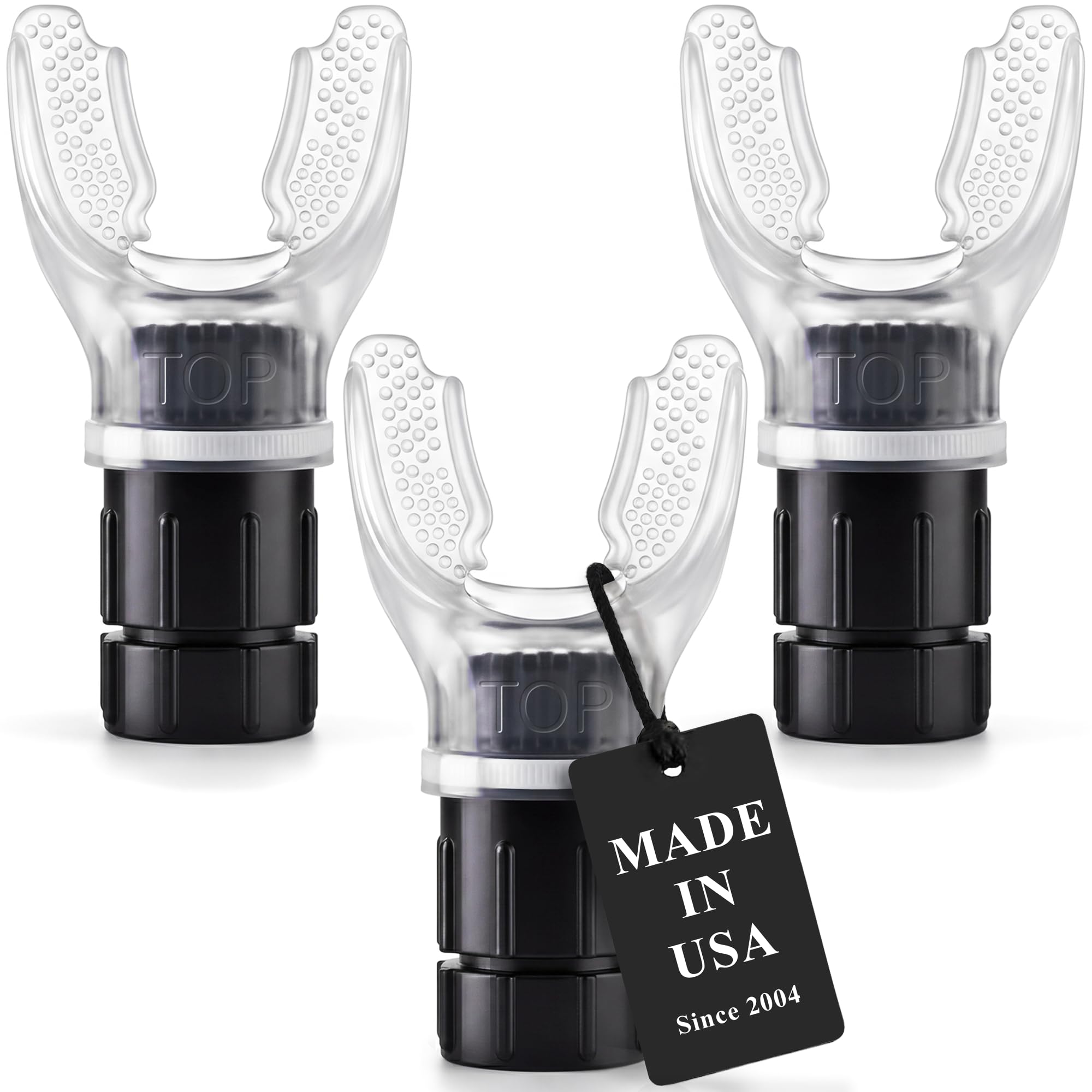
A USA-made dual-way trainer that works on both inhale and exhale, with a food-grade silicone mouthpiece.
The standout trait here is that it trains both directions of your breath — most trainers only resist one way, but Expand-A-Lung works on inhale and exhale, which owners say strengthens weak expiratory muscle control and improves deep breathing within a couple of weeks. At just 4 inches long, it is built for a gym bag or pocket, and the soft food-grade silicone mouthpiece is comfortable and rust-proof. The 3-pack makes it a natural choice for a household of athletes, singers, or wellness-minded family members.
The resistance knob offers a wide range from very light for beginners up to challenging levels for advanced endurance work, all without batteries. Owner outcomes include a former asthmatic eliminating wheezing and an older user measuring real improvement with a volumetric exerciser and oximeter. The recommended routine is 2-4 sets of 10-15 reps daily, with noticeable endurance differences typically showing within 2-4 weeks.
The recurring criticism is the adjustment mechanism — owners mention the bottom knob feels like it only has two distinct levels despite claims of more, and there are no clear instructions on resistance settings. You also need to seal your nose against air escape while using it, which takes practice to master. Compared to the Nemstar above, it offers the dual-way training edge but is bulkier and less precise in its adjustments.
The Versatility Edge
- Dual-way inhale and exhale resistance training
- Food-grade silicone mouthpiece is comfortable and rust-proof
- 3-pack covers a whole family
The Limits
- Knob feels like only two resistance levels in practice
- No instruction scale for repeatable settings
Choose this if: you want a full inhale-and-exhale workout and like having spares to share or rotate through the week.
skip it if: you need finely graduated resistance settings — the knob resolution here will frustrate you.
6. TRAININGMASK Elevation 2.0

A face mask that simulates elevation training with 36 on-the-fly resistance levels for brutal workouts.
This is the only wearable on the list — instead of a handheld tube, you strap on a silicone mask that restricts airflow to mimic high-altitude training, making your breathing muscles work harder during normal exercise. The 36 adjustable resistance levels are dialed in on the fly, so you can start easy during warm-up and crank it up for intervals. Owners call it an “effective multiplier of misery” — the kind of product that makes a hard workout feel far harder, which is precisely the point for conditioning.
The patented flux valve technology, backed by clinical studies on oxygen uptake and cardiovascular fitness, gives it a credibility edge over simpler trainers. One owner who has tried several masks over two years calls this one the best, citing the snug fit and true oxygen deprivation during training. The hook-and-loop closure keeps it secure, and the included 2.0 Turn Flow valves let you swap resistance settings mid-session.
The honest drawbacks center on fit and comfort, both rated mixed by owners. The mask presses on the bridge of the nose, which most adapt to but some find distracting, and bearded users hit real limitations with sealing. It is not for swimming, as one owner bluntly noted, and the medium size means larger or smaller faces should measure carefully before buying.
Why It Stands Out
- 36 adjustable resistance levels for progressive overload
- Wearable design trains lungs during real workouts
- Flux valve tech backed by clinical studies
The Trade-Offs
- Pressure on the nose bridge bothers some owners
- Beards compromise the seal significantly
Choose this if: you want to add breath resistance to your actual running, cycling, or gym sessions rather than doing separate breathing drills.
Look elsewhere if: you have a beard, a very large or small face, or you want a device for mucus clearance rather than athletic conditioning.
7. The Breather Pink

A gentle resistance trainer with 6 levels and a guided app that makes lung training feel easy.
This is the device for people who found other trainers too intimidating — The Breather Pink is aggressively beginner-friendly, with a simple inhale-and-exhale motion and six resistance levels that let you start comfortable and climb as your lungs strengthen. The packaged guided mobile app is the differentiator, offering structured sessions that owners say pair well even with speech therapy. It is featherlight at 0.1 kg, so carrying it in a bag is a non-issue, and the recommended 5-minute sessions twice daily are easy to slot into a routine.
Owner results include noticeably smoother breathing within weeks, with independent control over inhale and exhale resistance being a quiet strength. It suits all ages and fitness levels, which makes it a reasonable pick for someone easing back into lung health after illness. The positive consensus centers on how steadily it builds breathing strength without demanding heavy effort.
The value debate is real — some owners consider it overpriced for what it is, particularly since no storage container is included. One caution worth noting: cleaning with alcohol wipes may shorten the lifespan, so gentle washing is the safer routine. Compared to the Expand-A-Lung, it offers more resistance levels and app guidance but costs considerably more and lacks the multi-pack value.
Easiest entry point: six resistance levels plus guided app sessions remove the guesswork that stalls beginners.
The catch: you pay a premium for the simplicity and should budget for a separate storage case to protect it.
8. The Breather Voice

A vocal-focused trainer that strengthens diaphragm control for sustained high notes and smoother phrasing.
Singers and vocalists get a purpose-built tool here — The Breather Voice targets diaphragm expansion and respiratory muscles to give you stronger breath support for long phrases and controlled pitch. The adjustable resistance works in both inhalation and exhalation, so you can train the full breath cycle the way vocal coaching demands. Within a week of use, customers note breathing more deeply than they had in years, with the deep core engagement being the standout sensation.
The results extend beyond the stage: Reviewers point out a pulmonologist-recommended mention, immediate singing improvement with stopped voice cracking and throat spasms, and a side benefit of curing hiccups. A retired user with a sedentary lifestyle found it effective for improving VO2 max and lung capacity, with better sleep as an unexpected bonus. The 5-minute sessions twice daily fit neatly into a warm-up routine.
The most-discussed flaw is the companion app — it supports iPhones only, which contradicts the broader claims and frustrates Android users. Some owners also note that cheaper alternatives exist for basic breath training, though the vocal-specific design justifies the premium for performers. If you are a singer, this beats the generic Nemstar above purely on targeted breath-control training, not on price.
Built For Performers
- Dual-direction resistance mirrors real breath support needs
- Shoppers say stronger sustained notes and fewer voice cracks
- Effective for non-singers too, from retirees to voice actors
The Frustrations
- Companion app is iPhone-only despite broader claims
- Premium price with basic alternatives available
Buy this if: you sing, speak professionally, or want deep diaphragm conditioning with adjustable inhale and exhale resistance.
Think twice if: you are on Android and expect the app, or you just want simple mucus clearance rather than vocal performance training.
9. POWERbreathe Medium Resistance

The original inspiratory muscle trainer, recommended by voice therapists and trusted since its clinical debut.
This is the most established name in respiratory training, and it earns its premium reputation through focused inspiratory resistance — you inhale against a calibrated load to strengthen the muscles that pull air in. At 200 grams with a non-slip synthetic rubber body, it feels substantial and durable in the hand. The medium resistance setting suits most users, though the brand offers light and heavy variants for those who need a different starting point.
Voice therapists recommend it for lung strengthening, and a user with exercise limitations noticed a difference after a couple of weeks. One detailed account tracked a 5-week routine of twice-daily sessions that progressed from zero to one setting on medium resistance — roughly a 70% force gain — alongside better asthma medication suction and more jogging endurance. The cleaning routine is simple: boil for 2 minutes, then cool for an hour before reuse.
The most-discussed downsides are construction quality and value, with some owners calling it cheaply made for the price and others noting it lasts years. Resistance is fixed at a single level per unit, so progression means buying a different model rather than dialing up a knob. If you want adjustable resistance in one device, the Nemstar or The Breather Pink are far more flexible — but neither carries the same clinical pedigree for serious inspiratory training.
The Clinical Strengths
- Voice-therapist-recommended inspiratory training
- Non-slip rubber body with easy boil sterilization
- Measurable strength gains documented by owners
The Limitations
- Fixed single resistance level — progression needs a new unit
- Construction quality gets mixed owner feedback
Choose this if: you want the clinically-established inspiratory trainer for lung capacity and have a clear sense of your resistance level.
pass on it if: you want adjustable resistance in one device — you will outgrow this single-level unit and need to buy another.
Understanding the Specs
Flutter Valve vs. Inspiratory Resistance
The flutter valve creates oscillating positive pressure as you exhale, vibrating mucus loose from airway walls. Inspiratory resistance trainers instead load your inhale to build muscle strength. Know which one your goal demands before buying.
Resistance Adjustability
Steel balls of different sizes (16/18/20 mm), pressure knobs, or numbered dials all control effort. More granular adjustment means smoother progression as your lungs strengthen. Fixed-resistance devices cap your long-term gains.
FAQ
How often should I use a breathing exerciser to see results?
Is a flutter valve better than a resistance trainer for mucus?
Can I use a breathing exerciser if I have COPD or asthma?
How do I clean my breathing exerciser safely?
What is the difference between inspiratory and expiratory training?
How long does a breathing exerciser take to show improvement?
Can breathing exercisers help with singing or voice control?
Are more resistance levels always better?
Final Thoughts: The Verdict
For the majority of shoppers, the breathing exerciser winner is the Flutter Valve Device by NebuAksol because it balances proven mucus clearance with adjustable lung strengthening, backed by the strongest owner enthusiasm of the group. If you want a compact, budget-friendly flutter valve for clearing phlegm on the go, the MILLSTEPS delivers at a friendlier price. And for athletic conditioning or vocal performance — two very different needs — the Nemstar and the Breather Voice each target their niche with real precision.
How We Picked
We do not accept paid placement. Every pick is matched to a real buyer and a real use-case; we do not hands-on test units.
Sources & Methodology
Specifications: manufacturer listings and product documentation. Review insights: verified customer reviews, as of August 2026. Pricing: not shown on this page (it changes often); check the current price via the retailer link.
As an Amazon Associate, Gadgets Feed earns from qualifying purchases. This does not affect which products we feature.