
Our readers keep the lights on and my morning glass full of iced black tea. As an Amazon Associate, I earn from qualifying purchases.
Specs are compiled from manufacturer listings and verified buyer reviews and can change over time — please confirm the key details on the product page before buying.
When your student faces algebra, chemistry, or the SAT, you do not need a graphing calculator—a basic scientific model handles the work and saves money. The real choice depends on three things you can feel: how many lines the screen shows, whether solar power matters, and if the buttons survive years of daily homework.
I’m Min — the founder and writer behind Gadgets Feed. This guide is built by comparing the manufacturers’ published specifications and the patterns across verified customer reviews, so you get each pick’s real strengths and trade-offs instead of marketing spin.
The best basic scientific calculator keeps math visible, powers through exam seasons, and never leaves a student squinting at a single cramped line.
Our Picks at a Glance

How To Choose The Best Basic Scientific Calculator
Choosing a basic scientific calculator is less about raw power and more about matching the machine to the classes on the schedule. A middle schooler doing fractions needs something different from a college student grinding through calculus, and knowing that difference saves you money.
Display lines change how you check your work
A one-line display shows only the final answer, which forces you to trust your mental math. A two-line screen shows both your typed entry and the result at the same time, so you can spot a misplaced parenthesis before you write it down. Four-line displays go further, stacking multiple calculations or showing expressions the way they appear in a printed textbook.
Power source decides if you ever get stuck
Solar-powered models keep working in bright classrooms and under desk lamps, but a cloudy room can dim them. A dual-power system adds a small battery backup, so you are covered in both situations. Some units run purely on a battery, which is reliable but means you must remember to replace it every few years.
Quick Comparison
| Model | Best For | Display Lines | Power Source | Weight | Amazon |
|---|---|---|---|---|---|
| TI-30XIIS★ Best Overall | Middle & High School Math | Two-Line | Solar & Battery | 6.2 oz | Amazon |
| Casio fx-260 Solar IIBudget Champion | Budget Exam Prep | Single-Line 10-Digit | Solar & LR-44 Battery | — | Amazon |
| IPEROT 991ES | Advanced Math & Stats | Four-Line | Solar & LR44 Battery | — | Amazon |
| TI-30XS MultiView | Textbook-Style Viewing | Four-Line | Solar & Battery | 5.12 oz | Amazon |
| Casio fx-115ES Plus 2nd Ed | College Calculus & Physics | Four-Line 16-Digit | LR44 Battery | 6.05 oz | Amazon |
In‑Depth Reviews
1. TI-30XIIS Scientific Calculator Texas Instruments, Black
Our pick — over 4.5★ from 50,500+ verified ratings; the strongest balance of quality and price.
The every-classroom workhorse that earns its spot through sheer reliability and SAT approval.
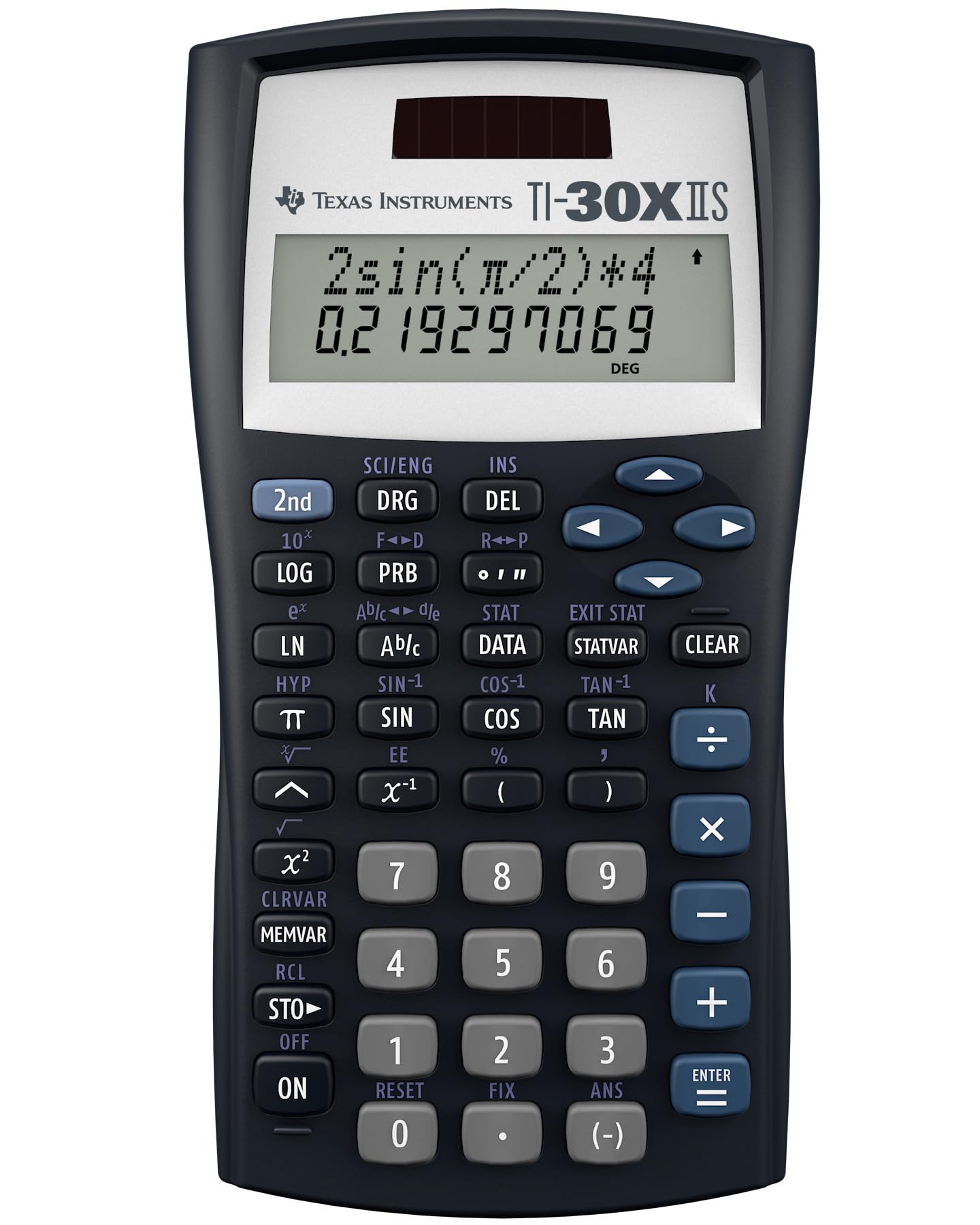
For a student moving through middle school math and into high school trig, the TI-30XIIS is the safest money you can spend on a calculator. Its two-line display shows your typed entry and the calculated result at the same time, so you can catch a typo before it becomes a wrong answer on a homework sheet. It handles fractions, conversions, basic trigonometric functions, and one- and two-variable statistics, which covers the full arc of high school coursework.
The build is where this Texas Instruments unit wins people over — it survives years of being tossed into backpacks, and its solar and battery dual-power setup means it keeps working in any lighting. At 6.2 ounces with dimensions of 6.12″L x 3.23″W, it is compact yet substantial enough to feel sturdy in the hand. It is approved for use on SAT, ACT, and AP exams, so there is no question about whether test proctors will accept it.
The one recurring gripe is button responsiveness, with some owners noting the keys feel a bit stiff at first. The review pages sum it up as a durable tool that gets the job done; the practical advice is to check the seller’s condition before buying, as an occasional unit arrives used rather than new.
Why Students Stick With It
- Two-line display makes checking work easy
- SAT, ACT, and AP approved for test day
- Solar plus battery means no sudden power loss
What To Expect
- Buttons can feel stiff until broken in
- Check seller condition to avoid a used unit
Reach for this if: you want one calculator that carries a student from sixth-grade fractions through high school calculus without ever needing a replacement.
Look elsewhere if: you need a four-line textbook-style screen for advanced college math, since this shows only two lines at a time.
2. Casio fx-260 Solar II Scientific Calculator, 10-Digit Display
The featherweight Casio that slips into a pencil case and runs on sunlight alone.
Casio’s fx-260 SOLAR II is the company’s smallest scientific calculator, and that compactness is exactly why it disappears into a backpack without adding bulk. At just 5″L x 2.9″W, it is noticeably tighter than the Texas Instruments picks in this list, which makes it the better choice for a student who wants to carry a calculator everywhere without noticing it. The single-line 10-digit display keeps things simple, which matches its intended role for pre-algebra, algebra, geometry, and trigonometry courses.
The power setup is the headline feature: it uses energy-efficient Solar Plus technology with a dual-power system that includes both solar cells and an LR-44 battery backup with a three-year life. This means students are never caught with a dead calculator in the middle of a chemistry exam. The slider cover fits securely to protect the screen and keys between classes.
The trade-off is the display: a single line means you cannot see your entry and the result at once, so checking work takes longer. It uses algebraic entry (typing in the order you read) rather than RPN (reverse Polish notation, used on some HP models), which only matters if you are used to HP. Buyers report it works just like typical calculators, and the large display handles hundreds of math functions for a price that is tough to top.
Pocket-Sized Reliability: The solar plus battery system is the differentiator here — no charging cables, no wall adapters, just open the slider and work.
Know The Limit: The single-line display is the main compromise, so this suits quick calculations more than multi-step problem solving.
Best for: the budget-conscious student who needs a dependable, portable calculator for exams and daily classwork without any extra bulk.
Think twice if: you rely on reviewing your typed entries on-screen, since the single line hides your input once you hit equals.
3. Scientific Calculators, IPEROT Math Solar Calculator with 417 Function
A four-line screen that open up 417 functions for students reaching beyond basic coursework.
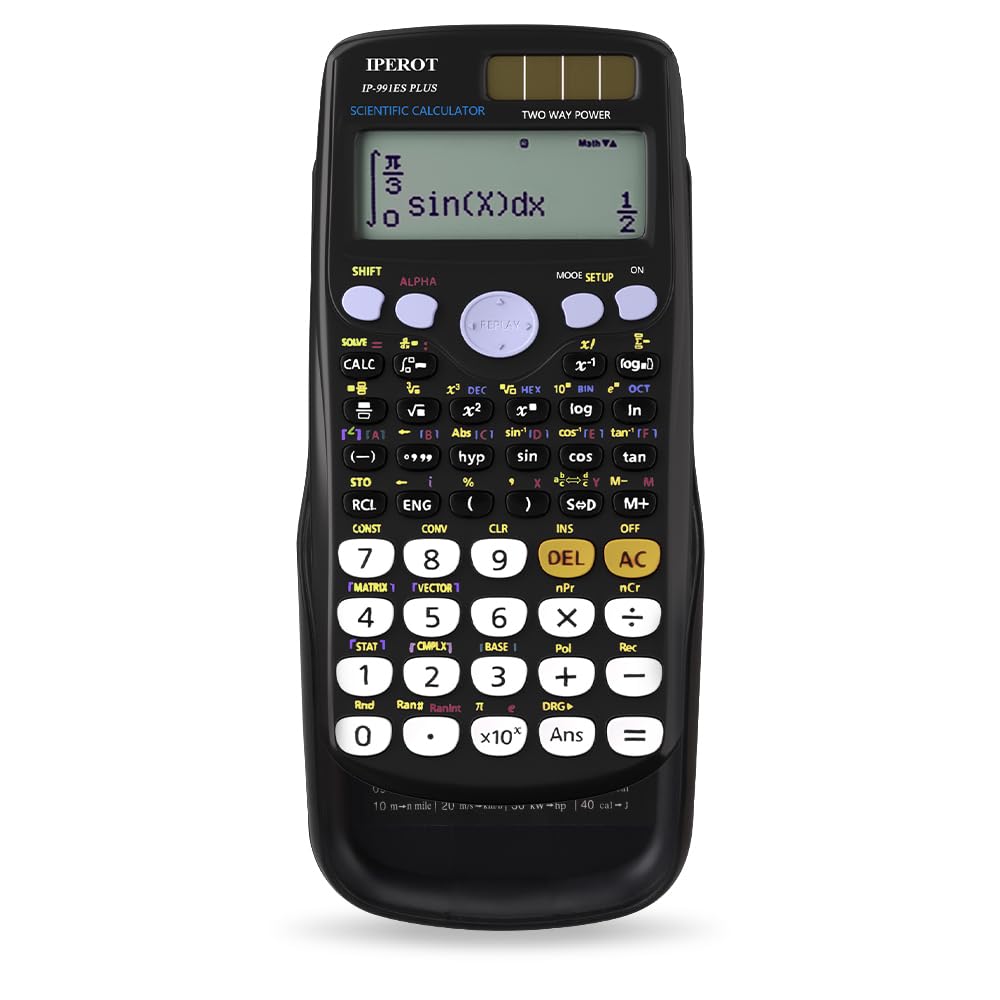
The IPEROT 991ES is the quiet overachiever of this group, packing a staggering 417 functions into a body sized at 6″L x 2″W. That count includes algebraic operations, fractions, derivatives, integrals, statistical analysis, complex numbers, linear regression, standard deviation, permutations, combinations, and variable solving. In plain terms, it handles everything a high schooler needs and keeps working for college-level statistics and engineering courses.
The large screen displays four lines of numbers at once, which makes reading expressions far easier than the traditional single-line layout. This non-programmable calculator shows the written expression and the calculation process on screen, so students can see exactly how an answer was derived. It runs on a dual-power system that combines solar and LR44 battery power, which is included in the box.
What wins people over is the functionality, though the button responsiveness draws mixed feedback — several owners note the keys are clickier than expected. The manual also gets mixed reviews for being hard to follow, so expect a short learning curve. As one buyer put it: “It works just like the ones I would typically buy but pink,” and the statistics functions are reported to work very well for advanced use.
Serious Function Count: The four-line display plus 417 functions makes this the clear choice for students who want one calculator to last through multiple math and science levels.
Clickier Keys: The buttons are stiffer and more tactile than some prefer, and the manual takes patience to decode.
Pick this for: the student heading into statistics, pre-calculus, or any class where seeing multiple lines of work at once speeds up understanding.
skip it if: you want the most intuitive out-of-the-box experience, since the learning curve here is steeper than on the Texas Instruments models.
4. Texas Instruments TI-30XS MultiView Scientific Calculator
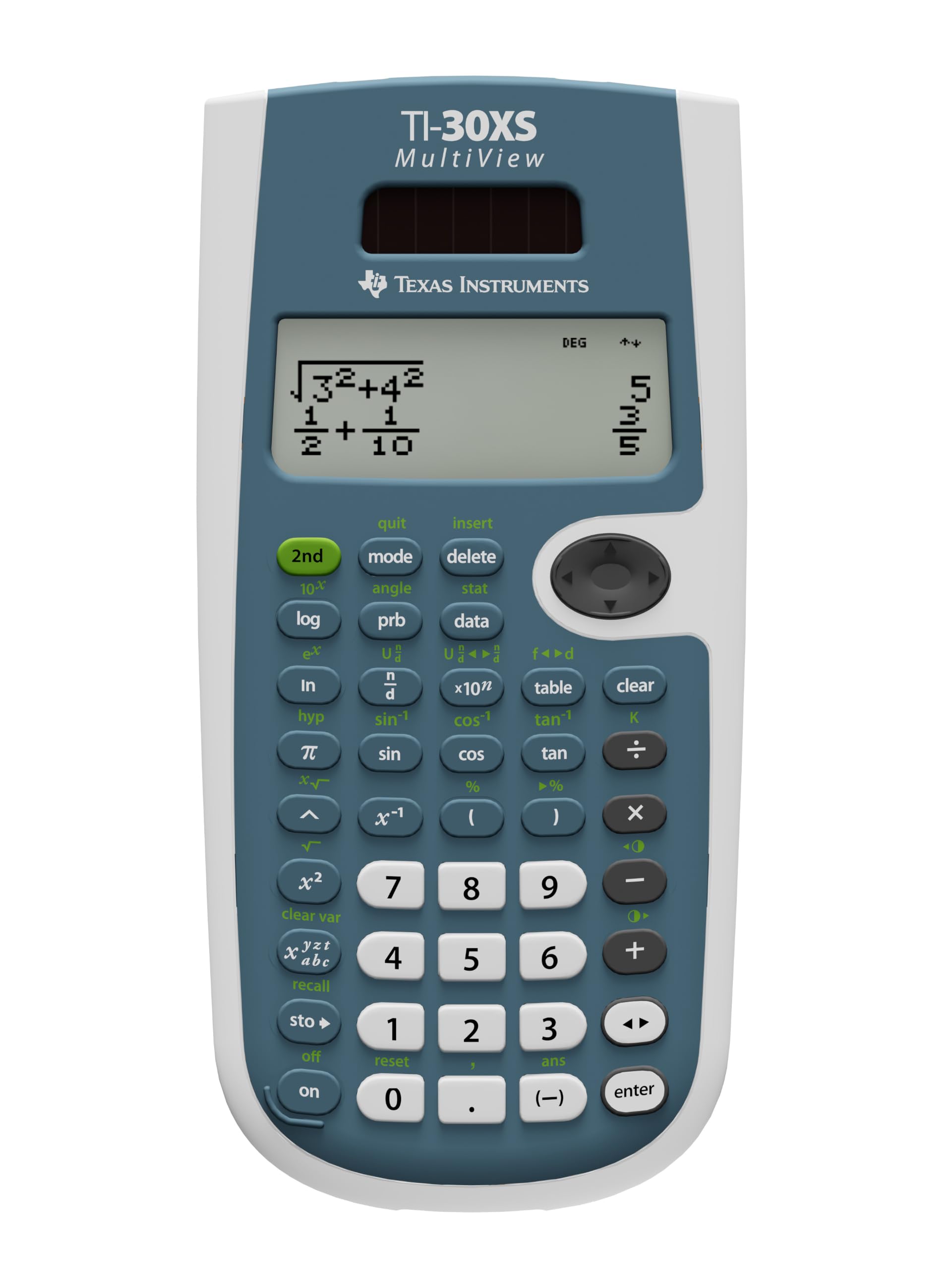
The MultiView screen shows math exactly as it appears in printed textbooks, stacked fractions included.
If your student loses points on careless errors, the TI-30XS MultiView helps because it shows work clearly. Its four-line screen lets you view multiple calculations at once, so you can compare results and spot patterns side by side. It also renders math expressions, symbols, and stacked fractions exactly as they appear in textbooks—no adapting to technical syntax, no squinting at a flat line of numbers.
This Texas Instruments model weighs 5.12 ounces and measures 7.22″L x 3.27″W, so it slips into a backpack easily. It shows scientific notation with proper superscripted exponents and lets you explore an (x,y) table of values automatically or by entering specific x values—useful for spotting trends in algebra. It suits general math, pre-algebra, algebra 1 and 2, geometry, statistics, general science, biology, and chemistry. Dual solar and battery power gives a five-year battery life, and you can replace the battery with a screwdriver when it runs low.
The durability rating is mixed, so treat the plastic shell with care rather than tossing it loose into a bag. The trade-off is that it lacks CAS, graphing, systems solving, and integrals — features that matter only if you are taking calculus, in which case the Casio fx-115ES Plus below handles derivatives instead. For everything through algebra and statistics, this is the display that prevents the most homework mistakes.
Built To Prevent Errors
- Four-line display shows stacked fractions like a textbook
- View multiple calculations at once to compare results
- Supports an (x,y) table of values for functions
Where It Stops
- No calculus-level features like integrals or systems solving
- Durability is mixed, so a protective case is wise
Reach for this if: you want a calculator that displays math the same way your textbook prints it, cutting down on entry errors in algebra and statistics.
Look elsewhere if: you are taking calculus, since this model stops short of derivative and integral functions.
5. Casio fx-115ES Plus 2nd Ed Advanced Scientific Calculator

The advanced Casio that powers through calculus, physics, and engineering without graphing.
When a student hits college-level math, the Casio fx-115ES Plus 2nd Edition is the calculator that grows with them. Its 16-digit, four-line LCD display pairs with a Natural Textbook Display that shows fractions, roots, and equations clearly, just as they appear in a printed textbook. At 6.05 ounces with dimensions of 9″L x 5.5″W, it has a more substantial footprint than the compact models, signaling the heavier workload it handles.
The defining advantage over the TI-30XS is that this model does derivatives and integrals, which makes it suitable through Calculus I and II. It also handles algebra, physics, statistics, and engineering coursework, making it the most future-proof pick for a student with an uncertain major ahead. It runs on a single LR44 battery that is included, and owners mention the battery life is impressive with no issues after months of use.
The quality is the most-praised aspect here, with owners describing it as a workhorse that lasts forever. Button responsiveness is mixed, and the display is not the brightest, so it reads best in well-lit rooms rather than dim lecture halls. As one happy owner put it, there is a super cool button that changes answers from fractions to decimals, and the recommendation over a TI is emphatic.
Calculus Ready: The ability to compute derivatives and integrals makes this the pick that survives a full college math sequence without needing an upgrade.
Watch The Screen: The display brightness is modest, so it is happiest under good lighting, and the buttons feel different from typical Casio models.
Choose this for: the college student taking calculus, physics, or engineering who wants textbook-style displays and integral support in a non-graphing calculator.
Pass on it if: you only need basic algebra and trig, since the extra calculus power adds cost you will not use.
Understanding the Specs
Display Lines
The number of lines on a calculator screen decides how much of your work stays visible. A two-line display shows your typed entry on top and the answer below it, so you can confirm you entered the problem correctly. A four-line display stacks multiple calculations or shows expressions with stacked fractions, which is far closer to how math appears in a printed textbook.
Dual Power Systems
Solar and battery dual-power systems protect you from sudden dead-calculator moments. Solar cells harvest light in bright classrooms, while a small backup battery like an LR44 keeps working in dimmer rooms. Some models run on battery only, which is reliable but requires remembering to replace the cell every few years. Check what battery type is required and whether it is included in the box.
FAQ
What is the difference between a two-line and a four-line display?
Will these calculators be allowed on the SAT or ACT?
How long does an LR44 battery last in a calculator?
Can these calculators handle calculus like derivatives and integrals?
Is a solar-powered calculator reliable in low light?
What does a textbook-style display actually mean?
Which calculator is best for statistics classes?
How do I know if a calculator is right for a middle schooler?
Do these calculators have graphing capabilities?
Final Thoughts: The Verdict
For most students, the clear winner among basic scientific calculators is the TI-30XIIS, because its two-line display, solar and battery power, and SAT/ACT/AP approval cover every high school need in one durable package. If you want a textbook-style four-line view that prevents entry errors, grab the TI-30XS MultiView. And for college-level calculus and physics, the Casio fx-115ES Plus 2nd Edition is the one to reach for, since it adds derivative and integral functions that the others cannot match.
How We Picked
We do not accept paid placement. Every pick is matched to a real buyer and a real use-case; we do not hands-on test units.
Sources & Methodology
Specifications: manufacturer listings and product documentation. Review insights: verified customer reviews, as of August 2026. Pricing: not shown on this page (it changes often); check the current price via the retailer link.
As an Amazon Associate, Gadgets Feed earns from qualifying purchases. This does not affect which products we feature.