
Our readers keep the lights on and my morning glass full of iced black tea. As an Amazon Associate, I earn from qualifying purchases.
Specs are compiled from manufacturer listings and verified buyer reviews and can change over time — please confirm the key details on the product page before buying.
A speed square is one of those tools that separates a guess from a precise cut. The best aluminum speed square locks onto lumber, gives you a crisp 90-degree line, and transfers angles without slipping—all while surviving a drop onto concrete. If you are tired of faded markings and bent plastic frames, this guide points you to the aluminum models that hold their edge and their accuracy.
I’m Min — the founder and writer behind Gadgets Feed. This guide is built by comparing the manufacturers’ published specifications and the patterns across verified customer reviews, so you get each pick’s real strengths and trade-offs instead of marketing spin.
When you’re framing, roofing, or doing finish work, the aluminum speed square you pick affects how fast you mark and how long the markings last. Size, durability, and grip matter most.
Our Picks at a Glance
How To Choose The Best Aluminum Speed Square
Choosing the right speed square is about matching the tool to the job you do most. A trim carpenter living on a ladder needs something light, while a framer scribing rafters all day wants a wider body with deep notches. Here are the specs that actually move the needle.
Size: 7-Inch vs 12-Inch
The 7-inch square is a back-pocket companion, perfect for studs, 2x4s, and quick 45-degree marks. The 12-inch version gives you a longer edge for framing lumber, stair stringers, and deck boards. Buy the bigger one if you are laying out roof rafters or need a reliable saw guide for wide stock.
Markings: Laser-Etched vs Stamped
Laser-etched graduations are burned into the metal, so they will not rub off or wear away with daily use. Cheaper stamped or painted markings can fade, especially when the square is scraping against a pencil or a circular saw base. If you want a tool that reads clearly in five years, look for laser etching.
The Lip and the Pivot
The raised lip locks the square onto the edge of your board, and the pivot point at the corner is what lets you swing the tool to mark a rafter angle. A thick lip—look for around 7/8 of an inch—gives your saw base something stable to ride against. A clean pivot with no divot keeps your angle transfers accurate.
Quick Comparison
| Model | Best For | Size | Graduation | Weight | Amazon |
|---|---|---|---|---|---|
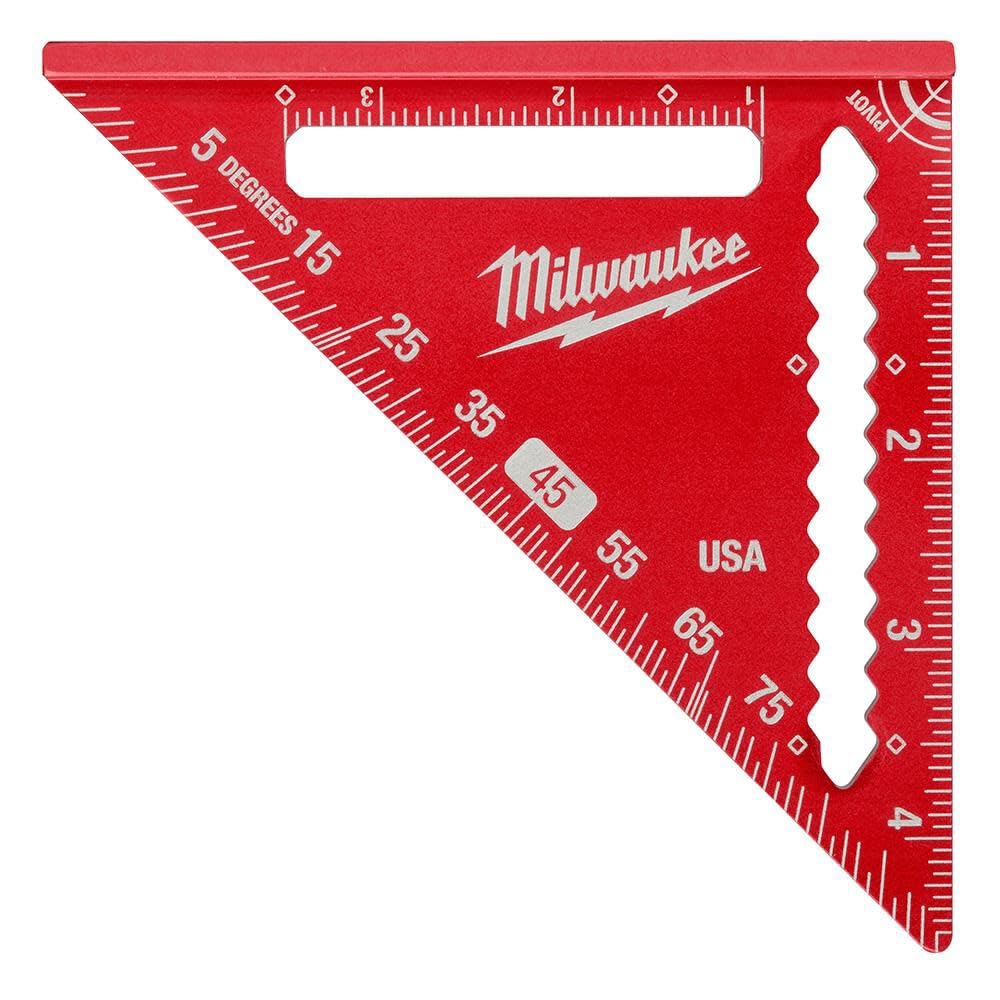
| Milwaukee 4-1/2″ Trim Square★ Best Overall | Pocket carry & trim work | 5″ x 5″ | 1/16 in | 3.68 oz | Amazon |
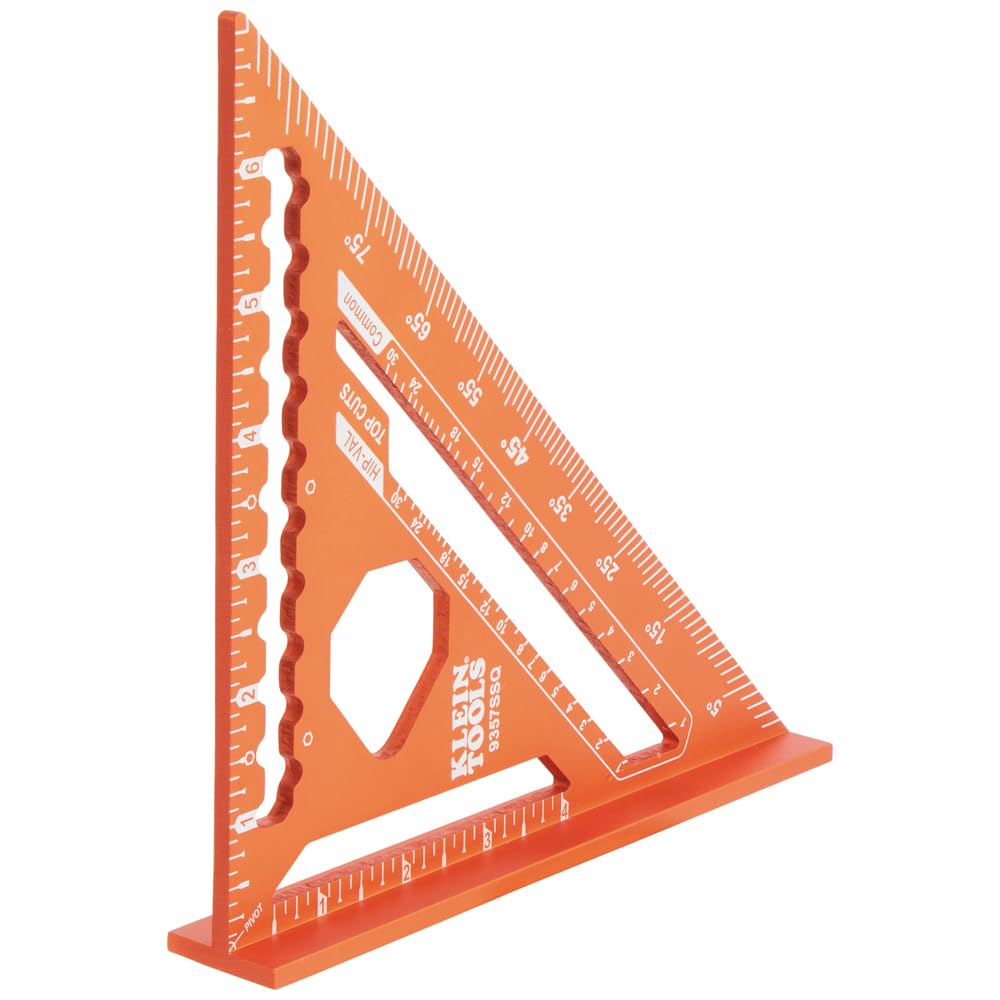
| Klein Tools 7″ Rafter SquarePrecision Pick | Precise marking & layout | 7″ x 7.25″ | 0-90° | 7.84 oz | Amazon |
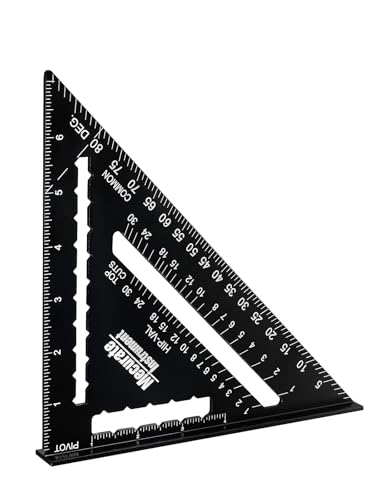
| Mecurate 7″ Rafter SquareBest Value | Heavy-duty durability | 7.28″ x 7.28″ | Laser-etched | — | Amazon |
| Beslands 12″ Rafter Square | Large markings, saw fence | 17″ x 12″ | 1/8 in | — | Amazon |
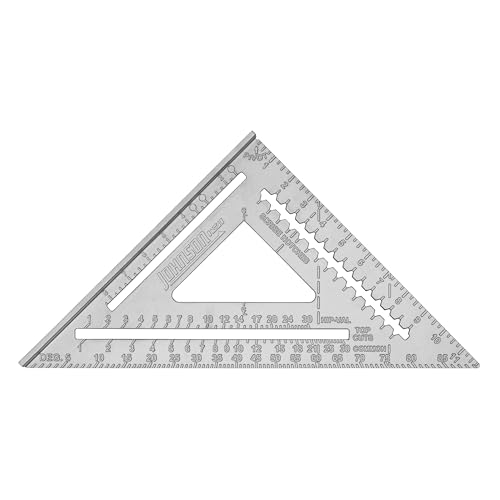
| Johnson RAS-120 12″ | Stair stringers & value | 10.2″ x 0.8″ | 1/4 in | 13.28 oz | Amazon |
| Preciva 12″ Rafter Square | Fine 1/16″ accuracy | 12″ x 12″ | 1/16 in | — | Amazon |
| Milwaukee 7″ Rafter Square | Tough jobsite durability | 10.24″ x 7.09″ | 1/8 in | 210 g | Amazon |
| Mecurate 12″ Carpenter Square | Cabinet & furniture work | 12″ x 12″ | Laser-etched | — | Amazon |
| POWERTEC 12″ Rafter Square | Saw guide & framing | 11.97″ x 11.97″ | 1/8 in | 1.4 lbs | Amazon |
In‑Depth Reviews
1. Milwaukee 4-1/2″ Trim Square
Our pick — over 4.5★ from 750+ verified ratings; the strongest balance of quality and price.
The featherweight that rides in your back pocket all day without complaining.
You forget this square is even there until you need it. At just 3.68 ounces and a 5″ x 5″ footprint, the Milwaukee 4-1/2″ Trim Square is 35% more compact than a standard square, which is exactly why new-construction guys clip it next to their torpedo level. It disappears into a tool pouch and stays ready for the next stud.
Don’t let the size fool you—the dual reference heel gives you both 1/4 in and 3/8 in offsets, and the precision scribe notches tick along at 1/8 in increments. Buyers report it is “sized well for cutting studs or using the offset for casing doors,” making it a go-to for trim carpentry. The 1/16 in graduation range keeps your marks tight on casing and shelving.
The single trade-off is the red anodized finish; if you bleed a different brand color, it may bug you, but that is a cosmetic nitpick. For 45 and 90 degree cuts on 2x4s and 2x6s, this little triangle is the crowd favorite among working carpenters.
Why it wins: Its pocket-friendly size means you never have to walk back to the bench for a square. The compact size, dual reference heel, and 1/8 in scribe notches cover 90% of trim and framing marks.
The fit check: If you mainly build cabinets with a 12-inch square on the bench, this feels small. But for on-the-job pocket carry, nothing in this lineup beats it.
Reach for it if: You are a trim carpenter or framer who lives on a ladder and wants a square that fits in your back pocket.
Look elsewhere if: Your work is mostly larger layout on deck boards or rafters, where a longer edge earns its keep.
2. Klein Tools 9357SSQ 7-Inch Rafter Square
The marking machine with double laser-etched scales that stay readable for years.
Klein brings its electrician-grade build to the carpentry aisle. Weighing 7.84 ounces, this 7-inch square has a thick, solid aluminum body with sharp edges that are made for precise marking—not rounded over like budget squares. The double laser etched markings are the headline, giving you high-visibility numbers that owners mention “will likely remain visible for a longer time.”
Unlike the Milwaukee 4-1/2″ above, the Klein steps up to a full 0 to 90-degree etched scale right on the face, plus 1/4-Inch scribe notches that hold a carpenter pencil for evenly spaced marks. There is even a pipe prop, so you can rest metal or plastic pipe securely while you measure and cut. The anodized orange finish is more durable than a painted one, and it is easy to spot in a crowded tool bag.
The honest catch: the scribe notches are rounded rather than V-shaped, and they alternate sides instead of giving you both 1/8 in and 1/4 in on the same edge like Milwaukee does. For most layout work this is a non-issue, but if you scribe repetitive lines all day, the notch shape takes a beat to get used to.
The edge it holds: That thick aluminum body and laser-etched face make it the most readable square in this lineup, especially in low light. It is the one you grab when the mark has to be right.
Who should pass: If you need the absolute finest scribe increments on every edge, the alternating notches might slow you down versus the Milwaukee below.
The standout spec: Double laser-etched markings on a 7-inch body is the reason this earns a spot in any serious kit.
The one caveat: Rounded pencil notches are the only real compromise on an otherwise excellent square.
3. Mecurate 7-Inch Heavy-Duty Rafter Square
A CNC-machined alloy body that shrugs off drops and bright-sun glare.
Mecurate’s 7-inch square is built around durability. The body is CNC-machined aluminum alloy—thickened, corrosion-resistant, and hardened—so it is not easy to break or bend. Customers note it is “incredibly durable and precise,” and the frosted, smooth surface keeps the permanent laser engraved scales readable even in bright sunlight, which is a real win for outdoor framing.
The 7.28″ x 7.28″ footprint is a touch larger than a standard 7-inch, giving you a slightly longer edge for marking. It works as a protractor, woodworking compass, triangle square, and frame square, with a horizontal base that is easy to slide along a board. The edges and corners are polished so they are smooth and do not dig into your hands during a long day of layout.
Some users report alignment issues, so test it against a known square when it arrives. Mecurate backs it with a 12-month warranty and lifetime support, which is more than most budget squares offer.
The durability story: This is the square you do not wince about dropping. The thickened CNC-machined body and corrosion resistance make it a true workhorse.
The honest read: Because some users report alignment issues, do a quick 10-second square check when it arrives. If it’s true, the price-to-value is tough to match.
Who it suits: The serious DIYer or carpenter who wants a tough, readable 7-inch square without paying a premium brand tax.
Think twice if: You need the absolute tightest tolerance straight from the start; the Klein above is the safer bet for that.
4. Beslands 12-Inch Rafter Square

The big-bodied square with lettering large enough for aging eyes.
If squinting at tiny numbers is your pet peeve, the Beslands 12-inch square fixes that immediately. It features very large lettering—”a must have for aging sight” is how one owner put it—and the high-visibility black scale is laser-etched so it won’t wear off. The 1/8 in graduation range is easy to read even in a dim garage.
This is a hefty tool. At 12 inches with a smooth anodized finish, it works as a protractor (0-90°), miter square, saw guide, and depth scriber. The built-in lipped edge locks securely onto the edge of lumber, which makes it excellent as a saw fence. Buyers specifically mention using it as a circular saw edge guide, and the pivot point at the corner lets you transfer rafters, hip, or valley angles straight to the saw blade.
Its large footprint suits bench work, not pocket carry, and it measures 11.5 inches rather than a full 12. The large footprint makes it a bench tool rather than a pocket tool, and one owner noted it measures 11.5 inches rather than a full 12 inches, which matters if you are marking 1-foot tiles or brittle materials. It is great for framing and deck work, but check that measurement if you need exact 12-inch layout.
The versatility win: Five tools in one—protractor, miter square, saw guide, and depth scriber—make this the most functional square in the mid-range tier.
The size reality: It is a bench and saw-guide specialist, not a pocket tool, and the 11.5″ actual measurement is a real quirk for tile work.
Choose this for: A primary square on your workbench for framing, deck building, and saw-guided cuts where readability matters most.
skip it if: You need a full 12-inch edge for measuring 1-foot materials exactly—check the Johnson below for that.
5. Johnson Level & Tool RAS-120 12″ Johnny Square
The USA-made workhorse that tested true against a machinist’s square.
Johnson’s Johnny Square is a straight-up accuracy story. It is CNC machined with a solid aluminum body, and one owner put it to the test against a 6″ machinist’s square—it passed. The permanent graduations are imprinted into the metal, not printed on top, so they won’t scrape off. Reviewers point out it is “accurate, tough, and USA-made,” which is a rarity in this category.
The scribe notches run from 1-3/4″ to 9″ in 1/4″ increments, which makes it particularly useful for stair stringers where you are laying out repeated rises and runs. The thick edge is genuinely useful as a saw guide, and the durable chip-resistant coating keeps it looking sharp. At 13.28 ounces, it has enough heft to feel solid without being a burden on a tool belt.
Compared to the Beslands above, the Johnson trades a little size for a truer edge and a better notch range for stair work. The 10.2″ x 0.8″ footprint is a bit narrower, but the accuracy and the USA-made label carry real weight for pros who demand consistency.
The accuracy proof: Passing a machinist’s square test is the kind of real-world verification that matters when you are laying out stair stringers.
The trade-off: The narrow profile and smaller graduations (1/4 in) are less forgiving for fine cabinet work than a 1/16 in scale.
Reach for this if: You value a true, verified edge and want a tool made in the USA for stair and framing layout.
Pass if: You need the finest 1/16-inch markings—the Preciva below is built for that.
6. Preciva 12-Inch Carpenter Square

The 1/16-inch scale that brings machinist-level precision to a carpenter’s triangle.
Most speed squares stop at 1/8-inch increments, but the Preciva goes a step finer. The 1/16-inch scale gives you more accurate measurement data and a wider range of applications—handy when you are fitting joints or doing precise drilling positioning. The scale is laser calibrated on an aluminum alloy body, so it is scratch-resistant and keeps its accuracy.
This 12-inch square is about workflow. With a single tool you can draw parallel lines, vertical lines, angle lines, locate table saw height, and mark drilling positions. Buyers who took on a deck build this summer said it “worked exceptionally well” as an affordable alternative to name brands, and beginner woodworkers found it made their efforts noticeably easier. The thick body and wide base keep it stable on the work surface.
With fewer owner reviews than established brands, its long-term durability is less proven. But for the fine-scale accuracy it offers at this price, it is a smart pick for a beginner or a detail-focused hobbyist.
The precision edge: That 1/16-inch scale is the differentiator here, giving you finer readings than the standard 1/8-inch squares in this list.
The trade-off: A shorter review history means you are trusting the 24-hour after-sales promise more than a decade of owner reports.
Who it’s for: The DIYer or beginner carpenter who wants finer precision without stepping up to a full machinist square.
Look past it if: You need the proven toughness of a Milwaukee or Johnson on an active jobsite.
7. Milwaukee 7-Inch Rafter Square MLSQ070
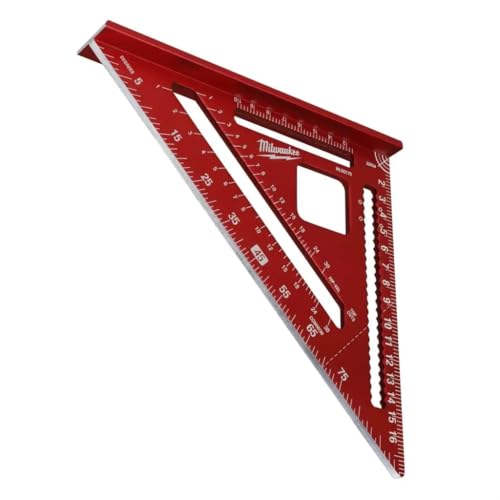
The full-size Milwaukee with a laser-cut pivot that stays divot-free.
This is the bigger brother to the 4-1/2″ Trim Square, and it brings the same Milwaukee DNA to a full 7-inch format. The thing owners rave about is the laser cutting at the pivot point—there is no divot, which keeps angle transfers very accurate. It is a detail the cheap squares miss, and it matters when you are swinging the square for a rafter cut.
The edges are sharp, not rounded over like some budget squares, so your pencil line sits right where you mark it. There are plenty of scribe notches, and the 1/8 in graduation range is easy to read inside or outside. Shoppers say it is “tough as nails”—one story involves a nail being shot through a board into the square, which hardly scratched it. That is the kind of abuse a framing square has to survive.
At 210 g, it is lightweight for a 7-inch tool, and the red anodized finish is classic Milwaukee. It skips the Klein’s double laser etching and pipe prop, but its divot-free pivot and rugged build win out.
The toughness factor: A square that survives a nail gun hit without scratching is the definition of jobsite-ready.
The pivot advantage: That laser-cut, divot-free pivot gives it a real accuracy edge for repeated angle transfers.
Pick this for: A tough, go-to 7-inch square where the clean pivot and sharp edges make every mark count.
Consider the Klein if: You want the extra readability of double laser-etched scales or the pipe-prop feature for plumbing work.
8. Mecurate 12-Inch Carpenter Square

A die-cast aluminum square that simply will not flex when you lean on it.
This 12-inch Mecurate is built with die-casting aluminum rather than a bent or stamped frame, which gives it a rigidity you can feel. It is thickened, corrosion-resistant, and high-hardness, and buyers are quick to note it is “one hundred times better than a plastic triangle.” The permanent laser engraved scales sit on a frosted, wear-resistant surface.
Cabinet makers will appreciate that it works on almost any size of common board, as one owner put it. It functions as a protractor, woodworking compass, triangle square, and frame square, all from one tool. The edges and corners are polished so they are smooth and safe on your hands, which is a thoughtful touch for longer sessions in the shop.
The pivot is marked with an arrow but lacks an indention, so some owners grind one in for nail-head pivoting. Also, the markings on this die-cast version are painted rather than etched, so there is a chance they wear with heavy use over years.
The build quality: Die-cast construction gives this square a solid, flex-free feel that works well for cabinetry and furniture work.
The known quirk: The missing pivot indention is a real con if you use the pivot trick—have a grinder handy.
Best for: The woodworker who wants a rigid 12-inch reference for cabinets and furniture, where the die-cast body shines.
Skip if: The missing pivot indention is a dealbreaker for your layout style—the POWERTEC below has it fully sorted.
9. POWERTEC 12″ Aluminum Rafter Square
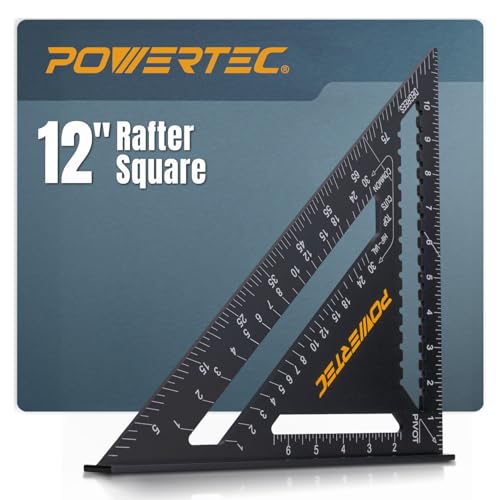
The saw-guide specialist with a thick lip and laser-marked dual scales.
POWERTEC engineered this 12-inch square around the saw guide. The 1/8″ thick body and 7/8″ wide lip give your circular saw base a stable, slip-resistant platform for cleaner 90° and 45° cuts. That wide lip is the standout feature here—it is wider than most squares, so it locks on and stays put while you rip a straight line down a sheet of plywood.
The scales are laser-marked and crisp, including a full 1/8″ increment marking edge and both 1/4″ and 5/8″ scales for layout versatility. The matte non-glare finish keeps it readable in bright sun. It also includes a common rafter conversion chart and 1/4″ scribing notches, so it is a true all-in-one framing tool. Buyers report it is accurate enough that one owner “mixed my cylinder head and got exactly the numbers they got at the machine shop.”
The edge markings are printed on a sticker that can scratch off with rough use. As a straight edge and saw guide, the flat, stiff body “never bends” per the crowd, but as a precision ruler, treat the markings with care.
The saw-guide authority: That 7/8″ lip is the widest in this lineup, making it the go-to for clean circular saw cuts.
The durability question: The printed edge sticker is the weak point—protect it if you plan to use this as a precision ruler.
Reach for this if: You want a dedicated saw guide and framing square that stays straight and true on the jobsite.
Look elsewhere if: You need a ruler with etched markings that will survive rough scrapes—the Klein or Johnson are safer there.
Understanding the Specs
Graduation Range
This is the finest measurement increment the square is marked in, usually 1/16, 1/8, or 1/4 inch. A smaller number like 1/16 means finer, more precise markings—great for cabinet work. A 1/4-inch graduation is coarser but perfectly legible for framing and stair layout. Match the scale to the tolerance your projects demand.
The Lip and Pivot Point
The lip is the raised edge that hooks onto your board; a thicker lip like 7/8 inch gives your saw base a stable guide. The pivot point at the corner is what you press against a board edge to rotate the square for angle marking. A clean, divot-free pivot makes angle transfers more accurate, so it is worth checking before you buy.
FAQ
What is the difference between a 7-inch and a 12-inch speed square?
Are laser-etched markings really better than stamped ones?
Can I use an aluminum speed square as a circular saw guide?
What is the pivot point used for on a rafter square?
Will a 12-inch square fit in my tool belt or pocket?
What are scribe notches for on a speed square?
Is a heavier speed square better than a lighter one?
How do I check if my speed square is actually square?
Final Thoughts: The Verdict
For the majority of shoppers, the aluminum speed square winner is the Milwaukee 4-1/2″ Trim Square because it is the one you will actually carry and use every single day. If you want the finest precision markings and the best readability, grab the Klein Tools 7-Inch. And for framing and saw-guided cuts, the POWERTEC 12″ is the one to reach for.
How We Picked
We do not accept paid placement. Every pick is matched to a real buyer and a real use-case; we do not hands-on test units.
Sources & Methodology
Specifications: manufacturer listings and product documentation. Review insights: verified customer reviews, as of August 2026. Pricing: not shown on this page (it changes often); check the current price via the retailer link.
As an Amazon Associate, Gadgets Feed earns from qualifying purchases. This does not affect which products we feature.