
For many mechanics, the first torque wrench they ever held was a beam style — a simple pointer, a steel beam, and a scale that didn’t need batteries or a calibration certificate. That plain design is still the most direct way to measure fastener tension, and for a specific set of jobs, nothing works faster or more reliably. The beam torque wrench eliminates the guesswork that comes with click-type wrenches in tight quarters or low-torque settings where the audible click is too faint to hear.
I’m Min — the co-founder and writer behind Gadgets Feed. I’ve spent years analyzing tool specifications, reading every customer review thread, and cross-referencing accuracy claims against real-world use patterns so that your buying decision is based on data, not hype.
Beam wrenches are often misunderstood as outdated, but they offer permanent calibration, zero spring fatigue, and a visual reading that never lies — here is everything you need to confidently choose the best beam torque wrench for your next project, from small engine rebuilds to bicycle maintenance and differential setup work.
How To Choose The Best Beam Torque Wrench
Unlike click-type wrenches that rely on an internal spring mechanism, beam wrenches measure deflection of a steel beam directly against a fixed scale. This fundamental difference means you never have to reset the tool after storage, and the calibration never drifts — but only if you pick the right range and drive size for your work.
Torque Range vs. Drive Size
Beam wrenches come in two broad torque families: inch-pound (in-lb) for light assembly, and foot-pound (ft-lb) for automotive chassis work. A 1/4-inch drive beam wrench typically handles 0–80 in-lb, ideal for bicycle components, scope mounts, and small engine fasteners. A 1/2-inch drive beam wrench ranges from 0–150 ft-lb, suited for lug nuts, suspension bolts, and engine mounts. Operating a beam wrench too close to its maximum or below 20% of its range can reduce accuracy — match the range to the most frequent fastener spec you torque.
Scale Readability and Dual Markings
The defining advantage of a beam wrench is that you read torque in real time as you pull. A wide, high-visibility scale with bold increments (2.5 in-lb or 2 ft-lb) and dual SAE/Metric markings (in-lb alongside Nm, or ft-lb alongside Nm) saves time on the job. Some models also include a red pointer for quick visual alignment. Look for a satin or matte scale finish to reduce glare under shop lights.
Handle Design and Build Quality
Beam wrenches with a ball-type handle localize force through the palm, which can improve reading consistency. A comfortable full-grip handle is better for higher-torque pulls. The steel beam should feel stiff but not brittle — the pointer should deflect smoothly without binding. Cheaper models sometimes arrive with a bent pointer that requires manual re-zeroing; this is a simple fix but worth inspecting upon delivery.
Quick Comparison
On smaller screens, swipe sideways to see the full table.
| Model | Category | Best For | Key Spec | Amazon |
|---|---|---|---|---|
| GEARWRENCH 2955D | Mid-Range | Precision low-torque assembly | 0–60 in-lb, satin finish scale | Amazon |
| Performance Tool W3001C | Budget-Friendly | Automotive bolt torque (0-150 ft-lb) | 0–150 ft-lb, 1/2-inch drive | Amazon |
| ARES 70213 | Mid-Range | Bicycle and electronics work | 0–80 in-lb, +/-4% accuracy | Amazon |
| Performance Tool M195 | Budget-Friendly | Differential pinion preload setup | 0–80 in-lb, ball handle | Amazon |
| Titan 23140 | Budget-Friendly | Light clockwise/counterclockwise fastening | 0–80 in-lb, 0.25 in-lb increments | Amazon |
| Jonard Tools TWAF-71630 | Specialty | F‑connector and telecom installs | 30 in-lb, 7/16-inch drive, click-audible | Amazon |
| Park Tool Ratcheting Click Type | Premium | Serious bicycle maintenance | 2–14 Nm, 3/8-inch drive, +/-4% | Amazon |
In‑Depth Reviews
1. GEARWRENCH 2955D Beam Torque Wrench
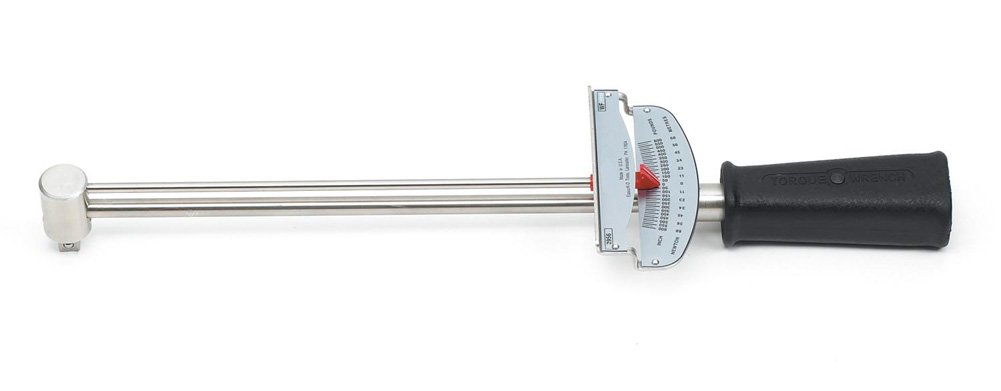
The GEARWRENCH 2955D is built around a 0–60 in-lb range with a fixed square head, and its satin finish scale virtually eliminates glare under bright workshop lights — a small detail that matters when you’re reading the pointer at an awkward angle. The beam deflects smoothly and registers in 2.5 in-lb increments, giving you consistent resolution for small fasteners on motorcycle controls, scope bases, and light machinery.
Users routinely report that the pointer can be flexed back to zero if it arrives slightly off, a trait common to quality beam wrenches that indicates a calibrated steel beam rather than a stamped part. The ball-type handle localizes pulling force through the palm, which helps maintain a steady reading. At this torque range, the GEARWRENCH is a reliable partner for differential pinion preload checks, where consistent low-torque readings are critical.
The head fits snugly on standard 1/4-inch drive sockets, though some users noted a tight fit with specific aftermarket sockets. This is an isolated compatibility issue rather than a design flaw, and the tool otherwise feels solid in the hand. For anyone who needs a mid-range beam wrench that stays accurate over years of occasional use, this model delivers the confidence of permanent calibration.
Why it’s great
- Satin finish scale reduces glare for easy reading
- Smooth beam deflection with no binding
- Consistent performance in the 0-20 in-lb sweet spot
Good to know
- Some sockets fit tighter than expected on the drive head
- Pointer may require manual zero adjustment on arrival
2. Performance Tool W3001C 1/2-Inch Beam Style Torque Wrench

The Performance Tool W3001C is the right tool when your fasteners call for foot-pounds, not inch-pounds. With a 0–150 ft-lb range and a 1/2-inch drive, this beam wrench handles everything from suspension bolts to wheel lugs on cars and small trailers. It reads both clockwise and counterclockwise, so you can tighten left-hand thread fasteners without needing a second tool.
The build is simple — a polished steel beam with a red pointer and a clear scale marked in 5 ft-lb increments. Several users reported that the pointer arrived offset by 30–40 ft-lb, which required bending the beam back to zero. While this is a minor adjustment, it suggests packaging that does not protect the pointer during shipping. Once corrected, the tool tracks torque consistently and holds its zero across multiple pulls.
This is a shade-tree mechanic’s beam wrench: no delicate internals to break, no batteries to check, and no calibration schedule to track. If you need a budget-friendly option for occasional automotive work and are comfortable checking the pointer zero before each use, the W3001C will tighten bolts accurately without complaint.
Why it’s great
- Wide 0-150 ft-lb range for automotive fasteners
- Works clockwise and counterclockwise
- Simple, durable construction with no internal springs
Good to know
- Pointer often arrives bent and requires re-zeroing
- Accuracy is adequate for non-critical tolerances
3. ARES 70213 1/4-Inch Drive Beam Torque Wrench

The ARES 70213 covers the full 0–80 in-lb spectrum with dual-scale markings (in-lb and Nm) in 2.5 in-lb and 0.25 Nm increments, making it a natural fit for bicycles, motorcycles, and delicate assembly work. Its 1/4-inch drive head accepts standard sockets, and the beam has a satin-like finish that keeps readings legible even when you’re working under a hood in mixed lighting.
Accuracy is rated at +/-4%, which is typical for beam wrenches at this tier, and the deflection beam design means there are no springs to fatigue over time. Users consistently praise its sturdy construction and easy-to-read markings. A few units arrived with the pointer resting a line or two off zero — a quick bend corrects this, and after that the tool holds its setting through repeated use.
The ARES is significantly lighter than many beam wrenches in its class at 8.8 ounces, which reduces arm fatigue when you’re tightening a series of fasteners. For home mechanics who work on bikes, small engines, or electronics where overtightening can strip threads or crack plastic, this beam wrench provides the visual feedback that click-style wrenches can’t offer at low torque values.
Why it’s great
- Lightweight build reduces fatigue during multiple pulls
- Clear dual-scale readings in in-lb and Nm
- No spring fatigue — permanent calibration
Good to know
- Pointer may not rest at true zero out of the box
- Scale increments are 2.5 in-lb, not fine enough for sub-10 in-lb work
4. Performance Tool M195 1/4-Inch Drive Torque Beam Wrench
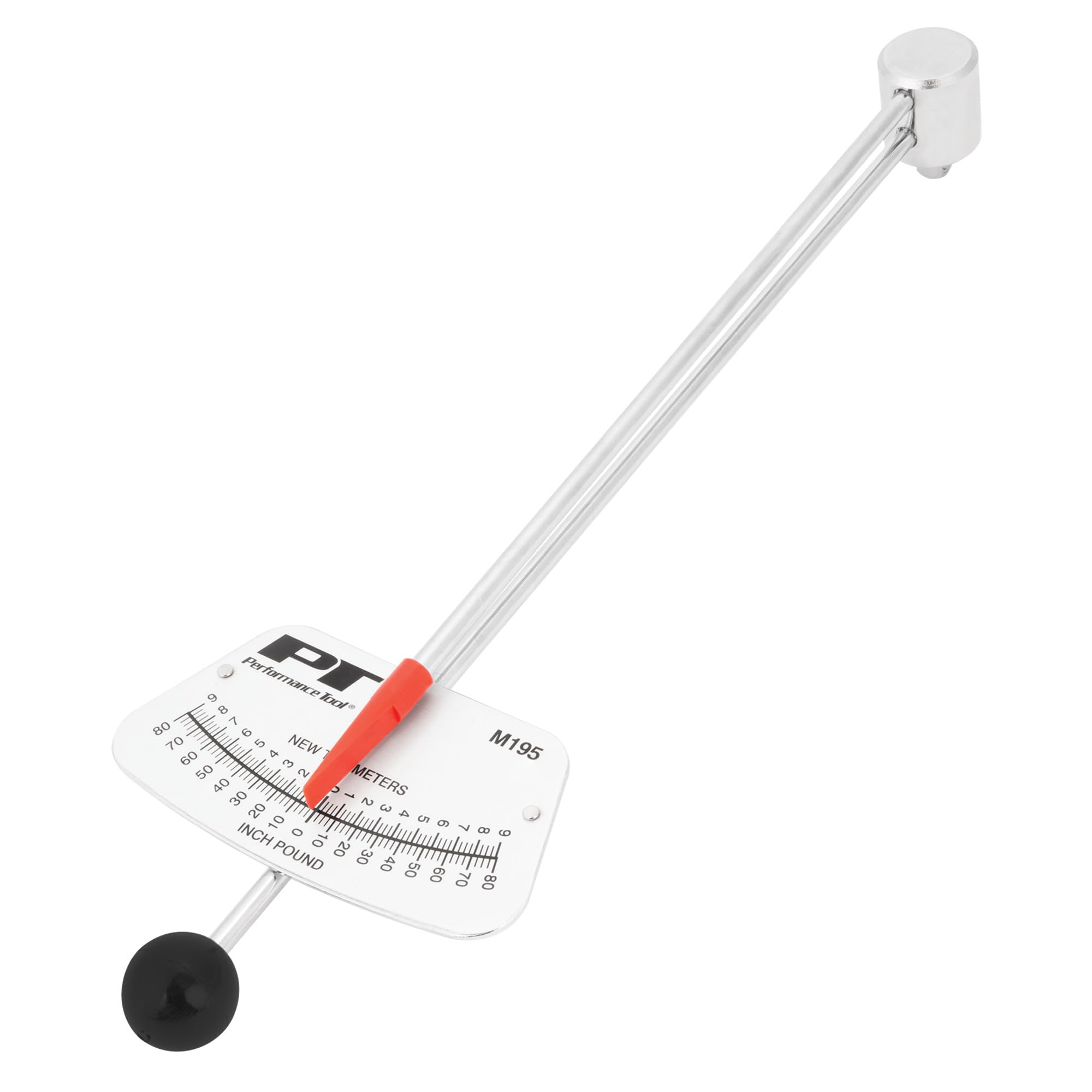
The Performance Tool M195 stands out in the 0–80 in-lb category because of its ball handle — a rounded grip that localizes your pulling force through the center of your palm, which can improve reading accuracy compared to a straight handle. This is particularly useful during differential pinion preload checks, where the exact torque applied matters more than speed.
The scale is marked in both in-lb and Nm with a red indicator needle for quick reference, and the beam design ensures no calibration drift over time. Many users specifically buy this tool for setting pinion bearing preload on differentials, a task that requires a consistent low-torque reading and a tool that can be used with a 1/2-inch to 1/4-inch adapter setup.
The only common complaint is a plastic cover on the pointer tip, which some worry could crack over time, though no widespread failures have been reported. At its price point, the M195 offers a dedicated ball-handle design that you don’t see on most budget beam wrenches, making it a smart choice for jobs where you need to control torque application precisely.
Why it’s great
- Ball handle localizes force for consistent readings
- Dual-scale markings in in-lb and Nm
- Widely used for differential pinion preload work
Good to know
- Plastic pointer tip feels less durable than all-metal designs
- Requires adapter for 1/2-inch drive sockets
5. Titan 23140 1/4-Inch Drive Beam Torque Wrench

The Titan 23140 is the most compact beam wrench in this lineup at just 11.3 inches overall length, making it easy to stash in a tool pouch or bike bag. It reads 0–80 in-lb with dual Nm markings, and the scale increments are fine enough (0.25 in-lb) to allow precise readings on small fasteners. The polished finish and 1/4-inch square drive handle both left-hand and right-hand threading.
Build quality is solid for the price point — the beam feels stiff, and the pointer resists flexing under accidental bumping. Users have noted that the pointer sometimes needs a gentle bend back to zero after shipping, but once set, the tool holds calibration reliably. Several reviewers mention using this wrench for torquing screws up to 15 in-lb, a range where click-type wrenches often fail to produce an audible click.
The handle is narrower than some competitors, which may not fill the palm as comfortably for large hands, but the trade-off is easy storage and a low weight of 0.2 pounds. For anyone who needs a no-battery, no-spring torque tool for light assembly work, the Titan 23140 delivers the essential beam-wrench functionality without taking up drawer space.
Why it’s great
- Compact 11.3-inch length for easy storage
- Fine 0.25 in-lb scale increments
- Works with both clockwise and counterclockwise fasteners
Good to know
- Narrow handle may be less comfortable for large hands
- Pointer may require zero adjustment on delivery
6. Jonard Tools TWAF-71630 Full Head Torque Wrench

The Jonard TWAF-71630 is a purpose-built tool for telecom and cable installation, calibrated to 30 in-lb for F‑connector compression fittings. Its 7/16-inch drive head is sized specifically for the hex fittings common on coax connectors, and the full-head (box-end) design lets you spin the nut on quickly before the final torque pull. The black oxide finish and high-carbon steel construction ensure a long service life in field conditions.
Unlike traditional beam wrenches, this tool includes an audible click feature — you hear a click when the preset 30 in-lb is reached, combining the visual reading of a beam with the audible confirmation of a click-type mechanism. The ergonomic handle has a cushion grip and an angled head for comfortable leverage when working in tight cable closets or behind equipment racks.
Veteran telecom installers consistently rate this tool highly, noting that it prevents over-tightening that can damage wall plates, modem ports, or compression connectors. This is not a general-purpose beam wrench — it’s locked to a single torque value — but for anyone who terminates coax fittings regularly, it eliminates guesswork and callback repairs.
Why it’s great
- Preset to exactly 30 in-lb for F‑connectors
- Speed-head design for faster tightening
- Audible click confirms correct torque
Good to know
- Fixed 30 in-lb setting cannot be adjusted
- 7/16-inch drive limits use to coax and similar fittings
7. Park Tool Ratcheting Click Type Torque Wrench

The Park Tool torque wrench covers a 2–14 Nm range (roughly 18–124 in-lb) through a 3/8-inch ratcheting drive, and while it is a click-type mechanism rather than a beam, it earns its place here for serious bicycle mechanics who demand the precision of a click-stop wrench at low torque settings. The dial-adjust system lets you preset the torque value on the tool body, and the ratcheting head makes repeated tightening fast on bike components.
Accuracy is rated at +/-4%, and the tool features a conversion scale printed on the body for quick reference between Nm and in-lb. The adjustment knob requires a push-and-turn motion to prevent accidental changes. A sturdy storage case is included, though the case interior lacks cutouts for easy tool removal — a minor but noted ergonomic oversight.
For cyclists performing delicate work on carbon frames, derailleur bolts, and stem face plates, this wrench gives you a clear click at the set torque, which is often easier to feel than to see on a beam pointer. It is more expensive than any beam wrench in this guide, but the precision engineering and Park Tool’s reputation in the cycling world justify the investment for regular bike maintenance.
Why it’s great
- Ratcheting 3/8-inch drive speeds up repetitive work
- Clear click feedback prevents under or over-tightening
- Adjustable in fine 0.4 Nm increments
Good to know
- Higher price than comparable beam wrenches
- Case design can make tool removal difficult with greasy hands
FAQ
Why would I choose a beam torque wrench over a click-type model?
How do I zero a beam torque wrench if the pointer is off?
Final Thoughts: The Verdict
For most users, the best beam torque wrench winner is the GEARWRENCH 2955D because its satin finish scale, smooth beam deflection, and reliable low-torque accuracy make it the most versatile choice for precision assembly work. If you need a higher range for automotive bolts, grab the Performance Tool W3001C. And for telecom installers who terminate F-connectors daily, nothing beats the purpose-built Jonard Tools TWAF-71630.