
Our readers keep the lights on and my morning glass full of iced black tea. As an Amazon Associate, I earn from qualifying purchases.
Specs are compiled from manufacturer listings and verified buyer reviews and can change over time — please confirm the key details on the product page before buying.
Setting up a backyard batting cage without a live pitcher used to mean endless hours of chasing balls and begging a friend to throw. A pitching machine changes that equation instantly, turning a single practice session into a non-stop stream of swings for you or your kid. The real question is which style fits your space, your batter’s age, and your willingness to chase down balls, because the differences run far deeper than sticker shock.
I’m Min — the founder and writer behind Gadgets Feed. This guide is built by comparing the manufacturers’ published specifications and the patterns across verified customer reviews, so you get each pick’s real strengths and trade-offs instead of marketing spin.
You want a baseball and softball pitching machine that fits your practice plan, not one that forces you to adapt. So match three things to your needs: speed range, ball capacity, and portability. A coach stocking team gear needs different specs than a parent setting up a home practice station.
Our Picks at a Glance

How To Choose The Best Baseball And Softball Pitching Machine
Before you sort through models, you need to know that “pitching machine” covers two very different tools: toss machines that lob a ball underhand for swing work, and wheel-driven machines that fire real pitches for batting practice. Toss machines are cheaper and gentler for beginners; wheel machines throw harder and faster but cost more and need more space. Your budget and your batter’s age will often decide the category for you.
Match speed to the batter, not the spec sheet
A machine’s top speed means nothing if your 8-year-old is terrified of the ball. Beginners and young kids do best with a soft toss machine that lobs the ball gently in a consistent arc, letting them build hand-eye coordination before facing heat. Older teens and adults chasing game-speed reps need a wheel machine that can reach 45-60 mph and up. Look for adjustable speed settings so the machine can grow with the player, and remember that a machine stated to throw 40 mph with a real baseball may throw differently with a heavier softball.
Count the capacity before you count the pitches
Nothing kills a practice rhythm faster than reloading the chute every two minutes. Toss machines typically hold somewhere between 10 and 50 balls depending on the model, while wheel machines with feeding hoppers can keep a steady stream coming. If you are practicing solo, a larger capacity means more continuous swings before you walk out to gather balls. Smaller capacities are fine for a coach who is feeding balls by hand anyway, and for young kids who need a pause between reps anyway.
Weigh portability against stability
A machine you can barely lift will end up stuck in the garage corner. Foot-powered toss machines are light enough to carry with one hand, while heavy steel wheel machines with motors and legs can weigh 50 pounds or more and need a cart or a second person. Think about whether you will be moving it between the garage and the backyard, or leaving it set up on a field. The trade-off is real: heavier machines are usually more stable and less likely to creep forward with each pitch.
Quick Comparison
| Model | Best For | Power Source | Ball Capacity | Speed Range | Amazon |
|---|---|---|---|---|---|
| Jugs Toss Machine★ Best Overall | Durable daily reps | Rechargeable battery | 14 baseballs / 10 softballs | — | Amazon |
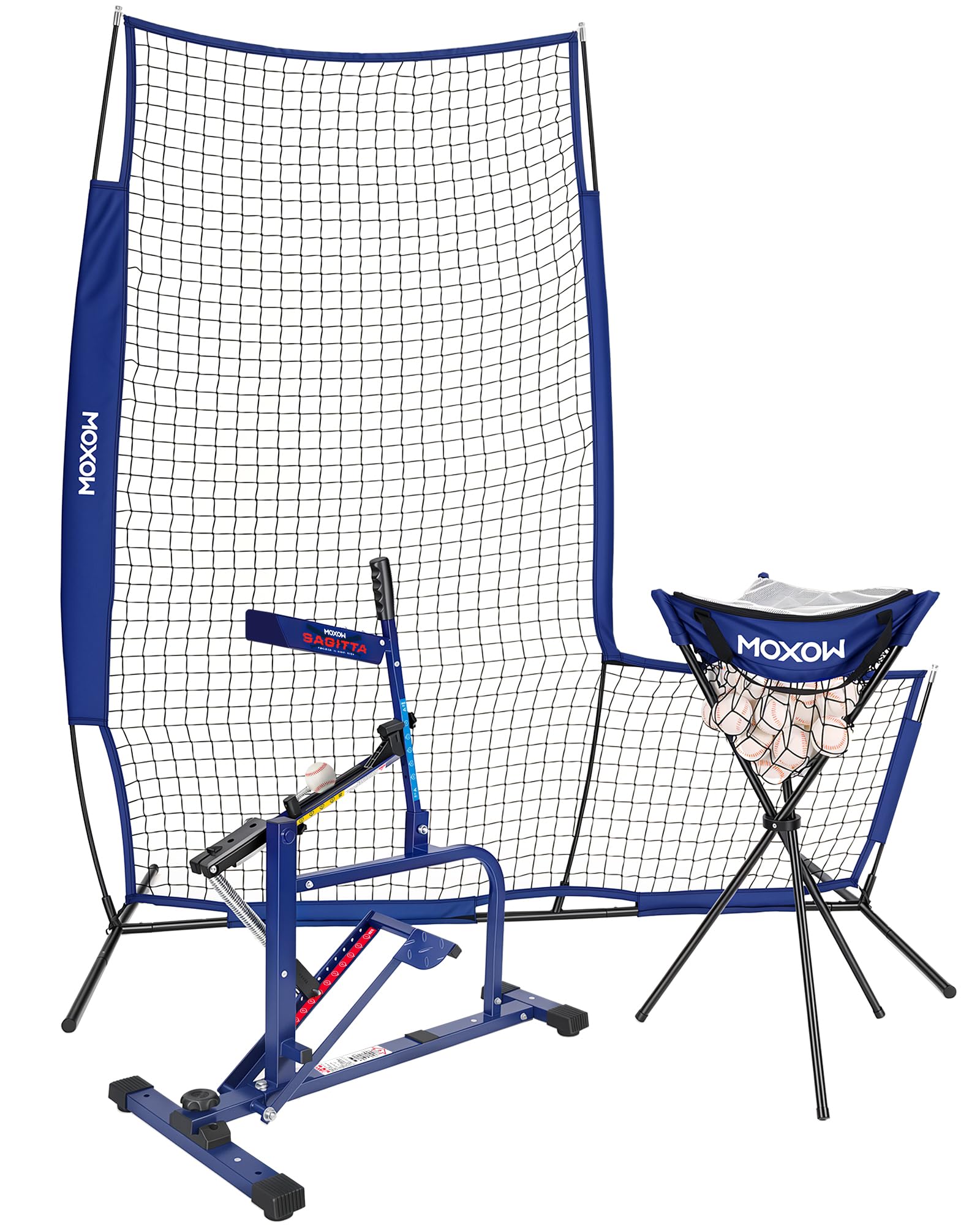
| MOXOW SagittaBest Value | Complete home setup | — | 50 baseballs / 30 softballs | — | Amazon |
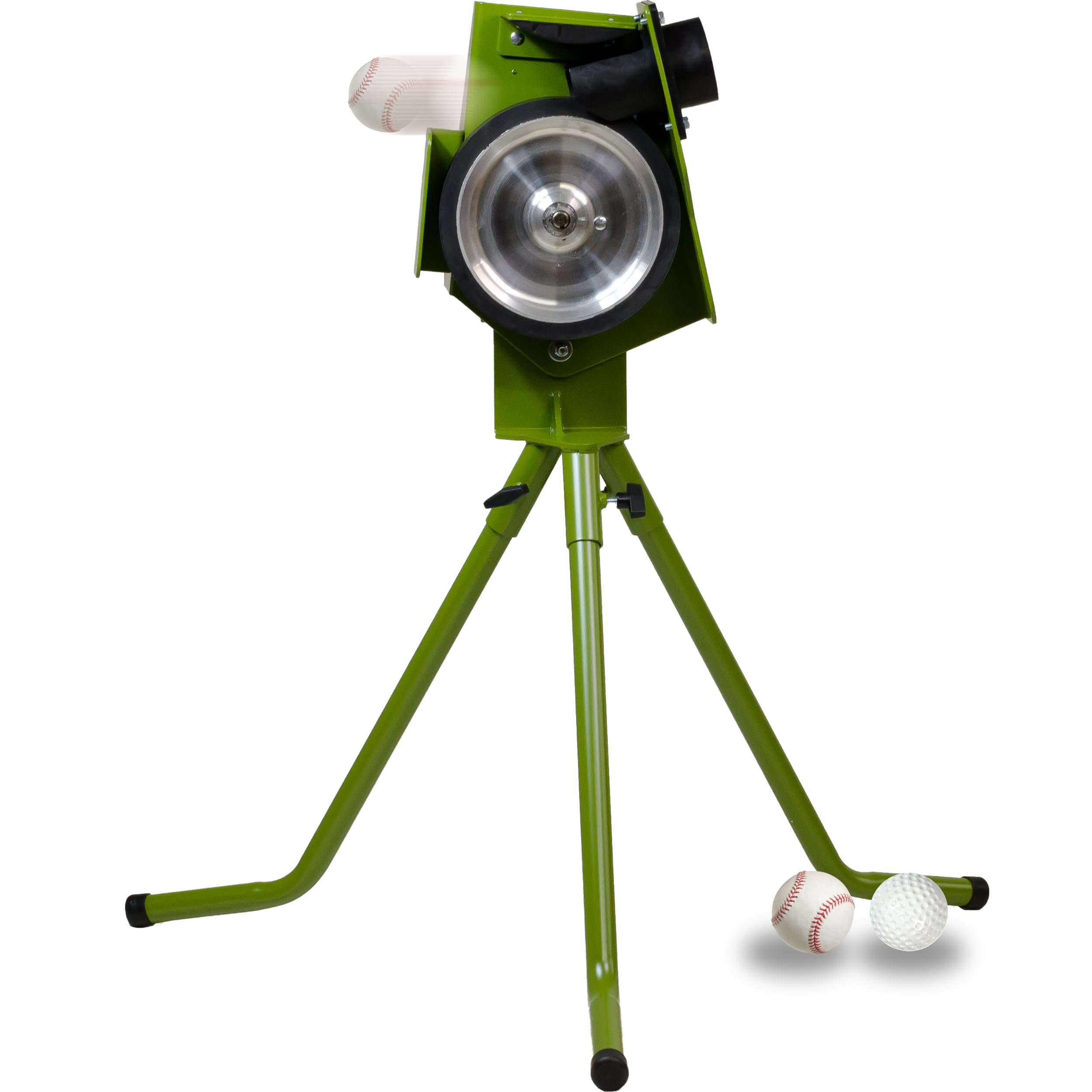
| Mound YetiTop Performer | Accurate game-speed reps | Electric | 2 chutes | 30-60 mph | Amazon |
| Furlihong 691BH | No-power portability | Foot pedal | 2 chutes included | 4 speed levels | Amazon |
| Heater Perfect Pitch | Lightweight portability | None | — | 15-45 mph | Amazon |
| Furlihong 6902BHA | Height-adjustable toss | Rechargeable battery | Extendable stacker | 1-4 speed settings | Amazon |
| Personal Pitcher Pro | Indoor curveballs | Rechargeable battery | 48 small balls | 4 speed settings | Amazon |
| PowerNet Launch F-lite | Dual-sport field drills | Electric | — | 40-90 mph | Amazon |
| BSN Bulldog | Team field use | 110V electric | — | 30-60 mph | Amazon |
In-Depth Reviews
1. Jugs Toss Machine
Our pick — over 4.5★ from 500+ verified ratings; the strongest balance of quality and price.
The workhorse toss machine that keeps firing long after cheaper units quit.
This is the machine the review pages describe as a “professional grade tool” — the kind that survives well beyond a thousand tosses and still throws true. It holds up to 14 baseballs or 10 softballs and feeds a ball every 5 seconds, which gives you a steady, swing-after-swing rhythm. The internal rechargeable battery runs up to 8 hours continuously, so a full afternoon of practice rarely needs a charge.
You can set this up in any 10-by-10-foot space, so a garage or backyard is plenty. But weigh the trade-off: at 21 pounds it is no lightweight, and buyers report it can creep forward during use since there is no height adjustment. Seamed balls can jam in the chute unless you load them individually. The battery life is the thing everyone raves about — “Battery lasts ~400 tosses/charge,” owners mention, which translates to days of practice between charges.
Consistent tosses and durable construction earn the most praise for functionality and build quality. It works for baseballs, softballs, and even foam balls, making it a versatile station for young players building hand-eye coordination and adults locking in swing mechanics. Some owners call it pricey for what it does, but the longevity is exactly why it earns the top spot — the crowd favorite with a 4.7-star average across hundreds of owners.
Built for the long haul
- 8-hour continuous battery that lasts days of practice
- Tosses a ball every 5 seconds for steady reps
- Handles baseballs, softballs, and foam balls
- Fits a 10-by-10-foot space
Know before you buy
- No height adjustment; tosses stay belt-high
- 21 lbs is heavy enough to need two hands
- Seamed balls can jam the chute
Who it suits: Any family or coach wanting a durable, battery-powered toss machine that will survive years of daily batting practice.
The catch: Expect to load seamed balls one at a time and accept that the toss height is fixed.
2. MOXOW Sagitta 3-in-1 Bundle
A complete home batting station that bundles the machine, caddy, and screen in one box.
Most machines ship alone, but this one arrives as a true 3-in-1 system: the launcher, a ball caddy that holds up to 50 baseballs or 30 softballs, and a 7×6 ft L-shaped protective screen. That caddy capacity is the standout — it holds roughly 3.6 times as many balls as the Jugs above, which means far fewer walks out to the bucket between rounds. The included 7×6 ft L-shaped screen stops line drives, keeping the pitcher safe on hard-hit returns.
You get a steel frame with an anti-tilt bar to keep each pitch on target, plus a stable dual-function beam that doubles as a carrying handle, so moving it around is easier than the 18.48 kg package weight would suggest. Buyers describe setup as easy and note the color-coded speed guide lets you adjust Launch (A), Trajectory (B), and Power (C) separately. That makes it simple to dial in a pitch for a young kid one minute and a teenager the next.
Customers note 300+ pitches without issues, and the steel frame and net stay stable on uneven ground. The main trade-off is the initial assembly time, which a few note takes a while, and the price sits above the simplest toss machines. But the bundle means you do not have to buy a screen and caddy separately. Reviewers call it “great value” because the machine, caddy, and screen ship as one complete station.
Why it wins: the all-inclusive bundle — machine, 50-ball caddy, and protective screen — makes this the most complete home practice package in this list, at a price that undercuts most machines sold alone.
Reach for this if: you are setting up a home or backyard station and want everything included without hunting for a separate screen.
Budget the time: assembly takes effort up front, so plan for a bit of build time before the first pitch.
3. Mound Yeti 1-Wheel Pitching Machine
The accuracy-first wheel machine that parents call “the real deal” for game-speed reps.
This is a true single-wheel pitching machine that throws real pitches at 30-60 mph, and it is the one owners describe as “extremely accurate,” with kids making visible strides in timing after just one day at the plate. It has 2 chutes to alternate between baseballs and softballs, so switching sports is just a matter of loading the other chute. The release height differs by sport — 37.5 inches for baseball and 27.5 inches for softball — which matters for proper swing planes.
Reversible steel legs let you vary the pitch height to suit baseball or softball, and at 50 lbs the sturdy steel construction keeps it planted during use. Buyers love how easy it is to assemble, noting it is mostly just installing the legs into slots. The one learning curve is the speed knob, which owners describe as “touchy” — turn it slowly or you will overshoot your target speed. Some note it needs regulation hard baseballs rather than soft training balls to perform at its best.
You get more than fastballs here: pop flies and ground balls are also in its repertoire, and the recurring praise goes to its performance and build quality. It is backed by a 2-year limited warranty, which adds real confidence at this price. The trade-off is the 50 lb weight — this is not a machine you casually carry to the field, but that heft is exactly why it stays put and throws true.
Game-ready accuracy
- 30-60 mph variable speed for youth to adult
- 2 chutes to switch baseball and softball
- Reversible legs vary pitch height per sport
- 2-year limited warranty
Consider this
- Speed knob is touchy — easy to overshoot
- 50 lbs is heavy to transport
- Needs a tall enough cage opening for the release height
Who it beats: it out-accuracies the cheaper toss machines for any player who needs real wheel-driven pitch speeds, not soft lobs.
Plan for: a permanent-ish field or garage spot given the 50 lb weight.
4. Personal Pitcher Pro

The tiny tripod-mounted machine that throws curveballs in your living room.
Here is a machine that breaks every assumption about pitching gear: it weighs less than 6 lbs, mounts onto any standard camera tripod, and fires lightweight plastic golf-ball-size balls — 48 of them are included in the box. The trick is that it throws curveballs, both left- and right-handed, which is an ability almost nothing else in this price range offers. With 4 speed settings that simulate 15-95 mph based on distance and reaction time, it can challenge a 4-year-old or keep a pro honest.
Owners call it a “professional-grade machine” that is excellent for indoor basement or garage use, with one setting up at a 30-foot distance for an intermediate 11-year-old with great results. The Pro Timing Light tells the hitter when to load, which builds proper timing habits, and the lightweight perforated balls will not crack wooden bats. The main drawbacks are that it is noticeably loud and the ball pickup is labor-intensive since the small balls scatter.
Reviewers praise its quality and value, calling it an economical alternative that still throws curveballs, sliders, soft toss, and fastballs. It comes with a 4-hr rechargeable battery and an AC adapter, so it works indoors off battery or plugged in. The catch is it is not for full-size balls: this is strictly a small-ball training system for contact, reaction, and hand-eye work.
Standout skill: no other machine near this price throws left- and right-handed curveballs on a tripod mount that fits in a closet — it is a category of one.
Ideal for: anyone with limited space who wants real pitch movement — curveballs and sliders — without leaving the house.
Expect: to chase small plastic balls around the room and cope with a loud motor.
5. Furlihong 6902BHA Rechargeable Toss Machine

The toss machine that adjusts its height so it fits kids and adults alike.
Most toss machines are fixed-height, which is why this one stands out: the toss height adjusts from 1.2 m to 1.7 m for baseball and from 0.4 m to 0.6 m for softball, so a 6-year-old and a 6-foot adult can actually use the same machine correctly. Buyers confirm this is the key feature — a fastpitch softball player uses it to practice at home, and a grandparent uses it for pre-game swings, both with the right toss height dialed in. The rechargeable battery means you can move it from field to field without hunting for an outlet.
It features an extendable ball stacker to hold more balls, plus 1-4 speed settings to vary the drill intensity. The high-end motor delivers a stable toss every 6 seconds, which keeps the practice rhythm moving. Reviewers point out the battery lasts impressively long — one used it for a month of adult softball before needing a recharge, and another measured 300+ balls per charge. It works with regulation baseballs, softballs, or dimpled balls, though it is designed for swing practice, not speed pitching.
Owners call it “great for off-season training” and “excellent for children,” noting consistent reps and solo operation. It is not designed to pitch directly at the plate like a wheel machine — the focus is on stance, contact, and eye tracking, which is exactly what younger hitters need to develop. The ball handling gets mixed notes from owners, so expect some fiddling with the stacker as you learn the loading rhythm.
Grows with the player
- Height adjusts 1.2-1.7 m for baseball, 0.4-0.6 m for softball
- Rechargeable battery lasts 300+ balls per charge
- 1-4 speed settings for varied drills
- Extendable stacker holds more balls
The fine print
- Designed for swing training, not speed pitching
- Ball stacker has a learning curve
- Plastic build, so treat it gently
Choose this for: a household with batters of very different heights who all need a toss machine that adjusts to them.
Remember: it is a contact-and-timing tool, so do not expect it to replace a wheel machine for game-speed pitching.
6. Furlihong 691BH Foot-Operated Toss Machine
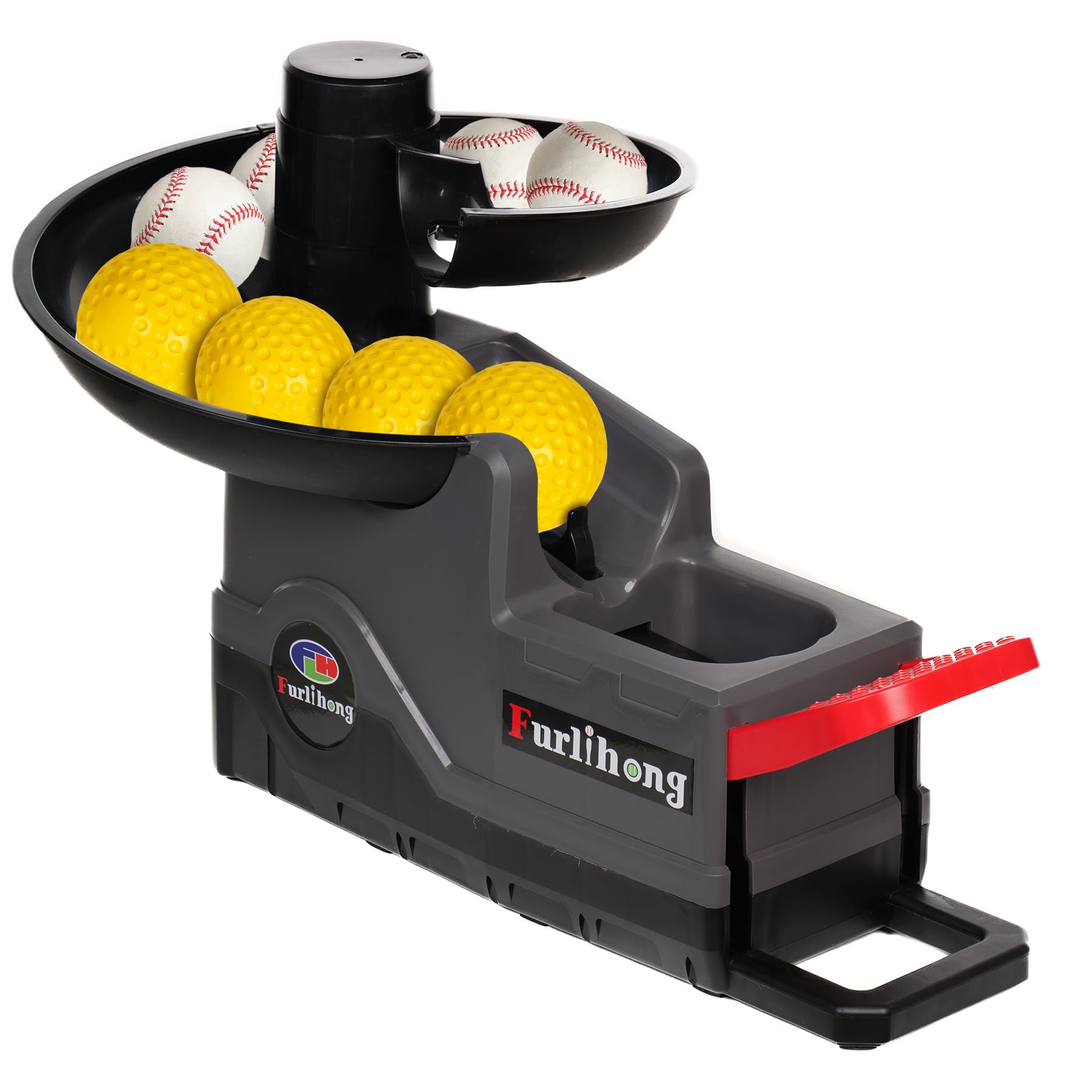
The battery-free tosser that runs on nothing but a tap of your foot.
This is the simplest machine on the list — no batteries, no electricity, no charging. Step on the red pedal and the ball launches in about 5 seconds, powered entirely by your foot. It has 4 adjustable gears, with Levels 1 and 2 tune for baseball and Levels 3 and 4 for softball, so you can tailor the launch to the sport you are practicing. The whole unit weighs just 3.86 kg, making it the most portable option here, and buyers describe assembly as “nearly simple to use.”
It ships as a complete set with 2 ball chutes, 1 PU baseball, and 1 PU softball, so you can start practicing right from the start. It is the entry-level pick, and the plastic construction reflects that. Buyers are honest about its character: it is “a fun and lighthearted toy” at heart, with most actual hitting done with softballs. The red pedal can be finicky — shoppers say “Foot pedal doesn’t always engage,” so it needs a deliberate full press to launch consistently.
The biggest physical contrast in this whole list is here: the Furlihong 691BH ships at just 3.86 kg versus the 18.48 kg of the MOXOW Sagitta, and its 20 x 12 x 10-inch package is roughly 68% more compact — a machine you can stash in a closet between sessions. The trade-off is launch consistency: some owners find launch height, distance, and timing a bit variable. It is the right pick for a budget-conscious family wanting a fun, no-maintenance trainer, not a precision tool.
The honest take: this is a grab-and-go trainer for casual backyard fun with softballs — genuinely useful, but buyers call it “hinky” about launch consistency, so manage expectations on precision.
Best for: a lightweight, budget-friendly first tosser when you are not ready to invest in a battery or wheel machine.
Who should pass: anyone needing consistent, repeatable pitch timing — the pedal engagement demands patience.
7. PowerNet Launch F-lite

The field-friendly launcher built specifically to switch between both sports in seconds.
This wheel machine is engineered for one machine, two sports, with two sets of interchangeable tripod base legs that alter the pitch height when you swap between baseball and softball. It simulates 40-90 mph speeds at a 25-foot distance with four adjustable settings, putting it in genuine batting-practice territory for older kids and adults. It ships with 12 Launch F-lite balls — 6 baseballs and 6 softballs — so you are ready for both sports immediately.
The ball launcher is calibrated to step in as your live pitcher, putting the ball where you want it consistently for both batting practice and fielding drills — pop flies and line drives included. Coaches and parents use it to run batting practice on the field or at home, and buyers report it works great across a wide age range, from a 6-year-old up to 16U players. The speed changes are easy to adjust, which matters when a 6-year-old and an 11-year-old are sharing the same machine in one session.
There is real nuance in the reviews here: the QC is mixed, with some units working perfectly and a few falling short of the advertised speed — buyers measuring with radar reported one unit capped around 27 mph rather than 40-90. Crucially, PowerNet states this machine performs optimally with its own Launch F-lite balls and that using other brands can affect performance and voids the warranty. So read the fine print: the machine is only guaranteed with its proprietary balls.
The smart play: its dual-sport leg design makes it the easiest baseball-to-softball switch in this lineup, if you commit to using PowerNet’s own balls.
Reach for it if: you are a coach or parent running drills for a mixed-age group in both baseball and softball.
Look elsewhere if: you want to use standard regulation balls — this one is locked to the brand’s proprietary balls.
8. Heater Sports Perfect Pitch 45 MPH

A 12-pound mechanical pitcher that throws real baseballs without a single wire.
At just 12 lbs, this is the lightest wheel-style pitching machine in the lineup, and it needs no electricity at all — it is fully mechanical. It pitches real baseballs at speeds from 15 to 45 mph with easy adjustments, and it can handle Lite and plastic baseballs up to 60 mph. For softball players, it pitches slow-pitch softballs with a 15-foot arc, which is a very different trajectory from the baseball pitches and shows genuine versatility.
The design prioritizes safety: there is no tension until the machine is actually under pressure, which minimizes injury risk compared to machines that store energy. Assembly is straightforward per owners, taking roughly 30 minutes with wrenches. The 12-lb weight makes it genuinely portable — carry it to the field, the backyard, or the garage without breaking a sweat, and it breaks down compact for transport.
The honest verdict from owners is split, and it matters: the majority of reviews are positive, with buyers praising it “great for kids 10 and above” for outfielding and groundball work. But a vocal minority had real accuracy problems, describing pitches that went “all over the place” regardless of settings, and one noted it struggled to throw a strike zone for a 5’1″ hitter with 11″/12″ softballs. Weigh that: this is a capable lightweight option for younger players doing fielding drills, but a demanding coach seeking consistent strikes for a taller, older batter may find it frustrating.
Light and unplugged
- Only 12 lbs — the lightest wheel machine here
- No electricity needed; mechanical operation
- Real baseballs at 15-45 mph, up to 60 mph with Lite balls
- Slow-pitch softball arc at 15 feet
Heads up
- Accuracy gets mixed reports — some struggle to hit the zone
- One unit arrived with missing bolts
- Strike-zone consistency varies for taller hitters
Who it fits: a parent wanting a light, unplugged machine for a young player’s fielding and groundball work — ideal for kids 10 and above.
Think twice if: you need a reliable strike-throwing machine for a taller or more advanced hitter.
9. BSN Sports Bulldog Pitching Machine

The coach-grade electric wheel machine that throws baseballs and both softball sizes.
This is the serious field machine for teams, throwing at 30-60 mph and running on 110-volt AC power or a generator with a 1/4 HP DC motor. It handles not just baseballs but both 11-inch and 12-inch softballs, which makes it a true team workhorse. The durable urethane wheel eliminates the air-pressure issues that plague rubber-tube wheels, and the heavy-duty legs are convertible to switch between baseball and softball height setups.
Owners emphasize accuracy, noting it “consistently pitches right down the middle” at speeds up to 60 mph. The metal guard protects the motor from comebackers, which is a smart safety touch for long practice sessions. It weighs 50.6 pounds, so this is a permanent field fixture rather than a carry-around unit — but that solidity is exactly what earns praise for its durable construction and precise speed/height control with no jumping.
Owners mention it outperforms machines costing twice as much, with value for money the top-praised aspect. The trade-offs are real, though: customers note black wheel marks on balls and bats, and the replacement wheel costs a significant portion of the machine’s price, which some buyers find frustrating. Durability gets mixed-to-negative notes about the bolts loosening on some units, and it is not built for curveballs. It also works best with quality leather raised-stitch balls rather than the soft training variety.
Team-grade power
- 30-60 mph with 110V electric or generator power
- Throws baseballs, 11-inch and 12-inch softballs
- Urethane wheel — no air pressure issues
- Metal guard protects motor from line drives
Know the upkeep
- Replacement wheel is pricey — near a third of the unit’s cost
- Black wheel marks appear on balls and bats
- Bolts can loosen with heavy use; check them regularly
- No curveball capability
Ideal for: a coach or serious program needing an accurate, durable, high-speed field machine that handles every ball type.
The cost to know: high upfront price plus periodic wheel replacement — budget for the consumable.
Understanding the Specs
Speed range and what it really means
Speed is the headline spec, but it is the least standardized number in this category. A toss machine “throws” very gently by design — the ball is lobbed, not pitched. A wheel machine spins a rubber wheel to fire the ball at real speed. The same machine can pitch a baseball faster than a heavier softball because the ball’s weight changes how the wheel launches it. Check what ball type the speed rating applies to, and remember a higher top speed is wasted on a young beginner who needs a gentle, consistent toss first.
Ball capacity and chute design
The number of balls a machine holds directly sets your practice rhythm. A bigger hopper or caddy (like 50 baseballs) means more consecutive swings before you walk out to gather balls. Smaller capacities are fine when a coach is feeding balls by hand anyway. The chute matters as much as the capacity — shared chutes can jam, especially with seamed baseballs, while dual chutes let you switch between baseball and softball without reloading. For solo practice, capacity is your best friend; for team drills, a coach’s hand can compensate for a smaller hopper.
Power source and portability
Machines run on batteries, foot power, or wall electric, and each changes where you can practice. Rechargeable battery machines go anywhere and run for hours, but add weight and need charging between sessions. Foot-operated machines are lightest and simplest, but rely on your pedal press for timing and consistency. Electric wheel machines throw the hardest and fastest, but need a 110V outlet or a generator — which usually means you are practicing near a building or carting a generator to the field. Match the power source to where you actually practice, not where you wish you could.
Weight and stability trade-off
There is a direct relationship between weight and how steady a machine stays through a pitching session. Light machines (around 12 lbs or less) are easy to carry but can creep forward or wobble on uneven ground, especially at higher speeds. Heavy steel machines (50 lbs and up) hold their position and throw more consistently, but they are a chore to move and need space to stay set up. Toss machines split the difference — most are light enough to move easily while still stable enough for their gentle lobs. Decide if you are hauling it each session or leaving it in place, then let that answer pick the weight class.
FAQ
Is a toss machine or a wheel pitching machine better for my child?
How many balls should the machine hold?
Can the same machine really throw both baseballs and softballs?
Does a pitching machine need electricity or batteries?
What speed range does my young player actually need?
Is it worth paying more for a steel-framed machine?
Will a pitching machine damage real baseballs or softballs?
What is the difference between fastballs, curveballs, and soft toss on a machine?
How much space do I need to practice safely with a pitching machine?
Final Thoughts: The Verdict
For the majority of shoppers, the baseball and softball pitching machine winner is the Jugs Toss Machine because its 8-hour battery life and durable build make it the machine families and coaches can rely on for years of daily reps. If you want a complete home station without buying extras separately, the MOXOW Sagitta bundles in a 50-ball caddy and a 7×6 ft protective screen. And for game-speed accuracy that impresses even a 10U coach, the Mound Yeti delivers consistent 30-60 mph pitches with the highest owner satisfaction in the wheel-machine tier.
How We Picked
We do not accept paid placement. Every pick is matched to a real buyer and a real use-case; we do not hands-on test units.
Sources & Methodology
Specifications: manufacturer listings and product documentation. Review insights: verified customer reviews, as of August 2026. Pricing: not shown on this page (it changes often); check the current price via the retailer link.
As an Amazon Associate, Gadgets Feed earns from qualifying purchases. This does not affect which products we feature.