
Our readers keep the lights on and my morning glass full of iced black tea. As an Amazon Associate, I earn from qualifying purchases.
Specs are compiled from manufacturer listings and verified buyer reviews and can change over time — please confirm the key details on the product page before buying.
Every rattle, hum, and exhaust drone is a leak in the driving experience, and the fix starts with the right sound deadening. The real question is which material and thickness fits your budget and DIY patience. This guide covers top options from budget butyl rolls to premium multi-layer composites, so you can hear your music over the road.
I’m Min — the founder and writer behind Gadgets Feed. This guide is built by comparing the manufacturers’ published specifications and the patterns across verified customer reviews, so you get each pick’s real strengths and trade-offs instead of marketing spin.
We’ve matched seven top-rated mats to specific use cases, from a flagship 157-MIL composite to value-priced rolls, all so you can confidently choose the best car audio sound deadening for your ride.
Our Picks at a Glance


How To Choose The Best Car Audio Sound Deadening
Before you buy, match the material to the job: butyl mats add weight to stop panel vibration, while closed-cell foam blocks airborne noise and heat. Most serious installs use both, so decide what you’re fighting first.
Butyl vs. Closed-Cell Foam
Butyl rubber mats (the heavy, foil-backed sheets) are for damping — they convert panel vibration into heat, so doors feel solid and bass stops rattling. Closed-cell foam (the lighter, flexible layer) is for blocking — it stops sound waves from passing through and insulates against heat. For a quiet car, you usually want the butyl on the metal and foam on top.
Thickness and Coverage
Thickness is measured in mils (one mil is one-thousandth of an inch), and it directly affects how much vibration gets killed. Check the square footage per roll to see if it covers your doors, trunk, and floor — a full sedan needs about 36 square feet for doors and trunk.
Quick Comparison
| Model | Best For | Thickness | Coverage | Material | Amazon |
|---|---|---|---|---|---|
| KILMAT 80 mil★ Best Overall | Overall Value | 80 mil | 36 sq ft | Butyl + Foil | Amazon |
| VOISEN 157 milHeat Blocker | Heat & Noise Block | 157 mil | 36 sq ft | Closed-Cell Foam | Amazon |
| CUKWUYBY 80 mil | Rattle Control | 80 mil | 36 sq ft | Butyl + 8-Wire Foil | Amazon |
| Second Skin Damplifier Pro | Pro-Grade Damping | 2 mm | 5 sq ft | Butyl + Annealed Foil | Amazon |
| Siless Black 80 mil | Classic Truck Builds | 80 mil / 2 mm | 36 sq ft | Bmastic Butyl | Amazon |
| Siless Hybrid 3in1 | All-in-One Barrier | 200 mil / 5 mm | 25 sq ft | Butyl + Foam + Mass Loaded | Amazon |
| Dynamat Xtreme Tech Pack | Trusted Premium Name | — | 28 sq ft | Butyl | Amazon |
In‑Depth Reviews
1. KILMAT 80 mil 36 sqft Car Sound Deadening Mat
Our pick — over 4.5★ from 26,000+ verified ratings; the strongest balance of quality and price.
The crowd-favorite roll that silences rattles without emptying your wallet
KILMAT earns its benchmark spot because its 80-mil (about 2mm thick) butyl sheet weighs 0.5 lbs per square foot, and that mass is what stops your door panels from ringing. Buyers report a 36 sq ft roll covers two trunks (a Mazda 3 and a Civic Si) with room to spare, and the indented squares on the foil make measuring and cutting with a box cutter a quick job.
The adhesive is the standout here — it sticks hard to bare metal and doesn’t peel after the car heats up. One owner who removed the resonator from a 2000 Monte Carlo summed up the effect: “Kilmat made a huge difference in the noise.” You get the noise-killing benefit at a budget-friendly price, so you don’t pay a premium for the same butyl chemistry.
What wins people over is the sheer noise reduction — it’s the most-praised feature — with adhesion and value for money close behind. The recurring note is that it’s work to install: rolling it flat takes elbow grease. Compared to the thicker Siless Hybrid 3in1 below, this is a pure damping mat, so pair it with foam if you want to block heat too.
Why It Wins Owners Over
- Noise reduction is the top praise
- Strong adhesion that survives heat
- Easy to cut and measure
What Takes Effort
- Installation is labor-intensive
- Not a heat barrier on its own
The smart first move: this is the all-around pick for anyone doing their first full doors-and-trunk install with proven results.
Think twice if: you need a single product to also block engine heat — you’ll want a foam layer on top.
2. VOISEN 157 mil 36 sqft Sound Deadening Mat
A 157-MIL closed-cell foam layer that blocks heat and highway roar together
This isn’t another butyl mat — it’s a 4mm (157.48 mil) high-density closed-cell foam that does double duty as a sound blocker and a heat barrier, it blocks 98% of radiant heat transfer. That makes it the right tool when your floor or firewall radiates summer engine heat into the cabin, a job butyl alone can’t do.
Owners say a single layer of this 36 sq ft roll produces a “noticeable drop in road noise, vibration, rattles on highway and towing” while also cleaning up the audio with better bass. Because it’s a foam layer, the smart play is to pair it with a butyl damper like the KILMAT above for a fully quiet cabin.
The easiest part of this product is installation — that’s the top praise here — and it’s flexible enough to follow curves and 30-year-old painted metal. The honest caveat: the adhesive gets messy in heat and the foil can tear when you’re repositioning, so plan your cuts before you peel.
The dual-purpose layer: this is the heat-and-noise blocker you stack on top of butyl for a complete install.
Watch the install: strong adhesive means you get one shot at placement, especially on warm days.
3. CUKWUYBY 80 mil 36 sqft Sound Deadening Mat
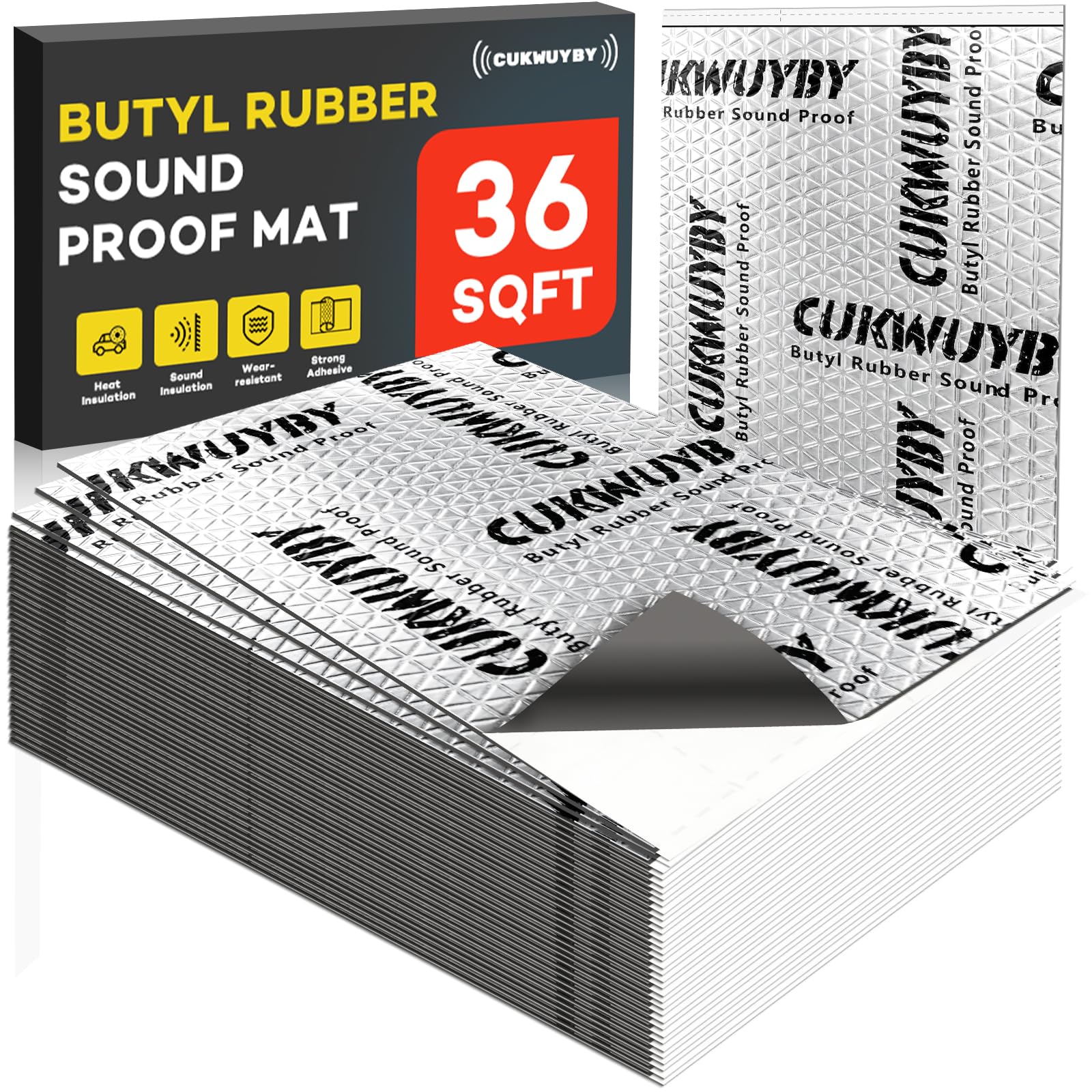
For aftermarket audio, this 80-MIL butyl sheet kills the rattles that ruin bass
If you just installed a powerful subwoofer and the doors are buzzing, this 3-layer 80mil mat is your fix. The 8-wire aluminum foil reflects heat while the butyl rubber core absorbs vibration, and a 36 sqft roll with 33 pre-cut pieces covers all your doors plus the trunk with ease. On a 2018 Durango with aftermarket audio, a single box eliminated severe rattling across the back gate and all doors.
The build quality is the most-praised feature here, and the high-tack adhesive is the second — owners note it sticks well even in 20-degree weather, and “removes paint if removed,” which tells you how firmly it bonds. It’s a great value option that one F-150 owner called “great quality and value for the money.” Another owner on a camper said it “made a hell of a difference.”
The trade-off is that thickness gets mixed feedback — it’s exactly an 80-mil sheet, so it’s not the thickest material out there. For a serious audio build with heavy bass, you may want to double up or move to the Siless Hybrid below, but for everyday rattle control this is a top recommendation.
The Strong Points
- Quality construction is the top praise
- Adhesive that holds in cold weather
- Pre-cut lines make cutting fast
The Limits
- Thickness is standard, not max
- Foil can lift on tight bends
The audio-build ally: reach for this when your main goal is stopping door and trunk rattles from your subwoofer.
Not for the extremes: if you want maximum heat blocking, this butyl sheet won’t deliver the same thermal barrier as a foam layer.
4. Second Skin Damplifier Pro (2mm)

A 2mm butyl tile with a 450°F heat rating that pros reach for over Dynamat
This is the specialist’s choice: Damplifier Pro uses a constrained layer of butyl rubber and annealed foil to damp vibration, and it carries a 450°F heat rating. That means it’s safe for firewalls and engine compartments where thinner mats would soften and sag. It’s made in the USA, which is why installers and hot rod builders trust it for anything loud and metal.
What makes it addictive is the feel — owners describe it as thicker and heavier than Dynamat, with a matte black foil that sticks firmly on the first try and rigidly holds its shape. One Honda Accord owner said “the moment I touch this stuff, I can feel it is a very high quality material.” The noise reduction is the top praise, and it also wins on being odorless even when the car heats up.
The catch is the size: this 5 sq ft pack comes as six 12″ x 10″ tiles, so it’s a premium pick for spot-treating problem panels rather than covering a whole floor. Know that it’s a vibration damper, not a noise blocker — owners advise covering 25-35% of a panel’s surface for 90% of the benefit, then layering foam and mass-loaded vinyl on top for full sound blocking.
The premium dampener: this is for the build where you want the best-feeling, most sturdy butyl tile on the market.
Budget check: the small 5 sq ft pack covers less area than the budget rolls, so factor that in for a full-car job.
5. Siless Black 80 mil (2mm) 36 sqft

The black 2mm favorite that has held up for years in hot classic trucks
Siless has earned a loyal following for its 80-mil (2mm) black butyl mat, and the proof is in longevity: owners mention running it in multiple cars and trucks for over five years with zero issues, including a 1951 Ford roof that survived years of North Carolina heat without sagging or releasing. The black finish is a bonus — it looks factory-clean in a visible trunk.
The functional performance is the top praise here, with noise level reduction close behind. One classic truck owner doubled it up to quiet the cab and kill exhaust drone, and noted the heat retention is great. It’s branded a “Bmastic” formula, and the peel-and-place application means no messy spray adhesives — just trim, peel, and hand-roll.
The honest note is that thickness gets mixed opinions — at exactly 2mm, some find it perfect while others describe it as thin. On vertical surfaces it works particularly well, which is exactly where you need the adhesive to hold. If you want a 36 sqft roll of proven, heat-tested butyl without paying a premium brand tax, this is the one.
What It Does Best
- Functionality is the top praise
- Holds on vertical surfaces
- Proven long-term durability
What To Know
- Thickness reads thin to some
- No roller included in the box
The classic-truck companion: grab this when you need a big 36 sqft roll that you know will hold up in heat for years.
Look elsewhere if: you want maximum thickness in a single layer — this is a standard 2mm sheet.
6. Siless Hybrid 3in1 200 mil 25 sqft

A 200-MIL three-layer barrier that kills low-frequency drone and heat in one step
The Siless Hybrid is the heavyweight of this list: a 200-mil (5mm) composite that layers Butyl Mastic, PE Foam, and Mass Loaded Butyl Membrane to solve three problems at once — vibration, heat, and low-frequency noise. This is the single-product answer for anyone who wants to dampen, insulate, and block in one pass rather than buying separate butyl and foam rolls.
Owners who used 40-50 sq ft across four vehicles said it cut cabin noise drastically and made the exhaust “barely audible,” calling it better than Dynamat for the price. Rain noise is the top thing customers note it fixing, and the 25 sqft coverage paired with a price tag gives it a strong value story versus pricier branded options.
The soft, flexible composite cuts easily with scissors — no hand fatigue — but the adhesive is almost too sticky: it gets tacky in hot weather and the backing is hard to remove until it cools. My verdict: reach for this when you want one material to do the whole job, but apply it on a cool morning.
The one-and-done solution: this is the pick if you’d rather install a single 5mm barrier than layer butyl plus foam separately.
The sticky catch: the aggressive adhesive makes hot-weather installation a chore, so plan for cooler temps.
7. Dynamat Xtreme Tech Pack

The original 1989 butyl name that still anchors pro builds with 28 sqft of coverage
Dynamat is the brand that defined this category, made in the USA since 1989, and the Xtreme Tech Pack delivers 28 square feet across seven 18″ x 32″ sheets. The proprietary butyl blend is extra sticky, adhering to a surface and staying put through heat and vibration — which is exactly why custom builders and hot rodders have trusted it for decades.
Owners describe a “night and day difference” in sound quality, and for a Tundra owner doing doors, it was worth the premium spend. The peel-and-stick install is thin, flexible, and easy to cut, so it conforms to floors, panels, hoods, and trunks without fighting you. The noise and heat reduction is the consistent thread across the feedback.
If you want a trusted, straightforward butyl install and aren’t chasing the cheapest per-square-foot price, Dynamat remains a safe, proven choice.
The Heritage Advantage
- Made in USA since 1989
- Extra-sticky butyl blend
- Thin and flexible to cut
The Premium Factor
- Higher cost per square foot
- Less coverage than budget rolls
The brand-name assurance: this is for buyers who want the original, trusted material and don’t mind paying a premium for it.
Choose budget if: you need maximum square footage for your dollar, since this pack covers less than the 36 sqft rolls above.
Understanding the Specs
Mils and Millimeters
Thickness is measured in mils (where one mil is one-thousandth of an inch) or millimeters. An 80-mil sheet equals 2mm, while the Siless Hybrid’s 200 mil equals 5mm. Thicker usually means better vibration damping and heat blocking, but it’s also heavier and less flexible, so thicker isn’t always easier to install on curved panels.
Butyl vs. Closed-Cell Foam
Butyl rubber mats add mass to stop metal panels from vibrating — that’s the “damping” part. Closed-cell foam (like the VOISEN above) is a different job: it blocks airborne sound and radiant heat. For the best results, pros use butyl on the metal and foam on top, so a composite like the Siless Hybrid combines both in one layer.
FAQ
How much sound deadening do I need for my car doors?
Should I pair butyl with closed-cell foam?
Will sound deadening help with my subwoofer rattling?
Does thicker sound deadening always perform better?
Is the 200-mil Siless Hybrid worth more than separate butyl and foam?
Can sound deadening reduce heat from the engine and exhaust?
How long does sound deadening last on a car?
What’s the difference between damping and blocking noise?
Will sound deadening improve my car audio quality?
How do I install a peel-and-stick sound deadening mat?
Final Thoughts: The Verdict
Across the board, the car audio sound deadening winner is the KILMAT 80 mil because it pairs proven, high-adhesion butyl with a huge 36 sqft roll at a budget-friendly price. If you want a single layer that also blocks heat and low-frequency drone, grab the Siless Hybrid 3in1 instead. And for spot-treating problem panels on a serious audio build, the Second Skin Damplifier Pro is the premium tile to reach for.
How We Picked
We do not accept paid placement. Every pick is matched to a real buyer and a real use-case; we do not hands-on test units.
Sources & Methodology
Specifications: manufacturer listings and product documentation. Review insights: verified customer reviews, as of August 2026. Pricing: not shown on this page (it changes often); check the current price via the retailer link.
As an Amazon Associate, Gadgets Feed earns from qualifying purchases. This does not affect which products we feature.