
Roasting coffee at home starts with a simple promise: the freshest cup you’ve ever tasted. But the path from green bean to perfect pour is lined with smoke, chaff, and the risk of scorching an entire batch in seconds. An air popper offers a uniquely fast, visible, and hands-on method to develop those delicate bean sugars, letting you hear the first crack and smell the exact moment the roast is ready — all without burying your kitchen in haze.
I’m Min — the co-founder and writer behind Gadgets Feed. I spend my days analyzing small-kitchen appliance specs, decoding customer longevity data, and mapping the real-world heat curves that separate a consistent roaster from a frustrating one. (And Homer 🐱 supervised every decibel test from the warm lid of the SR540 — his tail flicked only when the chaff basket rattled just right).
Whether you are chasing a light Ethiopian floral note or a dark Sumatran body, the right machine hinges on capacity, temperature control, and airflow precision. This guide breaks down seven top contenders to help you confidently choose the air popper for roasting coffee that fits your countertop and your taste.
How To Choose The Best Air Popper For Roasting Coffee
Selecting an air popper is different from buying a standard coffee maker. You are evaluating a controlled heat chamber that must circulate beans at the right velocity while you listen for the acoustic cues of first and second crack. The following factors will determine whether your roasts come out even or scorched.
Batch Capacity and Power
Most home fluid-bed roasters handle between 100 and 300 grams of green beans per batch. A higher wattage (1000W to 1500W) shortens the drying phase and gives you more thermal headroom to reach second crack without stalling. If you roast weekly for two coffee drinkers, a 180–220g capacity strikes the best balance between speed and countertop footprint.
Temperature Range and Control
The ideal roasting window spans roughly 200°C to 240°C, but real-time accuracy matters more than the max dial. Units with digital temperature displays and adjustable fan speeds let you dial in a specific drying curve and then drop the heat as sugars develop. Semi-automatic profiles with pre-sets help beginners, while manual fan-and-heat knobs appeal to those who want to replicate a favorite profile batch after batch.
Chaff Management and Ventilation
All air poppers generate chaff — the papery skin that separates from the bean during the expansion phase. A well-designed chaff collector or basket catches most of the debris before it ends up on your counter. Units that route exhaust through a top filter or a built-in collection tray reduce smoke and keep the roasting area cleaner. If you plan to roast indoors often, look for an ultra-low smoke claim paired with a sealed chaff compartment.
Build Quality and Support
Consumer reviews consistently report that stir arms, heating elements, and control boards are the first components to fail on budget roasters. A machine with a metal or heavy-duty heat-resistant chassis and a brand that offers post-warranty repairs or replacement parts will outlast a unit built entirely from thin plastic. Reading three-month and one-year failure patterns in verified reviews is the most reliable way to gauge longevity.
Quick Comparison
On smaller screens, swipe sideways to see the full table.
| Model | Category | Best For | Key Spec | Amazon |
|---|---|---|---|---|
| Fresh Roast SR800 | Premium Fluid Bed | Consistent 8 oz batches | 226g capacity, 9 power levels | Amazon |
| Fresh Roast SR540 | Mid-Range Fluid Bed | Compact daily roasting | 120g capacity, 9 fan/heat settings | Amazon |
| MAGO MAGA Roma Pro | Smart Fluid Bed | Beginner auto-mode roasting | 300g capacity, auto/manual modes | Amazon |
| ANGELLOONG Upgrade | Large Capacity | 750g batches, multi-bean use | 1200W, 0-240°C temp range | Amazon |
| JIAWANSHUN Electric | Value Fluid Bed | Up to 500g batches, nuts/seeds | 1200W, 100-240°C, 800g cap | Amazon |
| GIVEROO 500g | Entry-Level Electric | Learning the roasting process | 800W, 0-240°C temp control | Amazon |
| CAFEMASY Mesh Pan | Manual Stovetop | Outdoor / camping roasting | Stainless steel mesh, 120g cap | Amazon |
In‑Depth Reviews
1. Fresh Roast SR800 Coffee Roaster
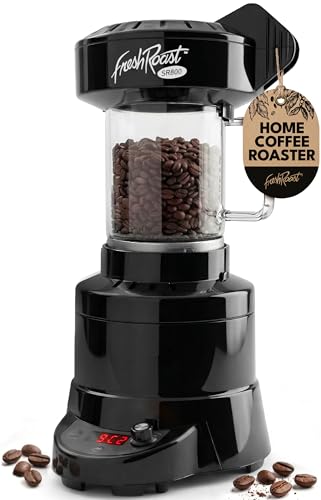
The SR800 is the sweet spot for anyone who wants batch sizes closer to half a pound without stepping into commercial territory. At 226 grams of wet-processed green beans per run, it doubles the capacity of the SR540 while keeping the same proven fluid-bed architecture. The nine-level power and fan settings let you shape a roasting profile with fine granularity, and the real-time digital temperature display removes the guesswork from the drying and development phases. Experienced roasters report finishing a full batch in 8 to 10 minutes with even bean coloration from edge to edge.
The control interface uses a push-and-turn knob that adjusts heat, fan speed, and timer — a design that works well until it doesn’t. Some users report that the button becomes temperamental after two to three years of regular use, making it harder to fine-tune mid-batch. The glass roasting chamber is easy to clean, but the top plastic chaff basket can crack if handled carelessly, and replacement parts are not always in stock. Despite these quirks, the SR800 regularly outlasts cheaper competitors, with multiple verified owners logging over four years of weekly roasting before needing a repair — and the company offers a flat-fee repair service even after warranty expires.
Where the SR800 truly shines is consistency. Owners who pair it with an infrared temperature gun report being able to replicate their favorite profile down to the degree. The machine handles light Ethiopian naturals and dark Sumatran wet-hulls with equal stability, as long as you stay within the recommended 170–180g range in colder ambient conditions. For a household that goes through a pound of coffee every week, this roaster pays for itself in a few months versus store-bought specialty beans — and the freshness gap is undeniable.
Why it’s great
- Batch capacity (226g) is ideal for 2–3 daily coffee drinkers
- Real-time digital temperature display aids profile replication
- Long lifespan with flat-fee post-warranty repair option
Good to know
- Control knob may degrade after 2–3 years of heavy use
- Top chaff basket is fragile if not handled gently
- Underpowered in cold weather; best to reduce batch to 170g
2. Fresh Roast SR540 Automatic Coffee Bean Roaster
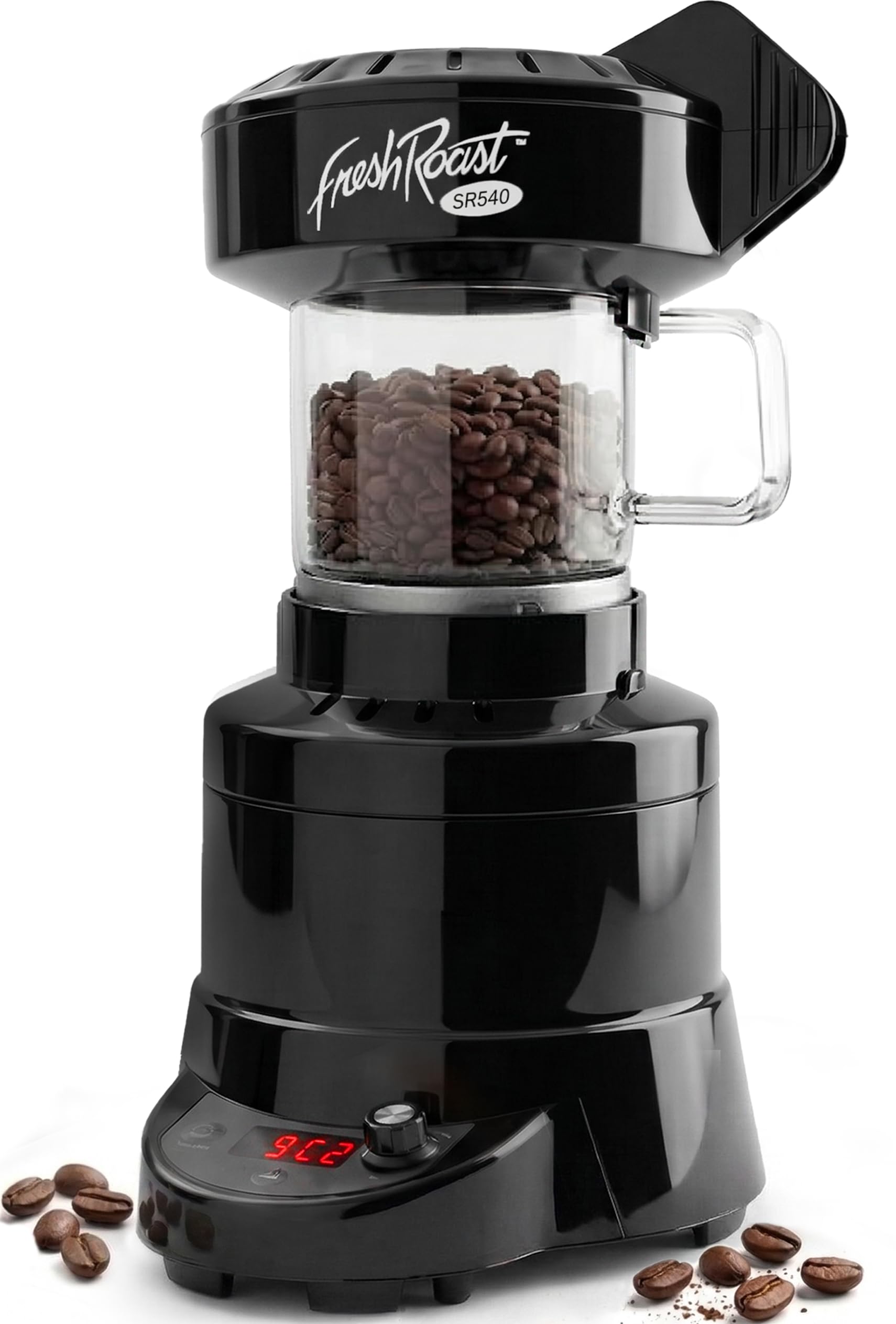
The SR540 is a streamlined version of the SR800, sharing the same fluid-bed convection system but scaled down to a 120-gram maximum batch (about 4 scoops of green beans). That makes it a natural fit for a single dedicated coffee drinker or for someone who wants to experiment with small lots of different origins without committing to a full pound. The glass roasting chamber gives you a clear view of the beans as they tumble, and the nine-level power and fan controls provide enough range to move through drying, browning, and development at your own pace.
Operation is straightforward: set your fan speed to keep the beans suspended, dial in the heat, and listen for first crack — which typically hits between 7 and 9 minutes depending on ambient temperature and bean density. The analog knobs are responsive but not digital, so reproducing a profile batch after batch requires taking notes on knob positions rather than saving a program. The chaff basket fits over the top of the glass chamber and catches the bulk of the silverskin, though some fine dust does escape into the air. Owners who roast outdoors or under a range hood report minimal smoke nuisance.
Durability is a strong suit here. Multiple verified customers report wearing out their first SR540 after hundreds of batches only to buy a second one — a reliable sign that the value proposition holds up. The company has also been known to send free replacement motherboards to users experiencing control issues, even beyond the standard warranty window. For someone entering home roasting on a moderate budget, the SR540 offers a forgiving learning curve and enough precision to produce cafe-quality light, medium, and dark roasts without overwhelming the countertop.
Why it’s great
- Clear glass chamber gives excellent visual feedback during roast
- Nine heat and fan settings offer solid profile control
- Brand has a strong reputation for post-warranty support
Good to know
- Limited to 120g wet-processed green beans per batch
- Analog knobs lack programmability for perfect replication
- Some chaff escapes into the air during roasting
3. MAGO MAGA Roma Pro Smart Home Coffee Bean Roaster
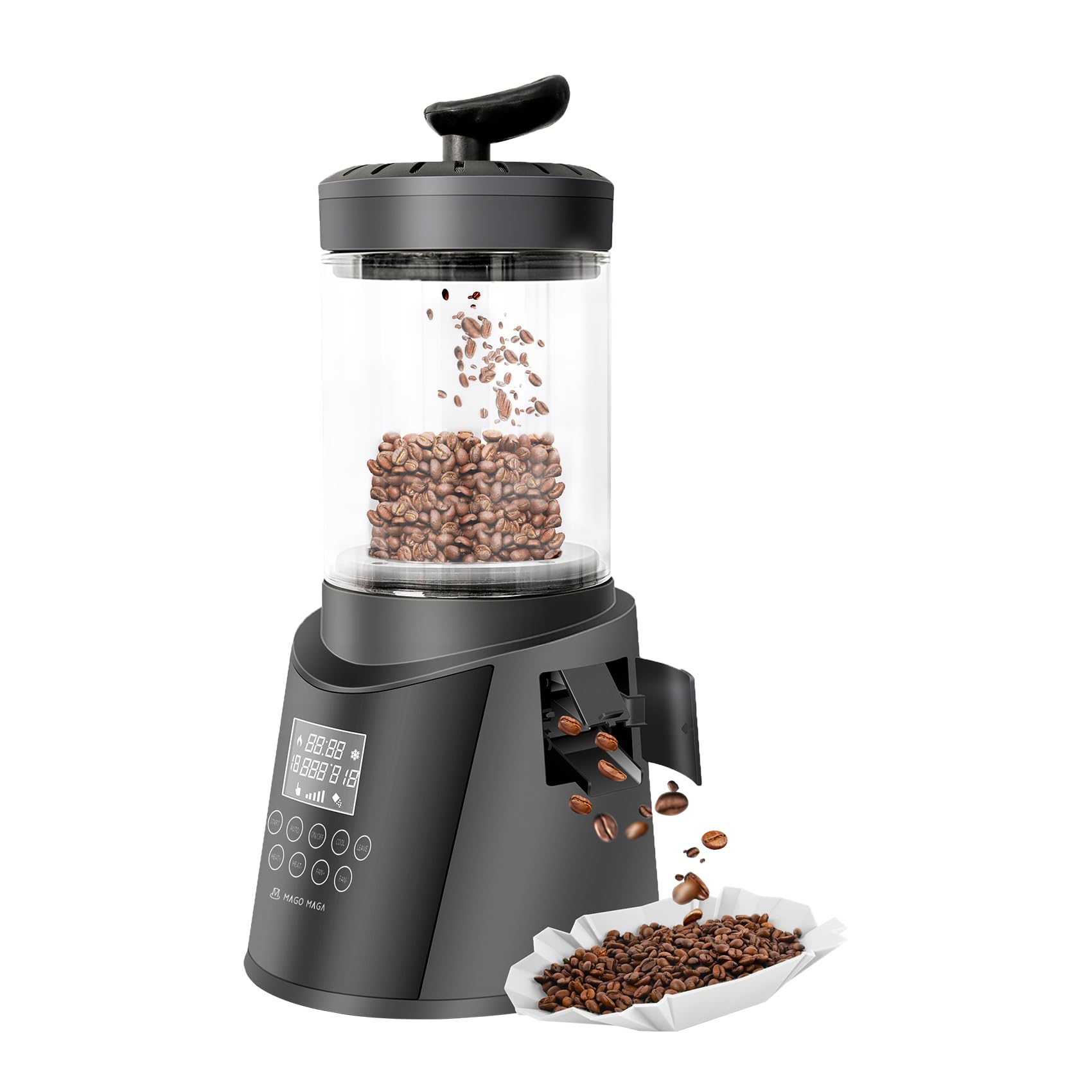
The Roma Pro is the only machine in this lineup that offers a genuine auto-roasting mode, making it the most accessible entry point for someone who has never heard first crack in person. Pop in up to 300 grams of green beans, select the auto profile, and the machine handles the heat curve from drying through cooling with minimal intervention. A double-layer glass window lets you watch the beans tumble, and the integrated chaff collector and auto-cooling cycle keep smoke and mess to an impressively low level for a hot-air roaster.
Manual mode is available for when you want to take the reins — you can set your own temperature and time targets within the 100–240°C range. The digital display shows both Celsius and Fahrenheit, and the interface is intuitive enough to adjust on the fly. That said, some users report that the US 120V version of the auto profiles runs slower than expected, and the recommended sweet spot for even roasts is closer to 250g rather than the full 300g. Decaf beans, in particular, benefit from manual mode because their density throws off the pre-programmed curve.
Ownership experience is mixed on longevity. A handful of buyers report the heating element failing after 50 pounds of roasted coffee (around 4–6 months of weekly use), while others have logged a full year without issues. The vendor appears responsive to replacements when problems arise, but the failure rate is higher than the Fresh Roast line. If you prioritize convenience and plan to roast smaller, more frequent batches, the Roma Pro delivers the easiest path from green bean to cup — provided you are comfortable with the risk of a shorter service life than the premium alternatives.
Why it’s great
- Auto-roasting profile is genuinely beginner-friendly
- Ultra-low smoke design with efficient chaff collection
- Auto-cooling cycle locks in flavor without extra gear
Good to know
- Auto mode runs slowly on 120V; manual profiles are often better
- Reported heating element failures after 4–6 months for heavy users
- Optimal batch is 250g, not the advertised 300g
4. ANGELLOONG Upgrade Home Coffee Bean Roaster Machine

The ANGELLOONG Upgrade distinguishes itself with a 750-gram roasting chamber that is roughly three times larger than the Fresh Roast SR800 and double the Roma Pro. If you regularly roast for a household of four or more, or if you want to do one big weekly batch and be done, this machine saves considerable time. The 1200W heating element and adjustable thermostat (100–240°C) give it enough thermal mass to push through a heavy load, and the transparent cover lets you track color development through the full cycle.
Operation is simple: set the timer and temperature, then let the built-in agitator rotate the beans. The interior has a honeycomb non-stick coating that helps heat distribution and makes cleanup straightforward with a damp cloth. Users aiming for a City or Full City roast report using 300–320g of beans at 220–240°C for about 25 minutes. The learning curve is shorter than a manual pan but longer than the Fresh Roast fluid-bed machines, because the agitator arm can occasionally catch small or broken beans and stall — requiring you to pause and free them manually. Some owners also bend the fixed arm slightly closer to the bottom to ensure it sweeps all beans evenly.
Build quality reports are split. The first unit from a number of buyers lasted two years of monthly use before the heating element died — a common failure point in this price tier. Others report their unit going strong past three years when used weekly. The ANGELLOONG lacks the layered fan control of a true fluid-bed roaster, so smoke is more noticeable, and you will need a metal colander and a fan for proper cooling. But for the sheer volume per batch, it has few rivals in the mid-range category.
Why it’s great
- Massive 750g capacity for high-volume weekly roasting
- 1200W heater and wide temperature range (100–240°C)
- Non-stick honeycomb interior is easy to clean
Good to know
- Agitator arm can jam on small or broken beans
- Heating element longevity is inconsistent (1–3 years reported)
- No integrated cooling fan; requires external colander setup
5. JIAWANSHUN Electric Coffee Bean Roaster

The JIAWANSHUN roaster is built around a 1200W heating core and a recommended roasting range of 300–500g, with an absolute capacity of 800g if you are willing to stir manually. The temperature dial spans 100–240°C, and the included timer lets you set a bake length and walk away — though the stirring arm needs the occasional nudge when small beans get trapped. The transparent glass lid with four ventilation holes gives you a clear line of sight to the beans as they progress from pale green to golden to brown.
Owners who push the machine to its limits find that 300g batches produce the most consistent results. The automatic mixing stirrer rotates the beans at a steady pace, but the design uses wire arms that can warp over time and stop spinning freely — a known failure point after 8–12 months of heavy use. The heating element itself has also been reported to fail due to a weak crimp connection. On the positive side, the machine doubles as a nut and seed roaster, and the non-stick honeycomb interior wipes clean quickly. Several users mention that roasting outside or under a range hood is necessary because the machine generates a lingering smell and noticeable noise.
For the price point, the JIAWANSHUN delivers a surprisingly large batch capacity and enough temperature granularity to explore different roast levels. It is best suited for a budget-conscious beginner who plans to roast at most once per week and is comfortable tinkering with the stirring mechanism. The consensus among long-term reviewers is that you get what you pay for — the unit will likely serve you for one to two years, after which the economics still favor replacing it over buying pre-roasted beans at retail prices.
Why it’s great
- Large effective batch size (300–500g) for the price tier
- Transparent lid and built-in timer simplify monitoring
- Also roasts nuts, seeds, and popcorn
Good to know
- Stirring wire arms can warp or jam after months of use
- Heating element connection (crimp) is a known weak point
- Generates noticeable smoke and smell — best used outdoors
6. GIVEROO 500g Coffee Bean Roaster

The GIVEROO 500g is the lowest-wattage electric roaster in this roundup at 800W, which means the drying phase takes longer and you have less thermal reserve to push through a large batch. The recommended load for even results is around 300–500g, but many users report the best performance with a single pound (454g) at 220°C for approximately 23 minutes, with manual stirring every five to six minutes to prevent hot spots. The straight-sided glass chamber provides decent surface contact, and the transparent lid lets you watch the color shift in real time.
Where this machine stands out is its value-to-longevity ratio. One verified reviewer reported roasting over 200 pounds of coffee over three and a half years before the unit failed — an impressive run for an entry-level appliance. The stirrer arm is simpler than the JIAWANSHUN design and tends to be more reliable, though it can still pinch very small beans. Retired commercial roasters have noted that the straight pan shape improves heat distribution compared to domed competitors, and the slower rotation speed helps maintain uniform bean contact. On the downside, there is no integrated chaff collection, so smoke and debris are unavoidable — plan to use this machine outdoors or under a heavy-duty range hood.
The controls are basic: a temperature knob and a timer. You cannot save profiles, and the lack of a cooling cycle means you will need to dump the hot beans into a colander and fan them manually. But the raw performance data from long-term owners suggests this machine can teach you the fundamentals of heat application and crack timing before you decide to invest in a higher-end fluid bed roaster.
Why it’s great
- Exceptional longevity reported (3.5+ years for some users)
- Straight-sided pan improves heat distribution over domed designs
- Affordable entry point for learning the roasting basics
Good to know
- 800W is underpowered; requires manual stirring for even roasts
- No integrated chaff collection — heavy smoke outdoors only
- Stirrer arm can catch small beans; may need manual clearing
7. CAFEMASY Portable Stainless Steel Coffee Roaster Pan

The CAFEMASY is not a machine — it is a stainless steel mesh pan with a long wooden handle and an included thermometer, designed to be used on a gas stove, electric ceramic burner, or open campfire. The mesh construction lets you watch the beans change color directly through the wire, and the thermometer probe gives you live temperature feedback. The recommended batch size is 120 grams (4.23 ounces), roughly a single layer of beans, which roasts in 10 to 15 minutes depending on flame height and your shaking rhythm. This is the purest hands-on method: you control every variable by shaking the pan and adjusting the burner.
The corrugated bottom helps tumble the beans as you shake, preventing scorch marks on the side that contacts the heat. The wooden handle stays cool enough to hold for a full 15-minute roast session. However, the smoke output is significant — the manufacturer explicitly warns that the pan will trigger smoke alarms if used indoors, making it effectively an outdoor-only tool for most home roasters. First crack is audible around the 9-minute mark with a medium flame, and you can push through to second crack by keeping the pan moving and monitoring the thermometer. Cleanup is straightforward: a rinse with warm water and air drying.
This pan is not a replacement for a dedicated electric roaster, but it serves a specific niche: the backpacker, the camper, or the purist who wants to understand the relationship between heat, motion, and bean development at a tactile level. The learning curve is steep — several first-time users report burning their initial batch before figuring out the right flame height and shaking speed. But once dialed in, the CAFEMASY produces respectable light to medium roasts that preserve delicate origin flavors. It is the most affordable way to start roasting coffee, provided you accept the modest batch size and the hands-on labor.
Why it’s great
- Minimalist, portable, and works on any open flame
- Thermometer included for live temperature monitoring
- Easy to clean and store; dishwasher safe
Good to know
- Significant smoke production — must be used outdoors
- Steep learning curve; first attempts often result in burnt beans
- Small 120g batch size requires frequent roasting
FAQ
Can I use a regular popcorn air popper for roasting coffee?
What is the difference between first crack and second crack?
How long should I let freshly roasted beans rest before brewing?
Final Thoughts: The Verdict
For most users, the air popper for roasting coffee winner is the Fresh Roast SR800 because it offers the best combination of batch size, real-time temperature visibility, and long-term reliability at a price that saves you money within months. If you want a compact footprint that still delivers consistent results for a single drinker, grab the Fresh Roast SR540. And for an ultra-convenient automated experience with the largest single-batch capacity in this guide, nothing beats the MAGO MAGA Roma Pro — just be prepared for a potentially shorter service life than the Fresh Roast alternatives.