
There was a decade when mixing consoles stopped being mere tools and became legends. The 1980s marked the golden age of analog circuitry, where every fader push introduced a subtle warmth and every preamp stage contributed a musical coloration that digital emulations still chase today. Whether you’re tracking a live band, building a home studio around a vintage core, or hunting for that unmistakable glue that made records sound alive, the 1980s mixing console represents a sonic fingerprint that modern gear rarely replicates.
I’m Min — the co-founder and writer behind Gadgets Feed. I’ve spent years studying the topology, transformer specs, and gain stage architectures that define these vintage consoles, mapping their lineage from broadcast desks to live-sound workhorses..
This guide cuts through the nostalgia to deliver the best 1980s mixing consoles that actually earn their place in a modern signal chain — balancing character, reliability, and the raw headroom that defined an era.
How To Choose The Best 1980s Mixing Console
Selecting a vintage console from this era requires more than just looking at channel counts. The 1980s were a transitional period — some desks used discrete transistor stages that deliver the creamy saturation everyone craves, while others leaned on early integrated circuits that can sound sterile if the design was cost-reduced. Understanding the architecture behind the brand name is the first step to finding a keeper.
Preamp Topology: Discrete vs. IC-Based
The single biggest predictor of an 80s console’s sonic character is what’s inside the preamp stage. Discrete preamps built from individual transistors — common on higher-end desks from Neve, API, and early Soundcraft — offer higher headroom and a richer harmonic distortion profile when pushed. IC-based preamps, found on many mid-range consoles from Yamaha and Mackie’s early VLZ line, are cleaner and quieter but lack the same saturation magic. Examine the schematic lineage: if the console traces its preamp design to a classic broadcast or recording desk, it likely uses discrete circuitry.
EQ Section and Filter Design
An 80s console’s equalizer is where the sonic fingerprint really lives. Look for swept mid-frequency bands with a wide Q range — these allow you to dial in body or sting without sounding artificially sculpted. Inductor-based EQ sections, though rare in this era, provide a musical phase shift that digital EQs cannot replicate. Many consoles also feature a fixed 100 Hz high-pass filter; test it for noise floor elevation, as aged capacitors can introduce rumble instead of removing it.
Condition, Recapping, and Fader Wear
A 40-year-old console is a mechanical device first and an electronic one second. The electrolytic capacitors in the power supply and signal path degrade over time, causing noise, hum, and reduced headroom. Factor in the cost of a full recap — typically a few hundred dollars in parts plus labor. Fader assemblies also wear: carbon-track faders develop scratchiness, while conductive-plastic faders from higher-end desks last longer. Ask for a fader noise test at unity gain before purchasing. A console that has been recapped and had its faders cleaned is worth significantly more.
Output Stage and Summing Architecture
Not all 80s consoles sum audio the same way. Active summing amplifiers, common on larger desks, add a layer of coloration and can drive long cable runs without signal loss. Passive summing, used on simpler boards, is cleaner but more susceptible to loading. For live sound applications, an active summing stage with transformer-balanced outputs provides both the headroom and the isolation needed for stage snakes. For studio use, a passive summing console fed into a high-quality outboard preamp can produce stunning clarity with the option to add external saturation later.
Quick Comparison
On smaller screens, swipe sideways to see the full table.
| Model | Category | Best For | Key Spec | Amazon |
|---|---|---|---|---|
| Zoom LiveTrak L-20R | Digital Recorder | Multi-track recording | 22-channel 96kHz recording | Amazon |
| Tascam Model 16 | Analog Mixer | Live recording & DAW interface | 10 Ultra-HDDA preamps | Amazon |
| Bose T8S | Digital Mixer | Compact live sound | 8 high-quality preamps | Amazon |
| Mackie ProFX30v3 | Analog Mixer | Large format live mixing | 25 Onyx preamps | Amazon |
| Zoom LiveTrak L-20 | Digital Recorder | Live multi-track recording | 20 channel 96kHz recording | Amazon |
| Allen & Heath ZED-24 | Analog Mixer | High-quality preamps & EQ | DuoPre dual-stage preamps | Amazon |
| Allen & Heath CQ-18T | Digital Mixer | Touchscreen control & Wi-Fi | 7″ capacitive touchscreen | Amazon |
| Yamaha MGP24X | Analog Mixer | Channel EQ & compression per input | 16 mic inputs with HPF | Amazon |
| Mackie 3204VLZ4 | Analog Mixer | Large-format studio/live | 28 Onyx preamps | Amazon |
| Behringer X32 | Digital Mixer | Full digital ecosystem | 32 Midas-designed preamps | Amazon |
| Bose T4S | Digital Mixer | Compact vocal processing | 4 ToneMatch preamps | Amazon |
In‑Depth Reviews
1. Allen & Heath CQ-18T Digital Mixer

The CQ-18T represents a modern reimagining of the 80s analog ethos, wrapped in a compact digital chassis that any engineer from that decade would have envied. Its 16 mic/line inputs (eight combo) feed into preamps that reviewers consistently describe as “clear and warm” — less bright than Focusrite’s Air mode, with a musicality that recalls the transformer-coupled stages of classic Allen & Heath theatre desks. The built-in 2.4GHz/5GHz Wi-Fi and stereo Bluetooth input make stage setup painless, while the 7-inch capacitive touchscreen offers intuitive control that feels natural even during live gigs.
What truly earns its place here is the Auto Gain feature, which removes the manual gain-staging guesswork that plagues vintage consoles. The four FX engines provide reverbs, delays, and modulation without external processors, and the 24×22 USB interface allows seamless integration with any DAW for multitrack recording. Multiple users reported replacing thousands of dollars worth of outboard gear with this single unit, praising its ability to handle live in-ear monitoring mixes and multitrack recording simultaneously.
At about 10 pounds, the CQ-18T is shockingly portable for the channel count — a far cry from the 45-pound behemoths of the 1980s. The only trade-off is that the touchscreen can feel small for complex routing tasks, but the three custom SoftKeys and SoftRotaries provide physical shortcuts that mitigate this. For any engineer seeking the flexibility of digital recall without sacrificing the tonal integrity that made Allen & Heath a 1980s staple, this is the modern answer.
Why it’s great
- Auto Gain simplifies setup dramatically
- Compact and lightweight with exceptional I/O
- Built-in Wi-Fi and Bluetooth for wireless control
Good to know
- Touchscreen menu depth can require scrolling
- No motorized faders; virtual faders on tablet only
2. Behringer X32 Digital Mixing Console
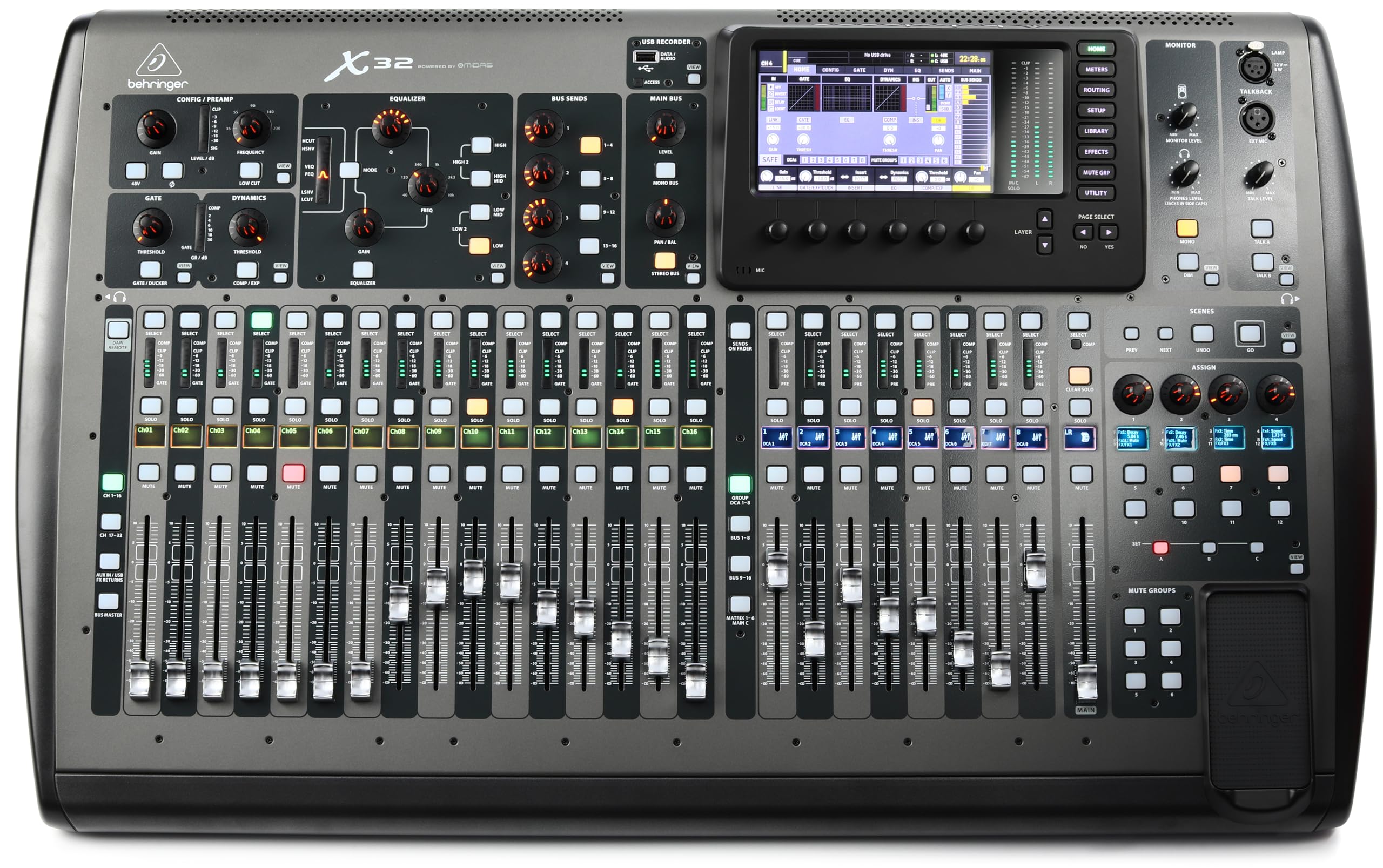
The Behringer X32 is the most ubiquitous digital console on the market for a reason — it delivers the flexibility of 40 input channels and 25 buses at a price point that rewards deep research. The 32 MIDAS-designed, fully programmable mic preamps offer 60 dB of gain with -128 dBu EIN performance, meaning they can handle even the quietest ribbon microphones without introducing noise. The 25 motorized 100 mm faders with scene management provide instant recall of complex setups, a feature that would have been unimaginable on any 1980s desk.
What makes the X32 particularly compelling for vintage console enthusiasts is its sound character. Users consistently note that the preamps are “transparent with good gain” and that the onboard effects — 8 stereo FX slots with side-chain capability — are workable without being characterless. The built-in USB stereo.WAV recording to an SD card is a practical bonus for capturing soundchecks, and the scribble strips on each channel make labeling a breeze. For houses of worship and small-to-medium venues, the X32 has become the de facto standard because it just works.
The trade-offs are typical of a console at this price: the channel meters are low-resolution, the fader resistance feels lighter than a vintage analog desk, and the bus routing is paired in groups of two, which can frustrate complex monitor mixes. The price has climbed notably since its launch, but it remains the best value in large-format digital mixing. For anyone who needs the recallability of digital with a channel count that competes with 80s giants, the X32 is the pragmatic choice.
Why it’s great
- Exceptional value for 32 channels of motorized faders
- MIDAS preamps provide clean, usable headroom
- Extensive online community and tutorial support
Good to know
- Low-res channel meters limit precise metering
- Price has risen significantly since launch
3. Mackie 3204VLZ4 32-Channel Mixer
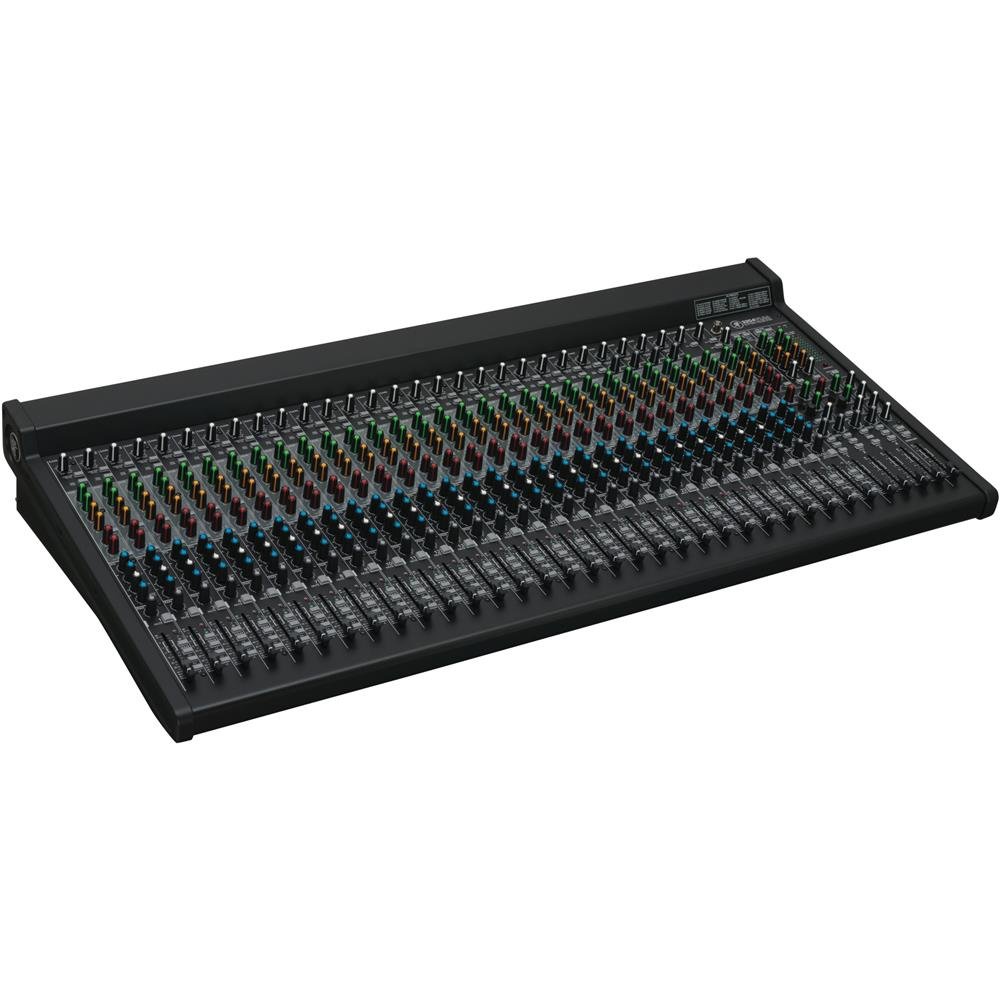
The Mackie 3204VLZ4 is the spiritual successor to the 1980s Mackie CR-1604 that put the company on the map — a 32-channel, 4-bus workhorse built on the same high-headroom, low-noise design philosophy that made the original VLZ series legendary. Each of the 28 Onyx mic preamps delivers up to 60 dB of gain with ultra-wide 60 dB gain range, and the improved RF rejection makes it a natural choice for broadcast applications. The dedicated inline channel compression on channels 25-28 is a thoughtful touch for critical inputs like vocals or snare drum.
Build quality is the headline here: all-metal construction, XLR balanced outputs, and a 3-bus board that feels indestructible. Users describe it as a “solid workhorse” with clean, powerful preamps that add no noticeable noise even at high gain settings. The outboard power supply saves rack space, and the color-coded knobs make quick adjustments intuitive during live sets. The lack of built-in effects is a feature, not a bug — it forces you to use outboard gear, which aligns with the 1980s philosophy of building your signal chain deliberately.
The main drawbacks are ergonomic: the knobs lack sufficient grip for sweaty hands, there’s no center detent on all knobs, and the headphone volume is not independent of the main mix. The Quick Start Guide that ships instead of a full manual is a minor frustration, but experienced engineers won’t need it. For those who want a large-format analog mixer with the reliability of a Mackie VLZ and the channel count to handle a full band plus monitors, the 3204VLZ4 is the modern analog answer.
Why it’s great
- Rock-solid all-metal construction
- Clean, powerful Onyx preamps with excellent RF rejection
- Dedicated inline compression on critical channels
Good to know
- No built-in effects require external processors
- Knob grip could be better for live use
4. Yamaha MGP24X Premium Mixing Console

The Yamaha MGP24X is the sort of console that reminds you why the 1980s Yamaha PM series became houseboards at venues worldwide. With 16 mic inputs, 24 line inputs, 6 aux sends, and 4 group buses, it offers the routing flexibility that made Yamaha a staple of live sound decades ago. The channel EQs are natural and musical — users describe them as “clean and usable” without the metallic artifacts that plague cheaper digital emulations — and the built-in Rev-X and SPX processors provide varied, tweakable reverb options that save rack space.
Each mic channel includes a compressor and a Leveler function, which automatically equalizes volume for spoken word or karaoke — a practical feature for houses of worship and corporate events. The Head Amp boost and Ducker function (which auto-drops music when speaking) add modern convenience without sacrificing the analog signal path. The 48V phantom power and HPF per channel allow condenser microphone use without channel-to-channel bleed, and the four group buses enable flexible submixing for drums, vocals, or backing tracks.
The build quality is generally excellent, though some users report that the channel faders feel “loose and wobbly” compared to the robust sliders on older Yamaha desks. A few units arrived with uneven bases or signs of prior use, so inspect the condition carefully. The USB interface is limited to 2-channel 16-bit/44.1kHz, which is disappointing for a console at this price but acceptable for basic recording. For the engineer who wants genuine 1980s Yamaha character without the maintenance of a vintage desk, the MGP24X delivers.
Why it’s great
- Natural, musical EQ with built-in Rev-X effects
- Leveler and Ducker functions for spoken word
- 4 group buses for flexible submixing
Good to know
- Faders can feel loose compared to vintage Yamaha desks
- USB interface is basic 2-channel only
5. Mackie ProFX30v3 30-Channel Mixer

The Mackie ProFX30v3 is the console that proves you don’t need to spend a fortune to get professional results. Its 25 Onyx mic preamps offer 60 dB of gain with ultra-low noise performance — perfect for the high-gain microphones popular with modern content creators and live performers. The 24-bit/192kHz USB recording is genuinely high-resolution, and the 2×4 USB I/O allows you to create two custom mixes on your computer to send back into the mixer for complex monitoring scenarios during overdubs.
The GigFX effects engine includes 24 different options ranging from reverbs to delays, and the single-knob blend between monitoring your computer’s output and the direct mixer feed is a thoughtful touch for podcasters and streamers. The ProFX30v3 is designed for maximum versatility — it works equally well for live sound with a band, home recording of vocals and instruments, and content creation setups where latency matters. Users praise the “rock-solid” sound quality and powerful features, with one beatmaker calling it “excellent for a small studio” and saying they would buy it again.
The primary caveat is that the included USB cable can cause random disconnects on Mac systems — a simple replacement with a higher-quality USB-B to USB-C cable solves the issue. The 25-pound weight is manageable for a 30-channel board, and the layout is logical even for engineers used to larger formats. For anyone building a hybrid studio that needs the analog feel of faders and knobs with modern digital connectivity, the ProFX30v3 offers one of the highest value-per-channel ratios on the market.
Why it’s great
- Excellent 24-bit/192kHz recording quality
- Versatile GigFX engine with 24 effects
- High-gain Onyx preamps handle demanding mics
Good to know
- Stock USB cable can cause disconnects on Mac
- No MIDI preset saving for DAW routing
6. Allen & Heath ZED-24 24-Channel Mixer
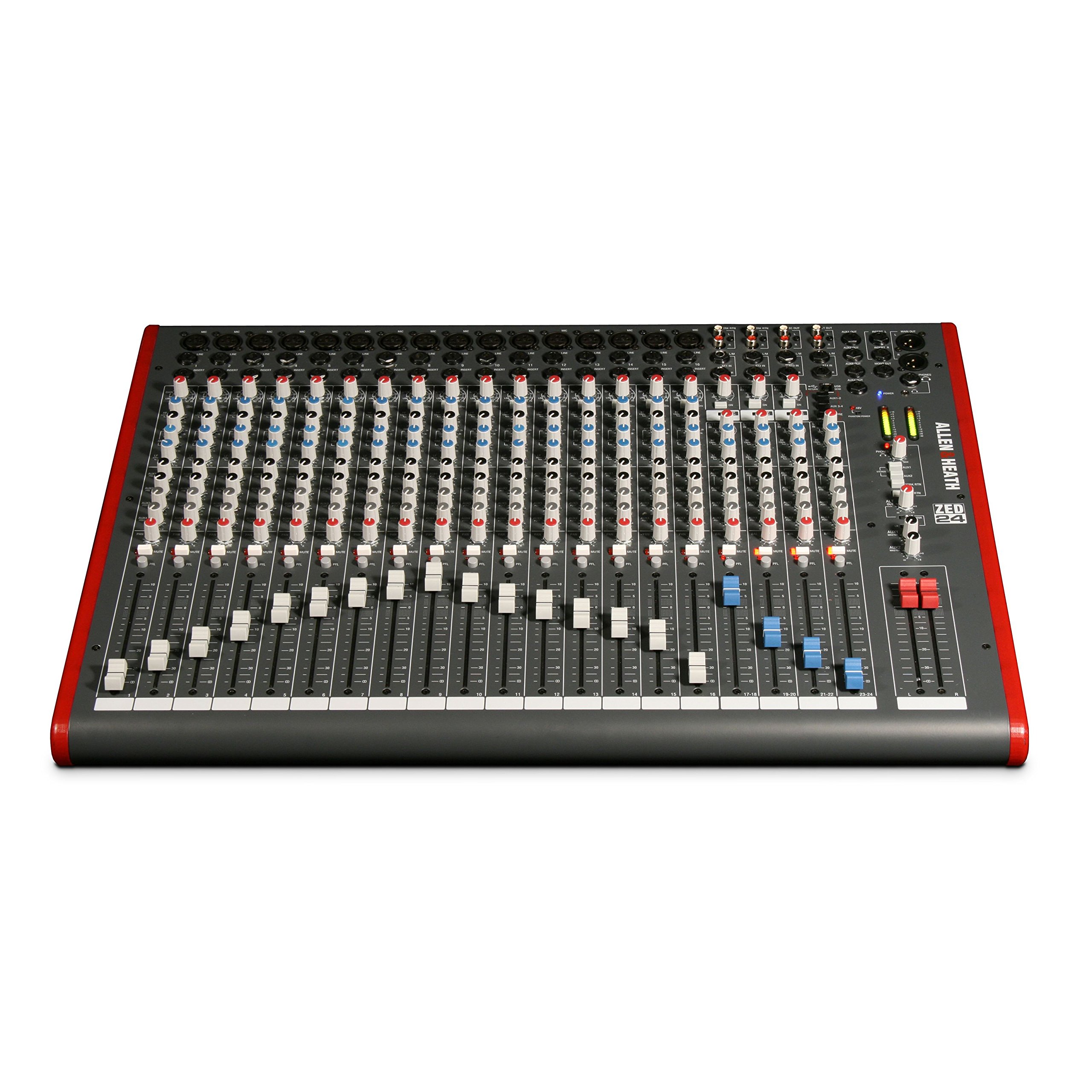
The Allen & Heath ZED-24 is the last great analog console from a brand that defined the 1980s theatre and broadcast markets. Its DuoPre XLR microphone preamps use two gain stages to deliver a full and accurate sound across the entire gain range, with up to 69 dB of gain that can handle even the most gain-hungry ribbon microphones. The 100 Hz high-pass filter on every mono input is a godsend for cleaning up low-frequency rumble, and the 3-band MusiQ EQ with swept mid frequency provides the kind of surgical mid-range control that makes vocals and guitars sit perfectly in a mix.
The routing is where the ZED-24 really shines for 1980s console enthusiasts: two pre-fade aux outputs for monitor mixes, two post-fade aux outputs for external effects or streaming feeds, and insert sockets on every mono channel and the main mix for outboard compressors or graphic equalizers. The routable stereo-in-stereo-out USB connection is class-compliant, meaning it works with any computer, tablet, or smartphone without driver installation — a rare convenience for an analog desk. Users consistently describe the sound as “clean and clear” and “rivaling pro pres” at the price.
The most common complaints are the global +48V phantom power (which makes ribbon microphone use impossible without a separate phantom power blocker), the limited 16-bit/44.1kHz 2-channel USB, and faders that feel too light with no tactile feedback. The 23-pound weight is substantial but manageable, and the build quality is miles ahead of budget alternatives. For the engineer who values genuine Allen & Heath preamp character and wants a console that can serve as a front-end for a DAW-based studio, the ZED-24 is a future classic.
Why it’s great
- DuoPre dual-stage preamps with exceptional headroom
- Insert jacks on every mono channel for outboard gear
- Class-compliant USB works with any device
Good to know
- Global phantom power requires blockers for ribbons
- USB is limited to 2-channel 16-bit/44.1kHz
7. Bose T8S ToneMatch Mixer
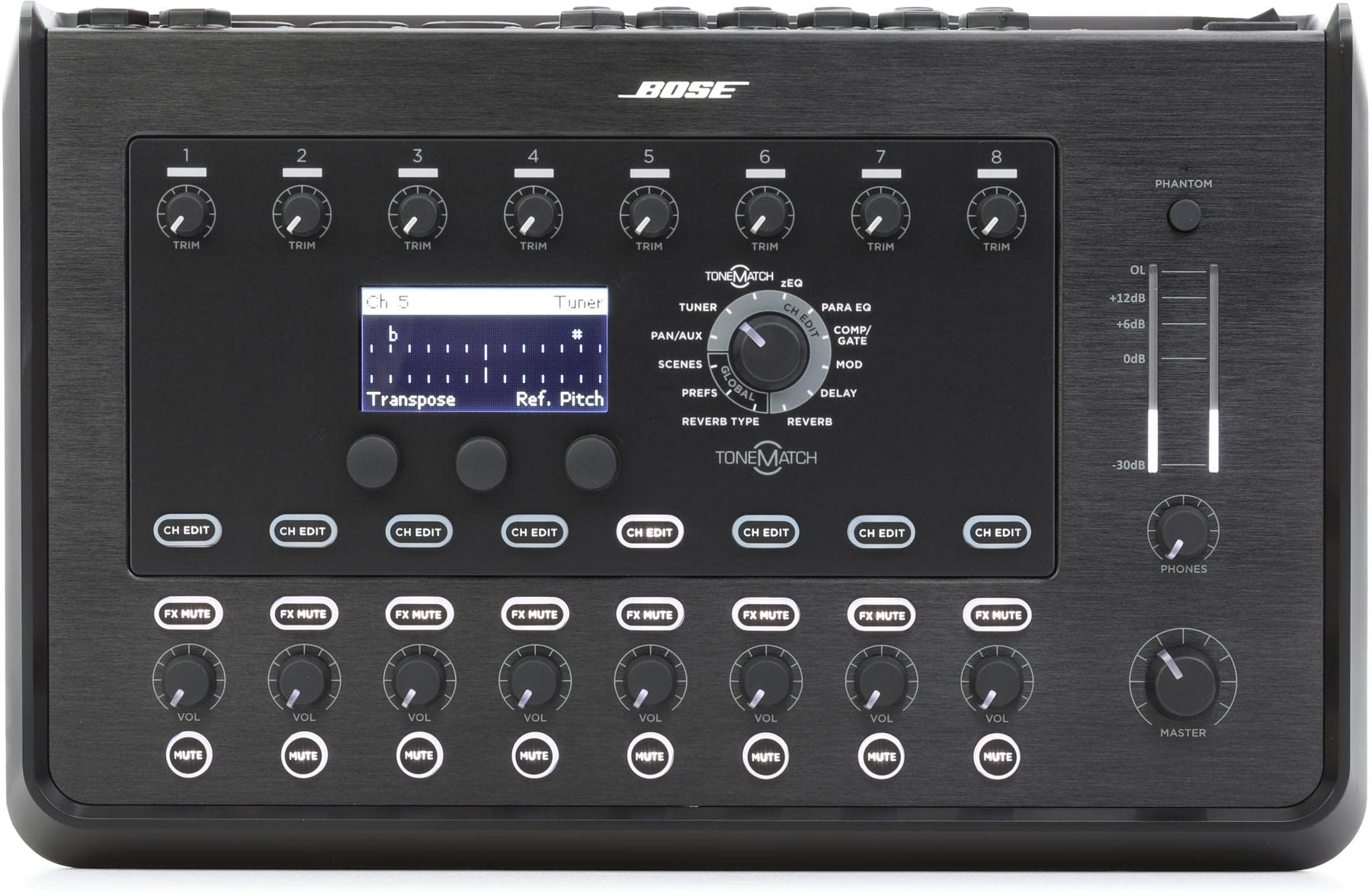
The Bose T8S is a digital mixer that captures the spirit of 1980s pro audio quality in a package that weighs just 4 pounds. Its 8 high-quality audio preamps with XLR-combo jacks deliver switchable phantom power for condenser microphones, and the exclusive ToneMatch processing provides EQ, compression, and effects optimized for specific instruments and vocal types. The result is a “studio-quality live sound” that users describe as “crystal clear” and “surpassing a Soundcraft Signature12 with half the size and weight.”
The tactile, illuminated controls and LED display are designed for dimly-lit stages — a thoughtful nod to the real-world conditions of live performance. The dual aux inputs and four aux sends allow complex monitor routing, and the USB-A and USB-B ports provide playback from a USB drive or direct PC/Mac interfacing. Users praise the “clean, acoustic sound” that is “cleaner than cheap non-powered boards,” and the camera tripod mount on the bottom is a clever design touch for mounting on a mic stand for easy access during gigs.
The main caveat is the learning curve for the ToneMatch effects parameters — users transitioning from DAW-based mixing may find the percentage-based adjustments frustrating. The 8-channel count limits it to smaller setups, and the absence of physical faders (all trim/volume via rotary knobs) may deter engineers accustomed to tactile fader control. For solo performers, duos, or small ensembles who want pristine Bose-quality preamps in a highly portable form factor, the T8S is a revelation.
Why it’s great
- Ultra-compact 4-pound design with 8 quality preamps
- ToneMatch processing delivers studio-grade live sound
- Daisy-chainable for expanded channel count
Good to know
- Effects percentage adjustments can frustrate DAW users
- No physical faders, only rotary knobs
8. Zoom LiveTrak L-20R Mixer/Recorder

The Zoom LiveTrak L-20R is a digital mixer that functions as a complete recording studio in a box. With 20 inputs and 22 channels of simultaneous 24-bit/96kHz recording to an SD card, it replaces the need for a separate audio interface, computer, and control surface. The 6 customizable monitor outputs with individual volume control allow each performer to get their own personalized mix — a feature that would have required a massive splitter snake and multiple headphone amps in the 1980s.
The built-in 20 chorus, delay, and reverb effects are more than usable for live applications, and the scene-saving function stores up to 9 complete console setups for instant recall between songs. The wireless iOS control via Bluetooth is a modern convenience, though users note that it requires an iPad — the app doesn’t support iPhone. The -128 dBu EIN preamps with up to 60 dB of gain provide clean, transparent signal handling that users describe as “transparent with good gain” and “clean, crisp audio.”
The primary frustration is the virtual fader implementation on the iPad: tapping must be exact on the target value, or the volume snaps abruptly, making live adjustments risky. The small screen on the unit requires scrolling, and the gray-on-dark panel labeling can be hard to read in stage lighting. For musicians who want to record first and mix later — capturing every instrument to its own track without computer dependency — the L-20R is a game-changing tool.
Why it’s great
- 22-track simultaneous recording without a computer
- 6 independent monitor mixes for band members
- Compact form factor with 20 input channels
Good to know
- iPad virtual faders require precise tapping
- Small screen necessitates scrolling for navigation
9. Tascam Model 16 16-Track Mixer/Recorder

The Tascam Model 16 is an all-in-one 16-track mixing and recording studio that blends analog workflow with digital convenience in a way that feels like a natural evolution of the 1980s Tascam cassette-based studios. Its 10 Ultra-HDDA mic preamps (channels 1-10) deliver the clean, reliable sound that users describe as “fat and beefy” — a testament to Tascam’s decades of preamp design experience. The 16-track multitrack recorder records WAV files up to 48kHz/24-bit to SD, SDHC, or SDXC cards, and the punch-in/out capability allows up to 8 simultaneous track comps.
The built-in USB audio interface sends/receives 16-in/14-out audio to a DAW, making it equally useful for live recording, streaming, and studio production. Users praise its “simple, easy, sounds great” operation, with one reviewer noting it recorded 12 inputs live without any issues and delivered “fat and beefy” tones. The flexible routing allows multiple output mixes for monitors, broadcast feeds, or streaming, and the channel-to-track assignment is straightforward once learned.
The limitations are real: channels 13/14 are Bluetooth and 1/8-inch inputs with no EQ or aux sends, and channels 15/16 are virtual only, meaning the Model 16 effectively has 12 real input channels. The scroll knob for punch-in is less intuitive than a dedicated button, and the color scheme makes labeling difficult in low light. For the musician who wants a dedicated multitrack recorder that doesn’t require a computer for basic tracking, the Model 16 offers unbeatable value per track.
Why it’s great
- Records 16 tracks directly to SD card
- Ultra-HDDA preamps provide clean, reliable sound
- Flexible routing for multiple output mixes
Good to know
- Only 12 real input channels; others are virtual or limited
- Punch-in scroll knob less intuitive than dedicated button
10. Zoom LiveTrak L-20 Mixer/Recorder

The Zoom LiveTrak L-20 is the earlier sibling of the L-20R, offering the same 20-input/22-channel recording capability with a more traditional fader-based interface. It records 22 tracks simultaneously at 24-bit/96kHz to an SD card, making it a powerful all-in-one solution for large band recordings and live shows. The six independent monitor mixes with individual volume control allow every performer to get their own mix during rehearsals and performances — a feature that professional live engineers from the 1980s would have killed for.
The -128 dBu EIN preamps with up to 60 dB of gain provide “clean, crisp audio” according to users, and the 20 onboard effects are usable for live applications. The wireless control via the free iOS app adds convenience, and the road-ready construction is designed to handle the demands of live performance. Users describe it as a “game-changer for home studios” because it replaces most traditional studio gear — recorder, interface, and mixer — in a single compact unit that weighs just 15.3 pounds.
The recording functions are spartan — no copy/paste, no quantize — but they work as a scratchpad for capturing live performances. The preamps are “transparent with good gain,” and the EQ is “serviceable,” though the effects lack modulation options like flanger or phaser. The fader’s stored settings mean they won’t respond to physical movement until the fader is moved back to the stored position — a safety feature that can confuse at first. For the band that needs to capture live shows with individual tracks for later mixing, the L-20 is a powerful, portable solution.
Why it’s great
- 22-track simultaneous recording without a computer
- 6 independent monitor mixes for complex setups
- Compact and road-ready for live performance
Good to know
- Recording functions lack advanced editing features
- Effects lack modulation options like flanger/phaser
11. Bose T4S ToneMatch Mixer

The Bose T4S is the little brother to the T8S, offering the same ToneMatch processing and studio-quality effects in a 4-channel format that is perfect for solo performers and small ensembles. Each of the four XLR-combo preamps delivers switchable phantom power and the same advanced digital audio processing that makes the T8S a favorite among demanding musicians. The ToneMatch cable connects directly to compatible Bose L1 systems for digital audio and power, creating a complete ecosystem that reduces setup complexity.
Users consistently praise the T4S as “a must-have for musicians with Bose systems” and note that it represents a “major improvement over the T1 with better sound quality.” The ZEQ function focuses the sound of ToneMatch presets for effective on-the-fly adjustments, and the compact 2.1-pound form factor makes it easy to throw in a gig bag. The multifunctional design with reclinable back adds versatility for different stage configurations.
The main concerns are reliability-related — one user reported that their unit “overheats, screen flashes, and shuts off,” though a factory reset and new power cable provided temporary relief. The software update process for Mac is “extremely difficult” according to users, and Bose customer service was unhelpful in resolving the issue. For the solo singer-songwriter or acoustic duo who already uses a Bose L1 system, the T4S offers the most streamlined signal chain possible — but be prepared for potential firmware frustrations.
Why it’s great
- Ultra-compact 2.1-pound design for portability
- ToneMatch processing optimizes vocals and instruments
- Direct digital connection to Bose L1 systems
Good to know
- Some units have reported overheating and shutdown issues
- Software updates for Mac are notoriously difficult
FAQ
How do I tell if a vintage console has been professionally recapped?
Can I use a 1980s analog console as a front-end for a modern DAW?
Why do some 1980s consoles have “global phantom” and why does it matter?
Final Thoughts: The Verdict
For most users, the best 1980s mixing consoles winner is the Allen & Heath CQ-18T because it combines the tonal integrity of classic Allen & Heath preamps with modern digital flexibility — the best of both worlds. If you want genuine analog character with enough channels for a full band, grab the Yamaha MGP24X. And for budget-conscious multitrack recording without a computer, nothing beats the Tascam Model 16.