
A single 50-watt panel sits at a sweet spot: sizable enough to top off a deep-cycle battery for a weekend camping trip or keep a trolling motor running all day, yet compact enough to mount on an RV roof or stow in a vehicle without turning your setup into a permanent fixture. The catch? “50 watts” on the spec sheet doesn’t always mean 50 watts in the real world. Factors like cell technology, build quality, and included accessories separate panels that merely exist from ones that genuinely keep your gear powered.
I’m Min — the co-founder and writer behind Gadgets Feed. I’ve spent years analyzing the technical specifications and real-world output data of small-scale solar kits, comparing encapsulation methods, temperature coefficients, and connector standards to separate marketing claims from usable watt-hours..
Whether you need to maintain an RV battery through the winter, charge a power station at a remote job site, or build a simple off-grid system for a shed, this guide breaks down the top models. With monocrystalline cells, MPPT compatibility, and rugged weatherproofing in common focus, a 50 watt solar panel offers a reliable balance of portability and power for small-scale off-grid needs.
How To Choose The Best 50 Watt Solar Panel
Not all 50W panels deliver the same usable power. The three factors that separate a high-performing setup from a disappointing one are cell architecture, included controller type, and physical durability for your specific mounting location.
Cell Technology: N-Type vs. P-Type and Busbar Count
Traditional P-type (PERC) cells suffer from LID (Light-Induced Degradation) in the first few weeks of use, which can permanently reduce output by 2-3%. N-type cells avoid LID entirely and offer better high-temperature performance — a crucial detail if your panel sits on a dark RV roof in July. Look for 16BB or higher busbar designs; more busbars reduce the distance electrons travel across the cell surface, meaning less resistance and higher effective output, especially in partially shaded conditions.
Portable vs. Fixed: Trade-Offs in Real Use
A rigid framed panel (typically 7–12 lbs) is ideal for permanent roof mounting or ground-mount arrays. It maximizes efficiency and costs less per watt. A foldable panel (around 2.5 lbs) sacrifices some efficiency and costs more, but unlocks true portability — perfect for topping off a power station at a campsite or hanging from a tree while fishing. Your choice depends entirely on whether the panel lives on the vehicle or comes with you on hikes.
Controller Decisions: Integrated or Add-On
Some kits bundle a PWM or MPPT charge controller. A PWM controller is fine for simple battery maintenance (trickle charging), but if you plan to cycle batteries deeply — running a fridge or power tools — an MPPT controller can recover 20-30% more watt-hours from the same panel. Many of the kits below include a basic controller; factor in a standalone MPPT upgrade if your budget allows and your usage demands it.
Quick Comparison
On smaller screens, swipe sideways to see the full table.
| Model | Category | Best For | Key Spec | Amazon |
|---|---|---|---|---|
| ZOUPW 50W N-Type | Rigid Roof | High-efficiency roof install | 25.6% eff., 16BB, IP68 | Amazon |
| Renogy 50W Mono | Rigid Ground/Roof | Proven reliability at entry-level | 22% eff., 2.67A, 7.3 lbs | Amazon |
| SOKIOVOLA 50W Foldable | Portable Foldable | Hiking & quick camp setup | 25% eff., 2.43 lbs, USB-C 30W | Amazon |
| VEVOR 50W Kit | Rigid Kit w/ Controller | Complete kit for boat/RV | Included MPPT controller | Amazon |
| Voltset 50W Kit | Rigid Kit w/ Controller | Premium trickle charge setup | IP67, 3-stage smart charge | Amazon |
| SOLPERK 50W Kit | Rigid Kit w/ Bracket | Angle-adjustable ground mount | 60° adjustable bracket, IP65 controller | Amazon |
| Goal Zero Boulder 50 | Rigid Premium | Goal Zero power station pairing | 22.6% eff., built-in kickstand, 12.4 lbs | Amazon |
In‑Depth Reviews
1. ZOUPW 50 Watt Solar Panel, N-Type 16BB

The ZOUPW N-Type panel represents a genuine leap in small-format solar efficiency. By switching to N-type cells and a 16-busbar architecture, the panel achieves a 25.6% conversion efficiency — a figure that once belonged exclusively to much larger commercial modules. In real-world tests, users reported peak output exceeding 69 watts on a clear day, meaning the panel comfortably outperforms its 50W rating under full sun, an unusual and welcome trait for this power class.
Its IP68 rating and 2400Pa wind/5400Pa snow load tolerance mean it can live on an RV roof or cabin full-time without degradation. The 8.8-pound weight and compact dimensions (30.08 x 18.43 x 1.18 inches) make it 13% smaller than typical P-type 50W panels, which simplifies installation on limited roof real estate. Backed by a 10-year warranty, it’s a strong candidate for anyone who prioritizes long-term panel performance over upfront savings.
The main caveat is that the panel is sold without a charge controller, so you will need to budget for a separate MPPT unit if you plan to cycle batteries rather than just maintain them. The included manual is adequate but not exhaustive for first-time solar builders. Still, for pure efficiency and build quality, this panel sets a new standard in the 50W category.
Why it’s great
- 25.6% N-type cell efficiency; routinely over-panel past 50W
- IP68 waterproofing with high wind/snow load ratings
- 10-year warranty and 84.5% output retention after 20 years
Good to know
- No charge controller included
- Manual could be more detailed for novice installers
2. Renogy Solar Panel 50 Watt 12 Volt
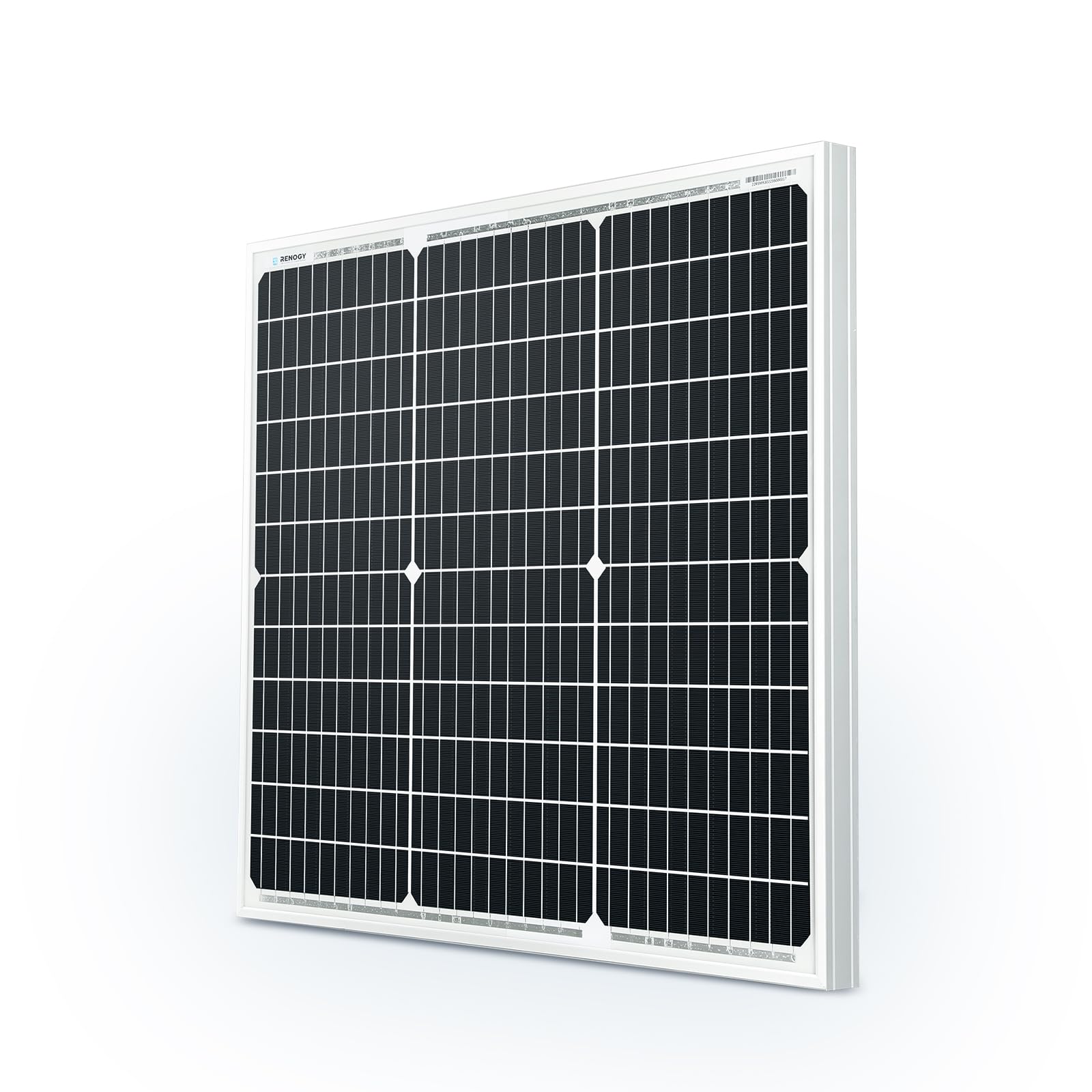
Renogy’s 50W monocrystalline panel has been a staple in the small-solar market for years, and its longevity on shelves reflects a consistent build quality that competitors still chase. The 22% efficiency is standard for P-type monocrystalline, but the panel’s real strength lies in its EL-tested modules and bypass diodes that minimize power drop from shading — a critical feature when mounting on an RV bumper or in a partially shaded yard.
At 7.3 pounds and 22.8 x 19.8 inches, it is one of the lighter rigid panels in this roundup, making it easier to handle during installation or temporary ground-mount setups. Users consistently report 40-42 watts even under cloudy skies and reliable 12V battery charging with a controller. The corrosion-resistant aluminum frame and IP65 junction box mean it holds up well after years of outdoor exposure, and the pre-drilled holes simplify mounting onto Z-brackets or pole mounts.
Drawbacks are minor: the 22% efficiency is no longer class-leading, and some users noted the MC4 connectors required adapter conversion for 12V automotive use. The 5-year warranty is shorter than newcomers offer, but Renogy’s widespread parts availability often compensates for that gap. For a budget-friendly rigid panel with proven long-term performance, this is a reliable choice.
Why it’s great
- Proven durability with bypass diodes for partial shade
- Lightest rigid frame option at just 7.3 lbs
- Stable output in cloudy conditions
Good to know
- 5-year warranty is shorter than some competitors
- MC4 connectors may need adapters for direct 12V hookup
3. SOKIOVOLA 50W Portable Foldable Solar Panel

The SOKIOVOLA foldable panel redefines what portability means in the 50W class. Weighing only 2.43 pounds and folding down to roughly the size of a small tablet (8.94 x 13.08 x 1.19 inches), it is the only panel in this roundup that can realistically slip into a backpack alongside a power station. The ETFE lamination and waterproof Dragon Dance Cloth construction ensure it survives rain and dust without adding weight, while the 25% A+ grade N-type cells keep conversion efficiency competitive with rigid panels.
Integrated output ports — QC3.0 USB-A (24W) and USB-C (30W) and a DC 18V/2.77A barrel — let it charge devices directly without a separate charge controller, making it a turnkey solution for topping up phones, tablets, and small power stations. Users report 45+ watt output even with vertical orientation and compatibility with popular brands like EcoFlow and Daran. The included 39.37-inch DC5521 cable and 10 adapters cover most power station models out of the box.
The trade-off for this portability is output stability: the panel relies on direct sunlight exposure and lacks the racket-angle adjustability of a rigid mount. Some users noted the PD output caps at 30W rather than the full 50W. The fabric can also get hot to the touch after extended sun exposure, and refolding it tightly can take a few tries. For hikers, campers, and emergency kits, though, this is the most versatile option available.
Why it’s great
- Extremely portable at 2.43 lbs with integrated USB-C and USB-A
- N-type cells with 25% efficiency in a foldable package
- Comes with adapters for most power stations
Good to know
- PD output limited to 30W max
- Fabric gets hot in extended sun; careful folding required
4. VEVOR 50W 12V Solar Battery Trickle Charger
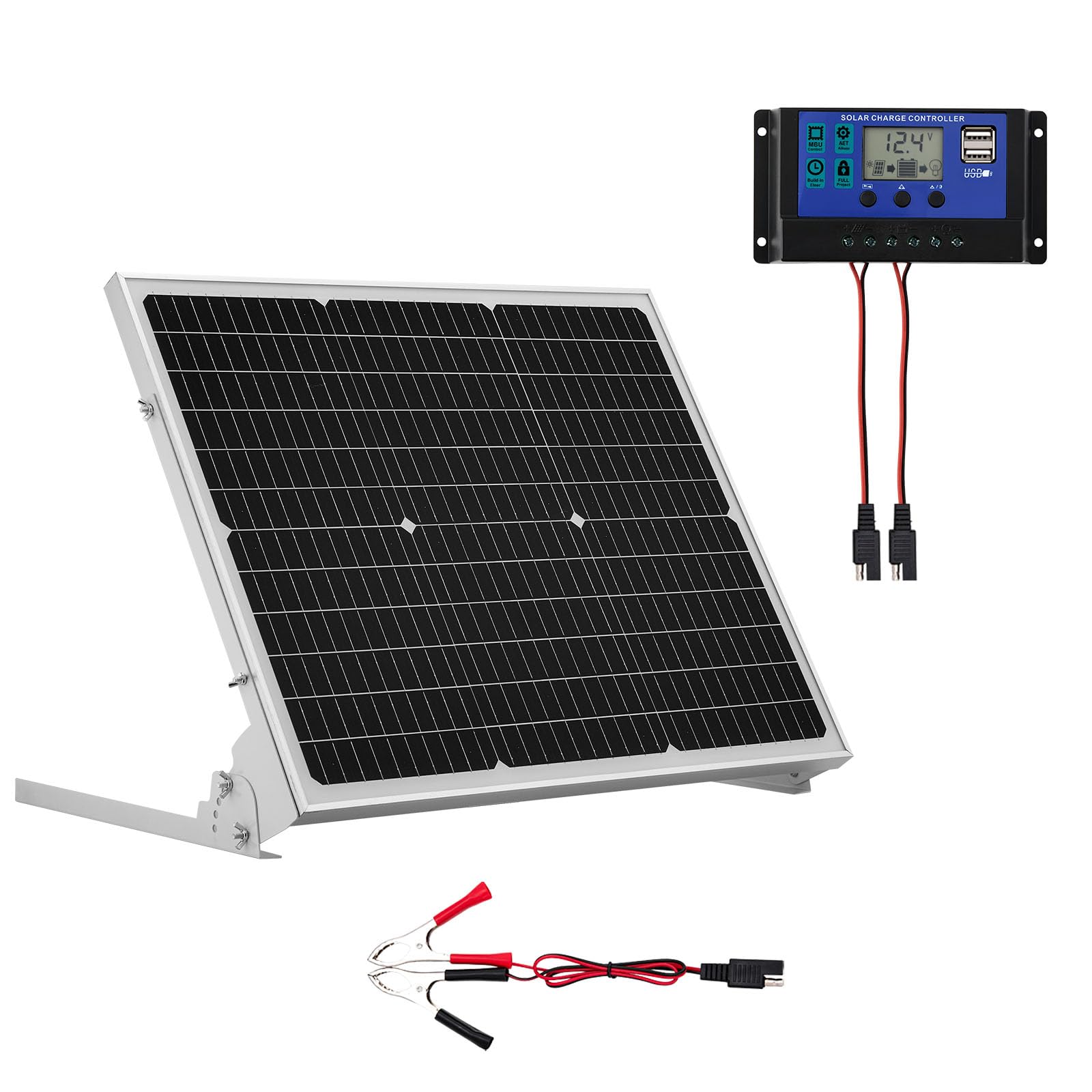
VEVOR’s entry is a rare all-in-one package: a 50W monocrystalline panel, an intelligent MPPT charge controller, a 0°-60° adjustable mounting bracket, and all wiring in one box. The MPPT controller with six-stage protection (overcharge, deep discharge, short circuit, reverse connection) means it can safely handle LiFePO4, Li-ion, AGM, and Gel batteries without the buyer needing to source a separate controller. The 122-inch extension cable and 43.3-inch alligator clips provide generous reach for deck, trailer, or rooftop installations.
User reports consistently confirm reliable battery maintenance: owners of summer cars, ATVs, and side-by-sides saw dead batteries replaced by easy starts. The adjustable bracket (0°-60° tilt with M6 screws) adds flexibility for seasonal angle changes — a feature often missing from default flat-mount kits. The IP65 rating with operation from -40°F to 185°F covers the vast majority of North American climates.
The main complaint is the thin 18 AWG wiring included; for longer cable runs (over 20 feet), upgrading to a thicker gauge reduces voltage drop and improves charging efficiency. Some users also reported the included MPPT controller lacks a voltage display — a small inconvenience for those who prefer exact readings. This is still one of the most complete 50W kits for someone who wants a single order and immediate installation.
Why it’s great
- Complete kit with MPPT controller and adjustable bracket
- Wide battery compatibility: LiFePO4, AGM, Gel, SLA
- All-weather operation from -40°F to 185°F
Good to know
- Included wiring is 18 AWG; longer runs may need thicker cable
- MPPT controller lacks a real-time voltage display
5. Voltset 50W Solar Panel Kit
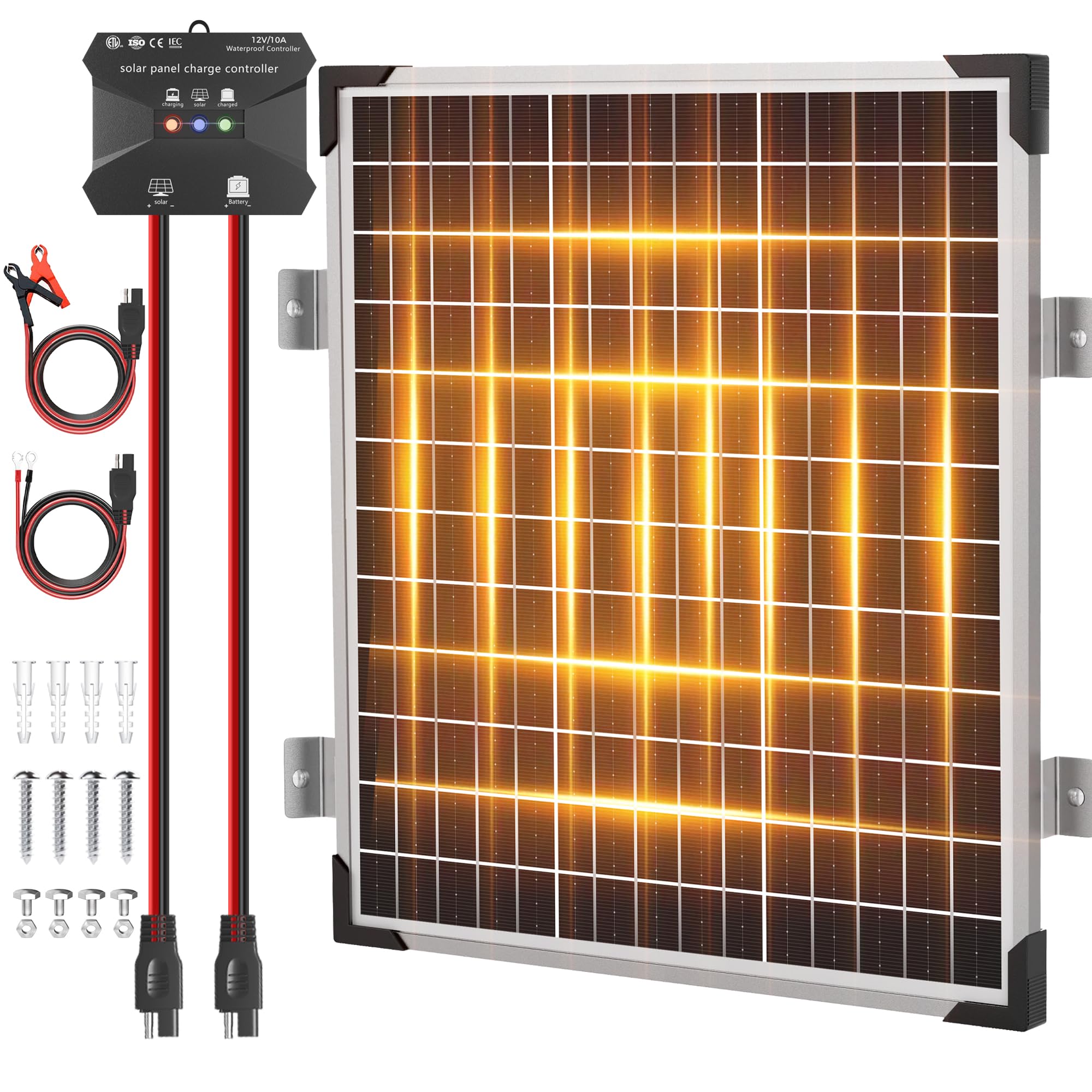
The Voltset kit focuses on user-friendliness and battery safety with a smart three-stage (direct/float/trickle) 10A controller that includes a three-color LED status indicator. It supports LiFePO4, lithium, AGM, lead-acid, and gel batteries, making it versatile for everything from RV bank maintenance to marine battery recovery. The monocrystalline cells claim a 20-30% higher conversion rate than polycrystalline equivalents, and user reports confirm that a dead 12V battery on a rarely driven Land Rover was fully charged within 1-2 days of roof rack mounting.
The tempered glass surface, aluminum alloy frame, and IP67 rating provide strong protection against moisture and physical impact. The controller also features an automatic power cut-off at night to prevent reverse drain — a valuable safeguard for unattended seasonal setups. Reports from users with boats and trolling motors confirm the panel can sustain two 55Ah batteries in parallel during extended fishing sessions, enough for an all-day run with a 36lb thrust motor.
At 8 pounds with a 14.6 x 12.8 x 1.7-inch panel, it is compact enough for smaller roofs or portable trailer setups. Some users noted that the included 10A MPPT controller lacks a detailed voltage readout (only three LED indicators), and a few opted to replace it with a third-party display controller for more granular monitoring. The clamps are functional but feel slightly thinner than premium aftermarket options. For plug-and-play reliability, though, this kit earns its premium reputation.
Why it’s great
- IP67 rated for superior moisture and dust ingress protection
- Intelligent 3-stage charging with automatic night cut-off
- Compatible with LiFePO4, AGM, Gel, and lead-acid batteries
Good to know
- Controller uses LED indicators only, no numeric display
- Alligator clips feel thin; consider upgrading for heavy use
6. SOLPERK 50W 12V Solar Panel Kit

SOLPERK’s kit stands out for its ground-mount flexibility: the included bracket adjusts in four steps (0°/15°/30°/45°/60°), letting you tilt the panel for optimum seasonal solar gain without drilling into a roof. The panel itself uses high-efficiency monocrystalline cells with a tempered glass surface and corrosion-resistant aluminum frame rated for 2400Pa wind and 5400Pa snow loads, giving it a 25-year projected lifespan. The included 10A IP65 charge controller is pre-wired with SAE connectors for quick setup.
Customers report using the SOLPERK to power greenhouse fans via a 12V battery and inverter, maintain RV coach batteries during storage, and charge 20Ah lithium batteries for security camera systems. Even in New England winter conditions, the panel has delivered enough charge to maintain a water pump battery, demonstrating solid low-light performance. The plug-and-play cable connections reduce installation time to under 30 minutes for most users.
The primary drawback is controller reliability: some users experienced controller failure after roughly 3 months of use, particularly in high-heat environments. While SOLPERK’s customer service is widely praised for quick replacements, the controller itself does not include a display screen for real-time voltage or charge status — only three indicator lights. The kit’s angle-adjustable bracket is best for ground or ground-level wall installations rather than roof mounting.
Why it’s great
- Five-position angle-adjustable bracket for seasonal optimization
- 25-year structural lifespan with high wind/snow ratings
- Excellent low-light performance in winter conditions
Good to know
- Controller quality is inconsistent; some units fail early
- No numeric display on controller; indicator lights only
7. Goal Zero Boulder 50 Watt Monocrystalline Solar Panel

The Boulder 50 is the premium icon of small solar, designed with the same ethos as Goal Zero’s larger panels: a heavy-duty anodized aluminum frame, tempered glass, added corner protection, and a built-in kickstand that doubles as a deployable tilt leg. The 22.6% monocrystalline efficiency is solid but not class-leading; the real value is in the seamless ecosystem pairing. When connected to a Goal Zero Yeti power station (150, 200x, or 500X), the Boulder 50 delivers full advertised wattage within minutes of setup, thanks to optimized voltage matching and plug-and-play compatibility.
In real-world outage scenarios, users report the panel kept a CPAP machine, cable modem, and several phones powered through a 48-hour blackout. One verified review noted it topped a Yeti 150 from 60% to 100% in 3 hours under 90°F sun with light cloud cover. The kickstand lets you angle the panel on the ground without a separate mount, and multiple Boulder panels can be daisy-chained for combined capacity. At 26.75 x 21.75 x 1.75 inches and 12.4 pounds, it is the largest and heaviest in this roundup.
The premium price places it far above other 50W panels, and the lack of an integrated USB port or MPPT controller (the Yeti’s internal charger handles that role) means it offers less standalone flexibility than the SOKIOVOLA. The heavy weight and bulky size also limit portability compared to a foldable option. For Goal Zero owners or anyone who prioritizes bulletproof build quality and ecosystem reliability over raw specs, the Boulder 50 justifies its cost.
Why it’s great
- Mil-spec build with aluminum frame, corner guards, kickstand
- Seamless plug-and-play with Goal Zero Yeti power stations
- Proven performance in multi-day power outage scenarios
Good to know
- Heavy (12.4 lbs) and bulky compared to foldable competitors
- No USB or direct device output; requires separate power station
FAQ
Can a 50W panel directly charge a 12V car or marine battery without a controller?
How much actual daily power can I expect from a single 50W panel in real-world conditions?
Is there a meaningful difference between a 50W rigid panel and a foldable one beyond weight and price?
Final Thoughts: The Verdict
For most users, the best 50 watt solar panel is the ZOUPW N-Type because its 25.6% efficiency, 16BB cell design, and IP68 rating deliver measurable real-world over-performance. If you want the most complete all-in-one kit with an MPPT controller and adjustable bracket, grab the VEVOR 50W kit. And for lightweight portability to pair with a power station on hiking trips, nothing beats the SOKIOVOLA Foldable 50W panel.