
Industrial HVAC systems that suffer from compromised heat exchangers or flue-gas backdrafts can flood an air handling unit with carbon monoxide in minutes, turning a ventilation system into a poison distribution network. Standard residential detectors are useless here — they trigger at levels that are already dangerous, and they cannot interface with a building management system or withstand the environmental abuse of a mechanical room.
I’m Min — the co-founder and writer behind Gadgets Feed. I specialize in dissecting the technical specifications of safety-critical industrial monitoring equipment, from electrochemical sensor lifespans to IP-rated enclosures and real-time data-logging protocols. (And Homer 🐱 keeps a skeptical eye on the probe kit, as if daring it to find a leak on his watch).
The right detector for this environment must offer a wide measurement range, a swift response time, and a rugged design that can handle dust, moisture, and temperature swings. This guide breaks down the top contenders to help you identify the carbon monoxide sensors for industrial hvac systems that meet your specific safety and operational requirements.
How To Choose The Best Carbon Monoxide Sensors For Industrial HVAC Systems
Selecting a CO sensor for industrial HVAC is not about picking the cheapest alarm. The sensor must integrate into your workflow — whether that means spot-checking flue gasses, providing continuous ambient monitoring, or acting as a personal safety device for technicians inside a mechanical room. Focus on the sensor type, measurement range, alarm logic, and environmental toughness.
Electrochemical vs. Semiconductor Sensors
Electrochemical sensors are the gold standard for industrial use. They consume very little power, provide a linear output down to 1 ppm, and maintain accuracy over years of service. Semiconductor (metal-oxide) sensors drift more, consume more power, and are prone to false alarms from non-CO gasses — avoid them for anything beyond basic residential detection.
Measurement Range and Alarm Thresholds
A sensor that only alarms at 200 ppm is borderline useless for HVAC diagnostics, where you may need to detect a flue spillage at 50 ppm or a cracked heat exchanger that produces intermittent bursts at 150 ppm. Look for a meter that reads continuously from 0 to at least 1000 ppm, with adjustable alarm points so you can set low-level warnings (e.g., 35 ppm) separately from high-level danger alerts (e.g., 200 ppm).
Pump-Assisted vs. Diffusion Sampling
A diffusion sensor relies on ambient airflow to bring gas across the sensing element, which works fine for open-air monitoring but fails when you need to sample inside a duct, a flue pipe, or a confined space. A pump-and-probe kit draws a sample from a specific point and delivers it to the sensor, giving you pinpoint readings without exposing the operator to the hazard. For HVAC work, a built-in or attachable pump is invaluable.
Data Logging and Connectivity
If you need to document CO levels for compliance, insurance, or trend analysis, choose a sensor that logs data to internal memory or exports to a computer. More advanced units offer Bluetooth or USB output for real-time graphing. Without data logging, you are relying on your memory of a peak reading, which is insufficient for OSHA recordkeeping or legal defense.
Quick Comparison
On smaller screens, swipe sideways to see the full table.
| Model | Category | Best For | Key Spec | Amazon |
|---|---|---|---|---|
| Sensorcon INS-CO-02 | Portable Monitor | Personal/Ambient safety | Range 0–1,999 ppm | Amazon |
| Sensorcon INS2-CO-01 Kit | Detector Kit | Investigative sampling | Pump & Probe included | Amazon |
| Testo 317-3 | Ambient Meter | Resi/Light commercial | 0–2,000 ppm range | Amazon |
| Forensics FD-4S-PUMP | 4-Gas Detector | Confined space entry | CO, H2S, O2, LEL | Amazon |
| RKI GX-3R | 4-Gas Detector | Oil & gas compliance | Ultra-compact 4-gas | Amazon |
| Forensics FD-600-4GAS | 4-Gas Monitor | Professional HVAC use | Color display, data log | Amazon |
| MSA ALTAIR 4XR | Multigas Detector | Industrial durability | IP68, 25-ft drop rated | Amazon |
| INFICON D-TEK Stratus | Leak Detector | Refrigerant + CO sensor | 0.03 oz/yr sensitivity | Amazon |
| Testo 300 HVAC Kit | Combustion Analyzer | Flue gas analysis | Up to 4,000 ppm CO | Amazon |
In‑Depth Reviews
1. Testo 300 Combustion Analyzer HVAC Kit

It measures CO from 0 up to 4,000 ppm, O2, temperature, draft, and differential pressure — everything required to certify a furnace or boiler in one pass. The large HD touchscreen presents all measurements simultaneously, and the extra-strong magnets on the back let you mount it hands-free on the duct panel.
Its electrochemical CO and O2 sensor carries an expected lifespan of up to six years, significantly longer than budget alternatives. The complete kit includes a basic flue gas probe, spare dirt filters, a mains unit, and the rugged hardshell case. Data flows to the Testo EasyHeat software for generating professional compliance reports, making this the choice for service departments that need documentation.
A few users have reported initial setup frustrations — including a missing Bluetooth connector in one shipment — and the unit requires a 40-minute cooldown after high CO exposure before it can zero again. Some early units shipped with a firmware quirk that prevented USB charging, though replacement units appear to have resolved this. For the technician who needs one tool for complete flue-gas analysis, the Testo 300 sets the standard.
Why it’s great
- Measures CO, O2, draft, and differential pressure in one device
- Large touchscreen with intuitive measurement menu
- 6-year sensor life reduces total ownership cost
- Hardshell case and spare probe included
Good to know
- Some units arrived with missing accessories (Bluetooth connector)
- 40-minute cooldown period after high CO exposure
- High price point for casual users
2. MSA ALTAIR 4XR Multigas Detector

The ALTAIR 4XR is built for the toughest industrial environments. With an IP68 rating (dust-tight and submersible beyond 1 meter) and MIL-STD-810G drop protection from up to 25 feet, it can survive the abuse of a mechanical room floor or a drop down an access ladder. It detects LEL, O2, H2S, and CO simultaneously using MSA’s XCell sensors, which deliver fast response and minimal cross-channel interference.
Beyond raw durability, the 4XR offers safety features that go beyond gas detection: the MotionAlert man-down alarm triggers if the unit remains motionless for a set period, and the InstantAlert manual alarm lets a worker signal distress at the push of a button. It logs over 500 alarm events and 50 hours of data, including bump and calibration records, so safety managers can audit usage. The rechargeable Li-polymer battery delivers a 24-hour run time — enough for a full shift plus overtime.
One common complaint is that the retail version does not include Bluetooth, despite the product photos showing it. If wireless data transfer is essential, confirm you are ordering the Bluetooth-enabled SKU. The upfront investment is substantial, but the 4XR provides the lowest total cost of ownership for high-turnover industrial fleets when you factor in its ruggedness and four-year warranty.
Why it’s great
- Industry-leading IP68 and 25-ft drop certification
- MotionAlert man-down alarm for lone workers
- 24-hour battery life covers a full shift
- XCell sensors minimize cross-channel interference
Good to know
- Bluetooth version is a separate SKU not always clearly marked
- Premium price positions it for fleets, not occasional use
- Larger footprint than compact single-gas monitors
3. Forensics FD-600-4GAS 4-Gas Monitor

The FD-600-4GAS punches well above its price tier by combining a built-in pump, a 4-foot probe, and a full-color graphing display — features usually found on units costing double. It uses UK-made electrochemical sensors for O2, CO, H2S, and LEL, with NIST-traceable calibration performed in Los Angeles. The color screen graphs real-time readings, making it easy to spot trends during a confined space entry or a flue gas sweep.
Data recording goes beyond peak-hold: this monitor stores 1,200 alarm records and logs continuous data for computer export via USB. The high-strength ABS enclosure with anti-slip rubber grip is both waterproof and explosion-proof, giving it genuine industrial pedigree. Customer support from Forensics is frequently praised for being responsive and knowledgeable, even on weekends — a rare commodity in this sector.
The sensor array is limited to the four standard confined-space gasses, so you cannot add PID or IR sensors later. Some users noted that the O2 sensor maxes out at 30%, which is fine for safety but not for pure-oxygen applications. For an HVAC technician who needs a multi-gas monitor with a pump and data-logging at this price point, the FD-600 is the most compelling option available.
Why it’s great
- Built-in pump with 4-ft probe for extractive sampling
- Color display with real-time graphing of all gasses
- 1,200 alarm records stored for compliance
- Exceptional customer support from the seller
Good to know
- O2 sensor range stops at 30% — not for pure-O2 checks
- No expansion slot for additional gas sensors
- Calibration gas and valve are separate purchases
4. RKI GX-3R 4-Gas Monitor

The RKI GX-3R is remarkably small for a four-gas detector — its dimensions of 2.2 by 2.55 inches make it barely larger than a matchbox, yet it houses sensors for LEL, O2, H2S, and CO. The compact form factor is a deliberate advantage for HVAC technicians who already carry a tool pouch full of meters; it clips onto a pocket or lanyard without adding noticeable bulk. The Li-ion battery pack charges via the included 100-240 VAC charger.
Approval from major oil and gas companies gives the GX-3R immediate credibility in confined-space entry workflows. It ships pre-calibrated and ready to use, though users should note that the countdown timer for the next calibration starts at 90 days from first power-on — a standard industry practice that sometimes surprises new owners. The electrochemical sensor response is fast and specific to the target gas.
The visual alarm is present, but the GX-3R lacks the loud audible or vibrating alerts of larger competitors, which can be an issue in high-noise industrial settings. The user interface is minimal — there is no color screen, no data graphing, and no built-in pump. This is a pure safety monitor optimized for wearability, not for investigative diagnostics. If your priority is a pocket-sized, compliance-ready 4-gas detector that major corporations trust, this is it.
Why it’s great
- Ultra-compact and lightweight for daily carry
- Trusted by major oil and gas safety departments
- Fast electrochemical sensor response
- Approved for confined space entry testing
Good to know
- No built-in pump requires diffusion-only sampling
- Alarm may be insufficient for loud environments
- Calibration due counter starts at 90 days from first power-on
5. Forensics FD-4S-PUMP Multi Gas Detector

The FD-4S-PUMP brings a built-in sampling pump and probe to a four-gas platform at a price point that undercuts most competitors. It measures CO, H2S, O2, and LEL using electrochemical nanotechnology sensors, with NIST-traceable calibration performed in the USA. The high-strength ABS enclosure with anti-slip rubber grip is waterproof, dustproof, and explosion-proof — a genuine confined-space entry tool rather than a hobbyist gadget.
The pump enables pre-entry testing of confined spaces, allowing the operator to drop the probe into a tank or duct without entering. Users have verified its accuracy against expensive emissions-grade meters and confirmed it effectively identifies gas leaks from industrial ovens and natural gas appliances. The calibration and QA certificate arrives with the unit, and the seller supports it with a one-year limited warranty.
The O2 sensor maxes out at 30%, so it will not measure pure oxygen environments. Some users also noted the lack of data logging — there is no USB export or alarm record storage, which limits its utility for compliance documentation. The user interface is straightforward but basic, with no color screen or graphing. For a budget-friendly confined space monitor with a pump that works out of the box, the FD-4S-PUMP is a strong performer.
Why it’s great
- Affordable 4-gas detector with built-in pump
- NIST traceable calibration certificate included
- Rugged ABS construction with explosion-proof rating
- Fast and accurate sensor response verified by users
Good to know
- No data logging or USB export capability
- O2 sensor limited to 30% measurement range
- Basic display without graphing or color
6. Testo 317-3 CO Meter
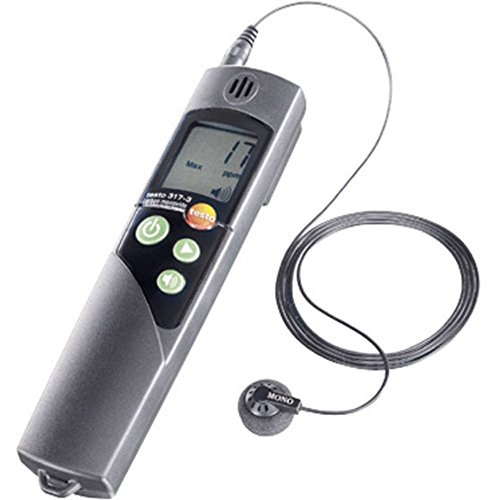
The Testo 317-3 is a purpose-built ambient CO meter that eliminates the most common annoyance of lower-tier detectors: manual zeroing. Turn it on in fresh air and it is immediately ready to measure from 0 to 2,000 ppm. The slim profile and included leather case make it comfortable to carry in a shirt pocket all day, which is exactly where residential HVAC technicians keep it during a full route of service calls.
Self-test mode verifies the CO sensor function without requiring test gas, so you can confirm the unit is operational before entering a customer’s home. The audible and visual alarms are adjustable, and the response time is notably faster than the averaging-style detectors that require 30 seconds to stabilize. Users have cross-checked the 317-3 against calibrated lab meters and confirmed accuracy within a few ppm.
The power button protrudes enough that it can be pressed accidentally when clipped in a pocket, and the shape is awkward enough that it does not slide in and out as smoothly as a dedicated pocket meter should. There is no backlight, which makes reading the display difficult in dim mechanical rooms. For a technician who needs a fast, accurate, no-zeroing ambient CO meter for daily residential calls, the Testo 317-3 is an excellent middle-ground choice.
Why it’s great
- No manual zeroing required — instant readiness
- Self-test mode verifies sensor without calibration gas
- Fast response time confirmed against calibrated meters
- Compact profile with included leather case
Good to know
- Protruding power button prone to accidental presses
- No backlight on the display
- Diffusion-only — no pump attachment available
7. Sensorcon Inspector 2 CO Detector Kit
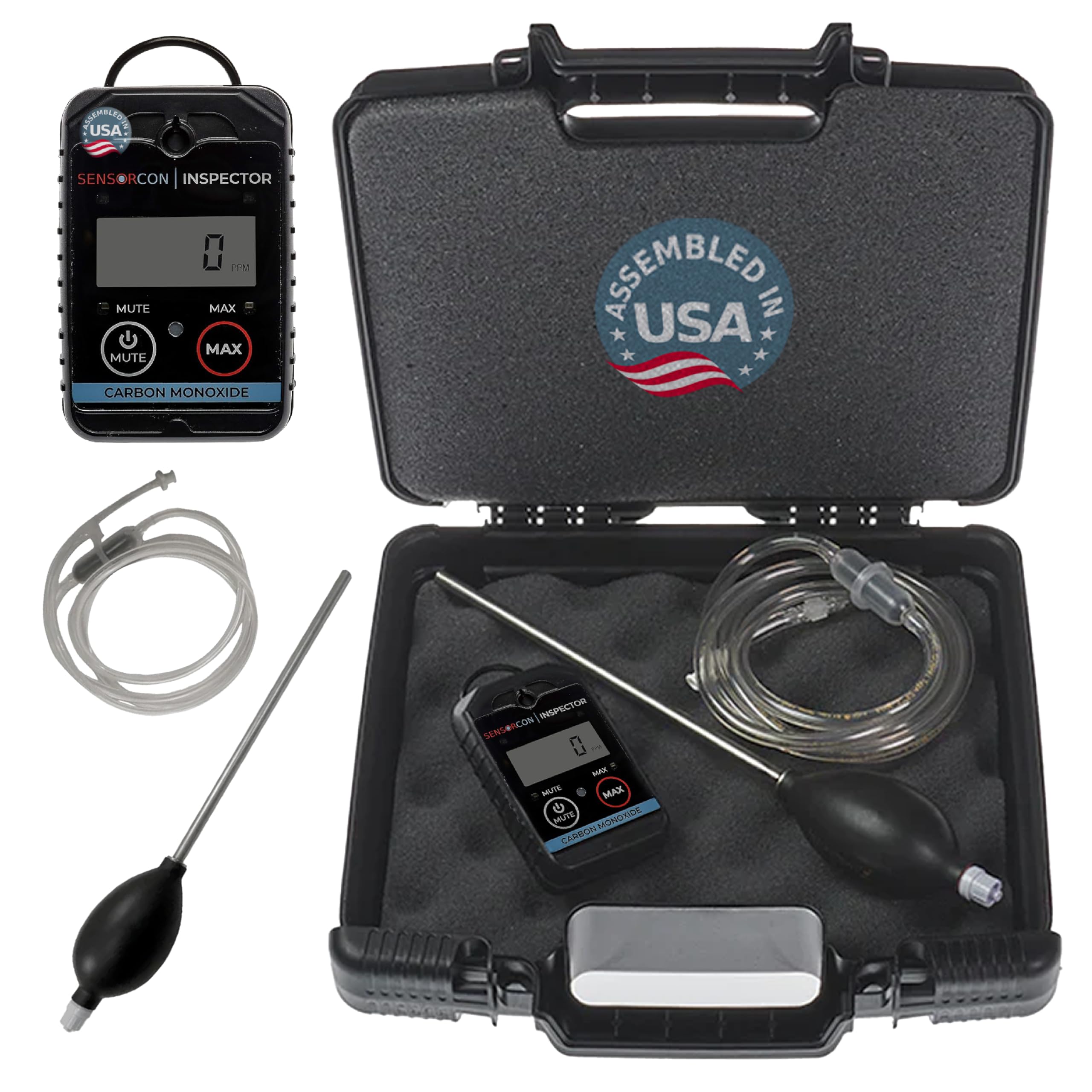
The Inspector 2 Kit transforms the standard Sensorcon INS2-CO-01 portable detector into a investigative tool by including a hand pump assembly, probe kit, and a rugged foam-lined storage case. The pump allows the user to draw gas samples from flues, ductwork, and other hard-to-reach locations without needing to place the meter directly in the airstream. The IP67-rated housing ensures the meter survives the dirt and moisture of a construction site or service truck.
The dual-alert system triggers LED indicators and an 80–85 dB audible alarm starting at 35 ppm, with a ceiling alarm at 200 ppm. The display provides real-time readings from 0 to 1,999 ppm, and the pump bulb provides enough suction for sampling temperatures that would be uncomfortable for the user. Professionals including HVAC technicians, home inspectors, and fire marshals consistently rate this kit as accurate and reliable for on-the-spot testing.
The recovery time after high CO exposure is slow — reaching fresh air does not instantly reset the reading, and users recommend powering off and restarting to zero the sensor. The bulky clip/loop combination on the meter itself is not well-designed for pocket carry. The Inspector 2 Kit is the right choice for the HVAC professional who needs to sample flue gas directly without investing in a full combustion analyzer.
Why it’s great
- Includes pump and probe for extractive sampling
- IP67 rated for water and dust resistance
- Real-time CO display from 0 to 1,999 ppm
- Kit includes foam-lined storage case
Good to know
- Slow recovery after high CO exposure
- Bulky clip design not suitable for pocket carry
- No backlight for dim environments
8. INFICON D-TEK Stratus Refrigerant Leak Detector

The D-TEK Stratus is primarily a refrigerant leak detector, but it earns a spot on this list because it can accept an optional CO2 sensor and because HVAC technicians often use it in the same diagnostic workflow as CO detection. Its redesigned infrared sensor detects all CFCs, HCFCs, HFCs, HFOs, and CO2 with a sensitivity of 0.03 oz/year — enough to find a pinhole leak that soap bubbles would miss. Cloud Hunter and Pinpoint modes let the user switch between wide-area sweeps and exact leak location.
The lithium-ion battery delivers 9 hours of runtime, and the sensor, battery, filter, and probe are all completely field-replaceable, minimizing downtime. Users report finding leaks on large commercial evaporator coils and chilled water rooms that other detectors walked right past. The alarm provides both visual and audible feedback, and an earphone jack is included for noisy mechanical rooms.
Quality control issues have been reported — some units arrived with a faulty audio jack that produced an inaudible beep, and a batch of units reportedly had bad audio components that required warranty repairs. The power/volume buttons are stiff and recessed, making them difficult to operate with gloved hands. For the HVAC technician whose primary hunt is refrigerant leaks and who also monitors CO2, the D-TEK Stratus is a specialized instrument that performs superbly when it works correctly.
Why it’s great
- Detects refrigerant leaks down to 0.03 oz/year
- Cloud Hunter and Pinpoint modes for efficient searching
- Field-replaceable sensor, battery, and filter
- Optional CO2 sensor available
Good to know
- Reported quality control issues with audio components
- Stiff power/volume buttons hard to operate with gloves
- Does not measure CO directly — refrigerant and CO2 only
9. Sensorcon Industrial CO Monitor INS-CO-02
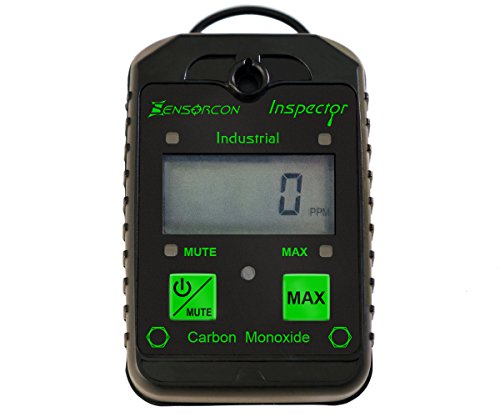
The Sensorcon INS-CO-02 is a rugged, waterproof (IP67) personal CO monitor that provides continuous real-time readings from 0 to 1,999 ppm. Its compact form — weighing only 4 ounces — and clip/lanyard attachment make it an unobtrusive daily companion for HVAC technicians working in garages, basements, and mechanical rooms. The alarm system includes visual, audible, and vibrating alerts, with a low-level warning at 35 ppm and a high-level alarm at 200 ppm.
The battery life is exceptional, with the original CR123A cell lasting up to two years under continuous 24/7 operation according to verified users. The unit is certified Intrinsically Safe for use in hazardous locations, and the 0 ppm reading below 35 ppm provides a constant confidence check. It is also built in the USA, which appeals to buyers who prioritize domestic manufacturing for safety-critical gear.
The lack of a backlight makes the display difficult to read in dark mechanical rooms, and the alarm threshold at 35 ppm (rather than a lower TWA-based trigger) means it will not catch slow accumulations below that level. The maximum reading holds the peak value, but the unit does not support data logging or USB export. For a budget-friendly, personal safety monitor that delivers continuous CO readings and survives drops and splashes, the Sensorcon INS-CO-02 is the entry-level gold standard.
Why it’s great
- IP67 waterproof and dustproof for industrial use
- Two-year battery life on a single CR123A cell
- Certified Intrinsically Safe for hazardous locations
- Real-time display down to 0 ppm for confidence checks
Good to know
- No backlight on the display
- Low-level alarm at 35 ppm may miss slow accumulations
- No data logging or USB connectivity
FAQ
What is the difference between a diffusion sensor and a pump sensor for HVAC applications?
Can I use a residential CO detector in an industrial HVAC mechanical room?
How often do electrochemical CO sensors need to be calibrated?
What does “intrinsically safe” mean for a CO sensor?
Final Thoughts: The Verdict
For most users, the carbon monoxide sensors for industrial hvac systems winner is the Testo 300 Combustion Analyzer HVAC Kit because it is the only unit that combines flue-gas analysis, draft measurement, and CO detection up to 4,000 ppm in a single full-kit solution with professional software support. If you need extreme durability and multi-gas confined-space entry capability, grab the MSA ALTAIR 4XR Multigas Detector. And for the HVAC technician who needs an affordable 4-gas monitor with a pump and data logging, nothing beats the Forensics FD-600-4GAS.