
Our readers keep the lights on and my morning glass full of iced black tea. As an Amazon Associate, I earn from qualifying purchases.
Specs are compiled from manufacturer listings and verified buyer reviews and can change over time — please confirm the key details on the product page before buying.
Before you pick a battery, ask yourself: how many nights do you want to camp without firing up the generator? The answer depends on the battery’s chemistry: lithium gives you nearly full usable capacity, while lead-acid only delivers about half. A lithium iron phosphate (LiFePO4) pack lets you use nearly all of its rated capacity, while a lead-acid or AGM unit only gives you about half before the voltage drops. This guide covers 12V deep-cycle batteries (Group 24 or 31 sizes, or 100Ah+ lithium) so you can match the right power source to your trailer’s real needs.
I’m Min — the founder and writer behind Gadgets Feed. This guide is built by comparing the manufacturers’ published specifications and the patterns across verified customer reviews, so you get each pick’s real strengths and trade-offs instead of marketing spin.
You’ll see exactly which amp-hour ratings and BMS protections matter for running a fridge or a 2000W inverter, and how weight changes how you install the pack. battery for travel trailer choices should be based on your camping style, not just the price tag.
Our Picks at a Glance

How To Choose The Best Battery For Travel Trailer
Your trailer’s battery runs everything when you’re not plugged into shore power — the fridge, the water pump, the lights, the furnace fan. The right pick keeps the fridge cold all night; the wrong one leaves you stumbling for the generator at 6 a.m. Start with how you camp, then let the specs below guide your choice.
Chemistry: The Fork In The Road
If you plan to dry camp often, a LiFePO4 (lithium iron phosphate) battery is the clear choice. It’s often 1/3 the weight of a comparable lead-acid unit, and you can safely drain it to 100% depth of discharge. A sealed AGM (absorbent glass mat) battery is cheaper upfront and maintenance-free, but you only want to use about 50% of its capacity — so a 100Ah AGM behaves more like 50Ah you can actually touch.
Capacity: What The Amp-Hours Actually Buy You
For a typical travel trailer, a single 100Ah lithium battery is a solid weekend baseline for a fridge and basic lights. If you want to run a 2000W inverter for a microwave or power tools, look at 165Ah to 300Ah units. A 280Ah lithium pack is what owners often choose when they want a whole week off-grid without worrying about conservation.
BMS And Cold Weather: The Hidden Safety Features
Every lithium battery here ships with a Battery Management System (BMS), which is a built-in computer that watches voltage, current, and temperature. It shuts things down to stop overcharging, over-discharging, and short circuits. A low-temperature cutoff — which pauses charging below freezing — is a must if you camp in cold weather, since charging lithium cells when they’re cold can damage them permanently.
Quick Comparison
| Model | Best For | Capacity | Weight | BMS | Amazon |
|---|---|---|---|---|---|
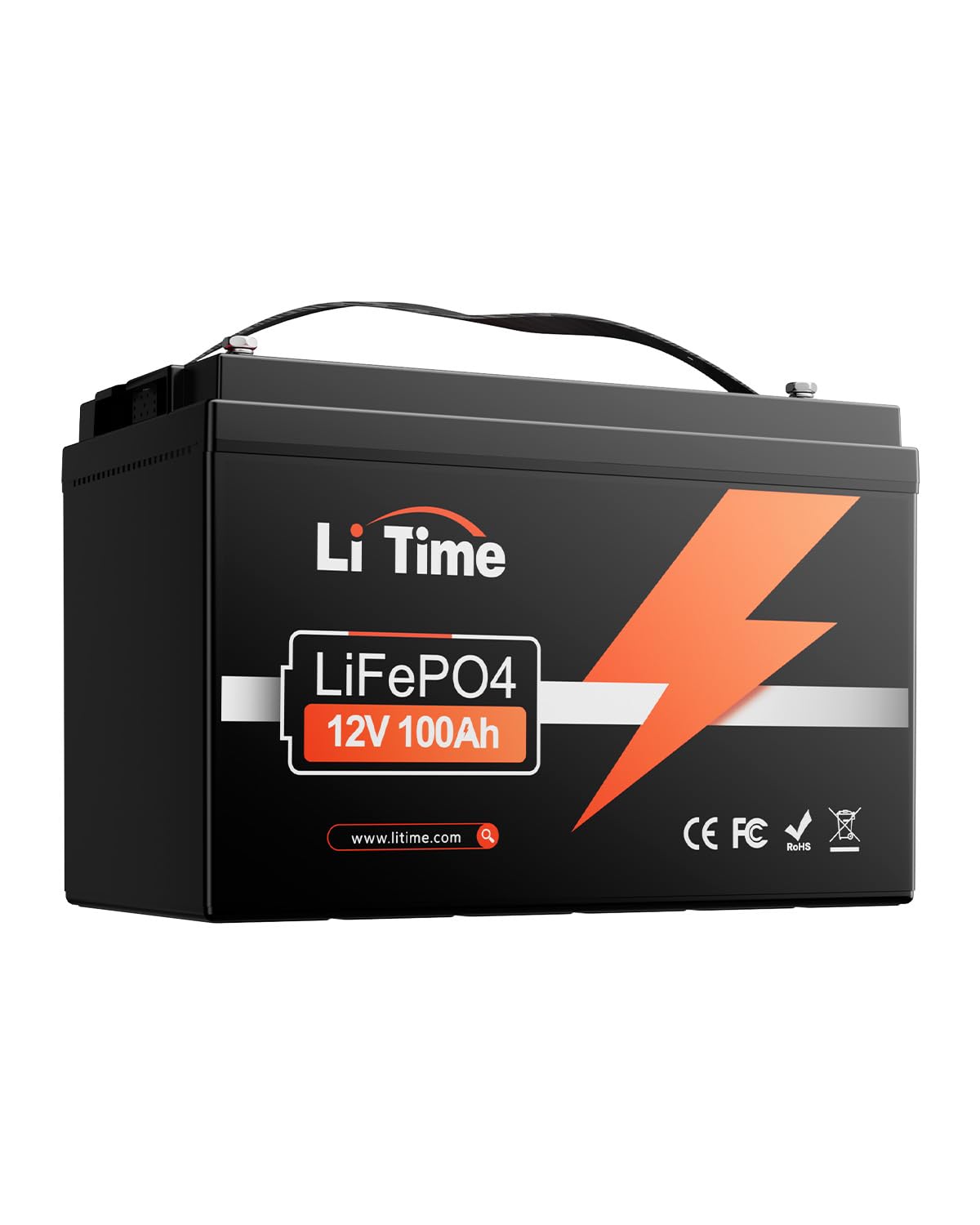
| LiTime 100Ah★ Best Overall | Best Overall / Value | 100Ah | 22.2 lb | 100A | Amazon |
| WEIZE 100Ah AGMBudget Champion | Budget Lead-Acid | 100Ah | 60 lb | — | Amazon |
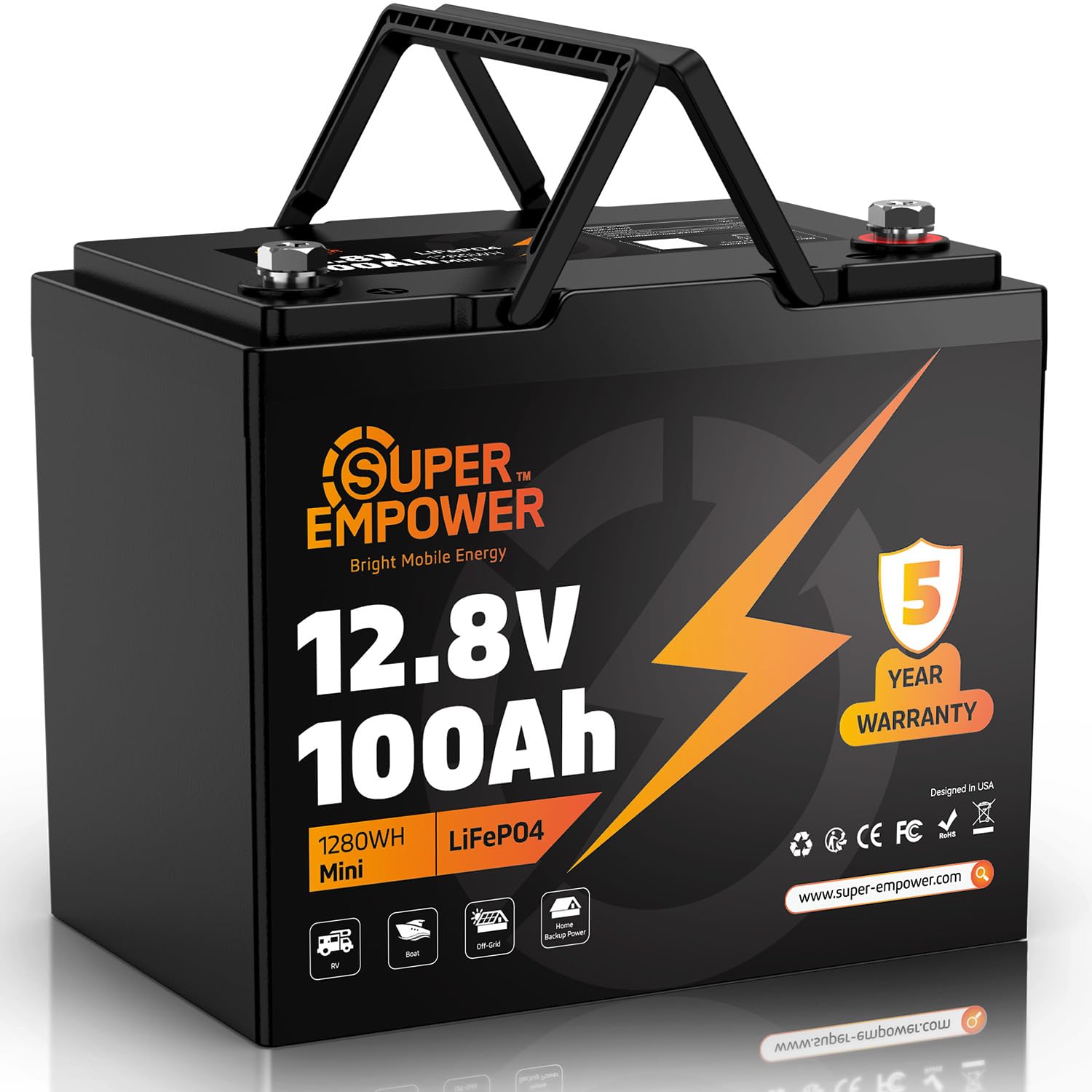
| SUPER EMPOWER 100AhCompact Pick | Compact Drop-In | 100Ah | 21.6 lb | 100A | Amazon |
| HumsiENK 100Ah BT | Bluetooth Monitoring | 100Ah | 19.7 lb | 100A | Amazon |
| Power Queen 100Ah | 10-Year Lifespan | 100Ah | 21 lb | 20+ | Amazon |
| Interstate 31M AGM | Dual-Purpose Marine | 100Ah | 64.5 lb | — | Amazon |
| ECO-WORTHY 280Ah | Long Boondocking (Metal Case) | 280Ah | — | 200A | Amazon |
| LiTime 165Ah | Mid-Size Power + Bluetooth | 165Ah | 32.2 lb | 165A | Amazon |
| ECO-WORTHY 314Ah | Max Capacity + LEDs | 314Ah | 60.4 lb | 200A | Amazon |
| Power Queen 300Ah | High Density / Long Runtime | 300Ah | 59.9 lb | 200A | Amazon |
In‑Depth Reviews
1. Litime 12V 100Ah LiFePO4 Battery
Our pick — over 4.5★ from 700+ verified ratings; the strongest balance of quality and price.
The 22.2-pound lithium that ends the 60-pound lead-acid battle for good.
The LiTime 100Ah is the pick we see travel trailer owners recommend most, and the numbers show why. It’s a 12.8V pack that weighs just 22.2 pounds — about a third of a comparable lead-acid unit — so you can lift it into a battery box without a second person. The 100A BMS handles a 30A fridge draw easily, per buyer reports of powering a fridge and compressor on a 2-year-old unit still going strong.
Owners praise the battery quality and reliability most, noting it ran flawlessly through a season of 34 cycles in a truck bed. The 1280Wh capacity translates to real-world camping: one owner says it runs a fridge for 6-7 months of the year. The Bluetooth app is handy for watching charge and discharge rates, though a few find the connection finicky during charging.
The honest catch: if you’re converting an older trailer from lead-acid, check your converter first. A few buyers report the stock charger can overwhelm the battery at 50+ amps, so a lithium-compatible charger might be in your future. That’s a one-time system upgrade, not a flaw in the battery itself.
Why It Wins
- Usable capacity: full 100Ah vs. roughly 50% of a lead-acid
- 30-pound weight savings over the WEIZE AGM version
- Expandable to 4P4S for a 51.2V 400Ah bank
Before You Buy
- Bluetooth app can be glitchy while charging
- Older RV chargers may need a lithium-compatible upgrade
Reach for it if: you want the best balance of price, weight, and verified reliability for a standard 100Ah install.
Look elsewhere if: your trailer’s converter can’t be upgraded — you’d be paying for lithium you can’t charge properly.
2. WEIZE 12V 100Ah Deep Cycle AGM Battery
The sealed workhorse that skips the fluid checks and still powers a 2000W inverter.
If you’re not ready to jump to lithium, the WEIZE AGM is the lead-acid pick that owners say outperforms a standard flooded battery at a better price. It’s a 60-pound sealed lead-acid with a 1150A max discharge current, so it can spike power to a 2000W inverter with room to spare — owners mention running a 700W inverter for a crock pot and TV without a hiccup. There’s no BMS (battery management system) and no Bluetooth, which keeps things simple and cheap.
The performance is what owners praise most — one ran two of these with 2x 150W solar for 2 years off-grid with zero issues. A common setup is two in parallel with a 2000W inverter for a 4.8kWh backup. The trade-off is physics: at 60 pounds, this is the heaviest pick here, and you’re only getting about 50Ah of usable capacity out of the 100Ah rating. It’s fine unless you plan long dry camping trips.
Buyers also like that it arrived holding a solid charge — new units were measured at 12.3V — and that it’s maintenance-free, which means no distilled water checks. The recurring mixed note is weight and battery life, both typical of AGM chemistry. It’s the right call for a weekend camper running basics, not a full-time boondocker.
Who it fits: the budget buyer who wants a reliable, maintenance-free AGM and accepts the weight.
The trade-off: you’re carrying 60 pounds for half the usable capacity of a 22-pound lithium.
3. SUPER EMPOWER 12V 100Ah LiFePO4 Battery
A Group 24 shape that drops into standard boxes with zero modifications.
The SUPER EMPOWER brings a 21.6-pound lithium pack into a classic Group 24 footprint, meaning it slides into most existing battery boxes without a screwdriver. The 100Ah capacity with 1280Wh handles a full day of trolling motor use — customers note a motor pulling 30 amps on full power with voltage that doesn’t drop all day. The 100A BMS is the safety brain, cutting off charging below 32°F and stopping discharge at -4°F.
Battery life is what owners single out most, with one noting it powered an electric blanket for three nights straight. Another uses it on a kayak motor and says it goes very far per charge. The weight is a big differentiator here — it’s far lighter than the heavy deep-cycle battery it replaced, which makes installs in tight trailer compartments much more pleasant.
The catch is the charging requirements: this is lithium, so it needs a dedicated LiFePO4 charger or a solar controller set to lithium mode. A buyer noted it ships partially charged due to shipping regulations, so plan a full charge before your first trip. It’s a straightforward drop-in if your setup is lithium-ready.
Best for: the boater or trailer owner who wants a lightweight lithium that fits the same box as an old lead-acid.
Consider this: if your RV only has a standard lead-acid charger, budget for a LiFePO4 charger upgrade.
4. HumsiENK 12V 100Ah LiFePO4 Battery With Bluetooth
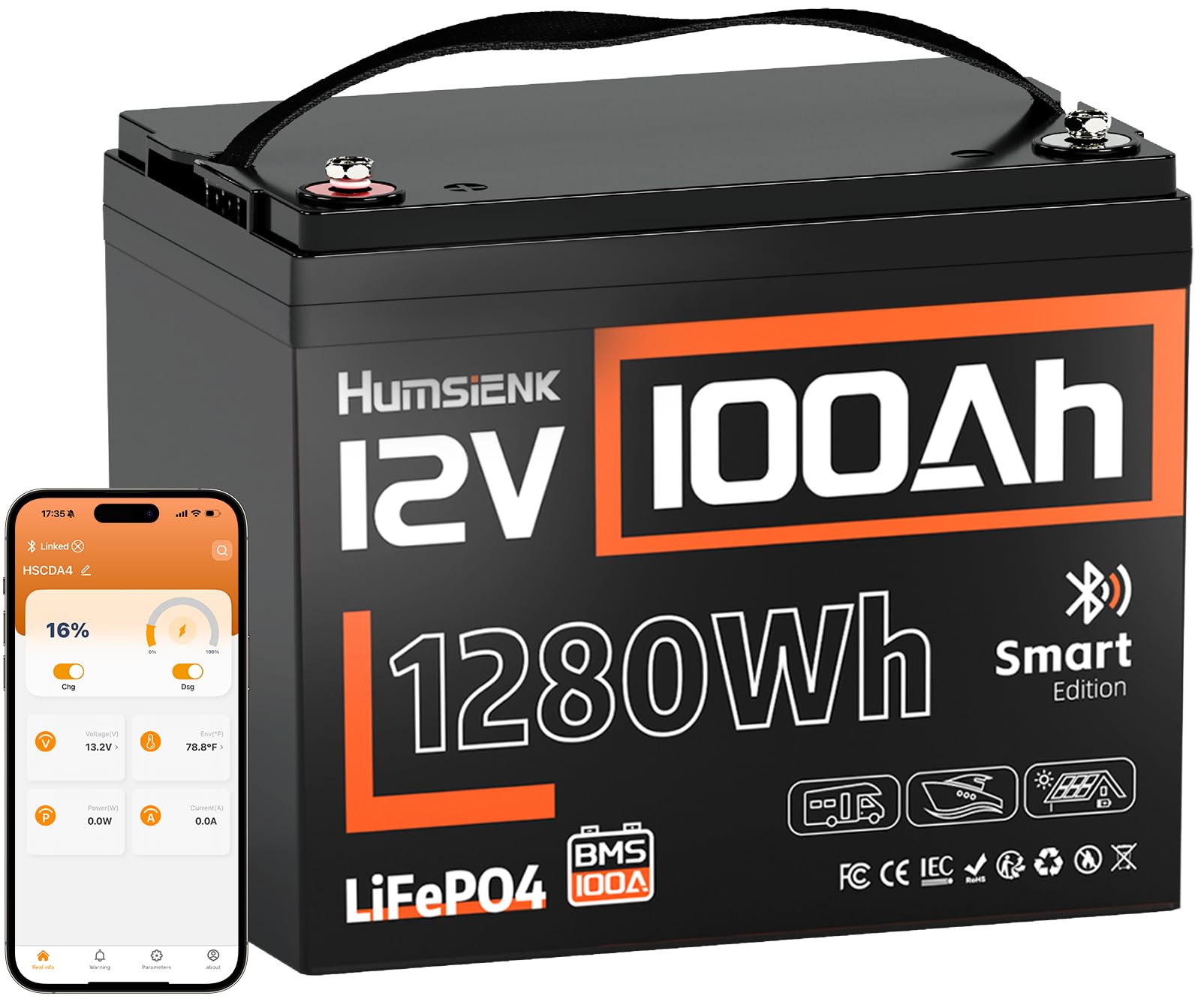
A 19.7-pound lithium with per-cell telemetry that fits Group 24-31 boxes.
The HumsiENK is for the owner who wants to see what’s happening inside the battery, not just guess. It’s a 100Ah lithium at just 19.7 pounds — one of the lightest in this lineup — with a Bluetooth app that streams voltage, state of charge, current, and temperature in real time. The app even lets you disable discharge remotely and shows per-cell data, which is a level of insight you won’t get on a lead-acid unit. The BMS includes low-temperature shutdown protection for safety in cold climates.
Quality is the most-discussed aspect, with owners noting it holds voltage well under load and can power all major kitchen appliances. One buyer runs four in parallel with a 2000W inverter to run freezers on solar, and the BMS shuts down at ~10V to protect the cells. The IP65 waterproof rating means it shrugs off the damp conditions common under a trailer floor.
The honest caveat: Bluetooth connectivity gets mixed feedback — some rave about the app, others find the connection drops. And there’s a rare durability concern, where one unit died after six months of limited use; the 5-year warranty is there, but read the return policy carefully. This one rewards owners who love data but accept that the app isn’t perfect yet.
The Tech Edge
- Live voltage, current, and per-cell data on your phone
- IP65 waterproof and salt-fog resistant
- 10-year lifespan with 15,000 cycle rating
The Gripes
- Bluetooth connection can be inconsistent for some
- Rare durability complaints mean check the warranty terms
Go with it if: you want smartphone monitoring and the lightest 100Ah pack here.
Think twice if: you’d rather have a dead-simple battery with no app to fuss with.
5. Power Queen 12V 100Ah LiFePO4 Battery
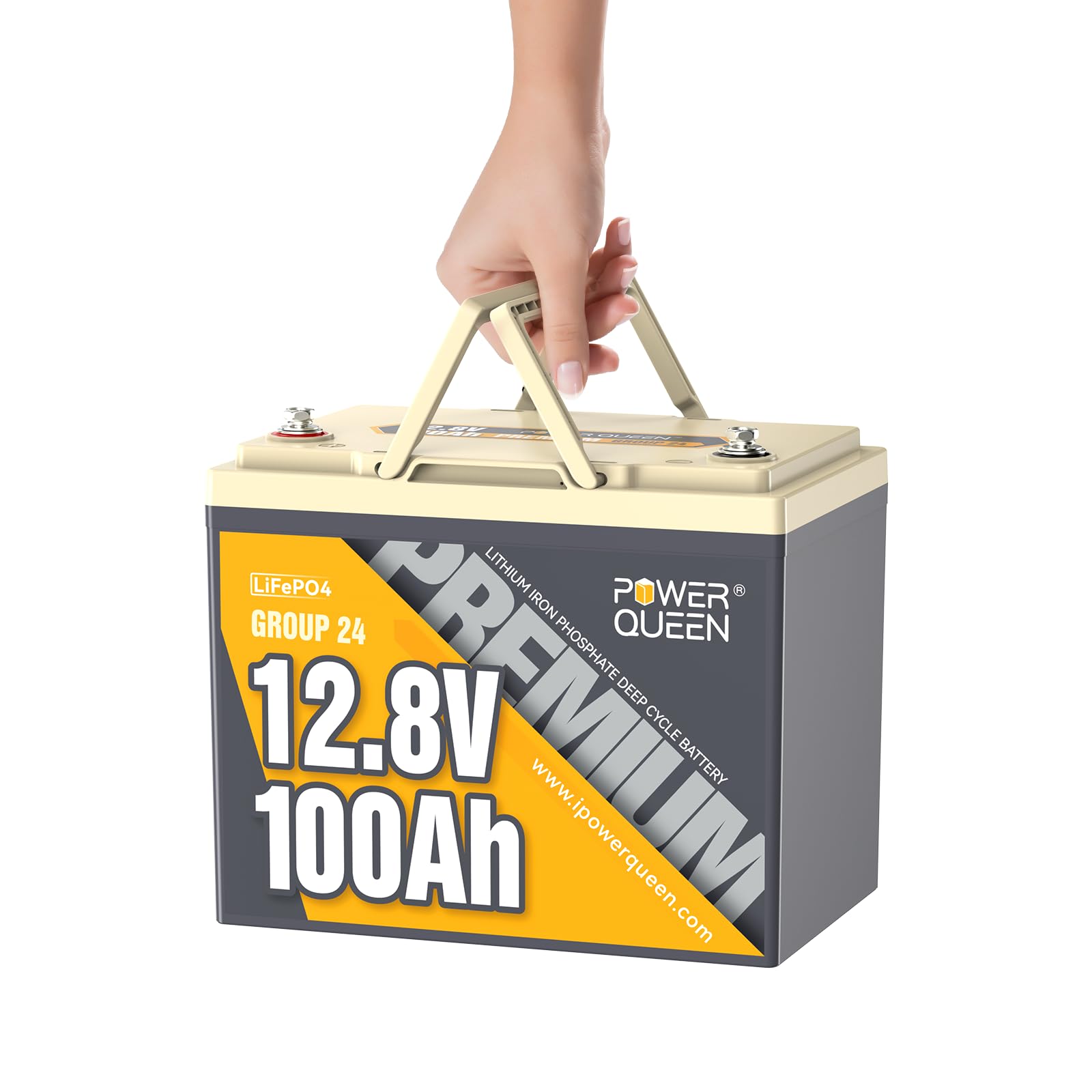
A 10-year design with a warranty that owners say the company actually honors.
Power Queen’s 100Ah lithium is the pick for the long-haul owner who wants proof the warranty means something. It’s a Group 24 unit at 21 pounds with 1280Wh of 100% usable energy — the spec sheet compares that to just 500Wh of a 70Ah AGM at 50% depth of discharge. The 20+ BMS protections handle overcharge, overdischarge, overheat, and short circuits, and the 5-year warranty has a real track record: reviewers point out a first unit that lasted 3+ years on a trolling motor before a BMS hiccup, and the replacement shipped within days.
Battery life is the standout aspect, with owners praising the longevity and how light it feels — one calls the carry handles great for hauling it to a field radio setup. It runs a 45 lb thrust trolling motor with ease, and the energy density means you drain every amp-hour instead of leaving half on the table like a lead-acid. The 10-year lifespan claim is backed by a 4000-cycle rating at 100% DOD.
There’s a practical note: this is an energy storage battery, not for engine starting or golf carts — the maker says so plainly. And the warm tip about using gaskets with screws under 2mm to prevent loosening is worth heeding during install. It’s a solid, drama-free lithium for a travel trailer that gets used weekly.
Why owners stay: the warranty experience is the thing people mention — real coverage, not a phone tree.
Keep in mind: it’s storage-only, so don’t use it for engine cranking.
6. Interstate Batteries Marine/RV 12V 100Ah 825CCA Group 31M AGM

The 825-CCA AGM that cranks an engine and still deep-cycles for the trolling motor.
The Interstate 31M is for the trailer owner who also wants a battery that can start a motor, not just store solar power. It’s a dual-purpose AGM with 825CCA — that’s cold cranking amps, the measure of starting punch — and it’s rated at 100Ah for deep-cycle use. That makes it a bridge: it will fire up a generator or boat engine and then run the lights and water pump once you’re parked. At 64.5 pounds, it’s the heaviest unit here, but it’s built “Interstate tough,” a brand with 70 years in the battery game.
Shoppers say it arrives with an 80% charge and tests healthy above its 950 CCA rating once fully charged. One owner runs two of these for a 3/4 HP sump pump backup and says the setup is rock-solid. The packing gets a shout-out too — a damaged first unit was replaced with a much thicker foam package the second time around.
The honest limit: pure-lead AGM offers more life than flooded lead-acid, but it’s still an AGM, so you’re working with roughly half the usable capacity of a lithium pack at this amp-hour rating. And the warranty is 2 years, shorter than the 5- and 10-year plans on the lithiums above. If you want one battery that does double duty for cranking and camping without a lithium converter upgrade, this is the classic pick.
Perfect for: the boater/RVer hybrid who needs starting power plus deep-cycle reserve.
Not ideal for: heavy dry camping — you’ll want lithium’s full usable capacity for multi-night trips.
7. ECO-WORTHY 12V 280Ah Metal Case LiFePO4 Battery
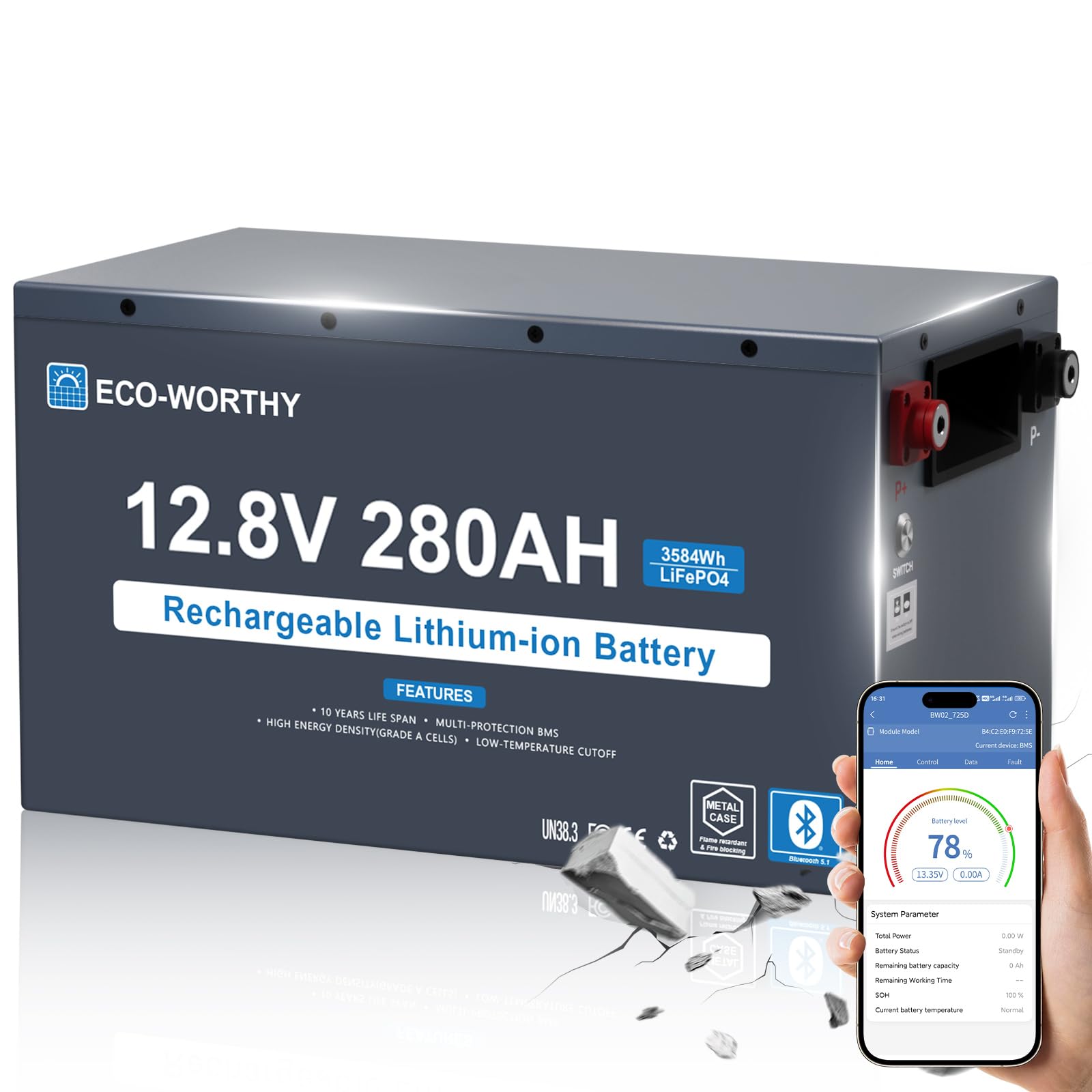
A 280Ah metal-cased power station that runs a week off-grid flat out.
The ECO-WORTHY 280Ah is the upgrade that turns a travel trailer into a genuine off-grid cabin. It’s a 12V lithium pack with 3584Wh of stored energy — that’s roughly triple a single 100Ah unit — wrapped in a heavy-duty metal enclosure for fire safety and road-vibration resistance. The 200A BMS handles serious loads: buyers report powering a microwave, instant pot, and induction burner on a 2000W inverter, plus a 1000W amp without breaking a sweat. Buyers run two of these (560Ah total) in a travel trailer for two months straight with zero issues.
What wins people over is the battery quality and built-in Bluetooth monitoring. The metal case means no extra battery box — it mounts directly to the floor with four feet, which saves space and keeps things organized. It even has a low-voltage power switch so you can cut output with one touch during installation. One owner says it exceeds its rated capacity in the first week of use.
There’s a wrinkle: because of shipping restrictions, your order may arrive in multiple packages at different times — that’s expected, not a problem. And the Bluetooth app is functional but light on detail compared to some rivals. The weight is substantial — it’s about what an AGM weighs for triple the capacity — but owners say the trade-off is worth it for a week of silence from the generator.
The Heavy Hitter
- 3584Wh runs the whole camper for days
- Metal case mounts directly, no box needed
- 200A BMS with low-temp cutoff at 20°F
Heads Up
- Arrives in multiple packages — don’t panic on day one
- Bluetooth app lacks some details
The verdict: if you boondock for a week or more, this is the capacity you actually need — start here, not with two 100Ah packs.
8. Litime 12V 165Ah Group 31 LiFePO4 Battery
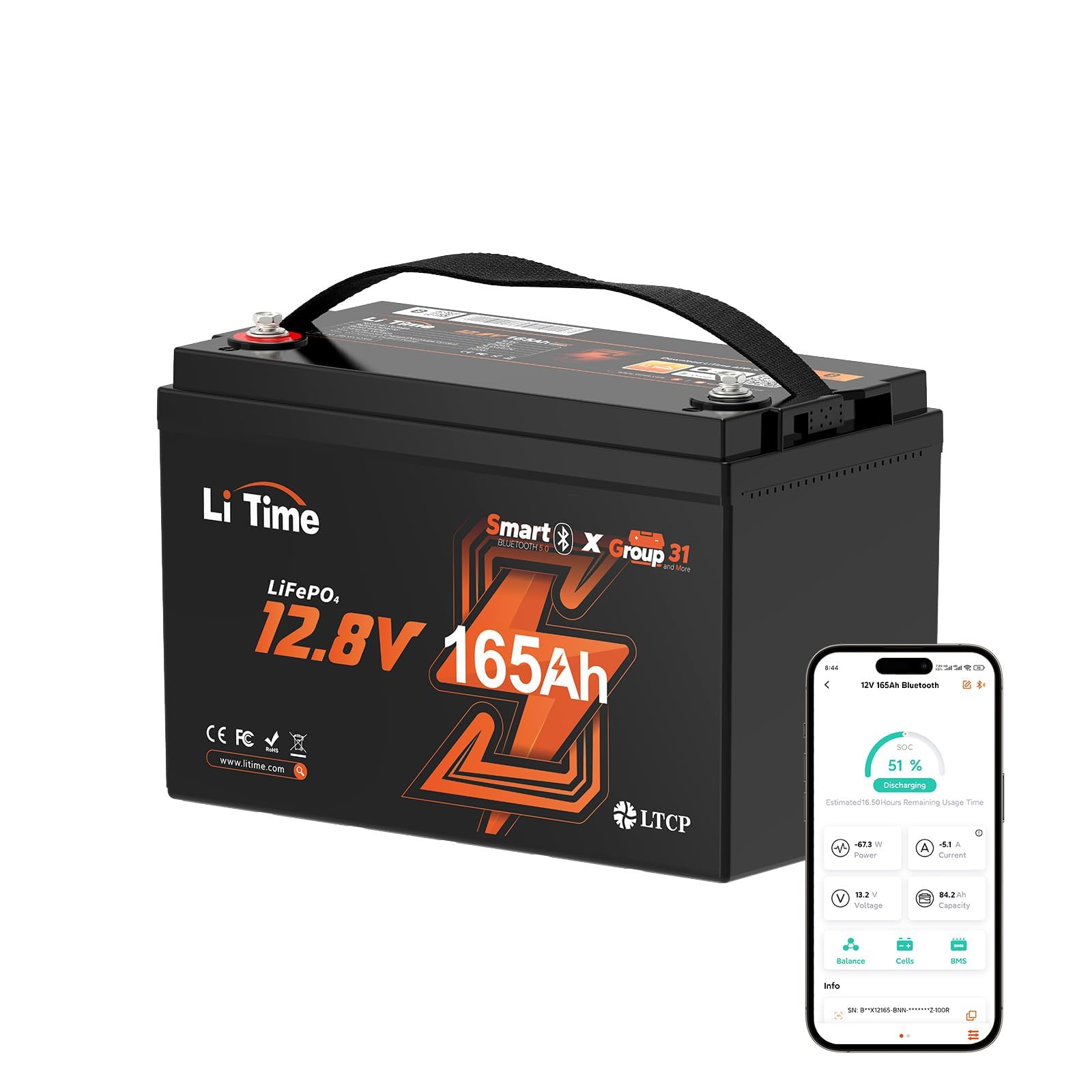
A 32.2-pound mid-size that splits the difference between 100Ah and 280Ah life.
The LiTime 165Ah is the just-right option for owners who find 100Ah too tight but don’t need a 280Ah monster. It’s a Group 31 lithium at 32.2 pounds with 2112Wh of stored energy — that’s 65% more capacity than a 100Ah pack in a box that fits the same space as the lead-acid it replaces. Owners mention running a 45 lb trolling motor for 8 hours in a tournament plus 4 more hours the next day, all on one charge. The Bluetooth 5.0 connection auto-connects and lets you monitor or even control discharge from your phone.
Battery life is the most-praised aspect by a wide margin, with owners noting a 2.5-year weekly-use record that’s still going strong. The weight is a huge win — one buyer says it cut boat weight by 80 pounds compared to the old acid setup. The 165A BMS and IP65 waterproof rating mean it handles the damp corners of a trailer or boat without worrying about corrosion.
The practical note: it arrived at 50% charge, and the converter may need a discharge cycle to recognize it as lithium. And the price has crept up since launch, so it’s not the screaming value it once was — but owners say they’d rebuy anyway for the reliability and weight savings.
Why it’s loved: the battery life and quality lead every conversation, plus it’s more than 50% lighter than the acid it replaces.
The cost: premium pricing for a mid-size capacity — fine if 2112Wh fits your trips.
9. ECO-WORTHY 12V 314Ah LiFePO4 Battery
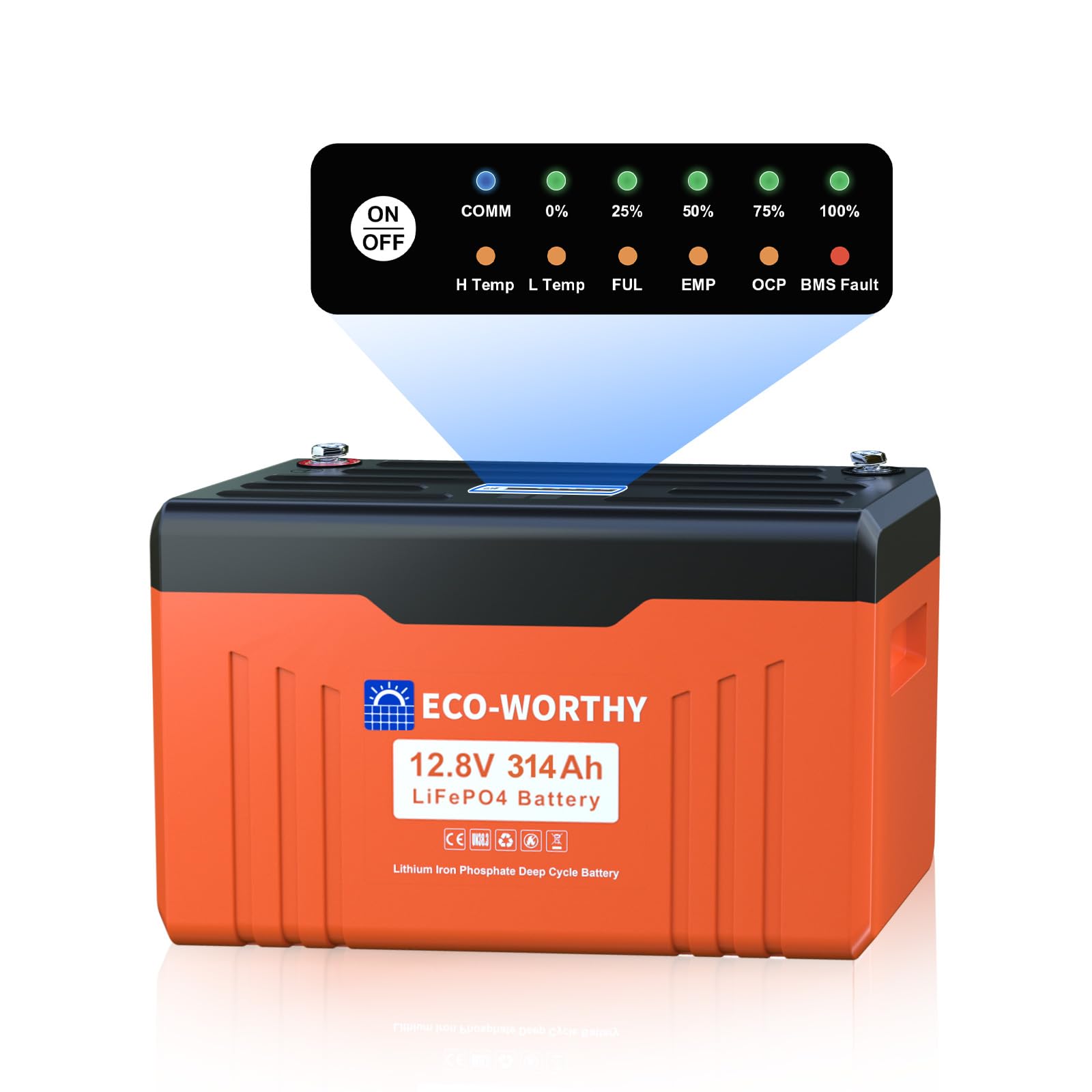
A 314Ah behemoth with SOC LEDs that tell you the state of charge at a glance.
The ECO-WORTHY 314Ah is for the full-timer who wants absolute maximum capacity and doesn’t want to fiddle with a phone app to know how much juice is left. It stores 4019.2Wh of energy — the biggest number in this lineup — and the built-in LED screen shows battery level and status right on the case, so you can glance at it from the pass-through compartment. At 60.4 pounds, the maker says it’s 1/3 lighter than lead-acid at the same capacity, which is impressive for a pack this size.
Quality and performance are the things owners praise most, with one noting it runs a greenhouse smoothly and another running a camper trailer on it without issues. The 200A BMS includes a buzzer that alerts you to faults, plus Bluetooth via the ECO-WORTHY app for remote monitoring. The low-temp protection cuts charging below 19.4°F to protect the cells during cold-weather camping.
The recurring mixed notes are charging and Bluetooth: some owners see it stop at 98% instead of a full 100%, and connectivity is occasionally finicky. One buyer notes a minor cell-balancing quirk during initial setup. This is also a physically big unit at 16.3 inches long, so measure your battery box carefully before committing. For sheer capacity per install, it’s the ceiling of what’s practical.
The big draw: 4019Wh and LEDs on the case — no app required for a quick check.
Reality check: rare reports of stopping at 98% charge and app quirks; measure your space first.
10. Power Queen 12V 300Ah LiFePO4 Battery
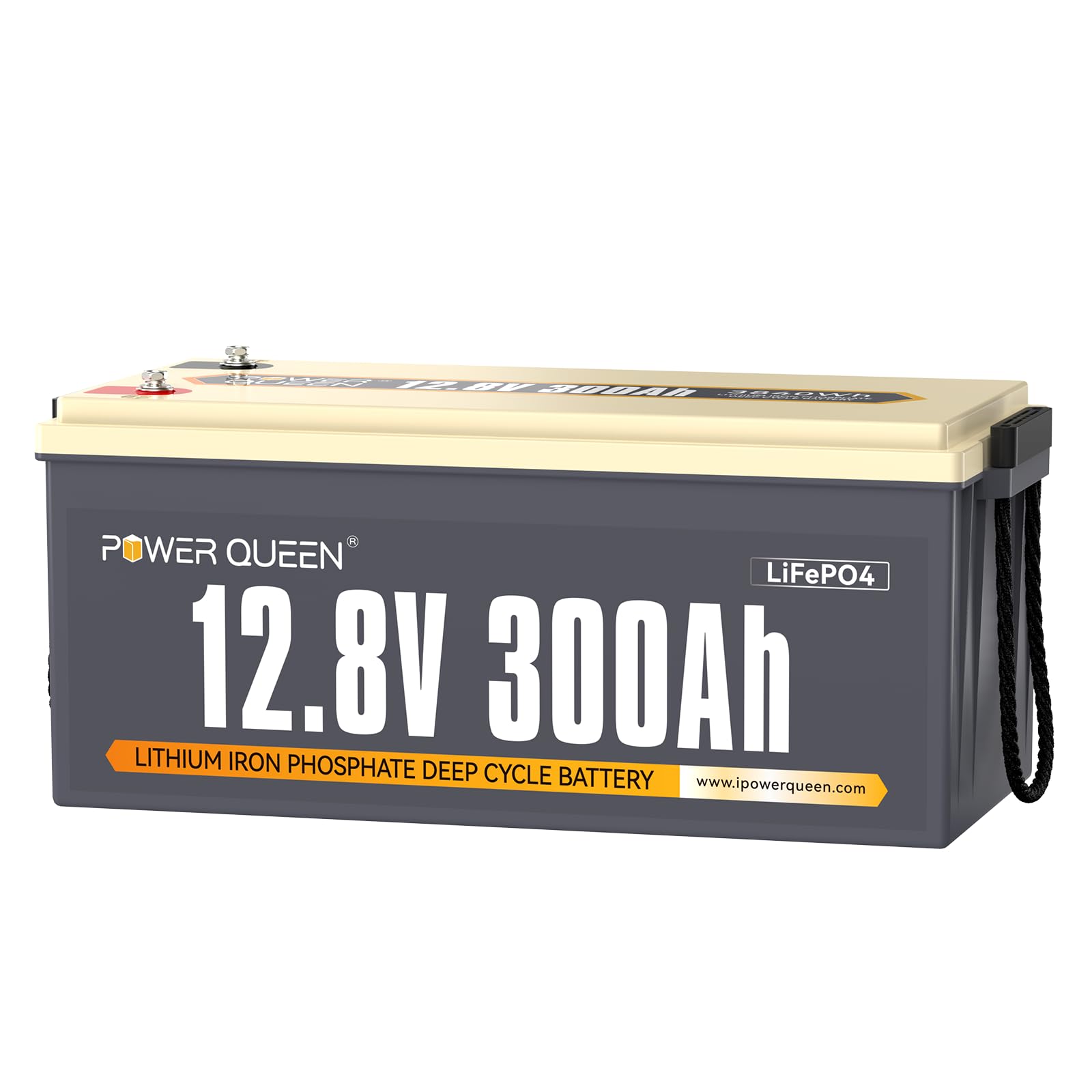
A 3840Wh block with the highest energy density per pound in this lineup.
The Power Queen 300Ah is the choice for the serious solar setup where every pound matters. It packs 3840Wh of usable energy — enough to run a 2000W inverter all day — with a 200A BMS for protection against overcharge, over-discharge, and short circuits. The high energy density is the stat that stands out: at 61.14Wh per pound, it’s among the most efficient ways to store power in a trailer. Owners install it on a 2025 Cherokee Gray Wolf and report it’s “large but not very heavy,” fitting the RV with room to spare. It’s rated for 4000 cycles at 100% depth of discharge, which the maker translates to a 10+ year design life.
Buyers who pair four of these for a 40.96kWh solar bank call them excellent, praising the power and reliability. One owner ran a battery charger through an inverter for over 50 hours straight without the pack quitting. The battery quality and reliability are the most-praised aspects.
The caveats are minor: there’s no built-in heater, so the BMS may stop charging in freezing temperatures — that’s unverified but worth knowing if you camp in deep winter. And a reviewer notes there’s no indicator showing the battery capacity scale on the case. At 59.9 pounds, it’s also a two-person lift. You’re paying a premium for density and runtime in a single box.
Why It’s The Heavyweight
- 3840Wh runs heavy loads for hours
- 61.14Wh/lb density, expandable to 40.96kWh
- 10+ year design with 5-year warranty
Watch These
- No built-in heater for freezing temps
- No capacity-scale indicator on the unit
Pick this if: you’re building a serious solar bank and want maximum runtime in the fewest parallel connections.
skip it if: you camp in sub-freezing weather without a heater or need a quick glance at remaining capacity.
Understanding the Specs
Amp-Hours (Ah) and Watt-Hours (Wh)
Amp-hours tell you how much current the battery can deliver over time — a 100Ah battery can give 10 amps for 10 hours in theory. But for lithium, the more useful number is watt-hours (Wh), which is the total energy stored: a 100Ah LiFePO4 at 12.8V equals 1280Wh. On a lead-acid battery, you can only safely use about half the labeled amp-hours, while lithium lets you drain to nearly 100%. That’s why a 100Ah lithium feels like roughly double the usable power of a 100Ah AGM.
BMS and Depth of Discharge (DOD)
The Battery Management System (BMS) is a computer inside every lithium battery that watches voltage, current, and temperature. It cuts power to prevent overcharging, over-discharging, and short circuits — think of it as a safety guardian. Depth of Discharge (DOD) means how much capacity you use before recharging. A 4000-cycle rating at 100% DOD means you can fully drain it 4000 times; at 60% DOD that same battery might last 15,000 cycles. The BMS is also where low-temperature protection lives, so charging pauses below freezing to protect the cells.
FAQ
Will a 100Ah battery run my travel trailer fridge all night?
What is the difference between a deep cycle battery and a starting battery?
Can I replace my lead-acid battery with lithium in my travel trailer?
How long does a LiFePO4 battery last compared to AGM?
What size battery do I need for a week of off-grid camping?
Why is my lithium battery so much lighter than my old lead-acid one?
Is Bluetooth monitoring on a battery worth it?
Can I connect multiple batteries in parallel to get more capacity?
What does low-temperature cutoff mean and why do I need it?
Is an AGM battery still a good choice for a travel trailer in this day and age?
Final Thoughts: The Verdict
If you want one dependable pick, the battery for travel trailer winner is the LiTime 12V 100Ah LiFePO4 because it nails the balance of price, weight, and proven reliability — the crowd favorite among owners who want to ditch lead-acid without overthinking it. If you want a week of off-grid capacity in one box, grab the ECO-WORTHY 280Ah and skip the generator for days on end. And for the budget-conscious who prefer the familiar AGM simplicity, the WEIZE 100Ah is the dependable entry point that won’t empty your wallet.
How We Picked
We do not accept paid placement. Every pick is matched to a real buyer and a real use-case; we do not hands-on test units.
Sources & Methodology
Specifications: manufacturer listings and product documentation. Review insights: verified customer reviews, as of August 2026. Pricing: not shown on this page (it changes often); check the current price via the retailer link.
As an Amazon Associate, Gadgets Feed earns from qualifying purchases. This does not affect which products we feature.