
Our readers keep the lights on and my morning glass full of iced black tea. As an Amazon Associate, I earn from qualifying purchases.
Specs are compiled from manufacturer listings and verified buyer reviews and can change over time — please confirm the key details on the product page before buying.
You are under the truck, wrestling a coil of stiff steel, and the rusted brake line has to come out. The right 1/4 inch brake line bends without kinking, flares into a leak-free seal, and resists road salt and moisture. Here is what to look for and which options hold up best.
I’m Min — the founder and writer behind Gadgets Feed. This guide is built by comparing the manufacturers’ published specifications and the patterns across verified customer reviews, so you get each pick’s real strengths and trade-offs instead of marketing spin.
The best 1/4 inch brake line for your project depends on your vehicle’s age and your tolerance for rust, so we break down the top contenders by material and hardware included.
Our Picks at a Glance

How To Choose The Best 1/4 Inch Brake Line
Choosing the right brake line tubing is a safety decision, not just a shopping decision. You need a line that bends without collapsing, flares without cracking, and resists the corrosive environment under your vehicle.
Match the Material to Your Climate
Galvanized steel is the budget-friendly workhorse, offering solid corrosion resistance thanks to its zinc coating. If you live in the rust belt or near the coast, copper-nickel alloy is the standout choice because it simply does not rust like steel, making it easier to work with years down the road. For the absolute maximum protection, 316L marine-grade stainless steel shrugs off road salt and moisture, but it is noticeably harder to bend and flare than the softer alloys.
Count the Fittings Before You Buy
Some kits include only the raw tubing coil, while others bundle a full set of inverted flare nuts and unions. Check which thread sizes your vehicle needs — common 1/4 inch line threads are 7/16-24, 1/2-20, and 9/16-18 — and make sure the kit covers them. A single roll of 25 feet is usually enough for one full brake line run, but if you are doing a complete frame-off restoration, you may need more length or even two rolls.
Understand the Flare Type
Virtually all modern vehicles use a double flare, also called an inverted flare, at the connection points. This creates a stronger, leak-free seal compared to a single flare. Make sure your tubing is soft enough to double-flare cleanly with a standard tool, and confirm the fittings in the kit are inverted tube nuts rather than compression fittings.
Quick Comparison
| Model | Best For | Material | Wall Thickness | Fittings Included | Amazon |
|---|---|---|---|---|---|
| 4LIFETIMELINES Galvanized Coil★ Best Overall | Budget-friendly multipurpose runs | Galvanized Steel | 0.028″ | None (Coil Only) | Amazon |
| Tnisesm Copper Coated KitTop Performer | Value kit with extra fittings | Copper-coated Steel | 0.028″ | 24 (incl. 4 extra) | Amazon |
| smseace Zinc Plated KitMost Complete Kit | Complete kit with unions | Zinc Plated Steel | — | 44 (incl. 4 unions) | Amazon |
| MuHize Dual Size Kit | Covering both 3/16 & 1/4 sizes | Copper Alloy | — | 32 (16 per kit) | Amazon |
| 4LIFETIMELINES Copper-Nickel Coil | Rust-proof daily driver repairs | Copper Nickel | 0.028″ | None (Coil Only) | Amazon |
| BSTIQUEUS Copper-Nickel Kit | Premium kit with long nuts | Copper Nickel | 0.028″ | 16 | Amazon |
| Racewill Copper Kit + Tool | DIYers without flaring tools | Copper Coated Steel | — | 20 (incl. 4 unions) | Amazon |
| 4LIFETIMELINES 316L Stainless Coil | Maximum corrosion resistance | 316L Stainless Steel | 0.028″ | None (Coil Only) | Amazon |
| 4LIFETIMELINES 316L Stainless Kit | Complete marine-grade replacement | 316L Stainless Steel | 0.028″ | 16 | Amazon |
In‑Depth Reviews
1. 4LIFETIMELINES 1/4″ x 25′ Galvanized Steel Coil
Our pick — over 4.5★ from 350+ verified ratings; the strongest balance of quality and price.
The budget coil that bends by hand and still meets DOT-grade standards.
The defining trait here is the double-walled, copper-brazed galvanized steel construction with a 0.028″ wall thickness. That specific build gives you a line you can shape by hand — buyers report bending it without a bender if you are strong enough — while the zinc coating adds genuine corrosion protection for the price.
The 25-foot length is versatile enough for brake master cylinder lines, front and rear brakes, and even fuel return lines. One classic-car owner used it to replace a defective fuel return line on a 1976 Jeep CJ5, gently unrolling it and using spring benders for the bends. This coil meets SAE J527 and international hydraulic braking standards, with a lifetime warranty.
It is a coil only, so you need to source your own fittings and flare tool. That is the honest trade-off at this price point.
Why It Wins
- Bends easily by hand thanks to copper-brazed construction
- Zinc coating resists corrosion well for the price
- Meets SAE J527 standards with a lifetime warranty
The Trade-Off
- Ships without fittings or a flaring tool
- Galvanized steel can still rust over many years in salt
Pick this if: you want a dependable, low-cost coil for a single line replacement and already own fittings and a flare tool.
Look elsewhere if: your truck lives in the rust belt and you want a fit-and-forget material.
2. Tnisesm 1/4″ 25 Ft Copper Coated Brake Line Kit
A fitting-packed kit that bends beautifully without crimping, ideal for older builds.
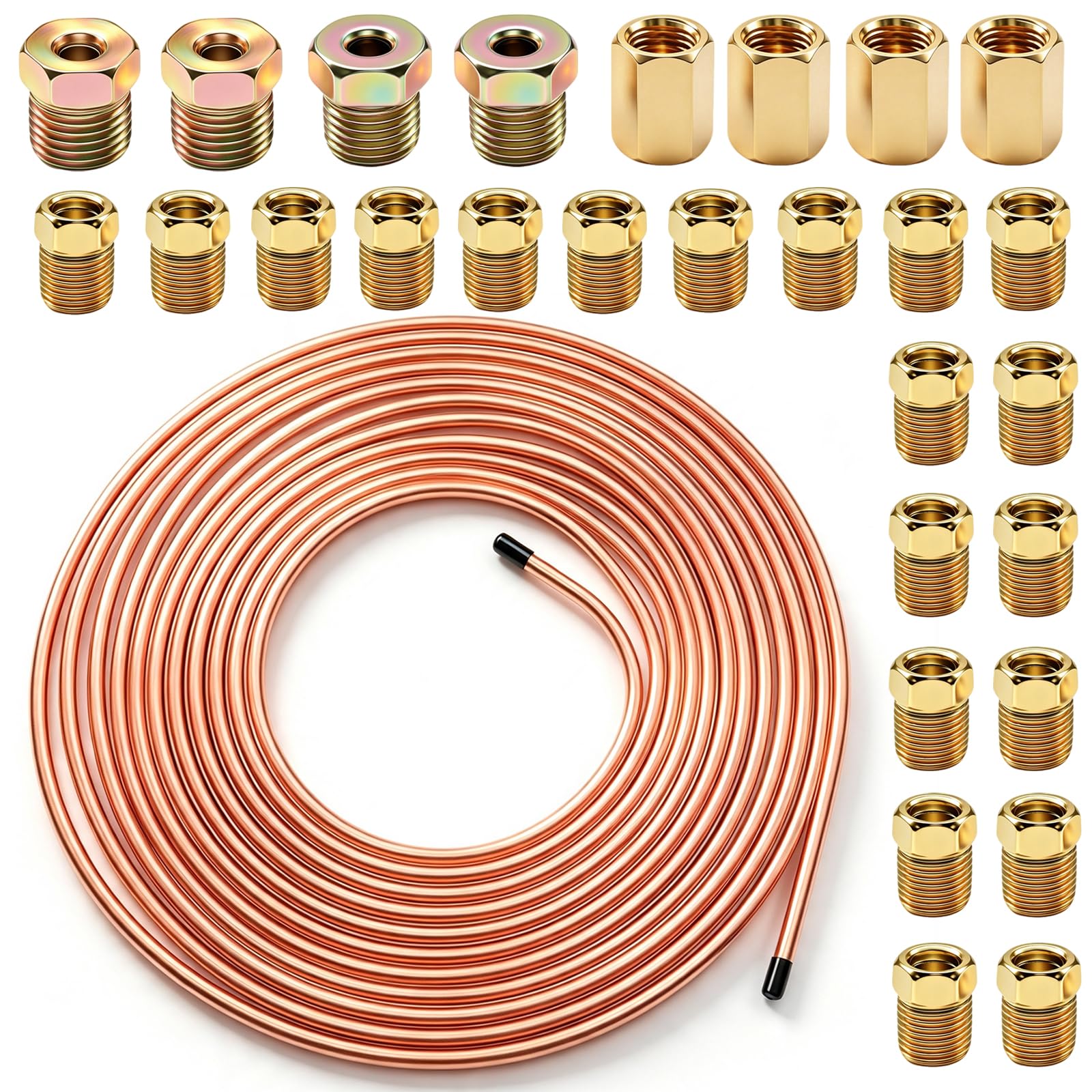
This kit leads with its 28-piece fitting set, which is more connection options than the typical 16-piece package. You get 20 x 7/16-24, 2 x 1/2-20, and 2 x 9/16-18 inverted tube nuts, plus 4 extra copper alloy fittings — enough variety to handle a classic truck’s mixed thread sizes.
The 25 ft roll features a highly flexible copper coating that routes smoothly in tight spaces without kinking. A restorer working on a 1958 F100 found the proportioning valve was set up for 1/4 inch lines to the rear brakes, and this kit had the right mix to make it work. The copper coating resists rust and road chemicals, though the material is copper-coated steel, not solid copper-nickel.
Bending and flaring are easy with basic tools, making this a practical choice for both DIY and professional repairs. A few buyers noted the possibility of receiving a kit short on fittings, so unpack and count yours right away.
Fitting flexibility: the 28-piece set covers more thread combos than most kits, which saves a parts-store trip on mixed-size projects.
Material note: it is copper-coated steel, so expect steel-like long-term rust behavior, not true copper-nickel longevity.
Reach for it if: you are working on a vintage vehicle where thread sizes vary and you want one box to cover it.
Think twice if: you expect a lifetime, non-rusting material — this is coated steel, not alloy.
3. smseace 48Pcs 25 FT 1/4″ Brake Line Kit
The do-it-all box with 44 fittings and unions that did not kink during a hurried install.
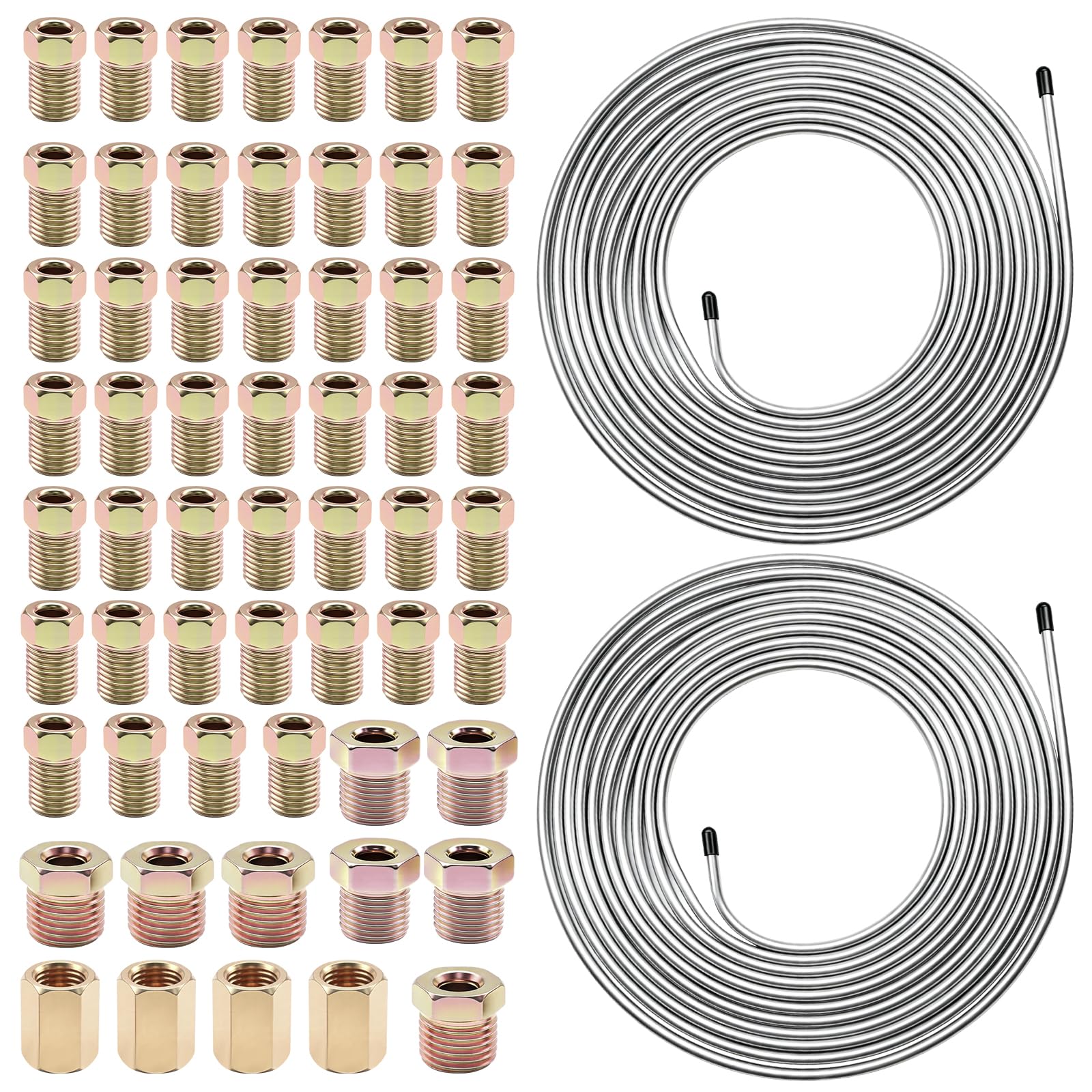
This kit packs the most hardware of any pick here, with 32pcs of the common 7/16-24 inverted nuts, 4pcs of the 1/2-20 size, 4pcs of the 9/16-18 size, and 4 unions. Every fitting is brass with anti-rust and anti-corrosion treatment, so you are not hunting for a missing piece mid-job.
The zinc-plated line offers superior corrosion resistance and flexibility compared to standard steel lines. One owner replacing a main brake line confirmed it did not kink even while rushing the install, and the flaring worked out cleanly on the first go. The kit is versatile across automotive, household, industrial, and commercial hydraulic systems.
The honest gripes are the same as any zinc-plated product: long-term rust resistance still trails copper-nickel or stainless. And one detail-oriented buyer noted the package contains a single 25-foot roll, not two, so plan your runs accordingly.
The Big Box
- 44 brass fittings plus unions cover nearly every thread combo
- Flexible zinc-plated line resists kinking during install
- Great value for a complete one-box solution
Watch For
- Single 25-foot roll, not a double roll
- Zinc plating is not as rust-proof as copper-nickel
Best for: the DIYer who wants every nut and union in the box before starting, with zero extra parts to source.
Not for: coastal drivers who need a material that will never show rust.
4. MuHize Brake Line Tubing Kit 3/16 + 1/4 Inch

Two full kits in one box, covering both common line sizes for mixed projects.
This is the rare package that covers both line diameters. You get Kit A with a 1/4 brake line and 16 fittings, plus Kit B with a 3/16″ brake line and its own 16 fittings. That means you can run a 3/16 chassis line and a 1/4 rear line from a single purchase.
The copper alloy construction is easy to bend by hand and flares cleanly with simple tools, which is why it worked perfectly for one owner’s pickup brakes. The copper coating offers better corrosion resistance than standard steel, though buyers should know the inside is a magnetic steel composite — it is copper-lined, not solid copper.
A long-term owner maintaining cars for decades flagged the key consideration: for a vehicle you plan to keep for 15 years in a rust-belt state, the copper-lined steel will not match true copper-nickel longevity. For a daily driver you expect to keep a few years, this dual kit is superb value.
Two-sizes-in-one: you get both 1/4 and 3/16 kits, which is ideal for a full vehicle re-line.
Straight talk: it is copper-lined steel, so rust resistance is better than plain steel but not equal to alloy.
Choose this if: your project spans both line sizes and you want to avoid buying two separate coils.
skip it if: you are restoring a car you plan to keep for decades in a snowy climate.
5. 4LIFETIMELINES 1/4″ x 25′ Copper-Nickel Alloy Coil

The non-magnetic, never-rusts alloy that shops prefer over stainless steel.
Copper-nickel alloy is the standout material for brake lines because it is immune to the rust that kills steel lines. This 25-foot coil is rated to a maximum pressure of 8,932 psi, far exceeding typical brake system demands.
Mechanics love how it double flares with a bottom-tier rental tool, as owners mention, without needing expensive shop equipment. It bends easily by hand, cuts easy, and does not kink easily. Multiple owners describe using it for fuel lines and brake lines, with one routing it through a rubber hose to protect against vibration where it passed through the frame.
The copper-nickel alloy is rated for 20 years of service and meets SAE and ISO standards, backed by a lifetime warranty. This is the coil that makes a rookie feel like a pro — one first-timer completed a leak-free line install.
Why It’s The Standard
- Non-magnetic alloy will not rust like steel
- Easy hand bending and double flaring with basic tools
- 20-year durability claim with lifetime warranty
The Catch
- Coil only — no fittings included
- Premium price over galvanized steel
Reach for it if: you want the best all-around material that will outlast the vehicle and never rust.
Look elsewhere if: you need fittings in the box or are on a strict budget.
6. BSTIQUEUS 25ft 1/4″ Copper-Nickel Brake Line Kit

A precision alloy kit with a documented material composition and a no-kink bend.
This kit tells you exactly what you are getting: a composition of 88.1% copper, 9.7% nickel, 1.4% iron, and 0.8% manganese. That is the genuine copper-nickel formula that resists rust and road salt far better than coated steel, meeting both SAE and ISO standards.
The 16 premium fittings are thoughtfully spread: 2pcs of the standard 7/16-24, 10pcs of the long 7/16-24, plus 2pcs each of the 1/2-20 and 9/16-18 sizes. This covers most conventional brake line scenarios without excess. Customers note bending it around a 2-inch PVC pipe to form coils for brake lines without crimping, and double flaring without problems.
Being a true copper-nickel alloy, it holds up against moisture, grime, snow, and road salt without corrosive damage or fluid leakage. The lifetime warranty covers material defects. It is slightly softer, so use a bender for aggressive 90-plus degree bends.
The Alloy Advantage
- True copper-nickel composition with documented percentages
- 16 fittings including 10 long nuts for deep connections
- Bends without crimping, flares cleanly by hand
Keep In Mind
- Slightly soft, so sharp bends need a proper bender
- Higher price than coated-steel kits
Best for: the buyer who wants a verified alloy composition plus a fitting set, without sourcing parts separately.
Not ideal for: anyone who plans only extremely tight 90-degree bends by hand.
7. Racewill 25 ft 1/4″ Copper Coated Kit + Flaring Tool
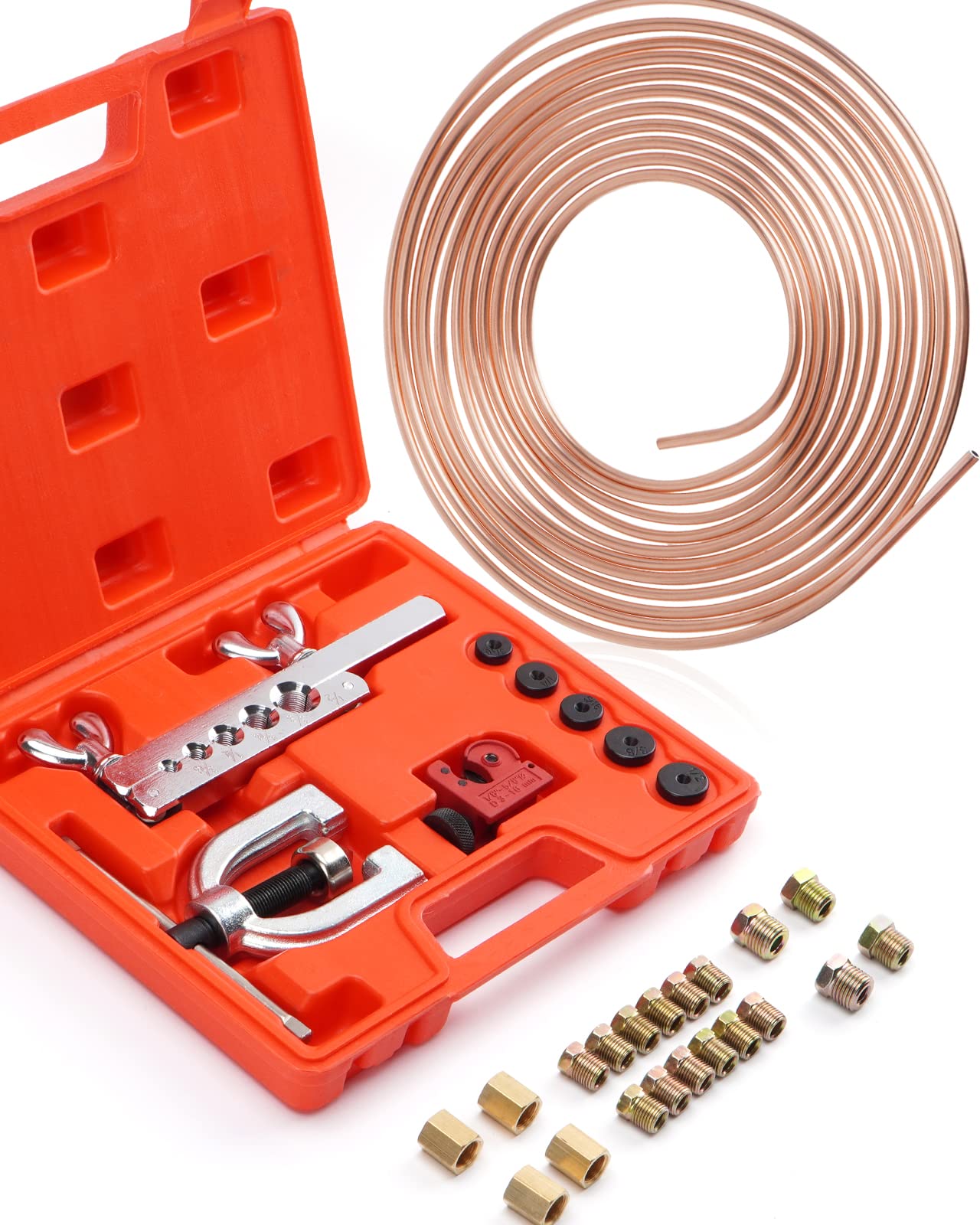
The kit that includes a flaring tool, so a first-timer needs nothing else to finish.
The standout feature here is the included double and single flaring tool kit plus a tube cutter, which makes this a true turnkey purchase for someone without an existing flaring setup. The tool works on copper, aluminum, brass, magnesium, and soft steel tubing from 1/2″ down to 3/16″ outside diameter.
You get 25 ft of copper coated steel line that bends by hand and flares with simple tools, plus 16 inverted tube nuts (12 x 7/16-24, 2 x 1/2-20, 2 x 9/16-18) and 4 unions. The brass fittings resist rust, and the kit has worked well for installing new lines on older trucks like the OBS Silverado.
The trade-offs are real and honest. The flaring tool has mixed reviews, with some buyers reporting it will not do double flares reliably, and the chrome finish can flake off the plunger. Durability of the line itself is also mixed, with a rare report of a failure after three days. For a weekend DIY job with a backup plan, the value is excellent.
Everything Included
- Flaring tool and tube cutter save a separate purchase
- 20 fittings including unions for flexible routing
- Copper coated line bends easily by hand
The Risks
- Flaring tool quality is inconsistent for double flares
- Line durability has mixed reports
Choose this if: you are starting from zero tools and want one box to complete a single line replacement.
Pass on it if: you are a pro who needs a reliable double-flare tool for daily use.
8. 4LIFETIMELINES 1/4″ x 25 ft 316L Stainless Steel Coil

The strongest material here, with a burst pressure that leaves zero doubt.
If you need a brake line that will not fail under extreme pressure, this 316L marine-grade stainless steel coil is built for it. The steel is smoothly drawn with molybdenum (a metal that boosts corrosion resistance), so it stands up to road salt and moisture far better than plain steel. It is rated to a burst pressure of 11,070 psi, a working pressure of 2,214 psi, and a tensile strength of 70,343 psi.
This is the coil for creating 1/4 brake lines across domestic, European, Japanese, British, and adapter applications. It meets SAE JI677 and ASTM A249 specifications, and the manufacturing prevents kinking while retaining shape during bending.
The honest caveat is that stainless is much harder to work with than copper-nickel. Reviewers point out it needs a quality flaring tool like a bench vice clamp, and cheap flaring tools will break. One owner said the ends must be “dead nuts” on or they will not seal like mild steel. But the durability payoff is real — stainless outlasts the vehicle.
The Strength Case
- 316L marine grade with molybdenum for max corrosion resistance
- Burst pressure of 11,070 psi for serious safety margin
- Meets SAE JI677 and ASTM A249 specs
The Effort
- Harder to bend and flare than copper-nickel
- Requires a quality, not cheap, flaring tool
- Coil only — fittings sold separately
Reach for it if: you have a quality flaring tool and want the most corrosion-proof material available.
Look elsewhere if: you are a beginner with a basic rental tool — stainless will fight you.
9. 4LIFETIMELINES 1/4″ x 25′ 316L Stainless Kit w/ 16 Fittings

The marine-grade kit that pairs 316L stainless with a complete SAE fitting set.
This is the full package version of the marine-grade coil, ready to install with 16 inverted flare fittings. You get (10) 1/4″ 7/16-24 inverted long nuts, (2) 1/4″ 7/16-24 inverted, (2) 1/4″ 9/16-18 inverted, and (2) 1/4″ 1/2-20 inverted — everything needed for a complete brake line replacement with no extra sourcing.
The 316L marine-grade stainless is the same alloy used in saltwater and chemical processing environments, so it resists corrosion far longer than galvanized or copper-coated lines. It has held up beautifully on a 1979 Chevy install and worked perfectly for fabricating Caterpillar 930 brake lines when flared with a hydraulic tool.
The 0.028″ wall thickness provides strength without fighting the tube. It bends smoothly with a standard tubing bender and cuts clean with a tube cutter, though buyers warn it will kink easily by hand on tighter bends — a quality slipper-shoe bender makes nice bends without kinks. It is compatible with DOT 3, DOT 4, and DOT 5.1 brake fluids.
Built To Outlast
- 316L marine-grade stainless resists road salt and coastal air
- Complete 16-piece fitting set in one box
- Compatible with DOT 3, DOT 4, and DOT 5.1 fluids
Install Notes
- Kinks easily by hand on tight bends — use a bender
- Best results need a hydraulic flaring tool
Best for: the owner in a salt-belt or coastal state who wants a complete, rust-proof kit without sourcing parts.
Not for: a beginner with only a cheap hand flaring tool — stainless demands better equipment.
Understanding the Specs
Wall Thickness & Outside Diameter
The outside diameter (OD) is the critical fitment number — for this category, 0.25 inches (or 6.35 mm) is the standard 1/4 line size that matches most factory fittings. Wall thickness, typically 0.028 inches, strikes the balance between strength and bendability. A thinner wall kinks easier, while a thicker wall resists kinking but fights you during installation.
Material & Corrosion Resistance
Material choice determines lifespan. Galvanized steel is cheapest but will rust eventually. Copper-coated steel offers better corrosion resistance but is still steel underneath. Copper-nickel alloy is non-magnetic and simply does not rust, making it the favored choice for long-term repairs. 316L marine-grade stainless is the most corrosion-proof but hardest to work with. Match the material to your climate and how long you plan to keep the vehicle.
FAQ
What is the difference between a single flare and a double flare?
Will a 1/4 inch brake line fit my vehicle?
How long does a copper-nickel brake line last?
Is stainless steel brake line better than copper-nickel?
How much brake line do I need for a full vehicle replacement?
What tools do I need to install a brake line kit?
Can I use brake line tubing for a fuel line?
Why is my brake line kit not rust-proof even though it looks copper?
Final Thoughts: The Verdict
If you want one dependable pick, the 1/4 inch brake line winner is the 4LIFETIMELINES Copper-Nickel Coil because it combines rust-proof alloy with easy bending and flaring, making it the most forgiving material for a first-time installer. If you want a complete kit with fittings and a flaring tool in one box, grab the Racewill kit. And for maximum corrosion protection in salt-belt states, the 316L Stainless Kit is the one to reach for — a complete, ready-to-install marine-grade package. The crowd favorite across the board remains the copper-nickel alloy for its balance of workability and longevity.
How We Picked
We do not accept paid placement. Every pick is matched to a real buyer and a real use-case; we do not hands-on test units.
Sources & Methodology
Specifications: manufacturer listings and product documentation. Review insights: verified customer reviews, as of August 2026. Pricing: not shown on this page (it changes often); check the current price via the retailer link.
As an Amazon Associate, Gadgets Feed earns from qualifying purchases. This does not affect which products we feature.