
Our readers keep the lights on and my morning glass full of iced black tea. As an Amazon Associate, I earn from qualifying purchases.
Specs are compiled from manufacturer listings and verified buyer reviews and can change over time — please confirm the key details on the product page before buying.
If you’re new to binoculars, the biggest fear is buying something heavy, blurry, and complicated that you end up leaving at home. Today’s beginner models are lighter, brighter, and more affordable than ever, so a clear view is within reach.
I’m Min — the founder and writer behind Gadgets Feed. This guide is built by comparing the manufacturers’ published specifications and the patterns across verified customer reviews, so you get each pick’s real strengths and trade-offs instead of marketing spin.
From featherlight compacts that slip into a jacket pocket to full-size models that gather light beautifully at dusk, this roundup of the best beginner binoculars is tailored to help you choose with confidence.
Our Picks at a Glance


How To Choose The Best Beginner Binoculars
The first number in a binocular’s name (like the “8” in 8×42) tells you how many times closer an object will appear. The second number (the “42”) is the diameter of the front lens in millimeters — a bigger number means more light enters, which is what makes the view brighter.
Match the power to your steadiness
A 10x pair brings things closer, but any shake in your hands is magnified too. If you’re new to this, an 8x or lower magnification is often more forgiving and easier to hold steady, which matters more than a few extra steps of zoom.
Prioritize the exit pupil for dusk
The exit pupil is the circle of light that reaches your eye, and you get it by dividing the objective lens size by the magnification. A bigger result (around 4 to 5 millimeters) means the image stays bright in low light, while a smaller number can get dim at dawn or dusk.
Quick Comparison
| Model | Best For | Magnification | Objective Lens | Eye Relief | Amazon |
|---|---|---|---|---|---|
| Leupold BX-1 Rogue★ Best Overall | Hunters and hikers | 10x | 25 mm | 15 mm | Amazon |
| Vortex Bantam HDGreat for Youth | Young users and small faces | 6.5x | 32 mm | 18.7 mm | Amazon |
| Gosky 8×42Best Value | All-round outdoor use | 8x | 42 mm | 15 mm | Amazon |
| Nocs Provisions Standard Issue | Pocket travel and style | 10x | 25 mm | 10 mm | Amazon |
| Vortex Vanquish | Close-up nature viewing | 10x | 26 mm | 16 mm | Amazon |
| Nikon TRAVELITE EX | Travel and everyday carry | 8x | 25 mm | 11.1 mm | Amazon |
| Celestron Outland X | Low-light wildlife views | 10x | 50 mm | 17.4 mm | Amazon |
| Nikon PROSTAFF P3 | Bright, rugged all-day use | 10x | 30 mm | 15.4 mm | Amazon |
| Steiner BluHorizons | Glare-prone environments | 10x | 26 mm | 12.4 mm | Amazon |
In‑Depth Reviews
1. Leupold BX-1 Rogue Binoculars, 10x25mm (59225)
Our pick — over 4.5★ from 750+ verified ratings; the strongest balance of quality and price.
The pocket-sized pair that punches above its weight in low light.
Deer hunters praise this pair for its dusk performance — buyers report “These are great for the deer stand, you will even be able to see longer at last shooting hours.” The 10x magnification (which makes objects appear 10 times closer) pulls you close to the action, while the extended eyecups block stray light so you can zero in on your target as light fades.
It stays easy to carry all day thanks to the inverted Porro prism design, which makes the whole thing remarkably small and light without cutting into clarity. The armor-coated housing gives you a positive, non-slip grip in wet or cold conditions, and it is fully waterproof and fogproof, backed by Leupold’s customer care.
What wins people over is the clarity — the most-discussed aspect by a wide margin — along with the solid build quality. With a 2.5mm exit pupil, it is a touch dimmer in very low light than a larger model, so it shines brightest as a daylight companion for hiking and hunting.
Why owners pick it
- crisp optics are the standout feature, with quality close behind
- Compact size and light weight make it easy to carry in the field
- Extension eyecups block ambient light for a focused view
Where it sits
- 10x power can feel shaky if you have unsteady hands
- Small 25mm lens gathers less light at dawn than a 42mm model
The verdict: this is the go-to compact for hunters and woods walkers who want proven Leupold quality in a shirt-pocket size.
Think twice if: you plan to spend most of your time glassing at dusk, where a larger objective lens would serve you better.
2. Vortex Bantam HD 6.5×32 Youth Binoculars
A kid-friendly 6.5x that meets skilled-glasses wearers at the eyepiece.
Most youth binoculars cut corners on glass, but the Vortex Bantam HD deliberately does not. It pairs a lower 6.5x magnification — which keeps the view steadier for young or shaky hands — with a wide 7.6-degree field of view, so spotting a bird in motion is far easier than with a comparable compact. That’s a 36% wider sweep than the Leupold BX-1 Rogue above, and the 18.7mm eye relief (the distance your eye can be from the lens and still see the full image) is 25% more generous.
The ergonomics are the real story: owners mention that “IPD down to 51mm suits small faces; single hinge stable,” meaning kids and adults with narrow-set eyes can get a proper, comfortable view without the double-hinge wiggling. The rubber armor shrugs off drops, and it is nitrogen purged so it stays fog and waterproof through all seasons.
Quality is the most-praised aspect here, with value for money a close second — owners say it rivals far pricier glass at a fraction of the cost. The one trade-off is the low magnification, which means distant subjects stay smaller than they would through a 10x pair, but for beginners that steadiness is worth more than raw reach.
The thing everyone raves about
- Outstanding build quality and value are the most-mentioned positives
- Wide 7.6-degree field of view makes tracking wildlife easier
- 18.7mm eye relief is a boon for eyeglass wearers
The honest catch
- Slight rolling-ball distortion can appear at the edge of the view
- 6.5x power limits how close distant objects appear
Reach for this if: you’re buying for a child, someone with a small face, or anyone who finds high magnification impossible to hold steady.
Look elsewhere if: your priority is maximum reach for open-country spotting, where 10x serves better.
3. Gosky 8×42 Binoculars for Adults with Phone Adapter and Tripod
The full-size all-rounder that arrives ready to film what you see.
This is the set that new birders keep coming back to, and it leads the whole list on sheer owner numbers. The 8×42 format is the classic beginner formula: 8x magnification for a steady, wide view, paired with a 42mm objective lens that pulls in plenty of light. That 42mm front glass is 68% larger than a 25mm compact, so low-light scenes stay noticeably brighter.
You also get the full accessory kit from the start — a universal phone adapter that swivels 360° and a 2.2-inch extendable tripod, so you can snap steady digiscoped photos instead of holding everything by hand. Customers note that “With only 1.25lbs, easily to carry for outdoor use,” which is a strong claim for a full-size model with this much kit included.
Quality is the overwhelming favorite in the feedback, with clarity right behind it, and the IPX7 waterproofing means it shrugs off rain and splashes without a second thought. The occasional gripes are the phone-photo sharpness (digital zoom on the phone limits it) and a tripod adapter that demands careful mounting, but neither stops it being the best-value full-size pick here.
Why it’s so popular
- Quality and clarity are the two most-praised aspects by far
- Phone adapter and tripod included for easy photo capture
- IPX7 rating makes it fully rain-ready
What to know
- Phone photos lose sharpness due to the phone’s own digital zoom
- Tripod adapter needs careful alignment when mounting
Best for: the casual outdoor explorer who wants one capable pair that covers birds, hikes, concerts, and phone photography without buying extra accessories.
Not for: serious photographers seeking true digiscoping quality, since the phone’s digital zoom caps the sharpness.
4. Nocs Provisions Standard Issue 10×25 Binoculars
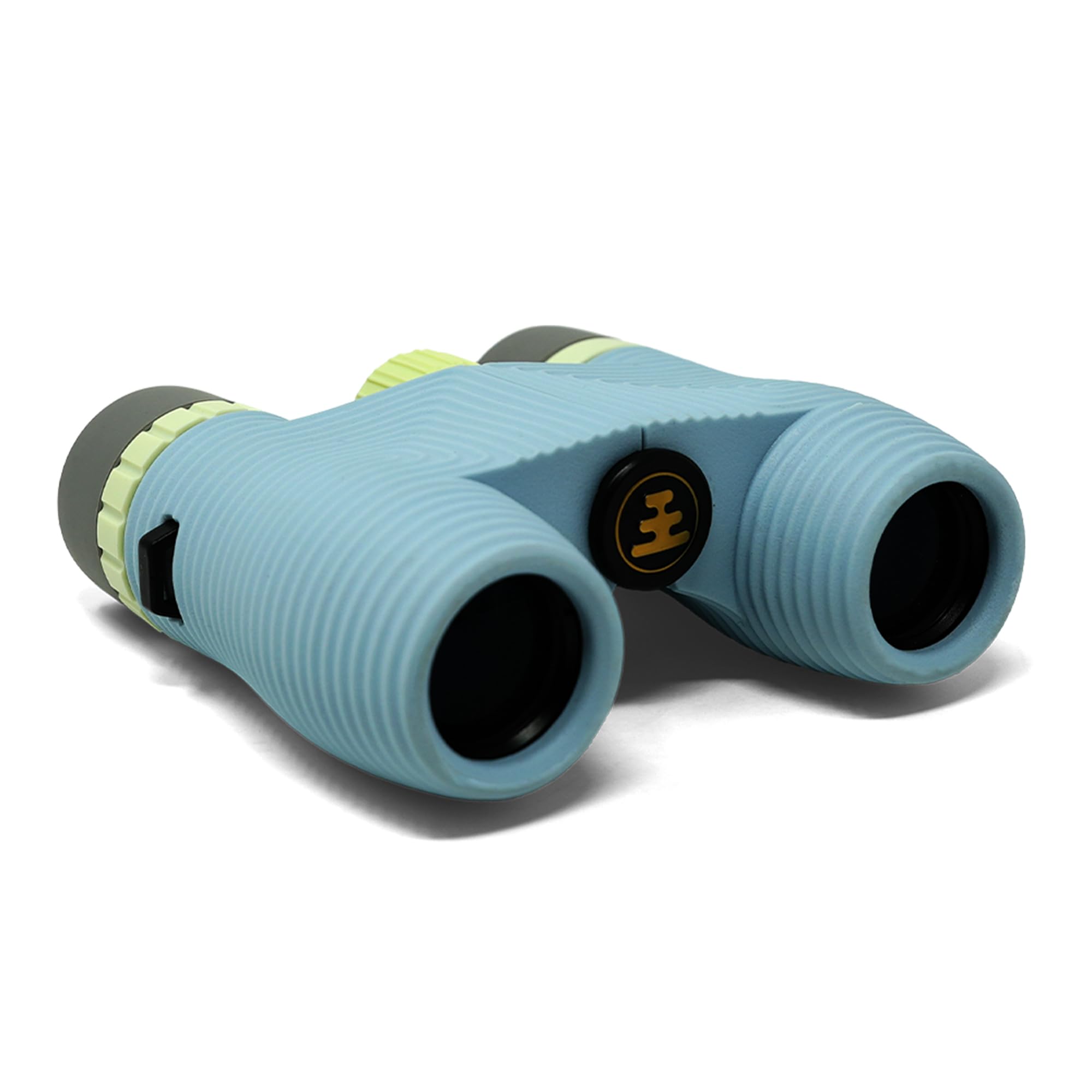
A style-first compact that has genuinely traveled to 30 countries.
Pocketability is the whole point here — at 11.85oz this is a binocular you can drop in a purse or jacket and forget until you need it. The 10×25 format (10x magnification with a 25mm objective lens) delivers true 10x reach (owners confirm it is “true 10x magnification”) and the Fully Multi Coated optics (lenses with multiple anti-reflective layers) produce a crisp, bright image with vivid color out to the very edge of the 315-foot field of view.
It is rated IPX7, meaning it can handle submersion in up to three feet of water for half an hour, and the nitrogen gas inside prevents fogging in humid air. The patented Rugged Wave Grip keeps it locked in your palm, and the twist-up eyecups offer three positions so eyeglass wearers and bare eyes both get a comfortable view.
The personality is a big part of the appeal — owners like the cool color schemes so much they buy a second pair. The trade-offs: eye relief sits at a tight 10mm, and the small 25mm lens means limited light in dim conditions, so this is a daylight travel companion, not a dusk hunter.
Style plus substance: quality and image quality are the top two praised aspects, and the compact size makes it a travel favorite.
The fit note: the 10mm eye relief can make it a little fiddly to position for focus, especially for glasses wearers.
Pick this for: travelers and everyday carriers who want a great-looking, rugged pair that vanishes into a bag and still delivers a sharp 10x view.
skip it if: most of your viewing happens at dusk or in dense shade, where a bigger objective lens is a clear advantage.
5. Vortex Vanquish Reverse Porro 10×26 Binoculars

The little pair that focuses close enough to study a spider at six feet.
Most compacts struggle to focus on anything nearer than ten meters, but the Vanquish is different — owners confirmed a true 2-meter close focus, testing it at roughly six feet while watching a spider. That makes it uniquely capable for inspecting butterflies, flowers, or bugs on a nature walk, not just scanning the horizon.
It’s one of Vortex’s smallest, lightest, and most compact binoculars, with fully multi-coated lenses for increased light transmission and resolution. The twist-and-lock eyecups adjust to your preference, and the full rubber armor gives a non-slip grip and durable protection against drops.
Clarity is the most-praised aspect, with owners taking them “on every hike and backpacking trip.” The real insurance policy is Vortex’s unlimited, unconditional lifetime VIP warranty — a fully transferable promise to repair or replace the pair if it gets damaged or defective. Vortex’s lifetime warranty and reliable optics often turn first-time buyers into repeat customers.
What stands out
- True 2-meter close focus opens up a whole world of near subjects
- Clarity is the top-praised aspect, with quality close behind
- Unlimited, transferable lifetime warranty adds confidence
The trade-off
- 10x power can feel unstable without a rest for some users
- Small 26mm objective limits low-light brightness
Reach for this if: you want a compact that handles both distant birds and close-up nature studies, with a warranty that makes it a one-time purchase.
Look elsewhere if: you need maximum brightness at dawn or dusk, where a larger lens wins.
6. Nikon TRAVELITE EX 8×25 Binoculars

The third-time-around travel pair that keeps earning its spot in the bag.
It’s rare for owners to buy the same binocular three times, but that’s exactly what happens with the Nikon TRAVELITE EX. The 8×25 configuration (8x magnification with a 25mm objective lens) is the travel balance — 8x power is steady enough for handheld use, and the compact 25mm objective fits easily in a pocket or purse, which is why it’s a go-to for hiking trails and basketball games alike.
Nikon’s multilayer-coated optics and aspherical eyepiece lenses work together to minimize distortion and deliver vivid, true-color views with sharpness right to the edge. It’s built to handle weather too — nitrogen-purged and O-ring sealed, it stays waterproof up to 2 meters for 5 minutes and completely fogproof in humidity or temperature swings.
Image quality is the most-praised aspect, with weight a very close second — a pairing that tells you exactly what travelers want. The high-eyepoint design and turn-and-slide eyecups make it comfortable even for eyeglass wearers. It won’t best a full-size 42mm in dim light, but as a compact travel companion, it’s hard to fault.
Why it earns repeat buys: image quality and featherlight weight are the two most-praised aspects, and the waterproof build holds up over years of travel.
The honest limit: an 11.1mm eye relief is on the shorter side, so positioning takes a moment for some users.
Best for: travelers, nature walkers, and sports fans who want a trustworthy, pocket-friendly Nikon that disappears into a bag and never lets them down.
Not for: anyone prioritizing serious low-light performance, since the compact lens caps brightness at dusk.
7. Celestron Outland X 10×50 Binoculars

A 50mm light-grabber built for the magic hours of dawn and dusk.
If you’re the kind of beginner who wants to watch wildlife as the sun drops, the larger objective lens is your friend — and at 50mm, this Celestron gathers noticeably more light than a compact 25mm model, which gives you a brighter image when conditions get dim. The 10x power brings distant animals in close with a steady-enough view, and the 4.8mm exit pupil (the diameter of the beam of light reaching your eye) keeps that view usable as light fades.
The multi-coated lenses boost transmission to your eye, and the BaK-4 prisms produce sharp, color-accurate images across lighting conditions. It is waterproof and nitrogen-purged, so rain or humidity won’t fog the view, and the rubber-armored housing protects against bumps on the trail. A built-in tripod adapter thread lets you mount it for shake-free, extended viewing sessions when you want to go hands-free.
Owners call the image quality and build value the top highlights, praising it for beach and birding use. The 17.4mm eye relief is generous for glasses wearers. The main caution: a 10×50 is a heavier, bulkier pair than the compacts on this list, and a small number of owners note the left eyecup can be stiff to twist.
The strengths
- 50mm objectives deliver bright low-light views
- Image quality and solid build are the top-praised aspects
- 17.4mm eye relief is friendly for eyeglass wearers
Fair caveats
- Bulkier and heavier than compact models for travel
- An occasional unit has a stiff eyecup that needs a firmer twist
Reach for this if: your viewing happens mainly at dawn, dusk, or in shade, where the big 50mm lens pays for itself.
Think twice if: you need something that slips into a jacket pocket — this one earns its bulk on the tripod.
8. Nikon PROSTAFF P3 10×30 Binocular

The 30mm middle-ground that pairs 10x reach with all-day carry comfort.
Sitting neatly between a shirt-pocket compact and a boat-anchor full-size, the PROSTAFF P3 uses a 30mm objective to gather plenty of light while staying light enough to carry for long stretches. The 10x power makes it a genuine distance performer, and the wide 346-foot field of view keeps tracking moving birds or athletes from slipping away.
Nikon multilayer coatings minimize reflections and boost brightness and contrast, while the silver-alloy prism coating keeps colors vivid and true across the visible spectrum. The fiberglass-reinforced polycarbonate body is wrapped in rubber armor for a secure, non-slip grip, and O-ring seals plus nitrogen purging mean it stays clear in rain, snow, or rapid temperature changes.
Clarity and optical quality are the top-praised aspects, with owners noting it worked beautifully on an Alaska cruise and was easy to handle all day. The turn-and-slide eyecups and long 15.4mm eye relief keep it comfortable with or without glasses. The only recurring nitpick: the tethered lens covers can be fiddly in the hand, which is a small price for the overall performance.
Why it works
- Clarity and optical quality are the two most-praised aspects
- 15.4mm eye relief works well for eyeglass wearers
- Rugged, weather-ready build for all-season use
The small stuff
- Lens covers are not the quickest to pull off while moving
- Slightly larger and heavier than some compacts on this list
Best for: the beginner who wants solid 10x reach and bright optics but doesn’t want to haul a heavyweight pair on long walks.
Not for: those seeking a truly pocket-sized grab-and-go, since the 30mm lens adds a little bulk.
9. Steiner BluHorizons 10×26 Binoculars
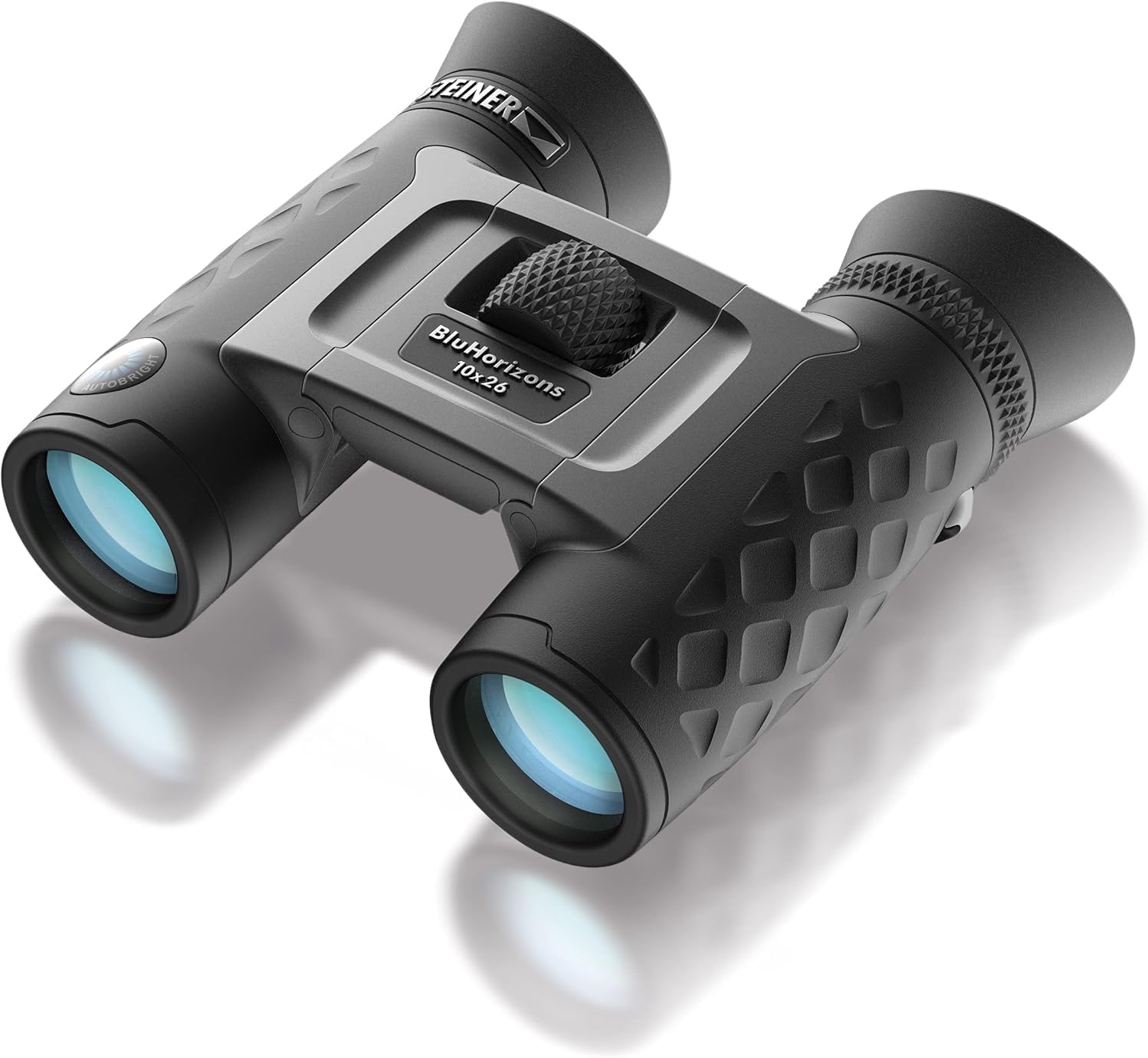
German-engineered glare control that shines on water, snow, and sun.
Steiner built the BluHorizons around one a neat extra that actually matters outdoors: Autobright sunlight-adaptive lens coating. This is a real edge for beginners who find themselves squinting at lakes, snowy fields, or midday concert stages — the coating cuts glare from sun, water, and snow so the view stays clear when other compacts wash out. It’s the most-cited strength in owner feedback.
The fast-close focus ring takes you from close range to infinity with minimal turning, and the textured NBR rubber armor gives a secure, non-slip grip that holds up from -20°C to +70°C. The teardrop eyecups block stray glare and dust, and they fold down for eyeglass wearers, while the double-hinge lets the body fold small for a bike pack or travel bag.
Build quality is the second most-praised aspect, and owners specifically mention great low-light operation and sharp color in fog. The downsides are real but fair: at a 12.4mm eye relief it’s more finicky for glasses, there are no lens caps included, and note that a narrower depth of field means you’ll be refocusing on subjects that move closer or farther.
Where it excels
- Autobright coating neutralizes glare from sun, water, and snow
- Optical quality and build quality are the top-praised aspects
- Fast, smooth focusing from close range to infinity
Fair warnings
- No lens caps included with the purchase
- Shallow depth of field requires frequent refocusing on moving subjects
Reach for this if: you spend your days near reflective water, snow, or bright skies where glare is the real enemy.
Look elsewhere if: you want the simplicity of a pair with included lens caps and a deeper depth of field for fast-moving birds.
Understanding the Specs
Magnification and objective lens
The two numbers on a binocular (like 8×42) are the heart of the choice. The first is magnification — how many times closer things appear. The second is the front lens diameter in millimeters, and a bigger number means a brighter, easier view, especially in low light like dawn or forest shade.
Eye relief
This is the distance your eye can sit from the eyepiece and still see the full view. If you wear glasses, you want a longer eye relief number (15mm or more is comfortable) so you don’t have to mash the eyepiece into your lenses. Try it yourself before you settle.
FAQ
What do the numbers 8×42 and 10×25 actually mean?
Is a 10x binocular too shaky for a beginner to hold?
What is a good eye relief for someone who wears glasses?
How do I know if binoculars are waterproof or fogproof?
What is the exit pupil and why does it matter?
What is a good close focus distance for nature viewing?
Which is better for a beginner, BaK-4 prisms or multi-coated lenses?
How does a full-size 50mm binocular compare to a compact 25mm?
Final Thoughts: The Verdict
For most people starting out, the beginner binoculars winner is the Leupold BX-1 Rogue because it nails the two things new users care about most: crisp optics and a compact size that you’ll actually carry with you. If you want a bright low-light view for dawn and dusk, grab the Celestron Outland X with its big 50mm lens. And for a child or anyone with a smaller face, the Vortex Bantam HD is the one to reach for. Choose a pair that matches your typical viewing time and carry style, and you’ll use it more than you think.
How We Picked
We do not accept paid placement. Every pick is matched to a real buyer and a real use-case; we do not hands-on test units.
Sources & Methodology
Specifications: manufacturer listings and product documentation. Review insights: verified customer reviews, as of August 2026. Pricing: not shown on this page (it changes often); check the current price via the retailer link.
As an Amazon Associate, Gadgets Feed earns from qualifying purchases. This does not affect which products we feature.