
Our readers keep the lights on and my morning glass full of iced black tea. As an Amazon Associate, I earn from qualifying purchases.
Specs are compiled from manufacturer listings and verified buyer reviews and can change over time — please confirm the key details on the product page before buying.
The scary thing about gluing Styrofoam is that the wrong adhesive will literally melt your project into a puddle. The right one bonds in seconds without eating the foam, and that is the single difference that decides whether your repair holds or ruins the piece. This guide sorts through the foam-safe options so you can pick the one that matches your project size, speed needs, and surface type.
I’m Min — the founder and writer behind Gadgets Feed. This guide is built by comparing the manufacturers’ published specifications and the patterns across verified customer reviews, so you get each pick’s real strengths and trade-offs instead of marketing spin.
From instant CA glues to big construction cartridges, here is what separates a lasting bond from a melted mess when you need the best adhesive for styrofoam for your specific repair or build.
Our Picks at a Glance
How To Choose The Best Adhesive For Styrofoam
Styrofoam, also called EPS foam, is made of tiny air-filled beads that regular super glue and many construction adhesives will dissolve on contact. The first rule is to look for a formula that is explicitly marked foam-safe, since that tells you it will not burn through the surface.
Match the adhesive to the job size
A small hobby repair needs a precision bottle, while insulating a basement wall calls for a cartridge or spray that covers square feet. Buying a 1 oz bottle for a big insulation job means endless refills; buying a 28 fl oz cartridge for one model airplane repair leaves you with a tube that dries out.
Understand set time versus full cure
Set time is how long you must hold the parts together, and full cure is when the joint reaches full strength. Some adhesives grab in seconds, which is great for small parts but punishing if you need to slide pieces into place. Others give you minutes of working time to adjust before the bond locks.
Know the drying look and flexibility
Before you pick a foam glue, think about what the finished joint will look like and how it will be used. Some glues dry clear, others dry white—that matters if the seam will be visible. Flexible bonds soak up vibration, so they suit RC planes (remote-controlled aircraft) that shake in flight; rigid bonds hold firm for static craft pieces that just sit on a shelf. So decide first: do you want a slightly rubbery hinge that flexes, or a hard weld that locks tight?
Quick Comparison
| Model | Best For | Volume | Set Time | Full Cure | Amazon |
|---|---|---|---|---|---|
| Bob Smith Super-Gold★ Best Overall | Fast hobby repairs | 1 oz | 5–15 seconds | — | Amazon |
| 4 OZ Foam Glue BrushBest Value | RC plane repairs | 4 oz | Minutes | 24 hours | Amazon |
| Beacon Foam-TacTop Performer | Flexible foam builds | 2 oz | — | 24 hours | Amazon |
| UHU por | Polystyrene models | 50 ml | — | 20 minutes | Amazon |
| Great Planes Pro CA | Thin gap filling | 20 g | 15–30 seconds | 5 minutes | Amazon |
| Loctite PL300 | Foamboard insulation | 28 fl oz | 20 minutes | 7 days | Amazon |
| Woodland Scenics Foam Tack | Model railroading | 12 oz | — | — | Amazon |
| Foam Fusion Glue | Non-toxic builds | — | 30 minutes | 12 hours | Amazon |
| 3M Polystyrene Spray 78 | Large insulation areas | 24 fl oz | 2 minutes | 24 hours | Amazon |
In‑Depth Reviews
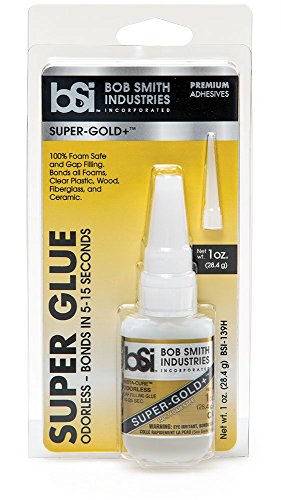
1. Bob Smith Industries BSI-139H Clear Super-Gold Odorless Foam Safe Super Glue
Our pick — over 4.5★ from 800+ verified ratings; the strongest balance of quality and price.
The crowd favorite that bonds foam in seconds without the eye-watering fumes.
This is the adhesive that wins people over with speed. It grabs in just 5–15 seconds, which means small parts stay put almost instantly and you are not stuck holding pieces together while you wait. It is also the first odorless super glue of its kind, so you can work indoors without the harsh chemical sting most CA glues bring.
It bonds all foams plus clear plastic, wood, fiberglass, and ceramics, making it a versatile single-bottle answer for hobby and repair work. The included extender tip helps you place a precise drop exactly where you need it, and the bond dries clear so visible joints stay tidy. Because it foams up slightly to fill gaps, it handles imperfect fits better than a thin watery glue.
What owners rave about most is the quality and effectiveness — the formula holds reliably across foam airplanes, XPS terrain crafting, and outdoor repairs. A few buyers do find the price a little high for a 1 oz bottle, and the cap needs to stay sealed to keep the glue fresh. The review pages sum it up well: “Strong, reliable bond; smooth application, fast set, dries clear.”
What Wins People Over
- Bonds in just 5–15 seconds for fast assembly
- Odorless formula is comfortable indoors
- Dries clear and works across many materials
The Honest Trade-Offs
- Small 1 oz bottle runs out quickly on bigger jobs
- Some owners find it pricey for the size
Reach for this if: you want a fast, odorless, clear-drying hobby glue that handles foam and many other materials from one bottle.
Look elsewhere if: you are covering large surfaces — the 1 oz size will disappear fast on a big insulation project.
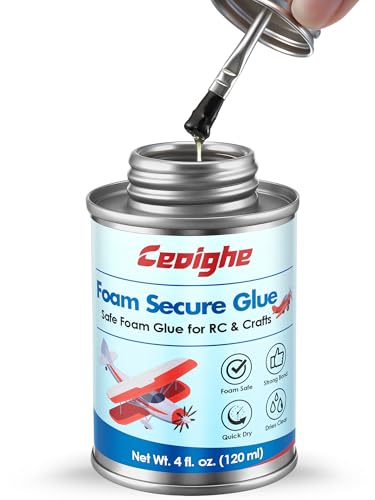
2. 4 OZ Foam Glue with Brush Cap for RC Airplanes
Four times the glue with a built-in brush for clean, precise foam repairs.
This one answers the biggest criticism of small glue bottles — you get 4 oz instead of 1 oz, a full 4.0x gap in volume over the Bob Smith pick, at a budget-friendly price. The built-in brush cap lets you sweep the adhesive evenly across small or intricate areas without staining your hands or work surface.
It is designed specifically for RC aircraft, compatible with EPP, EPO, EPS, balsa wood, and carbon fiber. The bond stays flexible after curing, so it absorbs the vibration and shock of flight and landing instead of cracking. It sets within minutes and fully cures in 24 hours, forming a waterproof and UV-resistant hold.
The thing everyone raves about is how well it grips EPO foam — owners call it “super sticky” and praise the in-bottle applicator. The honest trade-offs are the smell and the color: it has a strong chemical odor during use (it goes odorless after curing) and the glue dries dark yellow, not clear. Buyers recommend using it in a vented area.
Built for Foam Planes
- 4 oz bottle with brush cap for even application
- Flexible bond absorbs flight vibration
- Waterproof and UV-resistant after curing
Before You Buy
- Strong chemical odor during use
- Dries dark yellow rather than clear
Best if: you repair RC planes regularly and want a larger, flexible, brush-on adhesive that keeps your hands clean.
Think twice if: the smell bothers you or your joint needs to be invisible — this one dries dark yellow.
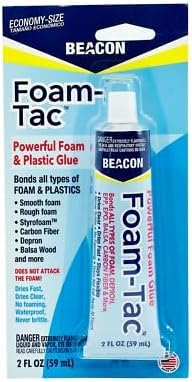
3. Beacon Foam-Tac Powerful Glue
A flexible, UV-protected formula that becomes a living hinge for foam planes.
Foam-Tac is the adhesive builders reach for when they want a bond that flexes instead of snapping. It works with EPP, EPO, Depron foam, balsa wood, carbon fiber, and 3D printed parts, so it covers nearly every material in a modern RC workshop. The improved formula includes UV blockers to prevent yellowing and degrading in sunlight.
A special adhesion promoter boosts the strength and durability of the bond, and the glue stays rubbery when dry. That flexibility is exactly why it is the top pick for attaching control horns, servos, and motor mounts — the joint moves with the airframe rather than resisting it. It fully cures in 24 hours.
Buyers report that this glue creates bonds stronger than the foam itself. One reviewer described gluing a 53-year-old dirty seat foam that had ripped, and the repair “turned out like it never had a crack.” That is the level of hold you get. The trade-offs: the glue stays slightly rubbery, it does not sand well if it oozes out of the joint, and an occasional tube arrives dried up.
Flexible and tough: the rubbery bond works as a hinge for RC control surfaces, which is something rigid CA glues simply cannot do. The UV blockers are a real plus if your model lives outdoors.
One caution: wipe off any squeeze-out at the joint edge — this glue does not sand cleanly once dry.
Grab this for: RC builds and repairs where flexibility and outdoor durability matter more than an invisible joint.
skip it if: you need a gap-filling super glue that dries hard and sands flush — this stays rubbery.
4. UHU por Quick-Setting Special Adhesive

The German-made tube that dries colorless, stays waterproof, and never ages.
UHU por is a quick-setting special adhesive made for bonding hard foam like Styrofoam, including to other materials. The elastic film it creates is colorless, so your repaired joint disappears into the foam instead of standing out. It is waterproof and non-aging, which means the bond stays stable over years rather than degrading.
Made in Germany, this 50 ml tube is a favorite among foam model airplane builders. The full cure time is just 20 minutes, yet the bond keeps getting stronger over a few days. Owners describe the grip as “extreme,” with one builder noting they tried to take apart a plane glued with UHU and the bond held so well it forced a replacement instead of a repair.
Builders say it forms a better bond than E6000 and remains reasonably flexible after curing. It has become the go-to glue for many modelers, replacing other foam adhesives entirely. The trade-off is simply that it takes a little time to reach full strength, so you need patience before stressing the joint.
Invisible strength: the colorless, waterproof film makes this the pick when you want the repair to vanish. It is the glue of choice for foam model airplanes.
Patience required: the bond improves over a few days — do not over-stress the joint right after the 20-minute cure.
Choose this when: you want a clear-drying, waterproof, aging-resistant bond for polystyrene models and craft work.
Not ideal if: you need an instant grab — this one rewards patience rather than speed.
5. Great Planes Pro Foam Safe CA Thin Glue

Water-thin CA glue that wicks into cracks for a welded-style foam joint.
This is a cyanoacrylate (CA) glue — the same family as super glue — formulated specifically to be foam-safe. It is water-thin, meaning it flows into tight cracks and seams rather than sitting on top of the surface. That capillary action creates a “welded” joint that bonds in 15–30 seconds when held by hand and hardens in 1–2 minutes.
The full cure time is just 5 minutes, which makes it one of the fastest options here for getting back to work. It pairs well with Dollar Tree Foam Board and other foam-safe materials, and the thin consistency means a 20 g bottle goes surprisingly far. The bottle is small, so it suits precise model work rather than large-area coverage.
What wins people over is its effectiveness on foam airplanes and CA-sensitive materials. The honest downside is that the fast, thin bond is unforgiving — it dissolves paint if you do not wipe it, and it requires tape or clamping while it hardens because it does not seep into cracks instantly. A few owners mention it melts some foams, so test on a scrap piece first.
Speed and Precision
- Bonds in 15–30 seconds by hand
- Full cure in just 5 minutes
- Thin liquid wicks into tight seams
The Fine Print
- Dissolves paint if not wiped quickly
- Needs tape or clamps while hardening
Best for: precise, fast repairs where you want a thin glue that flows into cracks and cures in minutes.
Not for: beginners or large surfaces — the instant grab leaves no room for sliding parts into place.
6. Loctite PL300 Foamboard Adhesive

A construction-grade cartridge that bonds foamboard insulation to walls without burning through.
When your project is a basement wall rather than a model plane, you need a cartridge this size. The Loctite PL300 is a 28 fl oz latex water-based adhesive designed for permanently bonding foamboard insulation to interior or exterior surfaces. It grips wood, gypsum board, concrete, brick, and more without burning through the foamboard.
The high-grab formula reduces the need for fasteners, setting in just 20 minutes and fully curing in 7 days. It is weatherproof, resisting water and weather for a durable outdoor bond. As a low VOC adhesive, it meets strict federal and state guidelines, so it is far less harsh than solvent-based construction glues.
Owners say it works perfectly for gluing 1-inch styrofoam insulation to basement walls and attaching foam panels to metal frames, with bonds that hold for months. The recurring gripes are the slow drying time and the oozing from the caulk gun after use — keep a putty knife handy to catch drips.
Built for coverage: this is the one to reach for when you are insulating a whole room, not repairing a single part. It dries white, which is fine for hidden joints.
Plan around the cure: a 7-day full cure means you need clamps or gravity to hold panels while it sets.
Reach for this if: you are bonding foamboard insulation to walls, concrete, or metal over a large area.
Look elsewhere if: you need a fast-drying glue — this one takes 20 minutes to set and a week to fully cure.
7. Woodland Scenics Foam Tack Glue

The slow-curing favorite that lets model railroaders position track with total control.
Woodland Scenics Foam Tack Glue is built for model railroading and scenic layouts, where you need time to position pieces before the bond locks. This 12 oz bottle offers a generous amount of working time — owners leave it to set for 30 minutes before applying track and bedding. That slow grab is a feature, not a bug, for precise layout work.
The glue dries clear and stays flexible, which owners describe as wonderfully rubbery unlike standard white glue. That flexibility lets it work as a hinge for RC foam control surfaces, and the bond becomes flyable after a 6-hour cure. It is also compatible with wood, foam, cork, and Homasote board, covering the full range of scenic materials.
What wins people over is the quality and the generous work time — it is a glue that forgives mistakes because you can adjust before it sets. The trade-off is the slow cure, which means it is not the pick for quick repairs. Owners also note it cuts cleanly with hot wire after drying, which is a bonus for foam terrain work.
Layout-Friendly
- 30 minutes of working time for positioning
- Dries clear and stays flexible
- Cuts cleanly with hot wire after drying
Not a Quick Fix
- Slow cure demands patience
- Rubbery texture is not for rigid joints
Ideal for: model railroaders and scenic crafters who need time to position pieces and a clear, flexible finish.
pass on it if: you want an instant bond for a quick repair — this glue is designed for deliberate work.
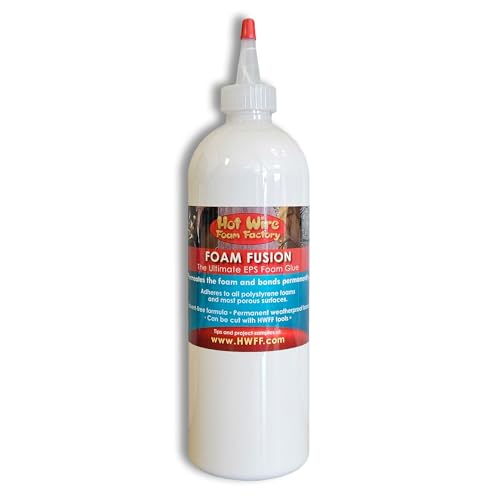
8. Foam Fusion Glue by Hot Wire Foam Factory
A solvent-free formula that fuses foam cells together without ever degrading them.
Foam Fusion is the answer for anyone who wants a non-toxic adhesive that will not degrade polystyrene foam. Unlike solvent-based glues that dissolve foam over time, this solvent-free formula permeates and bonds around the cells for a permanent hold. It is temperature resistant, so heat and cold do not break the bond like glue guns or expanding adhesives can.
It works with rigid foams like Styrofoam, white beaded EPS, and XPS boards, and bonds to most porous surfaces. The 12-hour full cure gives you time to work, and the glue becomes tacky within 30 minutes. A real bonus for foam fabricators is that the bonded joint can be cut with hot wire tools, so your seam does not limit your shaping.
Owners praise how well it bonds XPS foam, with one maker turning two ½-inch boards into a 1-inch base and several 1-inch boards into mountains. The glue is water-thinnable and cleans up with water, which keeps the workspace simple. The trade-off is the slower cure — you need clamps or weights overnight for a solid bond.
Gentle and strong: the water-based formula means no melting, no harsh fumes, and easy cleanup, which makes it a family-friendly workshop choice.
Patience pays: clamping overnight is the difference between a crude quick build and a clean, solid joint.
Best for: crafters and fabricators who want a non-toxic, hot-wire-friendly bond and do not mind waiting for an overnight cure.
Not for: instant repairs — this glue rewards planning and clamping over speed.
9. 3M Polystyrene Foam Insulation Spray Adhesive 78

An industrial spray that covers huge insulation panels without dissolving the foam.
When you are bonding expanding polystyrene (EPS) foam across large surfaces, a brush bottle is too slow. This 24 fl oz aerosol sprays in a lace pattern tune for insulation bonding, covering wide areas quickly and evenly. It is made specifically for EPS foam and creates bonds stronger than the foam itself, without dissolving or degrading the material.
The spray offers up to 15 minutes of working time, so you can adjust and reposition panels before the bond locks. Customers note it becomes tacky in about 2 minutes, holds firmly in an hour, and fully cures in 24 hours. One builder shared that it bonded XPS foam to wood, steel, aluminum, and foam so strongly it could not be removed by hand — and unlike another 3M spray, it did not dissolve the foam.
This is a professional-grade product marked for industrial use only, so it is not the casual hobby pick. The downsides are the price, the need for good ventilation, and the occasional report of a nozzle that gums up or breaks. A few owners also note it can be tricky to find in stores, making the spray pattern and coverage worth planning around.
Built for Coverage
- Sprays a lace pattern over large areas fast
- 15 minutes of repositioning time
- Stronger than the foam itself when cured
Know Before You Spray
- Industrial-use product needs ventilation and care
- Nozzle can gum up or break with heavy use
Reach for this if: you are bonding large foam insulation panels to walls and want fast, even coverage with time to adjust.
Look elsewhere if: you are doing small hobby repairs — this industrial spray is overkill and needs careful handling.
Understanding the Specs
Set Time vs Full Cure
Set time is how long you must hold or clamp the parts before the glue grabs enough to stay put. Full cure is how long until the joint reaches maximum strength. A glue can set in seconds but take 24 hours to fully cure, so plan your clamping around the full cure time, not the quick set.
Foam Safe vs Solvent-Based
A foam-safe formula uses a solvent-free or specially balanced chemistry that bonds the foam without dissolving the air-filled beads. Solvent-based glues eat through EPS foam. Look for the words “foam safe” on the label, and always test on a scrap piece if you are unsure.
FAQ
Will regular super glue melt Styrofoam?
What is the difference between set time and full cure time?
Can I use these adhesives on XPS foam boards?
Why does my foam glue smell so strong?
Which adhesive dries clear on foam?
How long does foam glue take to dry completely?
Is there a non-toxic adhesive for Styrofoam?
What is the best adhesive for large foam insulation panels?
Final Thoughts: The Verdict
If you want one dependable pick, the best adhesive for styrofoam is the Bob Smith Super-Gold because it bonds in 5–15 seconds, dries clear, and stays odorless while handling nearly any hobby material. If you want a flexible, UV-protected bond for RC aircraft, grab the Beacon Foam-Tac. And for large insulation panels, the 3M Polystyrene Spray covers the most ground without melting the foam.
How We Picked
We do not accept paid placement. Every pick is matched to a real buyer and a real use-case; we do not hands-on test units.
Sources & Methodology
Specifications: manufacturer listings and product documentation. Review insights: verified customer reviews, as of August 2026. Pricing: not shown on this page (it changes often); check the current price via the retailer link.
As an Amazon Associate, Gadgets Feed earns from qualifying purchases. This does not affect which products we feature.