
Our readers keep the lights on and my morning glass full of iced black tea. As an Amazon Associate, I earn from qualifying purchases.
Specs are compiled from manufacturer listings and verified buyer reviews and can change over time — please confirm the key details on the product page before buying.
You want that fat, punchy 80s drum sound without babysitting a 40-year-old machine that needs a technician on speed dial. The smarter path is a modern unit that recreates those classic tones reliably — and this list sorts out which one fits you. Whether you crave the boom of a TR-808, the snap of a 909, or the gritty low-bit crunch of early digital samplers, these picks put the era’s signature heartbeat under your fingers with modern dependability.
I’m Min — the founder and writer behind Gadgets Feed. This guide is built by comparing the manufacturers’ published specifications and the patterns across verified customer reviews, so you get each pick’s real strengths and trade-offs instead of marketing spin.
These are the best modern and vintage-style 80s drum machines for musicians who want that classic analog sound with dependable modern hardware.
Our Picks at a Glance


How To Choose The Best 80s Drum Machines
Buying a drum machine for that vintage sound is less about finding the oldest box and more about choosing the right engine for your music. Some players want pure analog warmth, others want the chaotic fun of early digital sampling, and some just want a foot-controlled drummer for live guitar work. Decide between analog warmth and digital grit before comparing models.
Match the Sound Engine to Your Genre
The classic 80s sound splits into two camps: analog synthesis and low-bit digital sampling. Analog machines like the TR-808 and TR-909 produce warm, punchy, synthetic drums that defined house, techno, and hip-hop. Digital samplers from that era captured real drum hits but mangled them at low sample rates, creating that gritty lo-fi texture you hear in early rap and industrial music. Decide which texture your tracks need, then look for a machine built on that foundation.
Think About How You’ll Actually Play It
A step sequencer with 16 buttons is perfect for programming precise patterns, but it is awkward when you want to trigger drums live while holding a guitar. If you perform solo, a pedal-based unit with footswitches keeps your hands free. If you produce in a studio, you want deep sequencing, an intuitive interface, and the ability to save and recall your own patterns quickly. Choose step sequencing for studio programming or foot pedals for hands-free live play.
Quick Comparison
| Model | Best For | Sound Engine | Sequencer | Weight | Amazon |
|---|---|---|---|---|---|
| BeatBuddy 10th Anniversary★ Best Overall | Live guitar performance | Sample-based kits | Pedal foot controls | 1.2 lbs | Amazon |
| Korg Volca BeatsBudget Champion | Budget analog jamming | Analog synthesis | 16-step Electribe | — | Amazon |
| Roland AIRA T-8Portable Pick | Portable 808/303 jams | ACB analog modeling | TR-REC 16-step | 1.3 lbs | Amazon |
| Arturia DrumBrute Impact | Punchy analog production | Pure analog | 64-step pattern | 1.84 kg | Amazon |
| Behringer RD-8 | Authentic 808 recreation | Analog + 662 OTA chip | 64-step | 3.98 kg | Amazon |
| Behringer RD-9 | 909-style classic beats | Analog/digital hybrid | 64-step | 3000 g | Amazon |
| Sonicware Lofi-12 XT | Gritty low-bit sampling | 12-bit sampler | 8-track sequencer | 550 g | Amazon |
| Roland TR-08 | Compact 808 authenticity | Digital reproduction | Step & Tap write | 3 lbs | Amazon |
In-Depth Reviews
1. BeatBuddy 10th Anniversary Edition
Our pick — 4.5★ from 700+ verified ratings; the strongest balance of quality and price.
The only drum machine you control with your feet, built to keep your hands on the guitar
The BeatBuddy earns its spot for solo performers, not studio producers, because its pedal format lets you trigger fills, transitions, and start-stop live while your hands stay on the guitar. Two foot switches handle those live moves, and it ships with 200+ songs across 24 genres and 10 ultra-realistic drum kits. Storage is enormous: 3.2 million songs and 300 drum sets, so you will never run out of room for custom beats or downloads.
Quality is the single most-praised trait here, and it shows in the sound engine: it plays individual.wav hits per MIDI note, so each drum strike responds to your playing speed dynamically, not like a canned loop. A color LCD with a visual metronome helps you lock in complex time signatures, and the 9V power draw is a low 100mA, so it sips power on stage. Expect a learning curve to master the 200+ beats, and building fully custom songs requires working with MIDI files and the free companion program — but the payoff is a simulated live drummer, not a repetitive backing track.
One honest note on sound: buyers report the drums sound realistic through a PA or stereo mixer, but noticeably muffled when you run them through a guitar amp. The recurring advice is to route it to a proper PA for gigs, which is a small logistical hurdle for the most human-feeling drum machine on this list. The crowd favorite rating — 4.5 stars across 700+ owners — reflects a product that musicians keep using shows after show.
What Makes It Click
- Hands-free foot-switch control for live solo performance
- Realistic individual.wav drum hits that stay dynamic at any tempo
- Visual metronome on a color LCD for timing precision
- Massive 3.2 million song storage capacity
The Reality Check
- Sound gets muffled through a guitar amp — use a PA instead
- Steep learning curve to master all 200+ beats
- Custom song building requires MIDI file work
Reach for it if: you are a guitarist or solo performer who wants a realistic drummer under foot control, with the library depth to cover any genre.
Look elsewhere if: you are a studio producer who needs deep step sequencing and analog synthesis — this is a performance tool, not a sound-design box.
2. Korg Volca Beats Analogue Drum Machine Bundle
A pocket-sized analog rhythm box that evokes classic machines without the vintage price tag
The Volca Beats is the entry point into real analog drum synthesis, with sounds created in reference to classic rhythm machines of the era. It runs an Electribe-style 16-step sequencer with eight memory patches, so you can store and recall your patterns easily. The built-in speaker and optional battery power mean you can jam anywhere without plugging into an outlet — a freedom the bigger studio boxes on this list simply don’t offer.
what separates it at this level is the stutter function, which generates repeated triggers that dramatically warp your sequence on the fly. You also get six editable analog parts with one knob per function, so you can tweak a kick or snare immediately without digging through menus. It is the smallest and most affordable way to get your hands on analog drum circuitry that nods to the 80s.
The honest caveat is the bundled experience: a few owners mention receiving a unit that looked pre-owned rather than factory-fresh, with one noting “Idk why but I was sent a used drum machine.” That is a shipping issue, not a sound flaw; the machine earns praise for its playability. At this price, it is a low-risk gateway into analog drum machines.
Analog Gateway: the stutter function and knob-per-part editing make this the most playable budget analog drum machine here, ideal for beginners building their first beats.
Know Before You Buy: check the unit on arrival since some buyers received what appeared to be a returned unit, though the sound quality itself wins people over.
3. Roland AIRA Compact T-8 Beat Machine
A palm-sized 808/909/606 powerhouse with a 12-hour battery for on-the-go beat making
The T-8 puts Roland’s most famous drum sounds — the TR-808, TR-909, and TR-606 — into a box that measures just 10 x 7 x 3 inches and weighs only 1.3 pounds. That makes it the most portable full-featured drum machine in this lineup, and the 12-hour USB-rechargeable battery is the standout feature for travel. You can sketch acid lines and trap beats on a train or in a park without hunting for a power outlet.
It is built on Roland’s Analog Circuit Behavior (ACB) technology, which faithfully recreates the tonality and behavior of the vintage instruments, and it pairs those drums with a TB-303 bass synth. The TR-REC sequencer gives you 64 user patterns with up to 32 steps each, plus advanced programming tools like probability, sub step, and velocity. A class-compliant USB-C audio/MIDI interface means you can plug straight into a computer for recording with no drivers needed.
Beginners love it — that is the second most-praised aspect, and the sound quality leads the conversation. The small buttons and knobs are the trade-off: a few owners mention squishy small buttons causing missed presses and a 40-page manual that takes time to absorb. It offers a curated blend of classic 808/909 sounds, not every original voice. It delivers authentic 80s tones at a fraction of vintage hardware prices.
Travel Companion: the internal rechargeable battery runs 12 hours, letting you build full 808-style tracks anywhere — a freedom no other pick here matches.
Small But Mighty: the compact size means small controls, so players with larger hands may need time to adjust to the button spacing.
4. Arturia DrumBrute Impact Analog Drum Machine

Pure analog punch with individual outputs, ready for studio processing and live experimentation
The DrumBrute Impact is the pure-analog workhorse of this list, delivering punchy, powerful analog drums with a built-in distortion circuit for extra bite. Its defining studio feature is individual outputs per drum, so you can route the kick, snare, or hats to separate effects pedals or mixer channels for external processing. One owner even ran an FM drum through guitar pedals and got cool experimental textures out of it — that routing flexibility is what keeps this in a studio setup.
The 64-step sequencer includes song mode for chaining patterns together, plus step repeat, roller, and solo functions that add live variation. A separate accent per drum lets you give individual hits extra punch, and the Color sound-shaping feature on all instruments (except the Cowbell) lets you darken or brighten each voice quickly. The build mixes a plastic top with a metal base, giving it solid weight without the heft of the larger Behringer units.
Sound quality is the top-praised aspect, with ease of use close behind. Reviewers consistently describe it as intuitive and fun straight from the start, with one calling it “the most fun out of box” they had tried. The known limitation is the sound palette — the drums are what they are, with limited sound variation compared to sample-based machines. If you want classic analog character with modern sequencing power and deep routing, this is the balance between the budget Volca and the high-end Behringers.
Studio Strengths
- Individual outputs per drum for external effects routing
- Built-in distortion circuit for extra analog bite
- 64-step sequencer with song mode, step repeat, and solo
- Color sound-shaping on every instrument except Cowbell
Before You Commit
- Limited sound palette — drums are fixed analog voices
- Plastic top panel may feel less premium than metal
- No built-in speaker, requires external monitoring
Right for: producers who want pure analog drum character with individual outputs to process each sound through outboard gear.
Not for: anyone who needs a wide, sample-based sound library or built-in effects — this is a raw analog instrument.
5. Behringer RHYTHM DESIGNER RD-8
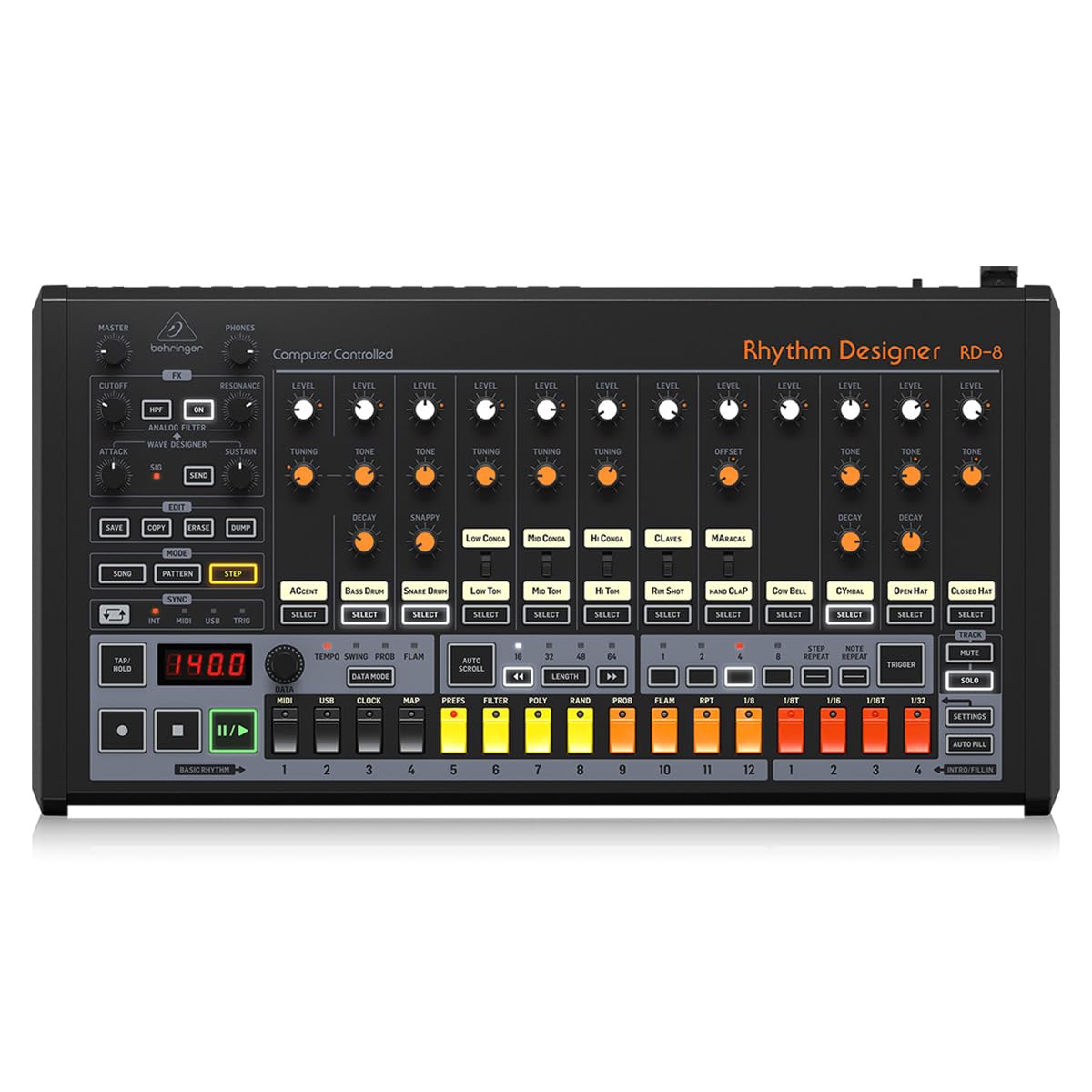
A faithful 808 recreation with 11 individual analog outputs for serious multi-track recording
The RD-8 is built around one mission: reproducing the legendary TR-808 sound with modern reliability. It packs 16 original drum sounds with additional parameters and global accent, powered by a reproduction of the legendary 662 OTA chip for sound authenticity. One owner who used a real 808 says the sound is “pretty close to the 808 that we have in our memories,” with an enhanced interface.
Where it truly flexes is connectivity: 11 independent analog outputs let you record each drum as its own multi-track audio channel or route individual sounds through external effects. The 64-step sequencer supports poly-meter, step-repeat, note-repeat, real-time triggering, track-mute, and track-solo, giving you deep performance options beyond the original’s capabilities. At 3.98 kg, it has real desktop presence and solid-feeling knobs.
The build quality and sound earn consistent praise, with owners noting it “feels reasonably well built, solid knobs and some weight to it.” The one recurring quirk is that the maracas and hand clap cannot be triggered simultaneously, even through MIDI — a limitation worth knowing if your patterns need those two sounds to hit together. For the price, it delivers the 808 experience with enhancements the vintage unit never had.
808 For The Studio: the 11 individual analog outputs make this the best choice for recording your rhythm as true multi-track audio.
The Quirk: maracas and hand clap won’t trigger at the same time, a small sequencing limitation to plan around.
6. Behringer RHYTHM DESIGNER RD-9

The 909-voiced sibling with an integrated FX bus and 10 individual outputs for classic techno
The RD-9 is the TR-909-inspired companion to the RD-8, trading the 808’s deep boom for the 909’s punchy kick and crisp hats that defined techno and house. It delivers 11 original drum sounds with the same 64-step sequencer capabilities as its sibling — poly-meter, step-repeat, note-repeat, real-time triggering, track-mute, and track-solo — plus 10 independent analog outputs for external processing or multi-track recording.
Its standout addition is an integrated FX bus featuring a Wave Designer and a dual-mode analog filter with per-voice assignment. That means you can shape individual drum sounds through the filter before they hit your mixer, adding a layer of sound design the original 909 never had. The full-size 18.78-inch width gives you spacious, playable controls that feel proper for a studio centerpiece.
Owners who love the 909 sound are enthusiastic — one calls it “such a bargain for all of these classic sounds with an updated feature list.” The most critical review comes from someone who owned an original TR-909 for 30+ years and found the buttons frustrating compared to the vintage unit. That is a high bar, and for most players the RD-9 delivers the classic sound at a fraction of the original’s cost, though the button feel is the compromise.
Classic Techno Voice: the 909-style kick and the integrated dual-mode filter with per-voice assignment make this a sound-design weapon for electronic production.
The Compromise: long-time 909 owners may find the button action less satisfying than the original — a feel issue, not a sound issue.
7. Sonicware Lofi-12 XT Sampler

A low-res digital sampler that recreates the gritty early-digital sound of 80s and 90s hip-hop
The Lofi-12 XT takes the opposite approach from the analog purists: it leans fully into the grimy, low-bit digital sampling sound of the late 80s. It samples at 12/24kHz with a 12-bit sampler mode, which deliberately produces that crunchy, lo-fi texture you hear on early rap records and vintage video game soundtracks. If your music needs that warm digital dirt rather than clean analog warmth, this is the machine that delivers it.
An 8-track sequencer keeps beat-making intuitive, and the signal processing is deep: 8 insert FX, delay, reverb, and master FX give you plenty of sonic shaping. The built-in microphone and two quarter-inch inputs let you sample directly into the machine without a computer, and it comes with extensive sample libraries of over 2,500 samples to get you started. At 550 grams and battery-powered, it is genuinely portable for sketching ideas anywhere.
Velocity-sensitive pads and built-in mic/two inputs enable creative field sampling. It is described as “loads of fun” and “hard to put down,” with one owner confirming it is the best sampler in its price range. This is the pick for beatmakers who want to capture and mangle their own sounds through a lo-fi lens rather than program fixed analog voices.
Why It Stands Out
- 12/24kHz low-res sampling for authentic early-digital grit
- Velocity-sensitive pads that feel responsive and musical
- Built-in mic and two quarter-inch inputs for on-the-fly sampling
- Over 2,500 included samples for instant beat making
Consider This
- Lo-fi sound is the point — not ideal for clean, hi-fi drum reproduction
- Plastic body with a smaller footprint than studio workhorses
- 8-track sequencer is capable but less deep than dedicated drum machines
Pick this if: you want to sample real sounds and process them through a low-bit, lo-fi filter for that unmistakable late-80s digital texture.
skip it if: you need pristine, high-fidelity drums or classic analog synthesis — this machine celebrates imperfection, not clarity.
8. Roland Rhythm Composer TR-08

The ultra-compact official recreation of the TR-808, packing the classic sound into a modern travel-sized frame
The TR-08 is Roland’s own ultra-compact recreation of the legendary TR-808, the machine that defined the sound of 80s hip-hop and electronic music. It retains the sound, character, and user interface of the original while shrinking it into a modern, dependable package. One owner who played the real deal back in the 80s confirms it is “a well-rounded update, though NOT analog — it’s a digital reproduction, but a darn good one.”
You get hands-on control for tone, level, tuning, and decay, plus added compressor, gain, tune, and pan features for selected instruments — modern enhancements the original never had. It supports both classic Step and Tap write modes for programming, so you can work the way you prefer. The 10 outputs give you flexible routing options for external processing, and the compact 14 x 7 x 3.5-inch footprint at 3 pounds means it travels easily.
Sound quality leads the praise here, with owners describing it as “amazing and full” with functionality that still delivers the nostalgic feel and workflow of the classic. The value holds up too, especially measured against scouting for an original 808 on the used market, which is far more expensive. It is note the TR-08 is a digital reproduction rather than analog circuitry, so the purist analog warmth is modeled, not generated — but the result is close enough that the classic workflow and sound are unmistakable.
Portable Classic: the compact body at 14 x 7 x 3.5 inches and 3 pounds delivers the 808 sound and workflow in a travel-friendly modern build.
Know The Tech: this is a digital reproduction, not true analog — immensely close to the original but generated through modeling rather than analog circuits.
Understanding the Specs
Analog vs. Digital Sound Engines
Analog drum machines generate their sounds through electrical circuits, producing the warm, punchy, slightly unpredictable tones that defined the 80s. Digital machines either sample real drum hits or model the analog circuits through software, offering more consistency and often more sound variety. Match the engine to your genre: analog for warm, punchy synth drums, digital for consistent, varied textures.
Sequencer Depth and Control
The sequencer is the brain that lets you program and arrange your drum patterns. A classic 16-step sequencer shows you one bar at a time, perfect for hands-on programming, while a 64-step sequencer gives you twice the pattern length for more complex arrangements. Look for features like song mode for chaining patterns, step repeat for live variation, and individual track mute to build arrangements on the fly — the right sequencer makes the difference between a toy and a performance instrument.
FAQ
Is a modern remake better than buying an original 80s drum machine?
Do I need a drum machine with individual audio outputs?
Can I use a drum machine without a computer?
What is the difference between the TR-808 and TR-909 sounds?
Will a drum machine work with my guitar amp or keyboard amp?
How hard is it to learn drum machine programming?
Can I sync a drum machine with other gear like synthesizers?
Which drum machine is best for live performance?
Final Thoughts: The Verdict
For most people, the 80s drum machines winner is the BeatBuddy 10th Anniversary Edition because it delivers the most human, expressive drumming experience with hands-free foot control. If you want authentic 808 boom in a portable travel-sized box, grab the Roland TR-08. And for the gritty low-bit digital sound of early hip-hop, the Sonicware Lofi-12 XT is the one to reach for.
How We Picked
We do not accept paid placement. Every pick is matched to a real buyer and a real use-case; we do not hands-on test units.
Sources & Methodology
Specifications: manufacturer listings and product documentation. Review insights: verified customer reviews, as of August 2026. Pricing: not shown on this page (it changes often); check the current price via the retailer link.
As an Amazon Associate, Gadgets Feed earns from qualifying purchases. This does not affect which products we feature.