
Our readers keep the lights on and my morning glass full of iced black tea. As an Amazon Associate, I earn from qualifying purchases.
Specs are compiled from manufacturer listings and verified buyer reviews and can change over time — please confirm the key details on the product page before buying.
A 6 1/4 hole saw is the tool you reach for when a perfect, round opening matters more than speed. This guide sorts through the nine most reliable models for recessed lighting, plumbing, and masonry work, so you can pick the one that matches your material without the guesswork.
I’m Min — the founder and writer behind Gadgets Feed. This guide is built by comparing the manufacturers’ published specifications and the patterns across verified customer reviews, so you get each pick’s real strengths and trade-offs instead of marketing spin.
You’ll find a few sizes here, like 6-inch and 6.5-inch, that sit close to the 6 1/4 mark and serve the same purpose. 6 1/4 hole saw options range from diamond-tipped tile cutters to heavy-duty concrete cores, and this breakdown tells you which material each one is built for.
Our Picks at a Glance

How To Choose The Best 6 1/4 Hole Saw
The single most important question is what you are cutting. A saw that glides through drywall will stall on a steel door, and a carbide core built for cinder block will shatter on porcelain tile. Match the cutting edge to the material first, then worry about the drill.
Match the edge to the surface
Diamond-tipped bits handle glass, porcelain, and granite by grinding rather than cutting. Tungsten carbide tips chew through stainless steel and iron. Bi-metal saws with high-speed steel teeth are the versatile pick for wood, drywall, and thin metal. Each edge material trades one set of surfaces for another.
Check the arbor and shank
The shank is the part that locks into your drill chuck. A standard hex shank fits most cordless drills, while an SDS Plus shank is required for hammer drills working on concrete. Some saws use a proprietary arbor system, which means you need that brand’s mandrel to attach the saw to your drill.
Think about cutting depth and teeth
Cutting depth tells you how thick a material you can pass through in one go. A 1.5-inch depth handles most plywood and drywall stacks. Tooth count and pitch affect the speed and smoothness of the cut. Variable tooth designs reduce vibration and clear chips more efficiently than uniform ones.
Quick Comparison
| Model | Best For | Cutting Edge | Cutting Depth | Arbor Type | Amazon |
|---|---|---|---|---|---|
| DKIBBITH Diamond-Tipped★ Best Overall | Porcelain & Glass | Diamond | 1-3/8″ | Hex Shank | Amazon |
| Genubi Recessed Light SetBest Value | Drywall & Recessed Lights | Bi-Metal | — | Arbor with drill bit | Amazon |
| Spyder Rapid CoreTop Performer | Plywood & Wood | Bi-Metal | 1-7/8″ | — | Amazon |
| TCT Tungsten Carbide Set | Stainless Steel & Metal | Tungsten Carbide | 1″ | 3/8″ 3-flatted | Amazon |
| Diablo Bi-Metal | Wood & Plywood | Bi-Metal | 2-3/8″ Length | Snap-Lock Plus | Amazon |
| cenyb TCT Carbide | Hard Metal & Steel | Tungsten Carbide | 1″ | 3/8″ Shank | Amazon |
| DKIBBITH Concrete Core | Cinder Block & Brick | Tungsten Steel | — | SDS Plus | Amazon |
| MaxTool Cobalt Bi-Metal | Metal & Wood | M42 Cobalt | 1.5-inch | 5/8-18 Thread | Amazon |
| SALI Diamond Core | Concrete & Masonry | Diamond | 10″ | 5/8-11 & SDS Plus | Amazon |
In‑Depth Reviews
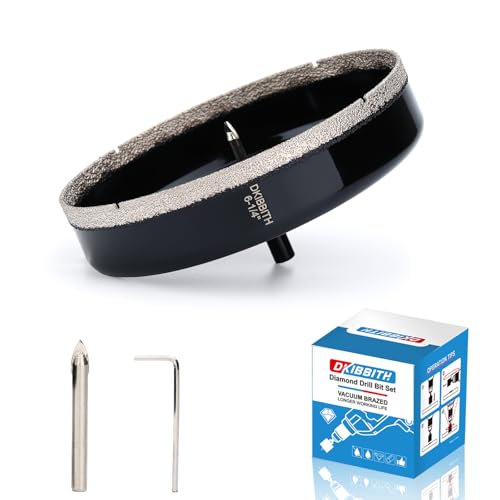
1. DKIBBITH 6-1/4″ Diamond-Tipped Hole Saw
Our pick — over 4.5★ from 650+ verified ratings; the strongest balance of quality and price.
This diamond-tipped saw grinds through porcelain, granite, and glass without chipping.
This saw is the top pick because it opens up the hardest surfaces in a home. The diamond-tipped edge cuts through ceramic, porcelain tile, granite, stone, and even glass bottles, with a cutting depth of 1-3/8″ that handles thick countertops and floor tile in one pass. The removable pilot drill bit helps you position the cut precisely before the big circle engages.
Functionality is what wins people over here, with the cutting performance right behind it. Owners describe it cutting through natural stone “like butter,” and one project involved a clean 1-3/4″ hole in a 3/4″ glass tabletop. The trick for glass and marble is to pre-drill a guide hole since the center bit is weaker, and to build a small dam of blue tape to hold water over the cut.
The hex shank locks into a standard drill chuck securely, and water cooling is recommended to keep the diamonds fresh. This is a single-piece saw, not a set, so you get the 160mm bit plus the guiding pilot bit. It suits tabletop faucet holes, grab-bar installs, and bath remodels without needing a separate cutting system.
Where It Shines
- Cuts porcelain, granite, stone, and glass in one tool
- Removable pilot bit for precise positioning
- Water-cooled operation keeps it sharp longer
Where It’s Delicate
- Center pilot bit is weak and needs a pre-drilled guide
- Single-use for some owners on quartz, best with water
Reach for this if: your project is tile, stone, or glass and you want one saw that handles all of them.
Look elsewhere if: you are cutting drywall or wood, where a cheaper bi-metal saw works better and lasts longer.
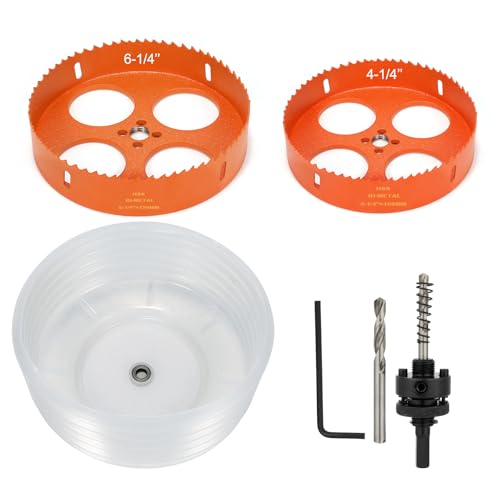
2. Genubi 6.25″ & 4.25″ Recessed Light Set
This bi-metal set traps over 95% of drywall dust in its included bowl.
This two-saw kit is built for one job: installing recessed can lights. You get a 6-1/4 inch saw for the 6-inch lights and a 4-1/4 inch saw for the 4-inch fixtures, plus a matching dust collection bowl that traps over 95% of the debris. The bi-metal construction with high-speed steel teeth cuts through drywall, plywood, and thin metal without flexing.
Dust containment is the thing everyone raves about. Owners drilled a dozen 6 1/8 holes in 5/8″ sheetrock in a garage and reported the shield “contained almost all of the dust.” Another project cut through 40-year-old ceiling drywall with no visible wear on the teeth. The kit includes the arbor with a drill bit, a replacement bit, and a hex key, so it is ready to mount in seconds.
This is not a saw for hard surfaces. The instructions are clear that it is unsuitable for glass, ceramic, or concrete, so keep it on the ceiling materials it was designed for. Five holes for wafer LED lights came out quick and painless, with no cleanup afterward — the “cherry on top,” as one owner put it.
Cleanest job you’ll do: the dust bowl is exclusive to these saws and will not fit other brands, but it makes ceiling work nearly spotless.
Know its limits: stick to drywall, wood, and thin metal — this set avoids tile and concrete entirely.
3. Spyder 600111 Rapid Core Eject 6-Inch
This bi-metal saw ejects plugs with a button press for fast, clean cuts.
Performance is the defining trait here, and the variable tooth pitch is the reason. The bi-metal steel saw cuts a fast, clean 6-inch hole through all thicknesses, with a cutting depth up to 1-7/8″. Owners timed it at about 20 seconds through 1-inch plywood, and it stays sharp after a dozen holes — enough to outperform a dedicated cornhole saw in head-to-head use.
The Rapid Core eject system is the standout feature. At the touch of a button, the plug drops out of the saw body, so you are not prying wood cores loose with a screwdriver between every hole. For cornhole boards, recessed lighting, and countertop work, that quick release keeps the pace up across a whole run of cuts.
This saw wants power behind it. It works best with a corded drill, and the torque can be fierce — one owner nearly got injured using it with a Makita hammer drill on 3/4″ oak plywood. It handles partial holes without a pilot drill, but full holes through wood go fastest. Durability opinions are mixed, and some owners find the sharpness varies, so treat the teeth with respect.
The Fast Lane
- Button eject drops the core cleanly and quickly
- Variable tooth pitch cuts fast with low vibration
- Shallow 20-second cuts through 1″ plywood
Handle With Care
- Strong torque demands a firm grip and a corded drill
- Sharpness and durability get mixed feedback
Best for: anyone cutting many holes in wood or plywood, like cornhole boards or lighting runs, who wants plug removal to be instant.
Think twice if: your only drill is a lightweight cordless model — this saw needs torque to perform.
4. TCT Tungsten Carbide 6″ Hole Saw Set
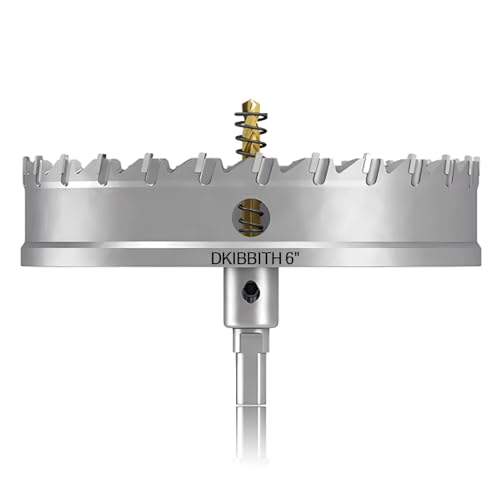
This tungsten carbide-tipped saw cuts through steel doors in seconds.
When a standard hole saw stalls on a steel door, this tungsten carbide-tipped cutter steps in. It is engineered for stainless steel, mild steel, copper, iron, and aluminum, with a cutting depth up to 1″ (25 mm). The 3/8″ 3-flatted shank gives a strong, steady grip in standard chucks and works with impact drills and CNC machines.
The set includes detachable pilot drill bits and Allen wrenches, so you can swap pilots to extend the saw’s life. One owner expanded a deadbolt hole in a steel door after a hardware-store saw “refused to cut,” and this one went through “in seconds.” Another cut through 3/16 gauge metal with no problem at all. The recommended technique is low speed and low torque with cutting oil to keep the carbide cool.
The trade-off is sharpness. While the holes come out clean without tearing, some owners find the teeth are not particularly sharp and the wood starts to burn even with light pressure. The pilot bit is the fragile point, with one owner reporting it bent after cutting most of a hole. For metal work it is a solid value, but it is not the gentlest option on wood.
Built for hard metal: stainless steel, copper, and iron are its home turf, and it cuts through them fast.
Go easy on wood: the teeth can burn softer materials, so save this one for the metal jobs.
5. Diablo Bi-Metal 6″ Hole Saw DHS6000
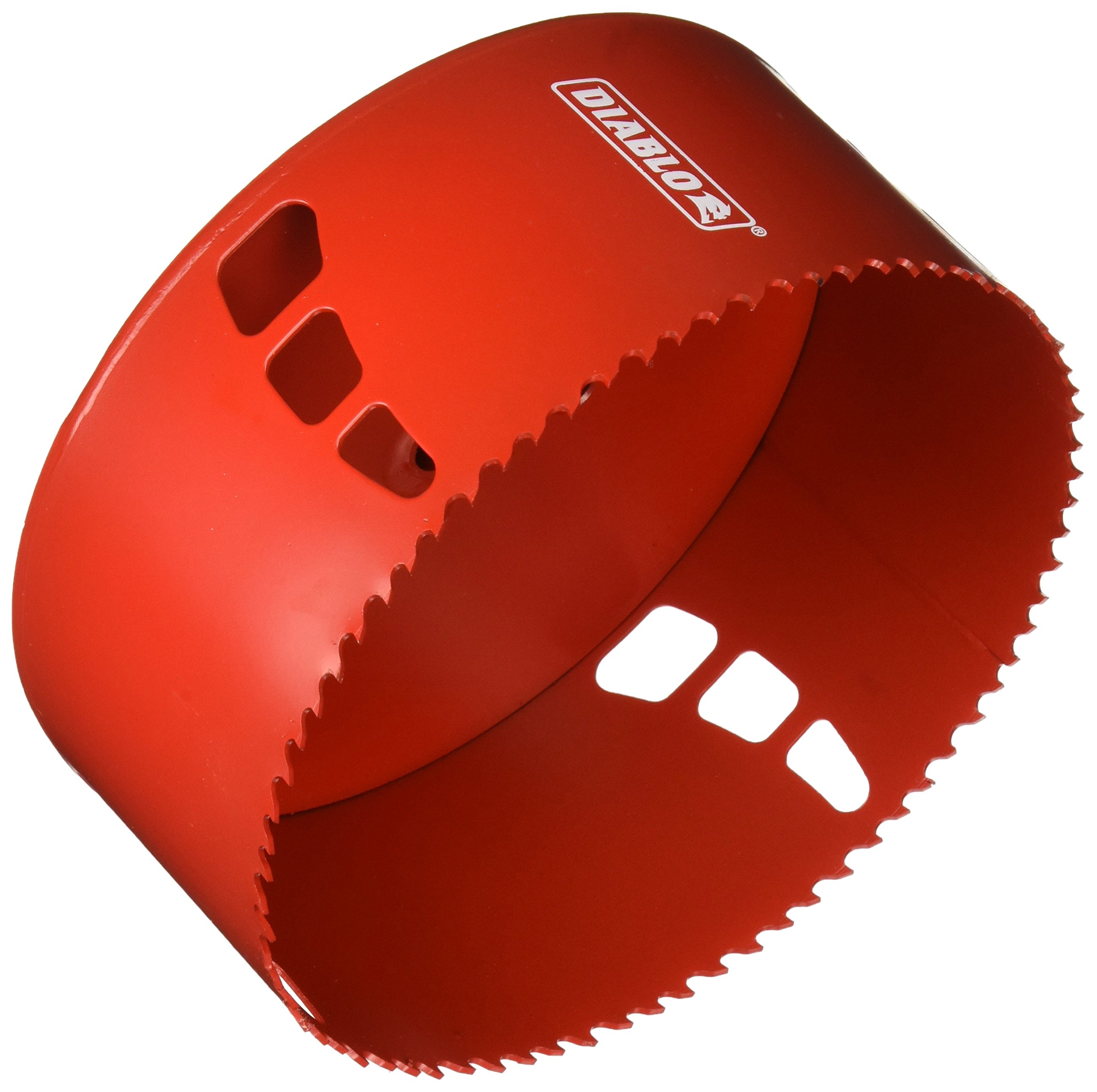
This bi-metal saw slices plywood fast and ejects plugs with a snap.
Diablo’s reputation for cutting tools carries this 6-inch bi-metal saw. The variable tooth design is meant for faster cuts, and the 2-3/8″ length gives you deep reach through stacked materials. It fits the Snap-Lock Plus mandrel system, which lets you pop the plug out quickly between holes.
Quality is the top-mentioned trait, with cutting performance close behind. Owners describe it cutting through 3/4″ birch plywood “like butter” and handling a tongue-and-groove pine ceiling for recessed lights with ease. The quick arbors from the kit “slip right in,” making setup nearly instant. The warning is real, though: this saw rips through wood fast, and one owner cautioned to “hold on tight or you will break your wrists.”
The catch is the arbor. While the saw itself is excellent, the proprietary Snap-Lock arbor is not interchangeable with standard mandrels, and one owner found it broke within weeks of use. The saw works great with its own system, but you are tied to Diablo’s accessories if you need a replacement.
Built To Rip
- Variable tooth design cuts wood and drywall fast
- Deep 2-3/8″ length handles thick stacks
- Quick-release plugs with the Snap-Lock system
The Arbor Catch
- Proprietary arbor is not interchangeable with standard mandrels
- Arbor durability drew a complaint from one owner
Who it serves: woodworkers and electricians who want a fast, clean cut and already own Diablo’s Snap-Lock system.
Who should pause: anyone who prefers one universal arbor for all their saws, since this one locks you into the brand.
6. cenyb 6-1/4″ TCT Carbide Hole Saw

This 36-tooth carbide saw cuts through 0.25-inch steel with ease.
This saw packs serious tooth count for the price. With 36 teeth arranged in a three-blade design — outer, middle, and inner — it is built to cut hard metals efficiently. The cutting diameter is 159mm or 6-1/4″, with a 1″ hole saw depth and a 3/8″ shank that fits standard drills.
Performance and quality lead the feedback, and owners highlight how it cuts mild steel and aluminum “like butter.” One project cut 18 holes in 3/8″ steel with the teeth still looking brand new. It works on hard metals, stainless steel plates, square tubes, iron, and wood, though the maker notes it cannot be used on concrete, tiles, or stone.
The set includes two titanium-plated pilot drill bits and a hex wrench in a plastic box. It is compatible with bench drills, magnetic drills, and gun drills. Durability gets mixed reviews, so this is a strong budget pick for occasional heavy jobs rather than daily industrial use. The carbide is thick and sharp, lasting much longer than standard steel-tooth versions.
Hard-metal hero: 36 carbide teeth chew through steel, aluminum, and iron without dulling fast.
Keep it off masonry: concrete, tile, and stone are off-limits for this cutter.
7. DKIBBITH 6″ Concrete Hole Saw

This SDS Plus core bit bores through cinder block without wandering.
This 152mm core bit is made for masonry, not wood. Built with tungsten steel and high-frequency welding, it handles Hardy Plank, drywall, fiber cement siding, backer board, air brick, stucco, and plasterboard. The SDS Plus shank fits hammer drills from all major manufacturers, making it the go-to for AC lines, exhaust systems, and sewer pipe runs.
Functionality leads the feedback, with cutting performance close behind. Owners describe it cutting through concrete blocks “like butter” and making smooth holes in cinder block without wandering. The kit includes a 220mm SDS Plus connecting rod and two 110mm center positioning drill bits for pinpoint accuracy. Triple-edged, razor-sharp teeth with internal and external grooves guide chips out for smooth operation.
The trade-offs are real. Durability is mixed, with some finding it heavy-duty and others noting it is not built for endless abuse. The center bolt for the pilot bit protrudes, which can prevent through-drilling, and the pilot bit may feel loose before it self-seats. Use flowing water on high-hardness materials and avoid marble, pebbles, and rebar to protect the teeth.
Masonry Muscle
- SDS Plus shank fits all major hammer drills
- Triple-edge teeth cut concrete and brick cleanly
- Includes two center positioning bits for accuracy
Know The Limits
- A protruding bolt can block through-holes
- Avoid marble, pebbles, and rebar to protect the teeth
Best for: anyone mounting AC units, exhaust, or pipes through cinder block, brick, or fiber cement siding.
Not for: polished stone or rebar-heavy pours where the teeth will not survive.
8. MaxTool 6-1/4″ M42 Cobalt Bi-Metal Saw

This M42 cobalt-edged saw stays sharp longer than standard steel.
This premium saw uses an M42 8% cobalt high-speed steel cutting edge welded to an alloy steel body. The cobalt content provides superior heat and wear resistance, which matters when you are cutting metal, wood, plastic, and composite. The 1.5-inch cut depth lets you drill through most studs in a single pass, and the 5/8-18 UNF thread fits most standard mandrels.
The variable tooth design uses a 4/6 teeth-per-inch pattern to reduce vibration and improve chip clearance. Owners praise how it cuts clean holes, with one describing a perfect cut through a 1.7-inch thick desktop with a Formica top. Another owner’s husband found it “deeper than other hole saws and very durable” while drilling holes for canless brass lights.
This saw is sharp — dangerously so. Owners warn that it “will rip your arm off if you don’t brace it properly,” and recommend starting it running in reverse on the lowest speed. Vacuum furnace hardening and precision-ground teeth give it extended blade life under demanding conditions. It is a contractor-grade tool for HVAC, electrical, and plumbing work that demands reliability.
Contractor-grade construction: M42 cobalt and vacuum hardening make this a long-lasting choice for daily use.
Respect the sharpness: it cuts aggressively, so brace the drill and ease into each hole.
9. SALI 6-1/4″ Diamond Core Drill Bit
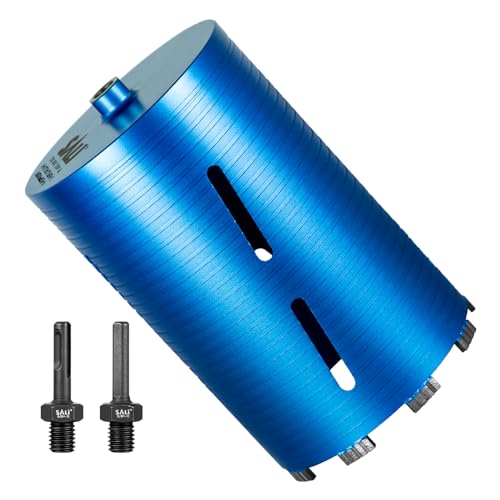
The deep-drilling diamond core that walks through 11 inches of concrete.
This is the deep-hole specialist. With a 10-inch (254mm) drilling depth and a 6-1/4″ (160mm) diameter, the SALI core bit bores through cured concrete, red brick, tile masonry, and reinforced surfaces. The package includes a 3/8-inch hex shank adapter and a 5/8″-11 thread male to SDS Plus shank, so it fits both standard drills and hammer drills.
Functionality is the standout, with owners drilling through 4 inches of concrete and cutting through poured wall foundations “with ease.” One project bored two holes in 12-inch thick old brick at 5-10 minutes per hole, surviving a hit on a steel I-beam. The laser-welded segments and chip removal holes keep the cut moving, and the maker recommends running it dry for best results.
The kit is best for occasional use rather than daily production. Durability gets mixed feedback, with some owners reporting teeth breaking off during heavy use. It works best with a non-clutch drill and a plywood guide to start the cut. The value is clear, though — one owner noted it was “far cheaper than driving to town and having to rent one” for a slab project.
Deep Reach
- 10″ depth drills through thick foundations in one setup
- Comes with both hex and SDS Plus adapters
- Handles concrete, brick, and reinforced masonry
Build For Occasional
- Durability is mixed on heavy daily use
- Teeth can break off under prolonged stress
Reach for this if: you need deep holes in concrete or old brick for pipes, AC lines, or railings.
skip it if: your work is daily production coring — this is built for a few big jobs, not a fleet.
Understanding the Specs
Cutting Edge Material
This is the teeth that do the actual cutting. Diamond edges grind through glass, porcelain, and granite. Tungsten carbide tips chew through stainless steel and iron. Bi-metal saws with high-speed steel teeth handle wood, drywall, and thin metal. M42 cobalt adds heat resistance for tougher metal jobs. Match the edge to your surface, or you will burn out the saw fast.
Cutting Depth
This tells you how thick a material you can pass through in one go. A shallow 1-inch depth struggles on a thick door, while a 10-inch depth handles a foundation wall. Deeper cuts also mean more torque required from your drill, so pair a deep saw with a powerful corded or high-torque cordless model.
Arbor and Shank Connection
The shank is what locks into your drill chuck. A hex shank fits most standard drills. An SDS Plus shank is required for hammer drills working on concrete. Some saws use a threaded connection like 5/8-18 UNF, which fits universal mandrels. Others use proprietary systems that only work with that brand’s arbor, so check compatibility before you buy.
Tooth Count and Design
More teeth generally mean a smoother cut, while fewer teeth with a variable pitch cut faster and clear chips better. Three-blade designs and variable tooth patterns reduce vibration and help the saw bite into hard metal. A higher tooth count can be slower but leaves a cleaner edge on softer materials.
FAQ
What is the difference between a diamond hole saw and a bi-metal hole saw?
Will a 6 1/4 hole saw fit in my standard drill?
Can I use one hole saw for both wood and concrete?
How do I keep the hole saw from getting too hot?
Do I need a pilot drill bit with my hole saw?
What does the cutting depth number mean for my project?
Is a higher tooth count always better?
Why does my hole saw keep grabbing or binding?
Final Thoughts: The Verdict
For most people, the best 6 1/4 hole saw winner is the DKIBBITH Diamond-Tipped because it opens up the hardest surfaces in a home — porcelain, granite, and glass — with a single reliable tool. If you are installing recessed can lights and hate the dust, grab the Genubi Set with its dust bowl. And for deep concrete foundations, the SALI Diamond Core is the one to reach for.
How We Picked
We do not accept paid placement. Every pick is matched to a real buyer and a real use-case; we do not hands-on test units.
Sources & Methodology
Specifications: manufacturer listings and product documentation. Review insights: verified customer reviews, as of August 2026. Pricing: not shown on this page (it changes often); check the current price via the retailer link.
As an Amazon Associate, Gadgets Feed earns from qualifying purchases. This does not affect which products we feature.