
Our readers keep the lights on and my morning glass full of iced black tea. As an Amazon Associate, I earn from qualifying purchases.
Specs are compiled from manufacturer listings and verified buyer reviews and can change over time — please confirm the key details on the product page before buying.
When the lights go out, your fridge, modem, and CPAP machine don’t have to go dark with them. A solar power station with enough capacity and output keeps your fridge and modem running through an outage., and it also fuels camping trips and weekend tailgates with zero noise and zero fumes. This guide digs into the batteries and solar power setups that actuallyearn their place in your home, RV, or garage, separating the genuinely useful from the awkwardly heavy.
I’m Min — the founder and writer behind Gadgets Feed. This guide is built by comparing the manufacturers’ published specifications and the patterns across verified customer reviews, so you get each pick’s real strengths and trade-offs instead of marketing spin.
You’ll find the best batteries and solar power solutions for home backup, off-grid trips, and everything between, ranked by real-world performance and honest owner feedback.
Our Picks at a Glance


How To Choose The Best Batteries And Solar Power
Before you buy a solar generator, ask yourself three things: what you’ll plug in, how long it must run, and how quickly you need it recharged. Answer those, and the right unit for your home, RV, or campsite becomes clear.
Match Capacity (Wh) to Your Loads
Watt-hours (Wh) tell you the total energy stored, like the size of a fuel tank. A 2048Wh station can run a 100W fridge for roughly 20 hours, while a 519Wh unit would manage just over 5 hours. If you want to power a full-size fridge overnight, you need the bigger tank.
Check Continuous Wattage (W) for Surge Demands
The wattage rating (W) is the maximum power a station can push out at once. Fridges and power tools draw a big surge on startup, so a 2400W rated unit handles them comfortably, while a 500W station will struggle. Always look at both the continuous and surge (peak) numbers.
Prioritize Solar Input for True Off-Grid Use
Solar input wattage tells you how fast the sun can refill the battery. A 1200W solar input can top up a large station in under two hours, whereas a 200W input might take a full day. If you plan to live off solar, this number matters as much as capacity.
Consider the Battery Chemistry for Longevity
LiFePO4 (lithium iron phosphate) batteries are the current gold standard, rated for thousands of charge cycles and a lifespan measured in years, not months. Older lithium-ion chemistries are cheaper but won’t last as long, making the pricier LiFePO4 the better value over a decade of use.
Quick Comparison
| Model | Best For | Capacity (Wh) | Output (W) | Weight | Amazon |
|---|---|---|---|---|---|
| BLUETTI AC200L★ Best Overall | Whole-home backup | 2048Wh | 2400W | 61.4 lbs | Amazon |
| BLUETTI Elite 200 V2Top Performer | High-power in compact size | 2073.6Wh | 2600W | 53.4 lbs | Amazon |
| EF ECOFLOW DELTA 3 MaxSmart Control Pick | Heavy appliance power | 2048Wh | 2400W | 48 lbs | Amazon |
| Sun Energise 25W | Trickle-charging 12V batteries | — | 25W | 5.6 lbs | Amazon |
| GRECELL EB500 | Light camping & small devices | 519.48Wh | 500W | 14.1 lbs | Amazon |
| LIBRIDS H1008 | Emergency UPS & CPAP | 640Wh | 600W | — | Amazon |
| EF ECOFLOW DELTA 2 | Bundle with solar panel | 1024Wh | 1800W | 27 lbs (battery) | Amazon |
| Jackery Explorer 2000 v2 | Lightest 2kWh station | 2042Wh | 2200W | 39.5 lbs | Amazon |
| Anker SOLIX C2000 Gen 2 | Fastest recharge + fridge runtime | 2048Wh | 2400W | 41.7 lbs | Amazon |
In‑Depth Reviews
1. BLUETTI AC200L Portable Power Station
Our pick — over 4.5★ from 500+ verified ratings; the strongest balance of quality and price.
A 2048Wh LiFePO4 station with 2400W output for whole-home backup.
Its 2048Wh capacity and 2400W continuous output handle multiple appliances at once.: 2048Wh of storage feeding 2400W of continuous AC power, with a 3600W power-lifting burst for startup surges. That means this unit will happily keep a full-size fridge, a 64″ OLED TV, security cams, and your modem/router alive simultaneously — buyers report a setup like that runs for roughly 10 hours on a single charge. Unlike most rivals, it also has a 30A RV port and a 48V/8A DC port, so it can charge your RV’s battery efficiently, not just power a few outlets.
It recharges from 0-80% in 45 minutes via AC or in under 2.2 hours with 1200W solar. The AC200L accepts up to 2400W of AC input, jumping from 0-80% in just 45 minutes, and it takes up to 1200W of solar input for a full charge in 1.7-2.2 hours of good sun. The LiFePO4 chemistry is rated for 3000+ cycles, which translates to years of reliable daily use before you’d notice any degradation. The app, Wi-Fi, and Bluetooth control add a layer of polish that makes monitoring simple.
At 61.4 pounds, it’s heavy but manageable for stationary home backup.: at 61.4 pounds, this is not a casual carry-on. It’s a “roll it where you need it” unit, best kept near your breaker panel or in the garage. The recurring owner sentiment is that it’s heavy but heavy-duty — a machine you’d trust with your freezer contents during a multi-day outage. Expandability is a strong suit too, as you can stack up to two B300 expansion batteries (3072Wh each) to reach a massive 8192Wh, plus a 5-year warranty backs the whole investment.
Why It Leads the Pack
- Blazing 45-min 0-80% AC recharge
- Expands to 8192Wh for serious backup
- 30A RV output for camper charging
The Weight of Power
- 61.4 lbs is a two-person lift
- Fewer total ports than some rivals
Your best pick if: you want one station that can back up your home’s essentials through a long outage and are fine with a heavy, stationary unit.
Think twice if: you need to carry it regularly — the Jackery below shaves 20 lbs off this capacity.
2. BLUETTI Elite 200 V2 Portable Power Station
A compact powerhouse that packs 2073.6Wh with a 3900W surge, taking on appliances others can’t.
If the AC200L is the workhorse, the Elite 200 V2 is the greyhound: it packs 2073.6Wh of capacity (enough to run a fridge for a day) into a footprint 40% smaller than typical 2kWh stations, yet delivers 2600W continuous and 3900W in power-lifting mode (a temporary boost for heavy appliances). That means you can run a hair dryer, coffee maker, or even a portable AC—most 2kWh units can’t handle those. Owners mention powering induction stoves, air fryers, and shop vacs without issue.
Charging speed is a standout: dual AC and DC input gets you from 0-80% in just 50 minutes with Turbo mode, or a full charge in 2 hours via a 1200W alternator (a car charger that’s 16x faster than a standard socket). In Silent Mode, it runs at 16-30dB (about as loud as a whisper), so it won’t disturb your sleep while topping up. The 6000+ cycle LiFePO4 battery (a lithium-iron-phosphate chemistry known for longevity) is rated for a 17-year lifespan, making it a long-term investment rather than a disposable gadget.
The catch is heft again — 53.4 pounds — though it’s notably lighter than the 61.4 lbs AC200L with similar capacity. Its low 10W standby draw is a subtle but huge win; that’s roughly 3x less wasted energy than competing stations, meaning the power you store stays stored until you actually need it. The dual handles and compact shape make it easier to carry than its weight suggests.
My read: The best blend of portability, raw power, and longevity for anyone who wants to run high-draw appliances off-grid.
Reach for this if: you need to run hair dryers, air fryers, or power tools and want the smallest possible unit that can do it.
Look elsewhere if: pure price-per-watt is your metric — the AC200L offers similar capacity for a leaner sticker.
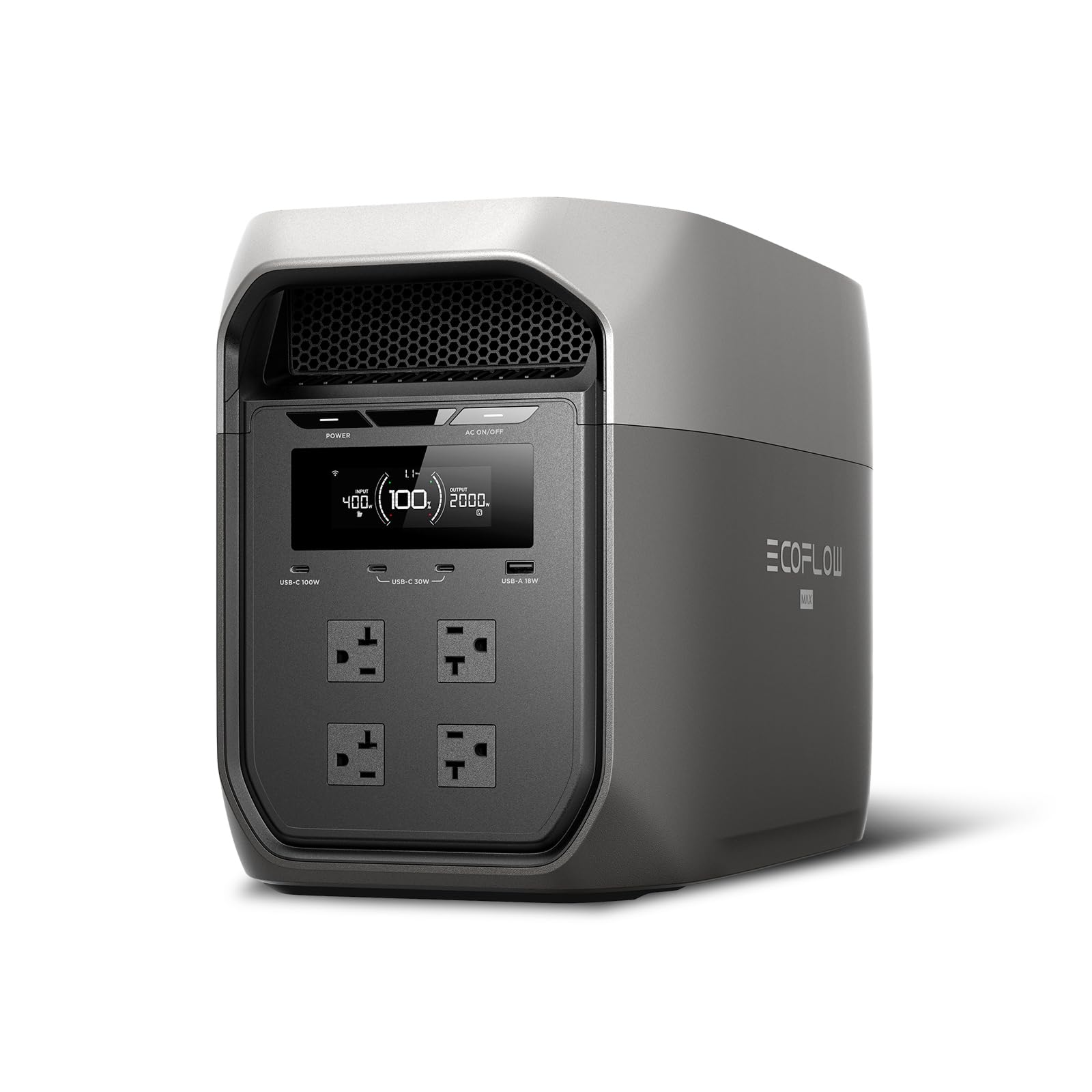
3. EF ECOFLOW DELTA 3 Max Portable Power Station
The smart-home backup that runs 99% of appliances and talks to you through an app.
The DELTA 3 Max is EcoFlow’s answer to “what if my power station were as smart as my thermostat?” With 2048Wh of LFP (LiFePO4, a long-life lithium battery) capacity and 2400W continuous output that surges to 3400W via X-Boost mode (a feature that lets it run higher-wattage devices), it can power 99% of household appliances, from fridges and microwaves to power tools. Its 10ms transfer time (how fast it switches to battery during an outage) makes it a genuine UPS substitute, so a PC, Wi-Fi router, and medical devices stay online smoothly.
Recharging is deceptively fast: X-Stream technology hits 0-80% in just 1.13 hours. But the real differentiator is the EcoFlow app, which owners praise for its easy setup and sophisticated control. You can monitor energy use in real time, set smart charging and discharging schedules, and even use the Storm Guard feature to pre-charge before severe weather — a level of automation the Anker and Jackery can’t match. The included XT60i cable open up even faster solar charging than a standard XT60 connection.
The build is lighter than you’d expect at 48 lbs, with dual handles and top/front/rear vents that allow flexible placement in tight spots. It’s designed for 10 years of daily use with a 5-year service plan. The only quibbles are minor: buttons are hard to see in dim light, and the app requires a Wi-Fi setup initially. But as a permanent home-backup hub that powers a waffle iron and two freezers for a small dessert business, as one owner demonstrated, it’s remarkably versatile.
Bottom line: A future-proof station with the best app integration here, ideal for those who want to automate their backup power.
Perfect if: you want app-driven automation, storm pre-charging, and a 10ms UPS for sensitive electronics.
skip it if: you never touch your phone for gadget control — simpler units offer similar power.
4. Jackery Explorer 2000 v2 Portable Power Station

The featherweight 2kWh champ — 41% lighter than rivals, so you actually take it with you.
The single defining spec here is weight: 39.5 lbs for a 2042Wh station. That’s 41% lighter and 34% smaller than typical 2kWh LiFePO4 units, thanks to the same Cell-to-Body (CTB) technology used in EVs. This is the unit you can realistically load into an SUV for a camping trip or carry up a flight of stairs during a weather event — something you simply won’t do with a 61-pound AC200L.
Don’t mistake lightness for weakness. With 2200W of AC output from 3 ports, one owner’s test ran a full refrigerator for 21.3 hours, while passing through ~1500W of power simultaneously. It charges to 80% in just 66 minutes via AC, or 102 minutes in Emergency Super Charging mode (a faster charge via the app), and Silent Charging mode tops up in 5 hours at under 30dB—quiet enough for a bedroom at night. The 20ms switching time is UL1778 certified (a safety standard for uninterruptible power supplies), so it’s safe for computers and sensitive gear.
The LiFePO4 battery is rated for a 10-year lifespan, so it’s a legitimate long-term investment. The display is clear, the app gives remote control, and there’s even a flashlight with SOS mode. The caveats: the AC inverter fan is noticeable during heavy draws (though not loud), and you can’t turn the unit off while plugged in. But if you prioritize portability with real capacity, this hits a balance no other 2kWh unit touches.
Why It’s Easy to Love
- 39.5 lbs — lightest 2kWh by far
- 10-year LiFePO4 lifespan
- 20ms UPS switchover (UL1778 certified)
Where It Gives a Little
- Fan is audible under heavy load
- Can’t power off while plugged into the wall
Grab it for: camping, RV trips, or anyone who needs 2kWh of backup they’ll actually haul around.
Pass if: you need 2400W+ output for heavy tools — the DELTA 3 Max edges it out there.
5. Anker SOLIX C2000 Gen 2 Portable Power Station
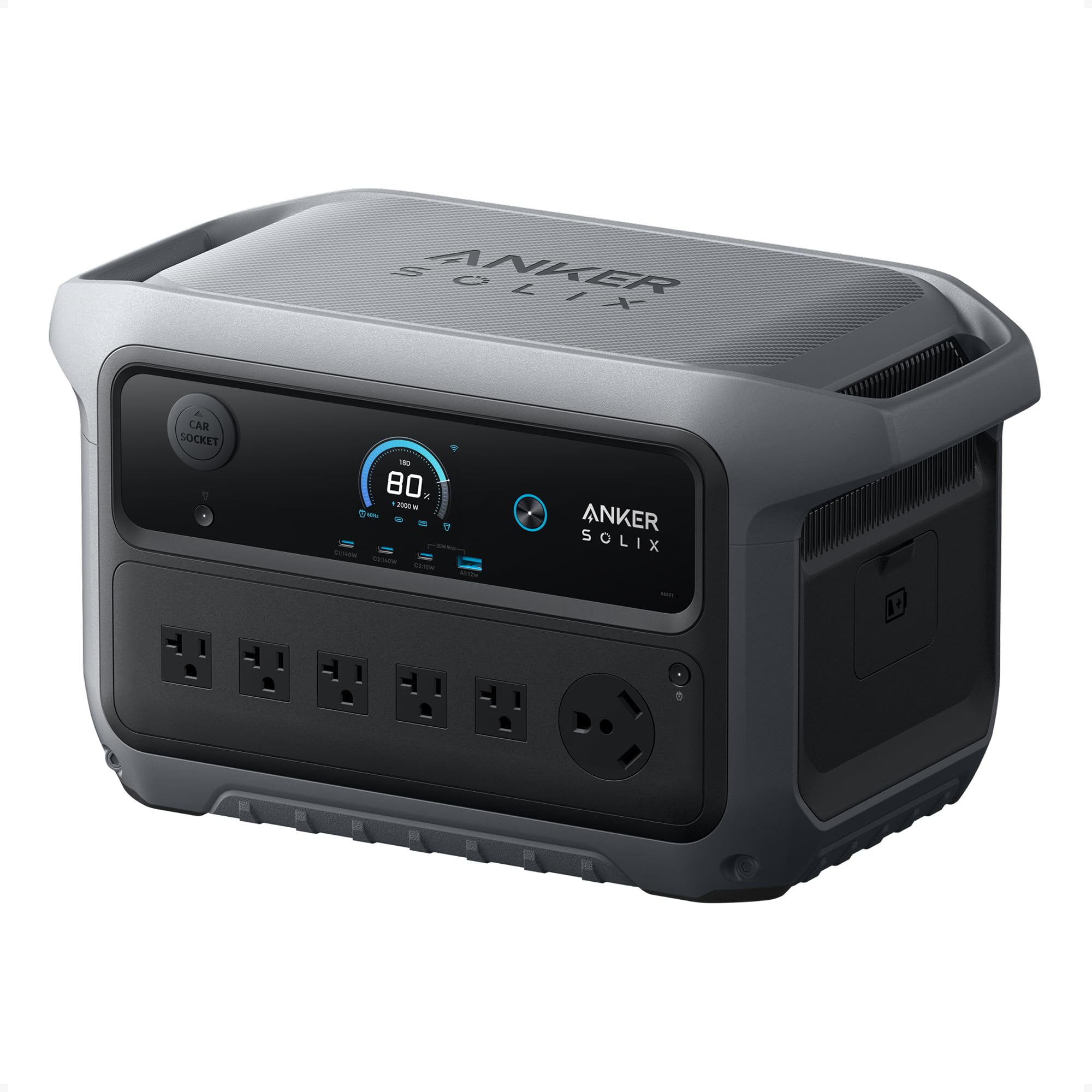
Recharge to 100% in 58 minutes — the speed king for fridge-saving blackout prep.
The C2000 Gen 2’s headline act is charging speed: a full 0-100% recharge in just 58 minutes from an AC outlet. That’s not 80% in an hour like most rivals — that’s a completely full 2048Wh tank in under an hour. Pair that with a 2400W rated output and 4000W peak power, and it can start most window and RV air conditioners, which is a feat for a 2kWh class unit.
Efficiency is the quiet genius here. It sips just 9W on standby, so a dual-door fridge can run for up to 32 hours on a full charge — and if you add an expansion battery, you can double runtime to 64 hours. One owner reported their fridge ran for 5-7 days with an extra battery attached. The 41.7 lb weight is 25% lighter than comparable units, and its compact 18.1 x 9.8 x 10.1-inch frame slides under counters easily.
It also charges on the go: an 800W alternator input hits 100% in 3 hours from your car, 8x faster than a standard socket. The built-in UPS function (with ~20ms switchover) keeps a PC and dual monitors alive during blips. The recurring theme in owner feedback is that it’s a “workhorse” — one buyer grabbed a second unit after the first impressed them. The only notable gripe is that the app’s runtime estimates aren’t always accurate, so trust the display over the app.
My take: The fastest way to a full battery on the market, and the best fridge-saver per pound in this list.
Choose this if: you want maximum recharge speed and long fridge runtime without paying for brand-name premium markup.
Consider others if: you need app automation as sturdy as EcoFlow’s — Anker’s is functional but simpler.
6. EF ECOFLOW DELTA 2 with 220W Solar Panel

The complete solar kit that recharges in about 6 hours of sun and powers 90% of your appliances.
This is the rare all-in-one that arrives ready to go green: a 1024Wh DELTA 2 station paired with a 220W bifacial solar panel that captures up to 25% more energy by using both sides. In moderate sunlight, customers note the panel recharges the battery in about 6 hours — a genuine “top it off for free” daily cycle. With up to 500W of solar input supported, you can add a second panel to cut that time in half.
The station itself is no slouch. Its 1800W AC output is on par with gas generators but without the fumes or noise, and 15 outlets let you power 90% of your household appliances simultaneously. The LFP (LiFePO4) battery is rated for 3000+ cycles, which EcoFlow says makes it last 6x longer than typical lithium-ion packs — years of camping, blackouts, and RV trips. The built-in BMS (Battery Management System) auto-regulates charging for safety.
Owners specifically praise how it handles a camper fridge and lights all weekend, and one reviewer used it to power a patio swamp cooler via solar, noting the bifacial panel picked up reflected light from nearby surfaces. Expandability to 3kWh with extra batteries future-proofs it. Solar-only recharging takes about 6 hours, so AC or alternator charging is faster for urgent top-ups., so you’ll want the wall plug or an alternator charger for urgent top-ups. For a first solar setup that works from the start, this is the one.
Why It’s the Complete Package
- 220W bifacial panel boosts solar gain by 25%
- 15 outlets power 90% of appliances
- Expandable to 3kWh
The Solar Slow-Lane
- ~6 hour solar recharge is leisurely
- Station and panel ship separately
Start here if: you want a working solar generator with zero assembly required and a panel included.
Upgrade if: you know you’ll need more than 1024Wh for a full-size fridge.
7. GRECELL Portable Power Station 500W
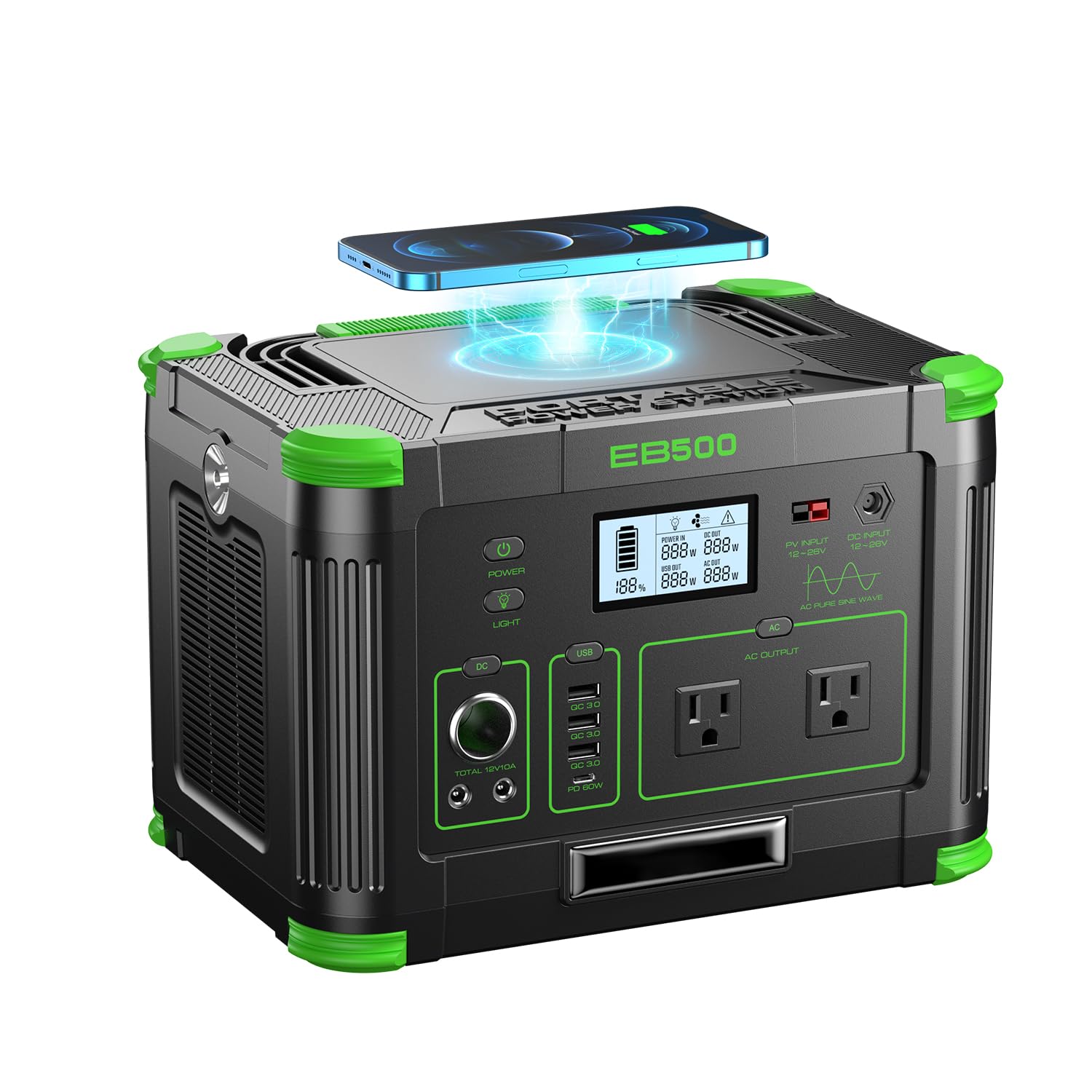
The budget-friendly 519.48Wh station that’s perfect for weekend trips and short home outages.
At 519.48Wh and 14.1 pounds, the GRECELL EB500 is the gateway to solar power—light enough to toss in a daily bag, yet capable of running a CPAP machine for 8 hours during an outage, as multiple reviewers point out. Its 500W pure sine wave inverter (which produces clean, stable power) is friendly to sensitive electronics like laptops and cameras, and the 2 AC outlets plus a total of 8 output ports let you charge a phone, smartwatch, and small appliances all at once.
The port selection punches above its weight: USB-C PD at 60W fast-charges a MacBook, 3 USB-A QC3.0 ports hit 18W each, and there’s even a 10W wireless charging pad on top. A built-in light is a nice emergency touch. It recharges three ways — AC in 6-7 hours, car charger in 7-8 hours, or a 100W solar panel in 6-9 hours of sun — making it flexible for any situation.
Compared to the BLUETTI AC200L, the GRECELL offers 519.48Wh versus 2048Wh and 500W versus 2400W output.: the GRECELL holds 519.48Wh versus the BLUETTI’s 2048Wh, a 3.9x gap, and outputs 500W versus 2400W, a 4.8x gap. That’s the difference between powering a CPAP overnight versus a full fridge, so don’t expect it to run large appliances. Owners call it durable and reliable for light use — the “lowest cost per watt-hour” value champion. The trade-off, echoed in feedback, is that battery and solar charging are both slow, so plan ahead.
Verdict: A reliable, compact workhorse for phones, laptops, and small electronics — not a fridge-runner.
Best for: budget buyers, students, or anyone needing portable power for a day trip or short outage.
Not for: powering a full-size refrigerator or any appliance over 500W.
8. LIBRIDS Portable Power Station 640Wh
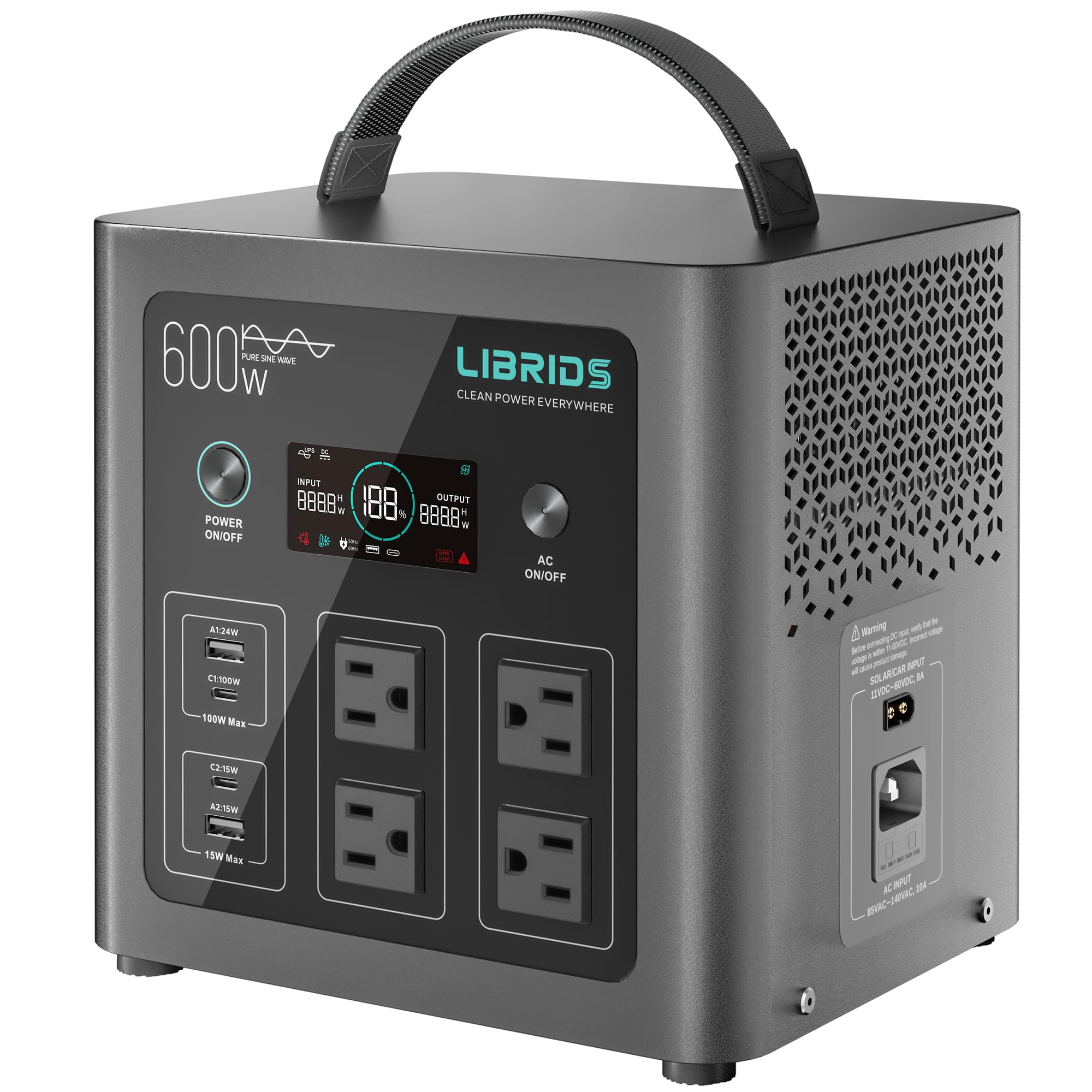
A 640Wh LiFePO4 station with a 10ms UPS that keeps medical gear and aquariums alive in a blip.
The LIBRIDS H1008 is built around one killer feature: a 10ms UPS switchover. That means if the grid flickers, this station jumps in instantly — no reboot, no interruption. For a CPAP machine user, that’s a literal lifesaver; one owner ran their Resmed Airsense 11 for 7 hours and drained only 24% of the battery. For reef-tank keepers, it means pumps and anemones stay protected through outages without missing a beat.
Under the hood is an automotive-grade LiFePO4 battery rated for 4000+ cycles — that’s a decade-plus of daily use — wrapped in a durable metal enclosure that dissipates heat well. The 640Wh capacity with 600W continuous output (1200W surge via PowerRaise tech) runs a Starlink Mini, laptops, and small appliances with ease. It recharges from empty to full in just 1.5 hours on AC, and the smart LCD screen shows real-time battery percentage and input/output wattage.
Its metal frame and quiet fan make it feel premium and durable.: a premium metal frame, comfortable handle, and quiet operation (low fan noise) make it feel far more expensive than it is. All 8 ports are usable at once — 4 AC outlets plus USB-A and USB-C. Owners consistently call it reliable, fast-charging, and a great value. The only limitation is that its 600W continuous output won’t handle a Keurig or microwave, so it’s best for essentials, not high-draw appliances. Note the “Indoor Use Only” label is a UL safety requirement; it’s fine at a dry campsite in clear weather but should stay out of rain.
Why It Stands Out
- 10ms UPS keeps sensitive gear online
- 4000+ cycle LiFePO4 in a metal shell
- 1.5-hour full recharge
Where It’s Limited
- 600W output won’t run a microwave or Keurig
- Keep it out of wet conditions per UL warning
Reach for it if: you run a CPAP, aquarium, or Starlink and need instant, quiet backup power.
Look past it if: you need to power kitchen appliances — that demands a 2000W+ unit.
9. Sun Energise 25W Solar Battery Charger

The 25W trickle charger that keeps a 12V battery topped off for months of storage — no outlet needed.
This is a completely different animal from the power stations above — it’s a 25W solar panel designed solely to maintain 12V batteries in cars, boats, RVs, tractors, and jet skis. The built-in smart MPPT (Maximum Power Point Tracking) charge controller squeezes up to 99% tracking efficiency and 98% peak conversion, boosting utilization by 20-30% versus cheaper controllers. In plain terms: it gets more usable power out of the same sunlight.
The defining real-world proof is longevity: shoppers say it maintained an outdoor jetski battery flawlessly for 1.5 years in Florida sun and rain, always starting on the first try. Another RV owner used it to keep a Ford Transit chassis battery above 12.6V through weeks of winter storage, preventing the parasitic drain that causes “deep sleep” failures. The 3-stage charging algorithm (Bulk, Absorption, Float) cuts off when the battery is full and resumes when it drops, so you never worry about overcharging.
It’s built to survive the elements: A+ mono solar cells with 21-30% efficiency sit under tempered glass in a corrosion-resistant ABS frame, rated to withstand 2400 Pa wind pressure, 5400 Pa snow load, hail, and sandstorms. The IP65 waterproof rating and spark-proof design make it safe to leave attached. The LED indicator shows charging status at a glance. One caveat: it’s a maintainer, not a charger — it’s excellent at keeping a healthy battery full but won’t revive a deeply discharged one, and its 2A current rating means it’s not for heavy loads. Some units had reliability gripes, so buy from a seller with good support.
My honest read: The cheapest insurance you can buy for any vehicle that sits for weeks — set it on the dashboard and forget it.
Perfect for: boats, RVs, jet skis, or seasonal cars where parasitic drain kills batteries during storage.
Not for: reviving a dead battery — that’s a job for a full-size charger.
Understanding the Specs
Watt-Hours (Wh) — Your Fuel Tank
This number measures total energy storage, like the gallons in a gas tank. A 2048Wh station can run a 100W appliance for about 20 hours. To estimate your needs, add up the wattage of everything you want to power and multiply by the hours you need.
Watts (W) — Your Engine Size
Wattage is the maximum power the station can push out at once. A fridge might draw 150W running but surge to 800W on startup. If your station’s rating is too low, it will shut off or trip. The “surge” or “lifting” spec covers those brief startup spikes.
FAQ
What size power station do I need for a refrigerator?
What is the difference between 500W and 2400W power stations?
How long does a 2048Wh power station last during an outage?
Can I use a solar panel to charge my power station while camping?
What does LiFePO4 battery mean and why does it matter?
Can I run a CPAP machine through the night on a power station?
What is UPS mode and why would I need it?
How do I size a solar panel for my power station?
Is it safe to leave a solar power station plugged in?
Final Thoughts: The Verdict
For most buyers, the batteries and solar power winner is the BLUETTI AC200L because it blends massive 2048Wh capacity, a fast 45-minute recharge, and expandability to 8192Wh in one heavy-but-capable package. If you want the lightest station you’ll actually carry, grab the Jackery Explorer 2000 v2 at 39.5 lbs. And for a ready-to-go solar kit that works from the start, the EcoFlow DELTA 2 bundle with its 220W bifacial panel is the one to reach for.
How We Picked
We do not accept paid placement. Every pick is matched to a real buyer and a real use-case; we do not hands-on test units.
Sources & Methodology
Specifications: manufacturer listings and product documentation. Review insights: verified customer reviews, as of August 2026. Pricing: not shown on this page (it changes often); check the current price via the retailer link.
As an Amazon Associate, Gadgets Feed earns from qualifying purchases. This does not affect which products we feature.