
Few things are more frustrating than watching your signal bars vanish the moment you step inside your home or drive into a rural stretch. The constant buffering, dropped calls, and missed texts aren’t just annoying — they disrupt work, safety, and everyday communication. A dedicated solution amplifies the weak signal already present outside your building and rebroadcasts it indoors, turning dead zones into reliable connectivity zones.
I’m Min — the co-founder and writer behind Gadgets Feed. I’ve spent years dissecting FCC filings, gain ratings, and band compatibility charts to understand how these devices really perform across real-world installations and carrier networks. (And Homer 🐱 supervised the antenna placement from the warm spot on the router).
Whether you live in a rural area with spotty reception, work from a basement office, or spend long hours on the road, the best cell phone antenna can transform your connectivity experience by amplifying weak signals into strong, usable coverage for calls and data.
How To Choose The Best Cell Phone Antenna
Buying a signal booster means investing in the right combination of gain, frequency band support, and installation type for your specific environment. Getting it wrong can mean no improvement at all.
Check Your Carrier’s Frequency Band
Every carrier broadcasts on specific spectrum slices — Verizon uses Band 13 (700 MHz), AT&T relies on Band 12/17 (700 MHz), and T-Mobile spreads across Bands 2, 4, and 12. A booster must match these frequencies. A single-band unit is fine if you have one carrier, but multi-band models support more carriers and future 5G roaming.
Understand Gain and Coverage Area
Gain, measured in decibels (dB), indicates how much the amplifier boosts incoming signal. Entry-level models start around 65dB, covering roughly 4,000–5,000 sq. ft. Premium units at 70–72dB extend coverage to 7,000 sq. ft. Higher gain also improves signal penetration through walls, metal roofs, and concrete basements.
Directional vs. Omnidirectional Antennas
Outdoor antennas come in two flavors. Directional Yagi or log-periodic antennas focus on one tower and deliver stronger gain — ideal for rural homes with a known tower direction. Omnidirectional whip antennas capture signal from all directions, making them better for vehicles or urban areas where towers surround your location.
Quick Comparison
On smaller screens, swipe sideways to see the full table.
| Model | Category | Best For | Key Spec | Amazon |
|---|---|---|---|---|
| ZORIDA ACE 5S | Home Booster | All carriers, app-supported setup | 72dB gain, 2,000 sq. ft coverage | Amazon |
| Nstcell 17C-5S-A01 | Large Home | Rural homes up to 7,000 sq. ft | 70dB gain, dual indoor panels | Amazon |
| GAGBK 6-Band RV Booster | Vehicle | RV, truck, car long-range use | 65dB gain, 5-8 mile range | Amazon |
| GAGBK Car/RV Booster | Vehicle | Road trips and camping | 65dB gain, Band 12/13/17 support | Amazon |
| FreeQueen Verizon Booster | Single Carrier | Verizon/Straight Talk homes | 65dB gain, 5,000 sq. ft coverage | Amazon |
| GAGBK Band 13 Booster | Single Carrier | Verizon home & office | 65dB gain, 5,000 sq. ft coverage | Amazon |
| JACOOL AT&T/T-Mobile Booster | Multi-Carrier | AT&T/T-Mobile/Cricket homes | 65dB gain, 4,000 sq. ft coverage | Amazon |
In‑Depth Reviews
1. ZORIDA ACE 5S

The ZORIDA ACE 5S delivers the highest gain on this list at 72dB, making it one of the most powerful consumer boosters available. It supports all major U.S. carriers across Bands 12/17, 13, 5, 4, and 2/25, covering 3G, 4G LTE, and 5G (where available on existing 4G bands). The 2,000 sq. ft coverage is modest compared to larger units, but the sheer gain means it punches above its weight even in challenging rural locations.
What sets this model apart is the companion ZORIDA app, which offers 1-on-1 technical support and helps you locate the optimal outdoor antenna position. Installation is relatively straightforward with the included 49.2 ft cable, outdoor directional antenna, and indoor whip antenna. The compact aluminum body (5.5 x 3 x 1 inches) helps dissipate heat during extended use.
Real-world users consistently report jumps from 1–2 bars of weak 4G to 5 solid bars with 35–40 Mbps download speeds. The automatic gain control prevents oscillation, and the FCC and IC certifications ensure legal operation. The 3-year warranty and lifetime US-based tech-support chat provide solid peace of mind for a mid-range investment.
Why it’s great
- 72dB max gain — highest on the list for max amplification
- App-assisted setup guides antenna placement precisely
- Supports 5G on DSS bands with all major U.S. carriers
Good to know
- Coverage limited to 2,000 sq. ft — not ideal for large multi-room homes
- 5G performance depends entirely on carrier DSS deployment in your area
2. Nstcell 17C-5S-A01

The Nstcell 17C-5S-A01 is engineered for large homes and rural properties, with a rated coverage of up to 7,000 sq. ft when the outdoor signal is strong. It achieves this through a 70dB gain amplifier paired with two indoor panel antennas — a rare configuration at this price tier. The outdoor setup uses a directional log-periodic antenna with a 49 ft cable, giving you substantial flexibility to place the outdoor unit in the best signal location.
Real-world installations in homes with metal roofs and siding — notorious signal killers — have seen dramatic improvements, with users reporting jumps from zero bars to 3–5 bars across 3,200 sq. ft ranch homes. The automatic gain control adjusts for self-oscillation, and the LED indicators clearly show operational status. The included 32 ft and 16 ft cables for the indoor panels allow placement in separate rooms.
Some users noted the instruction manual could be clearer, with poor translation and small text. Installation requires careful attention to the 32 ft minimum separation between outdoor and indoor antennas to prevent feedback loops. The 3-year manufacturer warranty is competitive, though customer support responsiveness has been inconsistent based on user reports.
Why it’s great
- 70dB gain with dual indoor panels covers up to 7,000 sq. ft
- Included log-periodic antenna focuses signal from distant towers
- Supports all North American carriers on 700/1700/1900 MHz bands
Good to know
- Instructions can be confusing — some users report installation frustration
- Customer support response times vary significantly
3. GAGBK 6-Band RV Booster
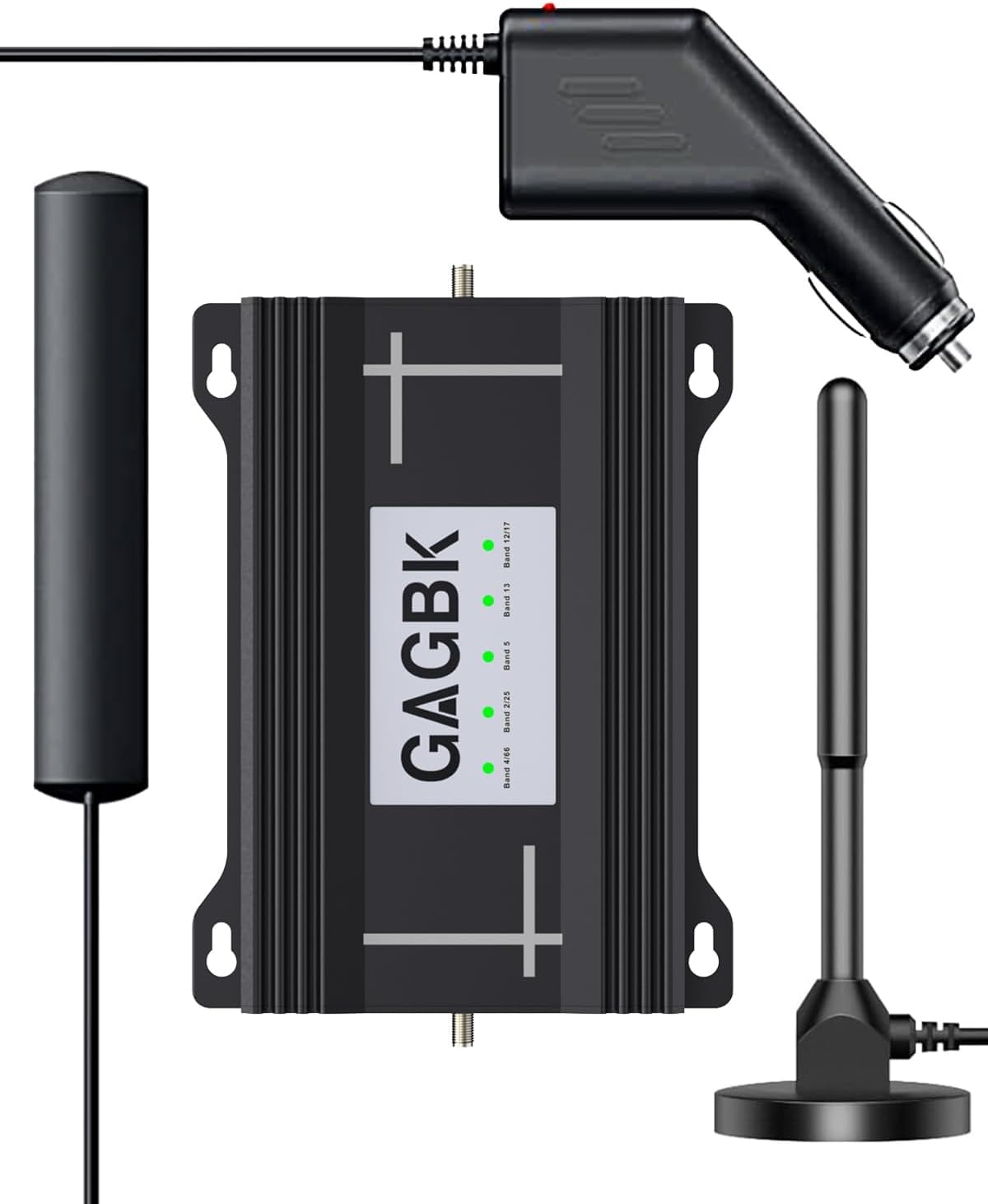
The GAGBK 6-Band RV Booster is the most versatile vehicle-focused unit on this list, supporting an unusually wide range of frequencies including Bands 2, 4, 5, 12, 13, 17, 25, and 66. This makes it compatible with all major U.S. carriers — Verizon, AT&T, T-Mobile, and more — across 2G through 5G networks. The 65dB gain amplifier claims a communication range of 5–8 miles to the nearest tower, which is generous for a mobile booster.
Installation is designed for non-technical users: the outdoor magnetic whip antenna attaches to your vehicle roof, running a 16 ft cable to the booster unit, while the indoor patch antenna connects via a 10 ft cable. Automatic Gain Control adjusts for changing signal conditions as you drive, and the inactivity mode reduces power draw when no device is connected. Users report noticeable improvements in remote camping spots, with some seeing signals go from non-existent to usable for streaming.
The main trade-off is that mobile boosters require careful antenna placement — the outdoor antenna must have clear sky visibility, and separation from the indoor antenna is critical to avoid oscillation. The 3-year manufacturer warranty and 90-day replacement policy are solid, but some users have reported that the system can be finicky to tune perfectly in densely wooded areas.
Why it’s great
- Exceptional multi-band support (2/4/5/12/13/17/25/66) for all carriers
- Magnetic mount antenna requires no drilling for installation
- AGC and inactivity mode optimize performance and battery life
Good to know
- Installation tuning is critical — wrong placement causes oscillation
- Claimed 5-8 mile range depends heavily on terrain and tower power
4. GAGBK Car/RV Booster

This GAGBK Car/RV Booster is a more budget-conscious alternative to the 6-band model, focusing on the core bands used by Verizon (Band 13), AT&T and T-Mobile (Bands 12/17). The 65dB gain amplifier works well for road trips and remote camping, with users reporting AT&T service jumping from 1 bar to 4 bars in rural locations. The kit includes a magnetic mount outdoor whip antenna with a 16 ft cable and an indoor patch antenna with a 10 ft cable.
Installation takes about 10–20 minutes with no drilling required, thanks to the magnetic antenna base. The automatic gain control detects incoming signal strength and adjusts itself for best performance, while the sleep mode reduces power draw when the booster is idle. The aluminum alloy body provides better heat dissipation than plastic alternatives, helping extend the unit’s life in hot vehicles.
The primary limitation is band support — it only covers Bands 12, 13, and 17, meaning it won’t work with carriers using Bands 2, 4, 5, or 25. Also, some users reported the unit stopped working after 3 months, though the 3-year manufacturer warranty covers such defects. For a single-carrier household looking for a basic road trip booster, this remains a solid entry-level value.
Why it’s great
- Simple 10-20 minute install with magnetic mount — no drilling
- Aluminum alloy body dissipates heat effectively in vehicles
- Automatic gain control optimizes performance on the move
Good to know
- Limited to Bands 12/13/17 — won’t work with all carriers everywhere
- Some users reported reliability issues within the first few months
5. FreeQueen Verizon Booster
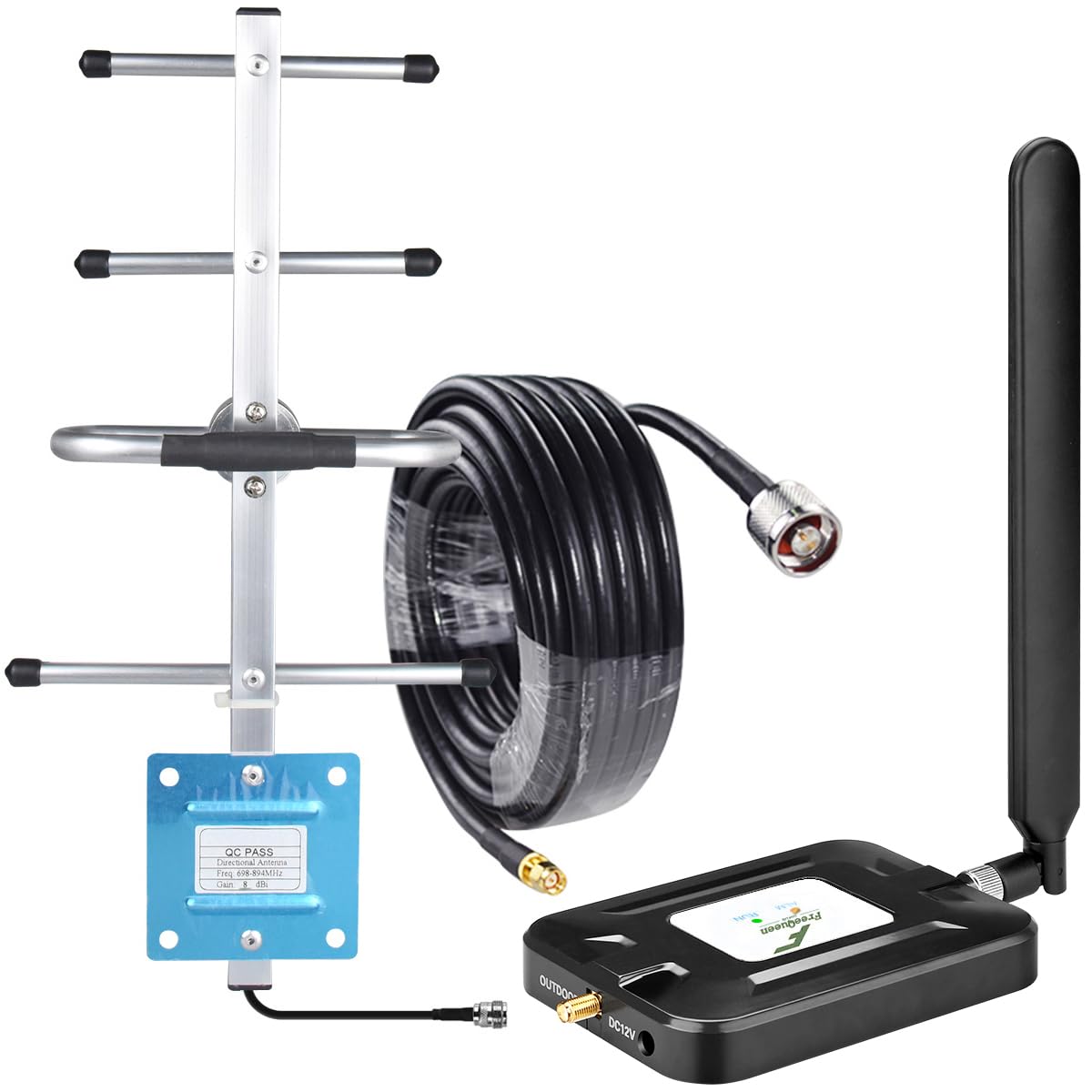
The FreeQueen Verizon Booster is a dedicated single-band (Band 13, 700 MHz) solution optimized exclusively for Verizon and its MVNOs like Straight Talk. This laser focus means it won’t work with AT&T, T-Mobile, or other carriers, but for Verizon subscribers in weak signal areas, it delivers reliable performance. The 65dB gain amplifier covers up to 5,000 sq. ft, making it suitable for medium to large homes.
Installation is straightforward with the included outdoor directional Yagi antenna, 50 ft N-SMA coaxial cable, indoor whip antenna, and 12V power supply. The Yagi antenna focuses on a specific cell tower direction, which is ideal for rural homes where towers are visible but distant. The automatic gain control intelligently adjusts amplification levels to prevent oscillation, and the LED indicator shows operational status at a glance.
User experiences suggest the booster can take a weak 1–2 bar signal and push it to 4–5 bars or full signal, with clear voice calls and reduced buffering for streaming. The FCC approval ensures it meets regulatory standards. The 3-year warranty and 30-day money-back guarantee are standard. The main downside is the single-band limitation — if you ever switch carriers or need multi-carrier support at home, you’d need a different unit.
Why it’s great
- Dedicated Band 13 amplification optimized for Verizon signals
- Yagi directional antenna focuses on distant towers effectively
- 50 ft coaxial cable provides flexibility for outdoor antenna placement
Good to know
- Single-band only — incompatible with AT&T, T-Mobile, or other carriers
- Yagi antenna requires precise aiming toward the nearest cell tower
6. GAGBK Band 13 Booster

The GAGBK Band 13 Booster is another Verizon-focused single-band solution, operating on the 700 MHz Band 13 frequency. It offers 65dB gain and covers up to 5,000 sq. ft — essentially the same specs as the FreeQueen booster above. The kit includes an outdoor directional antenna, indoor omnidirectional whip antenna, 50 ft N-SMA cable, and 12V power supply. The boosted signal claim of up to 100X makes for effective amplification in weak signal scenarios.
User feedback highlights solid performance in real-world installations. One reviewer in a 4,000 sq. ft building reported consistent 1–20 Mbps data speeds with good LTE/5G coverage after installation. The automatic gain control prevents oscillation, and the LED indicator shows signal status. The 2-year manufacturer warranty is slightly shorter than some competitors, but the 30-day money-back guarantee provides a risk-free trial period.
The main concern is the single-band limitation — it only works with Verizon and Straight Talk on Band 13. Users on AT&T, T-Mobile, or other carriers will need a different unit. Additionally, the included indoor antenna is an omnidirectional whip, which may not provide as even coverage as a panel antenna in larger homes. For a basic, no-frills Verizon home booster, this is a competent but unremarkable choice.
Why it’s great
- FCC approved with 65dB gain for solid signal improvement
- AGC adjusts amplification automatically to prevent feedback
- 30-day money-back guarantee allows risk-free trial
Good to know
- Single-band Band 13 design limits carrier compatibility
- Indoor omnidirectional antenna may not cover larger homes evenly
7. JACOOL AT&T/T-Mobile Booster
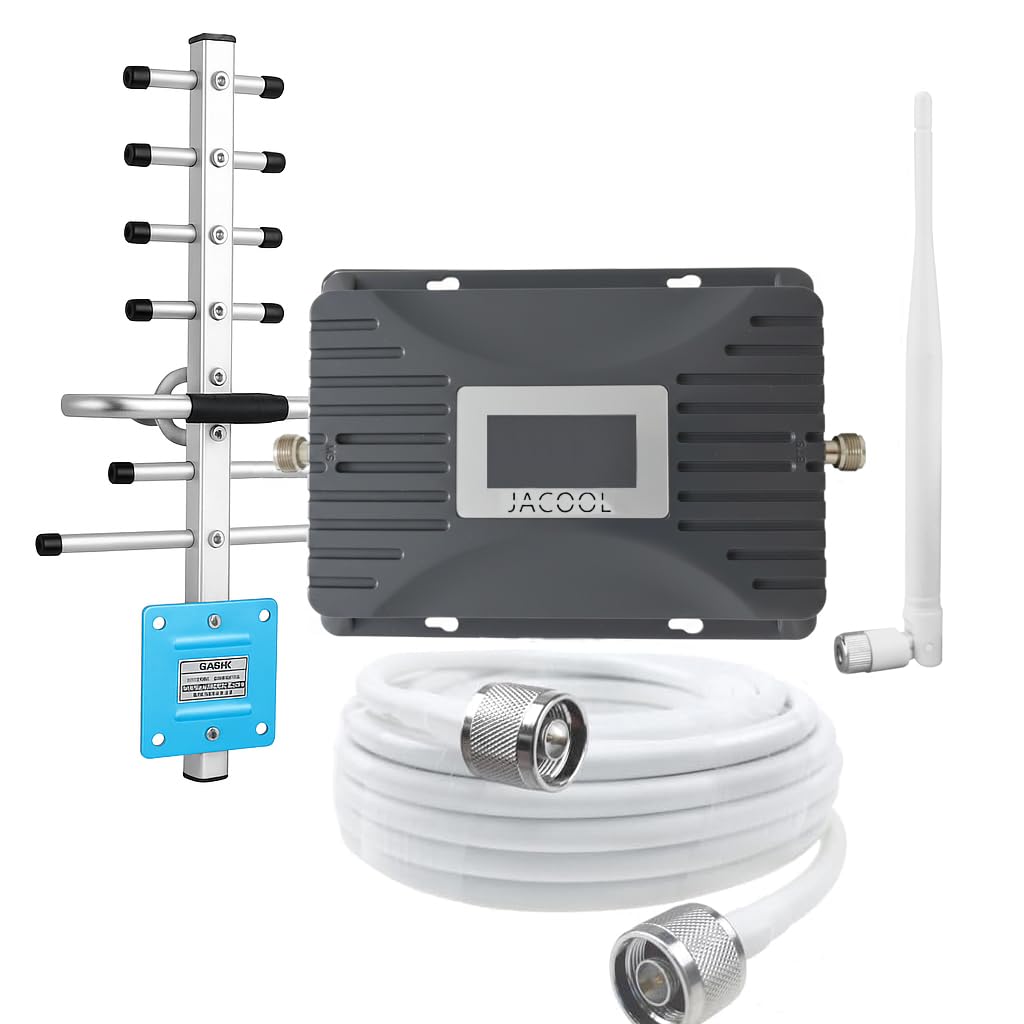
The JACOOL booster is engineered specifically for AT&T’s Band 12/17 (700 MHz) network, while also supporting T-Mobile, Straight Talk, Cricket, and U.S. Cellular on the same frequency. This makes it a strong pick for multi-carrier households that share the 700 MHz band. The 65dB gain amplifier covers up to 4,000 sq. ft, with a 150 Mbps data transfer rate ceiling — adequate for most streaming and browsing needs.
Installation is simplified by the included 50 ft coaxial cable (extendable to 100 ft) and automatic gain control with self-oscillation elimination. The 65dB maximum gain is standard for this tier, and the FCC certification ensures legal compliance. Users report that the booster effectively transforms weak 1–2 bar signals into strong 3–5 bar coverage, with clear VoLTE call quality and reduced buffering on streaming apps like YouTube and Netflix.
The single-band design means it won’t work with carriers using Band 2, 4, 5, or 13 frequencies. Some customer reviews appear to be from unrelated products — a sign of potentially merged listings or review manipulation. The 3-year manufacturer warranty and lifetime technical support are positive, but the mixed review authenticity is a concern. For those on AT&T or T-Mobile in a 700 MHz area, this is a functional option with reasonable specs.
Why it’s great
- Designed for AT&T Band 12/17 but supports T-Mobile, Cricket, and more
- 50 ft cable included, extendable to 100 ft for flexible installation
- FCC approved with AGC and self-oscillation elimination circuits
Good to know
- Single-band design — incompatible with Verizon’s Band 13 or other bands
- Some customer reviews appear unrelated, raising authenticity questions
FAQ
Can a signal booster create signal where there is none?
Do I need to register my booster with my carrier?
Final Thoughts: The Verdict
For most users, the best cell phone antenna winner is the ZORIDA ACE 5S because its 72dB gain, multi-band support for all carriers, and app-assisted installation make it the most capable and user-friendly home booster at this price point. If you need to cover a very large home, grab the Nstcell 17C-5S-A01. And for vehicle use where multi-band carrier support is critical, nothing beats the GAGBK 6-Band RV Booster.