
A car cabin turning into a sauna mid-August is a specific kind of misery. The fix often cited—”just recharge the AC”—leads most drivers to a simple can of refrigerant, which rarely resolves the underlying issue of improper pressure or a slow leak. A proper Automotive Air Conditioning Recharge Kit includes a manifold gauge set, hoses, and adapters to measure low-side and high-side pressures, diagnose compressor function, and evacuate moisture before adding refrigerant.
I’m Rikta — the co-founder and writer behind Gadgets Feed. Over the past several years, I’ve analyzed hundreds of automotive tool kits, cross-referencing technical specifications, user reports, and compatibility charts to determine which sets deliver accurate diagnostics and real durability without unnecessary complexity. (And Homer 🐱 supervised from the toolbox lid, silently judging every loose fitting).
This guide focuses on manifold gauge sets and vacuum pump kits designed for R134a systems, with some covering R12 and R1234yf, so you can diagnose, evacuate, and recharge with confidence. Whether you’re maintaining a sedan or servicing a mini-split, the right automotive air conditioning recharge kit saves money and prevents a blown compressor from overcharging.
How To Choose The Best Automotive Air Conditioning Recharge Kit
Most starter kits look similar—three color-coded hoses, a brass manifold, and a can tap—but small differences in materials and included tools determine whether your recharge succeeds or you end up chasing a leak. Focus on refrigerant compatibility, gauge accuracy, hose burst pressure, and whether the kit includes a vacuum pump or supports a full evacuation.
Refrigerant Compatibility and Couplers
R134a systems dominate vehicles from the mid-1990s through the early 2020s, but newer models use R1234yf. Check your vehicle’s under-hood sticker. A recharge kit that works with R134a, R12, R22, and R502 gives you the most flexibility for older cars and home appliances. Corresponding quick couplers—R134a or R1234yf—must be included; without them, the hose will not seal onto the vehicle’s service ports.
Manifold Gauge Quality and Accuracy
The manifold is the diagnostic center. Look for large, color-coded dials with Fahrenheit scales that accommodate at least 500 PSI high-side and 350 PSI low-side. A ±1.6% accuracy class is standard for DIY kits. The core body should be brass or forged aluminum to resist corrosion from refrigerant oils. A built-in sight glass helps you spot bubbles in the refrigerant flow during charging.
Hose Construction and Burst Pressure
Hoses rated at 600 PSI working pressure with a 3000 PSI burst pressure provide a comfortable safety margin for R134a systems, which typically operate below 250 PSI on the high side. Five-foot hoses offer enough reach to hang the manifold away from moving engine parts. Neoprene or rubber jackets resist abrasion and handle moderate bending without kinking. Valve core depressors at the service ends are mandatory to read actual system pressure.
Vacuum Pump vs. Gauge-Only Kits
A gauge-only kit allows you to check pressures and add refrigerant, but it cannot remove moisture or non-condensables. For any repair involving opening the system—compressor replacement, hose swap, or leak fix—you need a vacuum pump kit. Pumps rated 3.6 CFM to 4.5 CFM are adequate for passenger car systems. Confirm the pump includes oil, or budget for it separately. Single-stage pumps are sufficient for DIY; two-stage pumps are for commercial use.
Quick Comparison
On smaller screens, swipe sideways to see the full table.
| Model | Category | Best For | Key Spec | Amazon |
|---|---|---|---|---|
| testo 550s | Digital Manifold | Professional Diagnostics | Bluetooth, superheat/subcooling calc | Amazon |
| VIVOHOME 4.5 CFM | Full Kit | R1234yf & R134a systems | 4.5 CFM, sparkless motor, 800 PSI hoses | Amazon |
| VTG VOGTEN 4.5 CFM | Full Kit | Mini-split & auto AC | Leak detector, 4 hoses, trifold case | Amazon |
| BACOENG 3.6 CFM | Full Kit | Complete starter bundle | 3.6 CFM pump, includes R410a adapters | Amazon |
| PB Motor TECH 4.5 CFM | Full Kit | First-time full recharge | 4.5 CFM, copper motor, storage bag | Amazon |
| Orion Motor Tech | Gauge Set Only | Mid-range gauge diagnostics | XL dials, includes safety glasses & gloves | Amazon |
| Lichamp A301 | Gauge Set Only | Budget DIY diagnostic | 3-way manifold, 5FT hoses, brass body | Amazon |
In‑Depth Reviews
1. testo 550s AC Manifold Gauge Set
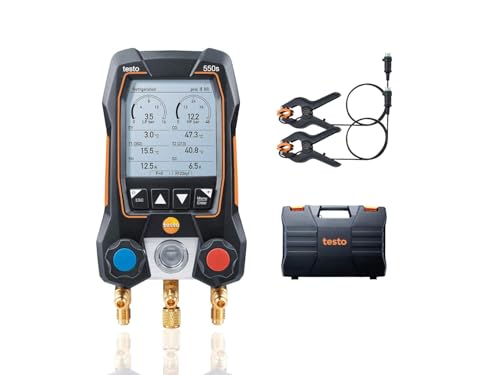
The testo 550s sits in a class of its own compared to analog manifold sets. The digital display delivers pressure accuracy within ±0.5% of full scale (0.5% FS) across a range from -15 to 870 PSI, and the two wired temperature clamp probes feed live data for automatic superheat and subcooling calculations. The Bluetooth connectivity pairs with the Testo Smart App, enabling remote monitoring of the evacuation curve and refrigerant charging directly from a smartphone.
For a technician servicing R32, R1234yf, R454B, or standard R134a and R410a systems, this kit eliminates manual chart lookup and transcription errors. The housing is compact—about 8.3 inches wide—and the backlit screen works well in dim engine bays. The unit supports A2L mildly flammable refrigerants, which is becoming critical for newer vehicle AC systems.
The kit includes two wired temperature probes and batteries; the plastic case lacks foam padding but holds everything securely. A signed calibration certificate is included, and the 2-year manufacturer warranty adds confidence for daily professional use. For the shop that bills by the job, the time saved on superheat calculation alone justifies the investment.
Why it’s great
- Automatic superheat/subcooling calculations reduce diagnostic time significantly
- Bluetooth app logs evacuation pressure curves for documentation
- Supports A2L refrigerants including R1234yf and R32
Good to know
- Requires periodic battery changes for the wireless module
- Plastic storage case lacks padded inserts for the probes
2. VIVOHOME 4.5 CFM Vacuum Pump and Manifold Gauge Kit
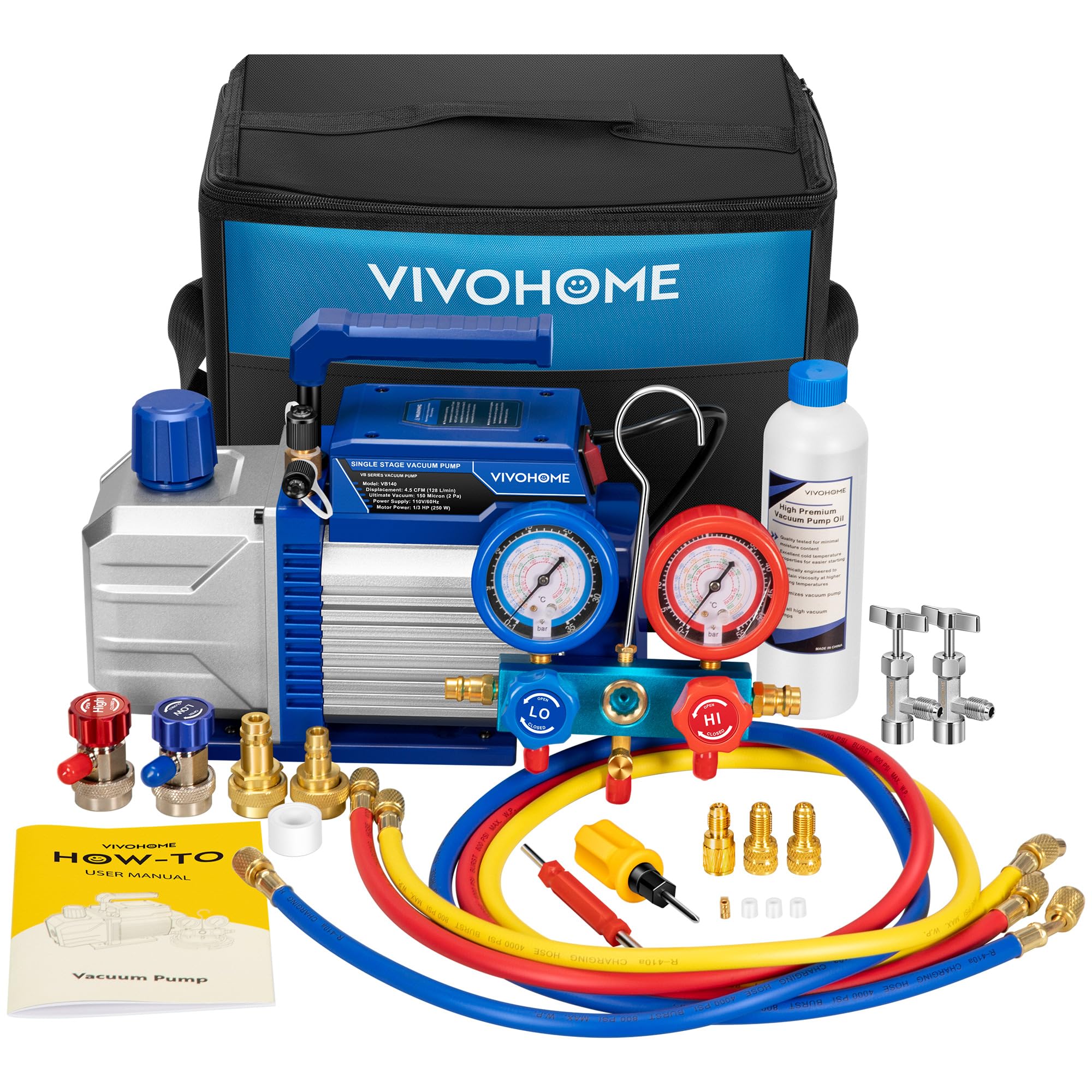
The VIVOHOME kit stands out because it ships ready for both R134a and R1234yf systems right out of the box. The 1/3 HP sparkless motor produces 4.5 CFM flow rate, which pulls a deep vacuum on a typical car AC system in under 15 minutes. The reinforced aluminum housing and built-in cooling fan keep the pump running at safe temperatures during extended evacuation sessions. The oil sight window and bottom drain valve make maintenance straightforward.
The 3-way manifold gauge uses 800 PSI working pressure hoses with a 4000 PSI burst pressure—higher than most budget sets. Color-coded hoses and a hanging hook improve workflow. Included R1234yf quick couplers and a self-sealing can tap allow immediate service on late-model vehicles without adapters. The 330ml oil bottle is included, which saves a separate purchase compared to many competitors.
Some users note the low-pressure gauge does not read vacuum depth in inches of mercury, so you may want a separate micron gauge for precise vacuum verification. The R134a can tap valve does not fully shut off when closed; a brass cap is recommended to preserve remaining refrigerant. For a DIYer servicing both older and newer vehicles, this kit’s dual-refrigerant compatibility is a genuine advantage.
Why it’s great
- Includes R1234yf quick couplers and can tap for late-model cars
- Sparkless motor improves safety when working near fuel vapors
- Carrying case and oil included—ready to work immediately
Good to know
- Low-side gauge does not indicate vacuum depth; a separate micron gauge is helpful
- R134a can tap valve doesn’t fully seal when closed
3. VTG VOGTEN 4.5 CFM Vacuum Pump and Gauge Set
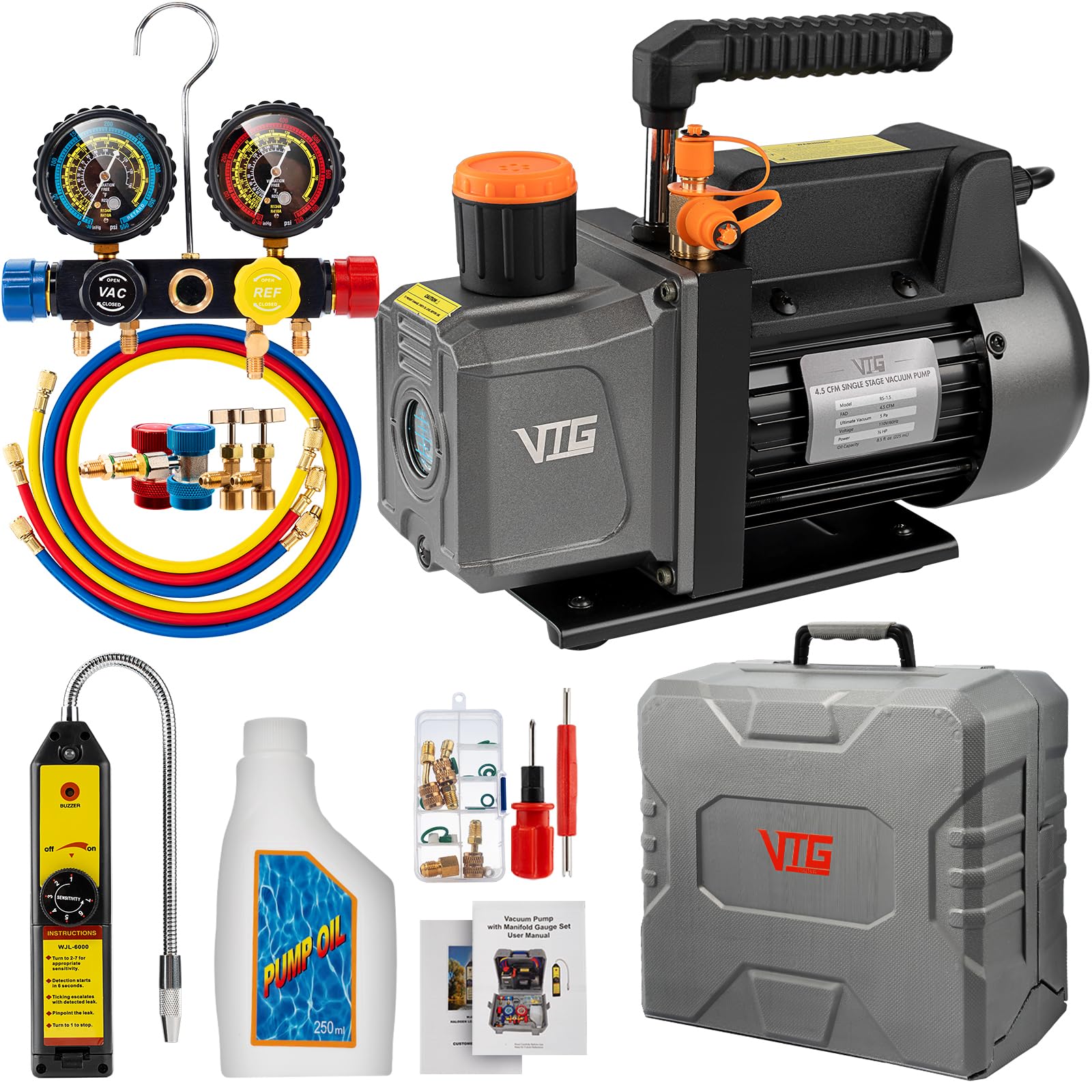
The VTG VOGTEN kit packs an unusual number of accessories into a single trifold case. Beyond the 4.5 CFM single-stage pump and 4-way manifold gauge, it includes a leak detector tool, both puncture-style and self-sealing R134a can taps, three R410a adapters (two 45-degree and one straight), a valve core wrench, and a screwdriver. The four-hose configuration adds a dedicated black hose for vacuum service, keeping the refrigerant charging path separated from the evacuation port.
The 1/3 HP copper motor and aluminum alloy housing follow the same proven recipe as other pumps in this tier. The manifold gauge provides direct readings of pressure in PSI, temperature in Fahrenheit, and refrigerant flow status. Hoses are rated at 800 PSI working pressure and 4000 PSI burst, matching the VIVOHOME set. The trifold case is thicker than a standard bag, holding components securely during transport.
The leak detector is a basic electronic sniffer suitable for locating larger refrigerant leaks, though it may miss very small seepage. Some units have shipped with oil residue from loose pump caps during transit—check the oil fill plug before first use. For a home mechanic managing both auto AC and mini-split installations, this all-in-one case eliminates the need to piece together separate tools.
Why it’s great
- Includes leak detector, both can tap types, and R410a adapters for mini-splits
- Four-hose setup separates vacuum and charging paths
- Trifold case organizes all accessories neatly
Good to know
- Oil may leak in transit if the cap is not tight—inspect before starting
- Leak detector is basic and may not find very tiny leaks
4. BACOENG 3.6 CFM Vacuum Pump and Gauge Set
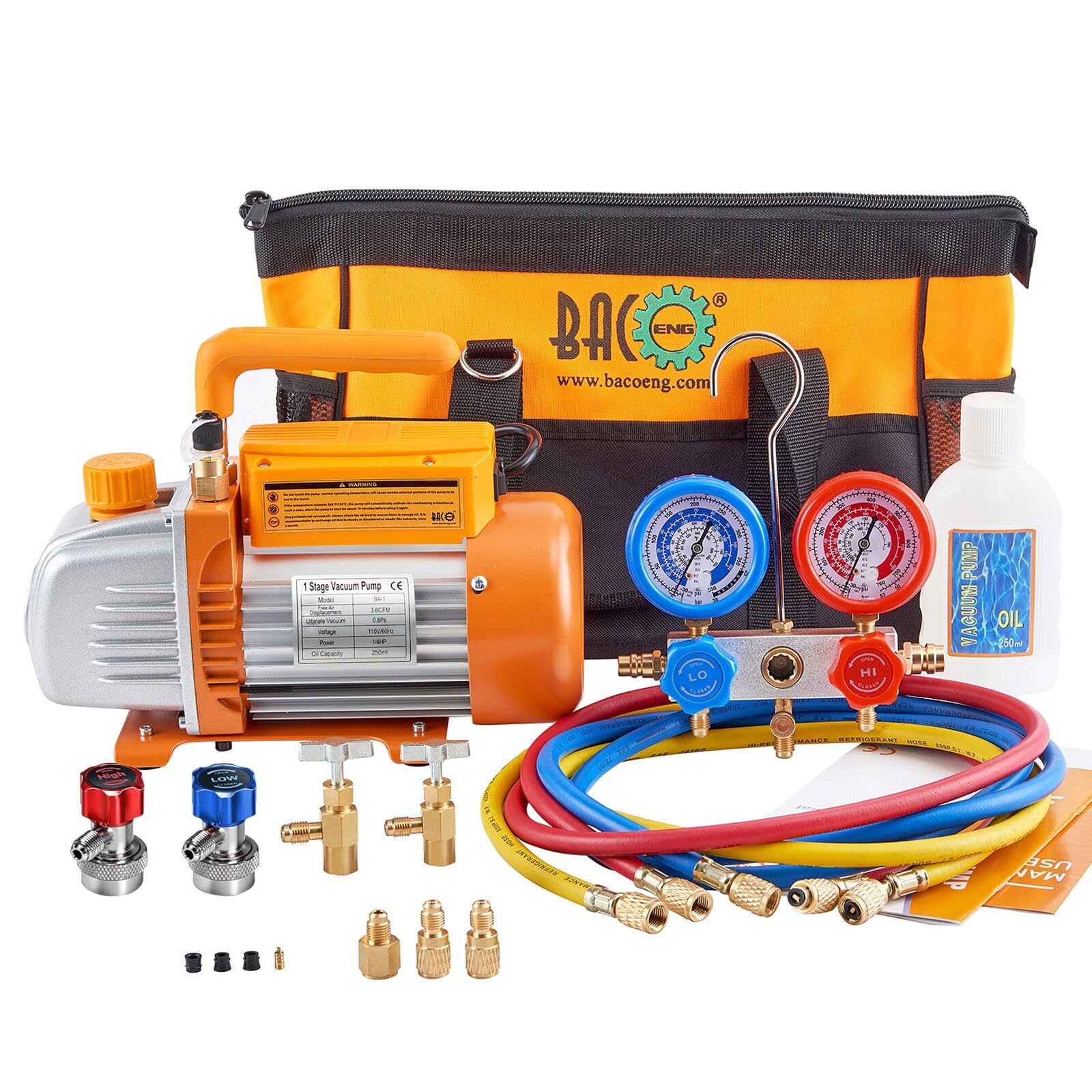
The BACOENG kit hits a sweet spot for the DIYer who wants a complete vacuum and gauge setup without overspending. The 1/4 HP single-stage pump draws 3.6 CFM, sufficient for automotive AC systems up to about 3 pounds of refrigerant charge. A built-in cooling fan and sight glass for oil level monitoring are included. The pump comes with oil in the box, so you can start evacuation immediately without a separate purchase.
The 3-way manifold gauge uses color-coded 5-foot hoses rated at 600 PSI working and 3000 PSI burst. Two R134a can taps (puncture-style and self-sealing) and two R134a quick couplers are included, plus two 1/4-inch male to 5/16-inch female straight adapters for R410a service. The large-capacity carry bag stores everything, though it is not as rigid as a molded case. Multiple users confirm the pump pulls 30 inches of mercury and holds vacuum for extended periods.
The included puncture-style can tap can be finicky—the pointed tip sometimes fails to pierce the can fully, leading to slow refrigerant flow. Users recommend the self-sealing tap for easier operation. The pump runs quietly and with low vibration; the alloy housing dissipates heat well during 30-minute cycles. For someone performing their first compressor replacement, this kit provides every necessary tool in one box.
Why it’s great
- Oil included—no additional purchase needed before first use
- Both puncture-style and self-sealing can taps included
- Pump maintains vacuum well after shutoff
Good to know
- Puncture-style can tap may not pierce all R134a cans fully
- Soft carry bag provides less protection than a molded case
5. PB Motor TECH 4.5 CFM Vacuum Pump and 3-Way AC Manifold Gauge Set

The PB Motor TECH kit centers on a 1/3 HP single-stage vacuum pump with a 4.5 CFM flow rate, a copper-wound motor, and a reinforced aluminum alloy housing. This pump pulls down a typical car AC system in 20–30 minutes. The 3-way manifold gauge set includes 48-inch hoses, which are slightly shorter than the 5-foot norm, but still adequate for most engine bay layouts. The gauge accuracy is rated at ±1.6%.
Included accessories cover the essentials: two R134a quick couplers, a puncture can tap, a plastic storage case, and a separate bag. The manifold features a hanging hook and a sight glass for monitoring refrigerant flow. The set is compatible with R134a, R12, R22, and R502 refrigerants, making it suitable for classic cars and home AC units as well.
The kit does not include vacuum pump oil, which is a necessary separate purchase. It also lacks a purge valve on the yellow charging line, so purging air after connecting hoses requires manually loosening the hose fitting—a minor inconvenience. The included can tap works reliably. For the price, this is a strong option for anyone performing their first full AC evacuation and recharge, provided they budget for oil and watch a tutorial on proper procedure.
Why it’s great
- 4.5 CFM pump evacuates system quickly and thoroughly
- Copper motor construction adds durability
- Sturdy plastic case keeps components organized
Good to know
- Vacuum pump oil not included—must be purchased separately
- No purge valve on yellow hose; requires manual air purging
6. Orion Motor Tech AC Manifold Gauge Set
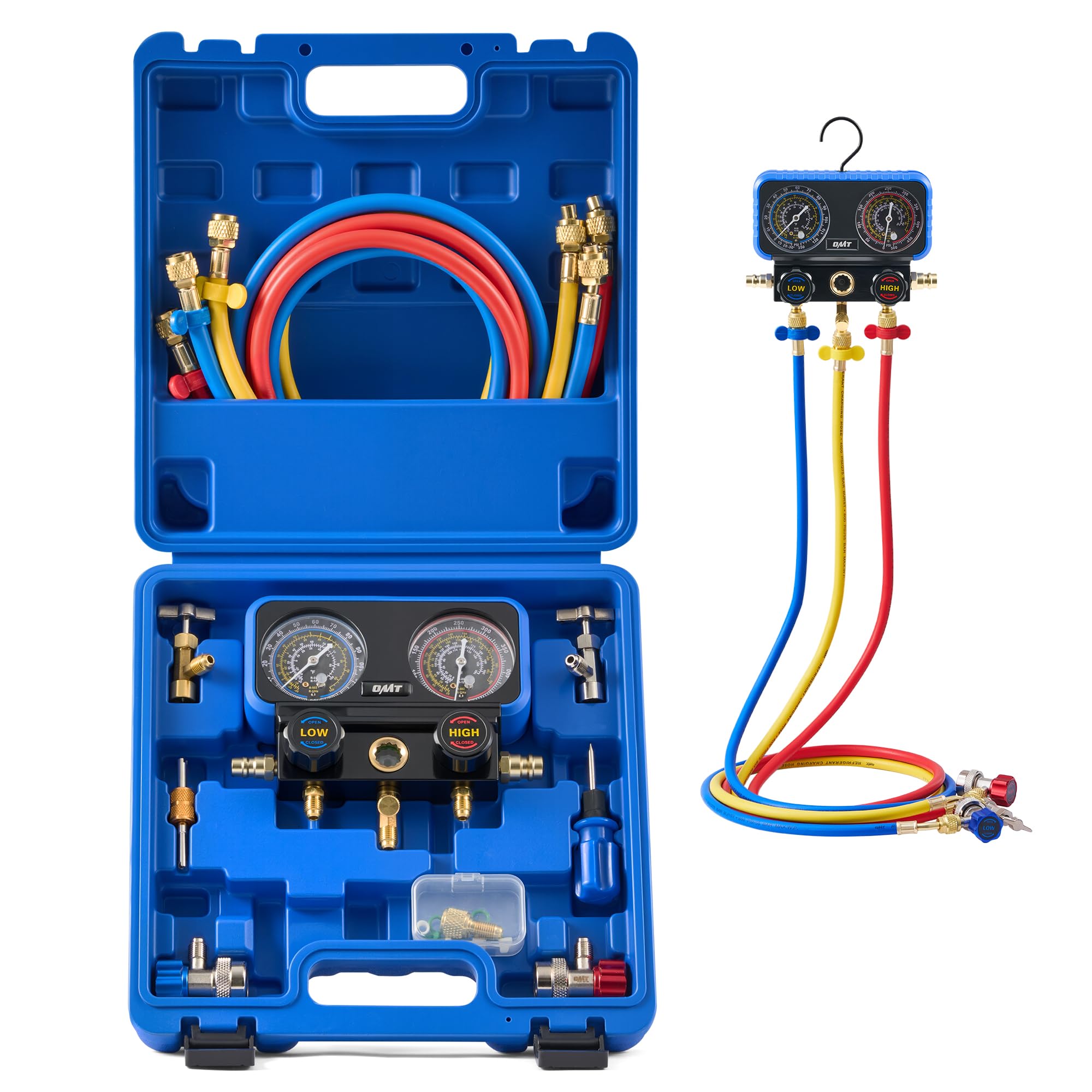
The Orion Motor Tech set is a gauge-only kit—no vacuum pump—designed for the DIYer who already owns a pump or plans to use single-can recharge cans with a self-sealing tap. The standout feature is the oversized gauge dials with thickened rubber covers that provide grip and drop protection. The 5-foot hoses are neoprene-coated with a 600 PSI working and 3000 PSI burst rating. Standard 1/4-inch female flare fittings with valve core depressors are present on all three hoses.
The kit includes a step-by-step instruction sheet with a parts diagram, which is helpful for first-time users. Notable additions are a pair of nitrile-coated work gloves and shatter-proof safety glasses—personal protective equipment rarely found in other gauge sets. The manifold is constructed from brass, aluminum, and ABS, giving it a solid feel without excessive weight.
Several users report that the included can tap feels less robust than the manifold; replacing it with a separate self-sealing tap improves the experience. The fittings are tight enough that Teflon tape is not necessary. For someone who simply wants to check static pressures and top off a slightly low system, this kit offers clear gauges and safety gear at a fair price point.
Why it’s great
- Extra-large color-coded dials with rubber protection covers
- Includes work gloves and safety glasses for safe operation
- Step-by-step instructions with parts diagram for beginners
Good to know
- Included can tap may feel clunky; upgrading to a self-sealing tap recommended
- No vacuum pump included—suitable for top-offs only
7. Lichamp AC Gauges R134a R22 R12 R502 A/C Diagnostic Manifold Gauge Set
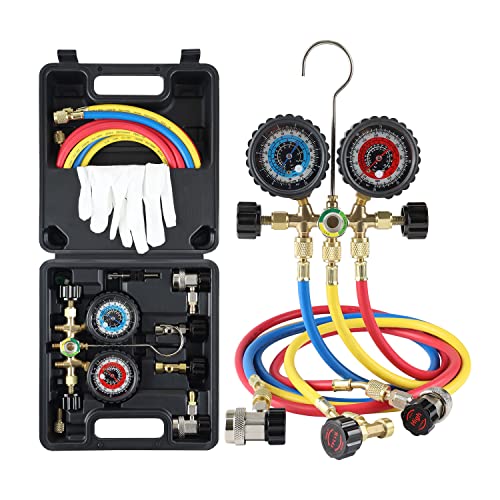
The Lichamp A301 is a basic 3-way manifold gauge set that covers all major refrigerants—R134a, R12, R22, and R502—at a very accessible cost. The dials are large and color-coded with Fahrenheit readings, covering 500 PSI on the high side and 350 PSI on the low side. A sight glass is built into the manifold body to help identify liquid refrigerant flow during charging. The hoses are 5 feet long, rated at 600 PSI working and 3000 PSI burst, with 45-degree bends at one end for easier access in tight engine compartments.
The set includes two adjustable R134a adapters, both puncture-style and self-sealing can taps, an ACME adapter for larger tanks, a valve core remover, and gloves. The manifold body is constructed from brass and aluminum, giving it a reassuring heft. The included plastic case keeps everything organized and portable.
A common observation is that the low-side gauge can read a few PSI high near the top of its range (around 120 PSI), though this is unlikely to affect typical diagnostic decisions in the 30–80 PSI range. The hose gaskets are plastic and may deteriorate over time, but replacement gaskets are included. For the DIYer on a tight budget who needs a functional manifold for occasional use, the Lichamp delivers reliable measurements and broad refrigerant support.
Why it’s great
- Affordable price with wide R134a/R12/R22/R502 compatibility
- Includes both puncture and self-sealing can taps plus ACME adapter
- Solid brass and aluminum manifold construction
Good to know
- Low-side gauge may read ~2 PSI high near 120 PSI
- Plastic hose gaskets may need periodic replacement
FAQ
Can I use an R134a recharge kit on a car that uses R1234yf refrigerant?
Why does my gauge set need both a high-side and low-side hose?
Do I really need to pull a vacuum before adding refrigerant?
Final Thoughts: The Verdict
For most users, the automotive air conditioning recharge kit winner is the VIVOHOME 4.5 CFM Kit because it includes everything needed for both R134a and R1234yf systems, a strong pump, and a durable manifold in one organized case. If you want professional-level digital diagnostics with automatic superheat/subcooling calculations, grab the testo 550s. And for a budget-friendly gauge-only set that still delivers reliable pressure readings and broad refrigerant support, nothing beats the Lichamp A301.