
Choosing the wrong 10-inch chop saw blade turns a five-minute cut into a fifteen-minute cleanup, with burrs, sparks, and burned edges you have to grind away. Whether you are slicing through steel angle iron, aluminum extrusions, copper pipe, or pressure-treated lumber, the blade’s tooth geometry, carbide grade, and kerf width determine whether you get a drop-in-ready finish or a mess that needs secondary work. The right blade saves time, material, and frustration on every single cut.
I’m Rikta — the co-founder and writer behind Gadgets Feed. I analyze carbide formulations, tooth counts, and arbor compatibility across the market to find which blades actually hold an edge through repetitive cuts in ferrous and non-ferrous stock. (And Homer 🐱 inspected each blade ring from his perch on the miter-saw table, unimpressed by sparks but approving of a silent cut.)
After comparing arbor sizes, maximum RPM ratings, and real-world performance reports across dozens of models, I have narrowed the field to the seven that deliver consistent results. This guide identifies the best 10 inch chop saw blade for metal fabrication, general woodworking, aluminum profiles, and multi-material versatility.
How To Choose The Best 10 Inch Chop Saw Blade
Your chop saw is only as good as the blade mounted on the arbor. Matching the blade’s tooth geometry, material compatibility, and kerf thickness to your specific cutting task determines everything from cut speed to edge finish. Ignore these factors and you risk burning wood, melting plastics, or shattering a blade on steel.
Tooth Count and Geometry
Fewer teeth (24-tooth ATB) remove material fast for ripping lumber and cutting thick steel. Higher tooth counts (40-tooth ATB or 80-tooth TCG) produce smoother edges for crosscuts, aluminum, and plastics. Triple-Chip Grind (TCG) teeth are essential for non-ferrous metals — they prevent gumming and chipping that wreck standard ATB blades.
Carbide Grade and Bonding
TiCo micro-grain and C3/C4 carbide formulations hold an edge longer than standard carbide, especially when cutting abrasive materials like pressure-treated wood or aluminum with high silica content. Tri-metal shock-resistant brazing keeps tips attached under the vibration and impact of chop-saw operation. Cheaper blades lose carbide tips mid-cut.
Kerf Width and Arbor Fit
Thin-kerf blades (0.07 to 0.09 inches) cut faster and waste less material but can deflect in deep cuts or under heavy feed pressure. Standard-kerf blades (0.11 inches and up) are stiffer and track straighter on a chop saw. Verify your saw’s arbor size — most 10-inch saws use a 5/8-inch arbor, but some import models use 1-inch arbors.
Quick Comparison
On smaller screens, swipe sideways to see the full table.
| Model | Category | Best For | Key Spec | Amazon |
|---|---|---|---|---|
| Diablo D1080N 80T | Premium | Aluminum & Plastics | 80 teeth, TCG, 5/8-in arbor | Amazon |
| Evolution RAGE255Blade | Premium | Multi-Material Cutting | 28 teeth, carbide, 5/8-in arbor | Amazon |
| Diablo D1040X 40T | Mid-Range | General Woodworking | 40 teeth, ATB, Perma-SHIELD coating | Amazon |
| Bosch DCB1024 24T | Mid-Range | Fast Ripping | 24 teeth, ATB, Speed Coat finish | Amazon |
| IVY Classic 40088 5-Pack | Value | Ferrous Metal Cutting | Aluminum-oxide, 3/32-in kerf | Amazon |
| DEWALT DW3112 24T | Mid-Range | Engineered Wood | 24 teeth, thin kerf, 5/8-in arbor | Amazon |
| DeWalt DW8005 | Entry-Level | General Metal Cutting | Aluminum-oxide, 0.11-in thick | Amazon |
In‑Depth Reviews
1. Diablo 10-Inch 80-Tooth TCG Saw Blade (D1080N)
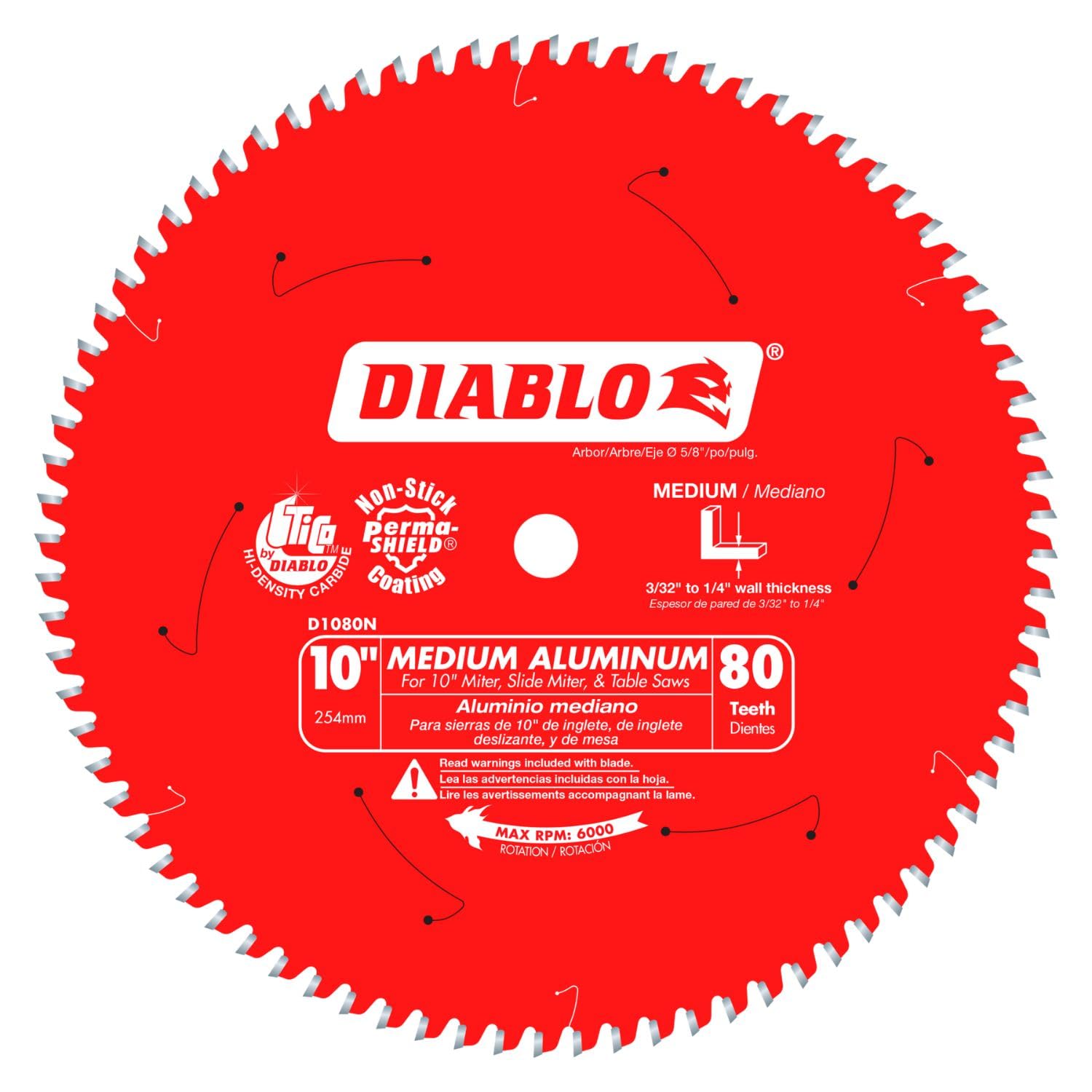
The Diablo D1080N is the definitive blade for non-ferrous metals and plastics, featuring 80 teeth with a Triple-Chip Grind geometry that produces burr-free, sanding-ready edges on aluminum extrusions, copper pipe, ABS, and acrylic. The TiCo Super-Density Micro-Grain carbide delivers exceptional wear resistance through abrasive materials, while the Perma-SHIELD non-stick coating prevents gumming when cutting aluminum or plastics with high resin content. Laser-cut stabilizer vents reduce vibration and noise significantly compared to standard non-ferrous blades.
Tri-Metal Shock-Resistant brazing keeps carbide tips locked in place under the impact loads common in chop-saw operation, even when you hit thicker wall sections. The -5° hook angle is specifically engineered for the lower RPM range of a chop saw or miter saw, preventing self-feeding and giving you precise control on every plunge. Users report cutting 3060 aluminum T-slot cleanly after a short learning curve with wax lubrication and consistent feed rate.
This blade excels for electricians cutting unistrut, plumbers slicing copper, and metal fabricators working with thin-wall aluminum. The 80-tooth count also handles plastics and melamine without melting or chipping. Some users note that the thin kerf (0.94 inches) requires a rigid saw setup to avoid deflection in 1/4-inch plate aluminum.
Why it’s great
- Burr-free cuts on aluminum, brass, copper, and plastics with no secondary finishing needed
- Perma-SHIELD coating prevents gumming and corrosion, extending blade life through hundreds of cuts
- Tri-Metal brazing keeps carbide tips attached under chop-saw impact loads
Good to know
- Thin kerf requires a rigid, low-vibration saw setup for thick plate materials
- Learning curve for square cuts on T-slot extrusions — consistent bite depth and lubrication help
- Not designed for ferrous metals like steel angle or rebar
2. Evolution Power Tools RAGE255Blade 10-Inch Multi-Purpose Blade
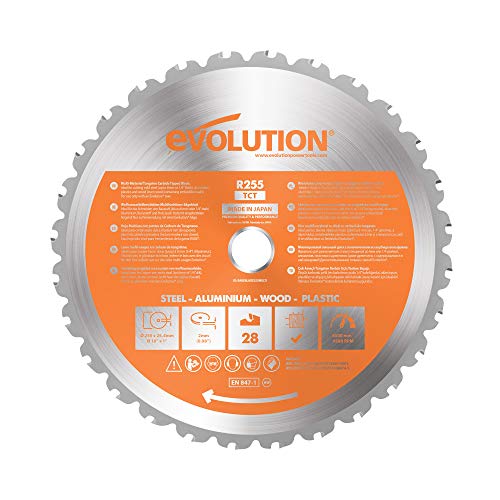
The Evolution RAGE255Blade is engineered for users who need one blade to cut steel, aluminum, wood, and plastic without swapping discs or blades. The 28-tooth carbide configuration produces virtually no sparks, heat, or burrs when cutting ferrous metals — a dramatic improvement over abrasive wheels that shower sparks across the workspace. Users report cleanly slicing 3x3x3/16-inch carbon steel angle after cutting through 2.5-inch oak, with no noticeable dulling between material changes.
This blade operates without coolant, making it ideal for job sites where carrying cutting fluid or a wet saw isn’t practical. The carbide tips maintain sharpness through hundreds of cuts, though some users note the edge does not hold as long as dedicated ferrous or non-ferrous blades when used exclusively for steel. The design works best at moderate feed rates — forcing the blade through heavy stock accelerates wear on the carbide tips.
For metal fabricators and contractors who switch between framing lumber and steel studs on the same job, this blade eliminates downtime from swapping between abrasive wheels and wood blades. The thin kerf (0.08 inches) produces less waste than standard abrasive cutoff wheels. The arbor is 5/8-inch and fits most Evolution saws as well as universal chop saws.
Why it’s great
- Cuts steel, aluminum, wood, and plastic with one blade — no swaps needed
- Virtually spark-free operation compared to abrasive cutoff wheels
- No coolant required, making it clean and portable for job sites
Good to know
- Carbide edge doesn’t hold sharpness as long as dedicated blades when used primarily for steel
- Best results require letting the blade do the work — forcing cuts accelerates wear
- Some users prefer a dedicated tooth configuration for a single material type
3. Diablo 10-Inch 40-Tooth ATB General Purpose Saw Blade (D1040X)

The Diablo D1040X strikes an ideal balance between rip speed and crosscut finish, making it the go-to blade for woodworkers who use the same miter saw for framing, cabinetry, and trim work. The 40-tooth Alternate Top Bevel (ATB) geometry delivers smoother edges than a 24-tooth blade while still cutting fast enough for ripping pressure-treated lumber. Users report three years of consistent performance cutting Brazilian walnut without burning or vibration, performance that rivals premium Freud blades at a lower price point.
The TiCo carbide formulation holds an edge through abrasive materials like treated lumber and hardboard, with the Perma-SHIELD non-stick coating reducing heat buildup and gumming from resinous woods. The laser-cut thin kerf (0.098 inches) removes less material per cut, reducing strain on lower-powered saws and extending battery life on cordless miter saws. The hardened steel body resists bending and deflection through repetitive cuts.
For the home woodworker upgrading from a stock blade, the D1040X delivers dramatically cleaner cuts — users describe the finish as feeling “sanded to 180 grit.” The blade handles plywood, melamine, and hardboard with minimal tear-out. It is not intended for metal cutting, so keep a separate blade for steel or aluminum work.
Why it’s great
- Clean, splinter-free cuts on plywood, hardboard, and pressure-treated lumber
- TiCo carbide holds edge through hundreds of cuts in abrasive materials
- Thin kerf reduces strain on less powerful saws and battery systems
Good to know
- Not suitable for cutting steel, aluminum, or any ferrous metals
- Red coating can transfer to wood stock on initial cuts
- 40-tooth count is a compromise — not the fastest for ripping or the finest for finish work
4. Bosch 10-Inch 24-Tooth Daredevil Table and Miter Saw Blade (DCB1024)

The Bosch DCB1024 is the fastest-ripping 10-inch blade in this lineup, using an upgraded C3/C4 micro-grain carbide formulation called Brute Carbide that withstands impact damage better than standard grades. The 24-tooth ATB geometry is optimized for fast crosscutting and cutoff work in wood and plywood, making it an excellent choice for framing crews and cabinet shops that burn through material quickly. Users report dramatically cleaner cuts than the stock blade that ships with most miter saws, with no burning even under heavy feed pressure.
The Speed Coat antifriction finish reduces heat buildup and prevents pitch adhesion, keeping the blade cutting cool through long sessions. The thinner kerf (0.071 inches) removes less material per cut, which translates to faster feed rates and less waste. The extra-hard steel body resists bending and deflection, maintaining true cuts even when cutting dense hardwoods like Brazilian walnut or oak.
This blade is not recommended for chop saw use — it is designed for table saws and miter saws where speed and clean crosscuts are the priority. The 24-tooth count leaves a slightly rougher edge than a 40-tooth blade, but the trade-off is dramatically faster cuts in thick stock. For users who need to rip dimensional lumber all day, the DCB1024 holds its edge longer than standard 24-tooth blades.
Why it’s great
- Brute Carbide C3/C4 formulation resists edge chipping and impact damage better than standard carbide
- Speed Coat prevents burning and gumming during extended ripping sessions
- Thin kerf removes less material, allowing faster feed rates and more cuts per charge on cordless saws
Good to know
- Not designed for chop saws — optimized for table and miter saw use only
- 24-tooth count leaves a rougher edge than 40-tooth or higher blades
- No anti-vibration vents, so noise levels are higher than premium Diablo models
5. IVY Classic 40088-5 Swift Cut 10-Inch Metal Cut-Off Blade 5-Pack

The IVY Classic 40088 five-pack is the smart buy for anyone cutting significant quantities of ferrous metal — angle iron, steel tubing, rebar, or threaded rod. Each blade is resin-bonded aluminum-oxide grain with double fiberglass mesh reinforcement, rated for a maximum of 6,100 RPM on standard chop saws. Users report cutting through over 200 feet of steel fence tubing on a single blade, then finishing another project without needing to swap to the next blade in the pack.
The 3/32-inch kerf (0.09 inch) balances cutting speed with durability, and the metal-reinforced arbor prevents the center hole from elongating under repeated use. These are Type 1 blades for cutting only — no side grinding. Users note that the blades cut cooler and with less vibration than bulk abrasive wheels, producing straight, true cuts on steel angle and tubing without wandering. The 5-pack essentially delivers five blades for the cost of a single premium carbide blade.
These blades work excellently for demolition work, metal fab, and home renovation where you are cutting through nails, rebar, or steel studs. They are not intended for non-ferrous metals or wood — use them strictly on ferrous materials. The aluminum-oxide grain wears faster than carbide, so expect a finite life per blade, but the pack price makes replacement painless.
Why it’s great
- Five blades for the cost of one premium carbide blade — exceptional value for high-volume cutting
- Double fiberglass reinforcement prevents shattering at 6,100 RPM
- Metal-reinforced arbor prevents elongation and maintains concentricity
Good to know
- Aluminum-oxide grain wears faster than carbide tips on heavy production work
- Not for use on aluminum, wood, or plastics — ferrous metals only
- Produces sparks like any abrasive cutoff wheel
6. DEWALT 10-Inch 24-Tooth Thin Kerf Table / Miter Saw Blade (DW3112)

The DEWALT DW3112 delivers reliable performance for the woodworker who needs a versatile 24-tooth blade for framing, rough carpentry, and engineered wood on a miter saw or table saw. The thin kerf (0.07 inches) enables fast, clean cuts with minimal waste, while the computer-balanced plate reduces vibration for improved accuracy. The proprietary wedge shoulder design puts more steel behind each carbide tip, increasing durability when cutting pressure-treated 4x4s and hardboard.
Users report smooth, burn-free cuts through Brazilian walnut, oak, and pressure-treated lumber across months of heavy use, with no vibration or deflection even on dense hardwoods. The blade’s performance is comparable to premium Freud models at a lower entry price, making it a solid upgrade from the blade that ships with most saws. Several users highlight that the blade excels at rabbet joints, delivering clean shoulders without tear-out.
This is a wood-cutting blade only — do not use it on metal or concrete. The 24-tooth ATB geometry is designed for ripping and crosscutting in solid wood, plywood, and engineered wood products. It is not ideal for finish work where a 60-tooth or 80-tooth blade would produce smoother edges, but for general-purpose woodworking, the DW3112 punches well above its price point.
Why it’s great
- Thin kerf produces fast, clean cuts with less strain on the saw motor
- Computer-balanced plate minimizes vibration for accurate cuts on long stock
- Wedge shoulder design adds steel behind carbide tips for impact resistance in dense wood
Good to know
- Not for use on metal, concrete, or non-ferrous materials
- 24-tooth count leaves a coarser edge than higher-tooth blades for finish work
- Some users note that thin kerf blades can deflect in deep rip cuts on hardwood
7. DeWalt DW8005 10-Inch General Purpose Metal Chop Saw Wheel

The DeWalt DW8005 is a solid entry-level abrasive chop saw wheel for general-purpose metal cutting, using high-performance aluminum-oxide grain with a high grain concentration for aggressive cutting action. It is compatible with low-power chop saws, high-speed stationary machines, and even portable grinders and circular saws. The 0.11-inch thickness provides a standard kerf that resists flexing in deeper cuts through angle iron, rebar, and threaded rod.
Users praise the blade for cutting stainless steel and aluminum with minimal burrs and low heat buildup, making it suitable for plumbing, automotive, and household tasks. The proprietary material mix extends the life of the wheel compared to bulk-store abrasive discs. Some users note that the blade produces heavy sparks, requiring a fire shield behind the cut area, and that a carbide-tipped blade produces significantly fewer sparks for similar work.
This wheel is best for the DIYer or small shop that needs an occasional metal-cutting wheel and does not want to invest in a premium carbide blade. It works well on graphite blocks, mild steel, and thin-wall tubing. The wheel wears faster than a carbide blade, so it is most economical for low-volume or intermittent cutting. Users cutting graphite note that one smooth motion produces a better surface than backing off mid-cut.
Why it’s great
- Compatible with chop saws, stationary machines, grinders, and circular saws for maximum versatility
- High grain concentration provides aggressive cutting action for fast cuts in steel and aluminum
- Proprietary material mix extends life over generic abrasive discs
Good to know
- Produces heavy sparks — requires fire shield or safe cutting area
- Abrasive wheel wears faster than carbide-tipped blades for production cutting
- Best for intermittent use rather than daily high-volume fabrication
FAQ
Can I use a wood-cutting blade on my metal chop saw?
What is the difference between ATB and TCG tooth geometry?
How many teeth do I need for cutting aluminum extrusions?
Why does my chop saw blade vibrate or make loud noise?
Final Thoughts: The Verdict
For most users, the best 10 inch chop saw blade winner is the Diablo D1080N 80-Tooth because its TCG geometry delivers burr-free, finish-ready cuts on aluminum, plastics, and copper. If you need one blade that transitions between steel, wood, and aluminum on the same job site, grab the Evolution RAGE255Blade. And for high-volume ferrous metal cutting where cost per cut matters most, nothing beats the IVY Classic 5-pack.