
That orange glow on your white paint isn’t dirt — it’s ferrous fallout from brake dust and industrial pollution actively embedding itself into your clear coat, ready to cause irreversible rust damage if left unchecked. A dedicated auto iron remover, applied correctly, chemically dissolves those iron particles on contact, turning them into a visible purple or red liquid that simply rinses away, preserving your vehicle’s finish without harsh scrubbing.
I’m Rikta — the co-founder and writer behind Gadgets Feed. I’ve spent years analyzing the chemical formulations, pH balances, and viscosity profiles of dozens of iron decontamination products, comparing how each breaks down ferrous oxides on paint and wheels. (And Homer 🐱 supervised this entire evaluation from his perch atop a freshly decontaminated wheel — tail flicking approval at every purple drip that hit the garage floor).
The right formula saves you hours of elbow grease and prevents your clear coat from failing prematurely. Start your search with this curated list of the absolute best auto iron remover options available today, ranked by chemical efficiency and real-world user results.
How To Choose The Best Auto Iron Remover
Not all iron removers are created equal. Some rely on aggressive acids that can etch your clear coat and discolor sensitive wheel finishes, while others use advanced chelating agents that safely encapsulate iron particles without damaging the underlying surface. The key is matching the formula to your specific vehicle needs.
Color-Changing Reaction Reliability
A product that visibly changes hue — from clear to deep purple, red, or blue — upon contact with iron gives you a real-time feedback loop on where contamination hides. This feature is non-negotiable if you’re serious about complete decontamination; it tells you exactly when the chemical has neutralized the embedded ferrous particles and when to rinse. Products without this visual cue force you to guess, often leading to under-treatment or wasted product.
Viscosity and Surface Adhesion
Thin, watery sprays run off vertical panels too quickly, reducing dwell time and chemical efficacy. High-viscosity gels or sprays with thickeners cling to wheels, fenders, and side panels long enough to break down stubborn iron deposits. If you frequently clean large SUV panels or intricate multi-spoke wheels, prioritize a formula with noticeable cling — it directly translates to less product consumption and better results.
pH Balance and Acid-Free Formulation
Acid-based cleaners can accelerate clear coat oxidation, dull chrome, and pit aluminum over repeated use. Premium iron removers are typically pH-neutral or pH-balanced, meaning they are safe for clear-coated paints, polished metals, anodized wheels, and ceramic-coated surfaces. Always verify that the product explicitly states it is acid-free before applying it to high-value finishes.
Scent and Odor Management
Iron removers universally struggle with the “rotten egg” or sulfur-like smell — it’s the byproduct of the chemical reaction breaking down sulfur-containing compounds in brake dust. However, some manufacturers now offer scented versions (citrus, lemon) or use less pungent active agents. If you work indoors or in a closed garage, a milder-scented formula or owning a proper respirator mask becomes a practical necessity.
Quick Comparison
On smaller screens, swipe sideways to see the full table.
| Model | Category | Best For | Key Spec | Amazon |
|---|---|---|---|---|
| CARPRO IronX Lemon Scent | Premium | Paint decontamination + mild scent | 10% more potent lemon formula, 17 oz | Amazon |
| Griot’s Garage Iron & Fallout Remover | Premium | Vertical panel cling + citrus scent | Gel formula, 35 oz, citrus scent | Amazon |
| SONAX Beast Wheel Cleaner | Mid-Range | Color-changing versatility | Acid-free, color-change (clear to red/purple), 33.8 oz | Amazon |
| KOCHCHEMIE Magic Wheel Cleaner | Mid-Range | Heavy brake dust on German wheels | High viscosity, acid-free, 16.9 oz | Amazon |
| Optimum FerreX Iron Remover | Mid-Range | Tar removal + iron decon | Purple color-change, orange scent, 17 oz | Amazon |
| P & S Professional Iron Buster | Budget-Friendly | Entry-level value cleaner | Color-change, pH balanced, 16 oz | Amazon |
| Meguiar’s Wheel & Paint Iron Decon | Premium Bulk | Large volume heavy users | Gel formula, 128 oz (gallon), strong odor | Amazon |
In‑Depth Reviews
1. CARPRO IronX Iron Remover: Lemon Scent
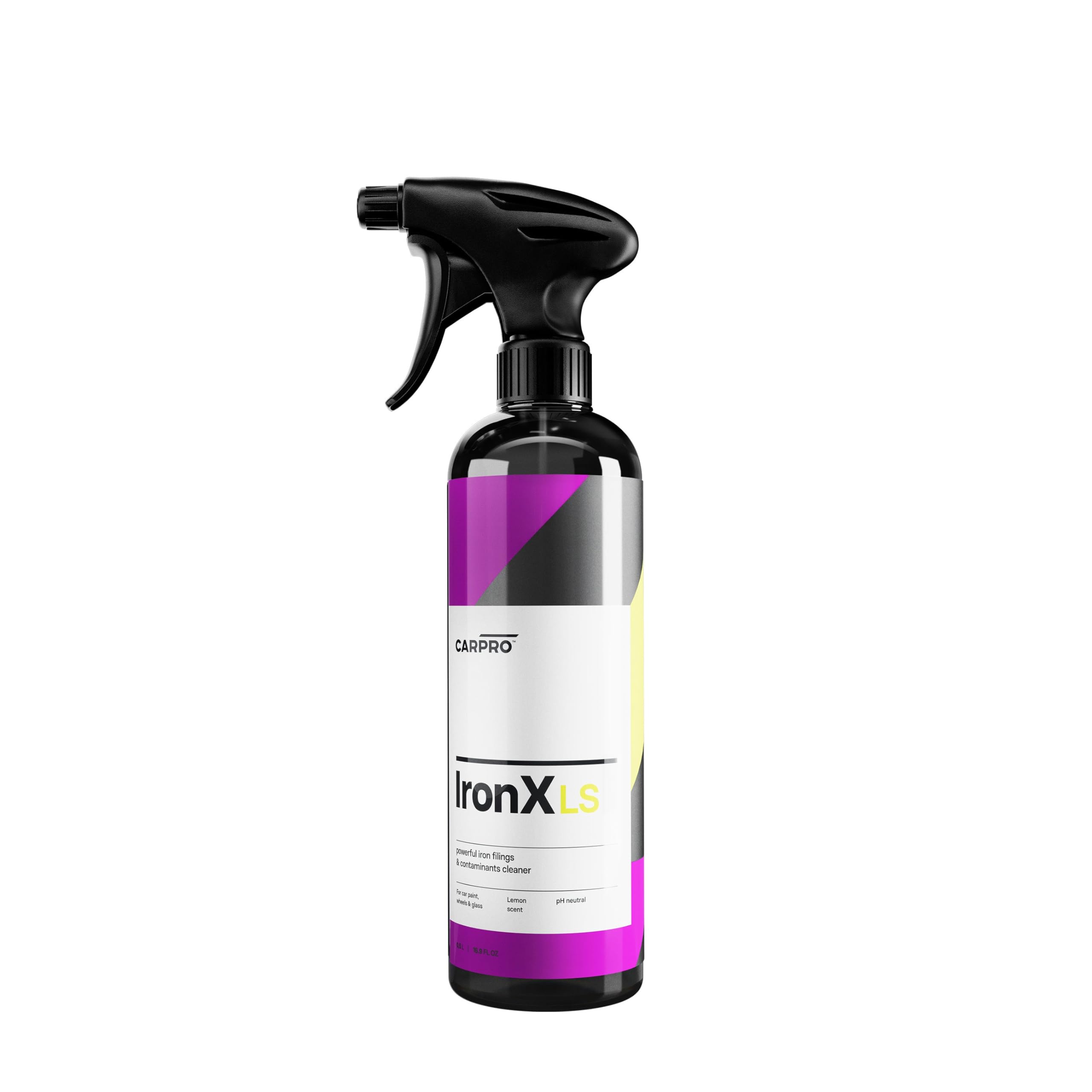
CARPRO’s updated IronX formula in the lemon-scented variant addresses the single biggest complaint about iron removers — the smell — without sacrificing any chemical aggression. At 17 ounces with a 10% potency increase over the original, this pH-neutral, acid-free spray actively targets ferrous particles on paint, clear coat, chrome, glass, and any wheel type. Users report it effortlessly cleared three years of orange rail dust from a white Audi A4 in three applications, consuming roughly three-quarters of the bottle. The color-changing reaction is immediate: you’ll see purple and red streaks appear within seconds of contact, confirming the chemical is working exactly as designed.
The production date on the bottle, printed in Day/Month/Year format, ensures you’re buying fresh chemistry — old iron removers slowly lose their reactive efficacy over time, making this a worthwhile quality check out of the box. A few users noted the sprayer nozzle extends too far for the bottle’s neck, requiring a small trim with scissors to sit flush. The formula was originally developed as a professional detailer staple, and it shows in how evenly it wets surfaces without beading off. For anyone doing a full paint decontamination before polishing or ceramic coating, this is the benchmark against which other removers should be measured.
Despite the improved lemon scent, the product still carries a noticeable chemical odor during active use — “perm chemicals and farts” as one long-term user described it — so working in a well-ventilated area remains mandatory. The eco-friendly, non-toxic material composition (acid-free and biodegradable) means you’re not stripping waxes or sealants as aggressively as some competitors. If you need a single bottle that handles both heavy wheel contamination and full-panel paint decontamination without staining trim, the IronX Lemon Scent delivers the most balanced performance-to-convenience ratio in this guide.
Why it’s great
- 10% more potent active formula breaks down tough embedded iron faster
- Improved lemon scent significantly reduces the rotten-egg odor of traditional formulas
- pH-neutral and acid-free, safe for ceramic coatings and clear coat finishes
Good to know
- Sprayer nozzle may need trimming to fit the bottle properly
- Still produces a noticeable chemical smell during use; ventilation recommended
2. Griot’s Garage Iron and Fallout Remover

Griot’s Garage took the iron remover format and addressed its biggest physical limitation — gravity. The gel-based formula in this 35-ounce bottle is thick enough to cling to vertical surfaces like fenders, doors, and wheels without immediately dripping onto the ground, giving you a significantly longer dwell window for the chemical reaction to do its work. The color-changing action is unmistakable: a deep purple transformation as it contacts embedded ferrous debris, visible even in direct sunlight. Users report that light-to-moderate contamination on German cars doesn’t even require scrubbing — spray, let it dwell for a minute or two, and rinse clean.
The citrus scent, while a welcome improvement over the sulfur-heavy smell of many competitors, still cannot fully mask the underlying chemical reaction odor. Multiple reviews describe the smell as “unbearable” or “like rotten eggs,” which is a recurring theme across nearly all iron removers due to the chemistry involved. The gel thickness also means you’ll use product more slowly: one user mentioned consuming roughly half a bottle per wash cycle, making the 35-ounce size a better value for frequent detailers than the 17-ounce alternatives. The pH-balanced formula is safe for paint, wheels, glass, chrome, and stainless steel trim, and Griot’s explicitly markets it as a deeper alternative to clay bars for removing bonded fallout.
Where this product truly earns its position is on large panel work — SUV side panels, truck bedsides, and tall wheel arches. The gel doesn’t run, allowing you to spray an entire door and walk around to inspect the reaction without losing coverage. Users also appreciate that it removes tar deposits alongside iron, saving a separate chemical step in the decontamination process. If your primary use case involves full vehicle paint decon with minimal product waste on vertical surfaces, the Griot’s Garage gel is the most practical choice in the lineup.
Why it’s great
- Gel formula clings to vertical panels for extended dwell time and less waste
- 35-ounce bottle provides better per-use value for frequent detailers
- Citrus scent is a noticeable improvement over traditional sulfur-based odors
Good to know
- Strong odor still present during reaction; some find it overwhelming
- Requires gloves to avoid purple staining on hands from the chemical dye
3. SONAX Beast Wheel Cleaner

SONAX’s Beast Wheel Cleaner occupies a rare sweet spot: it’s aggressive enough to dissolve winter-grade brake dust and baked-on grime, yet its pH-balanced, acid-free chemistry is safe on chrome, aluminum, steel, clear-coated, PVD, painted plastic wheel covers, and magnesium finishes. The color-changing indicator sprays on clear and turns deep red or purple as it reacts with ferrous metal contamination, giving you visual confirmation that the chemical is actively breaking down iron particles. Users consistently describe the results as “no effort” — spray on, let it dwell, watch the color change, then rinse with high-pressure water. For moderate contamination, scrubbing is entirely optional.
The 33.8-ounce (1-liter) bottle significantly undercuts the price-per-ounce ratio of smaller competitors, making it the clear value leader for anyone who does regular maintenance washes. The product is ready-to-use out of the bottle — no dilution required — which eliminates guesswork. A notable limitation is that users warn against using it on anodized wheels and brake systems without first testing in an inconspicuous area, as the chemical reactivity can sometimes affect certain anodized finishes. The smell, while present, is less offensive than some heavy-sulfur formulas, though it still carries that characteristic “working cleaner” odor.
Real-world feedback from winter-region owners of German sedans and SUVs is overwhelmingly positive: wheels that came out of salt and slush seasons emerged looking like new after a single application paired with a soft brush. The product also acts as an effective tar remover, adding another layer of utility. If you own a mix of wheel finishes across multiple vehicles or want a single larger bottle that handles everything from daily drivers to occasional show cars, the SONAX Beast strikes the best balance between chemical aggression and finish safety at a practical volume.
Why it’s great
- Safe on nearly every wheel finish type including PVD and magnesium
- Large 33.8-ounce bottle offers excellent per-use cost efficiency
- Color-changing chemistry provides clear visual feedback during cleaning
Good to know
- Not recommended for anodized wheels without a spot test first
- Heavy deposits on neglected wheels may require a second application
4. KOCHCHEMIE Magic Wheel Cleaner

KOCHCHEMIE’s Magic Wheel Cleaner, produced by the German chemical company that has been making professional cleaning agents since 1968, brings industrial-grade performance to the consumer market. The formula’s defining characteristic is its high viscosity — the spray clings to wheel surfaces, wheel wells, and tire sidewalls aggressively, preventing runoff and maximizing contact time with heavy brake dust deposits. Users restoring black rims report that a single application, even on wheels caked with baked-on contamination, returns a deep gloss shine with minimal agitation. The acid-free chemistry ensures it won’t etch clear coats or discolor chromed finishes, though the product’s strong “rotten eggs and industrial cleaner” smell is one of the most pungent in this guide.
At 500 milliliters (16.9 ounces), the bottle is smaller than many competitors, but the concentrated nature of the formula means you typically need only a few targeted sprays per wheel. Some users successfully dilute it up to 2:1 with water for routine maintenance washes without a noticeable drop in efficacy — a significant cost-saving consideration if you clean multiple vehicles. The product turns red on contact with iron, providing the expected visual feedback, but its real strength lies in how quickly and thoroughly it dissolves the thick, caked-on brake dust commonly found on European luxury cars that use aggressive semi-metallic brake pads.
Reviews consistently mention that this product outperforms large retail chain store brands by a wide margin when tackling neglected wheels, though some users still needed a brush for heavy deposits that had been baked onto the surface for months. The scent is unambiguously the worst aspect — “unscented” on the label simply means no masking fragrance was added, so the natural sulfur compounds are fully present. A respirator mask is recommended for enclosed garage use. If your wheels routinely accumulate a thick layer of dark brown dust that standard soap won’t touch, the KOCHCHEMIE Magic Wheel Cleaner is the most potent option in the mid-range tier.
Why it’s great
- High-viscosity formula clings to wheels and reduces product runoff
- Exceptional performance on heavy, caked-on brake dust from European cars
- Can be diluted up to 2:1 with water for regular maintenance, improving value
Good to know
- Extremely pungent odor; best used outdoors or with proper respiratory protection
- Smaller 16.9-ounce bottle may require more frequent repurchases for heavy users
5. Optimum FerreX Iron Remover

Optimum FerreX distinguishes itself with a dual-action personality: it simultaneously dissolves ferrous oxides and emulsifies tar deposits, saving you a separate cleaning step that most iron removers ignore. The 17-ounce spray bottle is marketed for use on cars, RVs, motorcycles, and boats, and the formula’s orange scent — while still mild compared to the sulfur bombs — helps mitigate the unpleasantness of the chemical reaction. Users on ceramic-coated wheels report that FerreX, applied for 2 minutes and agitated with a soft brush, completely eliminated all iron deposits without degrading the ceramic layer, a critical consideration for modern paint protection systems.
The color change is dramatic: the liquid turns a deep purple as it bonds to iron particles, providing unmistakable visual confirmation that the decontamination process is active. The product also functions as a wax remover, stripping old sealants in preparation for polishing or applying new protection — a time-saving feature for detailers who would otherwise need a dedicated wax stripper. Some users noted that the formula dries out faster than competing gels, with visible dry edges appearing in under 2 minutes in warm weather, so working in sections and rinsing promptly is essential. The bottle’s design includes a standard sprayer that wets surfaces evenly, though multiple users recommend using a separate spray bottle with a wider fan pattern for larger panels.
Real-world feedback from an owner of a 2013 BMW e92 showed that a full bottle covered a complete decontamination, including substantial iron and calcium deposits, before a clay bar pass — confirming FerreX’s role as a legitimate pre-polish decon agent. The primary drawback is price: at a per-ounce cost that sits well above the bulk options, frequent users will find it economical only if they value the dual tar-and-iron capability. If your vehicle sees both road tar from construction zones and iron fallout from industrial areas, this is the most versatile single-bottle solution available at this tier.
Why it’s great
- Dual-action formula removes both iron oxides and tar in one step
- Safe for ceramic-coated surfaces, preserving the protection layer
- Functions as a wax remover, streamlining pre-polish preparation
Good to know
- Dries quickly in warm weather; requires section-by-section application
- Higher per-ounce cost compared to bulk gel options like Griot’s or Meguiar’s
6. P & S Professional Detail Products Iron Buster

P & S Professional Detail Products brought a no-frills approach to the iron remover market with Iron Buster, a 16-ounce pH-balanced formula designed for owners who want a reliable color-changing decon product without paying premium-tier prices. The spray changes color on contact with iron, the same visual feedback mechanism found in bottles costing twice as much, and the chemical is safe for chrome, aluminum, steel, alloy, and painted wheels. Users report that it works effectively on both wheels and painted surfaces, making it a genuine all-purpose decon solution for the entry-level detailer who maintains a single vehicle.
The product belongs to the Renny Doyle Double Black Collection, a professional detailing lineup, which gives it a pedigree that budget-friendly prices typically don’t command. Real-world feedback, however, shows a performance ceiling: on heavily neglected wheels coated with months of baked-on brake dust, Iron Buster removed about 75% of the contamination, with users reverting to a fine steel wool pad (000 grade) to finish the job. The chemical smell is present but described as “less offensive” than other metal cleaners, making it more tolerable for indoor garage work without a mask. The 16-ounce bottle size is convenient for single-car owners but runs out quickly if you’re doing a full paint decon on an SUV or truck.
The product’s strongest recommendation comes from users who apply it as a pre-spray before a rinseless wash or use it to decontaminate glass before polishing and ceramic coating — it reacts fast on both paint and glass, showing purple and red streaks within 30 seconds. Users caution against letting it dry on the surface or using it in direct sunlight, as the chemical can leave residue if not rinsed promptly. For a first-time buyer who wants to understand what iron decontamination feels like without a major investment, the P & S Iron Buster delivers a competent introduction to the process at the lowest entry cost in this guide.
Why it’s great
- Color-changing chemistry at a significantly lower per-bottle cost
- Safe for all wheel types, glass, and painted surfaces
- Fast reaction time with visible purple/red streaks within seconds
Good to know
- Struggles with heavy, neglected brake dust; may require a second product or abrasive pad
- 16-ounce bottle size is small for full-vehicle decontamination jobs
7. Meguiar’s Wheel & Paint Iron Decon

Meguiar’s, a name synonymous with automotive surface care, packages its Wheel & Paint Iron Decon in a full gallon container that redefines the cost-per-ounce equation for regular users. This is a gel-based formula, similar in consistency to the Griot’s Garage product, and it is designed for both wheel cleaning and full-paint decontamination. Users consistently highlight that even a one-year-old car exhibited a strong color-changing reaction, indicating that iron particles accumulated faster than most owners realize. The gel clings well to vertical panels, and a single soak-and-rinse cycle effectively removes embedded iron, road grime, and the typical orange dust that plagues white and light-colored vehicles.
The smell is the product’s most polarizing quality: multiple users describe it as the most offensive “rotten eggs” odor they have encountered, even among a category famously plagued by bad smells. One user explicitly said, “The smell makes me never want to use it,” while others noted that it dissipates quickly after rinsing. The gallon format is explicitly aimed at professional detailers or serious enthusiasts who decontaminate multiple vehicles per month, and at this volume, the product is significantly cheaper per application than any smaller bottle in the comparison. Meguiar’s specifically recommends this as a pre-step before polishing or applying ceramic coatings, because it removes iron particles that would otherwise contaminate pads and compromise coating adhesion.
Real-world performance reports on a white metallic truck: the paint “looked better than new” after a single full-body application, with the gel safely handling clear coat, wheel surfaces, and even chrome trim. The included sprayer works adequately, though some users transferred it to a larger professional sprayer for more even coverage. If you have a stable of vehicles, run a mobile detailing side hustle, or simply want the lowest possible per-application cost for iron decontamination, the Meguiar’s gallon is the undisputed value champion. Just be prepared to tolerate the most intense sulfur scent in this entire review — a mask and a well-ventilated workspace are not optional with this product.
Why it’s great
- Gallon-size bottle provides the lowest cost per ounce of any product in this guide
- Gel formula clings to vertical surfaces for thorough decontamination coverage
- Effectively prepares paint for polishing, claying, or ceramic coating application
Good to know
- Extremely strong sulfur odor; personal respiratory protection is strongly advised
- The gallon size is oversized for single-vehicle owners who decon only once a year
FAQ
Can I use an auto iron remover on ceramic-coated paint without damaging the coating?
Why does my iron remover smell like rotten eggs and is this normal?
How soon should I rinse off the iron remover after it changes color?
Final Thoughts: The Verdict
For most users, the best auto iron remover winner is the CARPRO IronX Lemon Scent because it combines a 10% potency increase with the most tolerable scent profile in this category, all while remaining pH-neutral and safe on ceramic coatings. If you clean large vertical panels and want maximum dwell time with minimal runoff, grab the Griot’s Garage Iron and Fallout Remover with its exceptional gel cling. And for heavy-use detailers or anyone decontaminating multiple vehicles regularly, nothing beats the sheer value of the Meguiar’s Wheel & Paint Iron Decon gallon — just budget for a good respirator mask before your first spray session.