
Our readers keep the lights on and my morning glass full of iced black tea. As an Amazon Associate, I earn from qualifying purchases.
Specs are compiled from manufacturer listings and verified buyer reviews and can change over time — please confirm the key details on the product page before buying.
Your compressor’s tank stores high-pressure air, but your tools require a regulated, steady flow, not a sudden burst. Without a regulator, a nail gun or sprayer receives erratic pressure that can damage finishes and pose safety risks. The key is finding a regulator that maintains its set pressure without leaks and meets your shop’s flow requirements.
I’m Min — the founder and writer behind Gadgets Feed. This guide is built by comparing the manufacturers’ published specifications and the patterns across verified customer reviews, so you get each pick’s real strengths and trade-offs instead of marketing spin.
Whether you are fixing a leaking compressor, arming a spray gun, or building a new air line, this breakdown of the air regulator valve market covers nine top choices across every budget tier and use case.
Our Picks at a Glance


How To Choose The Best Air Regulator Valve
Selecting the right regulator involves matching three factors to your compressor: port thread size, tool flow demand, and your working pressure range. Match all three and the regulator becomes a reliable, maintenance-free component of your air system.
Thread Size and Ports
Most home and hobby compressors use 1/4″ NPT (National Pipe Taper) threads, which is the standard for small pneumatic accessories. Larger workshop setups may step up to 3/4″ NPT for higher flow, while some specialty gauges use 1/8″ ports. Check your compressor’s outlet before ordering — a regulator with the wrong thread needs adapters and can introduce leak points.
Pressure Range and Flow Rate
Flow rate, listed in SCFM (Standard Cubic Feet per Minute), tells you how much air the regulator can pass without choking your tools. A tiny 19.4 SCFM unit is fine for a single nailer, but a high-draw tool like a die grinder needs much more. Pressure range matters too — a 0-150 PSI unit covers most compressors, but if you need fine control at ultra-low pressures for airbrushing, you want a dedicated low-pressure regulator.
Relieving vs. Non-Relieving Design
A relieving-type regulator vents excess downstream pressure automatically when you dial the set point down. This protects sensitive tools from seeing a spike. Non-relieving types require you to bleed the line manually. For paint guns and precision work, relieving design is a serious advantage.
Quick Comparison
| Model | Best For | Max PSI | Flow Rate | Port Size | Amazon |
|---|---|---|---|---|---|
| Craftsman D27253★ Best Overall | Direct OEM-style replacement | — | — | Compression | Amazon |
| TAILONZ AR2000Best Value | Budget 5-in-1 kit | 145 psi | — | 1/4″ NPT | Amazon |
| SNS AR2000-N02Compact Pick | Compact replacements | 150 psi | 19.4 SCFM | 1/4″ NPT | Amazon |
| SNS AR3000-N02 | High-flow shop lines | 150 psi | 88.3 SCFM | 1/4″ NPT | Amazon |
| THB R706N | High-pressure 3/4″ lines | 215 psi | 140 SCFM | 3/4″ NPT | Amazon |
| PneumaticPlus PPR2-N02BG-2 | Ultra-low pressure work | 30 psi | 59 SCFM | 1/4″ NPT | Amazon |
| Ingersoll Rand ARO R37121 | Precision general use | 150 psi | 59 CFM | 1/4″ NPT | Amazon |
| LE LEMATEC DAR01B | Digital readouts on spray guns | 160 psi | — | 1/4″ NPT | Amazon |
| PneumaticPlus SAW2000M | Filter + regulator combos | 150 psi | 28 SCFM | 1/4″ NPT | Amazon |
In‑Depth Reviews
1. Craftsman D27253 Compressor Regulator
Our pick — 4.5★ from 700+ verified ratings; the strongest balance of quality and price.
The OEM-style swap that makes an aging Craftsman compressor feel new again.
If your trusty compressor’s original regulator has finally given up — perhaps after a decade of steady service — this Craftsman part is the fix. It is purpose-built as a replacement for specific models, fitting numbers 165570 and 167783, and at just 4 inches long and 8 ounces, it slips into the same footprint as your old unit. The metal body and compression-style connections are exactly what you expect from an OEM part.
Buyers consistently report that this is a direct, tool-simple swap. As one owner put it, “My original regulator was leaking after 10+ years of service. Replacing it was easy, about 30 minutes start to finish.” The caveat they raise is practical: bring a proper wrench and don’t skip the Teflon tape when you thread it in. Functionality and build quality are the two things owners praise most, which tracks with a part designed to disappear into your compressor and just work.
The honest trade-off here is that it’s not a universal, do-everything valve. It’s made for the compressors it lists, and a handful of owners note that a casual-use unit can still wear out after years — one went five years before needing a swap. If you want a simple, brand-correct restoration of your Craftsman, this is the one.
Steady pressure control
- Designed specifically for Craftsman model 165570 and 167783
- 30-minute install for most users
- Light metal build at just 8 ounces
Bulkier build
- Needs Teflon tape and the right wrench
- Not a universal fit for every compressor brand
grab it if: you own a compatible Craftsman compressor and want a faithful, low-maintenance replacement part.
think twice if: you need a multi-purpose regulator with a gauge for a non-Craftsman setup.
2. TAILONZ 1/4″NPT AR2000 Pressure Regulator Kit
A complete plug-and-play bundle that outfits a bare compressor port for less than a tank of gas.
This TAILONZ kit is the definition of value: you get the regulator body, a clear gauge, and the fittings needed to wire it straight into a 1/4″ NPT port. It handles up to 145 psi and is built from aluminum and plastic, which keeps the weight down to a light 10.8 ounces. The design uses a lift-to-turn knob with a push-lock, so you can set your pressure and trust it to stay.
For the money, owners say it outperforms pricier rivals, with one using it to run a plasma cutter and others wiring it into garage air tool hookups. The learning curve is real though — the adjustment mechanism isn’t obvious at first glance, and as the review pages put it, “Once I figured out how it adjusts it works well!” It’s a budget-friendly gateway into a properly regulated air system.
There’s a reason it sits at the value spot rather than the top: the plastic components feel less premium, and the fit can be inconsistent, with some noting loose gauge threads. This is a great pick for a hobbyist who wants a complete setup without spending much, but it’s not the one for a demanding daily-use shop.
Budget-friendly kit
- Everything needed for install included
- Light 10.8 oz build with locking knob
- Wall mount bracket in the box
Basic construction
- Plastic parts feel cheaper than metal rivals
- Adjustment takes a minute to learn
reach for this if: you want a full regulator-and-gauge setup at a rock-bottom cost for light workshop use.
look elsewhere if: you need the durability of an all-metal body for heavy daily operation.
3. SNS Air Compressor Pressure Regulator AR2000-N02
A tidy aluminum valve that brings steady pressure control to small 1/4″ NPT lines.
This SNS regulator packs a 0-150 psi range into a compact aluminum alloy body that keeps things light on your air line. It’s rated for a flow of 19.4 SCFM (550 L/min), which is plenty for a single nailer or a small blow gun, though not for high-draw tools. The included bracket and gauge mean it arrives ready to mount on a wall or panel.
It shines as a straightforward replacement, with buyers reporting it works well on compressors like a 3-gallon Craftsman. One owner summed up the consensus: “This is an excellent replacement for the regulator on my 3 gal Craftsman 125 psi compressor.” The knob pulls up to adjust, and you turn clockwise to raise pressure or counterclockwise to lower it — a simple system that holds its set point well.
The recurring gripe among owners is leakage, specifically air sneaking out around the adjustment knob. It’s a common frustration with inexpensive regulators and is worth knowing about before you buy. For a small, no-frills setup where minor seepage isn’t a dealbreaker, this is a solid mid-range choice.
choose this for: a compact, all-aluminum regulator with a gauge for low-flow single-tool setups.
be aware that: some units may weep air around the knob, so check your fittings carefully.
4. SNS AR3000-N02 Air Pressure Regulator

The high-flow workhorse that keeps a full workshop of tools fed without pressure sag.
If you’re building a shop air line and don’t want to starve your tools, this SNS AR3000 is the one to beat. It’s built from aluminum alloy, handles up to 150 psi, and comes with a bracket and gauge for easy mounting.
Owners rate it as a solid, quality unit, often using it at garage drops with added filters and moisture traps. It handles a running pressure of 150 psi without complaint, and the adjustment knob is responsive and accurate. There is a catch though: this unit has no airflow direction markings, and the review pages are clear that installing it the wrong way causes a leak under the knob.
This is a top-tier performer for the price, but it demands a careful install. If you take the time to identify the correct airflow direction — or swap the gauge and plug ports as some owners do — you get a regulator that outperforms the stock units on many compressors.
best for: anyone setting up a high-flow distribution line who needs 88.3 SCFM on tap.
just know: there are no flow markings, so a wrong-way install will leak until you flip it.
5. THB Heavy Duty In-Line Air Pressure Regulator

A massive 3/4″ NPT unit built for high-pressure lines that most regulators can’t touch.
This THB regulator is in a different league from the 1/4″ NPT crowd. It’s a heavy-duty 3/4″ female NPT in-line valve that adjusts from 7 to a hefty 215 psi, with a max input of 250 psi and a flow of 140 SCFM. The big high-impact locking composite knob is easy to grip, and the clear gauge helps you set your pressure precisely. It comes with a wall bracket so you can mount it right where you need it.
Owners use it for serious workshop duty, with one noting it “handles 210 PSI input” without issue while maintaining set pressure capably. The quality and value draw consistent praise, and the aluminum build feels durable enough for daily use. The design even allows the inlet to be reversed via a plugged port, giving you flexibility in how you route your line.
That said, the adjustment knob on some units is hard to turn, which could be frustrating if you change pressure often. And like many valves, a few buyers report leaks. This is the right call if you’re working with high-pressure, high-flow systems that would overwhelm a standard 1/4″ regulator.
pick this if: you need 215 psi capability and a massive 140 SCFM flow for a 3/4″ line.
be ready for: a stiff knob on some units and the need to seal threads well.
6. PneumaticPlus PPR2-N02BG-2 Low Pressure Regulator

The precision valve that tames air down to a whisper for airbrushes and laser cutters.
Standard regulators are terrible at ultra-low pressures — trying to dial in 5 psi on a 0-150 gauge is nearly impossible. That’s exactly the problem this PneumaticPlus solves. It’s a low-pressure specialist with a 0-30 psi gauge and an adjustable range of 3-30 psi, perfect for airbrushing, HVLP spray, and delicate pneumatic work. It’s a relieving type, so it automatically vents excess pressure to protect your tools.
Buyers absolutely love it for precision tasks. It’s small and light enough to mount directly on a powder coat gun, it nails the 3-5 psi range needed for a laser cutter, and it improves airbrushing noticeably. The 1/4″ NPT body installs quickly, and the included bracket saves you a trip to the hardware store. At 59 SCFM, it still delivers plenty of volume.
The weak link is the gauge, which some owners mention arrives faulty — reading incorrectly at ambient or sticking at a wrong value. For a product built around precise monitoring, that’s a real frustration. But if you do fine low-pressure work, the control this offers is worth navigating that risk.
perfect for: airbrush artists and laser cutter owners who need stable 3-30 psi output.
the catch: the included gauge sometimes arrives faulty, so budget for a possible replacement.
7. Ingersoll Rand ARO R37121-600-VS Air Regulator

Premium build and precise control from a brand name that professionals actually trust.
Ingersoll Rand’s ARO line is known for industrial-grade pneumatics, and this regulator lives up to that reputation. It’s a 1/4″ NPT unit with a 0-140 psi range and a relieving-style standard knob control. It’s compact at just 5.6 ounces, with a flush-mount gauge that sits tight to the body. The construction feels solid and sturdy — exactly what you’d expect from this brand.
Owners consistently call it the best regulator they’ve tried, noting it holds pressure with minimal drift of just 1-2 psi across adjustments. It’s highly configurable too: the gauge mounts on either side and even the yellow range bands can be adjusted to your preferred settings. The performance is notably better than other regulators, with pressure drop roughly a third to half less than rival units at typical tank pressures.
This is a premium pick, and the one real complaint is the small gauge — it’s hard to read without good eyesight. The compact design trades readability for a low profile. If you want the confidence of a trusted brand and don’t mind a tiny display, this is the best-performing 1/4″ NPT regulator here.
choose this for: a premium, precise regulator backed by a 2-year warranty and a trusted name.
downside: the integrated gauge is genuinely small, so many owners add an external one.
8. LE LEMATEC Digital Paint Gun Air Regulator
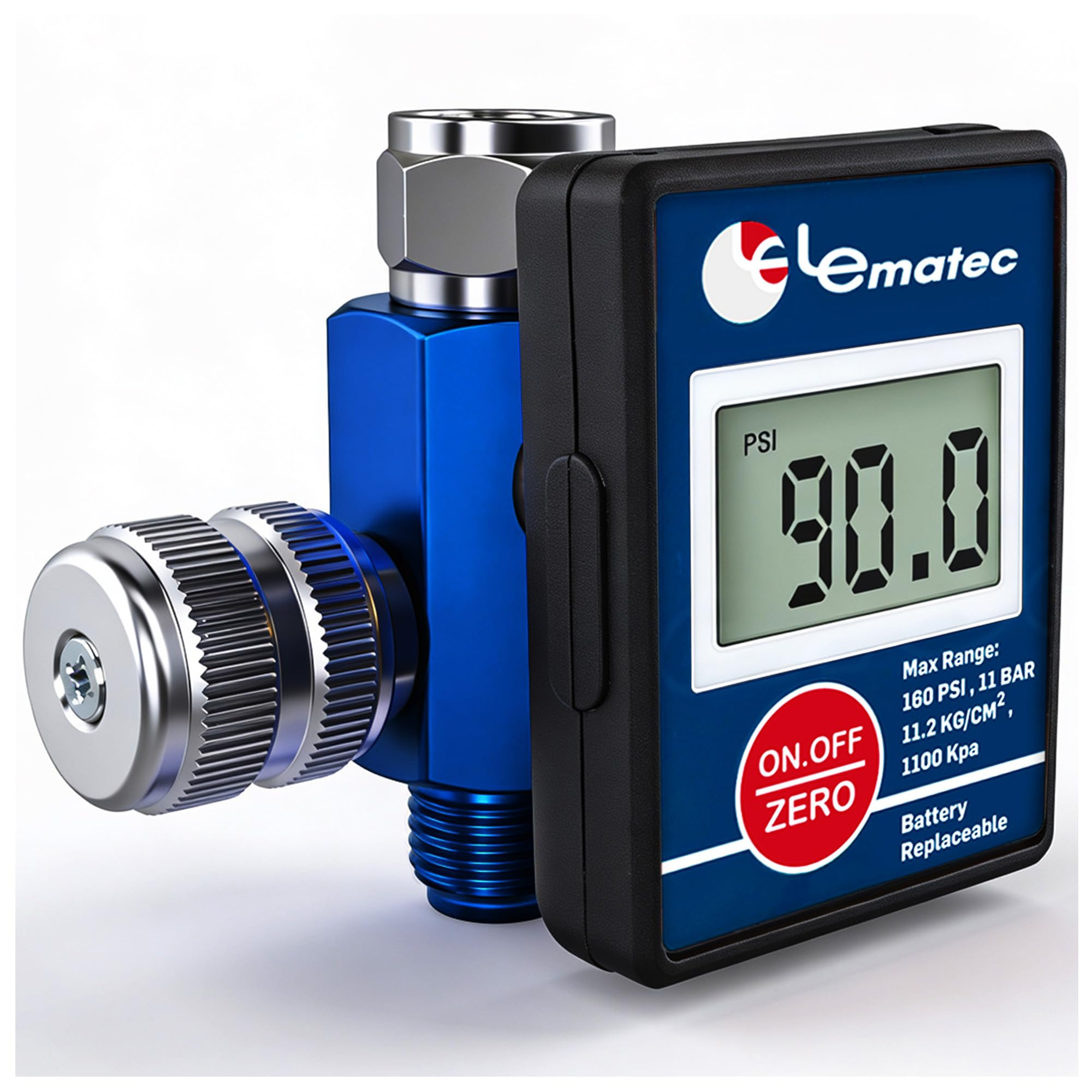
An LED-equipped regulator that makes reading your spray pressure easy.
Reading a tiny analog gauge in a dim garage is a pain. This LE LEMATEC solves that with a bright digital LED display that shows pressure in PSI, BAR, or KPA, so you always know exactly what your paint gun is seeing. It operates from 2.5 to 160 psi, fits standard 1/4″ NPT/PT threading, and weighs just 4.8 ounces, making it a lightweight addition right at the gun. An auto shut-off powers the display down to save battery life.
Painters love it. It’s become standard equipment on many spray guns for precise volume control, and the digital readout is a favorite among owners. It stands up to laquer thinner and gun cleaning solvent, which would melt lesser plastic gauges. The accuracy is well-regarded for setting repeatable pressures.
There’s an important caveat though: it’s not a true diaphragm-based regulator, so some owners note it behaves more like a precision flow meter than a traditional pressure control valve. That’s a critical distinction if you need a full-fledged regulator for demanding work. And while most customers note flawless use, there’s at least one story of a unit failing mid-paint-job — a rare but painful failure mode for a painter.
reach for this if: you want easy, readable pressure settings at the spray gun for paint work.
but note: it’s not a diaphragm regulator, so verify it fits your definition of pressure control.
9. PneumaticPlus SAW2000M-N02BG Filter Regulator Combo

A piggyback filter and regulator that clean your air and control it in one compact unit.
Clean, dry air is critical for sensitive tools like spray guns and laser engravers. This PneumaticPlus combo handles both jobs in one piggyback unit: a 10-micron filter element removes oil, water, and debris, while a regulator keeps pressure steady. It’s built on a 1/4″ NPT aluminum die-cast body, flows 28 SCFM, and handles a max supply of 250 psi with a 150 psi operating range. A 0-150 psi gauge and bracket are included.
Owners find it works exceptionally well, often as a direct replacement for costlier or failing units. It’s been running reliably for years on some compressors and is praised for holding pressure accurately while filtering effectively. The knob adjustment is easy, and installation is straightforward with standard Teflon tape.
The trade-off is mostly durability and size. Some bowls have broken after short use, and it’s tall enough that it won’t fit on a portable compressor — you’ll need a leader hose to keep vibration from loosening the fittings. For a stationary shop setup that needs clean, regulated air, though, it’s a strong 2-in-1 value.
best for: stationary shop compressors that need both filtered and regulated air in one compact package.
watch out for: the bowl’s durability and the unit’s height in tight spaces.
Understanding the Specs
SCFM Flow Rate
SCFM, or Standard Cubic Feet per Minute, measures how much air a regulator can pass through at a given pressure. A higher SCFM means your tools won’t starve when you pull the trigger. An 88.3 SCFM unit feeds a whole workshop, while a 19.4 SCFM unit is fine for a single low-draw nailer.
PSI Range and Max Supply
PSI, or pounds per square inch, is the pressure setting. The range tells you the adjustment window (like 0-150 psi), while max supply is the highest input the valve can safely handle. Match the max supply to your compressor’s tank pressure, and pick a range that includes your working pressure.
FAQ
How do I know if an air regulator valve will fit my compressor?
What does SCFM mean and why does it matter?
Why does my regulator leak around the adjustment knob?
What is the difference between a relieving and non-relieving regulator?
Can I use a standard 0-150 psi regulator for airbrushing?
Is it better to use a digital or analog gauge on a regulator?
How long should an air regulator valve last?
Do I need a filter before my air regulator?
Final Thoughts: The Verdict
If you want one dependable pick, the air regulator valve winner is the Craftsman D27253 because it delivers a faithful, low-maintenance replacement for the most common compressor brand with a 4.5-star consensus. If you want a high-flow unit for a full workshop line, the SNS AR3000 moves a massive 88.3 SCFM. And for precision low-pressure work like airbrushing or laser cutting, the PneumaticPlus PPR2 gives you the fine control standard valves can’t match.
How We Picked
We do not accept paid placement. Every pick is matched to a real buyer and a real use-case; we do not hands-on test units.
Sources & Methodology
Specifications: manufacturer listings and product documentation. Review insights: verified customer reviews, as of August 2026. Pricing: not shown on this page (it changes often); check the current price via the retailer link.
As an Amazon Associate, Gadgets Feed earns from qualifying purchases. This does not affect which products we feature.