
Our readers keep the lights on and my morning glass full of iced black tea. As an Amazon Associate, I earn from qualifying purchases.
Specs are compiled from manufacturer listings and verified buyer reviews and can change over time — please confirm the key details on the product page before buying.
Stripping wire is the one task that separates a quick electrical job from a frustrating afternoon. A bad stripper can nick the copper, fray the strands, or demand you squeeze twice for every wire, and that’s where the right tool pays for itself. The best choice isn’t always the most expensive one on the shelf, so this guide cuts through the jargon to show you which stripper matches your work.
I’m Min — the founder and writer behind Gadgets Feed. This guide is built by comparing the manufacturers’ published specifications and the patterns across verified customer reviews, so you get each pick’s real strengths and trade-offs instead of marketing spin.
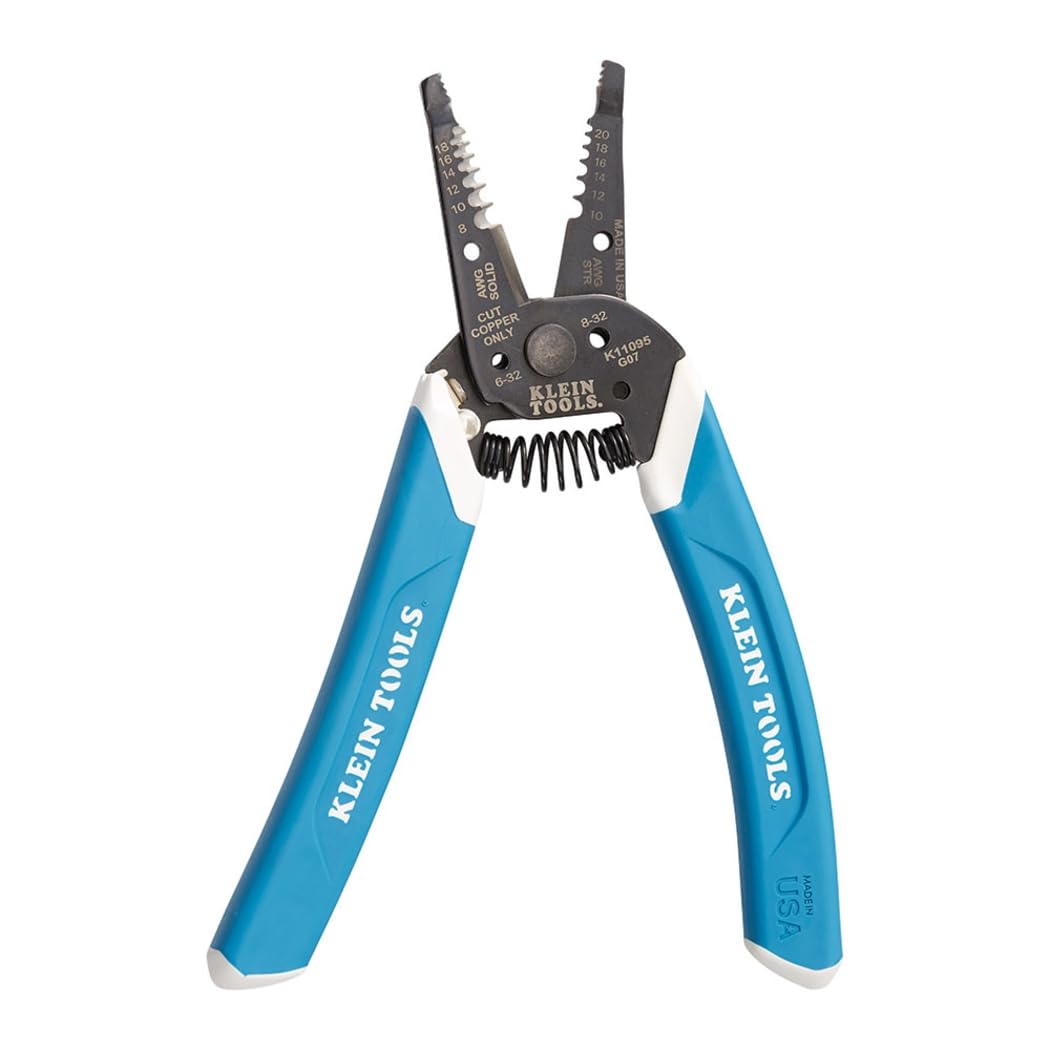
If you’re after a serious upgrade, the crowd favorite for house wiring is the Klein Tools K11095, with its precision-ground holes that handle both solid and stranded copper without the usual scoring. This guide ranks the best cable stripper models by real-world performance, so you know exactly which one suits your gauge range and your budget.
Our Picks at a Glance

How To Choose The Best Cable Stripper
You need a wire stripper that matches the wire gauge (the thickness of the wire) and the type of insulation (the plastic coating) you work with most. The right tool lets you strip a wire in one smooth pull without scoring (nicking) the copper underneath — that’s the difference between a good connection and a future failure.
Match the gauge range to your work
Every stripper has a stated AWG range (American Wire Gauge, the standard measure of wire thickness) for solid and stranded wire. A tool covering 8-18 AWG solid and 10-20 AWG stranded is ideal for residential work, while a dedicated auto-stripper handles the thin 14-22 AWG often found in automotive repairs. If your work spans many sizes, look for a wider range or a multi-hole design that gives you a precise match for each wire.
Choose the right tool for the jacket
Stripping the outer jacket of Romex or data cable is a separate job from stripping the individual conductors. A sheath cutter built into the stripper lets you score the jacket without touching the wires inside, while a radial stripper rotates around the cable to slice it cleanly. For heavy scrap copper recovery, an electric machine with adjustable blades handles thick cables by the foot without wearing out your hands.
Think about precision and ergonomics
Precision-ground holes create clean, consistent cuts that don’t score the copper, which is critical for stranded wire that frays easily. The handle design matters just as much if you strip wires all day, so look for a comfortable grip that reduces wrist strain. A locking mechanism keeps the tool closed when it’s not in use, and a crimping or screw-shear function adds versatility beyond simple stripping.
Quick Comparison
| Model | Best For | AWG Range | Weight | Special Features | Amazon |
|---|---|---|---|---|---|
| Klein Tools K11095★ Best Overall | House Wiring | 8-18 Solid / 10-20 Stranded | 5.6 oz | 6-32 & 8-32 Screw Shears | Amazon |
| Southwire SNM1214Best for Romex | Romex Jackets | 12-14 Gauge | 6.4 oz | Sheath Cutter | Amazon |
| Klein Tools VDV110-261Best for Data Cable | Data Cable | CAT3-CAT6A | 1.28 oz | Radial Rotation | Amazon |
| IDEAL Reflex T-Stripper | Professional Use | 8-16 Solid / 10-18 Stranded | 4.8 oz | Bolt Shearing | Amazon |
| Greenlee 1955-SS | Stainless Durability | 10-18 Solid / 12-20 Stranded | — | Crimp & Loop Holes | Amazon |
| Tool Aid 19000 | Auto-Stripping | 12-18 AWG | 7.68 oz | Multiple Wires At Once | Amazon |
| Hizmivos Manual Machine | Scrap Recycling | 0.06″-1″ Diameter | 1.5 kg | Drill-Powered Option | Amazon |
| KNIPEX Ergostrip | Fine Multi-Conductor | 11-24 AWG | — | Pistol Grip Design | Amazon |
| VEVOR BXJDD60 | High-Volume Recycling | 0.06″-0.98″ Diameter | 15.5 kg | 60W Motor & 7 Channels | Amazon |
In-Depth Reviews
1. Klein Tools K11095 Klein-Kurve
Our pick — over 4.5★ from 900+ verified ratings; the strongest balance of quality and price.
The household favorite that ends the stranded-wire struggle with a confident squeeze.
For decades, the Klein Tools K11095 has been the benchmark in electricians’ pouches, and the reason is simple: six precision-ground stripping holes cover 8-18 AWG solid wire and 10-20 AWG stranded wire (AWG stands for American Wire Gauge, a standard for wire thickness), which covers nearly everything in residential work. The narrower head geometry (the shape of the tool’s tip) lets you reach into tight boxes where bulkier tools won’t fit — a real time-saver when you’re wiring a switch or receptacle.
The build quality is what wins people over, with alloy steel construction and blades that stay sharp through countless jobs, all made in the USA. Beyond stripping, the screw shearing holes for 6-32 and 8-32 bolts and dual wire looping holes mean you can trim a screw or form a perfect hook without reaching for a second tool. Buyers report “I have struggled stripping stranded wires for years” — this tool makes that frustration disappear.
The comfort factor is real too, with a Thermoplastic Elastomer (TPE) handle that cushions your palm during repetitive work. It weighs just 5.6 ounces, so it disappears into your hand and your tool bag alike. This is the one tool that earns its place in both a homeowner’s drawer and a pro’s daily carry.
What owners love
- Quality is the top praise — the construction feels solid and precise
- Sharp blades give clean cuts without scoring the copper
- Wide size range handles both 8-18 AWG solid and 10-20 AWG stranded
Worth noting
- A few users wanted a longer reach for deep junction boxes
- The blue/white color shows grime after heavy jobsite use
Grab it for: Anyone wiring a house, garage, or workshop who wants one tool that does it all without fuss.
Look elsewhere if: You need a dedicated cable jacket stripper, since this is built for individual conductors, not Romex sheathing.
2. Southwire Romex Wire Stripper
A sheath cutter and stripper in one slim tool that lives for NM cable work.
This Southwire handles a very specific job brilliantly: stripping 10/2 and 12/2 NM Romex. The signature move is cutting and stripping the outer jacket in one tool, with stainless steel blades that stay clean and sharp. At 9.5 inches long, this is the longest tool in this lineup — that extra reach gives you real leverage when slicing through tough sheathing.
What owners rave about is the simplicity: “I like that it only has 12 and 14 gauge holes” — those are the two most common wires on a residential job, so you don’t fumble for the right slot. The ergonomic handle supports your hand during repetitive work, and the one-handed lock makes it easy to open and close on a ladder. It weighs 6.4 ounces, so it’s not the lightest, but it feels balanced and solid in hand.
The occasional critique mentions scoring the copper if you squeeze too hard on 12 or 14 AWG wire, though the sharpness makes it easy to over-apply pressure at first. That’s a minor learning curve for a tool that pros keep reaching for on every cable run.
Sharp and sharp-witted: The combination of sheath cutter and stripper in one unit is the reason tradespeople pick this over separate tools.
Expect a habit: Once you feel how much time the integrated cutter saves, you won’t want to strip Romex any other way.
Your move if: You run a lot of 12/2 and 10/2 Romex and want the fastest path from cable roll to stripped conductors.
Think twice if: You work mostly with a wide mix of gauges, since this one deliberately focuses on 12 and 14 only.
3. Klein Tools VDV110-261 Radial Stripper
The finger-spinning wizard that rotates around data cable without ever nicking the pairs inside.
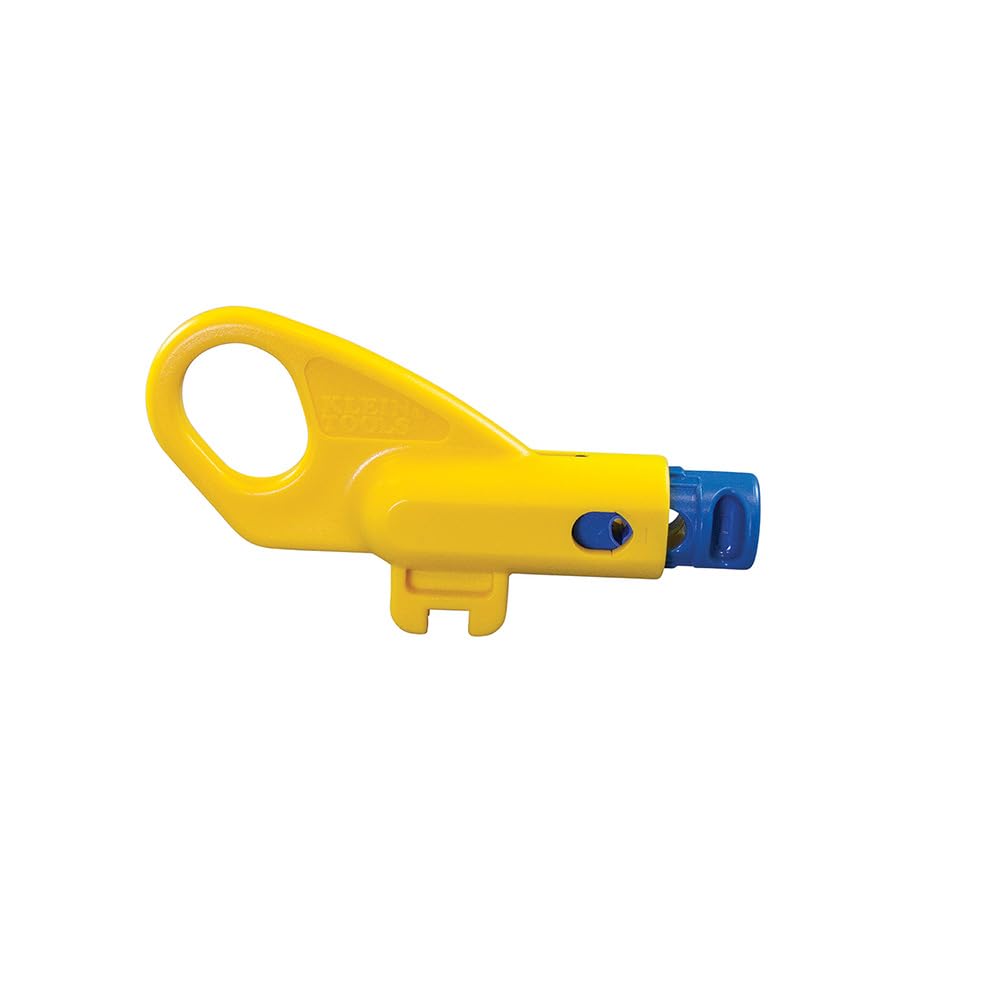
This is the tool that made me realize we needed a separate category — the VDV110-261 is a radial stripper, meaning it spins around the cable to cut the jacket in a perfect circle. It’s designed for shielded and unshielded twisted pair cable, including CAT3, CAT5/5e, and CAT6/6A, with high-carbon steel blades that self-adjust to the cable diameter. It weighs just 1.28 ounces and measures 4.75 inches long, so it’s the lightest and most pocketable tool on this list.
The accuracy is what wins people over, with buyers reporting “It cuts the jacket of this thick CAT6a riser cable perfectly and it has never nicked the internal pairs.” The finger loop design lets you spin it smoothly in one motion — pop it on, spin, strip, done. There’s even an external blade for slitting the jacket lengthwise for mid-span access, which is the move when you need to tap into an existing run.
Owners estimate 200–2000 terminations before the blade dulls., and it fits easily in a go bag alongside your crimper. The only friction is that there’s no instruction manual in the package, so you’ll spend a minute figuring out the hand motion on your first cable.
One-motion magic: The blade depth is precise enough for thick riser cable, which is the exact scenario where a knife usually ruins the pairs.
Small but mighty: At 1.28 oz against the Southwire’s 6.4 oz, this disappears into a pocket, yet it’s the only tool you need for network work.
Reach for this if: You terminate data, low-voltage, or coax runs and want clean, repeatable jacket cuts every time.
Not for: Heavy-gauge solid building wire, because it’s built around the thin, round jackets of network cable.
4. IDEAL Reflex Super T-Stripper
The electrician’s sidearm with blades that out-stay their welcome in the best way.
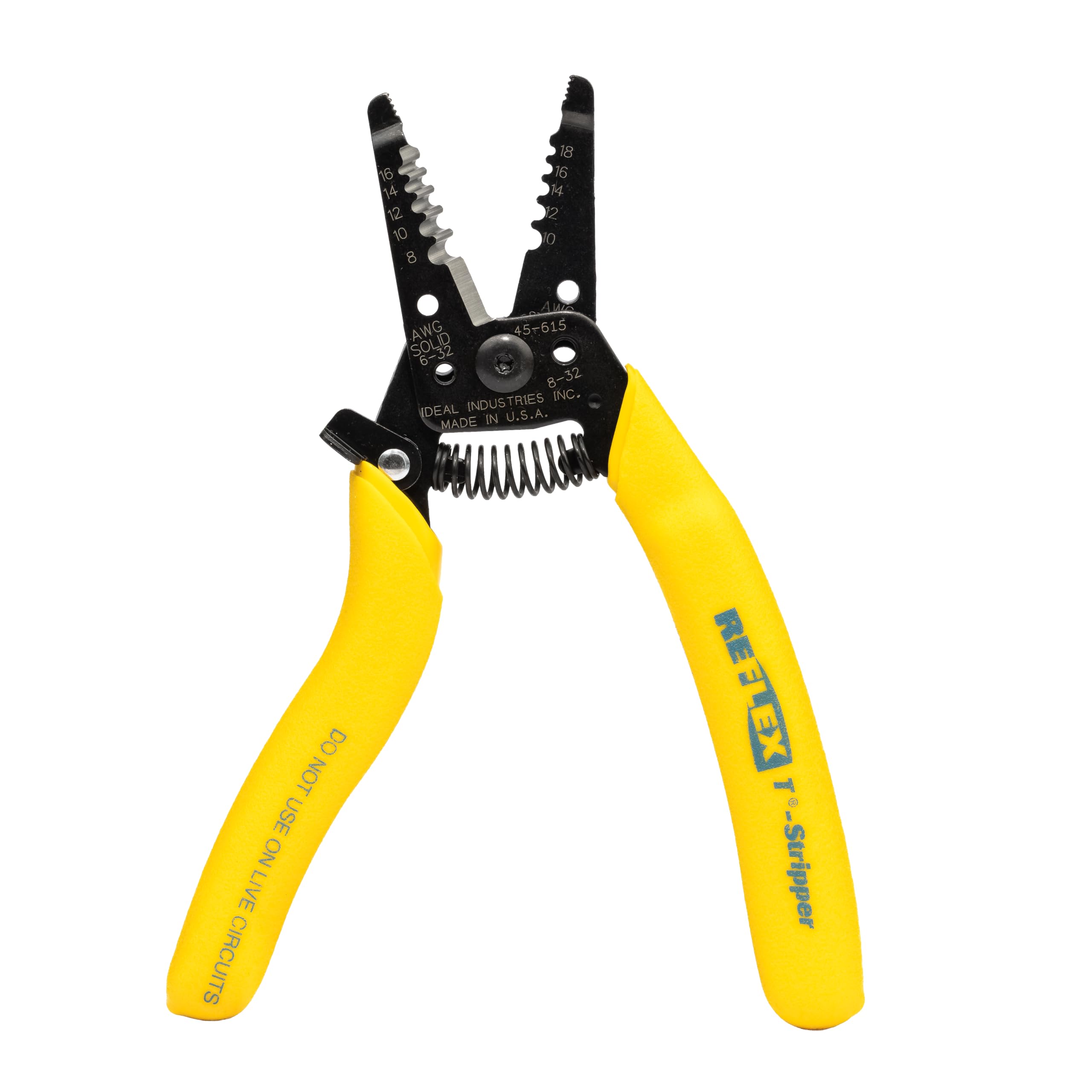
IDEAL has been making manual wire strippers for generations, and the Reflex Super T-Stripper is the culmination of that heritage. It handles 8-16 AWG solid and 10-18 AWG stranded wire through precision-designed holes, but the real headline is the curved handle design with textured sleeves that reduces wrist fatigue. For anyone who’s spent an afternoon on a panel, that ergonomic curve is the difference between finishing strong and calling it quits early.
The durability is the stuff of legend — there are accounts of IDEAL strippers from an apprentice’s first year still out-cutting newer tools from other brands. At 4.8 ounces, it’s noticeably lighter than the Southwire, and the narrow plier nose lets you twist and hold wires in hard-to-reach spots. It also includes 6/32 and 8/32 bolt shearing holes and a locking mechanism that keeps it securely closed when it’s not in your hand.
The most common note is that it cuts 12-stranded wire with impressive ease, and the blades stay sharp through years of constant use. There’s a rare mention that after months of daily work, the smallest 16-gauge notch needs a firmer squeeze, but the major sizes cut clean. Made in the USA, this is the tool pros pass down to apprentices.
The comfort edge
- Curved handles with textured sleeves reduce wrist strain on long jobs
- Blades stay sharp for years of constant use
- Narrow nose reaches and twists wires in tight spots
The trade-off
- Rare reports of the smallest notch dulling faster than the larger sizes
- No built-in cable jacket cutter like the Southwire
Choose it for: Daily professional work where wrist comfort and blade longevity matter more than any other feature.
skip it if: You only strip a few wires a year and don’t need the pro-grade ergonomics.
5. Greenlee 1955-SS Stainless Steel Stripper
A stainless steel workhorse that also crimps terminals, built for the job site’s harshest abuse.
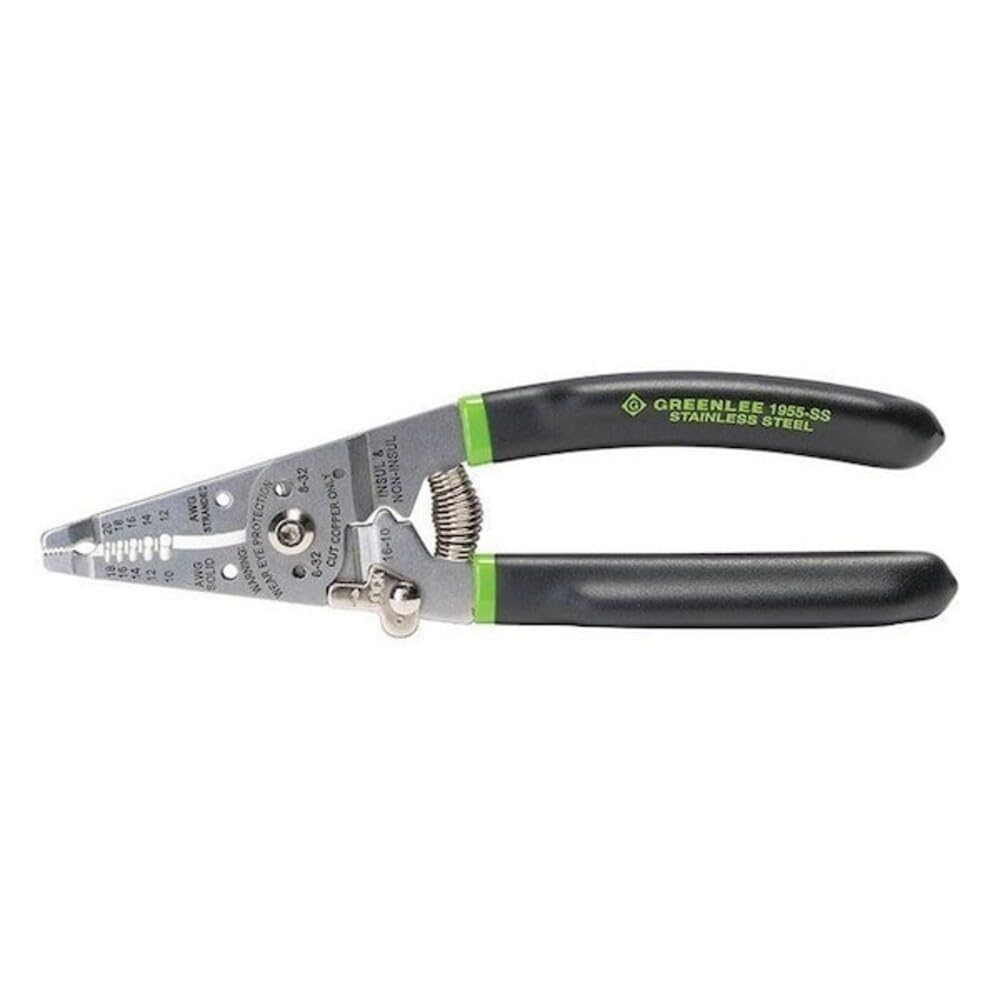
Greenlee’s 1955-SS stands out with high-grade stainless steel construction that won’t rust — a serious advantage if you work outdoors or in humid basements. It strips 10-18 AWG solid and 12-20 AWG stranded wire, but what really separates it is the built-in crimper for 16-10 insulated and non-insulated terminals (a crimper is a tool that squeezes a connector onto a wire). That’s a full electrical tool in one compact package, and it shears 6-32 and 8-32 bolts too.
Owners describe it as “the best ratio of value to usefulness” of any tool they own, with the serrated nose and looping holes handling wire bending, pulling, and shaping. The vinyl cushion grip resists slipping and is ergonomically shaped, which supports a comfortable hold through repetitive work. It’s a favorite among HVAC technicians and car audio installers who need a versatile tool that moves between tasks.
The consistent feedback centers on extreme sharpness with clean cuts, and the stainless construction means they will never rust. There’s a minor note that the rubber grip can slip off during heavy use — easily fixed with a bit of adhesive, but worth knowing before you swing it around a job site.
Multi-tool muscle: Stripping, crimping, snipping bolts, and looping wires means one tool replaces three in your bag.
Built to outlive you: Stainless steel construction is the answer for anyone tired of replacing rusted strippers.
Pick this if: You want one rugged, rust-proof tool that handles everything from wire to terminals and bolts.
Not ideal if: You prefer a lighter tool — the steel build gives it a reassuring heft that some find bulky.
6. Tool Aid 19000 Wire Stripper

The auto-stripper that chews through multiple small wires in a single squeeze.
If your job is stripping bundles of small-gauge wire quickly, the Tool Aid 19000 is the automatic model that repair techs swear by. It’s a self-adjusting stripper — you push the wire in and squeeze, and the tool handles the rest. Owners consistently call it the best automatic model available, particularly for automotive and 12-volt work where 14-22 AWG wires are the daily reality.
The defining strength is how it handles single or multiple conductor wire at once, with the ability to strip duplex 10 AWG or smaller without separating the wires. It weighs 7.68 ounces and is 9.25 inches long, making it a substantial tool in hand, but the ergonomic grip and intuitive design mean you don’t feel the weight during fast work. For splicing into a wire in a tight space under a dash, it’s the go-to.
It’s also built to last, with components from metal, stainless steel, and plastic combining for a tool that feels bulletproof in daily use. The one honest note: it’s less refined than the gauge-plate models like the Klein, but for repairs and heat-shrink work, speed trumps precision. As one long-time buyer puts it: “this is my favorite wire stripper for 12-volt stuff” — and they’ve been saying it for decades.
Why techs love it
- Strips multiple small wires at once without separating them
- Built to survive daily shop use
- Comfortable grip that stays put during fast work
Know before you buy
- Less precise than dedicated gauge-hole strippers
- Bulkier than a compact T-stripper
Reach for this if: You do automotive, appliance, or harness repairs where speed on 14-22 AWG wire beats everything else.
Look elsewhere if: You strip heavy house wiring, since this auto-stripper is aimed at smaller gauges.
7. Hizmivos Manual Stripping Machine
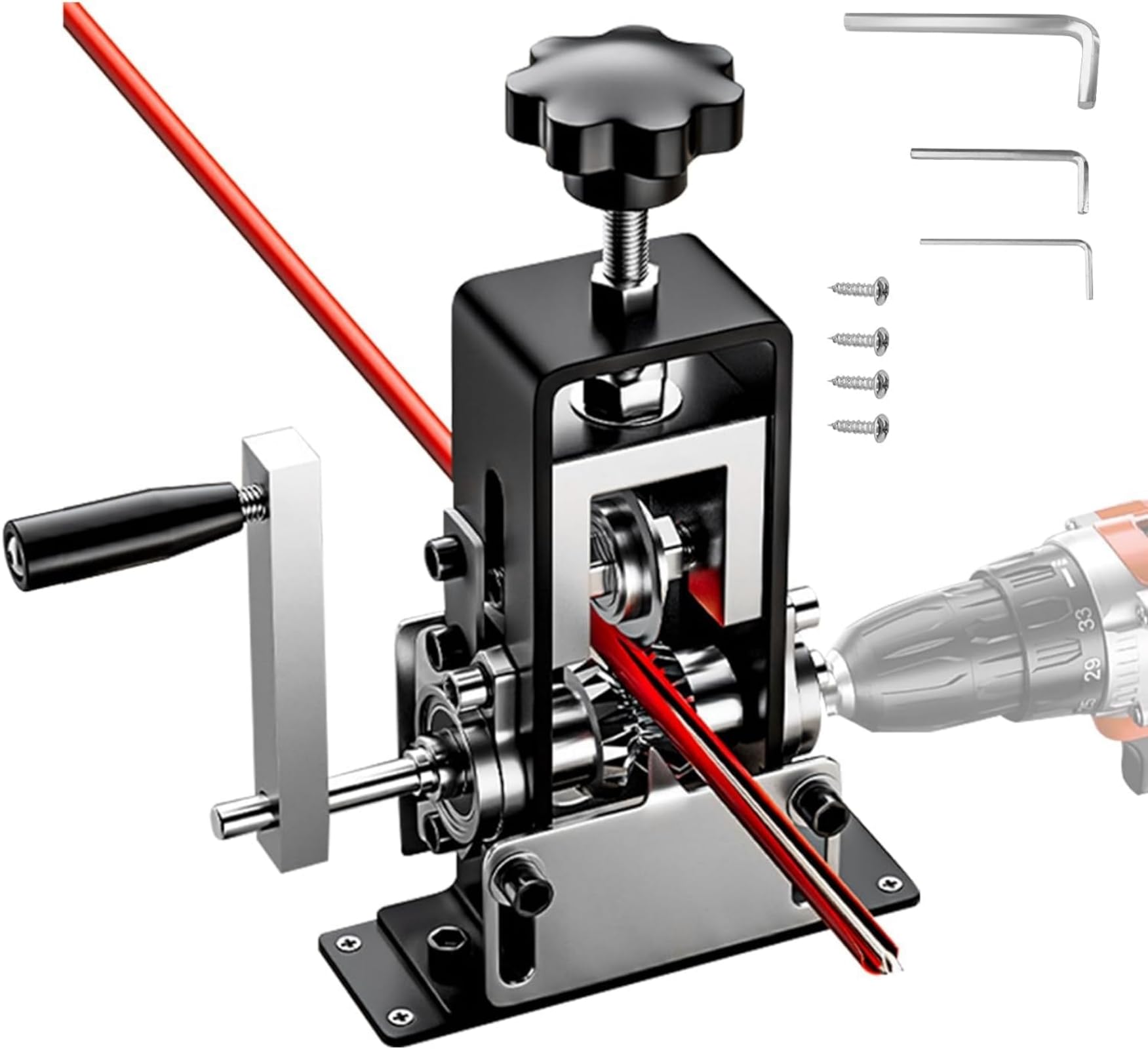
A bench-mounted peeler that turns scrap copper recovery from a wrist-killer into a fast-forward process.
When you’re stripping scrap copper by the pound, a handheld stripper is a recipe for a tired hand. The Hizmivos changes the game with a bench-mountable machine that feeds wire through a blade — and if your arms get tired from cranking, you can connect it to an electric drill for automated operation. It accommodates wires from 0.06 to 1 inch in diameter, with adjustable blade height via a regulating nut.
Owners mention stripping large quantities in under 90 minutes., with the simple “run it twice for thicker gauges” trick yielding clean separations. The 1.5 kg weight and compact footprint mean it doesn’t hog your workspace, and it saves hours of manual work for anyone with a steady stream of scrap. One reviewer noted it processed about 20 lbs of wire with precision sharp enough to handle stranded wire without shredding.
The honest caveats: setup requires a bit of patience to dial in the right blade depth, and the included parts don’t always include spare blades despite the listing. Braided jackets can clog the wheels, so it works best on standard Romex and solid copper. For the price, it’s a serious upgrade from hand-stripping.
Time-is-money tool: Batch processing through the hand crank or a drill turns hours of stripping into minutes of supervision.
Expect a setup session: Blade adjustment takes a few test runs, but once dialed in, the wire feeds smoothly.
Get this if: You recycle enough scrap copper that hand-stripping has become the bottleneck of your weekend.
Pass if: You only strip a few wires a month — the setup time isn’t worth it for occasional use.
8. KNIPEX Ergostrip 16 95 01 SB

A pistol-grip precision tool from Germany for those who demand zero nicks on fine cables.
KNIPEX is a name that means premium, and the Ergostrip justifies its reputation with a genuinely different design — an ergonomic pistol grip that gives you natural cutting, stripping, and longitudinal jacket-slitting all in one hand position. It strips 11-24 AWG wire, which covers the fine multi-conductor cables that frustrate other tools. With an opening spring and locking lever, you can use it one-handed without friction.
The defining feature is the precision for small gauge work — owners call it “the BEST wire stripper for small gauge” and note it handles 22 AWG wires flawlessly where other strippers butcher them. It also handles cable jacket stripping on select sizes, including NYM installation cable from 3 x 1.5 mm to 5 x 2.5 mm, data cable, and coax with the multi-component soft plastic grip guaranteeing a secure hold. There’s an opening aid that simplifies inserting coax and data cable.
For industrial electricians working with M12 connectors and AB or Phoenix Contact cables, this replaces a knife entirely, with no copper nicking. The honest trade-off is the price — it’s an expensive tool for what it looks like, but the precision pays for itself in the cable it saves from damage.
Precision pays off
- The best tool we’ve seen for fine 22 AWG wires
- Pistol grip reduces hand fatigue during precision work
- Handles NYM, data, and coax jackets with one tool
The premium cost
- Pricier than basic strippers, which makes some owners pause
- Jacket stripping is limited to select sizes
Worth it for: Controls engineers, low-voltage pros, and anyone whose work lives on small multi-conductor cables.
Maybe overkill if: You strip standard 12-14 AWG house wire, where a simpler tool does the job for less.
9. VEVOR Electric Wire Stripping Machine

A powered workhorse for serious copper recyclers who measure scrap in pounds, not pieces.
This is the big step up for anyone processing scrap copper in serious volume. The VEVOR runs on a 60W gear motor that delivers fast stripping speed, with a hands-free design that pulls the wire through automatically. The cast iron body and clear acrylic panel let you watch the stripping process, and the non-deformed structure means it’s built for years of service in a shop or garage.
It offers 7 stripping holes — 6 round channels and 1 flat slot — covering wires from 0.06 to 0.98 inches in diameter. The blade is made from 65 mn spring steel for ultra strength, and the added hole-size markings mean you can switch between different wire sizes without endless re-adjustment. It comes with a pair of gloves and a user manual with tips on the perfect stripping angle, so even a first-timer can jump right in.
Owners describe it as “a huge time saver” that pays for itself, with one apprentice noting it strips small stuff by hand in seconds. It’s notably quiet — usable even near a sleeping baby — though a few customers note it’s a bit noisy at higher settings. The machine excels on bigger wires, which is exactly what heavy recycling jobs throw at it, and the adjustability earns consistent praise.
The volume advantage
- Hands-free 60W motor processes large quantities fast
- 7 channels with size markings for quick gauge changes
- Surprisingly quiet operation for a powered stripper
Know the limits
- Heavy machine at 15.5 kg needs a dedicated bench spot
- Blades could be sharper from the start, per some buyers
Made for: Serious recyclers, electricians’ apprentices, and anyone turning scrap copper into cash on a regular basis.
Not for: The occasional DIYer — this earns its keep only with steady volume.
Understanding the Specs
AWG Range
AWG stands for American Wire Gauge, the standard system for measuring wire thickness — the lower the number, the thicker the wire. A stripper with a range of 8-18 AWG solid covers the thick 8-gauge wire used for heavy appliances down to the thin 18-gauge found in low-voltage fixtures. Always check both the solid and stranded ranges, since stranded wire needs gentler handling than solid.
Stranded vs. Solid Wire
Solid wire is a single metal conductor, while stranded wire is a bundle of thin strands twisted together — which makes it flexible but also prone to fraying. A stripper with precision-ground holes prevents scoring the copper, but with stranded wire, you also want blades that grip without cutting individual strands. Tools like the Klein K11095 and IDEAL Reflex are specifically designed to strip stranded wire cleanly without losing strands.
Jacket Stripping
The outer sheath of Romex or data cable is a different challenge from individual conductors. A sheath cutter, like the one on the Southwire, scores the jacket so you can peel it back without touching the internal wires. Radial strippers like the Klein VDV110-261 spin around the cable to make a clean circular cut, which is the safest way to open up round data cable without nicking the pairs inside.
Auto-Stripper vs. Gauge Plate
Gauge-plate strippers like the Klein and IDEAL have specific holes for precise target gauges — you insert the wire and squeeze. Auto-strippers like the Tool Aid self-adjust to whatever size you insert, which makes them fast for variable work but slightly less precise. If you strip a known set of gauges, a gauge-plate tool is more consistent; if you strip whatever comes your way, an auto stripper is faster.
FAQ
What is the difference between a wire stripper and a cable stripper?
What does AWG mean and why does it matter?
Can I use an auto-stripper on solid and stranded wire?
Will a wire stripper damage the copper inside the cable?
What is the best tool for stripping Romex cable?
How do I strip CAT6 or CAT6A cable without nicking the pairs?
Is an electric wire stripping machine worth it for home use?
How do I avoid fraying stranded wire when stripping it?
What additional features should I look for in a multi-purpose stripper?
How long do wire stripper blades stay sharp?
Final Thoughts: The Verdict
For most buyers, the cable stripper winner is the Klein Tools K11095 because its precision-ground holes and comfortable TPE handle make it the most versatile and reliable choice for residential work. If you want a dedicated tool for your data network, grab the Klein Tools VDV110-261 for its clean radial cuts on CAT6A. And for recycling scrap copper by the pound, the VEVOR Electric Stripper is the one to reach for.
How We Picked
We do not accept paid placement. Every pick is matched to a real buyer and a real use-case; we do not hands-on test units.
Sources & Methodology
Specifications: manufacturer listings and product documentation. Review insights: verified customer reviews, as of August 2026. Pricing: not shown on this page (it changes often); check the current price via the retailer link.
As an Amazon Associate, Gadgets Feed earns from qualifying purchases. This does not affect which products we feature.