
Our readers keep the lights on and my morning glass full of iced black tea. As an Amazon Associate, I earn from qualifying purchases.
Specs are compiled from manufacturer listings and verified buyer reviews and can change over time — please confirm the key details on the product page before buying.
You feel the rumble of explosions, the thump of a kick drum, and the weight of a synth line when you add a subwoofer (a dedicated speaker built just for deep bass). It takes those low notes off your main speakers, so you feel the music instead of just hearing it. The right subwoofer makes movie bass feel physical, not just audible.
I’m Min — the founder and writer behind Gadgets Feed. This guide is built by comparing the manufacturers’ published specifications and the patterns across verified customer reviews, so you get each pick’s real strengths and trade-offs instead of marketing spin.
Choosing the right one means matching power, woofer size, and connectivity to your room, and the bass speakers below are the models buyers consistently praise for clean, room-filling low end without the muddiness.
Our Picks at a Glance
How To Choose The Best Bass Speakers
Most buyers start by looking at wattage, but the first question should actually be about the room. A massive subwoofer in a small office will be overwhelming, while a small one in a big living room will leave you wanting more. Choose power and driver size based on your room’s square footage before considering extra features.
Match the woofer to your room
To get deep, loud bass, start with the driver size (the main speaker cone, measured in inches). An 8-inch woofer is the most common balance for medium rooms — it plays low enough for serious movie and music impact without dominating a small space. Power, measured in watts (RMS, which is continuous power, not peak), tells you how much clean volume the built-in amp can sustain. Prioritize room size and listening habits to determine the ideal woofer size and power.
Check how you will connect it
Before you buy, look at the back of your current speakers or receiver. If it has a “sub out” port, you can use a standard RCA cable. If not, you will need a sub with high-level speaker inputs, or one that connects in series between your source and speakers. A powered subwoofer with a built-in amplifier is the easiest option, as it needs no external receiver.
Quick Comparison
| Model | Best For | Power | Low-End Response | Connectivity | Amazon |
|---|---|---|---|---|---|
| Edifier T5s★ Best Overall | Overall Value & Music | 70W RMS | 35Hz | RCA (Sub out or series) | Amazon |
| PreSonus Eris Sub 8BT | Studio & Home Use | 100W | 30Hz | Bluetooth 5.0, ¼” TRS, RCA | Amazon |
| BESTISAN Powered Sub | Budget & Small Rooms | — | — | RCA, LFE, AUX, High-Level | Amazon |
In‑Depth Reviews
1. Edifier T5s Powered Subwoofer
Our pick — over 4.5★ from 350+ verified ratings; the strongest balance of quality and price.
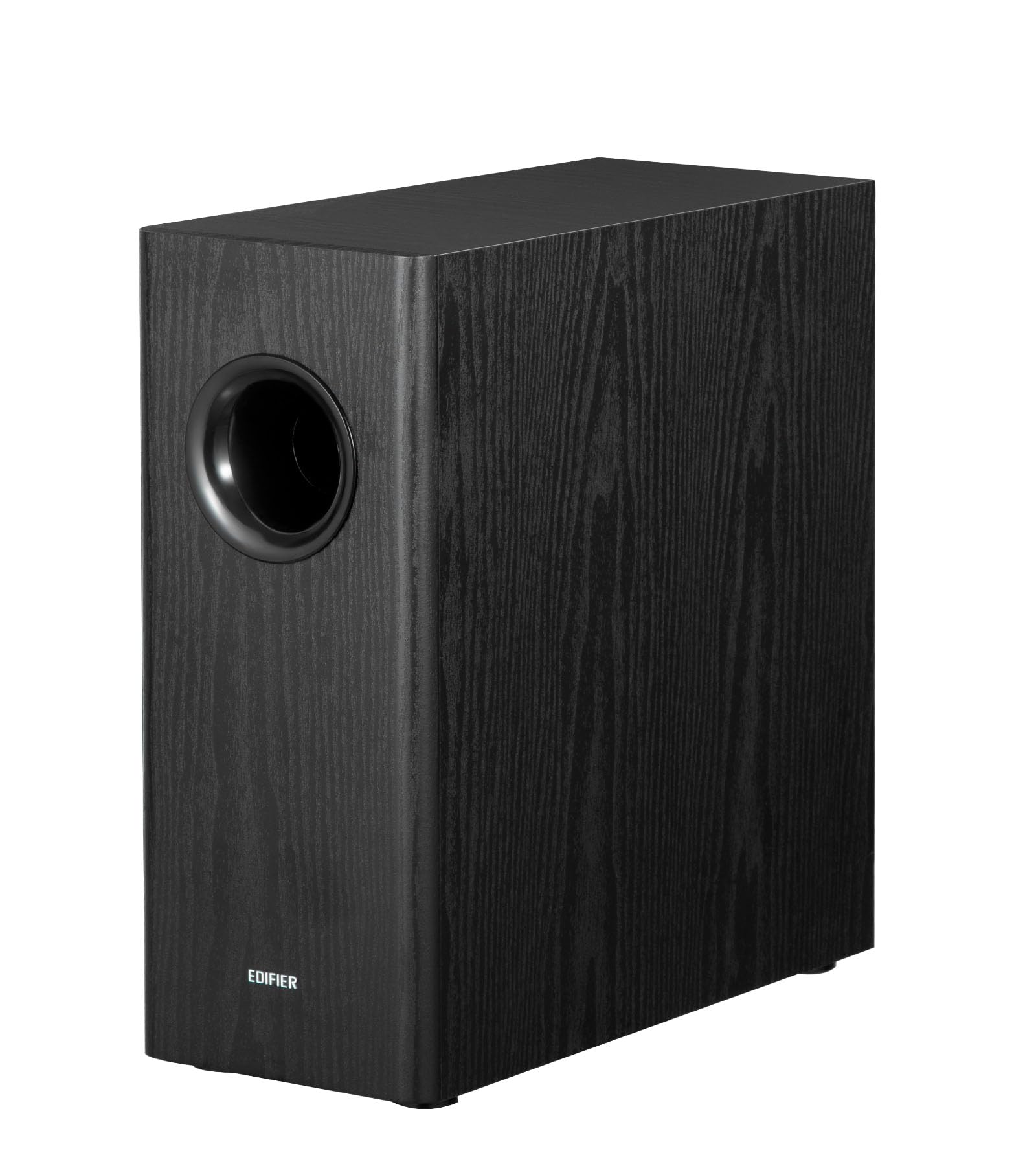
This 8-inch subwoofer delivers cinematic bass in medium-sized rooms.
The reason this wins the top slot is how it balances power and control. Its 8-inch long-throw woofer, driven by a 70W RMS Class-D amplifier, digs down to 35Hz — that is the range where you feel explosions in your chest during movies, not just hear them. The trick is that it stays tight; buyers report deep, clean bass that handles movie rumble and music alike without getting muddy.
You do not need a separate receiver because this sub has a built-in amp, so setup is plug-and-play. If your speakers have a sub out, run an RCA cable there; if not, you can connect it in series (audio source to the sub, then out to your main speakers), though that requires your mains to have a line-in. Auto-standby kicks in after 15 minutes of inactivity to save power.
The build is a highlight too — an 18mm MDF cabinet (a dense wood composite that resists vibration) with a front-firing driver and a wood-grain finish that hides under a desk easily. What wins people over is the sound quality, by far the most-discussed trait, followed closely by the rock-solid construction. The only mixed feedback centers on connectivity, so double-check your gear’s outputs before ordering.
The Payoff
- Deep 35Hz bass that still stays clean and punchy
- Built-in amp means no extra receiver needed
- Compact profile hides neatly in a small space
Watch For
- Series wiring needs main speakers with a line-in
- Official compatibility is best with Edifier speaker pairs
Reach for this if: you want the most balanced mix of deep bass, clean sound, and easy setup for a medium-sized room.
Look elsewhere if: your setup uses Bluetooth-only speakers with no physical line-in, since this sub connects by cable.
2. PreSonus Eris Sub 8BT

This studio subwoofer reaches 30Hz and combines Bluetooth with professional accuracy.
This is the pick for people who create audio, not just listen to it, but it serves both worlds beautifully. As the most powerful unit here at 100W, it drops down to a chest-rattling 30Hz — lower than the Edifier’s 35Hz — so you hear the full sonic spectrum when mixing music or scoring a scene. Its woven-composite woofer delivers tight bass you can feel, which owners mention makes it a huge upgrade for home studios.
Where it truly stands apart is connectivity. It offers Bluetooth 5.0 (a wireless standard that pairs quickly and stays stable) with a 10-meter range, plus professional ¼-inch TRS balanced inputs, unbalanced RCA for consumer gear, and a front-panel ⅛-inch aux for your phone. There is even a front headphone output with a built-in amp for quick late-night reference checking without waking the house.
The crossover controls (highpass and lowpass filters) let you set the exact frequency where the sub takes over from your main monitors, avoiding that flabby, smudged low end you get without them. Buyers pair it happily with JBL 305P MkII and KRK monitors, though a few report Bluetooth compatibility quirks — the wired path is the most reliable route. A power-saver mode engages after 40 minutes of idle time.
Why It Shines
- Deepest bass here at 30Hz with 100W of power
- Wireless and wired inputs cover almost any device
- Headphone output with built-in amp for private listening
The Trade-Off
- Bluetooth can be finicky with some non-PreSonus devices
- Larger than expected, so measure your space first
Best for creators: if you produce music or edit video and want accurate, reference-grade bass you can also enjoy for casual listening.
Who it misses: anyone wanting a tiny, invisible sub — this one has a bigger footprint than the photos suggest.
3. BESTISAN Powered Subwoofer

This budget down-firing subwoofer delivers surprising output for its size.
This budget pick proves affordable subs can still deliver real bass. Its tune down-firing design (the woofer points at the floor and bounces sound around the room) projects low frequencies that buyers describe as making a small space feel like a movie theater. It is a compact unit, and for a 10×10 office paired with 4-inch bookshelf speakers, the output is genuinely impressive.
Flexibility is its superpower. It offers RCA, LFE (a dedicated low-frequency effects input for home theater receivers), AUX, and high-level speaker inputs and outputs — so it can slot into almost any system, from a TV with analog output to a turntable with a preamp. A coaxial cable is included for quick start, and it is designed to pair ideally with BESTISAN soundbars or bookshelf speakers.
The honest caveat is genre performance. Customers note rock, pop, and movies sound great, but jazz and acoustic tracks come across muddy with a popping attack at low volume, and classical adds nothing. This is a sub for fun, energetic listening in small rooms, not critical studio work. Value for money is the second most-praised aspect after sound quality, and the consensus is clear about what it is not.
Smart money for: small rooms, desktop setups, and casual movie or music listening where you want big impact for a small outlay.
The fine print: complex genres like jazz and classical expose its limits — stick to rock, pop, and action flicks to hear it at its best.
Grab this for: a compact office or bedroom where you want an affordable, easy bass upgrade with the most wiring options in this list.
Think twice if: you listen mainly to acoustic or classical music, where this sub’s murkiness becomes noticeable.
Understanding the Specs
Power (RMS Watts)
RMS stands for “root mean square” and is the continuous power a subwoofer can produce cleanly, not a peak burst. A 70W RMS sub like the Edifier fills a medium room with ease, while the 100W PreSonus gives you headroom for louder, cleaner output. More watts generally means more volume without distortion, but it must match your room — too much power in a tiny space sounds boomy.
Frequency Response (Hz)
This is the range of low notes a sub can produce, measured in hertz. The lower the number, the deeper the bass. Human hearing starts around 20Hz, so a sub that reaches 30Hz (like the PreSonus) captures nearly everything you can physically hear, while a 35Hz spec (like the Edifier) is still deep enough for serious movie rumble and bass-heavy music.
FAQ
What is the difference between a powered and passive subwoofer?
How do I connect a subwoofer if my speakers have no sub out port?
What is a down-firing subwoofer and is it better?
What does the crossover control on a subwoofer do?
Will an 8-inch subwoofer be enough for a large living room?
Can I use Bluetooth to connect a subwoofer to my TV?
What is the difference between RCA, LFE, and TRS inputs?
How long does a powered subwoofer last and how do I maintain it?
Final Thoughts: The Verdict
For most buyers, the bass speakers winner is the Edifier T5s because it pairs deep 35Hz bass with clean, non-muddy playback and easy setup, all in a compact, well-built cabinet. If you want wireless streaming and studio-grade accuracy with the deepest low end here, grab the PreSonus Eris Sub 8BT. And for a small room on a budget, the BESTISAN Powered Subwoofer delivers surprising punch for the money — as long as your listening stays in the rock, pop, and movie lane.
How We Picked
We do not accept paid placement. Every pick is matched to a real buyer and a real use-case; we do not hands-on test units.
Sources & Methodology
Specifications: manufacturer listings and product documentation. Review insights: verified customer reviews, as of August 2026. Pricing: not shown on this page (it changes often); check the current price via the retailer link.
As an Amazon Associate, Gadgets Feed earns from qualifying purchases. This does not affect which products we feature.