
Our readers keep the lights on and my morning glass full of iced black tea. As an Amazon Associate, I earn from qualifying purchases.
Specs are compiled from manufacturer listings and verified buyer reviews and can change over time — please confirm the key details on the product page before buying.
When the power goes out, a battery power station keeps your fridge, router, and heating running. These units store grid, solar, or car power in a large built-in battery, providing silent, indoor-safe backup for hours or days. Match capacity and output to your actual needs to avoid hauling an oversized, heavy unit.
I’m Min — the founder and writer behind Gadgets Feed. This guide is built by comparing the manufacturers’ published specifications and the patterns across verified customer reviews, so you get each pick’s real strengths and trade-offs instead of marketing spin.
From a 2,048Wh workhorse that recharges in under an hour to a 3,600Wh home-scale unit, these picks span the best backup battery power station options for outages, camping, and everything in between.
Our Picks at a Glance

How To Choose The Best Backup Battery Power Station
Start by listing the essentials you must keep running during an outage. Then match those devices to the station’s capacity and output.
Capacity vs. Output: The Two Numbers That Rule
Capacity is measured in watt-hours (Wh) and tells you the total energy stored — think of it as the size of the fuel tank. Output is measured in watts (W) and tells you how much power it can deliver at once — the size of the engine. A 2,000Wh station with a 2,400W output can run a 100W fridge for roughly 20 hours, but it’s the output that decides whether a 1,500W microwave starts at all.
A bigger tank with a small engine (a 3,000Wh unit rated at just 1,500W) will keep a fridge running for days but will stumble on a hair dryer. Match the peak output to your heaviest appliance, then the capacity to how long you want everything running.
Chemistry and Lifespan: Why LiFePO4 Wins
Most modern stations use Lithium Iron Phosphate (LiFePO4) cells, a battery chemistry that tolerates more charge cycles and runs cooler than older lithium-ion packs. Where an older pack might degrade after a few hundred cycles, these often support several thousand before dropping to 80% capacity — translating to a decade or more of daily use for most households. The one trade-off is weight; these batteries are heavy, so a 3,000Wh unit will often top 50 pounds.
Recharging: How Fast Can It Bounce Back?
The convenience of a station depends heavily on how quickly you can refill it. Most flagship models now recharge from a wall outlet in one to three hours, with some hitting 80% in well under an hour. If you plan to add solar panels, check the maximum solar input wattage — a higher number means faster sun-powered refills, but panel voltage limits can cap how many panels you can safely string together.
Smart Buyer Insight: Before you commit, check whether the station doubles as a UPS (Uninterruptible Power Supply) with a sub-20ms switchover. That latency is what protects a desktop computer or network-attached storage from a hard reset during a brownout.
Quick Comparison
| Model | Best For | Capacity | Rated Output | Weight | Amazon |
|---|---|---|---|---|---|
| Anker SOLIX C2000 Gen 2★ Best Overall | Fast-recharging all-rounder | 2,048Wh | 2,400W | 41.7 lb | Amazon |
| Anker SOLIX S2000Compact Pick | Compact UPS & fridge backup | 2,010Wh | 1,500W | 35.7 lb | Amazon |
| BLUETTI Elite 200 V2Top Performer | Highest output in 2kWh class | 2,073.6Wh | 2,600W | 53.4 lb | Amazon |
| DABBSSON 2000L | Value with 6 outlets | 2,048Wh | 2,200W | 41 lb | Amazon |
| EF ECOFLOW DELTA 3 Max | Surge-heavy tools & appliances | 2,048Wh | 2,400W | 48 lb | Amazon |
| Jackery Explorer 2000 Plus | Expandable to 24kWh | 2,042.8Wh | 3,000W | 62 lb | Amazon |
| BLUETTI Elite 300 | RV-ready compact 3kWh | 3,014.4Wh | 2,400W | 58 lb | Amazon |
| Jackery HomePower 3000 | Whole-home essentials | 3,072Wh | 3,600W | 59.5 lb | Amazon |
| EF ECOFLOW DELTA Pro | Max capacity & generator pairing | 3,600Wh | 3,600W | 99 lb | Amazon |
In-Depth Reviews
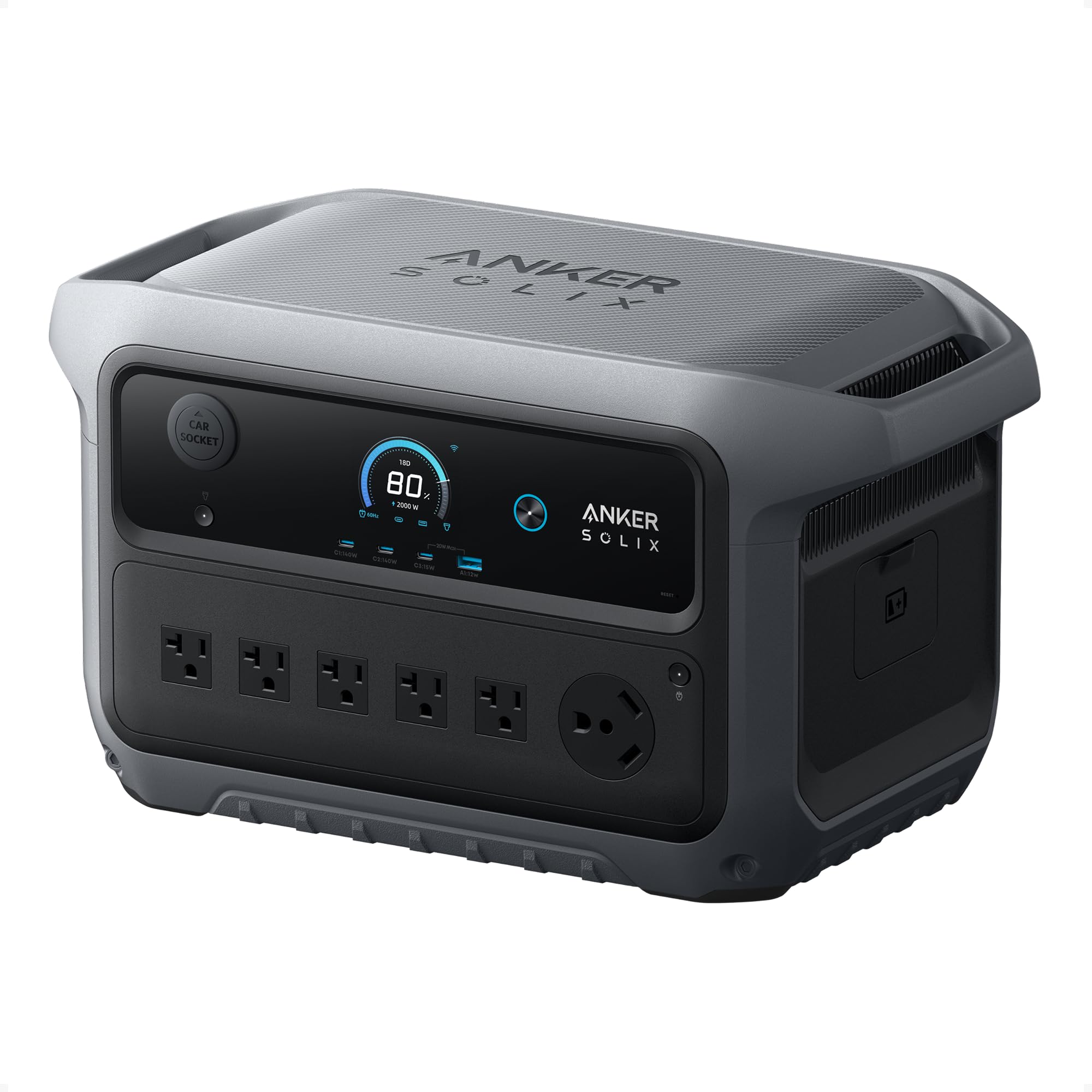
1. Anker SOLIX C2000 Gen 2 Portable Power Station
Our pick — over 4.5★ from 450+ verified ratings; the strongest balance of quality and price.
The 2kWh station that refills faster than your phone’s battery anxiety can sink in.
You’ll rarely wait long for power with this pick: it refills from empty to a full 2,048Wh charge (the total energy stored, enough to run a dual-door fridge for up to 32 hours) in just 58 minutes. When it’s idle in your closet before a storm, it sips only 9W of standby power, so it won’t drain itself. That fast refill plus a big tank means less stress when the lights go out.
It feeds appliances with 2,400W continuous power (the sustained output) and 4,000W peak (the burst to start motors), so most window and RV air conditioners start easily. Buyers report it runs a camper and 12V fridge for days, and even powers a miter saw and drill on a job site. At 41.7 lb, it’s lighter and more compact than most units in this class.
Weighing heavier than its rival, the DABBSSON 2000L comes close at 41 lb, but the Anker leads on rated output — 2,400W versus 2,200W — and its recharging speed is in a different league. What wins people over here is power quality and reliability, with those two factors drawing the most owner praise by a wide margin. The catch is the price tag, and a few owners find the app’s runtime estimates inaccurate, so treat those as rough guides.
Why It Earns the Crown
- Full 2,048Wh charge in just 58 minutes
- 4,000W peak output starts RV and window A/Cs
- Only 9W standby draw keeps the tank full
- Expandable to 4kWh with an add-on battery
The Honest Trade-Offs
- Premium price for the speed and brand
- App runtime estimates can be off
- Some owners still call it heavy
Grab it if: you want the 2kWh station that recharges fastest and powers the most appliances per pound.
Think twice if: you need a 2200W-class station on a strict budget — the DABBSSON delivers similar capacity for less.
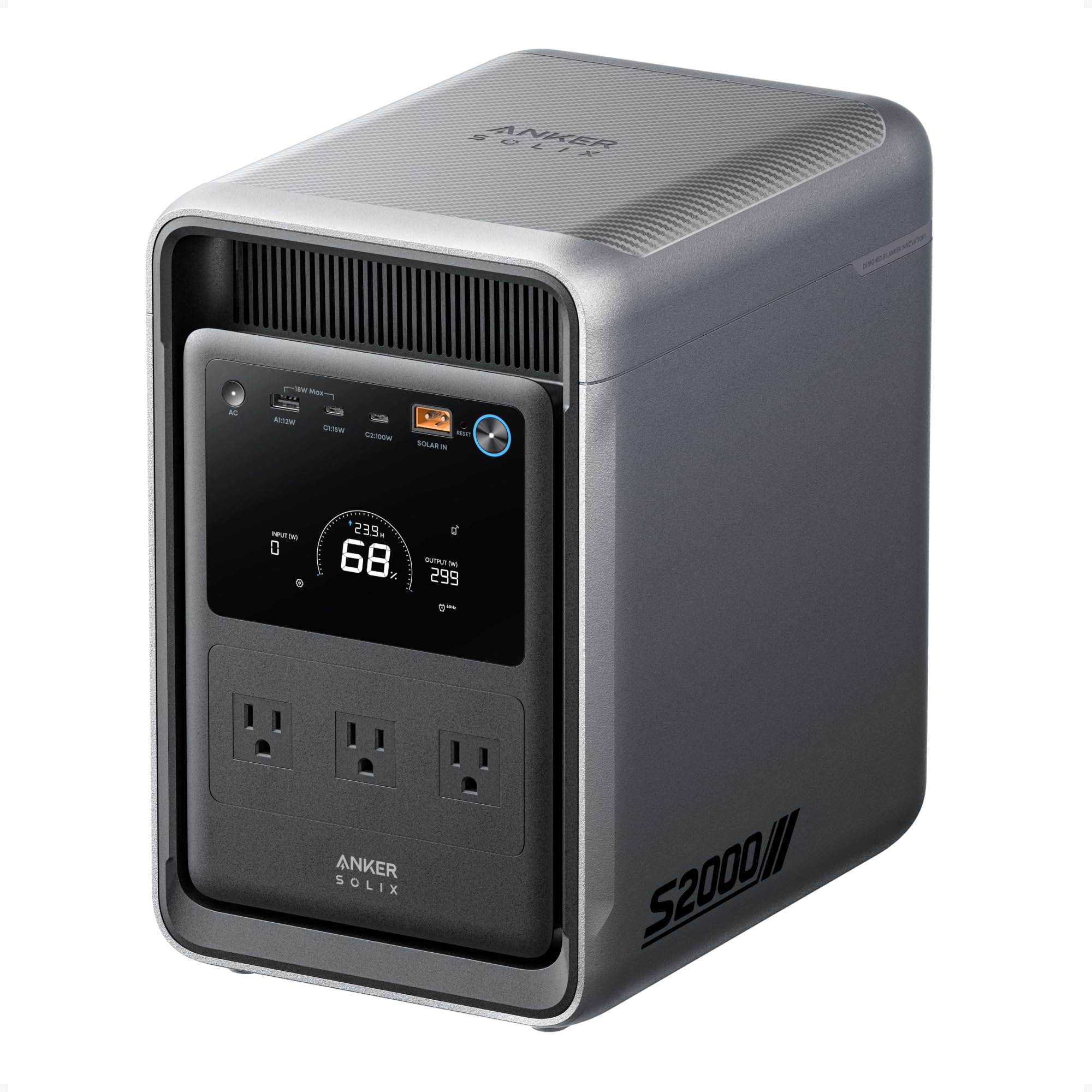
2. Anker SOLIX S2000 Portable Power Station
The lightest 2kWh station that’s built like a silent office bodyguard.
If 50-pound stations scare you off, the S2000 is your answer: it packs 2,010Wh capacity into just 35.7 lb — the lightest in this entire lineup — and at 8.2 × 11.1 × 12.7 in, it fits on a shelf or in a hall closet. Its 6W idle draw lets it run a fridge for up to 35 hours on one charge.
Output is a deliberate trade: 1,500W continuous and 3,000W peak. Anker claims that covers “99% of home essentials,” and the sub-10ms transfer time (the switchover delay when power cuts) makes it a smooth UPS for a computer, monitors, and networking gear. For a workstation or fridge, it’s ideal; for a hair dryer or space heater, you’ll want the higher-output C2000 Gen 2 above it.
Owners survived a 30-hour blackout with it and praise how quiet it runs once charged — the fans only really kick in during the initial wall charge. Reliability and performance are the two things owners praise most, and the compact size is a recurring highlight. The honest limits: it draws on a 400W solar input cap and has no 12V DC port, so if you camp off a car outlet or heavy solar array, this isn’t the one.
The fit here is: home office UPS duty and fridge backup where weight and footprint matter more than raw output.
Reach for this if: you want a light, quiet 2kWh station that guards your computer and fridge through an outage.
Look elsewhere if: you plan to run high-draw appliances like heaters or hairdryers — the 1,500W output won’t start them.
3. BLUETTI Elite 200 V2 Portable Power Station
The 2kWh box that out-muscles everything else in its weight class.
Skip the specs for a second and consider what buyers actually do with this: run a microwave, a coffee maker, an air fryer, an induction stove, and even a dishwasher — sometimes all in one session. The 2,073.6Wh capacity matters, but it’s the 2,600W continuous output and 3,900W power-lifting surge that let it punch far above its tier. It’s the highest-rated-output station in the 2kWh group here.
Recharging is a dual-threat: 0-80% in 50 minutes using both AC and DC together, or switch to Silent Mode for a battery-friendly 800W charge at just 16-30dB. Owners call it the quietest inverter they’ve owned from BLUETTI, and the 1,000W max solar input pairs well with portable panels. Its automotive-grade LiFePO4 battery supports over 6,000 cycles with a projected 17-year lifespan.
At 53.4 lb, it’s the heaviest 2kWh pick here, but that weight buys the biggest sustained output and the longest claimed lifespan. The standout praise goes to its raw power and charging speed, and its compact draw keeps it no bigger than units with half the capacity. The one fit-note is clear: if you want the best raw power-per-pound in a 2kWh footprint and don’t mind lifting 53 lb, this beats everything else on this list for output.
Why it wins: the biggest continuous output in the 2kWh class, a 50-minute partial refill, and a battery built to outlast a decade of daily use.
Best for: households that run heavy appliances — microwaves, kettles, tools — and want one station that won’t trip under load.
Not for: buyers who need to move it often; at 53.4 lb, it’s a lift, not a lark.
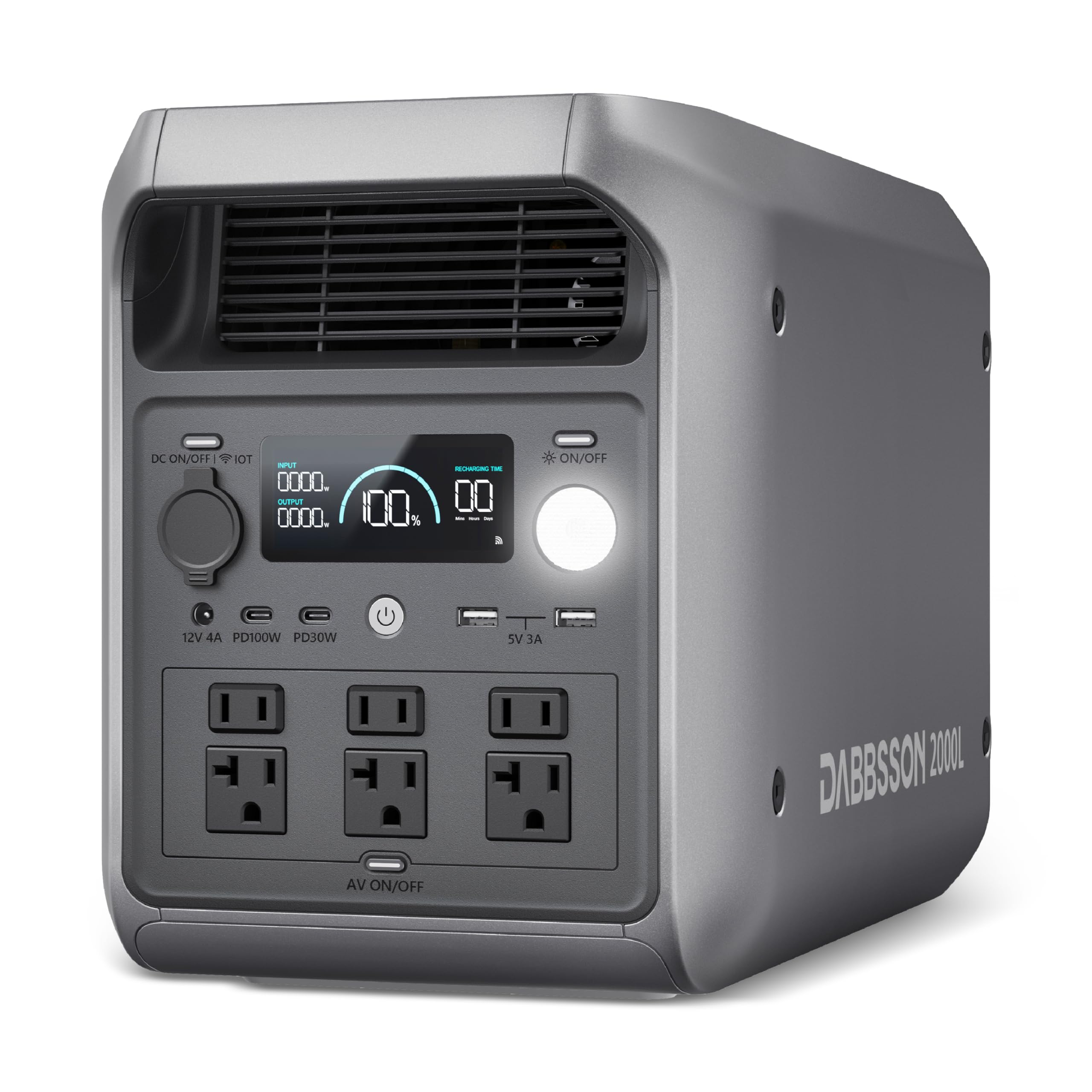
4. DABBSSON Portable Power Station 2000L
The budget-tier 2kWh station that shrugs off a 2.5kW load.
At nearly the same price as mid-range 2kWh rivals, the DABBSSON 2000L delivers a full 2,048Wh on a semi-solid LiFePO4 chemistry (a more stable variant of the standard LFP cells) wrapped in a flame-retardant UL94-V0 housing. It supports over 4,000 deep cycles (over 10 years of daily use) and weighs just 41 lb. It’s the value anchor of this list, and buyers confirm it handled a 2.4-2.5kW load and a 4kW surge without complaint.
The output stage is strong: 2,200W rated with a 3,300W surge boost, spread across 6 AC outlets so a family can run a fridge, a heater, and a grill station at once. An <10ms EPS switch (a nearly instant transfer to battery power) protects computers and NAS drives from data loss during a grid blip. Recharge hits under 2 hours from a wall outlet, and the app lets you adjust charging speed and set schedules over Wi-Fi or Bluetooth.
The caveats are real: solar input tops out at 800W, the fan runs loud even at idle per a few owners, and some had app connection hiccups on first setup.
Where It Saves You
- 2,048Wh capacity at a budget-tier price
- 6 AC outlets for whole-family power
- 41 lb stays portable enough for car camping
- 5-year warranty with registration
Where It Costs You
- Fan noticeable at idle for some owners
- 800W solar input is on the low side
- App setup can be finicky on first try
Buy it for: the best capacity-per-dollar in this lineup plus enough outlets to run a campsite or a small home backup setup.
skip it if: you absolutely need silent operation or plan a heavy solar array — the fan and 800W input cap will test your patience.
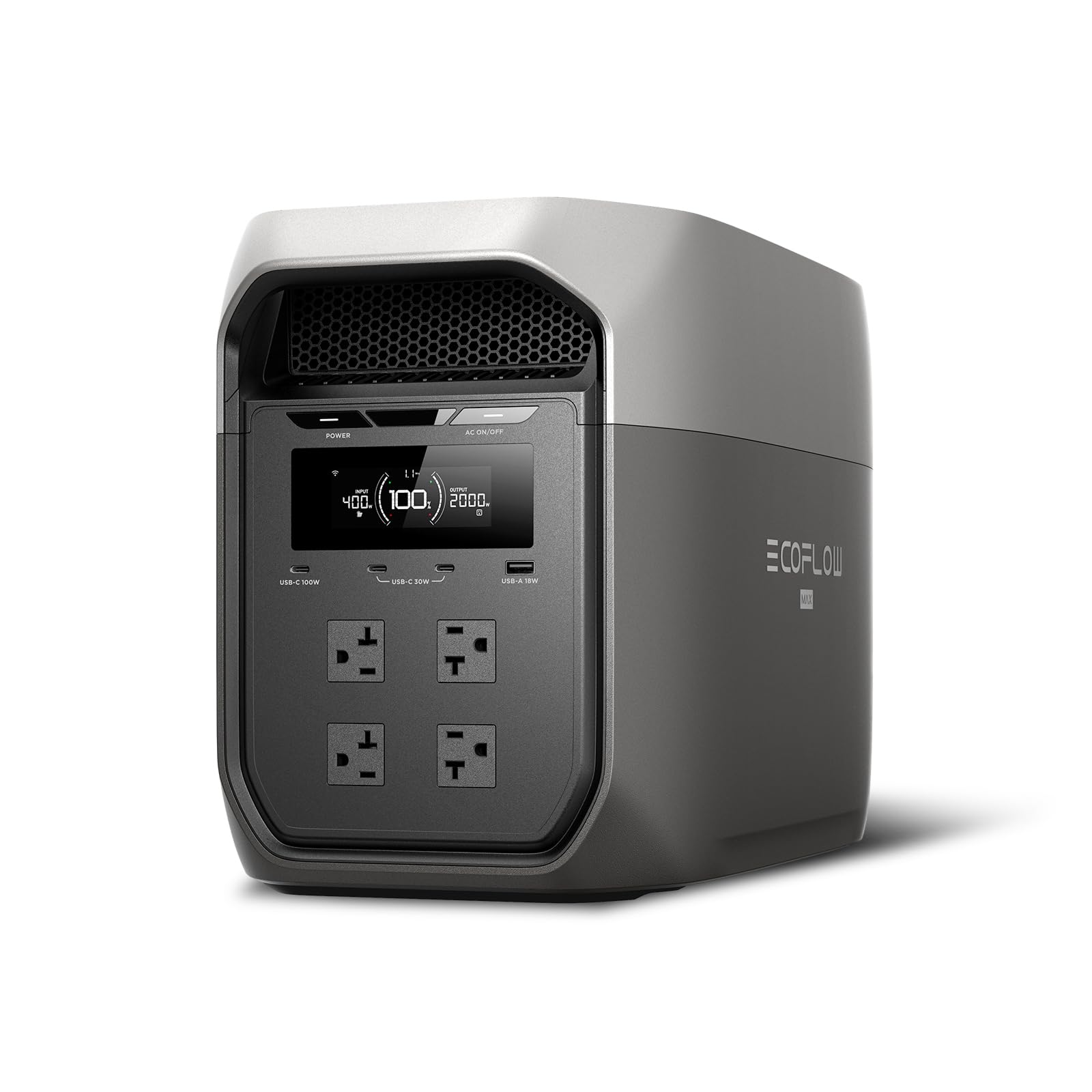
5. EF ECOFLOW DELTA 3 Max Portable Power Station
The EcoFlow that turns a 2kWh tank into a 99%-of-appliances powerhouse.
EcoFlow’s X-Boost tech is the headline here, taking the 2,048Wh LFP battery and letting it sustain up to 3,400W continuous — enough to run fridges, microwaves, and even power tools that would trip a typical 2,400W inverter. Owners mention it powers a waffle iron and two freezers simultaneously, and the strong surge handling means compressors and motors start without drama. It’s the station for people who want to plug in almost anything and not think twice.
Charging is where EcoFlow shows its muscle: X-Stream fast charging refills 0-80% in just 1.13 hours, and the sub-10ms transfer time keeps computers safe during grid hiccups. The 48 lb unit includes a small hand truck to make moving it around more bearable. Battery life and power capacity are the two most-praised aspects, and the app earns consistent kudos for easy setup and remote control.
Compared to the BLUETTI Elite 200 V2 above, the DELTA 3 Max gives up a smidge of peak surge (4,000W vs 3,900W — nearly identical) but adds a lower entry price and the hand truck. The known quirk: to hit maximum fast-charge speeds you need an XT60i cable, since a plain XT60 input caps at 12V/8A. And like most big stations, it’s solid but heavy, which owners accept as the price of a durable LiFePO4 pack built for 10 years of daily use.
The standout: 3,400W continuous output in a 2kWh station — the broadest appliance compatibility in its class.
Choose this if: you want one station that runs nearly your entire home’s essentials plus power tools without overload.
Pass if: you need the absolute fastest full recharge — the Anker C2000 Gen 2’s 58-minute full charge beats the DELTA 3 Max’s 1.13-hour 80% refill.
6. Jackery HomePower 3000 Portable Power Station
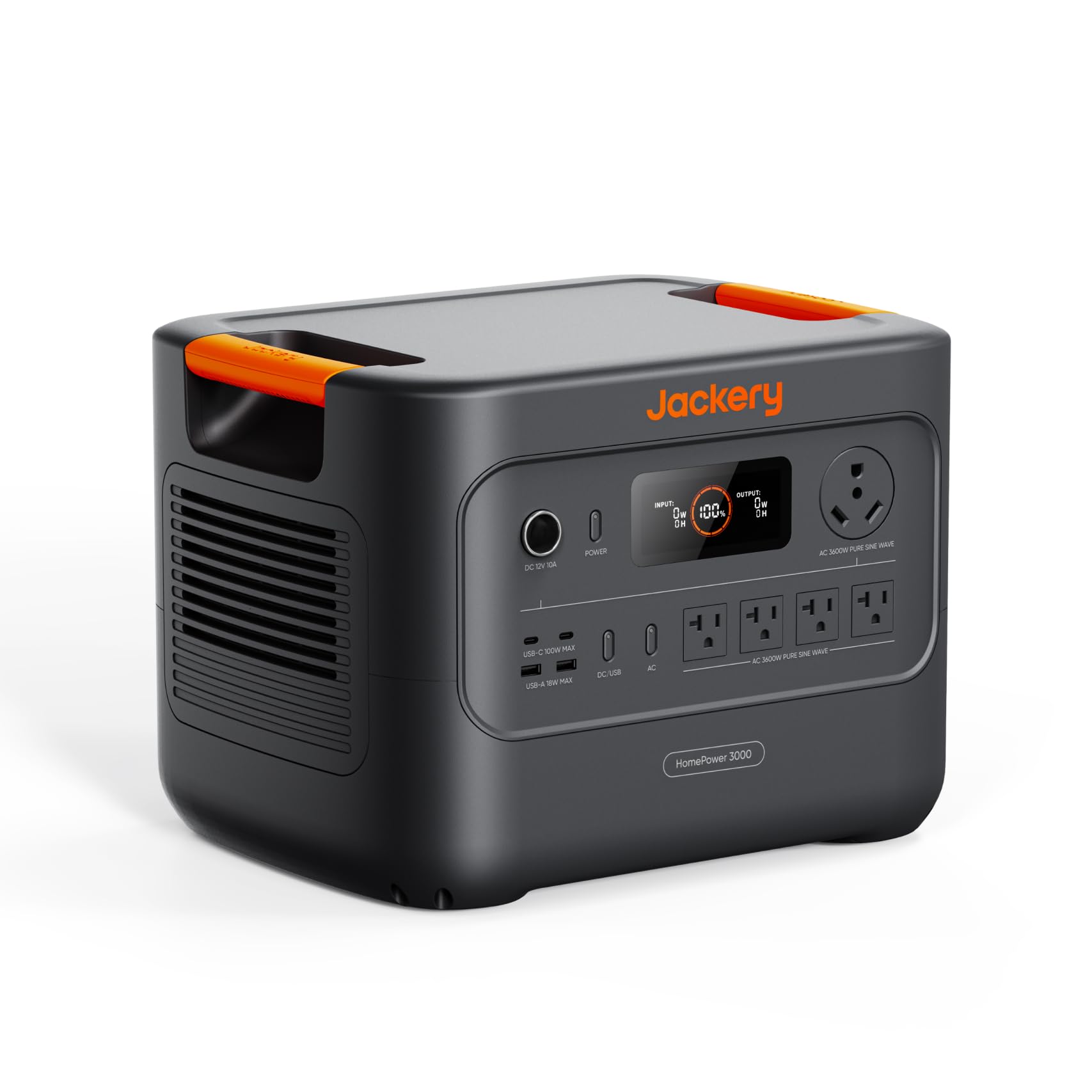
The 3kWh home backup that keeps a router lit for 16 straight hours.
Jackery’s HomePower 3000 is pitched squarely at the house, not the campsite. With a 3,072Wh capacity and a 3,600W output (7,200W surge), it’s built to hold down a household for up to 15 hours and keep a refrigerator running for 1 to 2 days. Buyers confirm the story: one owner powered a flat-screen TV and internet router for 16 hours straight, and another ran an office’s computer, monitors, and router through a two-day outage.
It’s the lightest and smallest 3kWh station on the market, per Jackery, using CTB technology to be 47% smaller and 43% lighter than comparable models. At 59.5 lb, that’s still a lift, but the honeycomb-style bottom shell adds strength, and the built-in TT-30 RV port makes it a plug-and-play match for a camper. The UL-certified UPS switches over in ≤20ms — fast enough to keep security cameras and medical refrigerators uninterrupted.
Charging is versatile: full recharge in 1.7 hours via hybrid AC/DC, and with two SolarSaga 200W panels it hits 80% in 9 hours. Owners praise power and build quality, but the weight is a recurring fit-note, and the fan can be noisy under load — one owner measured it around 60dB, making it less ideal as a daily office UPS. Reliability gets mixed feedback in the review data, so check your unit’s behavior in week one.
The appeal: the most efficient 3kWh footprint out there, with enough output to power a whole room of essentials.
Perfect for: homes that want one high-capacity unit to keep the fridge, router, and lights alive through multi-day outages.
Might not fit: if you need a silent station for a bedroom or office — the fan noise under load could annoy.
7. BLUETTI Elite 300 Portable Power Station
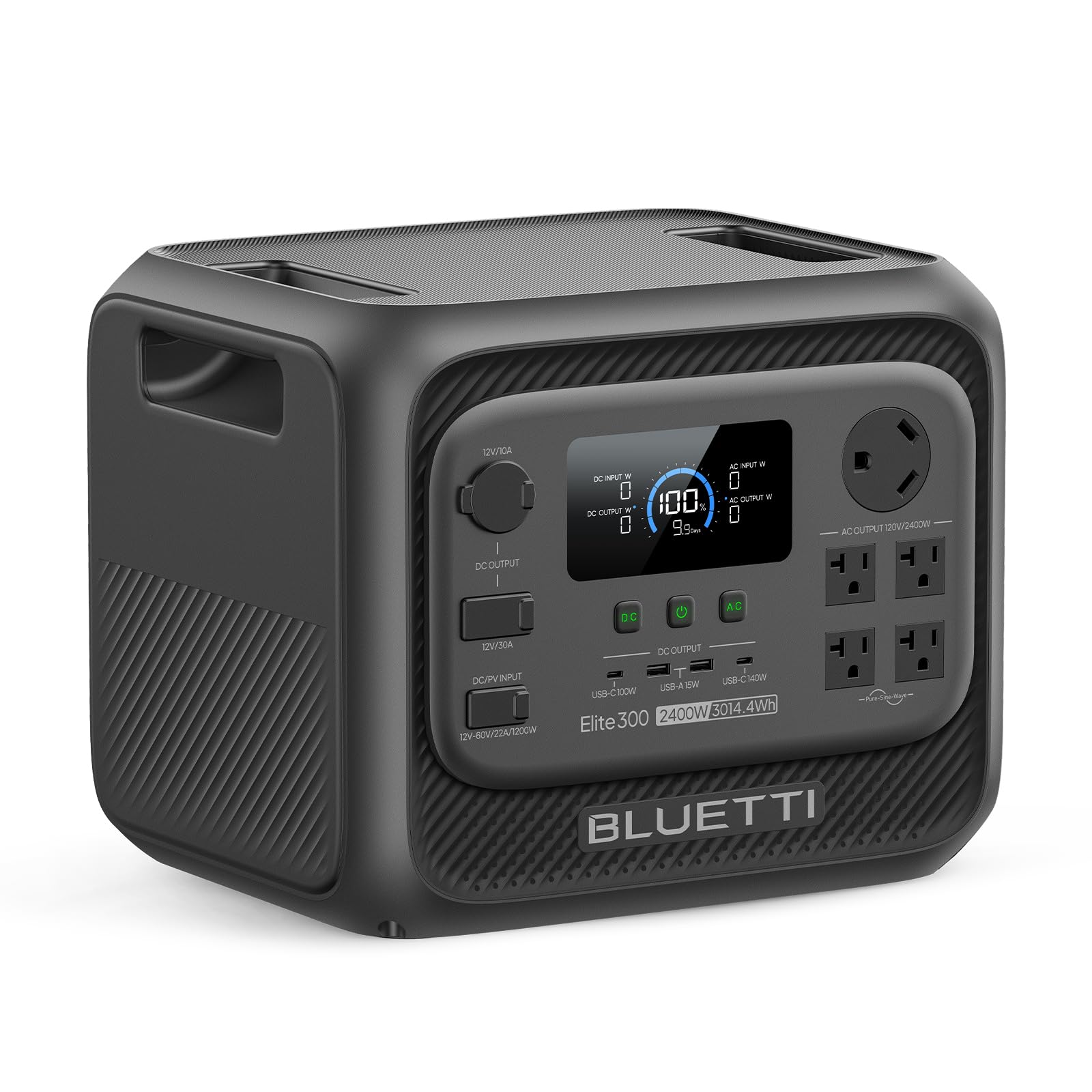
The world’s smallest 3kWh station that’s built to live in a van.
BLUETTI claims Frost & Sullivan verified the Elite 300 as the world’s smallest 3kWh portable power station, and the numbers back up the bravado. It packs 3,014.4Wh into a 14.4 × 12 × 11.7 in footprint — nearly 59% smaller than traditional large stations — making it a natural fit for camper vans and RV life. Buyers describe it as “the size of 2 ammo cans” with the heft of a truck battery, and it’s proven itself running a 15,000 BTU Coleman RV air conditioner for two hours.
The RV focus is unmistakable: a TT-30 RV outlet plus a high-current 12V/30A DC output runs 12V fridges, water pumps, and diesel heaters directly. For home backup, the 2,400W output with a 4,800W surge starts kettles and other resistive loads, and the 10ms UPS switch keeps computers and routers safe. Top up from 0-80% in as fast as 78 minutes via wall power.
Owners praise power capacity and reliability most, and it has a loyal following among full-time vanlifers. The trade-offs: no battery expansion option — you get the built-in 3,014Wh and nothing more — and solar input is capped lower than some rivals, with one owner noting voltage limits that complicate big panel arrays. It’s also a 58 lb unit, so “portable” is relative.
What stands out: the densest 3kWh footprint in this guide, purpose-built for RVs with a TT-30 port (the standard 30-amp RV hookup) most rivals lack.
Choose for: van life or RV travel where a small footprint and a TT-30 plug matter more than anything else.
Reconsider if: you plan to expand capacity later or run a large solar array — there’s no expansion and the solar input cap is limiting.
8. Jackery Explorer 2000 Plus Portable Power Station

The 2kWh starter that grows into a 24kWh whole-home system.
The Jackery Explorer 2000 Plus is the only station on this list that can truly scale with you. Start with the 2,042.8Wh core at 3,000W output, then add up to 5 expansion batteries to reach 12kWh, or pair two 2000 Plus units in parallel to hit 24kWh and a 6,000W output. That’s the flexibility to start with a camping station and end with a serious home backup — without buying a new unit.
The core itself is no slouch: a 3,000W AC output (6,000W surge) powers air conditioners and RVs, and the ChargeShield fast-charging tech claims a 50% battery life boost. Owners have used it to run a DeWalt rotary hammer for hours at full power and to charge a Tesla — about 3kWh for 10 miles of range. It charges to full in 2 hours via wall outlet or six 200W solar panels, and its whisper-quiet operation sits at just 30dB.
The battery is rated for 4,000 cycles to 70% capacity with a 10-year lifespan. The catch is plain: at 62 lb with wheels, it’s the heaviest 2kWh station here, and the telescopic handle feels flimsy to some owners. Charging and power draw the most praise, while reliability gets more mixed feedback — so test it fully when it arrives.
The smart play: buy the core now, expand to 24kWh later without replacing anything — the only true growth path on this list.
Pick this if: you want a station that can grow from camping backup to whole-home capacity as your needs evolve.
Look past it if: you’ll never buy expansion packs — you’re hauling 62 lb for capacity you could get lighter elsewhere.
9. EF ECOFLOW DELTA Pro Portable Power Station
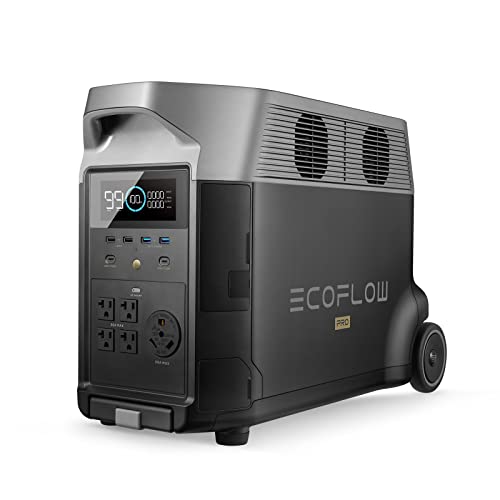
The 3.6kWh behemoth that pairs with a generator to power a whole house.
Treat power backup as infrastructure, not an accessory, and the DELTA Pro is your unit — the biggest single station here. It holds 3,600Wh with 3,600W AC output, expands up to 25kWh with extra batteries or a smart generator, and two paired units hit 7,200W. Buyers have run a heat press at a vendor market flawlessly without voltage drops, proving it handles sustained commercial loads.
Its 15 output methods are class-leading here: 5 AC outlets, 2 USB-C (100W each), 2 USB-A fast charge, 2 USB-A, DC outlets, a car port, and an Anderson port — enough to power multiple devices at once. Recharge is flexible: 2.7 hours from an 1800W wall outlet, faster via 240V at 3,000W, or from solar, a car outlet, or even an EV station. At 99 lb, this station lives in place, not in your daily carry.
Owners most praise quality and battery life, calling it a “standout” for mobile businesses and a reliable backup for short outages, with a full charge lasting up to 15 days on a light load. The honest negatives: it’s very heavy, some customers note failures after a year of use, and the 120V version — while versatile — has limits for heavy 240V appliances. Value and reliability draw mixed feedback in the broader review pool, so know what you’re powering before buying.
The Heavyweight’s Strengths
- 3,600Wh baseline, expandable to 25kWh
- 15 output methods for maximum flexibility
- Pair two units for 7,200W output
- Charges from wall, solar, car, EV station, or generator
What Weighs It Down
- 99 lb means it lives in one spot
- Rare reports of failure after a year
- 120V-only output in this version
Invest here if: you want the biggest single-station capacity plus generator pairing for near-whole-home coverage.
Choose something lighter if: portability is a factor — at 99 lb, even the 41.7 lb Anker C2000 Gen 2 feels featherweight by comparison.
Understanding the Specs
Watt-Hours (Wh) & Runtime
Watt-hours is the total energy your fridge, router, or laptop can draw over time. A 2,048Wh station running a 100W fridge delivers roughly 20 hours of runtime — though real-world numbers vary with efficiency and ambient temperature. Look for a low standby draw (measured in watts) because that’s the silent drain that erodes your stored energy while the station sits waiting.
Expandable capacity matters if you might outgrow a base unit. Some stations let you add battery packs to multiply the tank — useful for growing from a camping setup into a home backup without buying a second station.
Watts: Continuous & Surge
Continuous output is what the inverter can sustain indefinitely, and it must exceed the running wattage of your appliances. Surge (or peak) output is the brief burst needed to start motors — like a fridge compressor or a power tool — and it’s typically 25-50% higher than continuous. If your microwave needs 1,500W to run but 2,000W to start, you need a station with at least a 2,000W surge rating.
A simple rule: list your two heaviest appliances, add their starting wattages, and pick a station whose continuous output clears that number with headroom for the surge.
FAQ
How long will a backup battery power station run my fridge?
Can a power station run a microwave or hair dryer?
What is the difference between LiFePO4 and lithium-ion batteries?
Can I use a power station as a UPS for my computer?
How fast can I recharge a power station from a wall outlet?
Can I charge a power station with solar panels?
What can I run with a 3,000W output station?
How do I choose between a 2kWh and a 3kWh power station?
Are these power stations safe to use indoors?
What does the surge (peak) wattage rating mean?
Final Thoughts: The Verdict
Across the board, the backup battery power station winner is the Anker SOLIX C2000 Gen 2 because its 58-minute full recharge and 4,000W peak output cover the widest range of real-world outage needs without the bulk of a 99 lb unit. If you want the brute-force output to run heavy appliances all day, grab the BLUETTI Elite 200 V2 and its 2,600W continuous draw. And
How We Picked
We do not accept paid placement. Every pick is matched to a real buyer and a real use-case; we do not hands-on test units.
Sources & Methodology
Specifications: manufacturer listings and product documentation. Review insights: verified customer reviews, as of August 2026. Pricing: not shown on this page (it changes often); check the current price via the retailer link.
As an Amazon Associate, Gadgets Feed earns from qualifying purchases. This does not affect which products we feature.