
Our readers keep the lights on and my morning glass full of iced black tea. As an Amazon Associate, I earn from qualifying purchases.
Specs are compiled from manufacturer listings and verified buyer reviews and can change over time — please confirm the key details on the product page before buying.
The real question isn’t which battery pack has the biggest number stamped on the side. It’s which one fits how you actually live — whether that’s a daily commute, a cross-country flight, or a camping trip where outlets are a distant memory. The right pick balances raw capacity against weight, charging speed against portability, and a 50,000mAh brick only earns its place if you’re willing to carry its heft.
I’m Min — the founder and writer behind Gadgets Feed. This guide is built by comparing the manufacturers’ published specifications and the patterns across verified customer reviews, so you get each pick’s real strengths and trade-offs instead of marketing spin.
This guide cuts through the noise to find the battery charge pack that truly matches your daily routine.
Our Picks at a Glance
How To Choose The Best Battery Charge Pack
Before you buy a battery pack, ask yourself three things: how much power you need, how much weight you can carry, and where you’ll take it. Answer those, and the rest is just details.
Capacity vs. Portability
There is a direct trade-off between milliamp-hours (mAh — the measure of stored energy) and the physical weight you carry. A 10,000mAh pack can slip into a pocket, while a 50,000mAh unit is a serious slab. The crowd favorite — 4.6 stars across 28,000+ owners — proves a dense 20,000mAh pack can still feel portable, but you will notice the heft.
Fast Charging Explained
Wattage (W) tells you how quickly power flows into your phone. A 22.5W charger can top up an iPhone to 60% in about 25 minutes, while a 45W unit pushes that even faster — up to 84% on a Galaxy S25 Ultra in 30 minutes. The catch is that your phone must support the same protocol to see those speeds.
The Flight Rule
Airline rules are a hard line, not a suggestion. Packs up to 100Wh (roughly 27,000mAh) are typically allowed in carry-on luggage. Anything bigger — like a 50,000mAh or 56,800mAh unit — is banned from planes entirely, so check the label before you pack.
Quick Comparison
| Model | Best For | Capacity | Max Output | Weight | Amazon |
|---|---|---|---|---|---|
| INIU 20000mAh 22.5W★ Best Overall | Best Overall | 20,000mAh | 22.5W | 320g | Amazon |
| INIU 10000mAh 45WCompact Pick | Ultra-Portable | 10,000mAh | 45W | 160g | Amazon |
| JKELAR 50000mAhHigh-Capacity Value | Multi-Device | 50,000mAh | 22.5W | 488.2g | Amazon |
| HETP 30800mAh Wireless | Wireless Charging | 30,800mAh | 25W | — | Amazon |
| NOBIS 20000mAh 45W | Laptop Charging | 20,000mAh | 45W | 392g | Amazon |
| MaiVoz 56800mAh | Camping Backup | 56,800mAh | 22.5W | 459.4g | Amazon |
| LOOPEAK 50000mAh | Long Trips | 50,000mAh | 22.5W | 530g (1.17lb) | Amazon |
| Anker 10000mAh 30W | Premium Compact | 10,000mAh | 30W | 223g | Amazon |
| VRURC 20000mAh | Built-In Cables | 20,000mAh | 22.5W | 345.3g | Amazon |
In‑Depth Reviews
1. INIU Portable Charger, Smallest 20000mAh 22.5W
Our pick — over 4.5★ from 28,500+ verified ratings; the strongest balance of quality and price.
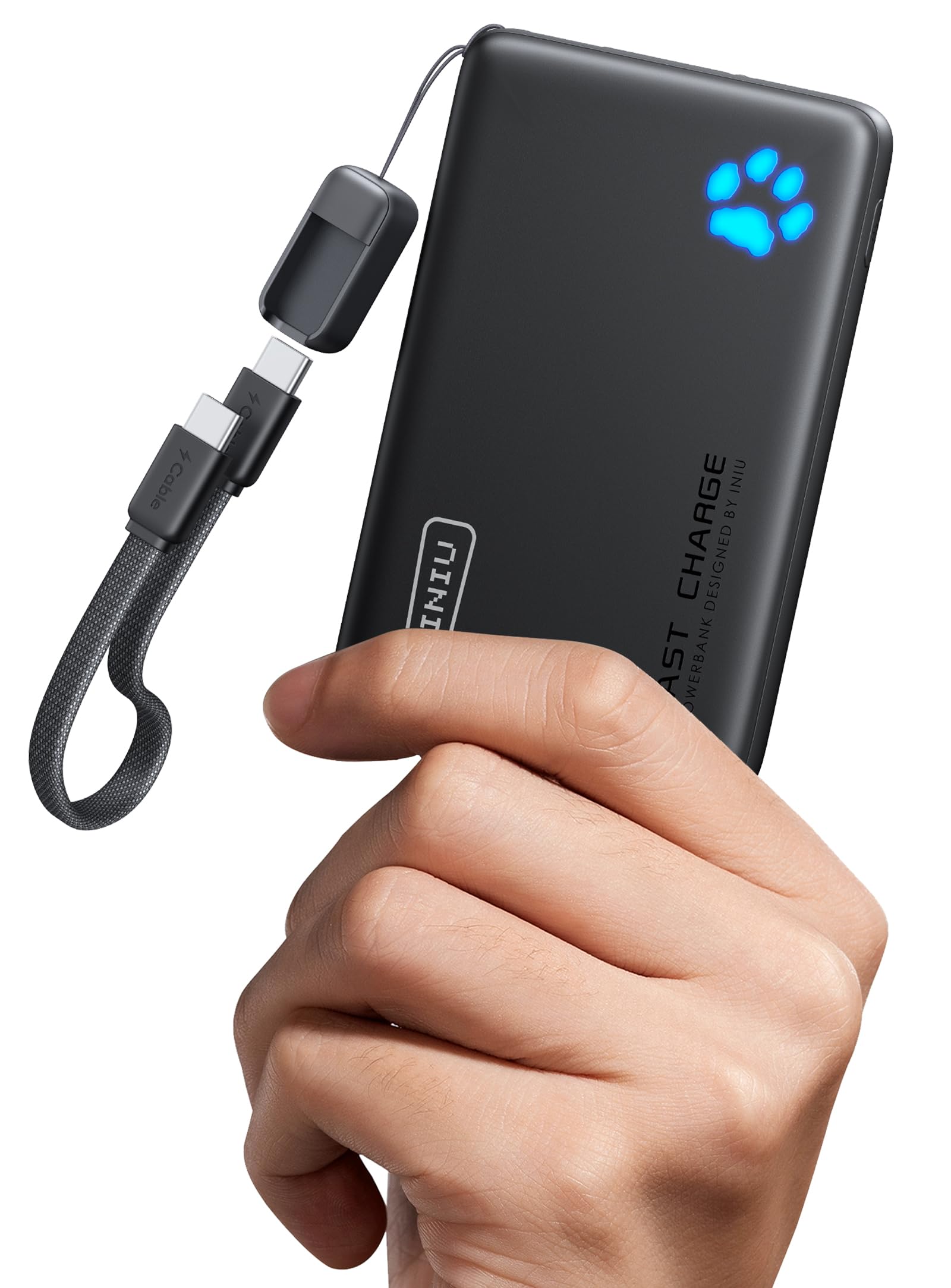
The pocket-sized powerhouse that turns a single 320g block into four full phone charges
The headline here is the density: this pack crams 20,000mAh into a 4.1 x 2.8 x 1.2-inch body that weighs 320g, so you get the capacity of a big unit without the slab feel. In practice, buyers report it reliably pushes through three full smartphone charges and still has enough left for a tablet — “at least 3!” as buyers put it, plus two iPad top-ups before the phone.
What wins people over is reliability — it’s the most-praised trait by a wide margin — along with a build quality that feels solid in the hand. The detachable nylon lanyard doubles as the USB-C cable, so there’s no hunting for a cord, and the digital display plus flashlight cover the practical bases for travel. Charging speed is the honest caveat: it’s genuinely quick — an iPhone 16 to 60% in about 25 minutes — but some owners note the pack itself takes a while (5.4 hours) to refill.
At 320g you do notice it in a pocket; several owners flag the weight as the one real trade-off for this much capacity. That’s the price of carrying a true 20,000mAh unit rather than a lighter 10,000mAh stick. For anyone who wants one pack that handles a full day-plus without thinking, this is the one.
What Owners Love
- True 20,000mAh capacity delivers 3-4 full phone charges
- Detachable nylon lanyard doubles as the USB-C cable
- Digital display and flashlight add real travel utility
Honest Trade-Offs
- Weighs 320g — you notice it in a pocket
- Recharging the pack itself takes 5.4 hours
- Detachable cord is easy to lose
Reach for this if: you want a single, flight-safe 20,000mAh companion that powers a phone for days of travel.
Look elsewhere if: every gram counts — the 200g-plus weight will feel heavy in a slim pocket.
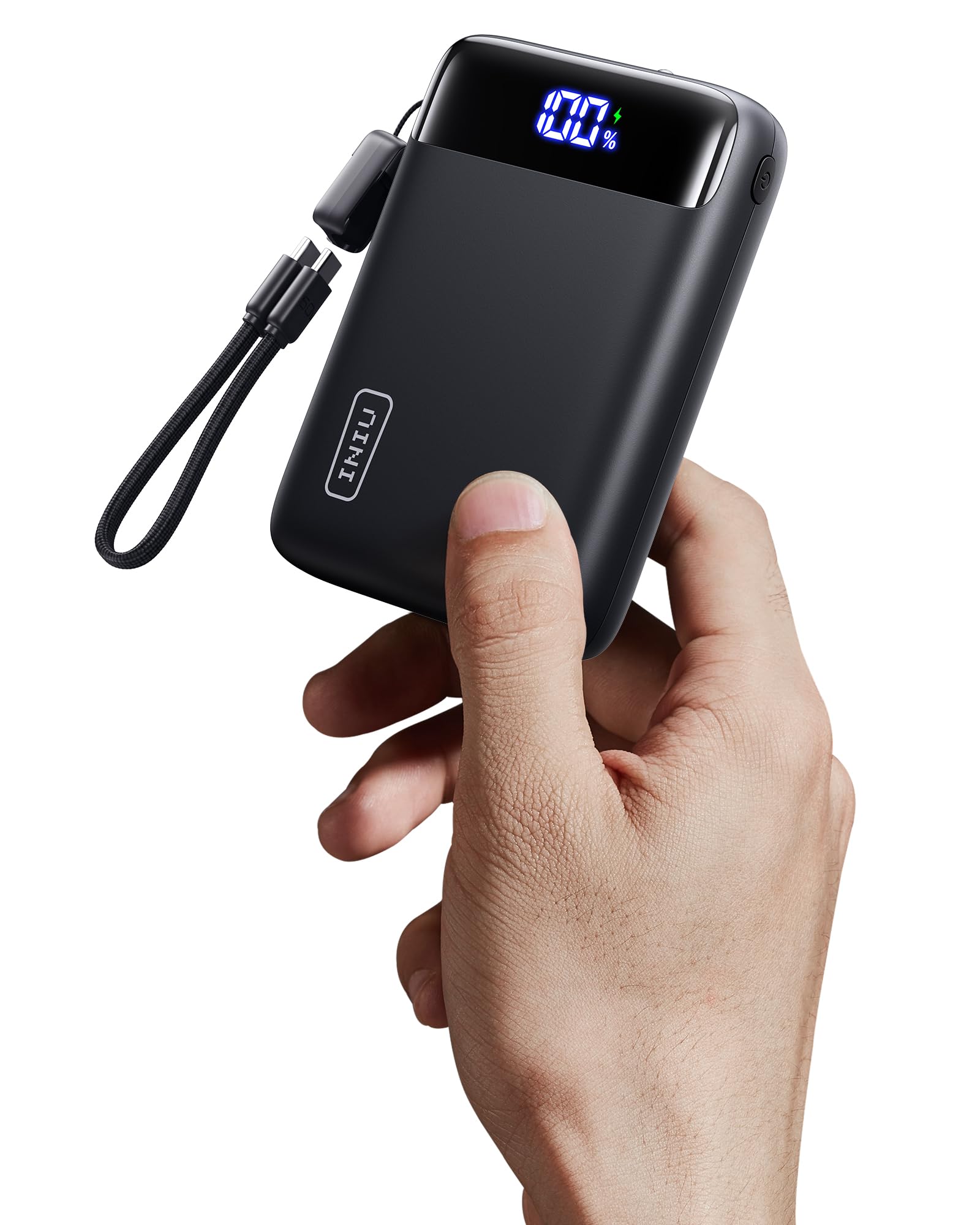
2. INIU 45W Fast Charging Portable Charger, Smaller 10000mAh
A featherweight 160g slab that charges a phone at 45W — faster than many bigger packs
This pack slips into a purse or pants pocket without a bulge. Weighing 160g and measuring 5.26 x 2.7 x 0.5 inches, it’s half the weight of the 20,000mAh INIU above, yet it delivers 45W output — enough to charge an iPhone 17 Pro Max to 76% or a Galaxy S25 Ultra to 84% in 30 minutes from 20%. Owners say it’s about the size of a deck of cards.
Charging speed is the most-discussed trait here, and it’s all positive. The 10,000mAh capacity delivers about two full phone charges, and the detachable 0.4ft braided USB-C cable can be swapped if it ever breaks — a smart fix for the built-in-cable-fails problem. The 2 USB-C plus 1 USB-A output means you can run a phone, earbuds, and a smartwatch at once.
The honest limitation is the capacity: 10,000mAh suits a daily commute, not a multi-day trip. The battery gauge is a simple 4-light indicator, not a digital readout. Durability gets mixed reviews — most units hold power for a long time, but a few stop working early. If you’re a commuter or student who wants speed without bulk, this fits well.
The crowd favorite in the compact tier — it solves the “I forgot my cable” problem by making the cable part of the handle, so you can’t lose it.
Bottom line: At 160g this is the lightest true fast-charger here, and the detachable cable protects your investment.
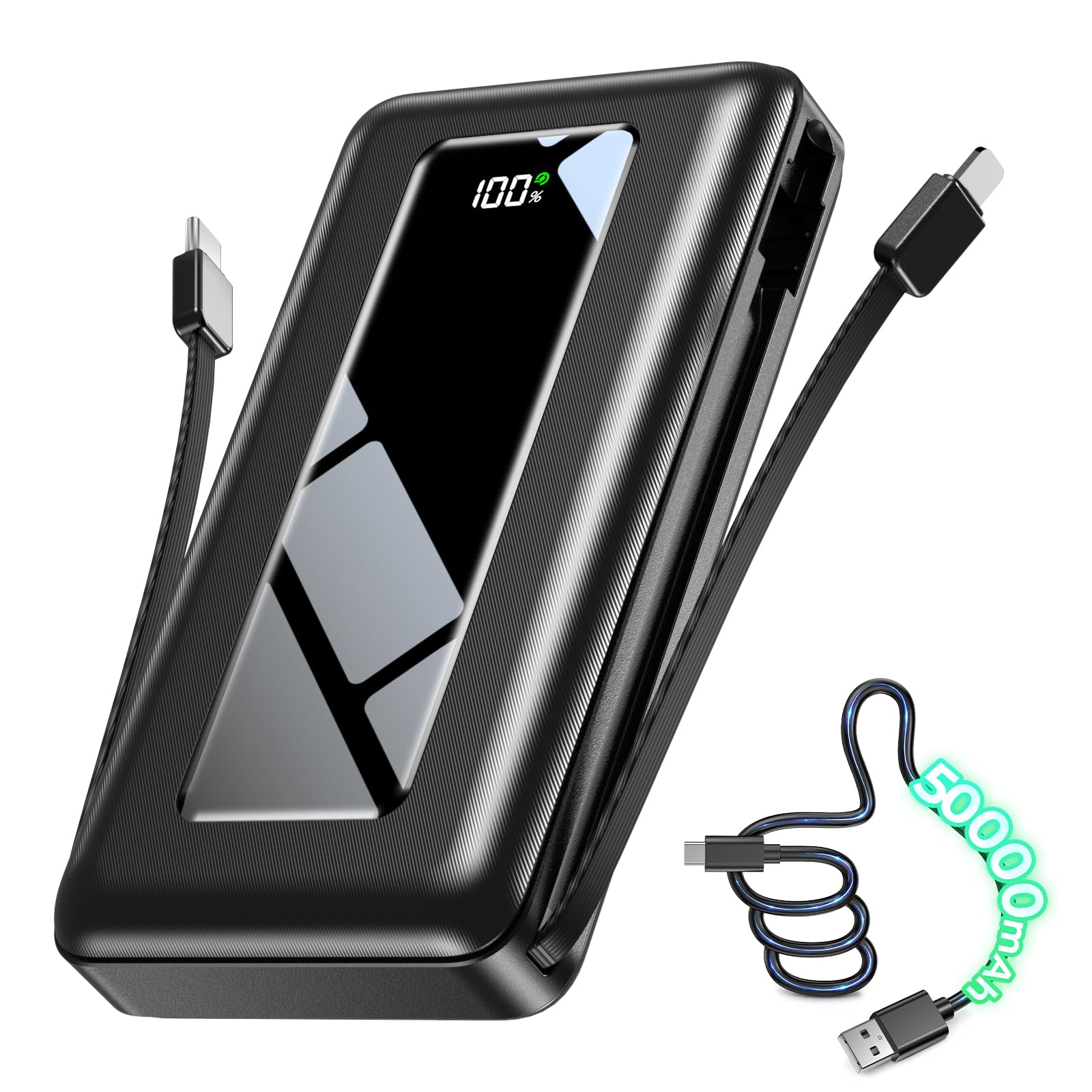
3. JKELAR 50000mAh Portable Charger with Built-in Cables
A 50,000mAh multi-day lifeline with both an iOS and a USB-C cable built right in
This one suits the traveler who wants to forget about power. The 50,000mAh capacity — the standout spec — keeps a phone running for 2 to 3 days, according to owners, and charges multiple devices at once via two built-in cables (USB-C and iOS) plus an extra USB-C port. Charging speed earns the most praise, with 22.5W fast charging powering compatible phones quickly.
The build quality earns consistent praise, and the LED display shows remaining percentage precisely so there’s no guessing. A built-in flashlight covers emergencies and camping. The 6-hour recharge time is a real commitment, and at 488.2g it’s not something you’ll want in a pocket — it’s a backpack or gear-bag companion.
The big caveat is air travel: at this capacity it’s well above airline limits, so it’s strictly a road-trip or camping tool. Owners note it’s heavy but “perfect for trips” — the weight is the trade-off for days of backup power.
Who it’s for: road-trippers and campers who’d rather carry one heavy brick than hunt for outlets all weekend.
4. HETP Wireless Portable Charger 30,800mAh, 15W Wireless

The only pack here that charges your phone without a cable — a 15W wireless pad atop 30,800mAh
This is the pick for anyone tired of cable tangles. The distinguishing feature is the 15W wireless charging pad — just rest a compatible phone on top and it charges, no plugging in. Below that sits a 30,800mAh battery that also offers 2 USB-A and 1 USB-C outputs, so you can run a wired device and a wireless one at the same time. Owners mention powering multiple devices reliably, with one noting it handled seven at once.
Reliability is what people praise most here — it works as advertised and holds its charge well. The 25W USB-C fast charging handles wired devices quickly, and the 4-output design (3 wired + 1 wireless) makes it a genuine hub for a family or group trip.
The catch is the wireless grip: this is not a magnetic pack, so a phone can slide off the pad — several owners note the surface is slick, especially in a car. And the charging speed over wireless is slower than wired, which some find frustrating. Weight is the other flag. For desk-side cable-free charging at home or on a trip where the pack sits flat, it shines.
The Upside
- 15W wireless pad charges without cables
- 4 outputs total — wireless plus 2 USB-A and 1 USB-C
- Large 30,800mAh capacity for multi-device days
The Catch
- Not magnetic — phones can slide off the slick pad
- Wireless charging is slower than wired fast charging
- Owners flag the weight as noticeable
5. NOBIS 45W 20000mAh Portable Charger Power Bank
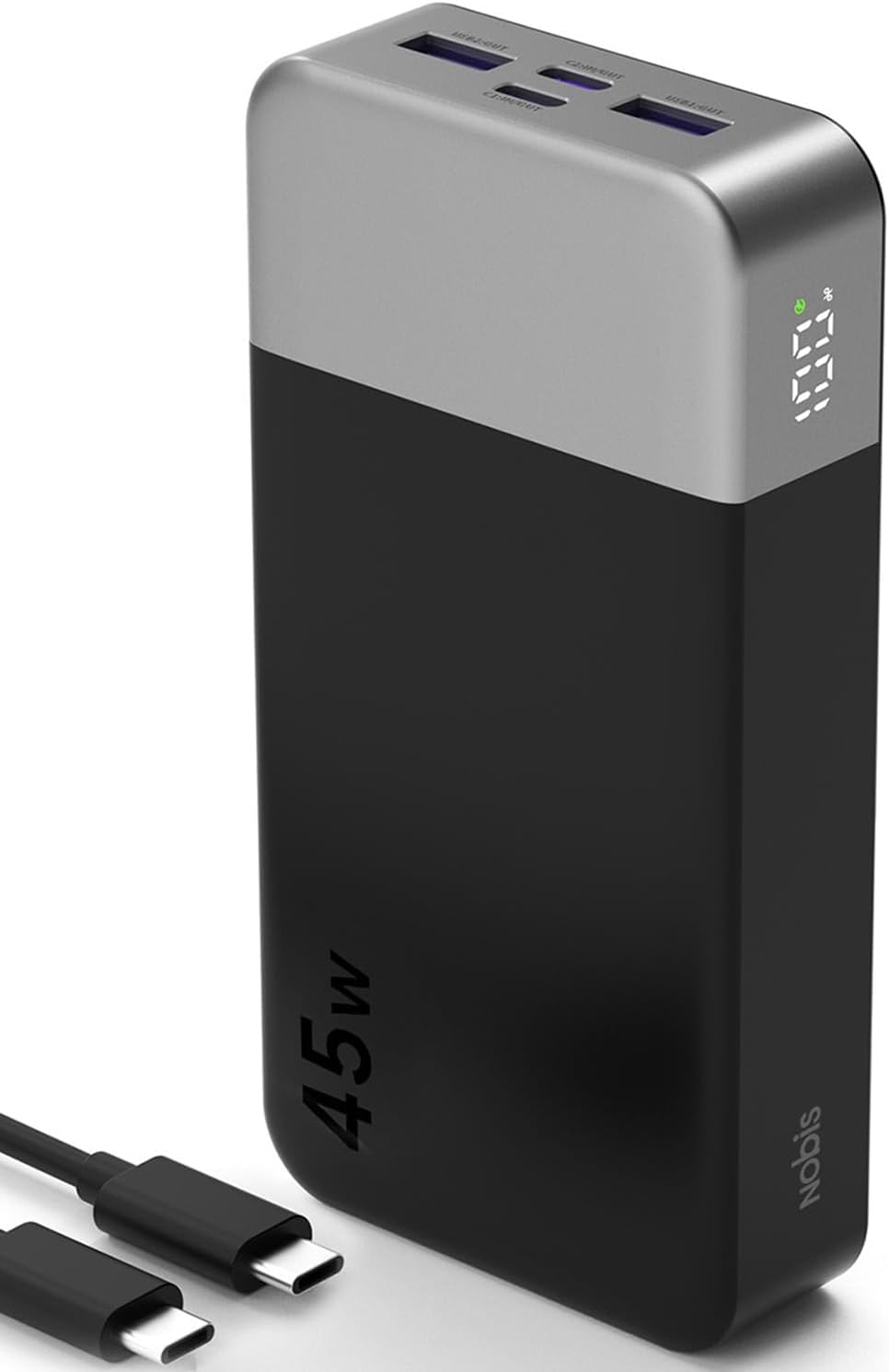
A laptop-capable 45W pack that refills itself in two hours and charges four devices at once
This one earns its premium spot with 45W output that can actually top up a MacBook, Chromebook, or Steam Deck — not just a phone. The 20,000mAh capacity fully recharges most smartphones about 3.5 times, and the bidirectional USB-C means the pack itself refills in just 2 hours, far quicker than the 5.4-hour INIU above. Charging speed is the most-praised trait, with a phone going from 15% to 60% in about 30 minutes.
The 4 ports — 2 USB-C and 2 USB-A — let four devices charge simultaneously, which owners use for phone, watch, and even a headset at once. The digital display is accurate, and a clever Small Current Mode protects low-power wearables from overcharging. Owners note it stays cool even under load, and several bought multiple units in different colors for trips.
At 392g it’s heavier than the 10,000mAh sticks, but lighter than the 50,000mAh bricks above. The only recurring note is that it doesn’t hold a charge quite as long as a certain well-known rival brand when idle. For anyone who needs laptop power plus phone backup in one tidy 20,000mAh unit, this is the standout.
Best for: digital nomads who need one pack powerful enough for a laptop but not so big it needs its own bag.
6. MaiVoz Portable Charger 56,800mAh, 22.5W with LED Display
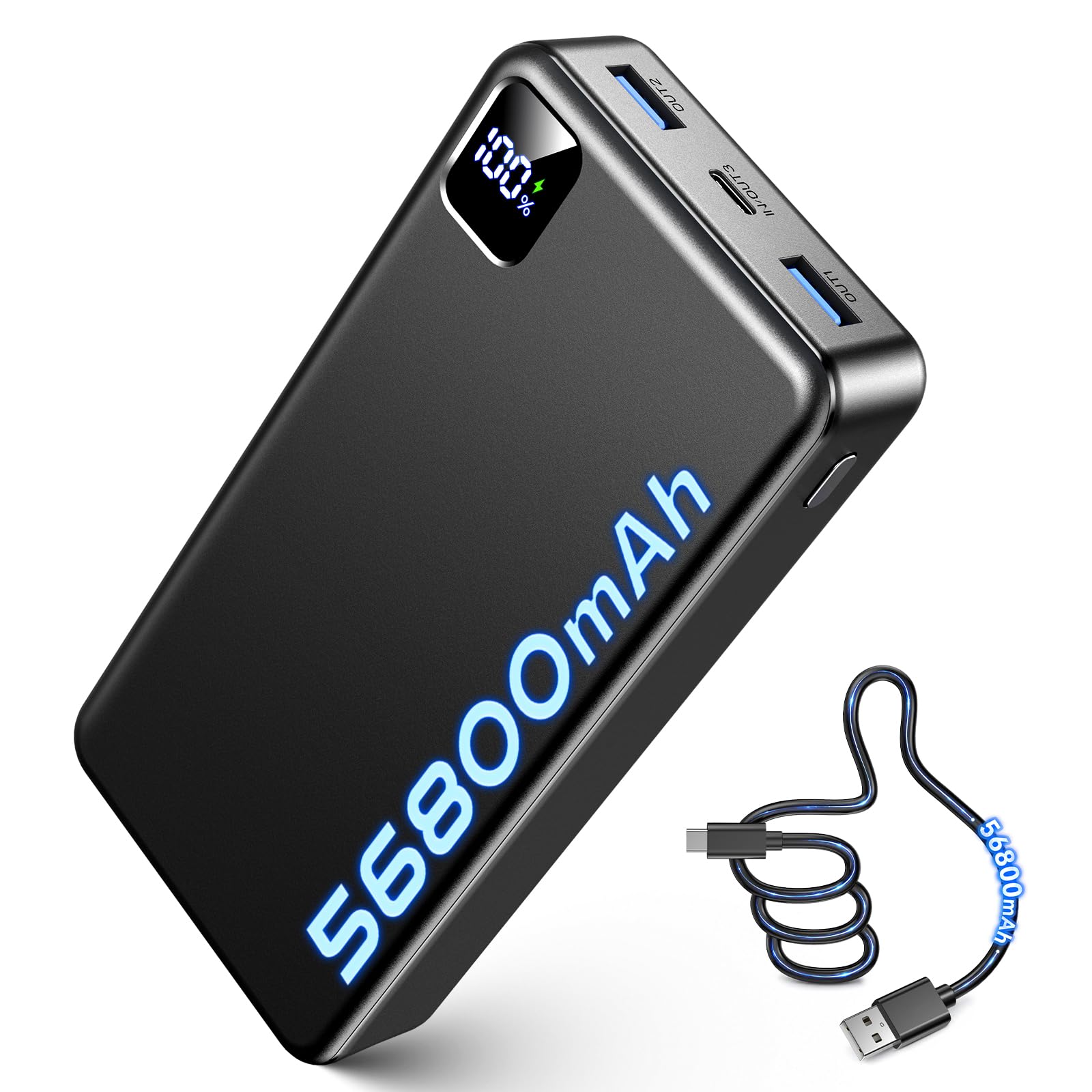
A 56,800mAh multi-day behemoth that charges an iPhone 17 over ten times before giving up
This is the biggest capacity in the lineup, built for multi-day off-grid power. The 56,800mAh battery charges an iPhone 17 to about 60% in around 40 minutes at 22.5W, and delivers 10+ full charges before it’s empty — customers note using it for days on camping trips and still having power left. Charging speed earns the most praise, with one owner noting an iPhone charges at “turbo speed.”
The 3 ports (2 USB-A, 1 two-way USB-C) charge three devices at once, and the LED display is bright enough to read in daylight — a small touch owners appreciate. It arrives about 75% charged and holds that charge well, according to multiple reports. The build feels durable and weighty, and the safety protections cover overvoltage, overheating, short circuits, and overcurrent.
The honest limits are clear: at 459.4g it’s a brick, and it is not allowed on airplanes due to capacity. It also takes roughly 3 hours to refill via an 18W USB-C adapter. This is a car-camping or emergency-kit tool, not an everyday pocket companion. One owner did note the actual capacity seems less than advertised after a drain test, so treat the 56,800mAh as a generous estimate.
Reach for this if: you need a week of backup power for a whole family of devices on a road trip or during outages.
skip it if: you fly regularly or want something pocket-friendly — this one stays home or in the trunk.
7. LOOPEAK Portable Charger Power Bank 50,000mAh, 22.5W
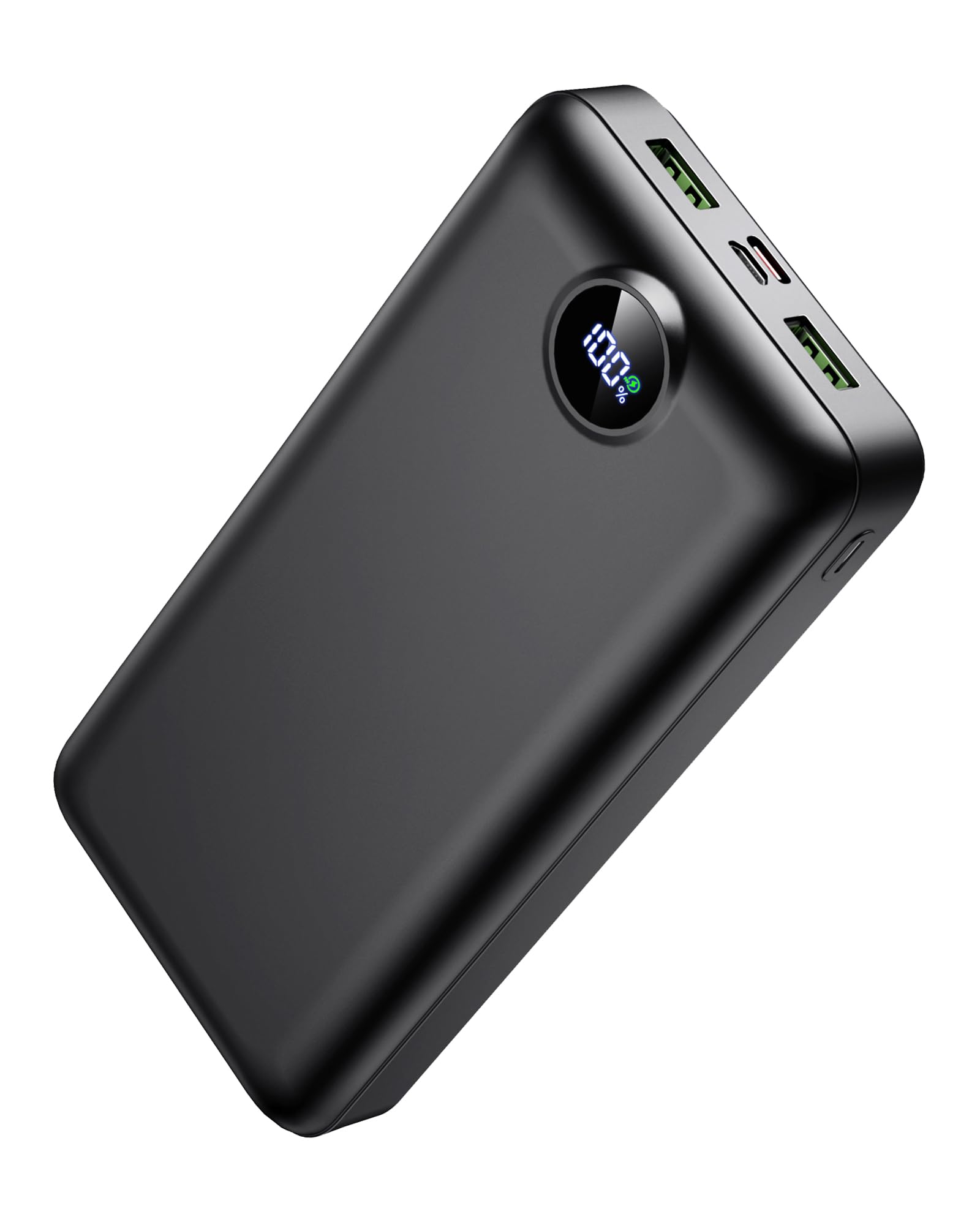
Provides 11 full iPhone 17 charges for a week-long camping trip that ignores outlets entirely
This is the power bank for people who go off-grid for a week and want zero battery anxiety. The 50,000mAh capacity provides 11 charges for an iPhone 17, fully charges most phones over 10 times, and handles a tablet 2-3 times. Owners call it “strong and powerful” and say it delivers stored power over and over for up to a week — one uses it to run red light therapy devices in addition to phones.
Charging capacity is what owners praise most, and the 3 outputs (2 USB-A, 1 USB-C in/out) charge three devices at once. The digital display gives precise remaining power, and the multi-protection chip covers over-current, short-circuit, and over-temperature. It’s engineered for portability “despite its high capacity,” measuring 6.17 x 2.98 x 1.3 inches and weighing 1.17lb.
The trade-offs are honesty from the spec sheet: it’s heavy, and it takes a long time to recharge itself. It is not approved for air travel, so check with your airline before flying. Charging speed gets mixed feedback — some say it’s fast, others note it drains quicker than expected. For car camping and emergencies, it’s a reliable workhorse.
Who it’s for: campers and emergency-kit builders who want a single 1.17lb block to power a whole trip.
8. Anker Power Bank, 10,000mAh 30W with USB-C
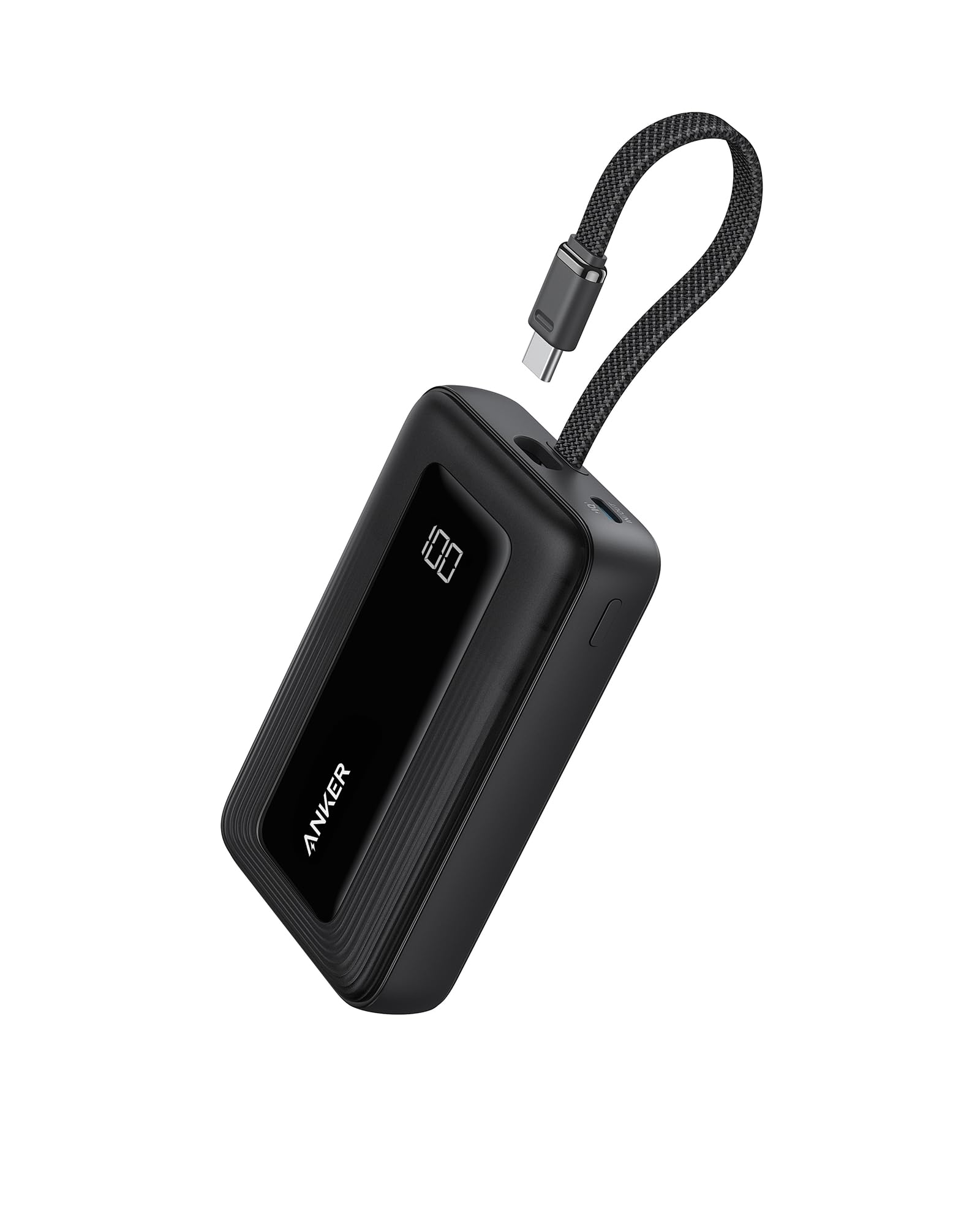
A 5.4-inch built-in cable tested to survive 10,000 bends — Anker’s durability obsession in a 223g frame
This premium compact stands out for its built-in USB-C cable: a 5.4-inch cord tested to withstand over 10,000 bends, so it won’t fray like cheaper integrated cables. The 30W output charges an iPhone 16 Pro Max to 50% in just 27 minutes — twice as fast as a standard 5V/3A charger — and the 10,000mAh delivers up to 2 full charges for an iPhone 15, or 10 charges for AirPods Pro 2.
Charging speed earns the most praise here, and owners consistently call it reliable and well-built — the traits that make Anker a trusted name. The 30W bidirectional USB-C means the pack refills quickly too, at up to 20W input. The 4.32 x 2.58 x 0.98-inch footprint and 223g weight make it genuinely pocket-friendly, which owners confirm.
The one recurring note is the integrated cable itself: since it’s built in, you can’t swap it if it ever does fail. And pass-through charging (using the pack while it charges) is slow. At this size you’re choosing daily-convenience over multi-day capacity, and Anker delivers that trade-off exceptionally well. Compatibility with iPhone 14 and earlier needs your own Lightning cable via the USB-A or USB-C port.
Why It’s Worth It
- Built-in cable rated for 10,000 bends
- 30W output — 50% in 27 minutes on an iPhone 16 Pro Max
- Compact 223g, fits in a pocket
Consider This
- Integrated cable isn’t replaceable if damaged
- 10,000mAh is daily-only, not multi-day capacity
- Pass-through charging is slow
9. VRURC Portable Charger with 4 Built-in Cables, 20000mAh
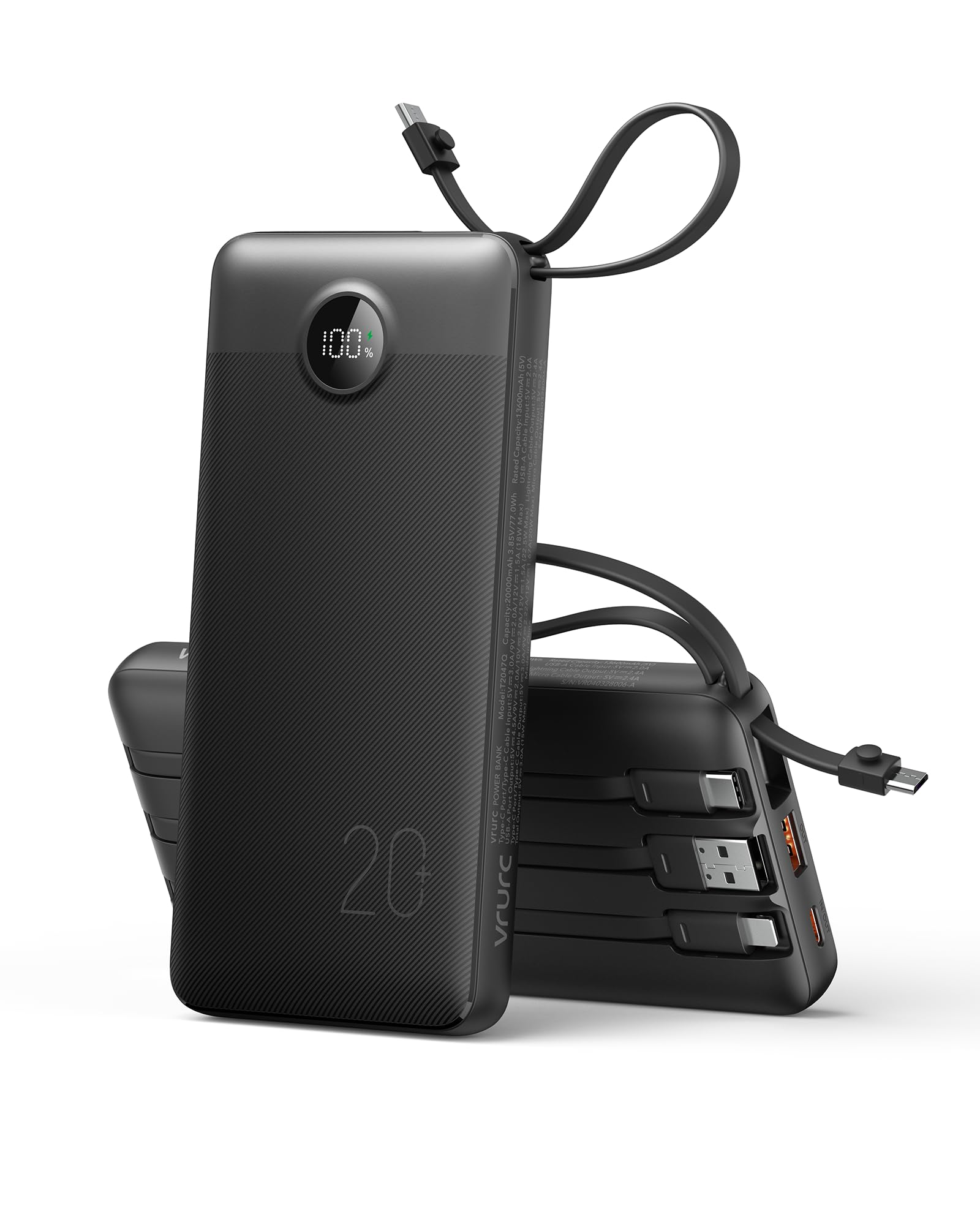
Four cables built in — Type-C, Phone, Micro USB, and USB-A — so the right cord is always attached
The whole pitch here is “never dig for a cable again.” This pack has Type-C, Phone (Lightning-style), Micro USB, and USB Type-A connectors built in, plus two extra ports, so virtually any device you own plugs straight in. The 20,000mAh capacity delivers 3-4 full phone charges, and at 22.5W fast charging, reviewers point out a phone jumping from 60% to 100% in about 20 minutes.
Charging speed is the most-praised trait, and the dual premium cells deliver the full 20,000mAh rather than falling short. The upgraded 19mm-thin design is 33% thinner than the old version, with a built-in strap that doubles as a Micro USB cable — you can hook it on a backpack and swing it. Owners call it versatile and reliable, with one taking it through Italy hiking and charging four phones to full while still having 60% left.
The honest gripes: it’s heavy at 345.3g, not pocket-friendly, and recharging the pack itself is slow — one owner initially found it took about 30 minutes per 1%, though plugging directly into a USB-C wall adapter with fast-charge support speeds that up significantly. For travelers juggling mixed devices (iPhone, Android, older gadgets), the built-in cables make this uniquely convenient.
Choose this if: your household mixes iPhones, Androids, and older Micro USB devices and you’re tired of carrying four separate cords.
Pass if: you need something pocket-sized — the 345.3g weight makes it a bag companion, not a pocket stick.
Understanding the Specs
Capacity (mAh) & Real-World Charges
Milliamp-hours (mAh) measures stored energy. A 10,000mAh pack delivers roughly 2 full phone charges; a 20,000mAh delivers about 3.5-4; a 50,000mAh+ unit pushes past 10. But bigger isn’t always better — capacity directly drives weight, so match the number to how many days you actually need between outlets.
Output Wattage (W) & Charging Speed
Watts (W) tells you how fast power flows out. A 22.5W charger tops an iPhone to 60% in about 25 minutes; a 45W unit can push a Galaxy S25 Ultra to 84% in 30 minutes, and can even charge a laptop. Your phone must support the same fast-charging protocol (like PD or QC) to see those speeds.
FAQ
What size battery charge pack can I take on a plane?
Is a 20,000mAh pack worth the extra weight over a 10,000mAh one?
What does 22.5W fast charging actually mean for my phone?
Can a battery charge pack power a laptop?
Built-in cables vs detachable cables — which is better?
How long does a battery charge pack take to recharge itself?
Why does my 50,000mAh pack weigh so much?
What is wireless charging on a power bank and does it work well?
Final Thoughts: The Verdict
For most people, the winning battery charge pack is the INIU 20000mAh 22.5W because it nails the balance of capacity, speed, and portability that the crowd clearly values most. If you want the lightest possible daily carry, grab the INIU 10000mAh 45W at 160g. And for multi-day trips where outlets don’t exist, the MaiVoz 56,800mAh is the one to reach for — just leave it out of your carry-on.
How We Picked
We do not accept paid placement. Every pick is matched to a real buyer and a real use-case; we do not hands-on test units.
Sources & Methodology
Specifications: manufacturer listings and product documentation. Review insights: verified customer reviews, as of August 2026. Pricing: not shown on this page (it changes often); check the current price via the retailer link.
As an Amazon Associate, Gadgets Feed earns from qualifying purchases. This does not affect which products we feature.