
Our readers keep the lights on and my morning glass full of iced black tea. As an Amazon Associate, I earn from qualifying purchases.
Specs are compiled from manufacturer listings and verified buyer reviews and can change over time — please confirm the key details on the product page before buying.
The biggest fear with a budget racing sim cockpit isn’t the price tag — it’s the flex. You bolt a force feedback wheel to a flimsy stand, hit a curb at 150 mph, and the whole rig groans and shudders, ruining the immersion you paid for. The picks below prove you can get direct-drive-ready stability without emptying your wallet.
I’m Min — the founder and writer behind Gadgets Feed. This guide is built by comparing the manufacturers’ published specifications and the patterns across verified customer reviews, so you get each pick’s real strengths and trade-offs instead of marketing spin.
From foldable frames that tuck into a closet to 104-pound aluminum monsters that never budge, this breakdown of the budget racing sim cockpit market separates the genuinely rigid from the merely cheap.
Our Picks at a Glance
How To Choose The Best Budget Racing Sim Cockpit
Before you swipe your card, you need to know what separates a cockpit that feels like a real car from one that feels like a wobbly lawn chair. A rig’s core job is to hold your wheel, pedals, and body rigidly so force feedback reaches your hands, not a flexing frame.
Match the Rig to Your Wheel’s Force
Not all wheels shake the same. Entry-level gear like a Logitech G29 belts out around 2-3 Nm of torque, while direct-drive bases like a Moza R9 or Fanatec CSL DD push 8-13 Nm. A frame that feels fine with a G29 can twist and shudder under a direct-drive base. Look for rigs that explicitly state they handle high-torque direct-drive wheels — that spec is your shorthand for a seriously stiff frame.
Know Your Space and Storage Reality
A cockpit with a fixed seat can be 50 inches deep, which is a permanent piece of furniture. A foldable design that collapses upright with wheel and pedals attached lets you reclaim your room between races. Folding mechanisms often trade away some adjustability.
Check the Adjustment Points That Matter
You adjust a rig in three places: the wheel deck (height and angle), the pedals (distance and tilt), and the seat (fore-aft slide and recline). Solo drivers can live with limited adjustability. For shared use, sliding rails and tool-free knobs let different-sized drivers adjust in seconds.
Quick Comparison
| Model | Best For | Frame Type | Weight | Seat Recline | Amazon |
|---|---|---|---|---|---|
| Marada 50mm Tube Rig★ Best Overall | Direct-drive stability on a budget | 50x50mm Round Tube | ~80 lbs | 90°–180° | Amazon |
| ARES WING GRS1001BUBest for Tall Drivers | Tall drivers & long races | Powder-Coated Steel | 56.9 lbs | 90°–150° | Amazon |
| Dardoo G920 RigEasiest Build | Quick assembly with clear guides | High-Strength Alloy Steel | 72.1 lbs | 90°–180° | Amazon |
| DIWANGUS Foldable Rig | Small spaces & easy storage | Foldable Steel | 45 lbs | Fixed | Amazon |
| Next Level Racing GTLite Pro | Beginners who fold away between races | Foldable Metal | — | Fixed GT-style | Amazon |
| Next Level Racing F-GT Lite | Formula & GT position switching | Foldable Metal | 42 lbs | Multi-position | Amazon |
| VIVO STAND-RACE1B | First-time rig buyers | Alloy Steel | — | Slides & Reclines | Amazon |
| GTPLAYER GTS03 | Built-in speakers & rolling mobility | 2-inch Alloy Steel | 63 lbs | Up to 160° | Amazon |
| Marada 8040 Aluminum Rig | Maximum rigidity & infinite adjustability | 40x80mm Aluminum | 104.7 lbs | Adjustable Back | Amazon |
In‑Depth Reviews
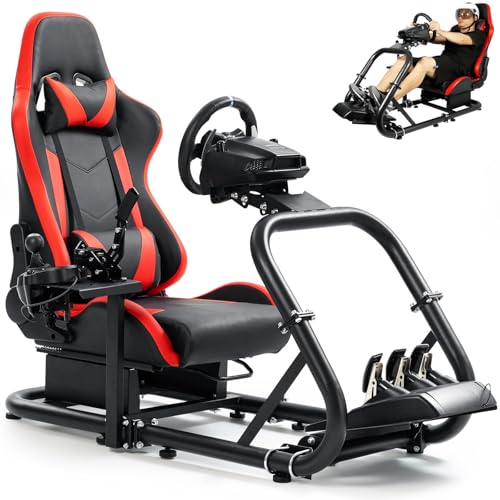
1. Marada Racing Simulator Cockpit with Red Seat
Our pick — over 4.5★ from 150+ verified ratings; the strongest balance of quality and price.
The crowd favorite that shrugs off 12Nm torque without a hint of flex.
The first thing owners mention is how solid this thing feels under a serious wheel. The 50x50mm large round tube frame connected with 4-hole flange joints is the kind of structure that doesn’t twist when a direct-drive base slams you into a corner, and reviews confirm it stands up to the punishment. What wins people over is the build quality — it’s the single most-discussed trait by a wide margin, and the assembly process is the second-biggest talking point, in a good way.
That assembly does take patience. Buyers report it takes roughly 5 hours and the rig weighs in around 80 lbs, so you’ll want a helper for the seat install — the trick is attaching the panels to the seat first. Once it’s up, a 6’1″, 210 lb driver fits comfortably, with the seat sliding forward and back, reclining from 90 to 180 degrees, and coming with neck and lumbar pillows. It slides across carpet easily, and Velcro straps keep cables tidy.
Compatibility is the real ace here: it’s built for Logitech G29/G920/G Pro, Fanatec DD, Thrustmaster T300/T598/T818, and Moza R3/R5 series. The steering wheel platform has two-stage adjustment for both height and angle, and the pedal angle and shifter settings are customizable. A few owners note the seat runs warm and could use more side bolstering, but for the money, this is the rig most people should start with.
What Earns the Top Spot
- Sturdy 50x50mm tube frame handles high-torque direct-drive wheels
- Seat reclines 90°–180° with neck and lumbar pillows included
- Works with Logitech, Thrustmaster, Moza, and Fanatec gear
What to Know Before Buying
- Assembly is a multi-hour project — set aside an afternoon
- At roughly 80 lbs, it’s not something you’ll move around casually
- USB cable routing and power cord management could be cleaner
Reach for this if: you’re stepping up to a direct-drive wheel and refuse to pay aluminum-profile prices for rigidity.
Think twice if: you need a rig you can fold up and stash between sessions — this is a permanent piece of furniture.
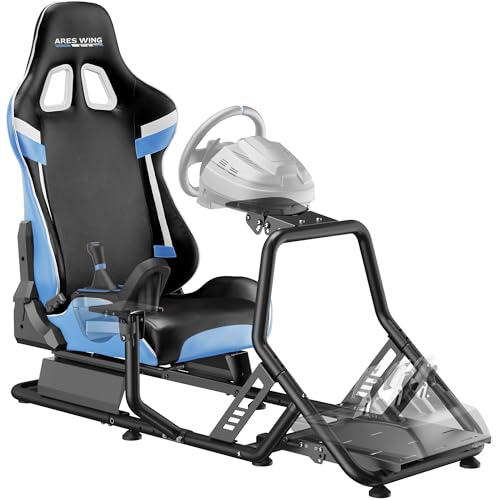
2. ARES WING Racing Simulator Cockpit, Blue
A 56.9-lb steel frame with legroom for a 6’5″ driver and no wobble.
If you’re over 6 feet tall, you won’t have to fold yourself into the ARES WING. Owners mention that a 6’5″ frame fits without knees hitting the wheel column, thanks to the upgraded strengthened frame structure designed to handle high-torque direct-drive wheels like the Fanatec Pro. At 53.7″D x 21.3″W x 42.5″H, it takes up more floor space than tight budget rigs, but that room is exactly what tall drivers need.
The seat offers 7.1″ of forward-and-back sliding and tilts from 90° to 150°, which owners say is firm like a real sports car rather than plush. Eight non-slip support feet at the bottom keep the whole thing from shaking during furious racing. Build quality gets steady praise, with thick metal and a rigid, no-flex feel that survives a bass shaker without rattling.
It takes about 2 hours to put together, and the wheel, pedals, shifter, and monitor mounts are all fully adjustable, with the shifter mount installable on left or right. The seat comfort pulls genuinely mixed feedback — some find it great, others swap in a junkyard car seat — and the steering column occasionally works loose for a few owners. Six cable management clips keep wires organized. This is a lot of rig for the money, especially if you’re built bigger than average.
Why it stands out: the sturdiest frame in its price band, with buyers praising its no-wobble rigidity more than anything else.
The honest trade-off: the seat padding splits opinion, and if you’re short, the wheel can’t move quite close enough without height blocks.
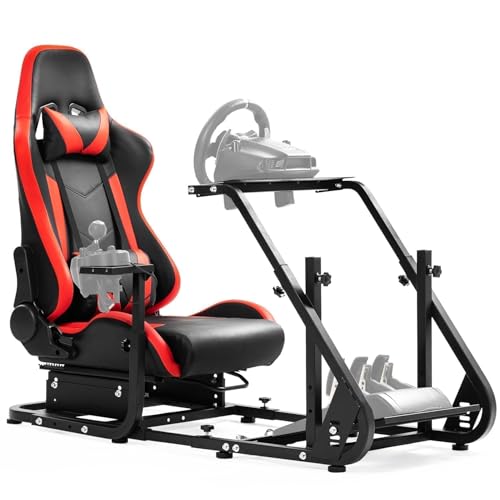
3. Dardoo G920 Racing Simulator Cockpit with Red Seat
High-strength alloy steel that big and tall drivers say fits comfortably.
If your last IKEA build ended in frustration, the Dardoo is the rig that changes your mind. Customers note the assembly instructions use clear pictures that are easy to follow, and the build quality punches well above the price — quality, durability, and comfort all get positive reviews, with sturdiness confirmed by bigger drivers who fit without issue. The high-strength alloy steel frame handles the G29, G920, G923, Thrustmaster T300RS, and Moza R5, so it works with most popular wheels.
The seat is the surprise highlight. It uses dual-lock, dual-slide rails for front-to-back positioning, a three-level height adjustment, and a backrest that reclines from 90° to 180°, giving you the full range you’d want for relaxing between stints. Owners describe it as genuinely comfy, not just “good for a sim rig.” The setup includes built-in cable management straps and eight non-slip foot pads to protect your flooring.
Compared to the Marada above, the Dardoo weighs 72.1 lbs — noticeably lighter while still feeling solid — and its compatibility list skews more toward Logitech and Thrustmaster than Fanatec or Moza. There are pre-installed upgrade points for adding a monitor mount later. One owner bought this specifically as a teaching tool and found the realistic sensations helped a new driver learn the rules of the road. Solid, easy, and comfortable covers the essentials.
The Highlights
- Pictorial instructions make assembly genuinely easy
- Seat reclines 90°–180° with three-level height adjustment
- Built-in cable straps and eight non-slip foot pads
Worth Watching
- Compatibility list is lighter on Fanatec and Moza gear
- A few owners find the seat padding firmer than expected
Grab this one for: a stress-free build experience and a genuinely comfortable reclining seat that suits bigger frames.
skip it if: you already own a Fanatec or Moza base that isn’t on the compatibility list.
4. DIWANGUS Foldable Racing Simulator Cockpit
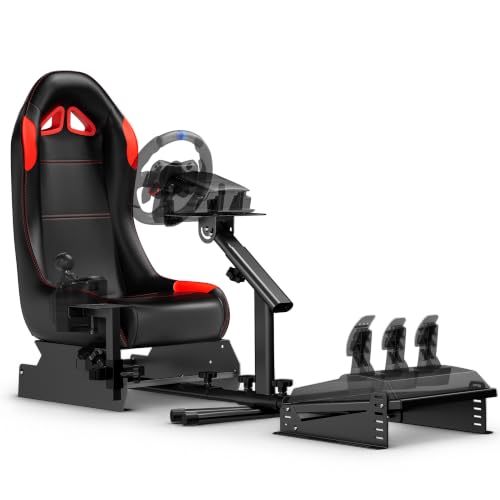
The 45-lb foldable that stands in the closet with your wheel still attached.
Apartment-dwellers, this is your rig. The DIWANGUS folds down to 65 x 49 x 115 cm and stores upright while your compatible wheel and pedals stay mounted — no re-cabling every session. At just 45 lbs, it’s by far the lightest fixed-seat cockpit here, and the folded footprint means it disappears into a corner when friends come over. The included seat stays fixed, though, so there’s no slide or recline to adjust.
Value for money is the loudest praise in the reviews, with buyers calling the seat quality near the level of units costing more. The wheel deck adjusts for height, a 20°-30° angle, and fore-aft position, while the pedals get distance and 3-step tilt adjustment. The frame supports riders up to 7 ft and 375 lb, which is remarkable for something this compact.
The catch is durability and stability — the most-discussed aspects come back mixed. Bolts have been known to loosen after first use (keep the included Allen wrench handy), the seat pivot doesn’t have a manual lock, and the pedals and wheel supports feel shakier than the pricier fixed frames. A buyer who set up two of these for his boys says they’ve lasted a good while with the occasional tightening. If you need a rigid rig for high-torque wheels, this isn’t it. If you need a light, storable cockpit for a Logitech-class wheel, it’s a steal.
Perfect for: renters and small rooms where a 50-inch permanent frame is a dealbreaker.
Not for: direct-drive torque monsters — this frame favors entry-level wheels and gentle hands.
5. Next Level Racing GTLite Pro Foldable Racing Cockpit

A GT-style foldable that surprisingly handles 13Nm direct-drive without flexing.
You’d expect a foldable cockpit to fold under pressure, but the GTLite Pro from Next Level Racing is rated for entry-level direct-drive wheelbases up to 13 Nm (a measure of torque, or twisting force). Owners running an 8Nm Fanatec base confirm it stays rock-solid through intense drifting. The GT-style padded seat gets the most praise for comfort, with buyers noting it fits anywhere from 5’2″ to 5’9″ and stays breathable through long sessions — one owner logged 5-10 hour stints comfortably.
What makes this a beginner favorite is the tool-free adjustment system. You can tweak the wheelbase plate and pedal angle without searching for an Allen key, and the whole thing folds compactly for transport or storage. The included shifter and handbrake mount works with both accessories, and it suits kids and adults of different sizes.
The flip side is quality control. Assembly experiences are the most-discussed aspect and they’re genuinely mixed — some say a 20-minute easy build, others report bent parts on arrival and soft metal hardware that deforms, requiring a rubber mallet. The flexible frame in the shifter plate area also means the handbrake mount can flex. When you get a good unit, it’s outstanding value. When you don’t, the return process is the remedy. The 13Nm rating makes it the most capable foldable here.
What Wins People Over
- Foldable design stores upright with gear still attached
- Rated for direct-drive wheelbases up to 13 Nm
- Tool-free, quick adjustments for personalized setups
The Fit Note
- Quality control is inconsistent — some units arrive with bent parts
- Shifter plate can flex when using a handbrake
Choose this if: you want a foldable that won’t embarrass itself when you eventually upgrade to a direct-drive base.
Be ready for: a possible quality-control lottery on arrival — inspect your box carefully.
6. Next Level Racing F-GT Lite Foldable Simulator Cockpit
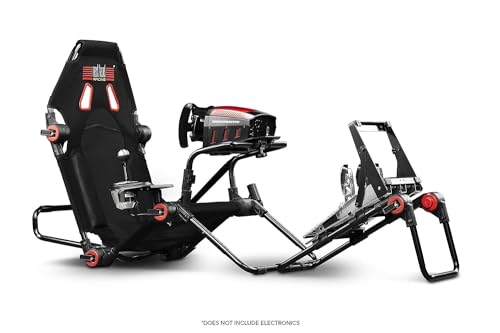
The legendary NLR-S015 that switches between Formula and GT seating in minutes.
This is the cockpit with a genuine a neat extra: you can switch from a laid-back Formula position to an upright GT position quickly, thanks to the Next Level Racing Hubs adjustment system. That flexibility is why the F-GT Lite has a massive following — it’s the pick for sim racers who race F1 cars one day and GT3 cars the next, and a 6’3″ driver reports being very comfortable in the F1 position. The seat is made from highly-breathable fabric for long sessions.
At 42 lbs, it’s the lightest of the Next Level Racing foldables here, and it folds in under 5 minutes — though it’s large and heavy enough when folded that owners say it’s easier to slide aside than to fully set up and tear down every time. The wheel, gear shifter, and pedal positions and angles all adjust, with the shifter mounting on the left or right side. It’s pre-drilled for Logitech, Thrustmaster, and Fanatec gear, so you can mount your existing wheel without extra adapters.
The mixed feedback centers on durability and build quality. Reviewers point out paint scratches on the tubing from the start, misaligned holes that need loosening to align, and a seat that gets uncomfortable after about 2 hours. The tube slots are tight enough that some use a hammer to align holes. Still, the value for money is rated positive by the most people, and the adjustability — once you get it set — is excellent. It’s the most versatile foldable on this list, at the cost of some polish.
Why it endures: no other budget foldable switches between Formula and GT positions, and that versatility has kept it popular for years.
Know this: you trade some build refinement for that flexibility — expect to fiddle with alignment and a firmer seat.
7. VIVO Racing Simulator Cockpit with Wheel Stand

A 21.5-inch-wide steel recliner that’s outlasted three and a half years of racing.
Few budget rigs have the track record of the VIVO. Buyers who’ve owned it for 3 and a half years report zero regrets, with the sturdy frame handling an 8Nm Fanatec force feedback base without issue. The all-alloy-steel construction and solid back seat get consistent praise, and the compact 21.5″ x 51.2″ x 44.5″ footprint makes it among the most space-efficient fixed seats you can buy. Assembly is straightforward with included hardware and pictorial instructions.
The tilting wheel mount and a chair that slides forward, backward, and reclines to your preferred angle give you real adjustability for a permanent rig. It’s a universal design that fits most racing wheels from Logitech, Thrustmaster, and Fanatec, and the gear shift can install on the left or right hand side. The product includes the chair and frame only, so you pair it with your own wheel, pedals, and shifter.
The seat comfort is where opinions split — several owners find it uncomfortable for long sessions and fixed it with a simple 2-inch gel cushion. The shifter mount also sits at an odd angle for some. But the build quality tops the positive list, and for a first rig that you’ll eventually outgrow, the VIVO holds its own. It’s the most proven, no-surprises starter cockpit in this lineup.
Why It’s Trusted
- Proven longevity — happy owners at the 3.5-year mark
- Handles 8Nm Fanatec force feedback without flex
- Compact 21.5-inch width fits tight gaming corners
Before You Commit
- Seat is firm — a gel cushion helps for long stints
- Shifter mount angle isn’t ideal for every setup
Trust it for: a dependable first rig that’s comfortable enough to keep for years while you learn the hobby.
Plan around: the firm seat — budget for a cushion if you race for hours.
8. GTPLAYER Racing Simulator Cockpit with Seat and Bluetooth Speakers

A 63-lb steel throne with built-in Bluetooth speakers and wheels that roll on carpet.
The GTPLAYER is the only rig here that comes with its own sound system. Built-in Bluetooth speakers pump race audio right behind your head, and while owners note the bass is modest, the convenience of not needing a separate speaker setup wins people over. The frame uses 2-inch alloy steel pipes, cold-pressed and bent, and the maker claims it stays “as sturdy as a rock” even with the seat reclined at 160° and a high-torque direct-drive wheel attached. The overall dimensions measure 51.2in x 21.7in x 43.3in.
The memory foam and premium leather seat is the second-most praised feature, with owners from 5’8″/300 lb to 6’2″/200 lb reporting comfortable 12-hour sessions. It reclines fully and includes 6 wheels so the whole rig rolls easily across carpet — a nice touch for repositioning. The adjustability covers the wheel, seat, and pedals, and it fits a 49″ ultrawide monitor setup at low profile. The panel hole positions are compatible with Logitech, Fanatec, Thrustmaster, and Moza, though some wheels need DIY drilling for a perfect match.
Assembly takes about 2 hours and really needs two people, especially for the shifter mount. A few owners found mounting holes misaligned with certain wheel bases requiring drilling and zip ties, and the adjustability and assembly both get mixed feedback. The packaging splits into two boxes — if one arrives first, the other is on its way. For a rig that rolls, reclines, and plays its own music, the GTPLAYER is uniquely fun.
The Standout Features
- Built-in Bluetooth speakers save you a separate audio setup
- Six wheels let the 63-lb rig roll easily on carpet
- Memory foam and leather seat comfortable for 12-hour marathons
Fair Warning
- Some wheel bases need DIY drilling to align mounting holes
- Speakers lack bass — fine for ambience, not a sound system
Perfect if: you want an all-in-one rig with audio, mobility, and a plush reclining seat.
Not ideal if: you expect plug-and-play mounting for every wheel brand — bring a drill for some setups.
9. Marada 8040 Aluminum Profile Pro Racing Simulator Cockpit
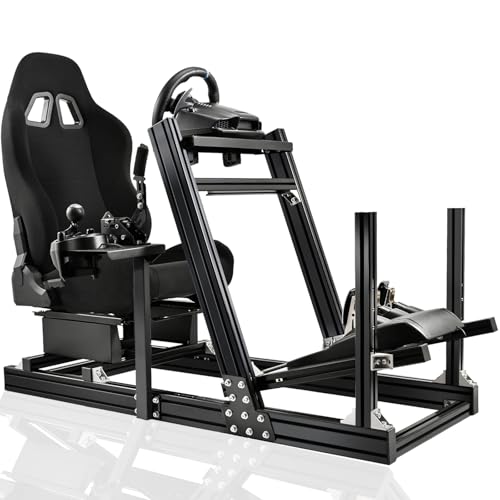
The 104.7-lb aluminum-profile endgame that runs an 18Nm wheel with zero flex.
This is the rig you buy when you’re done upgrading. The Marada 8040 is built from 40x80mm solid aluminum profile — the same construction style as rigs costing twice as much — and owners running an 18nm direct-drive base report absolutely no flex, no shaking, and no coming apart during intense gaming. The embedded slots and sliding rails allow unlimited adjustment of the seat, steering wheel bracket, and footrest, open up three driving modes: F1, truck, and off-road.
The ergonomic black seat is breathable, horizontally adjustable like a real car seat, and designed not to collapse over long use. Compatibility spans Logitech G29/G920/G923, Thrustmaster T300RS/T598/T818, Moza R5, and Fanatec DD Pro.
Assembly is the one real hurdle — it’s the most time-consuming build here at anywhere from a few hours to 8 hours, depending on who you ask, and the illustrated instructions are small and occasionally wrong about screw sizes. Owners recommend a tape measure and level, plus a helper. The seat also lacks lumbar support from the start, easily fixed with a pillow. If you have the patience for one big build, this is the last cockpit you’ll ever need to buy.
The Endgame Arguments
- 40x80mm aluminum profile handles 18Nm direct-drive with zero flex
- Unlimited adjustment across seat, wheel, and pedals
- F1, truck, and off-road driving modes in one rig
Plan Your Build Day
- Assembly can take up to 8 hours and needs mechanical patience
- Instructions have errors — bring a tape measure and level
Buy this if: you’re committed to sim racing long-term and want to skip the upgrade path entirely.
Reserve a full day: this build is a project, not a quick assembly — but it pays off with class-leading rigidity.
Understanding the Specs
Frame Material and Torque Ratings
Frame material determines how much force your rig can handle. Round steel tube (like 50x50mm) and alloy steel are budget-friendly and sturdy, while aluminum profile (like 40x80mm) is the gold standard for rigidity and adjustability. A rig rated for a specific Nm torque number — like 12Nm or 13Nm — tells you it can handle a direct-drive wheel without twisting. If a cockpit doesn’t mention direct-drive at all, assume it’s best suited for entry-level geared wheels like the Logitech G29.
Weight as a Stability Signal
Heavier rigs are generally more stable. A 104.7-lb aluminum rig will resist force feedback far better than a 45-lb folding frame. But weight cuts both ways — a heavy rig is a permanent fixture, while a lighter one can be moved or folded. Consider your floor. Rigid frames often benefit from casters or rubber feet, and some cockpits include non-slip pads to protect flooring and prevent sliding.
Seat Adjustability Range
The seat is where your body spends hours, so its adjustment range matters. A sliding rail (like 7.1″ of travel) and a reclining backrest (90° to 180°) let you match your real driving posture and accommodate different drivers. Some budget rigs have fixed seats with no slide or recline — those save money but can be cramped for taller users. A breathable fabric seat beats leather for long sessions, though leather is easier to clean.
Compatibility Lists Are Contracts
Before buying, check the exact wheel models a cockpit supports. A list like “Logitech G29/G920, Thrustmaster T300RS, Moza R5” means those bases bolt directly onto the wheel deck without drilling. A vague “fits most wheels” claim often means you’ll be handling a drill or zip ties. If you already own a specific base or plan to upgrade to direct-drive, make sure it’s on the list — or be prepared to DIY.
FAQ
Will a budget cockpit handle a direct-drive wheel?
Is a foldable cockpit as stable as a fixed one?
How long does it take to assemble a racing cockpit?
Will a cockpit fit a tall or heavy driver?
Do I need to buy a steering wheel and pedals separately?
Can I mount a shifter and handbrake to these rigs?
What is the difference between Formula and GT seating positions?
Are the included seats comfortable for long racing sessions?
Final Thoughts: The Verdict
For most people, the budget racing sim cockpit winner is the Marada 50mm Tube Rig because it delivers direct-drive-ready rigidity and a reclining seat at a price that leaves room for a wheel and pedal upgrade later. If you need to fold your rig away between races, the Next Level Racing GTLite Pro is the capable foldable choice. And for those building a permanent rig designed to handle an 18Nm wheel without flex, the Marada 8040 Aluminum Profile is the endgame pick.
How We Picked
We do not accept paid placement. Every pick is matched to a real buyer and a real use-case; we do not hands-on test units.
Sources & Methodology
Specifications: manufacturer listings and product documentation. Review insights: verified customer reviews, as of August 2026. Pricing: not shown on this page (it changes often); check the current price via the retailer link.
As an Amazon Associate, Gadgets Feed earns from qualifying purchases. This does not affect which products we feature.