
A dead battery on a cold morning is almost always preceded by signs a simple voltmeter misses. The difference between a battery that just needs a charge and one that’s truly finished is a load test — and that’s what a dedicated 12 volt battery tester is built to deliver. These tools measure internal resistance and cold cranking amps (CCA), giving you a concrete health percentage rather than a vague voltage reading that can look fine on a dying battery.
I’m Rikta — the co-founder and writer behind Gadgets Feed. I’ve spent countless hours analyzing technical specifications and comparing the algorithms, display quality, and safety features of dozens of battery testers to identify which ones actually give you reliable, repeatable results. (And Homer 🐱 supervised every test, bolting upright every time the KW600’s waveform graph lit up the room).
Whether you’re a DIY mechanic trying to avoid an unnecessary replacement or a technician needing a fast, accurate tool for the shop, this guide breaks down the key specs and real-world performance of the best options available. Read on for a detailed look at the 12 volt battery tester market and find the model that fits your workflow.
How To Choose The Best 12 Volt Battery Tester
Not all battery testers work the same way. Some apply a physical load and measure voltage drop, while others use conductance technology to calculate internal resistance. Your choice depends on battery type, CCA range, and how much detail you need about your charging system.
Analog vs. Digital: Two Testing Philosophies
Analog load testers like the Battery Tender dump a heavy current (often 100 amps) across the battery and show the voltage drop on a needle gauge. They are simple, durable, and don’t rely on software — but they generate heat and require a cool-down period between tests. Digital testers use conductance algorithms that measure internal resistance in milliseconds, producing a health percentage (SOH) and estimated CCA without generating significant heat. Digital units are faster and safer for repeated testing, but they require a known CCA rating to compare against.
CCA Range and Battery Type Compatibility
Every tester lists a minimum and maximum CCA rating. For a standard passenger car, you need at least 1000 CCA of support. For trucks, SUVs, and heavy equipment, look for testers that go up to 2000 CCA. Also verify the tester works with AGM, EFB, GEL, and flooded lead-acid batteries — some budget models only handle one or two types. If you work on motorcycles or marine batteries, ensure the tester supports lower CCA values (around 100-200 CCA) as well.
Display Quality and Test Speed
A bright, high-contrast display matters when you are testing a battery in direct sunlight or a dim garage. Digital models with color LCDs or large segmented screens are easier to read at a glance. Test speed varies from 2 seconds to about 10 seconds — faster units use more advanced chipsets but may sacrifice some diagnostic depth. If you are a professional mechanic doing frequent tests, a sub-5-second cycle is a major time saver.
Quick Comparison
On smaller screens, swipe sideways to see the full table.
| Model | Category | Best For | Key Spec | Amazon |
|---|---|---|---|---|
| FOXWELL BT301 | Digital | Accurate diagnostics | 2.8″ color display, 6.5ft cable | Amazon |
| AUTOPHIX BAS100 | Digital | 12V & 24V systems | 99.98% accuracy claimed | Amazon |
| KONNWEI KW600 | Digital | Graphing & waveform view | 2.4″ color LCD, waveform | Amazon |
| Clore Solar BA9 | Digital | Pro-grade build | 4-line LCD, 40-1200 CCA | Amazon |
| TOPDON BT50 | Digital | Compact & portable | Spark-free, 8V min input | Amazon |
| Battery Tender 026-0020 | Analog | Simple analog load test | 100A load for 12V | Amazon |
| Sound Troubleshooting Kit | Combo | Relay + battery testing | Tests 4 & 5 pin relays | Amazon |
In‑Depth Reviews
1. FOXWELL BT301 12V Car Battery Tester
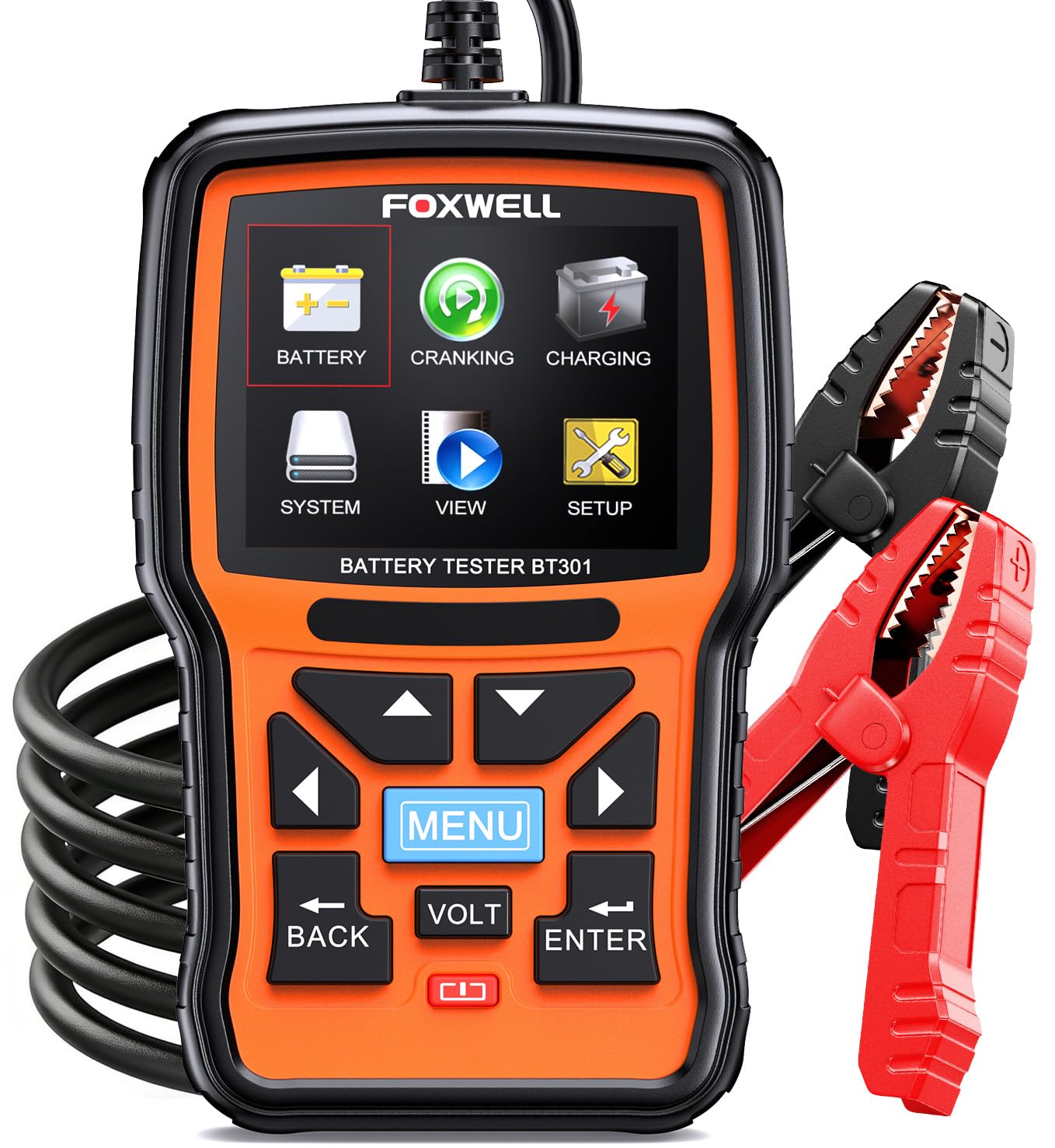
The FOXWELL BT301 sits at the top of this list because it combines a large 2.8-inch color display with a 6.5-foot testing cable — a pairing that makes live diagnostics from the driver’s seat genuinely practical. Its intelligent chip delivers up to 99.9% accuracy on SOH, SOC, and CCA measurements, and the starter and alternator tests go well beyond what most sub- testers offer. The bright screen stays readable in direct sunlight, a real advantage for outdoor roadside checks.
Compatibility covers flooded, AGM flat and spiral, EFB, and GEL batteries from 100 to 2000 CCA, making it useful across cars, trucks, motorcycles, boats, and lawn equipment. The unit is phantom-powered by the battery under test, so there are no internal batteries to replace. Reverse polarity protection and heavy-duty insulated clamps add a reassuring layer of safety, especially when working in tight engine bays.
Users consistently praise its accuracy versus professional shop equipment, with several noting the CCA readings matched their calibrated Fluke multimeter within a few amps. The included zip-up carrying case keeps everything organized, and the 6.5-foot cable eliminates the need for a helper during cranking tests. If you want a single reliable tool that covers every 12V battery scenario without compromise, this is the one.
Why it’s great
- Large color display with excellent sunlight readability
- Long 6.5ft cable for flexible testing positions
- 99.9% accuracy on CCA and SOH measurements
- Phantom-powered — no extra batteries needed
Good to know
- Must connect directly to battery posts, not ground points
- One unmarked button on the keypad is undocumented
2. AUTOPHIX BAS100 Car Battery Tester

The AUTOPHIX BAS100 stands out for its dual-voltage capability — it tests both 12V and 24V systems, covering everything from passenger cars to heavy-duty trucks and construction equipment. Its high-conductivity copper alligator clips with anti-slip coating ensure a stable connection that minimizes fluctuating readings, and the built-in AI chip processes results in seconds with a claimed 99.98% accuracy. The intuitive LCD display makes navigation straightforward even for first-time users.
Compatibility spans flooded, AGM flat and spiral, GEL, and EFB batteries across multiple rating standards (CCA, BCI, CA, MCA, JIS, DIN, SAE). The tester also includes a 4-in-1 smart protection system that guards against reverse connections, short circuits, over-voltage, and over-current. It works on batteries as low as 30 Ah, so small motorcycle and lawnmower batteries are within range, but it explicitly does not support lithium chemistries.
Verified buyers consistently report that the BAS100 matched dealership diagnostic results, with one user noting it correctly identified a failing battery at 8% SOH that a shop had misdiagnosed as an alternator issue. The compact sky-blue housing is lightweight and easy to store, and the unit is phantom-powered so there is no charging cable to lose. For anyone managing a mixed fleet of 12V and 24V equipment, this is the most versatile pick in its tier.
Why it’s great
- Tests both 12V and 24V systems
- High-accuracy AI chip with fast results
- Smart protection against reverse polarity and shorts
- Broad CCA standard support (JIS, DIN, SAE, etc.)
Good to know
- Not compatible with lithium batteries
- Cannot test batteries under 30 Ah
3. KONNWEI KW600 Car Battery Tester

The KONNWEI KW600 is the only model in this lineup with an oscilloscope-style waveform display, showing real-time voltage fluctuations during cranking and charging tests. Its 2.4-inch intelligent color LCD, powered by an STM-32 main chip, delivers crisp text and graphing that makes it easy to spot patterns like a weak alternator diode or a slow crank. The tester supports all common 12V lead-acid types — flooded, AGM flat and spiral, and GEL — with a CCA range of 100 to 2000.
Beyond standard SOH and SOC readings, the KW600 measures internal resistance in milliohms, a key metric for diagnosing battery degradation before it becomes critical. The firmware is updateable via the included Mini-USB cable, so you can keep the tester current without buying a new unit. The heavy-duty clips and long cables make it practical for large batteries in trucks and marine applications, though the screen can be hard to read in direct sunlight.
User reviews highlight its accuracy on deep-cycle AGM batteries and its ability to test non-automotive batteries such as those in UPS systems. One owner tested seven-year-old UPS batteries and found them at 2% SOH, confirming they were ready for recycling. The KW600 is a strong choice for anyone who wants the visual detail of a waveform graph alongside standard battery health metrics, especially for diagnosing intermittent electrical issues.
Why it’s great
- Oscilloscope waveform view for cranking/charging
- Measures internal resistance in milliohms
- Firmware updateable via USB
- Wide CCA range (100-2000)
Good to know
- Screen is difficult to read in bright sunlight
- Struggles with AGM batteries on hybrid vehicles
4. Clore Automotive SOLAR BA9 Digital Tester

The Clore Automotive SOLAR BA9 is a compact, professional-grade tester built around a four-line LCD that shows resting voltage, CCA, SOH, SOC, starting voltage, and charging system results without scrolling. Its 40-1200 CCA range covers most passenger vehicles and light trucks, and its 7-15V operating window works with standard 12V systems. The tester supports flooded, AGM, spiral, and gel cell batteries, making it a versatile tool for both home mechanics and small shop environments.
Unlike many digital testers that rely on user input for battery type and rating, the BA9 requires you to enter the battery’s rated CCA, then it compares that against measured conductance. A CCA reading 20% or more below the rated value indicates the battery should be replaced. This conductance-based method does not generate heat, so there is no cool-down period between tests, and the small form factor (0.6 pounds) makes it easy to stash in a glove box or tool pouch.
Experienced users consistently note that the BA9 can predict battery failure before symptoms appear — one reviewer in Phoenix uses it at every 5,000-mile oil change to catch heat-weakened batteries before they strand a driver. The LCD is easier to read in bright conditions than single-line LED displays found on the older BA7 model, though the manual is very basic and does not include on-screen instructions. For a no-frills, highly accurate conductance tester from a trusted brand, the BA9 is a measured upgrade.
Why it’s great
- Four-line LCD shows all results at once
- Lightweight and portable (0.6 lbs)
- Conductance-based — no heat generation
- Accurate CCA prediction for proactive replacement
Good to know
- Small manual is hard to read in windy conditions
- Lower CCA limit (1200) excludes large diesel trucks
5. TOPDON BT50 12V Battery Load Tester

The TOPDON BT50 is a slim, pocket-friendly tester (0.7 inches thick, 215 grams) that prioritizes safety with spark-free technology and reverse polarity protection. Despite its small size, it handles a 100-2000 CCA range and works with flooded, AGM, and GEL batteries across cars, trucks, motorcycles, and boats. The one-button operation and bright LCD make it accessible for beginners, while the six-language interface (English, Spanish, French, German, Italian, Russian) broadens its appeal for international users.
The BT50 uses conductance testing with an upgraded algorithm that delivers results in seconds, including SOH, SOC, cranking voltage, and charging system analysis. It operates on as little as 8 volts from the battery under test, so it can still function when the battery is deeply discharged. The anti-overheating safeguards and durable ABS housing add longevity, though the included cable length is shorter than some competitors at just under 3 feet.
User feedback is overwhelmingly positive for its speed and accuracy at the price point, with several professional lube techs noting it takes under 10 seconds for a full test. The main criticism is that the clamp grips are not as secure as heavier-duty units, and the short cables can make positioning awkward on larger vehicles. For a compact, travel-friendly tester that does not compromise on core diagnostics, the BT50 is a smart buy.
Why it’s great
- Ultra-compact and lightweight for portability
- Spark-free technology for safe operation
- Works with deeply discharged batteries (8V min)
- Multilingual interface
Good to know
- Short cables and weak clamp springs
- Not built for full-time professional shop use
6. Battery Tender 026-0020 Load Tester
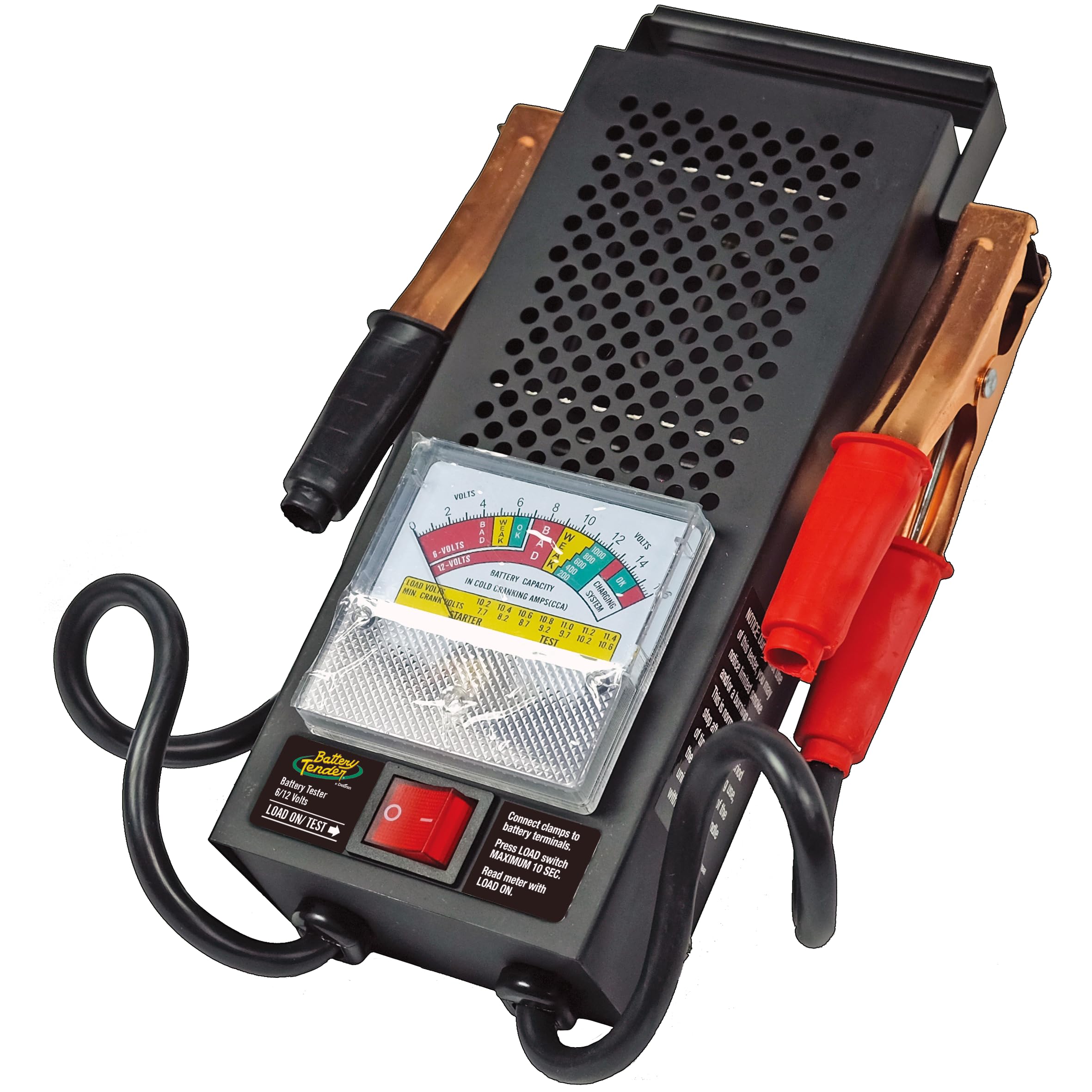
The Battery Tender 026-0020 is the only analog load tester on this list, applying a 100-amp load to 12V batteries (50 amps for 6V) and reading the voltage drop on a color-coded gauge. This is the same technology shops used for decades, and it still works — a needle that falls into the red zone under load means the battery cannot deliver its rated current. The rubber-insulated carrying handle and color-coded alligator clamps are built for rough handling, and the single toggle switch operation is as simple as it gets.
It supports starter and deep-cycle batteries for cars, trucks, SUVs, motorcycles, RVs, boats, and ATVs with up to 1000 cranking amps. The analog design has advantages and drawbacks: it is immune to software glitches and works with every battery chemistry (including lithium, provided it can handle the 100A load), but the resistive coil generates significant heat. The manual explicitly states you must follow run/cool time cycles to avoid burning out the internal coil.
Long-term users report the unit surviving over three years of regular use, and several note it is cheaper than comparable Harbor Freight models. The gauge is sensitive and easy to read, and the heavy-duty wire and clamps provide a solid connection. The main caveat is that it requires discipline with cool-down periods — running multiple back-to-back tests without a pause can damage the coil. For a reliable, no-electronics backup tool, this is a classic choice.
Why it’s great
- True 100A load test for definitive results
- Simple analog gauge, no software to fail
- Durable construction with insulated handle
- Works with all battery chemistries
Good to know
- Generates heat; requires cool-down between tests
- Lower CCA limit (1000) does not cover large diesel trucks
7. Sound Troubleshooting Relay & Battery Test Kit
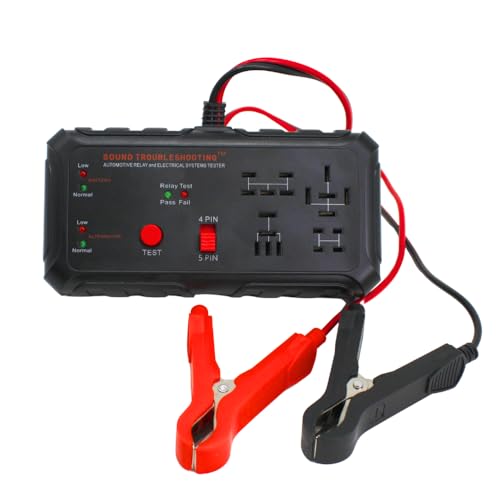
This kit from Sound Troubleshooting is a hybrid tool that combines a battery and alternator voltage checker with a 4-pin and 5-pin relay tester. The relay function is its standout feature — you plug a relay into the built-in socket, press the TEST button, and the unit’s LEDs show whether the coil and switching contacts are working correctly. This eliminates the guesswork of swapping relays one by one and is a genuine time-saver for electrical system diagnostics.
On the battery side, the heavy-duty clamps connect directly to the 12V battery terminals and display the voltage reading, confirming whether the battery holds a charge and the alternator produces the correct output. The unit is vehicle-powered, so it draws its operating current from the battery under test. The compact, lightweight design (0.4 kg) fits easily into a glove box or roadside toolkit, and the push-button operation requires no menus or settings.
Users praise the relay tester for catching bad relays without needing a multimeter or scope, with one reviewer noting it saved replacing an entire set of four relays just to find one faulty unit. The battery voltage test is basic — it does not calculate SOH or CCA — so it functions more as a quick-check voltmeter than a full battery diagnostic tool. For someone who regularly troubleshoots electrical issues involving both relays and battery voltage, this combo kit earns its place as a specialized problem-solver.
Why it’s great
- Tests 4-pin and 5-pin relays instantly
- Combines battery voltage check with relay test
- Simple push-button operation, no menus
- Compact and easy to store
Good to know
- Battery test is voltage-only, no load or CCA analysis
- Limited to 12V vehicle systems
FAQ
Can a 12 volt battery tester check an AGM battery?
What does “SOH” mean on a battery tester display?
Why does my battery read 12.6V but the tester says it is bad?
Can I test a lithium (LiFePO4) battery with these testers?
How often should I test my car battery?
Final Thoughts: The Verdict
For most users, the 12 volt battery tester winner is the FOXWELL BT301 because its 2.8-inch color display, 6.5-foot cable, and 99.9% accuracy combine pro-grade diagnostics with genuine ease of use. If you want dual-voltage flexibility for both 12V and 24V systems, grab the AUTOPHIX BAS100. And for the visual detail of a waveform graph plus firmware updateability, nothing beats the KONNWEI KW600.