
Our readers keep the lights on and my morning glass full of iced black tea. As an Amazon Associate, I earn from qualifying purchases.
Specs are compiled from manufacturer listings and verified buyer reviews and can change over time — please confirm the key details on the product page before buying.
A 360 drone captures the entire sphere in one pass, so you never aim the camera mid-flight. You capture the entire sphere in one pass, then pick your favorite angle back on the ground. These two picks show the two very different ways to get that freedom.
I’m Min — the founder and writer behind Gadgets Feed. This guide is built by comparing the manufacturers’ published specifications and the patterns across verified customer reviews, so you get each pick’s real strengths and trade-offs instead of marketing spin.
Your flying style, location, and editing appetite decide which 8k 360 drone fits you. If you crave a cinematic headset experience, you’ll lean one way; if you want a featherlight travel companion, you’ll lean another.
Our Picks at a Glance
How To Choose The Best 8K 360 Drone
First, pick your priority: an rich first-person flight experience or a compact, portable camera platform. These two goals lead to very different drones, so start with how you actually plan to fly.
Weigh the Flight Experience
The key question: do you want to see through the drone’s eyes in real time? rich goggles (headsets that show the drone’s camera feed) make you feel like you’re in the cockpit, which is thrilling but adds a learning curve. A lighter drone with a phone or controller view is easier for absolute beginners to manage.
Check the Weight Rules
Drones under 250 grams sit in a different, simpler regulatory category in many regions. At 249g, a drone can often be flown with fewer restrictions, and it’s light enough to pack for a trip without hesitation. Heavier drones above that mark bring more stability and often better features, but they come with more rules and a bigger carry case.
Understand What 360 Actually Delivers
A true 360 camera captures every direction at once, so you can re-angle the shot after you land. That means you fly once and frame later, instead of trying to aim a fixed camera mid-air. It’s the single biggest benefit of this category, and it changes how much pressure you feel while flying.
Quick Comparison
In‑Depth Reviews
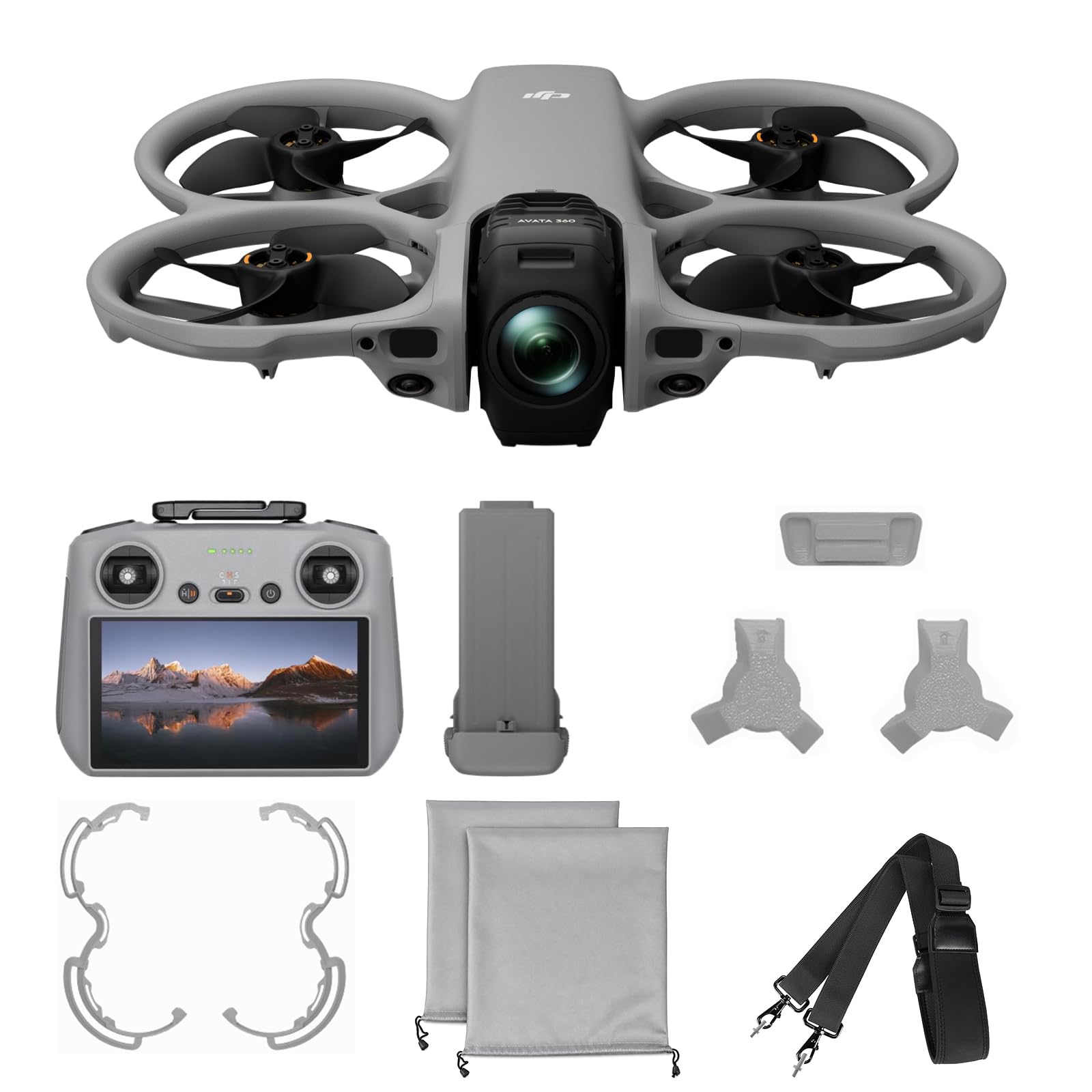
1. DJI Avata 360 (RC 2), 8K 360° Camera Drone with Protection Kit
The seasoned pilot’s pick: serious FPV range and a low-maintenance protection bundle in one box.
The defining trait here is the video link, not the camera itself. O4+ FHD Video Transmission delivers a clear 1080p/60fps feed straight to your screen, so what you see is sharp, smooth, and nearly lag-free. That’s the spec that makes high-speed, low-altitude flying feel safe, and it’s backed by a range that reaches up to 20 km [5] — the longest in this lineup, versus the Antigravity A1-360’s 10 km spec.
New gear is half the battle of going FPV. The Everyday Protection Bundle includes 3D-printed landing gear and impact guards to soften takeoffs, landings, and the occasional bump, without adding enough weight to change how it flies. You also get the DJI RC 2 (the remote controller), a neck strap, and two storage pouches, so the whole kit stays organized on the move. That said, this is the heavier of the two drones at 455g versus the A1-360’s 249g, and it shows in the size — the Avata’s 9.69″L x 7.83″W body is more compact on paper than the A1-360’s 12.14″L x 15″W footprint, but its extra mass means it sits in a heavier, more regulated flight category.
Buyers report the included parts are authentic DJI spares that fit original Avata frames perfectly. The one practical hiccup: the kit ships with screws but no Allen wrench or screwdriver, so keep a tool in your bag if you plan to swap a prop in the field. It’s a minor note, not a flaw — the entire bundle is built around reducing wear, and owners treat it as a dependable everyday setup.
Why it wins: the O4+ transmission and 20 km [5] range put real FPV capability in your hands, and the protection kit removes the anxiety of learning on a fresh drone. The crowd verdict is clear — it holds a 4.8-star average across hundreds of owners, the highest in this comparison.
Who it’s not for: if you want the absolute lightest, most travel-friendly drone with no registration hassle, the 455g weight pushes you toward the A1-360 instead.
The pick for: anyone who wants a proper FPV drone with strong signal stability and protection straight from the start.
Just know: carry your own hex tool — the screws are included, the driver is not.
2. Antigravity A1-360 Drone with Camera 8K, rich Goggles, Point-to-Fly
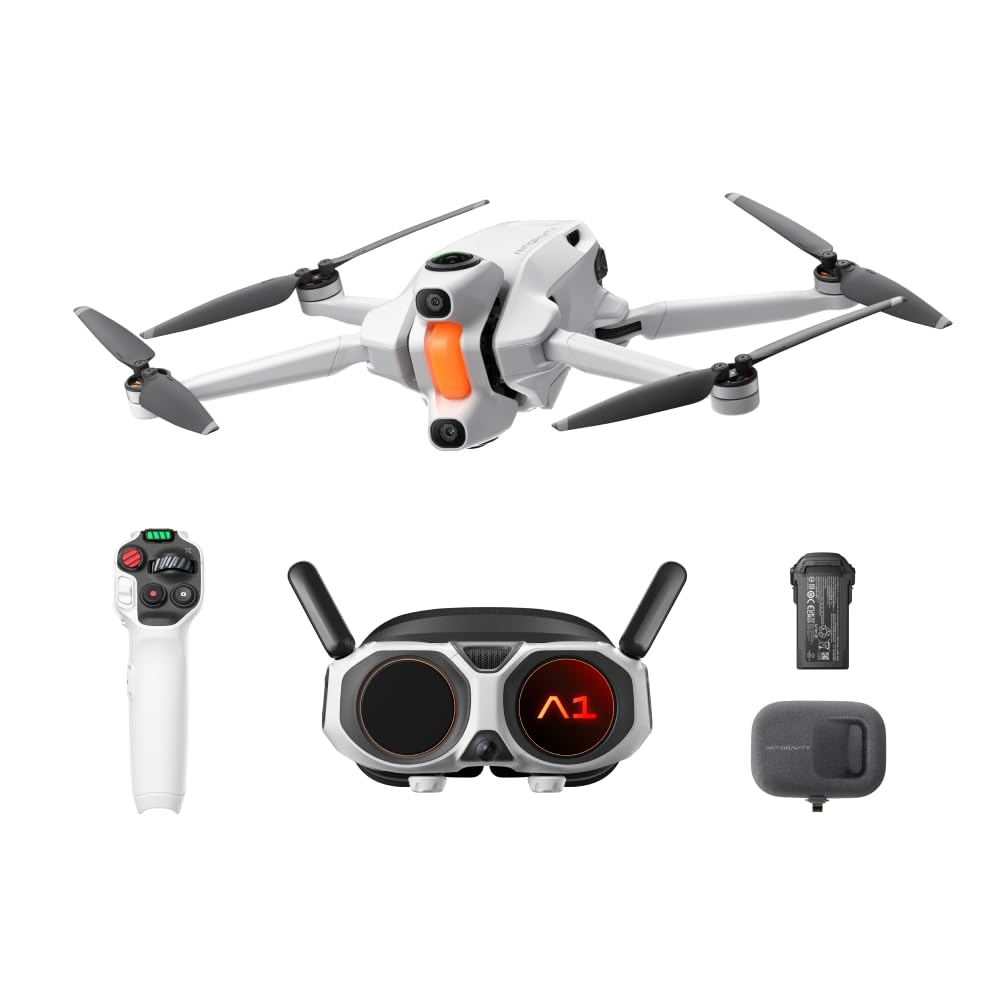
The fun-first 360 rig that turns flying into a game anyone can pick up.
The headline feature here is the Vision Goggles, and they are the reason people lose track of time. With a 90° FOV — which the specs note is 66% wider than standard goggles — plus dual 1-inch Micro-OLEDs and Pancake optics, the image wraps around your vision and makes you feel genuinely airborne. The whole goggle setup weighs 340g and has a built-in diopter adjustment, so you can dial in sharpness without wearing glasses underneath.
This is the drone that leans into 360 capture for pure fun. FreeMotion Mode lets you simply point where you want to go, while FPV Mode gives experienced pilots wrist-based control. The 8K 360 camera relies on Insta360’s stitching technology to hide the seams, which buyers confirm in practice — the footage comes out extremely detailed with no editing at all. The Sky Genie modes trigger aerial moves like arc shots with a single tap, and Deep Track keeps a subject centered automatically, so beginners get professional-looking results without studying flight theory.
At 249g, this is the featherweight of the pair — versus the DJI Avata’s 455g — and it folds down small enough to live in a backpack. Owners mention flying it for about an hour on a single charge of its 2360 mAh battery, with a stable signal out to roughly 300 feet in real-world tests. The fun factor is the thing everyone raves about: a dusk flight with crisp night video and saved flight routes turned one session into a memorable birthday moment. It’s the drone that makes kids and grown-ups alike want to charge up and go again.
What wins people over
- Goggles deliver a genuinely rich, glasses-free view with a wide 90° FOV
- Point-to-fly motion control is instantly learnable for absolute beginners
- Lightweight 249g body is the most portable and travel-friendly option here
- Omnidirectional obstacle avoidance adds confidence for new pilots
Honest trade-offs
- 10 km maximum range versus the DJI Avata’s 20 km [5] spec
- Plastic build and beginner focus won’t satisfy hardcore FPV racers
- The 55 MP still resolution is impressive, but the 12.14″L x 15″W footprint is the biggest of the two when unfolded
Reach for this if: you want a travel-friendly, genuinely fun first 360 drone with the most rich goggles in this comparison.
Look elsewhere if: you need the longer range and heavier-duty FPV transmission of the DJI Avata 360.
Understanding the Specs
Drone Weight and 249g Rule
Weight is the single most practical spec on a drone. Models under 250 grams sit in a simpler, less-regulated class in many countries, which means fewer registration steps and more freedom to fly. The Antigravity A1-360 hits 249g to fit in that category, while the DJI Avata 360 at 455g trades that simplicity for more mass and stability. Lighter also means easier to pack for travel; heavier usually means more wind resistance and a steadier hover.
FOV and Goggle Immersion
FOV, or field of view, is how much of your peripheral vision a goggle display fills. A wider FOV makes you feel like you’re inside the flight instead of watching a small screen. The Antigravity A1-360’s goggles use a 90° FOV with dual 1-inch Micro-OLEDs to create that wrap-around sensation. For a true sense of being airborne, prioritize a wide FOV and clear optics over just the resolution number.
FAQ
What does a 360 drone actually do differently from a normal camera drone?
Is a 249g drone better than a 455g drone?
How important is obstacle avoidance on a beginner 360 drone?
What is the real-world battery life of an 8K 360 drone?
Can I fly an 8K 360 drone without goggles?
Does a higher maximum range matter for casual flying?
What goes into the DJI Avata 360 Protection Kit?
Is the Antigravity A1-360 good for kids or complete beginners?
Final Thoughts: The Verdict
If you want one dependable pick, the 8k 360 drone winner is the DJI Avata 360 because it combines the longest transmission range, a protection kit, and the highest owner satisfaction. If you want the most rich goggles and the lightest travel drone for pure fun, grab the Antigravity A1-360. And for beginners who want to feel like they’re flying fantasy missions instead of piloting a camera, the A1-360’s point-to-fly controls are the reason to reach for it.
How We Picked
We do not accept paid placement. Every pick is matched to a real buyer and a real use-case; we do not hands-on test units.
Sources & Methodology
Specifications: manufacturer listings and product documentation. Review insights: verified customer reviews, as of August 2026. Pricing: not shown on this page (it changes often); check the current price via the retailer link.
As an Amazon Associate, Gadgets Feed earns from qualifying purchases. This does not affect which products we feature.