
Our readers keep the lights on and my morning glass full of iced black tea. As an Amazon Associate, I earn from qualifying purchases.
Specs are compiled from manufacturer listings and verified buyer reviews and can change over time — please confirm the key details on the product page before buying.
If you are reading this, you likely have a basement that smells musty, feels sticky, or shows damp spots on the walls. The fix is a machine that pulls water out of the air before mold and mildew get a foothold. This guide covers the best 70-pint-class dehumidifiers for that job, with honest detail on what each one actually does well and where it cuts corners. Note on sizes: this list takes a flexible approach to the “70 pint” mark — every unit here removes at least 50 pints a day, and most pull far more, so you get a machine that handles a real basement.
I’m Min — the founder and writer behind Gadgets Feed. This guide is built by comparing the manufacturers’ published specifications and the patterns across verified customer reviews, so you get each pick’s real strengths and trade-offs instead of marketing spin.
We’ve matched each unit to real basements, so you can find the right 70 pint dehumidifier for basement by capacity, noise, and drainage without sorting through 200 near-identical listings.
Our Picks at a Glance
How To Choose The Best 70 Pint Dehumidifier For Basement
Basements are cooler and damper than the rest of your home, so they push a dehumidifier harder than a bedroom ever would. Buy the biggest capacity you can fit, then check the drainage setup — that single choice decides whether you empty a bucket daily or never think about it again.
Read the “pints” number carefully
Manufacturers quote two numbers. One is the dramatic “max” figure at 95°F and 95% humidity, and the other is the realistic standard figure at 86°F and 80% humidity. A basement runs closer to the standard number, so that is the one to compare between models — a unit rated 52 pints at standard conditions will feel very different from one rated 70 or 80.
Drainage decides your daily routine
Every unit here has a removable tank, but a tank in a basement fills fast. If you can reach a floor drain or a nearby sink, look for a machine that accepts a hose for continuous drainage — the reviews show that owners who set up a hose almost never look back, while those who rely on the tank are emptying it several times a day in peak humidity.
Noise matters more than you think
If your basement is a workshop, home gym, or second living room, a droning compressor will drive you out of it. The quietest units here sit around 40–45 dB, which is a soft background hum, while louder ones can reach 50 dB or more. Check the decibel rating before you buy, not after.
Quick Comparison
| Model | Best For | Max Pints/Day | Coverage | Noise Level | Amazon |
|---|---|---|---|---|---|
| boglvr 4500 Sq.Ft★ Best Overall | Overall value & smart control | 80 pints | 4500 sq ft | 40–45 dB | Amazon |
| KNKA 5500 Sq.FtWidest Coverage | Largest coverage area | 80 pints | 5500 sq ft | 40–45 dB | Amazon |
| MIONJO 4500 Sq.FtTargeted Drying | Adjustable airflow drying | 80 pints | 4500 sq ft | 40 dB | Amazon |
| AEOCKY Leo-Lite | Energy Star v6 efficiency | 74 pints | 4500 sq ft | 44 dB lowest | Amazon |
| KeepGlad 4500 Sq.Ft | Whisper-quiet operation | 80 pints | 4500 sq ft | 35 dB | Amazon |
| Waykar 5000 Sq.Ft | Proven track record (20K+ owners) | 80 pints | 5000 sq ft | 42 dB | Amazon |
| NYpeak Wi-Fi 5000 Sq.Ft | App control & auto swing | 80 pints | 5000 sq ft | Below 35 dB | Amazon |
| DECIUU 5000 Sq.Ft | High-capacity premium pick | 100 pints | 5000 sq ft | Quiet (not specified) | Amazon |
| Vellgoo 6000 Sq.Ft | Extreme capacity for huge spaces | 140 pints | 6000 sq ft | Low noise | Amazon |
| Moiswell Defender ME-7 | Compact metal commercial unit | 70 pints | 1000 sq ft | Super quiet | Amazon |
| Prikod 70 Pint | Tough metal crawl-space duty | 70 pints | 1000 sq ft | Quiet | Amazon |
In-Depth Reviews
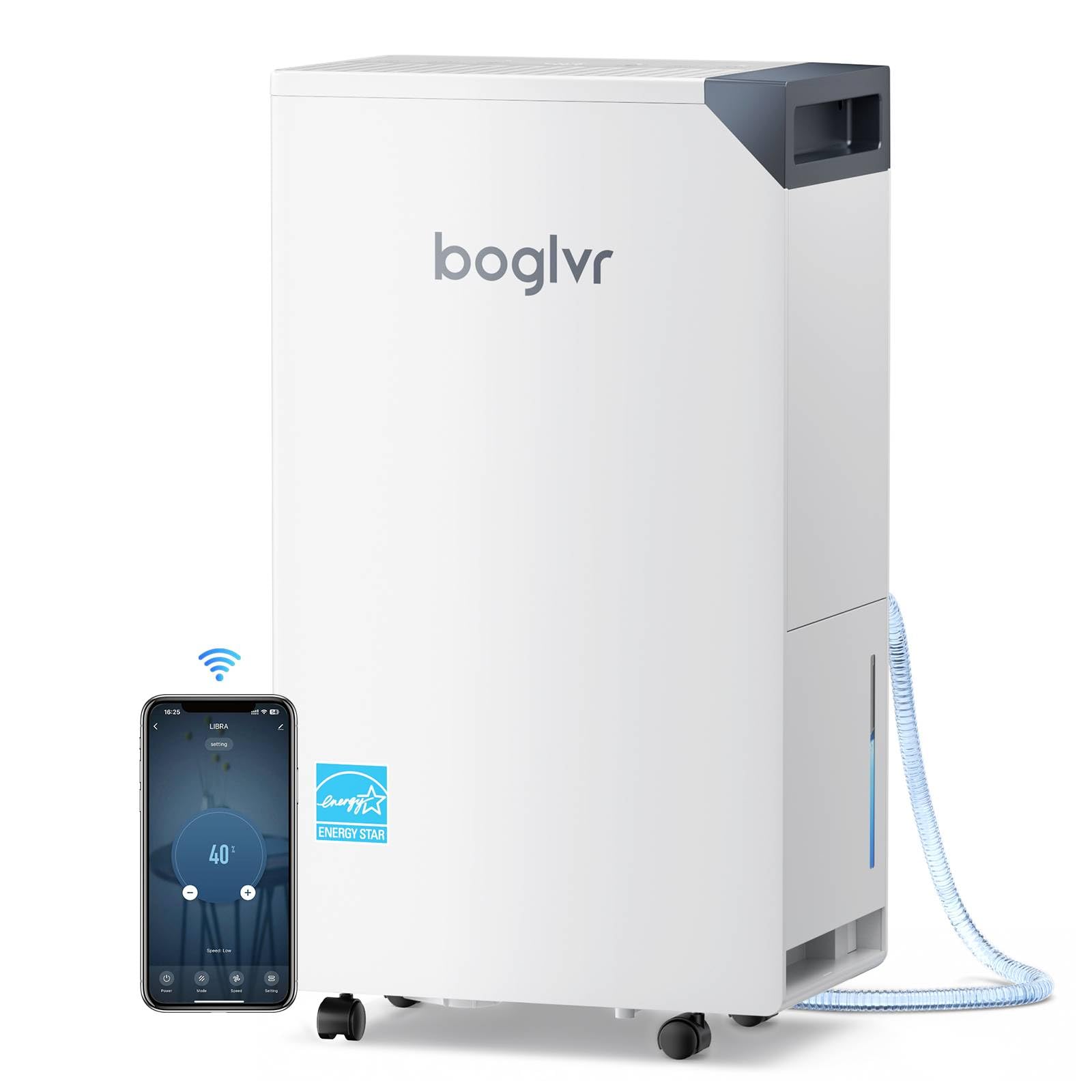
1. boglvr 4500 Sq.Ft Smart Dehumidifier
Our pick — over 4.5★ from 250+ verified ratings; the strongest balance of quality and price.
The connected pick that dries a 4,500 sq ft basement and lets you watch it from your phone.
Your basement drops from a swampy 75% to a dry 50% in about five days — that’s the real-world result buyers report with this boglvr unit., which removes up to 80 pints a day at peak conditions. Under standard basement conditions it still pulls a solid 52 pints daily while covering up to 4,500 sq ft, so this isn’t a machine you’ll outgrow. The built-in WiFi means you can adjust humidity, flip modes, or check the current moisture level from your phone through the Tuya or Smart Life app on iOS or Android.
It’s also unusually quiet for its size, running at just 45 dB on high — about the level of a soft whisper — and dropping to a near-silent 40 dB in Sleep Mode. That makes it viable for a bedroom or home office, not just a remote basement. The 5.5L (1.25-gallon) tank auto-shuts off when full, but the included drain hose is the smarter play for continuous hands-free drainage. At 31.3 pounds with smooth caster wheels and a hidden handle, it rolls easily between rooms.
What wins people over is the whole package: strong drying, app control, and a whisper-quiet compressor in one. The recurring trade-off is the tank size — owners mention the reservoir is small next to the machine’s output, so you’ll want that hose connected rather than emptying the bucket by hand.
Why it leads the list
- WiFi and touch-panel control from anywhere
- Quiet 40–45 dB operation with a dedicated Sleep Mode
- Covers up to 4,500 sq ft with 80 pints/day max output
What to plan around
- Small 5.5L tank fills fast — use the drain hose
- Large footprint; customers note it needs real floor space
Reach for this if: you want app control, quiet operation, and heavy drying power all in one unit for a large basement.
Think twice if: floor space is tight — this machine is physically bigger than photos suggest.
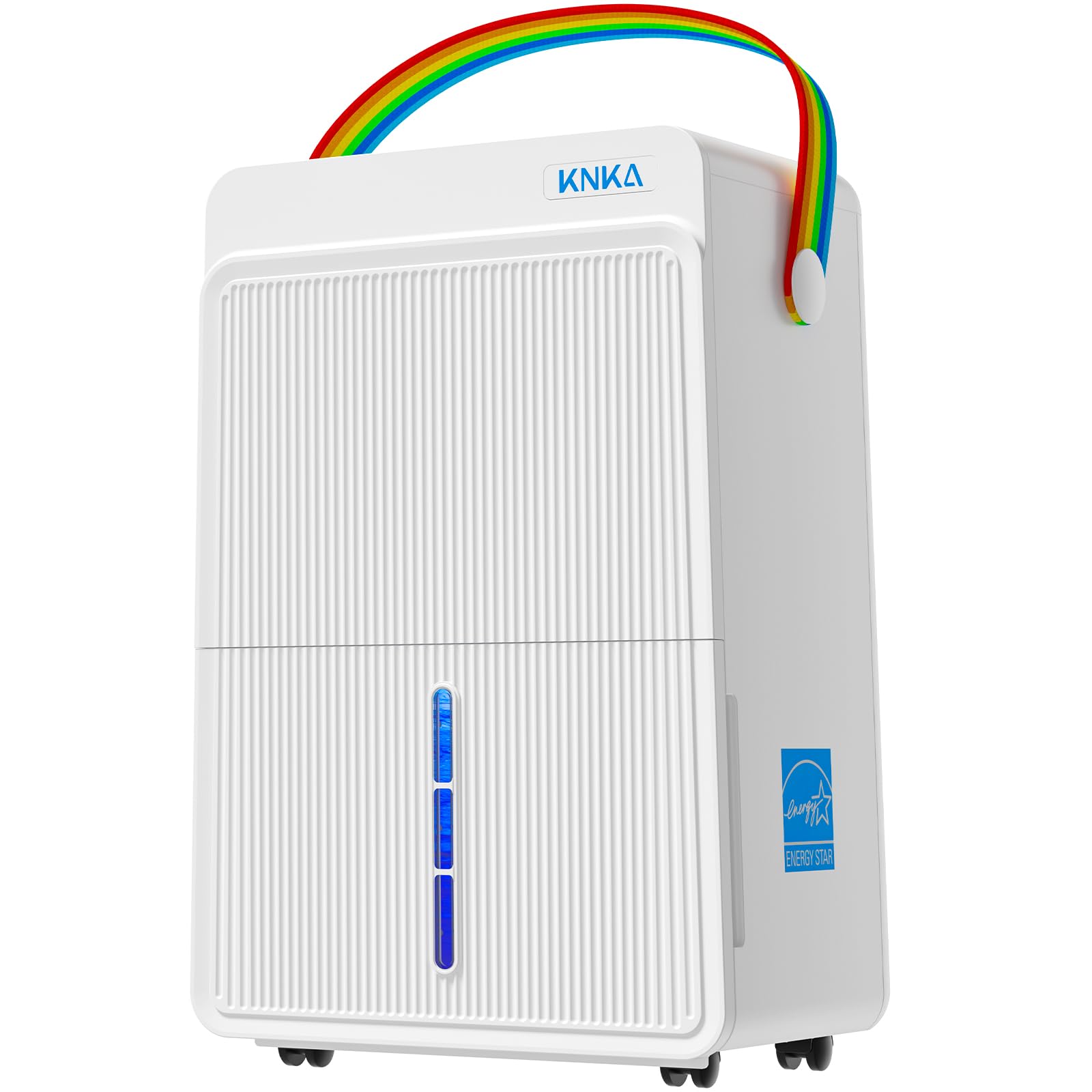
2. KNKA 5500 Sq.Ft Dehumidifier
The biggest net of the bunch — a 5,500 sq ft reach with a 1.45-gallon tank that’s easy to empty.
If you have a truly oversized basement or a half-finished walkout level, this KNKA is built for the job. It covers up to 5,500 sq ft — that’s 22% more floor area than the boglvr’s 4,500 — while removing up to 80 pints a day in humid mid-summer conditions and 56 pints a day in typical basement conditions at 86°F and 80% RH. The built-in 1.45-gallon tank comes out easily for quick empties, and the included 6.56 ft drain hose lets you run it continuously instead.
The clever extra here is the optional 2.64-gallon external tank, sold separately, which clips on for far fewer trips to the drain. Owners rate the humidity control highly — a color-changing breathing light on the display reflects moisture levels at a glance, and the machine auto-cycles to hold your target. At 40–45 dB it’s quiet enough for a bedroom or living area, not just a basement corner. The 12-hour timer, child lock, 360° casters, and built-in cord storage round out a very complete package.
What wins people over is moisture removal and build quality — the two most-discussed strengths by a wide margin. The honest caveat: like the boglvr, it’s a substantial machine, and you should keep it upright for 24 hours after delivery before first use.
Best value per square foot: class-leading coverage for the price, with a tank that’s genuinely pleasant to remove and empty.
The one thing to know: buy the optional external tank if you want to empty less often — it changes the daily routine entirely.
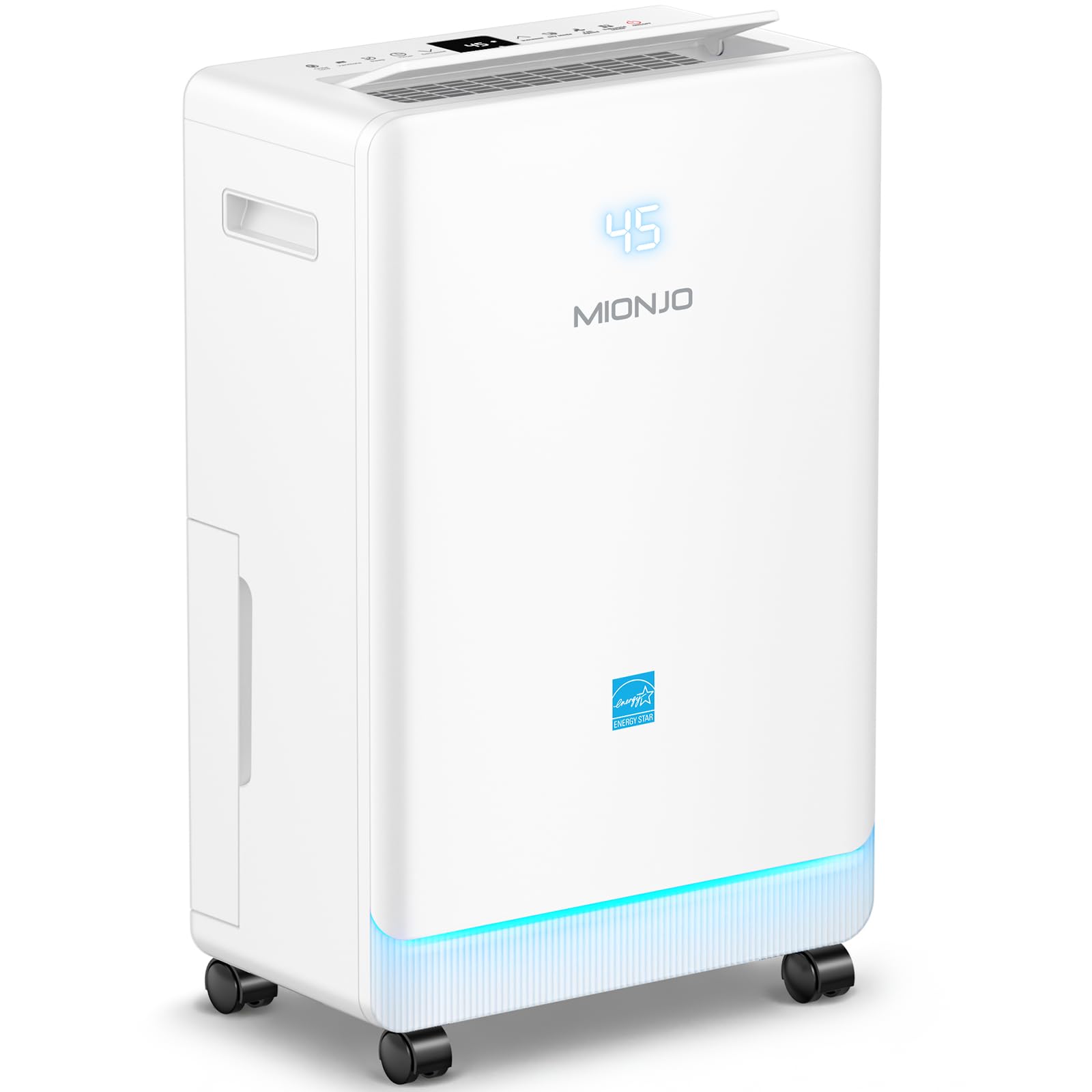
3. MIONJO 4500 Sq.Ft Dehumidifier
The only unit here that aims its dry air exactly where you need it, corners and damp laundry included.
Most dehumidifiers just blow air straight up, but this MIONJO has a 90° adjustable outlet that directs dry air into stuffy corners, away from skin, or straight at wet laundry for faster drying. That single feature makes it the most versatile pick for a basement that doubles as a laundry or utility space. It pulls up to 80% of the moisture daily across 4,500 sq ft, with a 1.72-gallon tank that self-shuts off when full plus an included drain hose for continuous operation.
At just 40 dB — quieter than a library — it’s among the most discreet units on this list, and one-tap sleep mode drops it even further for overnight use. The self-developed rotary compressor saves 55% of internal space for smoother airflow, while smart sensors auto-trigger defrost and overload cutoffs to protect the machine during long basement runs. Four 360° swivel wheels make it easy to glide between rooms.
The thing everyone raves about is effectiveness — owners see fast moisture removal in underground basements and call the intelligent humidity control a genuine comfort upgrade. The trade-off to note: it’s not Energy Star rated like some rivals, so if maximum efficiency is your priority, check the ratings on competing models first.
The standout feature: aimable airflow for drying laundry or clearing trapped corner moisture.
Fair warning: no Energy Star badge here, so it may cost slightly more to run than the certified units.
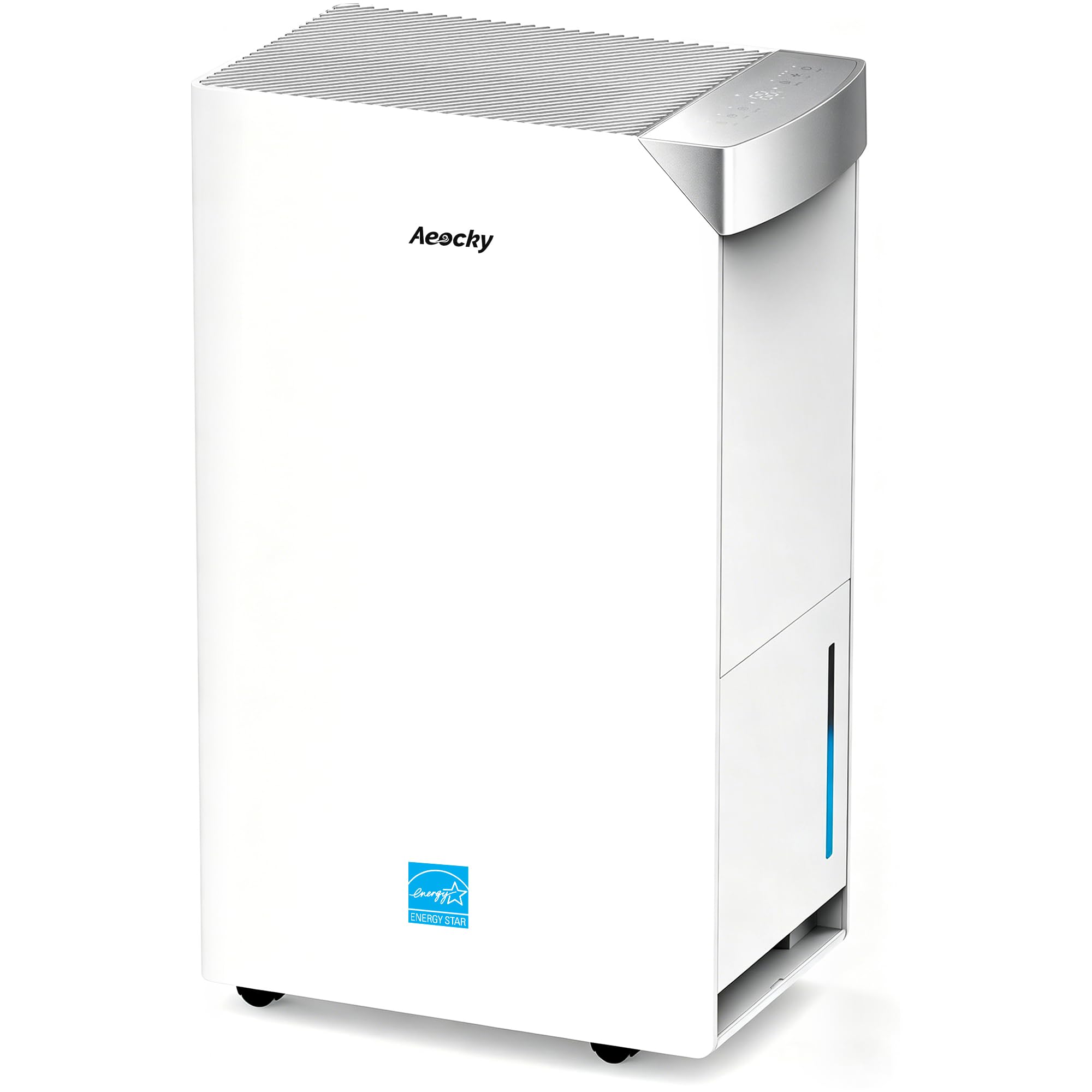
4. AEOCKY Leo-Lite 4500 Sq.Ft
The efficiency champion — Energy Star Version 6.0 with barely-there noise and 2.5 gallons pulled daily.
If energy savings matter as much as drying power, this AEOCKY Leo-Lite is the pick. It meets the strict latest Energy Star Version 6.0 standard. — the brand claims efficiency improved by up to 50% versus non-certified units — while removing 74 pints a day in humid mid-summer and 52 pints a day in a warm, damp basement. Reviewers point out pulling up to 2.5 gallons of water daily while holding a steady 55% moisture level, all at a claimed power draw of just 280 watts..
Quiet is the other headline: the lowest fan speed is just 44 dB, running like white noise, and the brand says even the highest setting stays quieter than rivals’ lowest. At 14.4″D x 8.6″W x 23.3″H and 31 lbs, it’s compact for its capacity — roughly half the weight of older units owners replaced. The auto-defrost system is a genuine plus for basements, kicking in below 65°F to keep the coils clear instead of shutting down. A power-off memory function means it resumes your settings after an outage, which pairs neatly with a smart plug.
What wins people over is the quiet operation and precise humidity control. The honest caveat: a few shoppers say the water bucket is on the smaller side for a machine this thirsty, so plan on the included drain hose for set-and-forget service.
What makes it special
- Latest Energy Star Version 6.0 efficiency rating
- 44 dB lowest fan speed — quieter than most competitors even on high
- Auto-defrost keeps working in cool basements below 65°F
Worth knowing
- Modest tank size means frequent empties without the hose
- Brand recommends letting it sit upright 24 hours before first use
Best for: efficiency-focused owners who want the newest energy standard and near-silent operation in a compact frame.
Look elsewhere if: you refuse to set up a hose — the small tank is the one real friction point.
5. KeepGlad 4500 Sq.Ft Dehumidifier
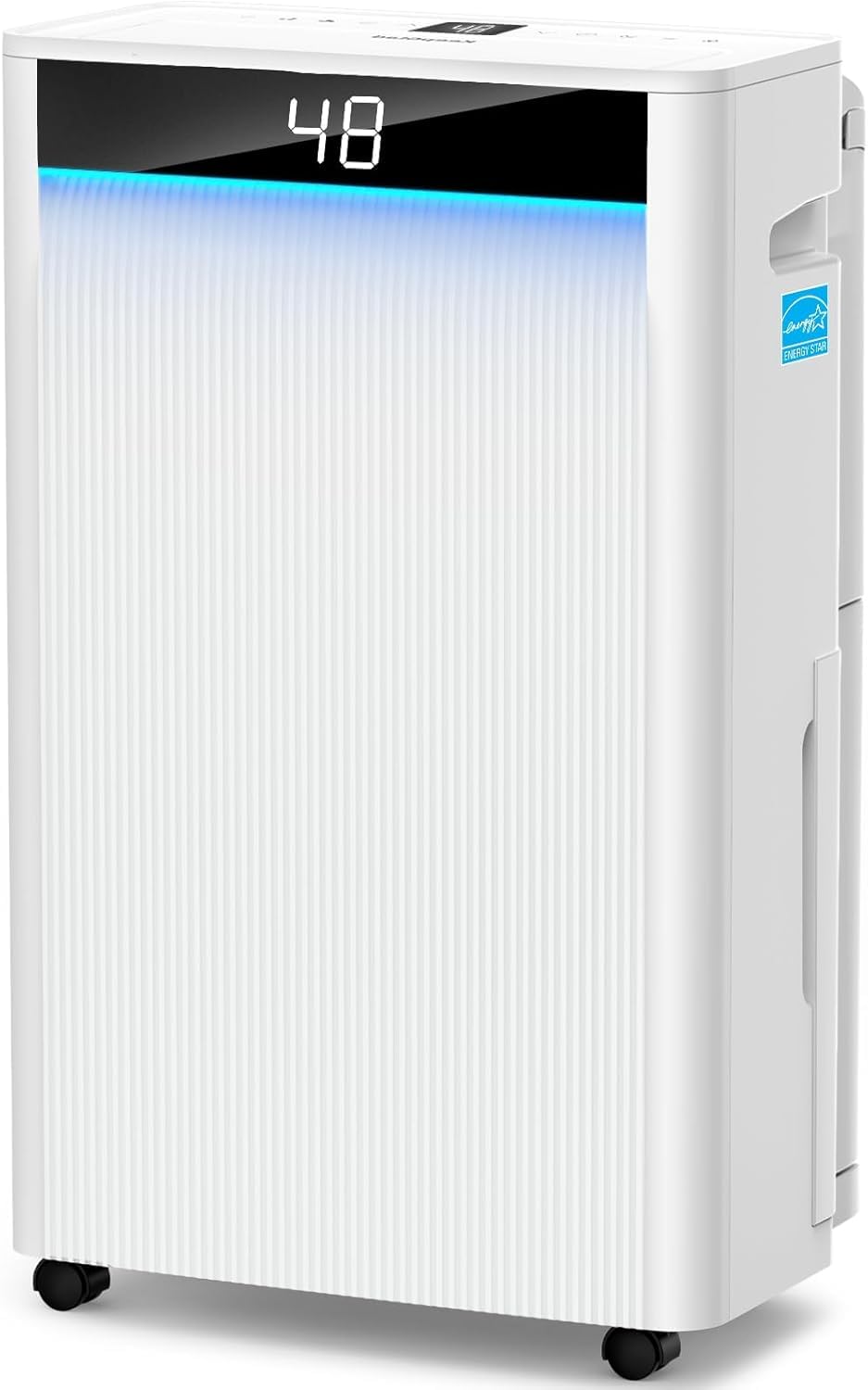
The quietest claim on the list — 35 dB — wrapped in a machine that handles a 4,500 sq ft basement.
If your basement doubles as a bedroom, home office, or playroom where silence matters, this KeepGlad is tuned for you. The brand rates it at an ultra-low 35 dB — quieter than a library whisper — and owners consistently confirm it runs nearly unnoticeable. Performance holds up too: up to 80 pints a day in humid mid-summer, 56 pints in typical basement conditions, across 4,500 sq ft, with a 24-hour timer and child lock for low-maintenance operation.
The four smart modes give you real flexibility. Comfort Mode auto-adjusts based on room temperature, Dry Mode hits 30–80% RH precision for bedrooms or wood furniture, Turbo Mode speeds up basement or bathroom drying, and Continuous Mode can drive humidity down to 30% RH for long-term storage. A 90° adjustable outlet pairs with auto-swing to aim dry air where it’s needed, and the built-in display glows in changing colors to show humidity at a glance. The washable mesh filter and RCS-grade recycled materials keep maintenance simple.
What wins people over is the combination of quiet and effectiveness — owners note the color-changing indicator and smooth, stable build as standout details. The one thing to plan for: at 14.37″D x 8.07″W x 23.82″H it’s a tall unit, so make sure you have the vertical clearance and floor space it needs.
Why pick this: the lowest noise floor on the list, ideal for a basement you actually live in.
Mild caveat: tall footprint; check shelf clearance before you commit.
6. Waykar 80 Pints 5000 Sq.Ft

The proven workhorse — over 20,000 owners have trusted this 80-pint unit to dry their basements.
With tens of thousands of owners, this Waykar has the longest track record on the list, and the consensus is clear: it just works. It removes up to 80 pints a day at 95°F and 90% RH across up to 5,000 sq ft, and buyers report holding a steady 50% RH in basements over months of continuous use — one even used it to dry stacked lumber. The 90° auto-swing airflow distributes dry air evenly rather than blowing one corner dry while leaving another damp.
Flexible humidity control is a real differentiator here: it can reach as low as 30% RH, lower than many rivals stuck at 40%, which matters for storage rooms and closets. At 42 dB it hums quietly in the background, and the 24-hour timer lets you schedule operation. The built-in 4.3L (1.14-gallon) tank is easy to remove, and the included 3.3 ft drain hose connects to a standard 3/4-inch garden hose for continuous drainage without extra adapters.
What wins people over is effectiveness and performance — by far the two most-discussed strengths. The honest caveats are minor but real: a few owners mention the humidity readout can run a bit off from a separate hygrometer, and the drain hose is on the flimsy side. Waykar’s U.S.-based support gets consistent praise for fast, responsive service when issues do surface.
The safe bet: massive review history and dependable drying at a very approachable price.
Minor gripes: humidity display can read high, and the included hose feels thin — budget for a replacement.
7. NYpeak Wi-Fi 5000 Sq.Ft
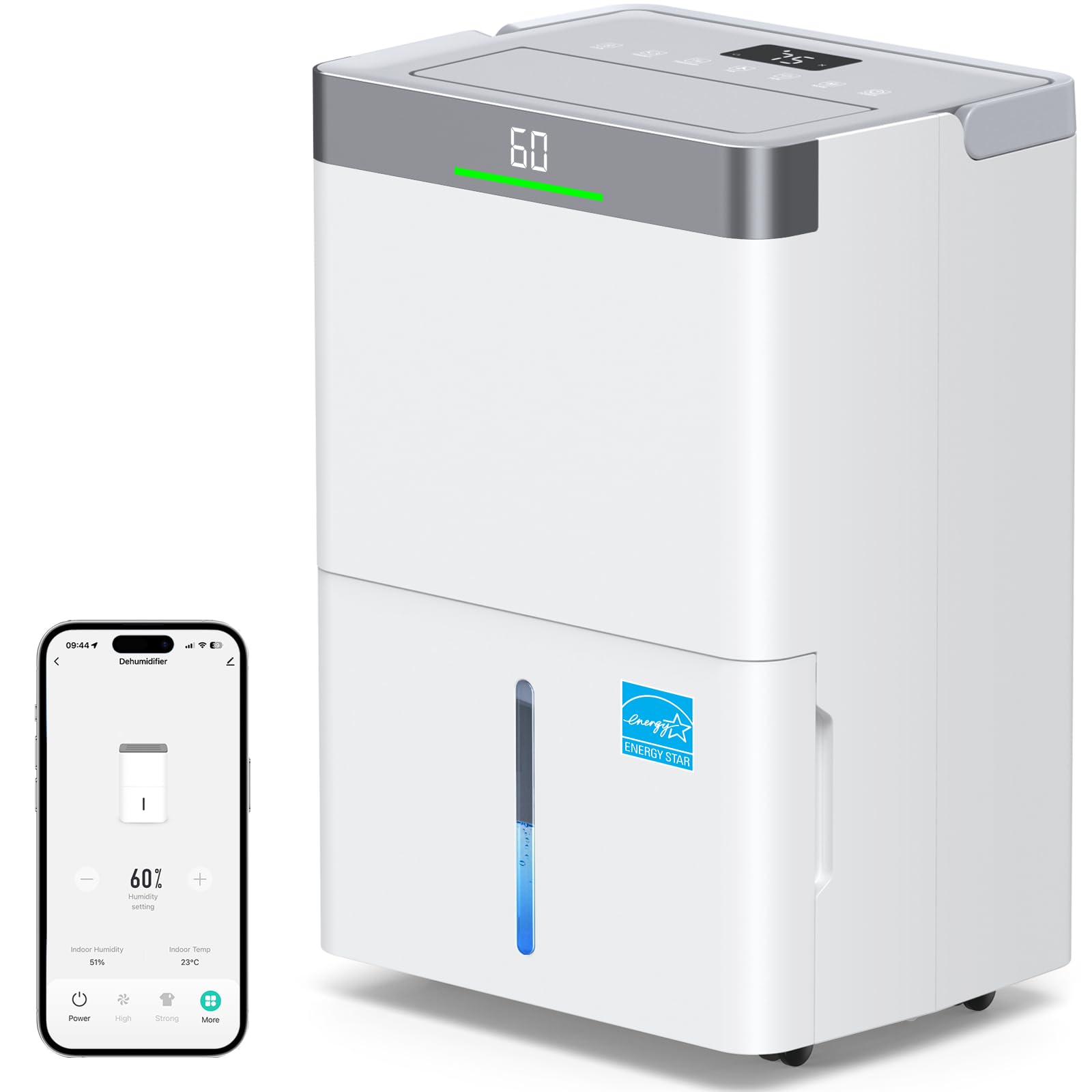
The app-first pick that lets you check basement humidity from the couch, plus whisper-quiet running.
Owners upgrading from older 50-pint units say this NYpeak is a huge step up — one holds a 3,000 sq ft basement at 45% RH where the old unit could only manage 60%.. It removes up to 80 pints a day at 95°F and 90% RH, with a wide performance curve: 60 pints at 86°F and 80% RH, 35 pints at 80°F and 60% RH. The WiFi app control is the headline feature, letting you monitor humidity from anywhere and even sending drain notifications when the tank needs attention.
At below 35 dB it claims the quietest operation on this list, with sleep mode that dims the panel lights and cuts noise further for nighttime use. The 1.45-gallon removable tank reduces empty frequency, and the included 3.35 ft drain hose plus a garden hose connector supports continuous drainage. Auto-swing airflow, two fan speeds, a foldable handle, and 360° universal wheels make placement easy, while power-outage memory automatically restores your previous settings after an outage.
What wins people over is the dehumidification power and the genuinely useful phone app. The one thing to note: drainage is gravity-only — there’s no built-in pump — so your drain point needs to sit below the unit.
Why owners love it
- WiFi app with drain alerts and remote humidity monitoring
- Sub-35 dB operation with a true sleep mode
- Auto-restart after power outages restores your settings
Check before buying
- No built-in pump — gravity drain placement required
- Auto-swing and 2 speeds, but no dedicated laundry dry mode
Reach for this if: you want to monitor and control basement humidity from your phone with the quietest operation available.
Plan around: the lack of a pump if your basement floor drain sits higher than the unit.
8. DECIUU 5000 Sq.Ft 100 Pint
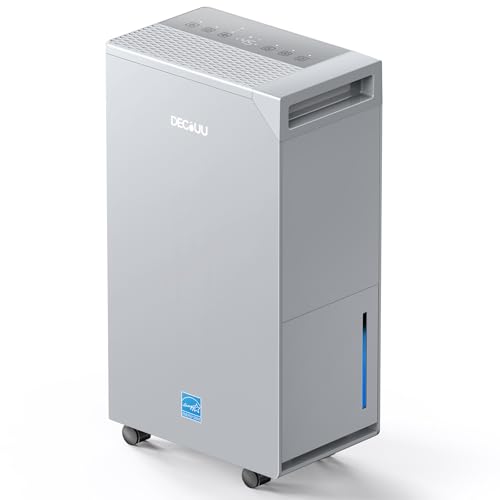
The overachiever — 100 pints of raw capacity for basements that flood with moisture.
For the wettest basements — the ones where a standard 70-pint unit runs constantly and still falls behind — this DECIUU steps up with up to 100 pints per day at 95°F and 90% RH, and 70 pints at 86°F and 80% RH. That extra headroom means it cycles on and off rather than running nonstop, which owners noticed right away: several report humidity dropping from the mid-70s to the mid-40s within a week of hookup.. It covers up to 5,000 sq ft, making it a whole-home option, not just a basement machine.
It earns the ENERGY STAR Most Efficient 2024 badge, one of the highest efficiency standards available., so that extra power doesn’t necessarily mean an extra bill. Three drainage options cover every setup: a 5.5L (1.45-gallon) tank for manual empties, the included 6.56 ft drain hose for continuous service, or a standard 3/4-inch garden hose for extended reach. Intelligent humidity control spans 35%–80% RH, with auto-defrost to keep coils clear in cooler basement air. At 32.8 pounds with 360° swivel casters and a hidden handle, it’s easy to reposition.
What wins people over is the sheer effectiveness in large basements plus the sturdy build quality. The honest trade-offs: a few owners wish the tank were bigger given the machine’s appetite, and one flagged that the heavy-duty packaging can be awkward — any dehumidifier this size should be kept upright and settled for 24 hours before its first run.
Why it earns the premium label: 100-pint capacity is the class above the rest, with efficiency to match.
Know this: the tank is compact for a machine this thirsty — route the hose for best results.
9. Vellgoo 6000 Sq.Ft 140 Pint
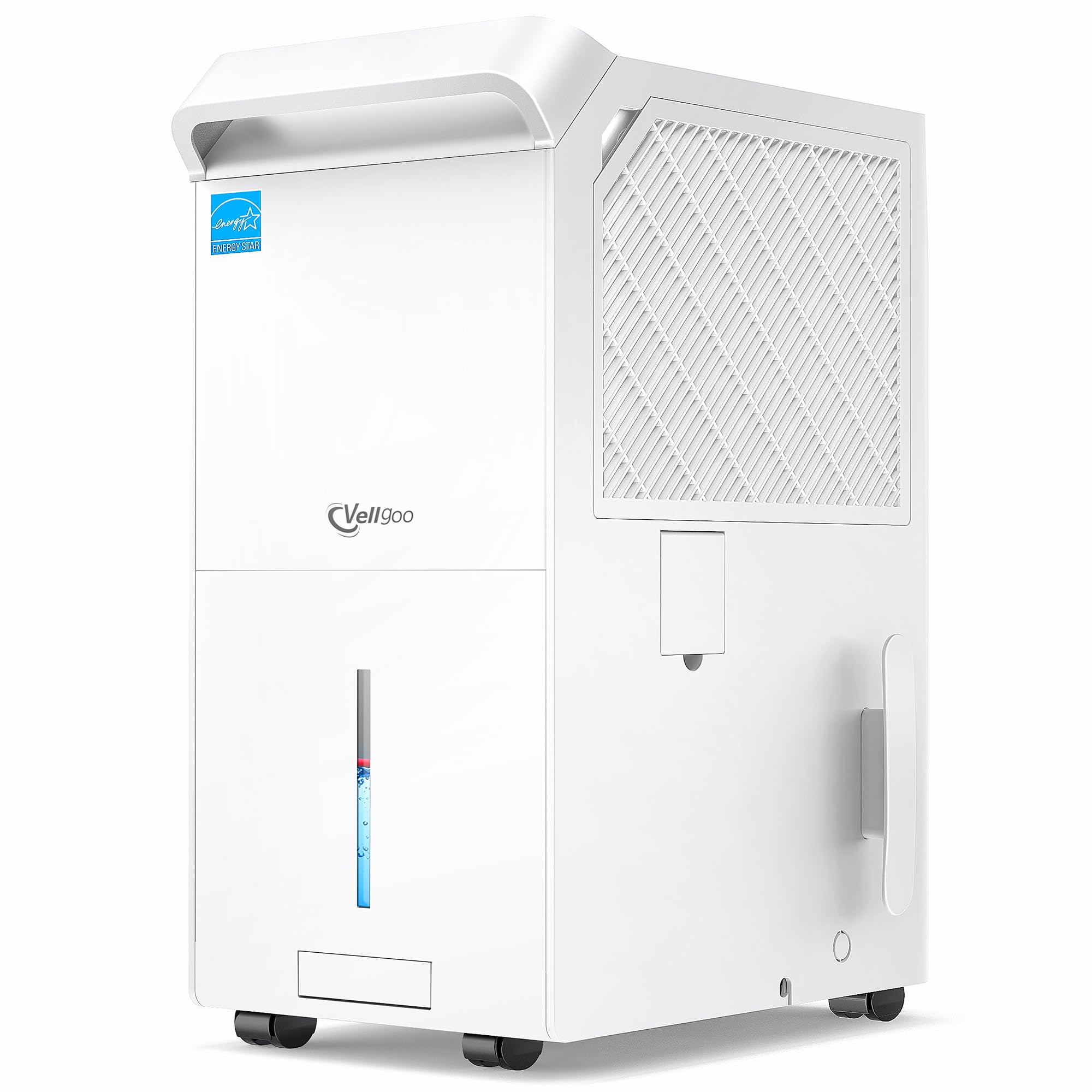
The giant that solved a serious humidity problem in two days — owners emptied it four to six times daily.
This is the most powerful unit on the list by a wide margin — up to 140 pints per day at 95°F and 95% RH, covering spaces up to 6,000 sq ft. Owners with genuinely wet basements saw dramatic results: one says it solved high humidity “in 2 days,” pulling so much water that the tank needed emptying four to six times a day.. If your basement is the dampest room in a humid climate, this Vellgoo has the muscle to actually keep up.
It comes with the ENERGY STAR Most Efficient 2025 rating., so the power doesn’t automatically mean high running costs. The included 6.56 ft drain hose handles continuous gravity drainage, or you can switch to the built-in 1.65-gallon tank for manual empties — a standard 3/4-inch garden hose also connects for extended reach. Three operating modes — Continuous, Custom, and Sleep — plus a 24-hour timer, auto-restart with memory, and full-tank auto shutoff make it ideal for spaces you don’t check daily. Auto-defrost keeps it running in cooler environments, and the washable filter plus built-in wheels and side handles make maintenance and moving straightforward.
What wins people over is the dehumidification performance and the fact that it stays quiet doing it. The honest caveat: it pumps noticeable heat into the room as a byproduct of the compressor — a few owners flagged this — and the 21.36 kg (roughly 47 lbs) weight means you won’t casually carry it up stairs.
For the wettest basements: class-leading 140-pint capacity that actually conquers severe humidity.
Fair warning: expect it to add heat to the room, and note there’s no built-in pump.
10. Moiswell Defender ME-7 70 Pint
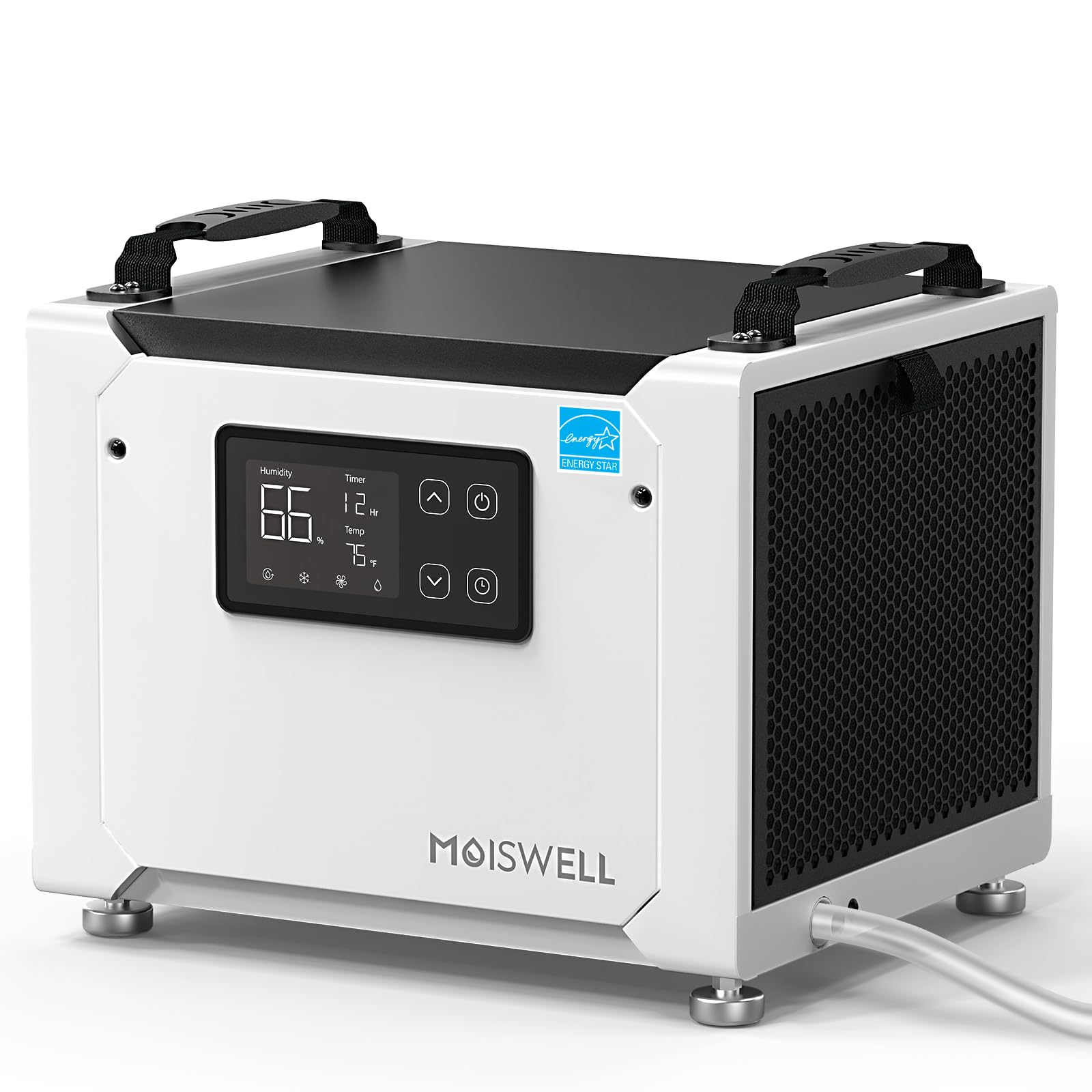
The compact metal commercial unit that fits on a shelf near your HVAC and just runs.
Where most basement dehumidifiers are tall plastic towers, this Moiswell is a squat 13″D x 15″W x 12″H metal box that weighs 40 pounds — small enough to tuck onto a shelf beside your HVAC system, which is exactly how one owner runs it: set the drain hose into the floor drain and let gravity do the work. It removes up to 70 pints a day at saturation and up to 35 pints under standard AHAM conditions, covering up to 1,000 sq ft, so it’s built for a tighter basement footprint rather than a whole home.
The metal casing and upgraded refrigeration system with high-quality copper components are engineered for demanding environments — crawl spaces, flood-prone areas, commercial settings. The gravity drainage system means no pump motor and no moving parts in the drain path, just uninterrupted operation with minimal maintenance. The large display panel shows whether it’s dehumidifying, defrosting, or if the pump is running, and the 24-hour timer handles scheduling. Two lifting handles make it genuinely easy to carry between locations.
What wins people over is the build quality — owners call it top-notch and super quiet, noting it keeps humidity right at the set point while blowing a lot of air. The honest trade-offs: a few found the drain hose connection finicky since you can’t thread a standard garden hose onto it, and one long-term owner noted weakening performance after about a year. It’s the right tool for a compact, damp space that needs heavy-duty reliability.
Why it stands out
- Compact metal build fits tight spaces and stands up to rough conditions
- Gravity drainage with no pump motor to fail
- Super quiet with an easy-to-read status display
What to check
- Drain hose won’t accept a standard garden thread
- 1,000 sq ft coverage is small for a whole open basement
Best for: crawl spaces, tight utility rooms, and anyone who wants a rugged metal machine that disappears into a corner.
Not for: large open basements that need whole-room coverage beyond 1,000 sq ft.
11. Prikod 70 Pint Crawl Space
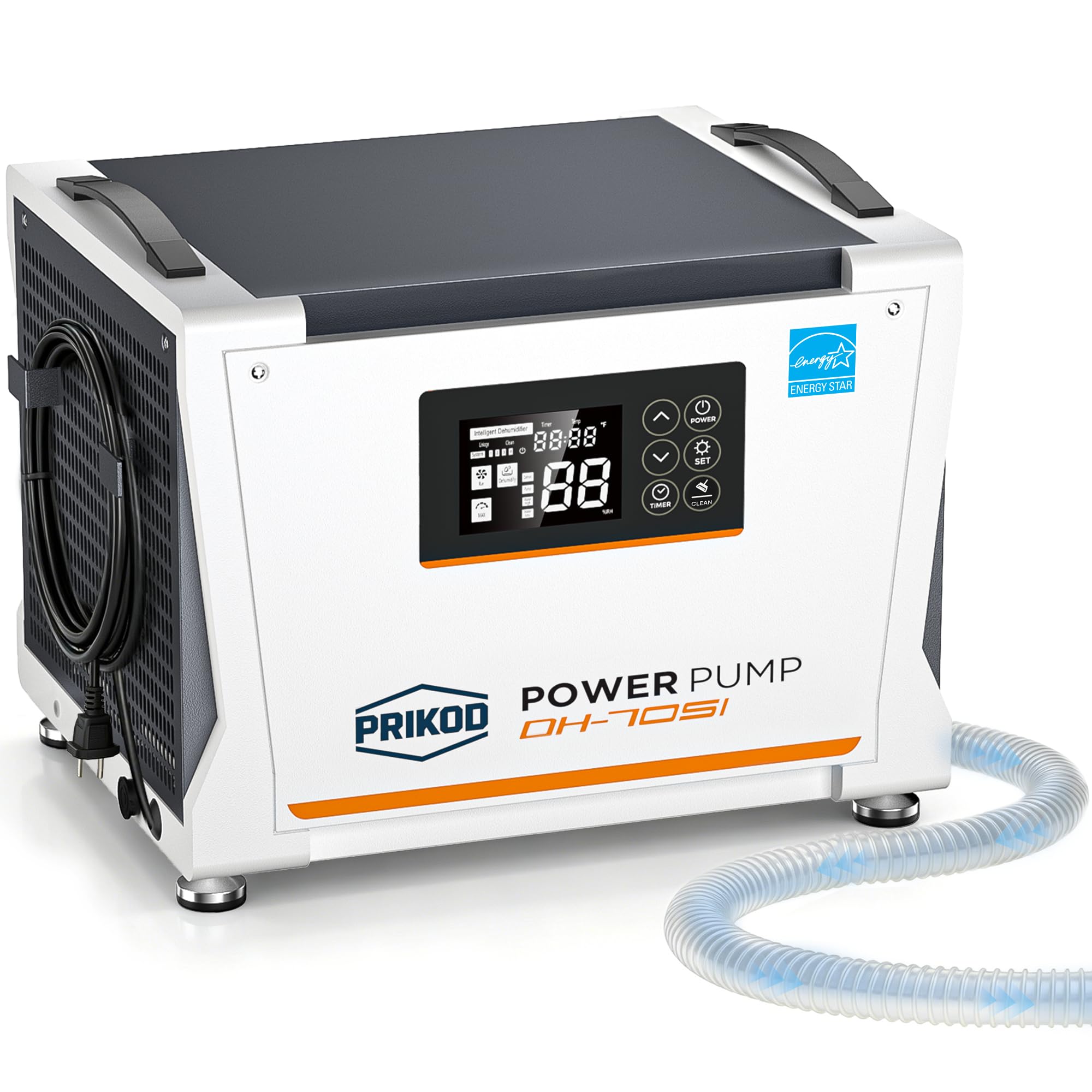
The tankless industrial unit that runs 24/7 on pure gravity drainage for crawl spaces and job sites.
This Prikod takes a completely different approach: there’s no water tank to empty at all. It’s a 70-pint commercial dehumidifier built for spaces up to 1,000 sq ft that drains purely by gravity — no pump, no moving parts in the drain path, zero maintenance. Just connect the included hose to a floor drain and it runs around the clock, which makes it a natural fit for crawl spaces, unfinished basements, flood restoration areas, and job sites.
The corrosion-resistant metal shell is far more rugged than plastic-cased units — it withstands physical impact and long-term use in humid, dusty environments without cracking. A magnetic vent cover hides the removable, washable filter that traps pet hair and dust while boosting efficiency. Auto-defrost keeps it working in chilly spaces down to 41°F (5°C), and the 24-hour timer plus automatic restart after power outages mean you can set it and walk away. Adjustable leveling feet keep it steady and improve above wet floors. At 45.4 pounds, it’s heavy but manageable with the built-in handles.
What wins people over is the strong airflow — one owner says a musty, damp basement lost its mold smell within a few days. The build quality earns consistent praise, and the overheat protection feature offers real confidence. A few honest notes: it’s on the louder side even at its quietest, there’s no display for humidity readouts, and one buyer found the drain hose missing from the packaging — worth checking immediately on delivery.
The pick for: crawl spaces and tough environments where a tank-based unit would be a hassle.
Trade-off: heavier and louder than consumer models, and no tank means it needs a drain point nearby.
Understanding the Specs
Pints per day (and the two numbers)
This is the heart of the spec sheet, but it comes with a catch. Manufacturers quote a max figure at 95°F and 95% humidity — a hot, tropical condition — and a standard figure at 86°F and 80% RH, which is closer to a real basement. A unit rated “80 pints max” might only pull 52–56 pints in actual basement conditions, so compare the standard number between models, not the flashy max one. In general, the larger the standard number, the faster your basement dries.
Coverage area in square feet
This tells you how large a space the unit can handle in one go. A 4,500 sq ft rating suits a big finished basement; a 1,000 sq ft rating is meant for a crawl space or utility room. It’s a guide rather than a hard limit — a very damp space may need more power than its square footage suggests, while a mostly-dry one can get away with less. If your basement is the wettest room in the house, size up half a tier.
Noise level in decibels (dB)
Decibels measure sound pressure; every 10 dB jump sounds roughly twice as loud. A 40 dB unit is a soft background hum, while 50 dB is about the level of a quiet conversation. If your basement is a living space, workshop, or bedroom, look for something rated 45 dB or below. Sleep modes that drop the noise further are a genuine plus for overnight use, and a few units here claim 35 dB or lower.
Tank vs. continuous drainage
Every unit has a removable tank, but tanks fill fast in a damp basement — often within a day. Continuous drainage via a hose changes everything: you run the hose to a floor drain, sump pit, or laundry sink, and the unit runs nonstop with zero emptying. Units that accept a standard 3/4-inch garden hose give you even more reach. If your basement has any drain access, choose a model with a hose and never empty a bucket again.
FAQ
Should I buy a 70 pint dehumidifier for my basement?
What is the difference between max pints and standard pints per day?
Can I drain a basement dehumidifier with a garden hose?
How often do I need to empty the water tank?
Will a dehumidifier lower my electric bill or raise it?
Why won’t my new dehumidifier work right after delivery?
What humidity level should I set for my basement?
Can a crawl space dehumidifier work in my finished basement?
Is a 100 or 140 pint unit overkill for a normal home?
How do I clean and maintain my basement dehumidifier?
Final Thoughts: The Verdict
For most basements, the 70 pint dehumidifier for basement winner is the boglvr 4500 Sq.Ft because it combines WiFi control, whisper-quiet operation, and serious drying power at a price that undercuts rivals with fewer features. If you want the widest coverage ever, grab the KNKA 5500 Sq.Ft. And for a compact, rugged unit that disappears into a crawl space, the Moiswell Defender ME-7 is the one to reach for.
How We Picked
We do not accept paid placement. Every pick is matched to a real buyer and a real use-case; we do not hands-on test units.
Sources & Methodology
Specifications: manufacturer listings and product documentation. Review insights: verified customer reviews, as of August 2026. Pricing: not shown on this page (it changes often); check the current price via the retailer link.
As an Amazon Associate, Gadgets Feed earns from qualifying purchases. This does not affect which products we feature.