
Our readers keep the lights on and my morning glass full of iced black tea. As an Amazon Associate, I earn from qualifying purchases.
Specs are compiled from manufacturer listings and verified buyer reviews and can change over time — please confirm the key details on the product page before buying.
If you watch movies or sports in a bright living room, an ALR screen (ambient light rejecting screen, a special optical surface that blocks overhead and side light while reflecting the projector’s beam back to you) is the single biggest upgrade you can make. Instead of the washed-out, milky image you get on a plain white wall or standard screen, you get watchable daytime TV, not a cave-screening ritual.
I’m Min — the founder and writer behind Gadgets Feed. This guide is built by comparing the manufacturers’ published specifications and the patterns across verified customer reviews, so you get each pick’s real strengths and trade-offs instead of marketing spin.
Whether you own a standard throw, long throw, or ultra-short-throw projector, finding the right alr screen means matching its light rejection, viewing angle, and form factor to your specific room and setup.
Our Picks at a Glance

How To Choose The Best ALR Screen
Start by identifying your projector’s throw distance. Ultra-short-throw (UST) projectors sit just below the screen and need a screen with a micro-louvered or Fresnel surface that rejects light from above. Standard and long throw projectors sit further back and use a different optical pattern. Buying a UST-specific screen for a standard throw projector (or vice versa) will give you a dim, uneven image.
Match the screen type to your projector
Check the rejection ratio and gain. A higher rejection percentage means better performance in daylight, but often at the cost of a narrower viewing angle. A higher gain (like 1.2 or 1.8) means a brighter image, which helps if your projector is on the lower end of lumens. The trade-off is that high-gain screens can create “hotspots” in the center of the image if your seating is wide.
Quick Comparison
| Model | Best For | Light Rejection | Gain | Type | Amazon |
|---|---|---|---|---|---|
| VIVOHOME 100″ Motorized★ Best Overall | Flexible installs & easy storage | — | — | Motorized Pull-Down | Amazon |
| Elite Screens Aeon CineGrey 3DBest Value | Standard throw in bright rooms | 65% | 1.2 | Fixed Frame | Amazon |
| NothingProjector 100″ UST | UST in living rooms | 85% | — | Fixed Frame | Amazon |
| ALR UST 100″ (WonTeam) | Budget UST daylight viewing | 95% | 0.8 | Fixed Frame | Amazon |
| SilverMagic 120″ Tensioned | Motorized with a flat surface | — | — | Motorized Tab-Tensioned | Amazon |
| IN&VI 120″ Floor Rising | No-wall-mount spaces | — | — | Motorized Floor-Rising | Amazon |
| Valerion 120″ Fresnel | High-brightness long throw | 85% | 1.8 | Fixed Frame | Amazon |
In‑Depth Reviews
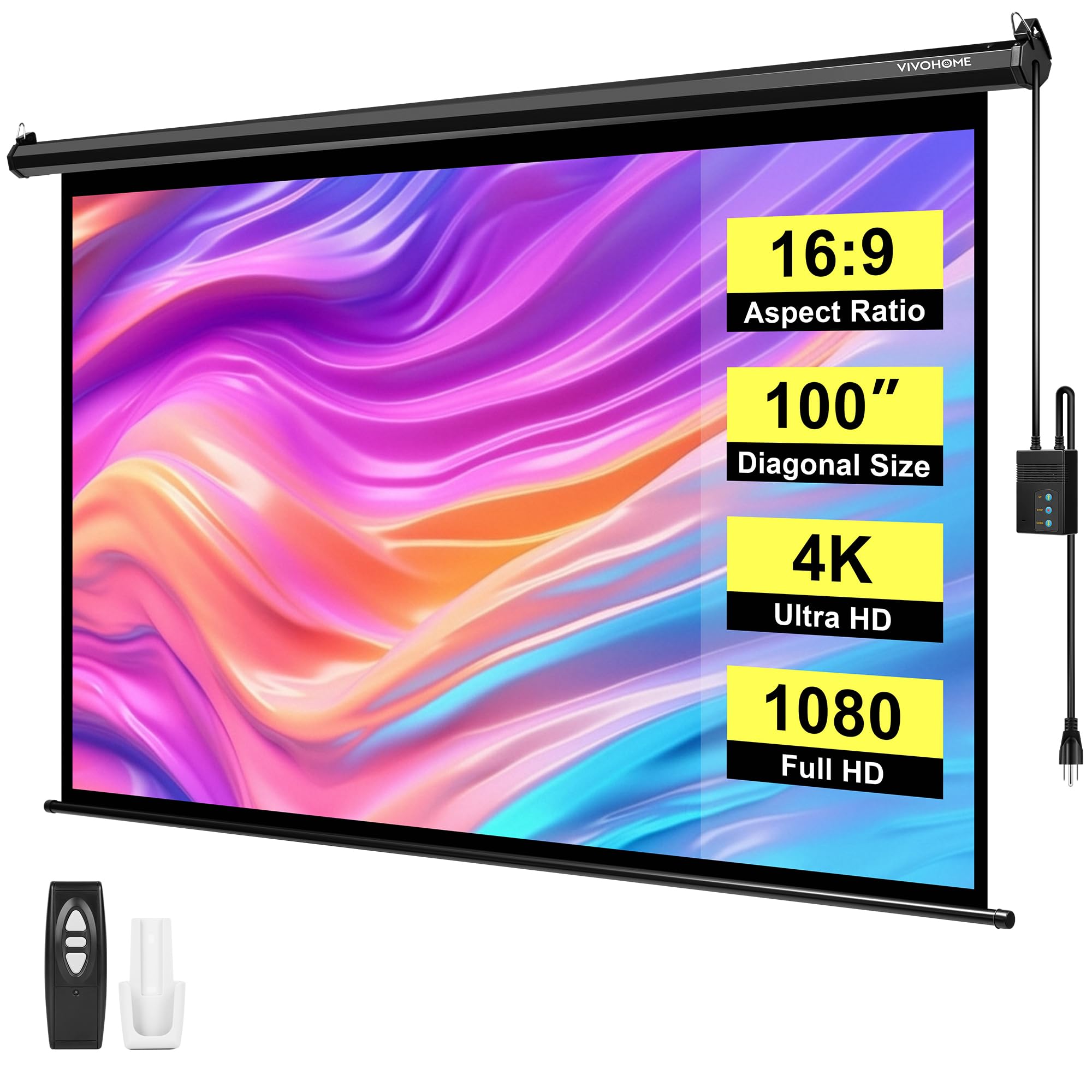
1. VIVOHOME 100 Inch Motorized Screen
Our pick — over 4★ from 650+ verified ratings; the strongest balance of quality and price.
The motorized workhorse that rolls up out of sight when movie night ends.
This is the pick for anyone who wants the big-screen experience without a permanent black rectangle on the wall. At 15.4 pounds, it’s light enough for a standard drywall ceiling mount, yet the metal casing protects it during transport and the 3-layer waterproof PVC fabric resists creases in changing humidity. Buyers report a bright daytime image with the motor rolling down in 30 seconds at under 40 dB, so the whir won’t drown out dialogue.
The wireless remote reaches up to 82 ft, letting you lower the screen from the couch without standing. It handles 3D, 1080P, 4K and Full HD sources on a matte white surface with a 160° viewing angle. The visible trade-offs are minor but real: a loud beep on button press you can’t disable, and a slight squeak during roll-down that fades over time. Slight wrinkles exist but become invisible once a projector lights them up.
It needs a wall outlet for the motor, though the battery option on the remote lasts days. The 100-inch display area (87″W × 49.2″H) pairs naturally with most mid-range projectors at an 8-10 ft viewing distance.
Why It Wins
- Motorized retractable design keeps the room clean when not in use
- Quiet motor under 40 dB won’t distract from the film
- Versatile horizontal or vertical mounting with expansion screws included
Trade-Offs To Know
- Loud, non-disableable beep every time you press a button
- Slight squeak during roll-down can be heard in quiet scenes
- Requires a nearby outlet for operation
Reach for it if: you want a screen that disappears between uses and you value the convenience of a remote control from the couch.
Look elsewhere if: you’re a perfectionist about an utterly silent mechanism — the beep and squeak are part of the package.
2. Elite Screens Aeon CineGrey 3D 92″
The picture-quality champion that turns a white wall into a cinema-grade surface.
Owners mention this screen is a “standout vs white wall,” dramatically cutting ambient light so content stays watchable in a lit family room or living space. The CineGrey 3D material rejects 65% of ambient light with a 1.2 gain (a measure of how much light the screen reflects back), and the 90° viewing angle means it shines brightest for viewers sitting near the center balance. The EDGE FREE design with a 1cm bezel reads as a giant flat-panel TV when the projector is off — a massive aesthetic upgrade over a blank wall.
At 20.1 pounds, the 6-piece split aluminum frame is heavier than the VIVOHOME motorized option, and assembly is the real hurdle here. The tensioned design uses dozens of springs, and solo installers report a 4-hour build with careful attention needed to get the surface perfectly flat before mounting the border. The payoff is a wrinkle-free, taut surface that holds shape for years. The 92-inch diagonal (45.1″H x 80.2″W viewing area) suits a smaller room where a 100-inch panel would overwhelm the space.
It’s designed specifically for standard throw projectors, so don’t pair it with a UST model. ISF certification ensures accurate color, and GREENGUARD Gold certification keeps indoor emissions low for safe use in offices or classrooms.
The Upside
- ISF certified color accuracy and GREENGUARD Gold certified safety
- Velcro tensioning and quality tools included for a taut surface
- Frameless “EDGE FREE” look mimics a modern big-screen TV
The Assembly Tax
- Installation is challenging solo — plan for up to 4 hours with dozens of springs
- 90° viewing angle is narrower than the 160° options on this list
- Heavier than the motorized pull-down at 20.1 pounds
Best for: owners of standard throw projectors who prioritize image quality and want a permanent, TV-like fixture that justifies its footprint with better blacks and color.
Think twice if: you need a wide 90°+ seating arrangement or you’re not prepared for a serious DIY install session.
3. NothingProjector 100″ UST ALR Screen

Built for ultra-short-throw projectors, this screen makes daytime living-room viewing a reality.
This screen is engineered for UST projectors, which sit just below the screen and need a surface that rejects ceiling light while capturing the projector’s steep upward beam. The advanced PET Crystal technology rejects up to 85% of ambient light, and a multi-layer design with a black light-absorbing core and a 3D imaging layer keeps blacks deep and colors vivid. A veteran AV installer with 30 years in the field rated the aluminum frame the best he’s seen versus Draper, Da-Lite, SI, and Dragonfly.
The 10mm ultra-thin frame keeps the profile sleek, while the 160° viewing angle accommodates a wider couch than the Elite Screens pick. The classic lenticular screen finish is tune for UST — don’t try to pair this with a standard throw projector; the image will look uneven. Customers note the image looks identical with lights on or off, confirming the ALR surface’s effectiveness.
Assembly is straightforward but not fast, with some noting the instructions are too simple and the bracket alignment is finicky. Give yourself an hour with a second pair of hands. The PVC-free substrate is an eco-friendly touch, and it comes with a 1-year manufacturer warranty.
What wins you over: the image holds its contrast and black levels with room lights on — the highest-impact improvement you can feel from a screen upgrade. The tensioning produces a perfectly flat surface with no wrinkles, and the spring-loaded wall brackets are genuinely easy to hang.
Who it beats: it’s a 160° viewing angle versus the Elite Screens’ 90°, so a wider family couch works here without losing brightness at the edges.
Your move: pick this if you own a UST projector and want premium build quality without paying name-brand markup.
Fair warning: the assembly instructions could be clearer, so budget time to figure out bracket alignment the first time.
4. WonTeam 100″ UST ALR Screen
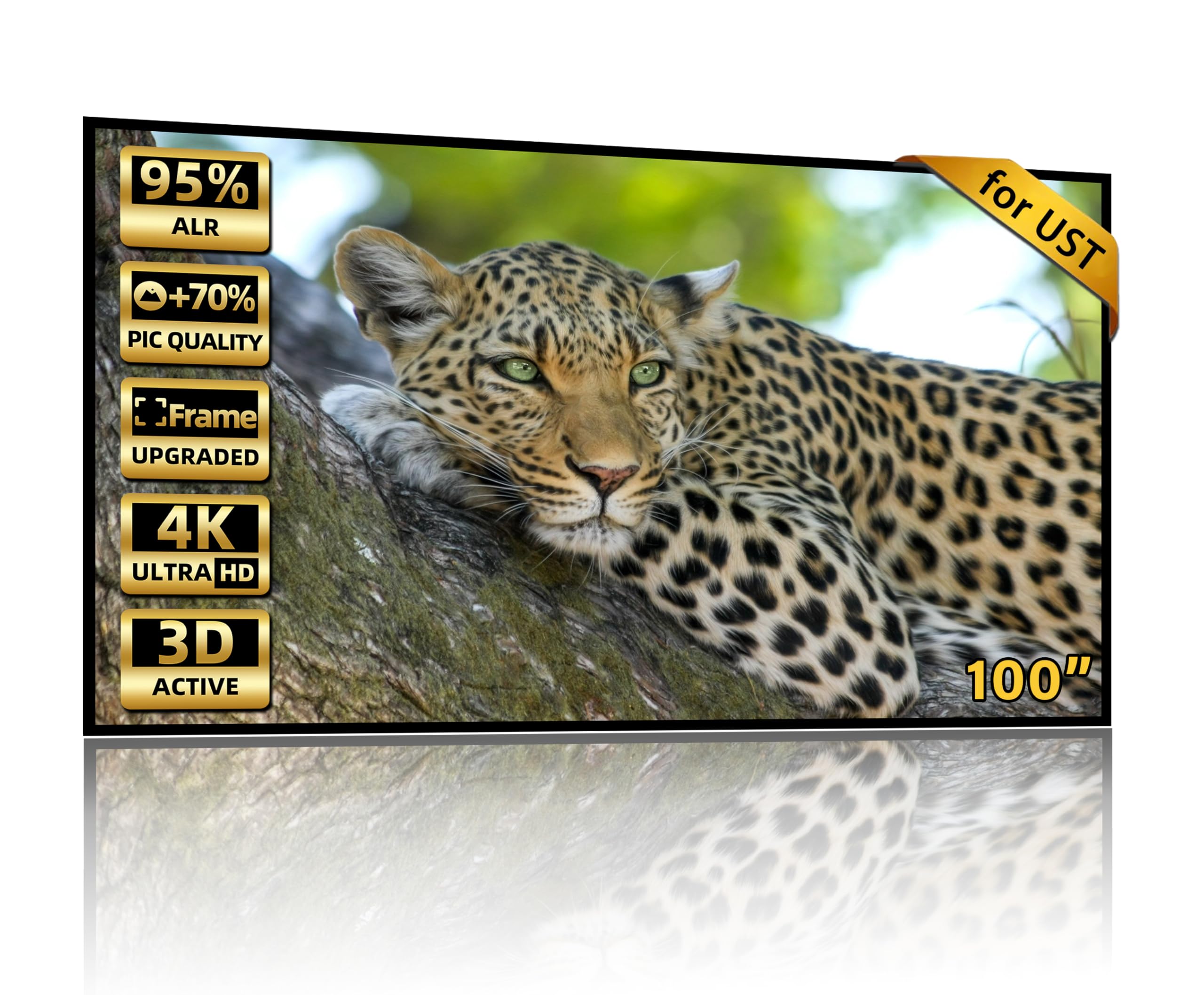
The value king that delivers serious daylight rejection at a fraction of the big-brand price.
This screen screams value on the spec sheet: 95% ambient light rejection, a 0.8 gain for deep blacks, and a 160° viewing angle — all running about half the cost of comparable name-brand UST screens. Buyers who own a Nexigo Aurora Pro report excellent ambient light deflection even with multiple windows open in full daylight. The precision micro-toothed 3D structure uses a triangular grating with one black side and one white side to absorb overhead light while directing the projector’s beam toward the audience.
The dual-frame design with adaptive spring tension keeps the surface flat, and the 0.39″ ultra-narrow bezel (about 1cm) gives it that slick, borderless look. The velvet trim adds a premium feel and hides minor wrinkles that can appear during spring installation. At 11 kg (about 24 pounds), it’s the heaviest fixed frame on this list — expect a two-person job for the 2-hour assembly, with springs being the fiddliest part. Attach springs to the screen first, then to the frame, and you’ll avoid the frustration others hit.
It’s UST-specific, so skip it for standard or long throw setups. The upgraded PVC material self-heals minor scratches and resists deformation, while the black backing blocks light leakage from behind. Pair it with a bright UST projector and this is one of the smartest spend-to-value ratios in home theater.
Value Highlights
- 95% ambient light rejection — the highest ratio on this list
- Ultra-narrow 0.39″ bezel for a sleek, modern look
- Velvet trim hides minor installation wrinkles
Watch For
- Heaviest pick here at 11 kg — needs two people to install
- 0.8 gain means it works best with a bright UST projector
- Spring installation is the trickiest part of the build
Choose it when: budget matters and you have a UST projector with enough lumens to drive a 0.8 gain surface.
Look elsewhere if: you use a standard throw projector or you can’t manage a two-person, spring-heavy install.
5. SilverMagic 120″ Tab-Tensioned Motorized Screen
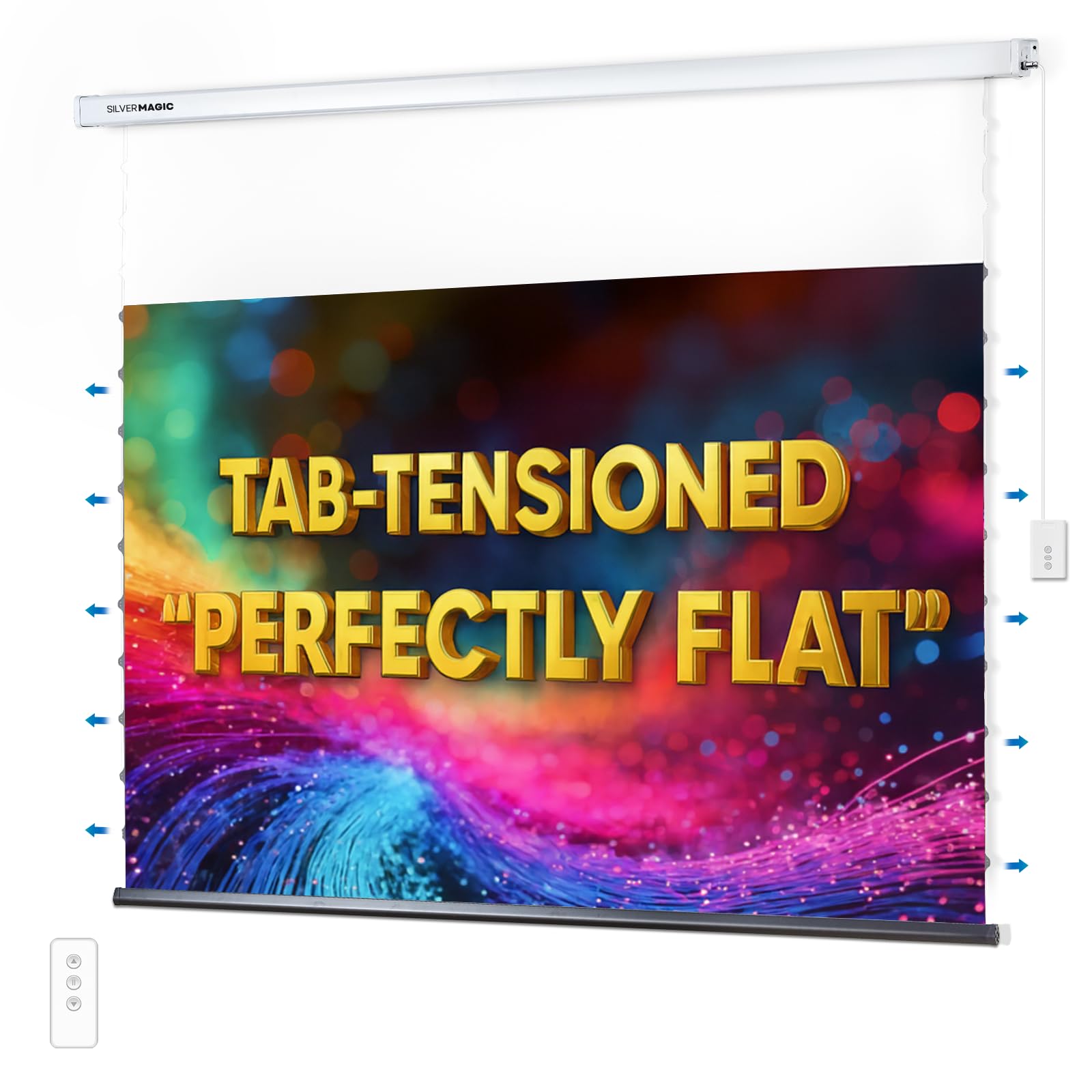
A motorized screen that refuses to wrinkle, thanks to tab-tensioning usually reserved for fixed frames.
Most motorized pull-down screens develop waves and curls over time. The SilverMagic uses an upgraded tab-tensioned system — fabric tabs pull the screen taut from all sides — so the surface stays perfectly flat even at 120 inches. This is the feature that makes it work with demanding UST projectors, which are brutal on any surface imperfection. The gray screen material with a PET+Photo Grey Optical Coating improves contrast, deepens blacks, and adds vibrance under ambient light — ideal for projectors with over 1000 lumens.
The mechanics are quiet and smooth, with adjustable up/down limit dials so you can fine-tune exactly where the screen stops. The remote raise/lower works as expected, and the white aluminum case blends into living rooms, offices, and conference spaces without screaming “AV equipment.” At 104″W x 58″H, it’s a substantial presence, and owners note it needs wall studs or solid wood support for a proper ceiling mount — this is not a drywall-anker job.
Owners consistently praise the vendor support: damaged-in-shipping units and a defective wall controller were replaced quickly. Laser projector owners should note there’s a speckle-reducing variant recommended for RGB laser units, as the standard model can show sparkles in bright areas. A 3-year warranty and US-based support back it all up.
Why It’s Premium
- Tab-tensioning keeps the surface flat for UST projectors
- Quiet, silent motor operation during raise and lower
- Adjustable up/down limit dials for precise positioning
The Fine Print
- Heavy — needs studs or solid wood for ceiling mounting
- Laser projector users should order the speckle-reducing variant
- Plastic mounting brackets feel less premium than the rest
The standout spec: a motorized screen with a wrinkle-free surface — the combination is rare and worth the premium if you can’t commit to a fixed frame.
The honest caveat: mounting is a serious job requiring real structural support, so plan your install before you commit.
6. IN&VI 120″ Motorized Floor-Rising Screen
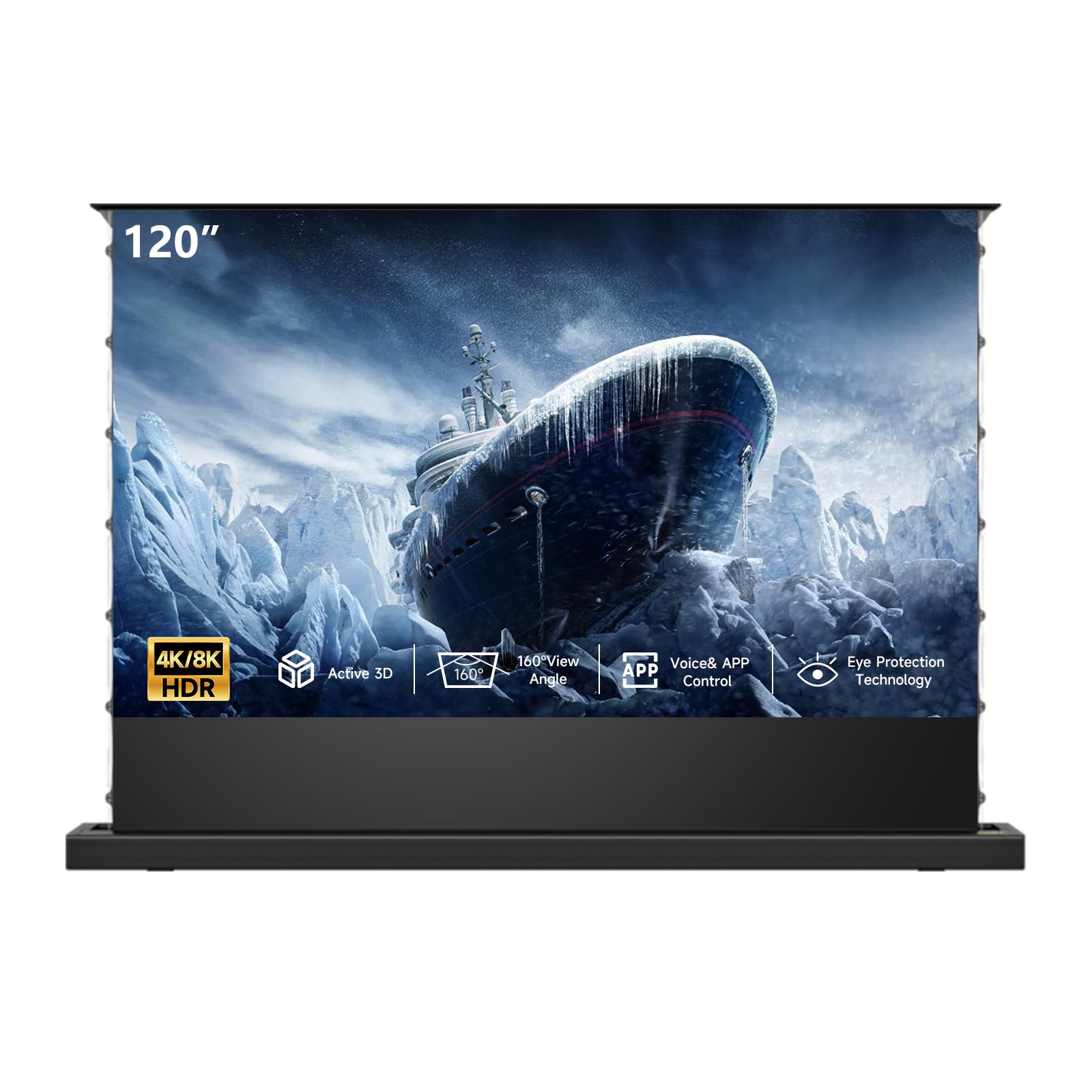
The screen for renters and living rooms where drilling into a wall is off the table.
This floor-rising design solves a specific problem: you want a big screen but can’t (or won’t) mount anything to your wall. The motorized unit rises out of a base on the floor and retracts back when the show’s over. It’s built for standard and long throw projectors only — the listing states plainly it’s not suitable for UST models, so keep that in mind. At 104.6″W x 58.8″H, it delivers a true 120-inch diagonal viewing experience.
Control options are the story here. You get voice control and app control, plus the option to auto-raise when your projector powers on via a USB dongle. Reviewers point out the auto-open/close integration with projector power is smooth and reliable. The quality of the screen surface matches higher-priced competitors, though owners note the ALR performance is effective but not high-end — think of it as a solid improvement over a white screen, not a reference-grade optical surface.
The real caveat, mentioned by a few, is the height-memory function. Some units forget their fully-raised position after about a week, causing the screen to rise only halfway until you reset it with the remote. The tab-tensioning also misses the top edge, which can cause minor corner warping. These are quirks, not deal-breakers, and the vendor’s customer service is responsive to installation questions.
What it nails: the convenience of an invisible screen whenever you want one, without touching your walls. The app and voice control, plus USB auto-trigger with projector power, make it the smartest-connected pick here.
The honest trade-off: the height memory reset is a recurring annoyance for a few owners, so it’s best for someone comfortable with occasional remote adjustments rather than a low-maintenance buyer.
Right for: renters, multipurpose rooms, and anyone who refuses to put holes in their walls.
Not for: UST projector owners or perfectionists who can’t tolerate the occasional height-reset quirk.
7. Valerion 120″ Fresnel ALR Screen
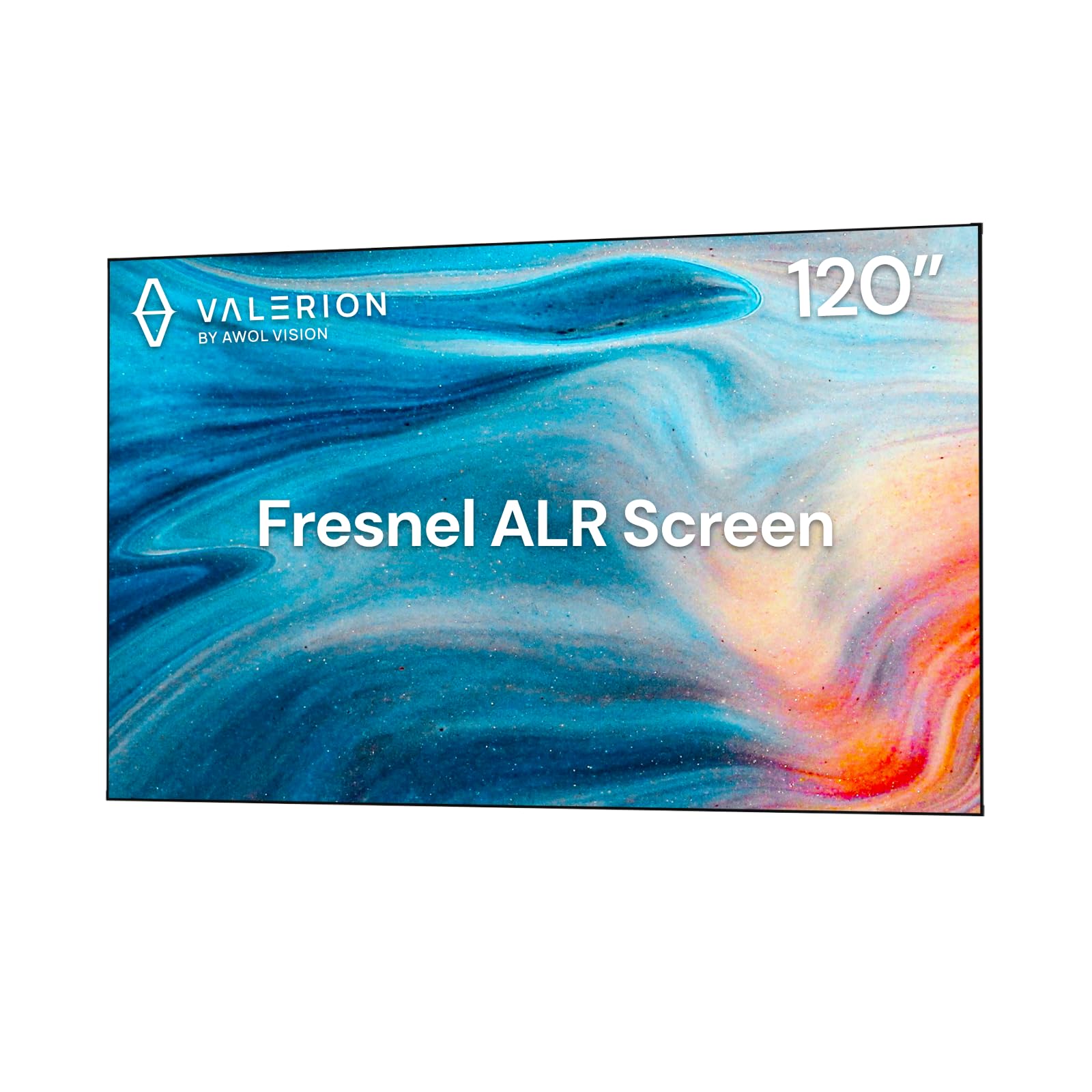
The high-gain Fresnel screen that turns midday daylight into your best movie hour.
This is the big gun on the list, built for long throw projectors and packing a 1.8 gain — nearly double the brightness of a standard 1.0 gain white screen. The precision-engineered 8-layer Fresnel structure rejects up to 85% of overhead and side ambient light, so you get a punchy, contrast-rich image even with basement canned lights blazing. Buyers with an Epson LS11000 report the picture stays amazing in both dark and lit rooms, exactly the flexibility a Fresnel surface provides.
The 90° viewing angle is on the narrower side, so this favors a center-focused seating arrangement rather than wide sofas. The screen rolls up for easy transport and DIY installation — at 39.7 pounds it’s heavy, but the rollable design means two people can carry it and mount it without a bulky rigid frame. The scratch-resistant, easy-to-clean surface survives daily use, and owners praise the even coverage and sharpness across the entire 120-inch diagonal (105.51″ screen dimension).
It’s not compatible with ultra-short-throw projectors (UST, which sit close to the screen), so this pairs with the new crop of long-throw 4K laser units. The Fresnel pattern (a series of concentric ridges that focus light) directs light back toward a balance, which means viewers sitting dead-center get the full impact. Assembly is rated easy — owners describe a polished look once installed and appreciate that all hardware is included.
Why It’s The Heavyweight
- 1.8 gain delivers a dramatically brighter image than standard screens
- 85% ambient light rejection from both ceiling and side sources
- Rollable design simplifies transport and DIY mounting
Who Should Pass
- 90° viewing angle means wide seating loses brightness at the edges
- Only for long throw projectors — UST owners need a different surface
- At 39.7 pounds, it’s a two-person job to hang
Pick this if: you own a long throw 4K or 8K laser projector and want the brightest possible daytime image for a dedicated home cinema.
Reconsider if: your seating spreads wide beyond a central balance, or you’re working with a UST projector.
Understanding the Specs
Ambient Light Rejection Ratio
This is the percentage of ambient light the screen surface blocks. A 65% ratio (like the Elite Screens) is a solid improvement over a white wall, while 85% to 95% (NothingProjector, WonTeam, Valerion) delivers a watchable image in full daylight. Higher rejection usually means a more complex optical surface, which is why those screens cost more.
Gain and Viewing Angle
Gain measures how much light the screen reflects relative to a standard white surface. A 1.2 gain (Elite Screens) is a moderate boost; a 1.8 gain (Valerion) is nearly twice as bright but narrows the viewing angle. A 0.8 gain (WonTeam) sacrifices brightness for deeper blacks. Wide 160° angles suit family rooms; tight 90° angles focus brightness for dedicated theater seating.
FAQ
What’s the difference between a UST ALR screen and a standard ALR screen?
Will an ALR screen work with my standard throw projector?
What does screen gain mean for my projector?
Is a fixed frame screen better than a motorized screen?
Can I use a motorized ALR screen with a UST projector?
How hard is it to install a fixed frame ALR screen?
Does an ALR screen really work in a fully lit room?
What’s the difference between a Fresnel screen and a regular CLR screen?
Final Thoughts: The Verdict
Across the board, the alr screen winner is the VIVOHOME 100″ Motorized because it pairs solid daytime brightness with the convenience of retracting out of sight, all backed by the crowd’s stamp of approval. If you want a permanent, cinema-grade surface with ISF-certified colors, grab the Elite Screens Aeon CineGrey 3D. And for UST projector owners chasing daylight viewing on a budget, the WonTeam 95% rejection screen is the value pick that punches far above its price tier.
How We Picked
We do not accept paid placement. Every pick is matched to a real buyer and a real use-case; we do not hands-on test units.
Sources & Methodology
Specifications: manufacturer listings and product documentation. Review insights: verified customer reviews, as of August 2026. Pricing: not shown on this page (it changes often); check the current price via the retailer link.
As an Amazon Associate, Gadgets Feed earns from qualifying purchases. This does not affect which products we feature.