
Our readers keep the lights on and my morning glass full of iced black tea. As an Amazon Associate, I earn from qualifying purchases.
Specs are compiled from manufacturer listings and verified buyer reviews and can change over time — please confirm the key details on the product page before buying.
Every angler knows the ache of staring at flat water and wondering what lurks below. A fish finder ends that guesswork by showing you the bottom, the structure, and the fish, but the price tags on premium units can feel like a second mortgage on your boat. The good news is that a solid budget unit gets you the critical features—depth, temperature, and fish arches—without emptying your wallet.
I’m Min — the founder and writer behind Gadgets Feed. This guide is built by comparing the manufacturers’ published specifications and the patterns across verified customer reviews, so you get each pick’s real strengths and trade-offs instead of marketing spin.
We break down the top options to help you find the best budget fish finder that matches your fishing style, from kayak to ice to bank.
Our Picks at a Glance


How To Choose The Best Budget Fish Finder
Before you buy, match the machine to your fishing reality. A kayak angler needs a different unit than a hardcore ice fisherman, and both need something different than a bass boat owner. Start with your boat or lack thereof, then your budget.
Mount vs. Castable
The first fork in the road is whether your transducer (the sonar puck that sends sound waves) stays on your boat or goes flying through the air. Mountable units like the Garmin Striker are fixed to your boat and give you a constant, real-time read of the water beneath you. Castable units like the Deeper PRO+ 2 are small pucks you cast out with a fishing rod; they float and send data back to your phone or a handheld screen. Castables are perfect for bank fishing and kayaks because they go where you go, no installation required.
The Depth Rating Reality
The maximum depth figure is the spec that sells units, but it is often the most misunderstood. A unit rated for 1600 feet in freshwater is built for deep lakes and saltwater trolling. A budget castable rated for 147 feet is perfect for shore fishing, kayaks, and most inland lakes. Do not buy a 1,600-footer for a 20-foot deep pond—you are paying for range you will never use. Conversely, do not buy a shallow-rated sensor for serious lake trout fishing.
Screen Size and Sunlight
The screen is your only window into the underwater world, so it matters more than almost any other spec. A larger screen (3.5 inches or up) shows more detail and is easier to read when you are bouncing across the water. But a big screen is only useful if it is readable in full sun. Look for terms like “sunlight-readable” or “IPS screen” in the specs; these panels stay crisp even with polarized sunglasses on, which is a feature that will save your eyes every single trip.
Quick Comparison
| Model | Best For | Sonar Depth | Screen Size | GPS | Amazon |
|---|---|---|---|---|---|
| Garmin Striker 4★ Best Overall | Boat & Kayak All-rounder | 1600 ft | 3.5 in | Waypoint Map | Amazon |
| DANOPLUS PortableBest Value | Castable Simplicity | 147 ft | 2.4 in | No | Amazon |
| FishPod 5XSmart Pick | Phone App Users | 199 ft | 5 in (uses phone) | No (uses phone) | Amazon |
| LUCKY FF1108 | Ice & Night Fishing | 147 ft | 2.4 in | No | Amazon |
| Yoocylii Xf-08 | Portable Depth & Alerts | 164 ft | 3.5 in | No | Amazon |
| Lowrance Eagle 4X | Small Boat Basics | — | 4 in | No | Amazon |
| Garmin STRIKER Cast | Castable Phone View | — | Uses Smartphone | No (Quickdraw maps) | Amazon |
| Humminbird PiranhaMAX 4 | Structure Scouting | — | 4.3 in | No | Amazon |
| Deeper PRO+ 2 | Anglers Who Map | 330 ft (100 m) | Uses Smartphone | Bathymetric Mapping | Amazon |
In‑Depth Reviews
1. Garmin Striker 4
Our pick — over 4.5★ from 9,000+ verified ratings; the strongest balance of quality and price.
The compact all-rounder that brings serious sonar power to any small boat.
This is the unit that keeps winning because it does the two things right that matter most: it finds fish and it navigates you back to them. The CHIRP sonar (a technology that sends a continuous sweep of frequencies instead of a single ping) creates crisper fish arches and better target separation than older single-frequency units. It reads down to 1,600 feet in freshwater, which is a stunning 10.9 times deeper than the typical castable sensor in this range.
That depth rating alone would make it a serious tool, but it pairs it with a built-in waypoint map so you can mark brush piles, stumps, and docks, then navigate straight back to them. The 3.5-inch display is small but sharp, and buyers report the screen stays visible in direct sunlight. It is also a joy to install, with dedicated buttons and a keyed interface that makes it easy to set up and use right from the start.
Anglers report mounting it to a trolling motor and watching the bottom contour, baitfish, and fish arches appear in real time. The recurring theme in owner feedback is the reliability of the depth, temperature, and trolling speed readings, plus the GPS tracking that holds a trolling speed of 1.2 mph. The main caveat is the thin power wires, which need secure crimping to avoid cutting out, and the instructions are light on the power hookup details.
Why It Wins
- CHIRP sonar gives near-photographic detail of structure and fish.
- Waypoint map lets you mark and navigate to hot spots easily.
- Splash-proof IPX7 rating shrugs off rain and spray.
- Affordable price for a full-featured mountable unit.
Real Trade-offs
- Power wires are thin and need careful crimping.
- Setup instructions are sparse on the electrical hookup.
- Screen is on the smaller side at 3.5 inches.
Your best bet if: you want a proven, mountable unit that works on a kayak, jon boat, or rental—this is the default recommendation for most freshwater anglers.
Think twice if: you are strictly a bank fisherman with no boat to mount it on; a castable unit will serve you better.
2. Portable Fish Finder Large HD Display Wireless by DANOPLUS
A throw-and-go pocket unit that turns any shore into a fishing spot.
If you have no boat and no plans to install anything, this is your gateway into the world of sonar. The whole kit is built around a small wireless sensor you cast into the water, and a handheld 2.4-inch color screen that shows the bottom contour, water temperature, and fish size icons right in your palm. It measures depth to 147 feet, which is plenty for dock fishing, river banks, and most lake shorelines.
The clever part is the sensor’s built-in lamp that turns on the moment it touches water. That light serves two purposes: it attracts fish, and it helps you see exactly where your sensor landed as dusk falls. The screen also has a fish alarm that beeps when something swims through the sonar cone, showing the estimated size and depth of the fish, so you can keep your eyes on the rod instead of the display.
You won’t be swapping AAs after every trip because both the screen and the transducer have internal rechargeable batteries. The trade-off, as owners mention, is the proprietary magnetic charger—it is very small and easy to lose, and it is not a standard USB-C cable. The unit ships with a one-year warranty, which adds a little confidence to an already budget-friendly package.
Perfect for beginners: it is dead simple to use, works well from a canoe or kayak, and the price is low enough that it is an easy “try it” purchase.
Watch out for: that tiny proprietary charging cable—buy a spare or keep it in a safe place, because customers note that losing it is a real pain.
Reach for this if: you want a low-commitment, castable fish finder for kayaks, canoes, ice, or bank fishing without any installation.
Look elsewhere if: you need GPS mapping or a big fixed screen for a larger boat.
3. FishPod 5X Bluetooth Fish Finder with AI Technology
A 199-foot smart sonar puck that turns your phone into a fish-finding screen.
This is the unit for anglers who want the big-screen experience without paying for a big screen. The FishPod 5X is a wireless sonar device that streams all its data to your smartphone via a free app, which means your display is as big as your phone or tablet. The 5-inch “display” in your hand is actually the phone screen, which is 2.1 times larger than the little 2.4-inch screen on the castable units in this lineup. It measures depth down to 199 feet.
what separates it is the AI-driven modes. The FishEcho mode tunes the sonar to pinpoint fish size and depth while tuning out clutter and false echoes. There is also a BottomScan mode that reads the bottom contour and composition to decipher between vegetation and soft or hard seabed. The Vertical Flasher mode is built for ice fishing, amplifying the most recent sonar echoes so you can track your jig.
The mounting system is versatile too: the TraxNut system attaches to any standard 1/4 x 20 bracket, so it expands to any fishing platform you own. Owners say the app is free, simple, and connects easily, with accurate depth readings that matched a much pricier Lowrance unit on the water. The consistent negative thread is battery life—some units arrive holding no charge at all, and Bluetooth connectivity can drop, so a power bank is a wise companion.
What wins people over: the app is genuinely good, the depth accuracy is spot-on for the money, and the larger phone screen is a huge advantage over tiny LCDs.
Fair warning: battery life is the recurring gripe; treat it gently and expect to charge it often, and keep the transducer shallow because Bluetooth struggles through deep water.
Choose this if: you already live on your phone and want a lightweight sonar that uses it as a big, clear display.
skip it if: you are far from a wall outlet for long trips and cannot afford battery anxiety.
4. LUCKY Portable Fish Finder FF1108
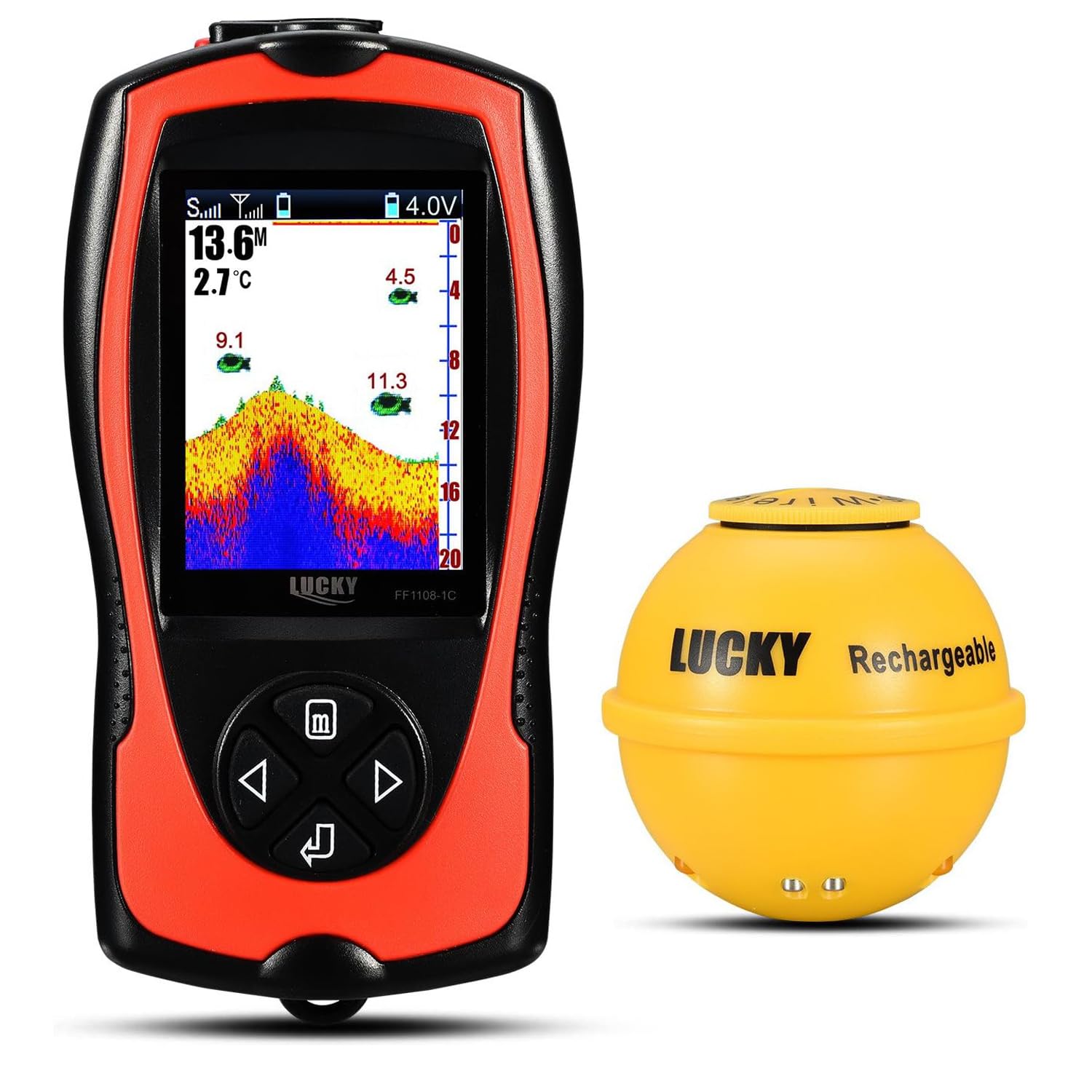
A rechargeable handheld finder that teaches you the ropes with a simulation mode.
This is the unit for the tinkerer and the night owl. The LUCKY FF1108 has a 2.4-inch TFT color screen and a castable sonar sensor with an attractive lamp, and it comes with a “simulation mode” that lets you test every function on dry land before you ever get to the water. That feature is genuinely helpful for first-time buyers who want to learn the menus without floating a sensor.
The battery story here is a strong point in a category full of battery complaints. The handheld lasts 4 hours on a full charge, and the sonar sensor lasts a solid 10 hours; a USB cable is included for charging both. The wireless operating range extends to 492 feet with the antenna pulled out, which gives you real freedom to cast far from the bank and still read the return signal.
Reviewers point out it is accurate in calm, shallow water, and the floating transducer works well from a kayak. There is a transparent replacement cover on the sensor, so you can see where it is in the dark, which pairs well with the fish-attracting lamp. The honest caveat is reliability: some shoppers say signal loss even with the antenna extended and units that fail to power on, so this is a budget gamble on quality control.
Why it stands out: the simulation mode is a unique teaching tool, and the 10-hour sonar battery beats most rivals in this class.
The honest catch: quality control is inconsistent—some units are flawless, others lose signal or die early, so treat it as a low-cost experiment, not a lifetime tool.
Best for: beginners who want to practice at home and night anglers who value the visible sensor lamp and long sensor battery.
Not for: anyone who needs guaranteed reliability trip after trip; the mixed durability reviews mean you might get a dud.
5. Yoocylii Handheld Fish Finder Xf-08
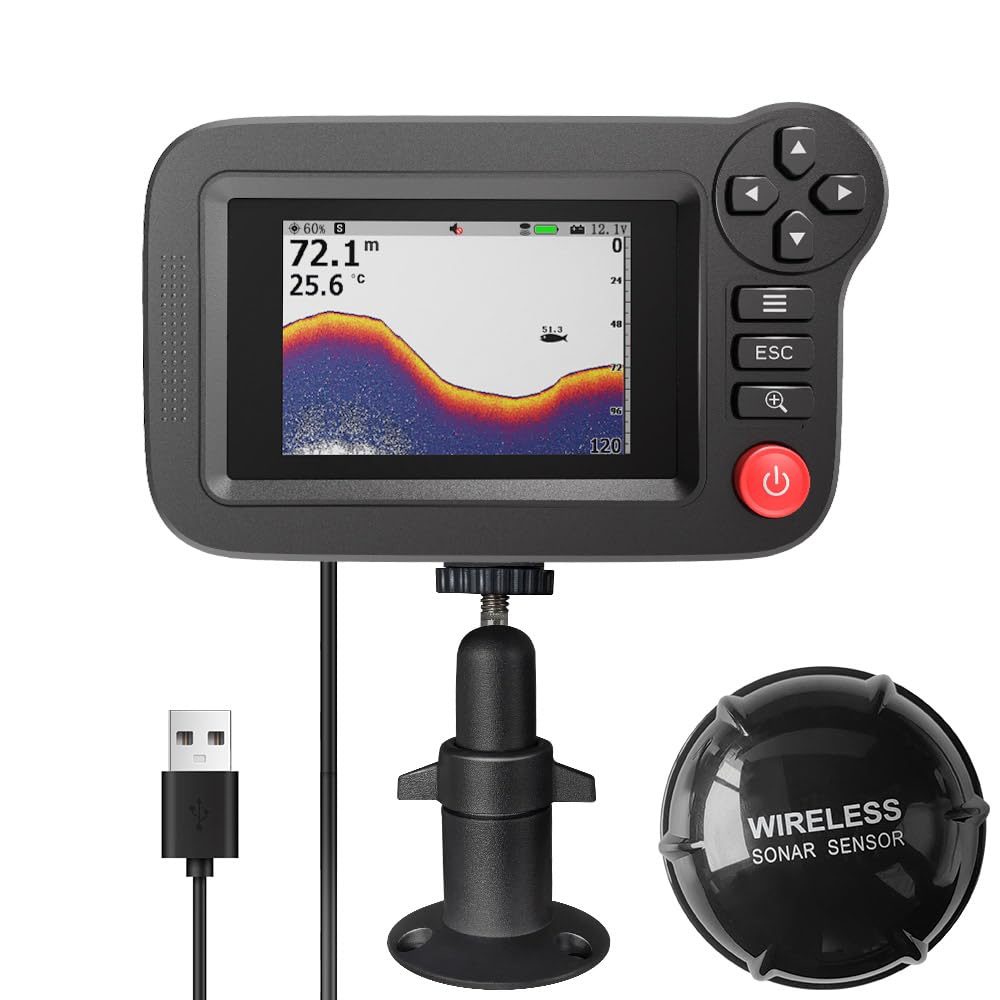
A pocket-sized depth finder with a bright screen and smart fish alerts.
This unit is designed for the angler who wants a real screen, not just a phone app, but still wants it portable. The Xf-08 boasts a 3.5-inch color LCD with a 480×320 resolution that is explicitly sunlight-readable, so you can actually see it on a bright afternoon—a spec some pricier units fumble. It runs on a 125 KHz sonar sensor that reaches depths of 164 feet, and the wireless probe has a range of 328 to 656 feet.
The sonar sensor is water-activated, which means it powers on automatically when it touches the water and turns off when you pull it out, saving battery life without any thought from you. The screen shows fish size icons (small, medium, large), water temperature, bottom contours, and you can set alarms for shallow or deep zones and fish detection. It charges in about 2 hours via USB or a 12V cable.
Owner feedback is a tale of two batteries. Some report the included batteries die within 30 minutes, while quality aftermarket batteries give about 2.5 hours of run time. The unit itself is praised as a great value for kayaks and small boats, with an IP67 waterproof probe (meaning it is fully protected against dust and temporary immersion) that lets you hang the transducer over the side without a permanent mount.
What You Get
- Large 3.5-inch screen that stays readable in daylight.
- Water-activated probe saves battery automatically.
- Catch alerts with a fish icon that signals when fish pass by.
The Catch
- Included batteries are weak—budget for quality replacements.
- Depth readings can be inaccurate going upstream until reset.
Grab it if: you want a portable, bright-screen finder for kayak, small boat, or shore use and do not mind supplying your own quality batteries.
Pass if: battery anxiety ruins your day; the stock batteries will not last a long session.
6. Lowrance Eagle Fish Finder with IPS Screen

A rugged no-nonsense sonar with an IPS screen that laughs at bright sunlight.
This is the pick for the angler who wants a dedicated, permanent install and cares most about a screen they can actually see. The Lowrance Eagle uses an IPS (In-Plane Switching) screen, a panel technology that keeps colors and contrast accurate even at extreme viewing angles and in bright daylight with polarized sunglasses on. The 4-inch screen is bigger than the Garmin Striker 4’s 3.5-inch display, giving you a bit more room to see the bottom.
Installation is genuinely painless thanks to the new twist-lock connector system—you twist the transducer cable into place, no tools or soldering required, and the included bracket and knobs make mounting to any boat or kayak straightforward. It also has a plug-and-play autotuning sonar that sets the optimal sonar settings for you from the moment you power it up, so you are not digging through menus trying to find the right gain and frequency.
Buyers report it works great as a basic depth finder and performs effectively at low speeds, which is exactly what you want in a small boat. It is small and easy to use, and it does not take up much room, which makes it a favorite for “little puddle jumpers.” The honest limit is that it is a basic unit: it will show you a brush pile and a fish or two, but it is not a fish-finding wizard, and owners note it is better at depths than at locating scattered fish.
Why it’s a solid buy: the IPS screen is genuinely excellent in sunlight, the twist-lock install is quick, and the autotuning sonar gets you fishing fast.
Keep in mind: this is a dedicated depth machine first, a fish locator second; do not buy it expecting Down Imaging or GPS.
Choose it if: you want an affordable, rock-solid depth finder with a superior screen for a small boat or skiff.
Look past it if: you need GPS mapping, fish-ID icons, or advanced imaging—this is a pure basic unit.
7. Garmin STRIKER Cast
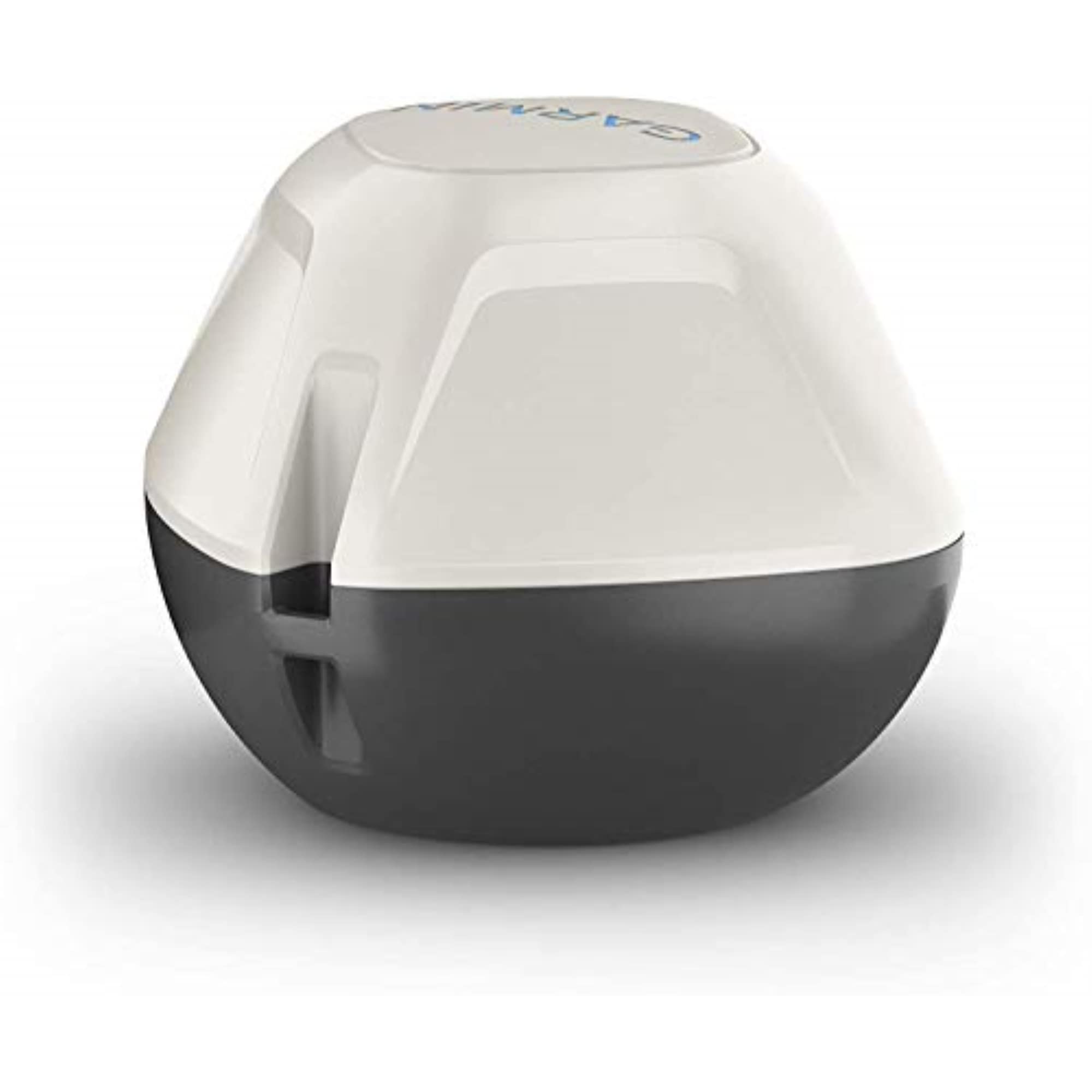
A rugged castable puck that streams Garmin-grade sonar to your phone from 200 feet.
You get the trusted Garmin name and sonar quality without mounting anything to your boat. The STRIKER Cast is a rugged, castable sonar device that works with the free STRIKER Cast app on Apple or Android devices, wirelessly streaming sonar to your smartphone or tablet so you can see what is below from the bank, a dock, or a kayak. It is a different beast from the mountable Striker 4, sharing the brand but built for total mobility.
It streams both traditional 2-D sonar and an ice-fishing flasher mode from up to 200 feet away, and it performs well in both shallow and deep water. The battery is a genuine highlight: it runs for over 10 hours on an internal USB-rechargeable battery, and it conserves power by automatically turning on when it floats in water and off when you pull it out. You can also download maps with up to 1-foot contours from the Garmin Quickdraw Community to add context to your scouting.
In practice, owners use it to find fish around docks, cast a long ways, and get accurate water temperature and depth in real time. The setup is simple: download the app, pair the device, and start fishing in minutes. The catch is that it is not a standalone device—it is completely dependent on your phone for the display, so it will drain your phone’s battery during a long day, and you will want to keep the puck on a dedicated rod with heavy braided line to avoid losing it.
The thing everyone raves about: the ease of pairing and the 10-hour battery life—it just works, and it works for a long time.
The trade-off: it is tethered to your phone’s screen and battery, so plan for phone power on long trips.
Perfect for: kayak fishers, bank anglers, and anyone who wants Garmin reliability in a package they can throw in a tackle box.
Not ideal for: anglers who hate fishing with their phone in the boat or want a permanent dashboard display.
8. Humminbird PiranhaMAX 4 with Down Imaging

A 4.3-inch screen with Down Imaging that reveals structure with sharp clarity.
This is the unit that punches above its weight on imaging, and it is the one to grab if you fish around heavy cover. The PiranhaMAX 4 features Humminbird’s Down Imaging, a sonar mode that gives you a clear, almost photographic view of what is directly below the boat—you can see timber, brush, bridge pilings, and rocks with sharp detail. That is a feature usually reserved for much pricier units, and it makes a real difference when you are trying to drop a bait on a specific stump.
The 4.3-inch color display is the biggest of the mountable units in this lineup, and owners mention it is easy to read even in bright sun. It also has Dual Beam sonar, which means you can choose a narrow beam for great detail or a wide beam for generous coverage, helping you identify fish, structure, and contours. It comes packed with Fish ID+, fish alarms, depth alarms, and zoom, and the redesigned interface is genuinely easier to navigate.
Owners love it for kayaks and small boats, and one buyer liked it so much they bought it twice. It works great on pontoons and is described as an affordable unit with a big screen that is a bang for the buck. The one consistent complaint is that the transducer cable length is not stated in the specs, which can be a problem on larger boats over 22 feet where you might need a longer cable to reach the transom.
Why It’s a Great Value
- Down Imaging reveals sunken structure with sharp detail.
- Big 4.3-inch screen is readable in bright sunlight.
- Dual Beam offers both detail and wide coverage options.
Know Before You Buy
- Transducer cable length is not listed—measure your boat’s transom reach.
- No GPS or mapping capability.
Reach for this if: you fish structure-heavy lakes and want to see brush piles and docks clearly without paying premium prices.
Check your boat first if: you run a larger vessel and need to ensure the transducer cable can reach the transom.
9. Deeper PRO+ 2 Sonar Fish Finder
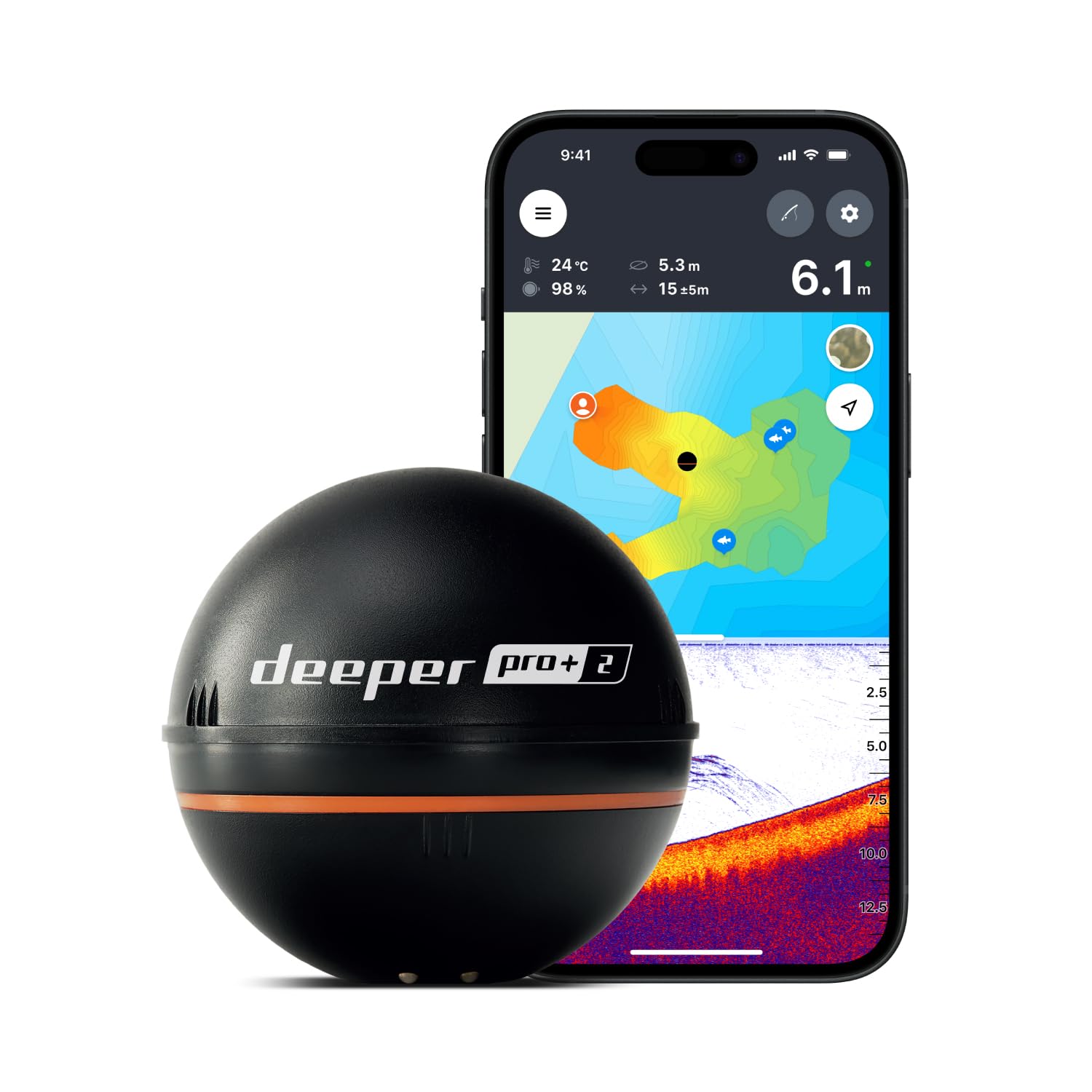
A tennis-ball-sized sonar that maps the lake bottom as you fish.
This is the premium castable for the angler who thinks of fishing as data collection. The Deeper PRO+ 2 is a sleek, lightweight wireless sonar that connects to your phone via its own dependable Wi-Fi, and it is the only castable in this list with a built-in GPS. That GPS is the headline feature: it lets you create bathymetric maps (detailed underwater contour maps) directly from the shore, dock, or bank as you cast and retrieve, and it saves all your maps to the integrated Fish Deeper app.
The sonar itself is seriously capable, reading to a maximum depth of 100 meters (about 330 feet). It offers wide, mid, and narrow beams so you can cover large expanses or drill down on a specific spot, and it boasts a target separation of just 0.4 inches on the narrow beam and 1 inch on the wide and mid beams—which means it can track even the tiniest lure when you are vertical jigging. That is elite-level precision for a castable.
Anglers report it works like top-dollar models, accurately showing fish location, depth, and bottom structure, and it helps them understand the water better than just finding live fish. It is praised for portability and ice fishing, with the app making it easy to spot fish and structure and save your favorite spots. The catches are the app upsells for premium features, the need for heavy line (up to 50lb braid) to avoid tangles, and a long-term reliability question—some customers note battery or Wi-Fi failures after a couple years, with repairs costing nearly the price of a new unit.
What makes it special: the built-in GPS and bathymetric mapping are a genuine step up from every other castable here.
The honest trade-off: it is the priciest of the castables, the app pushes paid subscriptions, and long-term durability is a gamble some owners lost.
Best for: the data-driven angler who wants to build a personal map of their favorite lake and track tiny lures with pinpoint precision.
Skip if: you are on a strict budget or you want a simple “just show me fish” tool without app subscriptions.
Understanding the Specs
Sonar Frequency & CHIRP
This is the heart of any fish finder. Traditional sonar sends a single frequency pulse, while CHIRP sonar sends a continuous sweep of frequencies, giving you a wider range of information and creating crisper fish arches with better target separation. Higher frequency (like 125 KHz on some portable units) gives you better detail in shallow water, so it is ideal for kayaks and small lakes. Lower frequencies reach deeper but with less detail.
Maximum Depth Rating
This spec is a ceiling, not a recommendation. A unit rated for 1,600 feet in freshwater (like the Garmin Striker 4) is built for deep lakes and saltwater. A castable rated for 147 feet is perfect for most inland shore fishing and kayaks. Match the rating to your actual fishing spots—buying a 1,600-foot unit for a 20-foot pond is wasted money, and buying a 147-foot unit for deep lake trout is a waste of a trip.
FAQ
What is the difference between a mountable and a castable fish finder?
How deep do I really need a budget fish finder to read?
Will a fish finder work for ice fishing?
Can I use a castable fish finder without a boat?
Why does my fish finder show fish that are not there?
Is a bigger screen worth paying more for?
Do budget fish finders come with GPS?
How long does the battery last on these budget units?
What is Down Imaging and why would I want it?
Final Thoughts: The Verdict
For the majority of shoppers, the budget fish finder winner is the Garmin Striker 4 because it packs CHIRP sonar, a waypoint map, and a 1,600-foot depth rating into a proven, easy-to-install package that works on kayaks and boats alike. If you want a castable unit that turns your phone into the display, grab the FishPod 5X for its large app screen and AI modes. And for the angler who wants to map the lake bottom, the Deeper PRO+ 2 with its built-in GPS is the one to reach for.
How We Picked
We do not accept paid placement. Every pick is matched to a real buyer and a real use-case; we do not hands-on test units.
Sources & Methodology
Specifications: manufacturer listings and product documentation. Review insights: verified customer reviews, as of August 2026. Pricing: not shown on this page (it changes often); check the current price via the retailer link.
As an Amazon Associate, Gadgets Feed earns from qualifying purchases. This does not affect which products we feature.