
Our readers keep the lights on and my morning glass full of iced black tea. As an Amazon Associate, I earn from qualifying purchases.
Specs are compiled from manufacturer listings and verified buyer reviews and can change over time — please confirm the key details on the product page before buying.
Choosing a 750W modular power supply is mostly about dodging two headaches: a fan that turns your PC into a leaf blower, and a nest of unused cables you have to stuff behind the motherboard tray. A good modular unit lets you plug in only the cables you need, which keeps airflow clean and the inside of your case looking orderly. This guide sorts through the spec sheets and owner experiences to find the units that actually deliver stable power to your components without the noise or the mess.
I’m Min — the founder and writer behind Gadgets Feed. This guide is built by comparing the manufacturers’ published specifications and the patterns across verified customer reviews, so you get each pick’s real strengths and trade-offs instead of marketing spin.
Whether you are chasing dead-silent operation or a future-proof 750w modular power supply, this breakdown covers nine fully modular units rated for modern ATX 3.1 builds.
Our Picks at a Glance


How To Choose The Best 750W Modular Power Supply
Picking the right power supply is less about raw wattage and more about how cleanly it delivers that power. For a modern build, you want a fully modular design so you are not wrestling with a bundle of unused cables, plus the latest connectors so your current and next graphics card both plug in directly.
Full, Semi, or Not at All
Fully modular means every cable, including the 24-pin motherboard one, detaches from the unit. This is the easiest to install because you only connect what the build needs. Semi-modular units keep the essential motherboard and CPU cables attached but let you remove the extras, which cuts cost while still reducing clutter. For the cleanest look and easiest routing, fully modular is the way to go.
The New ATX 3.1 Standard
ATX 3.1 is the latest Intel power standard, designed to handle short power spikes from high-end graphics cards without tripping protections. It also brings the native 12V-2×6 connector, which is the updated version of the 12VHPWR plug used on newer GPUs. A unit with this connector means no adapter dongle is needed for a modern card, which is one less point of failure and one less cable to hide.
Efficiency Ratings Made Simple
Efficiency tells you how much of the wall power actually reaches your components instead of turning into heat. An 80 Plus Gold rating means the unit runs at roughly 90% efficiency under typical loads. There are also independent certifications like Cybenetics that test both efficiency and noise. Higher efficiency means lower electricity bills, less heat inside the case, and often a quieter fan, since there is less waste heat to push out.
Quick Comparison
| Model | Best For | Wattage | Efficiency | Weight | Amazon |
|---|---|---|---|---|---|
| Corsair RM750x★ Best Overall | Quiet all-round performance | 750W | Cybenetics Gold (up to 91%) | 3.9 lbs | Amazon |
| Cooler Master MWE Gold 750 V3Best Value | Budget ATX 3.1 value | 750W | 80 Plus Gold (90%) | 5.7 lbs | Amazon |
| Thermaltake GF1 750WQuiet Performer | Ultra-quiet 140mm fan | 750W | 80 Plus Gold | 3.4 lbs | Amazon |
| Montech Century II 850W | Extra headroom on a budget | 850W | 80 Plus Gold | 4.6 lbs | Amazon |
| be quiet! Pure Power 13 M 750W | Near-silent high efficiency | 750W | 80 Plus Gold (up to 94.3%) | 2.94 kg | Amazon |
| Corsair RM750e (2025) | Reliable mainstream choice | 750W | Cybenetics Gold | 3.3 lbs | Amazon |
| ASUS Prime 750W Gold | Compact premium build | 750W | 80 Plus Gold | 3.2 lbs | Amazon |
| Thermaltake Toughpower GT 750W | Flexible cable options | 750W | 80 Plus Gold (90%) | 5.3 lbs | Amazon |
| be quiet! Pure Power 13 M 850W | Future-proof quiet power | 850W | 80 Plus Gold (up to 94.4%) | — | Amazon |
In‑Depth Reviews
1. CORSAIR RM750x
Our pick — over 4.5★ from 300+ verified ratings; the strongest balance of quality and price.
The set-and-forget pick that stays silent while your whole rig runs underneath it.
The defining quality here is the Cybenetics Gold efficiency rating, which pushes up to 91% efficiency. That translates to lower power consumption, less heat, and a quieter fan because the unit simply does not have to work as hard. Buyers report the fan is effectively dead quiet under normal loads, which makes this a strong fit for a bedroom or office PC where constant hum gets old fast.
It is fully modular, so you attach only the cables your system needs, and the embossed cables with low-profile combs are flexible enough to route cleanly behind a motherboard tray. The native 12V-2×6 connector means a modern card like the RTX 5070 Ti plugs directly into the PSU with no adapter in between — a single 12VHPWR cable that owners say works flawlessly.
The smart fan control knob gives you manual control over the fan curve, which is a rare extra at this tier. Owners mention a real-world efficiency win on a Plex server build: the RM750x pulled 80W where an older PSU pulled 120W, saving 40W on a machine that runs around the clock. That kind of idle efficiency is exactly what makes this unit feel premium beyond its wattage.
quiet and reliable
- Quiet operation under normal loads with a manual fan control knob
- Native 12V-2×6 connector for direct GPU hookup, no adapter
- High on the PSU Tier List and reliable across long-term use
pricey for 750W
- 750W is enough for most builds, but owners say an 850W unit is the safer call if you plan a top-tier GPU
- While it is the crowd favorite here, its total rating count is lower than the RM750e (2025), which has far more owner feedback behind it
premium pick: your priority is a dead-silent, efficient, future-ready unit you will not have to think about for years.
budget build: you already own a very high-end graphics card and want guaranteed headroom — step up to an 850W model.
2. Cooler Master MWE Gold 750 V3
The budget-friendly entry into modular building that owners say changes the cable game.
If you are building your first PC with modular cables, this unit earns its spot because owners consistently praise how easy it is to install and how much cleaner the case looks afterward. The fully modular design (every cable detaches, so you only plug in what you need) eliminates the cable clutter you might be used to. As one buyer puts it: “First time buying a fully modular PSU and I am never going back.” Quiet operation is the most-discussed positive aspect, so you can expect a hushed system even under load.
It delivers 80 Plus Gold efficiency at 90% and comes ready for ATX 3.1 with a 90° 12V-2×6 PCIe 5.1 connector that is angled to improve electrical durability and safety. That angled connector is a real convenience in tight cases where a straight plug would strain against the side panel. It can push up to 450W over that ATX 3.1 cable to your GPU, which is plenty for a card like the RTX 5070.
One thing to note is its size and weight. At 5.7 pounds and 7.09 x 5.91 x 3.39 inches, it is noticeably heavier and longer than slimmer units like the Thermaltake GF1, which comes in at 3.4 pounds. That is not a problem in a standard mid-tower, but it is worth checking clearance in a compact case. The hexagonal fan cover with 80% airflow intake helps it run cool, and the dedicated heat sink adds to its thermal headroom.
best value: a builder on a budget who wants the full modular experience with ATX 3.1 support and does not mind a larger footprint.
flashy rig: mixed feedback on accessory cable quantity — some builds receive fewer 6+2pin cables than expected, so count them at unboxing.
3. Thermaltake GF1 750W
The featherweight with a big 140mm fan that barely whispers under load.
At just 3.4 pounds and 5.9 x 5.5 x 3.4 inches, this is among the most compact and light units in the lineup, so it is easy to handle during installation and fits well in smaller cases. The standout physical feature is the ultra-quiet 140mm fluid bearing fan (a larger fan that spins slower to move the same air, which keeps noise down). Smart Zero Fan mode pauses the fan entirely at low load, so the unit is effectively silent during light work like web browsing or document editing.
It is 80 Plus Gold certified and ready for Intel C6/C7 low-power states, with a high-amperage single +12V rail and DC-to-DC design for stable delivery. The flat black modular cables are a plus for clean routing, and owners who bought two of these units note the manual energy-saving mode and quiet, cool operation. It even carries a 10-year warranty, which is a strong commitment at this tier.
Builders also praise the power quality here — it delivers everything a modern motherboard and CPU need, and the zero-RPM fan means no noise at idle. However, the most-discussed aspect in the review data is reliability, and it gets a mixed verdict: most units run perfectly, but a small number of customers note failures within the first week. The cable length also earns mixed feedback, so measure your case before assuming the runs will reach neatly.
compact and cool: a 140mm fluid bearing fan in a 3.4-pound frame — the quietest physical design in this roundup for the money.
cable management: owners split on cable length, so it suits standard mid-towers better than huge full-towers.
4. MONTECH Century II 850W
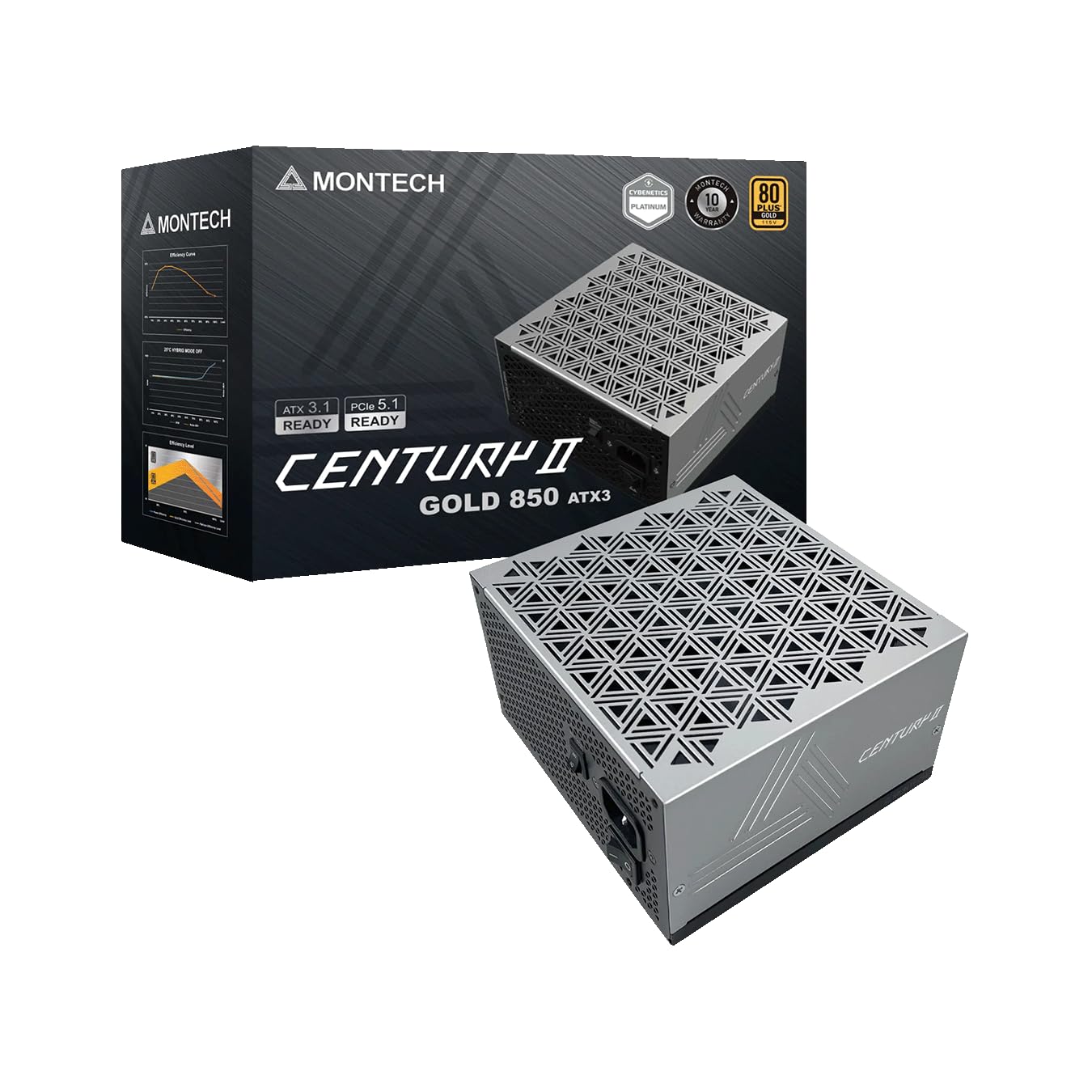
An 850W unit at a 750W price that owners call the budget goat.
The headline number here is 850W, which gives you extra headroom over a strict 750W unit without paying a premium for it. It is 80 Plus Gold certified, and owners point out it is rated A on the SPL tier list — a respected community ranking — which is impressive for a unit at this price point. The 100% Japanese capacitors are the key reliability component, and the 10-year warranty backs that up.
It is fully modular with a native 12V-2×6 cable for ATX 3.1 and PCIe 5.1 platforms, so a modern GPU plugs straight in. The 135mm FDB silent fan has a zero RPM mode, and owners consistently describe it as whisper quiet with no coil whine. The silver metallic design is a distinctive look too, if you care about what is visible through a glass panel.
What wins people over is power quality — it is the most-discussed positive aspect by a wide margin. It has been used in commission and server builds where reliability matters, and it holds up. The main trade-off is the cable management: the port spacing on the unit is tight during install, though owners say it yields cleaner routing once in place. A few note the basic black cables may need extensions for a truly pristine look.
future-proof: you want 850W of future-proofing and Japanese capacitors without stepping up in price.
tight budget: the tight port spacing is the recurring install gripe, and cable management is a mixed bag for some builders.
5. be quiet! Pure Power 13 M 750W
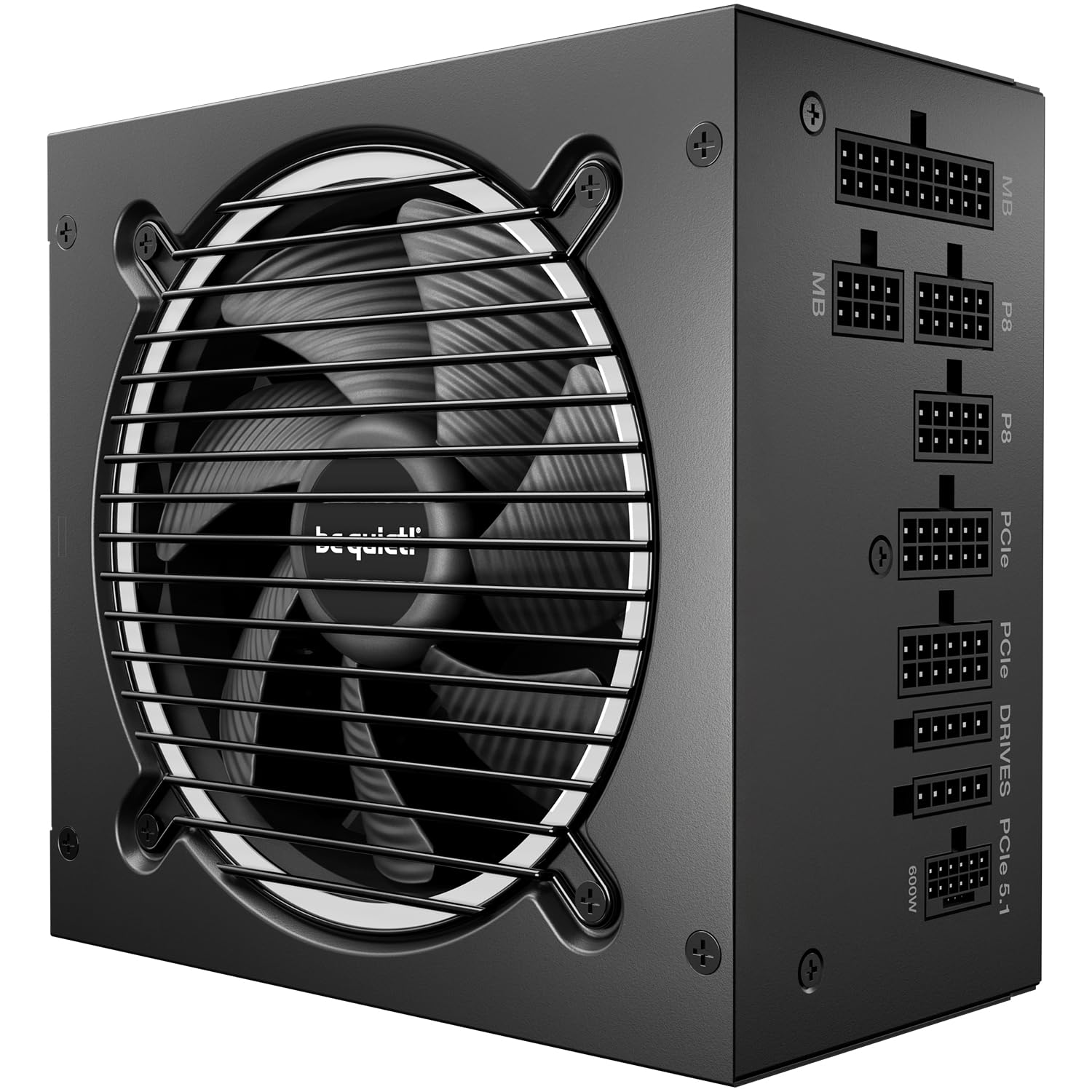
The efficiency king that handles double its rated wattage in a pinch without breaking a sweat.
The defining spec here is efficiency: up to 94.3% efficiency on an 80 Plus Gold certification. That is a serious number that directly means lower power consumption, less heat, and quieter operation. It is the kind of spec that makes this a smart pick for systems that run long hours, like a media creation PC or a gaming rig that doubles as a workstation.
To keep your system ready for modern and future GPUs, it ships with both a native 12V-2×6 connector (the new standard for PCIe 5.1 cards) and four PCIe 6+2-pin connectors for current-gen graphics cards. That versatility is the whole point of the “future-proof” pitch. It delivers 750W of continuous power on one massive +12V rail, and crucially it can handle power excursions up to double its rated power — so a sudden spike from a demanding GPU does not shut the system down.
The semi-passive 120mm fan turns off completely at low load, which is why owners who upgraded from a 500W PSU noticed the extra power was phenomenal and the noise stayed minimal. It uses LLC topology (a resonant converter design that gives top-tier voltage regulation). The one mixed area is cable management — the stiff 24-pin cable is harder to bend in small cases, and the cable routing earns mixed feedback overall.
silent operation: up to 94.3% efficiency and double-power excursion handling — the geekiest, most future-proof combo in the 750W tier.
mid-range cost: stiff cables, especially the 24-pin, demand patience in compact builds.
6. CORSAIR RM750e (2025)

The most-reviewed unit here, built around reliability that owners trust for servers and home labs.
Reliability is the standout theme in the owner feedback for this one — it is the most-discussed positive aspect, and that matters because this is the unit with the deepest pool of real-world verdicts in the lineup. Reviewers point out it works well with RTX 50-series graphics cards and delivers clean, steady power. One builder even installed it in a home lab server with dual Xeons and 256GB of RAM, which is a genuinely demanding test.
It is Intel ATX 3.1 certified and PCIe 5.1 compliant, which means it can withstand 2x transient power excursions from the GPU without tripping protections. The 120mm rifle bearing fan uses a specially calculated fan curve to keep noise down even at full load, and the 105°C-rated capacitors deliver steady, reliable power. The matte black finish matches most cases, and owners note it is worth the price.
The cable management is the honest trade-off here — it is the most-discussed mixed aspect, with owners calling the included cables “mediocre but acceptable.” The modular cabling still makes for a clean build, but if you want premium sleeved cables, budget for an aftermarket set. Also, one owner noted a loud thump on shutdown, which is a quirk rather than a fault, since the unit otherwise performs flawlessly. It is lighter than you might expect at 3.3 pounds, making it easy to handle during install.
efficiency pick: a proven, reliable workhorse with the largest base of owner feedback backing its day-to-day stability.
budget option: included cables that get the job done but are not the prettiest or easiest to route.
7. ASUS Prime 750W Gold

The lightest full-featured unit here, with dual ball bearings built to outlast the build.
At 3.2 pounds and just 5.9 x 5.9 x 3.3 inches, this is the lightest and most compact unit in the lineup, which makes it an easy fit for a mid-tower or a build where space is tight. The dual ball fan bearings are the durability story here — they can last up to twice as long as sleeve bearing designs, which is a meaningful spec if you plan to run this rig for many years. The 8-year warranty matches that longevity promise.
It is 80 Plus Gold certified, and the certification comes from low-ESR capacitors and other premium components that keep voltage regulation tight. It is ATX 3.1 compatible and bundles a 16-pin PCIe cable that works with PCIe Gen 5.0 graphics cards. Shoppers say it powers a 4070 Super without issue, and that 750W is sufficient for all but the most power-hungry video cards.
The axial-tech fan design uses a smaller fan hub to allow longer blades and a barrier ring that increases downward air pressure — a fancy way of saying it pushes air more effectively at lower speeds. The one design quirk is that it comes with two color options in one, but owners note you cannot always show the color you want. It is quiet at idle, though there is slight fan noise under load, which is a fair trade for such a compact unit.
smart features: a compact, light, 80 Plus Gold unit with an 8-year warranty and fan bearings built for the long haul.
higher price: the reversible color panel sounds clever but does not always let you display your preferred shade.
8. Thermaltake Toughpower GT 750W
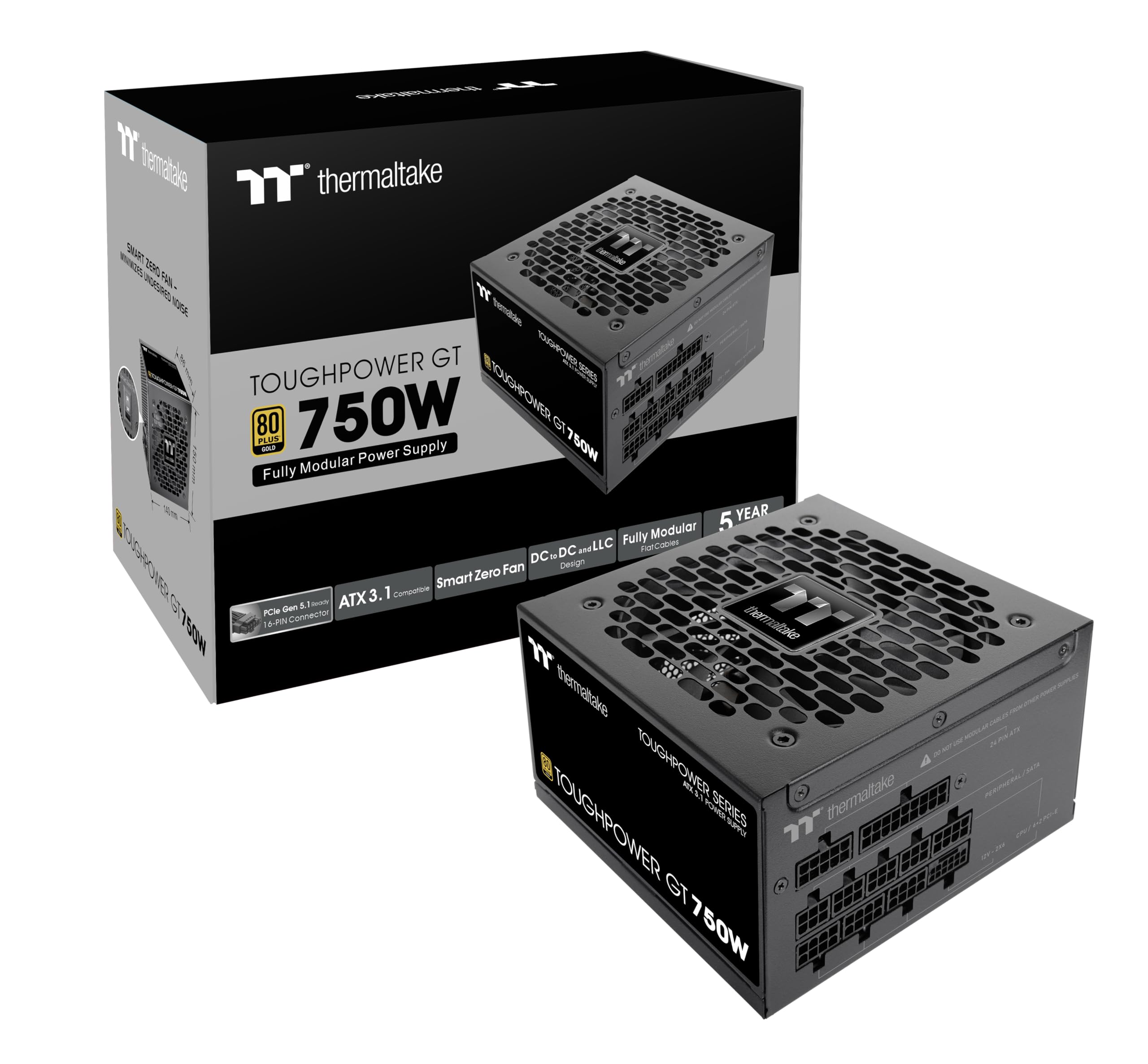
A cable setup so complete that owners say it had every connection they could need and then some.
This is the unit that impresses most with its included cabling — cable quality is the top positive aspect, and owners describe A+ connections with a full set of modular options. It is fully modular with low-profile flat black cables that make cable management easier and improve airflow. You get ATX, Molex, PCI Express, and SATA connectors, plus a native PCIe 12V-2×6 (12+4 pin) connector for the latest GPUs.
It delivers up to 90% efficiency with its 80 Plus Gold rating, which means reduced energy consumption and less heat output. The Smart Zero Fan technology automatically adjusts fan speed based on load, minimizing noise during low-load operations, and there is even a rear fan switch for manual control. The high-amperage single +12V rail is tune for gaming and workstation builds, delivering stable power under heavy load.
Buyers report it handles demanding setups with ease — one runs it with an ASUS ROG Strix X870E-E and an RX 9060 XT while powering 10 ARGB fans, an AIO cooler, and 10 SSDs. Another has run it for six months with zero issues. At 5.3 pounds it is on the heavier side, but the stable rails and quiet operation make it a solid mid-to-high-end pick. The white color option is a nice bonus if you are building a light-themed rig.
durable choice: you value a complete, high-quality cable kit and want a native PCIe 5.1 connector with a rear fan switch for manual control.
silent seekers: you are building in a very small case — at 5.3 pounds and a longer frame, it suits standard mid-towers better.
9. be quiet! Pure Power 13 M 850W
The bigger sibling that owners call genuinely dead silent even under heavy load.
This 850W version of the Pure Power 13 M takes everything good about the 750W model and adds headroom, with an efficiency rating of up to 94.4% — the highest number in this entire roundup. For a high-end gaming PC or a media creation machine that will eventually get a bigger graphics card, that extra wattage and efficiency is pure future-proofing. It is the correct choice for quiet systems and gaming PCs, per the maker.
It ships with a native 12V-2×6 connector for PCIe 5.1 cards plus four PCIe 6+2-pin connectors for current-gen GPUs, making it extremely versatile. It delivers 850W of continuous power on a single +12V rail and can handle power excursions up to double its rated power. The semi-passive 120mm fan turns off completely at low load, and owners consistently report it is genuinely dead silent even under load, with no coil whine.
What wins people over is power quality, the most-discussed positive aspect, followed closely by reliability. Owners note it solved GPU coil whine and handled their video card well, with the detachable cable bundles plugging cleanly into the PSU. The honest trade-off is the cable stiffness — the 24-pin cable is hard to bend in small cases, so plan your routing carefully if you are working in a compact enclosure. It is a heavier unit with no listed weight in the data, so brace for a solid feel during install.
more wattage: up to 94.4% efficiency in an 850W frame — the most efficient and most future-proof unit in this list.
price bump: stiff cables, especially the 24-pin, demand patience in small cases.
Understanding the Specs
Fully Modular vs. Fixed Cables
Fully modular means every single cable detaches from the power supply, including the big 24-pin motherboard cable. You connect only what your build actually needs, which reduces clutter, improves airflow, and makes routing behind the motherboard tray much easier. Fixed-cable units have all cables permanently attached, which is cheaper but leaves you stuffing unused connectors somewhere.
ATX 3.1 and the 12V-2×6 Connector
ATX 3.1 is the latest Intel power standard that handles short transient power spikes from modern graphics cards. The native 12V-2×6 connector is the updated replacement for the older 12VHPWR plug, and it is what new GPUs want. A unit with this connector lets your graphics card plug directly into the PSU without an adapter, which is cleaner and safer than using a dongle.
Efficiency Ratings
Efficiency is the percentage of wall power that reaches your components instead of becoming heat. 80 Plus Gold means roughly 90% efficiency under typical loads, and Cybenetics is an independent certification that also tests noise. Higher efficiency means lower electricity costs, less heat inside the case, and usually a quieter fan because the unit does not have to work as hard to cool itself.
Zero-RPM and Smart Fan Modes
A zero-RPM or semi-passive fan mode lets the fan stop spinning entirely at low loads, making the PSU effectively silent during light work or idle. The fan only kicks in when the unit gets hot enough to need it. This is great for quiet builds, but it does mean the fan cycles on and off under variable loads, which some owners find noticeable.
FAQ
Is 750W enough for a modern gaming PC?
What does fully modular actually mean for my build?
Do I need ATX 3.1 for a new graphics card?
Is a zero-RPM fan mode worth it?
Does a higher efficiency rating really save money?
Will a heavier power supply be hard to install?
What is the difference between 80 Plus Gold and Cybenetics Gold?
Do I need to buy extra cables for these power supplies?
Final Thoughts: The Verdict
For the majority of shoppers, the 750w modular power supply winner is the Corsair RM750x because it pairs Cybenetics Gold efficiency with a native 12V-2×6 connector and a dead-quiet fan that owners consistently praise. If you want the best wattage-per-dollar value, grab the Montech Century II 850W for extra headroom at a budget price. And if near-total silence with top-tier efficiency is your goal, the be quiet! Pure Power 13 M 750W is the one to reach for, with up to 94.3% efficiency backing its quiet promise.
How We Picked
We do not accept paid placement. Every pick is matched to a real buyer and a real use-case; we do not hands-on test units.
Sources & Methodology
Specifications: manufacturer listings and product documentation. Review insights: verified customer reviews, as of August 2026. Pricing: not shown on this page (it changes often); check the current price via the retailer link.
As an Amazon Associate, Gadgets Feed earns from qualifying purchases. This does not affect which products we feature.