
Our readers keep the lights on and my morning glass full of iced black tea. As an Amazon Associate, I earn from qualifying purchases.
Distributing a live 4K signal across every TV in a large home, bar, or commercial building without running new HDMI cables or sacrificing picture quality is the central challenge of any modern smart TV distribution project. An RF modulator bridges that gap by converting a pristine HDMI source into a broadcast-style signal that travels over existing coaxial wiring to every television on the network.
I’m Min — the co-founder and writer behind Gadgets Feed. I spend my days dissecting RF distribution specs, comparing encoding standards like ATSC 3.0 versus QAM, and evaluating how real-world latency and compression artifacts affect multi-room setups. (And Homer 🐱 supervised the signal testing from a warm coax spool).
Whether you’re retrofitting an RV, wiring a sports bar, or upgrading a whole-home A/V system, choosing the right unit means weighing tuner count, resolution limits, and coax compatibility. This guide breaks down the top options for the best 4k rf modulator for smart tv distribution to help you match the right hardware to your distribution layout.
How To Choose The Best 4K RF Modulator For Smart TV Distribution
RF modulators are not one-size-fits-all. Your choice depends on whether you are broadcasting a single HDMI source to a dozen old TVs over legacy coax (where a simple modulator works) or building a whole-home distribution system where every TV independently picks its own channel from multiple sources (where a network tuner is required). Three specs define the decision: output format compatibility, tuner count, and real-world latency.
Output Format: ATSC vs. QAM
ATSC (Advanced Television Systems Committee) is the over-the-air digital broadcast standard used by every modern TV sold in North America. If you connect the modulator’s coax output directly to a TV’s antenna input, ATSC is the format your TV expects. QAM (Quadrature Amplitude Modulation) is the standard used by cable TV providers. If you are injecting the signal into an existing cable distribution system that includes cable boxes or older hotel-style setups, QAM is necessary. Most consumer-grade units output ATSC only; commercial modulators often support both. Picking the wrong format means your TVs will not detect the new channel.
Tuner Count and Simultaneous Streams
A simple HDMI-to-RF modulator encodes one source and broadcasts it as a single channel on a single frequency. If you want every TV in the building to watch the same thing, that is fine. But if you want each TV to independently watch a different source — satellite box, streaming stick, security camera feed, Blu-ray player — you need a network tuner like the HDHomeRun Flex 4K. It connects to your router and lets every TV or tablet tune into any of its four tuners independently via an app, rather than broadcasting a single shared channel. The choice is between shared-channel simplicity and multi-source independence.
Quick Comparison
On smaller screens, swipe sideways to see the full table.
| Model | Category | Best For | Key Spec | Amazon |
|---|---|---|---|---|
| SiliconDust HDHomeRun Flex 4K | Network Tuner | Multi-source whole-home viewing | 4 tuners (2 ATSC 3.0) | Amazon |
| SatLink ST-7000 | HDMI Modulator | Single-source coax distribution | 1080p ATSC/QAM output | Amazon |
| Thor Broadcast HDMI to Coax | HDMI Modulator | Compact single-source broadcast | MPEG2 + AC3 Dolby encoding | Amazon |
| PVI MINIMOD 2 Vecoax | HDMI Modulator | RV/church coax distribution | 1080p + Dolby channel injection | Amazon |
| TESmart 16×1 HDMI Switch | HDMI Switcher | Centralized 16-source HDMI control | 16-in-1 4K@60Hz HDCP 2.2 | Amazon |
| OREI 4K 4×4 HDMI Extender Matrix | HDMI Matrix | 4-source 4K over CAT cable | 4K@60Hz HDR 230 ft CAT5e/6 | Amazon |
| Decimator 12G-CROSS | SDI/HDMI Converter | Professional SDI/HDMI cross conversion | 12G-SDI 4K scaler + frame rate | Amazon |
In‑Depth Reviews
1. SiliconDust HDHomeRun Flex 4K ATSC 3.0

The HDHomeRun Flex 4K is not a traditional RF modulator — it is a network tuner that sits between your antenna and your router, converting over-the-air ATSC 3.0 and 1.0 signals into IP streams that any device on your home network can access. Its four tuners allow up to four simultaneous independent streams, meaning different TVs can watch different channels at the same time, which is the defining feature that makes this the best choice for smart TV distribution.
Setup is straightforward: connect an antenna, plug it into your router via Ethernet, and let every TV, tablet, or phone on your network discover it via the HDHomeRun app. The picture quality is uncompressed, delivering cleaner-than-cable broadcast TV. ATSC 3.0 support adds future-proofing as more stations transition to NextGen TV, although DRM-encrypted 3.0 channels remain a compatibility headache with some devices.
The DVR functionality is solid: attach a USB hard drive and the /year guide subscription enables scheduled recordings without any monthly fee. The main drawback is app stability — the Roku app, in particular, has a history of crashing and unreliable playback controls. A budget Fire TV or Android TV box is a reliable workaround, but it adds to the total cost.
Why it’s great
- Four tuners enable simultaneous independent viewing on multiple TVs
- Uncompressed picture quality surpasses cable and Tablo
- No subscription required for basic DVR with USB storage
Good to know
- Roku app is unstable; Android TV or Fire TV recommended
- DRM-protected ATSC 3.0 channels not supported on many platforms
- DVR playback controls lack fine scrubbing and commercial skip
2. SatLink ST-7000 HDMI to RF Modulator

The SatLink ST-7000 is a dedicated HDMI-to-RF modulator that encodes a single 1080p HDMI source and broadcasts it as an ATSC or QAM channel over your existing coax network. It is the right tool when you need every connected TV to see the same source — security camera feed, digital signage, or a satellite box — without running extra HDMI cables or installing a matrix switch.
Configuration happens over Ethernet via a web interface, which is convenient for remote or rack-mounted installations. The adjustable RF output power (70–100 dBuV) lets you fine-tune the signal strength to match your coax length and splitter configuration. Users report excellent picture quality at 1080p, comparable to an over-the-air digital broadcast with minimal artifacting.
The main limitation is resolution: it maxes out at 1080p, so any 4K source is downscaled before encoding. Some users also report that the RF IN passthrough can attenuate the incoming antenna signal, blocking lower VHF channels. It is a specialized tool that excels at its single-source broadcast job but lacks the multi-tuner independence of a network-based solution.
Why it’s great
- Web-based IP configuration simplifies remote setup
- Adjustable RF output power for challenging coax runs
- Excellent 1080p picture quality with clean encoding
Good to know
- Limited to 1080p — no 4K passthrough
- RF IN can attenuate lower antenna channels
- First-unit failure reported by some buyers
3. Thor Broadcast HDMI to Coax Modulator
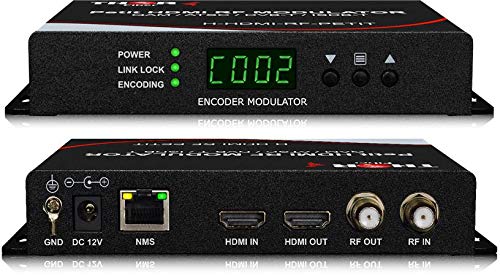
The Thor Broadcast modulator is an ultra-compact all-in-one unit that combines an HD MPEG2 encoder with AC3 Dolby audio and a digital modulator, outputting DVB-C/T, ATSC, or ISDB-T RF over a single F-type coax connector. Its form factor (just 4 x 2.5 inches) makes it the easiest unit to stash behind a TV, in an RV cabinet, or inside a small equipment closet without dedicated rack space.
Configuration is handled through Thor’s proprietary GUI over Ethernet. Despite the small footprint, it supports full 1080p input and delivers clean HD output with minimal delay — users report around 600 ms of latency, which is fine for live TV but noticeable for real-time gaming. The frequency agility lets you pick any clear channel, and the unit can coexist with existing antenna or cable signals through a simple combiner.
Build quality is sturdy, with a metal case that dissipates heat effectively. The main trade-off is that it is a single-source device — one HDMI in, one coax out. If you need to distribute multiple independent sources, you will need one unit per source, which quickly becomes expensive. For a single-source broadcast scenario, its size and reliability make it a top choice.
Why it’s great
- Extremely compact metal chassis fits anywhere
- Frequency agile with ATSC and QAM support
- Stable firmware with remote web configuration
Good to know
- ~600 ms latency may be noticeable for gaming
- Single-source input only — not expandable
- Premium pricing for a 1080p-only device
4. PVI MINIMOD 2 Vecoax HDMI to Coax Modulator

The MINIMOD 2 is a purpose-built HDMI-to-coax modulator that injects a full HD 1080p channel with Dolby audio directly into your existing TV distribution coax. Its key design edge is the onboard color display and front-panel channel selector, allowing you to set the output channel and name without needing a laptop or web browser — a huge convenience for RV owners or quick installs where network configuration is impractical.
Picture quality is strong for an RF modulator, though users upgrading from older analog modulators report a major improvement rather than parity with a direct HDMI connection. Compression artifacts are present on Blu-ray sources but are comparable to what you would expect from a cable or satellite broadcast — acceptable for secondary TVs in an RV, church, or bar environment but not for a home theater critical viewing setup.
The adjustable gain and slope settings let you balance the modulator’s output against existing OTA antenna signals to avoid channel overlap or signal drowning. Some users found that a 20 dB attenuator on the antenna feed was necessary for the MINIMOD to appear reliably during a TV channel scan. It is a solid workhorse for single-source coax distribution where ease of setup matters more than absolute video fidelity.
Why it’s great
- Onboard color display and front-panel channel setup
- Adjustable gain and slope for precise signal balancing
- Easy integration with existing OTA coax networks
Good to know
- Compression artifacts visible on high-bitrate sources like Blu-ray
- Some RV antenna systems require extra attenuation
- Slight overscan on some TV models
5. TESmart 16×1 HDMI Switch 4K

The TESmart 16×1 HDMI switch is not an RF modulator — it is a centralized HDMI switching hub that lets you route any of 16 4K sources to a single output, which can then feed an RF modulator or a display. For distribution systems that require multiple source selection before encoding to RF, this switch solves the signal management problem with 4K@60Hz support, HDCP 2.2 compliance, and a standard 1U 19-inch rack-mount form factor.
Control flexibility is a standout: front-panel buttons, IR remote (with extender cable), RS-232 serial commands, and IP-based control all work. The built-in EDID emulator keeps source devices happy by maintaining consistent display information even when the output is disconnected. Auto-scan mode cycles through inputs at set intervals, which is useful for digital signage or security camera monitoring.
Reliability is a mixed story. While many users report years of trouble-free operation, a significant minority experience early failures — HDMI OUT ports dying after 12–18 months, or auto-input detection failing to retain settings after power loss. TESmart’s customer support generally replaces failed units, but the 1-year warranty feels short for a component expected to run 24/7 in a commercial rack. Pairing this with a modulator creates a powerful but complex distribution chain.
Why it’s great
- Supports 16 4K sources with HDCP 2.2 compliance
- Multiple control methods: IR, RS-232, IP, front panel
- 1U rack-mount design with EDID emulator
Good to know
- Inconsistent reliability; some units fail within 18 months
- Auto-input detection settings lost after power loss on some units
- Bright LED backlight can be distracting in dark racks
6. OREI 4K 4×4 HDMI Extender Matrix

The OREI 4×4 HDMI Extender Matrix is the alternative to RF modulation when you have existing CAT5e/6/7 cabling instead of coax. It takes four HDMI sources and distributes them to four displays over a single CAT cable each, supporting 4K@60Hz with HDR and full 4:4:4 chroma subsampling — something no RF modulator can deliver because RF encoding compresses the video signal.
Each receiver is powered via PoC (Power over Cable) from the main unit, so no local power adapters are needed at the TV end. The IR control works bidirectionally, letting you control the source device from the display location or switch inputs from the matrix unit. The RS-232 port adds professional automation integration for commercial installations, and the EDID management prevents handshake issues with finicky HDMI sources.
Long-term reliability is a concern: after about a year of use, some units develop pink tint artifacts on all outputs or randomly drop connections, requiring a power cycle to restore. The matrix defaults to 1080p out of the box, requiring a trip into the web interface to enable 4K. It is a solid solution for 4K distribution over CAT but not a direct replacement for coax-based RF systems in legacy-wired buildings.
Why it’s great
- True 4K@60Hz HDR with no compression artifacts
- PoC powers receivers over CAT cable — no local power needed
- RS-232 and IR control for professional automation
Good to know
- Requires CAT cable infrastructure — not compatible with coax
- Pink tint and connection drops reported after ~12 months
- Defaults to 1080p; web config required for 4K
7. Decimator 12G-CROSS 4K SDI/HDMI Converter

The Decimator 12G-CROSS is a professional broadcast-grade converter that crosses between HDMI and SDI signals at up to 4K resolution with scaling and frame rate conversion. It is not an RF modulator or a distribution switch — its role in a smart TV distribution system is to bridge the gap between a pro production chain (SDI from cameras, switchers, or streaming gear) and the consumer HDMI inputs that feed into RF modulators or matrix switches.
The 12G-SDI support handles up to 4Kp60, making it fully future-proof for high-bandwidth video workflows. The built-in scaler and frame rate converter accept any input resolution and output a clean, standardized signal, which prevents the handshake and resolution mismatch issues that plague lesser converters. Settings are saved to non-volatile memory, so the unit boots with your configuration even after a power cycle.
Users consistently praise its reliability and image fidelity — it does not add visible artifacts or alter the signal. The primary audience is live event production, church A/V, and commercial installation work where SDI is the backbone. For a pure coax-based smart TV distribution system, it adds unnecessary cost unless you specifically need SDI-to-HDMI or cross-format conversion. It is the ultimate bridging tool but not the main distribution engine.
Why it’s great
- 12G-SDI support handles 4Kp60 with no compression
- Built-in scaler and frame rate conversion solve resolution mismatches
- Settings persist through power loss — no reconfiguration needed
Good to know
- Does not distribute signals — converts format only
- Overkill for pure HDMI-to-coax distribution
- Premium price for a single-format bridge
FAQ
Can a 4K RF modulator distribute a 4K signal without downscaling to 1080p?
What is the difference between an RF modulator and a network tuner for TV distribution?
How much latency does an HDMI-to-RF modulator add to the video signal?
Can I combine an RF modulator signal with my existing over-the-air antenna channels?
Final Thoughts: The Verdict
For most users, the 4k rf modulator for smart tv distribution winner is the SiliconDust HDHomeRun Flex 4K because its four-tuner network design gives every TV independent access to live OTA channels without needing a separate modulator per source. If you only need to broadcast a single HDMI signal to multiple TVs over existing coax — like a satellite box or security camera feed — the SatLink ST-7000 delivers excellent 1080p picture quality with web-based control. And for the simplest single-source installation with front-panel channel setup, the PVI MINIMOD 2 is the most user-friendly option for RV, bar, or small business coax distribution.