
Our readers keep the lights on and my morning glass full of iced black tea. As an Amazon Associate, I earn from qualifying purchases.
Specs are compiled from manufacturer listings and verified buyer reviews and can change over time — please confirm the key details on the product page before buying.
Deciding on a 2 zone amplifier really depends on one question: do you want the same song in two rooms, or different songs in each? That choice splits the market in two—simple two-channel amps that share one audio source, versus multi-zone units that let each room play its own thing. This guide explains the difference so you buy the right level of control the first time.
I’m Min — the founder and writer behind Gadgets Feed. This guide is built by comparing the manufacturers’ published specifications and the patterns across verified customer reviews, so you get each pick’s real strengths and trade-offs instead of marketing spin.
Everything here comes straight from the spec sheets and owner feedback for each unit, with no invented numbers. Read on to find the right 2 zone amplifier for your home, your speakers, and the way you actually listen.
Our Picks at a Glance

How To Choose The Best 2 Zone Amplifier
Before you compare watts and channels, ask yourself one question: do you want the same song playing in both rooms, or the ability to play different music in each? That single answer determines if you need a simple stereo amp or a true multi-zone matrix.
Zones vs. Channels: Know the Difference
A “zone” is a listening area, like your living room or patio. A “channel” is one speaker output. Since most speakers need two channels (left and right), one stereo zone usually uses two channels. An amp with 8 channels can therefore power up to 4 stereo zones if each zone is a stereo pair—though some manufacturers label mono or bridgeable outputs as zones, so 8 channels can also be marketed as 8 zones. You will see numbers like “12 channels (6 stereo zones)” on a spec sheet.
Power: Match It to Your Speakers, Not Your Ego
Watts per channel tells you how loud an amp can drive your speakers. In-ceiling speakers are usually efficient, so they need less power than big floor-standing towers. Check your speakers’ recommended power range and buy an amp that sits comfortably inside it—too little power causes distortion, and wildly too much can damage tweeters.
Bridging: When Two Channels Become One Big One
Some amps let you “bridge” two channels into a single, higher-powered output. This is useful for powering one large speaker or a subwoofer with more wattage, but it means you lose that second zone. If you need both rooms fully powered, avoid bridging and keep the channels separate.
Streaming and Control: How You Want to Play Music
Modern multi-zone amps often include built-in streaming and an app for control. If you live in the Apple ecosystem, look for AirPlay 2 support. Spotify users should check for Spotify Connect. A physical remote or front-panel controls matter less if you plan to use your phone as the main controller.
Quick Comparison
| Model | Best For | Channels | Output Power | Streaming | Amazon |
|---|---|---|---|---|---|
| Dayton Audio DAX88★ Best Overall | Whole-home matrix control | 8 | 75 WPC / 260 W bridged | Wi-Fi, AirPlay | Amazon |
| Rockville Rock Zone 8Best Value | High power on a budget | 8 | 125W RMS at 4 ohms | Bluetooth, FM, USB | Amazon |
| Dayton Audio MA1260 | Raw multi-zone power | 12 | — | None (line-in) | Amazon |
| Marantz MM7025 | Audiophile 2-channel / 2-zone | 2 | 140 WPC at 8 ohms | None (analog) | Amazon |
| Juke-6 | Streaming simplicity | 12 | 40 WPC at 8 ohms | AirPlay 2, Spotify, BT | Amazon |
| Juke-8 | 8-zone streaming hub | 16 | 40 WPC | AirPlay 2, Spotify, BT | Amazon |
In‑Depth Reviews
1. Dayton Audio DAX88 8-Source 8-Zone Matrix
Our pick — over 4★ from 50+ verified ratings; the strongest balance of quality and price.
The command center that lets each room play its own source, all from your phone.
If your goal is true whole-home flexibility—different music in different rooms from different devices—the DAX88 is the pick that does it all. It is an 8-source, 8-zone matrix, meaning up to eight separate audio inputs can be routed independently to eight zones. You get 75 watts per channel at 8 ohms, and if you bridge channels, that jumps to 260 watts per channel. That bridging option is the key to its versatility: run two rooms normally, or combine outputs for one seriously powered space.
Streaming is built in with Wi-Fi and AirPlay, and the Matrio app (iOS and Android) handles per-zone volume, balance, bass, and treble. The flexibility of separate source and speaker control is a huge quality-of-life win. Buyers report: “Flawless so far. Installed in a gut-to-studs renovation and currently running all 6 powered zones in entertaining areas.” The main gap is a dated Android app—iPad users are happy, but Android owners lose a star over it. It also measures 21.5 x 20 x 9 inches, so plan your rack space accordingly.
This is the unit to get when you want professional-grade routing without hiring a custom installer. Backup is the famous 5-year Dayton Audio warranty, which is a genuine comfort on gear this complex.
What wins people over
- Independent control of sources and speakers in each zone
- 75 WPC standard, 260 WPC when bridged for serious power
- AirPlay plus a wide array of analog and digital inputs
The trade-offs
- Android app lacks current updates—iPad experience is superior
- Large footprint at 21.5 x 20 x 9 inches needs real rack space
Reach for this if: you want independent music sources in multiple rooms with app control and are willing to set up a proper rack.
Look elsewhere if: you are an Android-only household that values a polished app above raw routing power.
2. Rockville Rock Zone 8 Channel Amplifier
A heavy-duty powerhouse that drives a whole house of ceiling speakers without breaking a sweat.
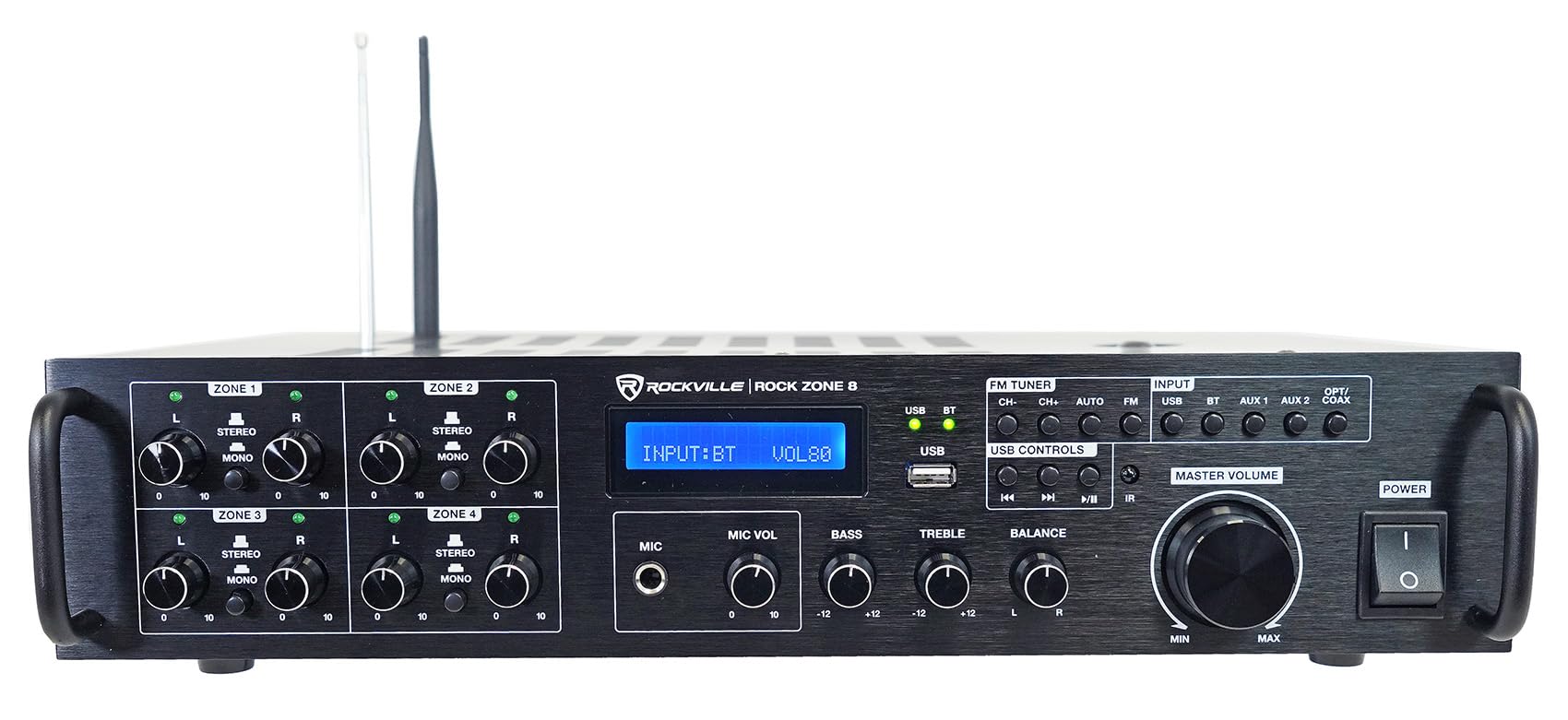
The Rockville Rock Zone 8 is the value play that does not skimp on muscle. It delivers 1000W RMS across 8 channels, which breaks down to 125W per channel at 4 ohms or 90W at 8 ohms. That is real, usable power for homes, restaurants, or retail spaces. Owners mention: “Heavy-Duty Beast. Powers 13 Ceiling Speakers Like It’s Nothing!”
Each of the 8 zones gets its own volume, mono/stereo selector, and EQ adjustments. Connectivity is a grab-bag: Bluetooth, 2 RCA inputs, optical, coaxial, USB playback (up to 32GB), FM radio with presets, plus a mic input. There is also a subwoofer output and a record output for hooking up extra gear. It is rack-mountable with removable brackets, and the 115V/230V switchable voltage means it travels well.
The honest caveats: a single Bluetooth antenna limits range, and there is no manual in the box—the tutorial video is the better guide anyway. One owner noted a high-end hiss in small rooms, while others report crisp sound with no low-end hiss. At 22.93 lbs with a 16.92″ x 12.67″ x 3.81″ build, it is a substantial piece of gear.
Straight talk: this is the budget champion for power-hungry setups where raw output matters more than app polish.
Watch for: its size and weight—make sure your rack or shelf can handle a 23-pound amp.
3. Dayton Audio MA1260 Multi-Zone 12 Channel Amplifier

Twelve channels of pure amplification for the serious whole-home builder who brings their own sources.
The MA1260 is a different animal from the DAX88: it is a pure amplifier with no built-in streaming or app. What it offers instead is 12 channels (6 stereo zones) of clean power in one enclosure, making it the physical foundation of a serious multi-room system. It is a smart choice if you already own a streamer or receiver and just need the muscle to push speakers in six rooms.
Independent and bus inputs give you real flexibility—you can feed each zone its own source or daisy-chain a single source everywhere. Bridgeable channel outputs add power where a single speaker needs it, and independent gain controls let you match each speaker’s output perfectly. The multi-stage protection circuitry and temperature-controlled cooling fans are built for reliability. At 16.33 kg (about 36 lbs) and 16.7 x 14.25 x 4 inches, it is a compact-for-its-class rack unit.
Sound quality is the standout. Owners describe it as “surprisingly fantastic,” with no hum or distortion in quiet listening rooms. There is, however, a real reliability split: some units work like a charm while a few owners hit shutdown issues, and one warranty claim was denied. This is the most-discussed aspect of the amp, so it is worth knowing before you buy.
The muscle it brings
- 12 channels = 6 full stereo zones from one box
- Independent gain controls to match each speaker perfectly
- Bus input lets one source feed every zone
Know before you commit
- No streaming, app, or Bluetooth—bring your own source
- Reliability reports are split, with occasional shutdown issues
- Phoenix connectors work but banana plugs would be easier
Best for: the hands-on enthusiast who already owns a streamer and wants the cheapest path to six powered zones.
Think twice if: you want app control or a set-and-forget warranty experience.
4. Marantz MM7025 Stereo Power Amplifier
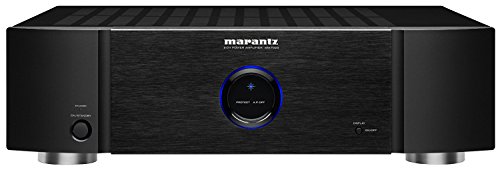
Pure audiophile-grade power for two channels, with balanced XLR inputs for a noise-free signal.
The Marantz MM7025 is the pick for the listener who prioritizes sound quality above all else. It delivers 140 watts per channel at 8 ohms, and its substantial current capability keeps complex audio sources clear—from action-movie explosions to soft whispers. Unlike the multi-zone matrix units in this list, this is a 2-channel amp, so it fits two use cases: a dedicated high-end stereo setup, or two zones to power speakers in different rooms.
what separates it is the input flexibility: both single-ended RCA and balanced XLR inputs. Balanced connections reject noise over long cable runs, which is a genuine advantage in a pro-style setup. The cooling fan is silent even when it speeds up, and with a depth under 14 inches and 5-inch height, it slides into most shelves or cabinets. The slightly curved aluminum front panel looks premium wherever you put it.
Owners rave about the sound: warm, musical, and full, with tight bass that revives speakers that sounded thin on a receiver alone. One replaced a Classé CA200 and found the soundstage better with cleaner highs. A dissenting voice found it muddy for critical music listening and returned it—a reminder that speakers and personal taste matter. Value is debated; some call it excellent, others feel the price-to-performance ratio is only fair.
The verdict: the sonic upgrade path for two-channel purists who want reference-quality power and don’t need streaming built in.
The catch: it is a 2-channel amp at heart, so “two zones” here means two rooms with the same source, not independent music.
5. Juke-6 6-Zone Audio Amplifier
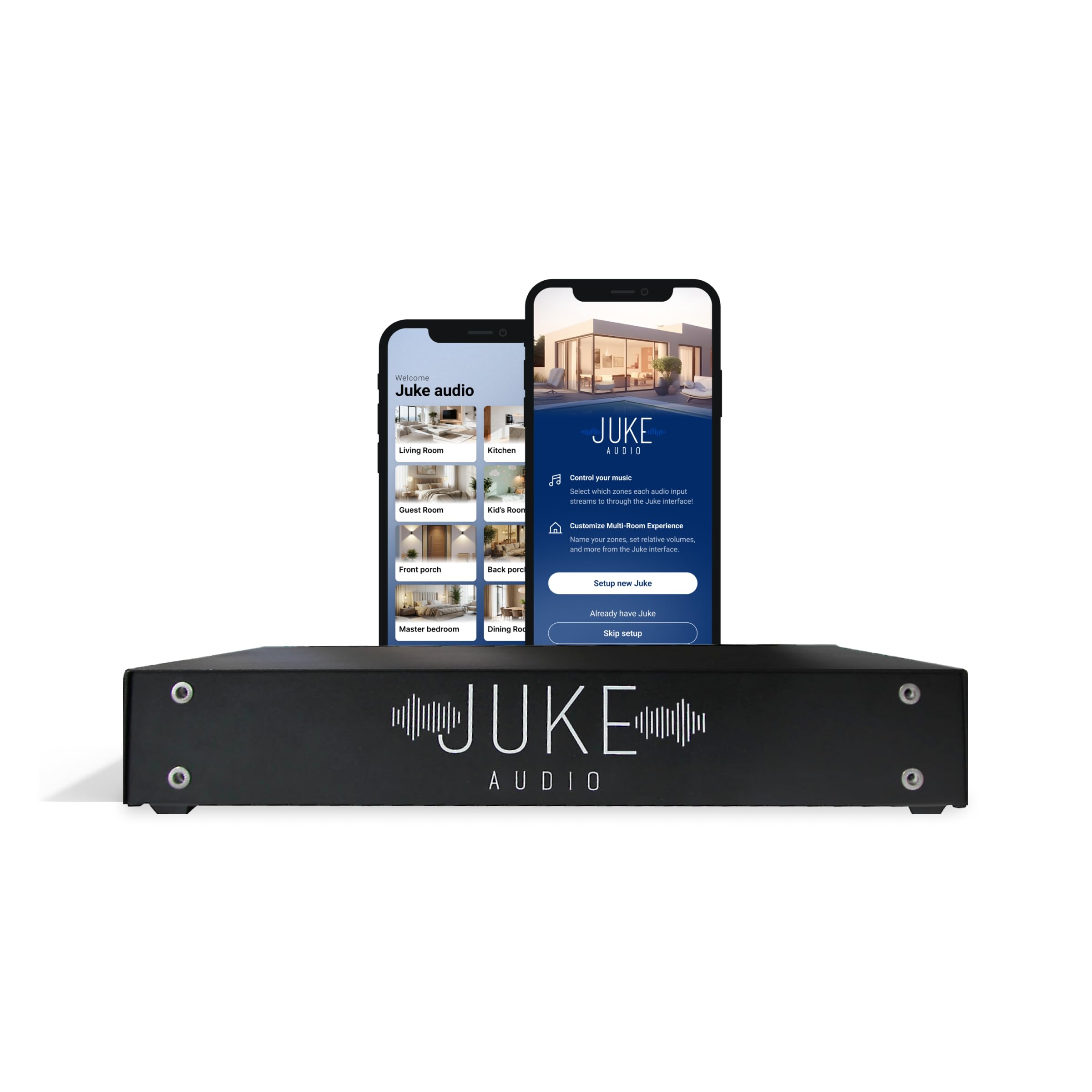
A compact streaming hub that makes whole-home audio as easy as picking a room in your music app.
The Juke-6 is the simplicity king. It powers up to 12 speaker channels across 6 zones, with 40 watts per channel into 8 ohms and stability down to 2 ohms per channel. That 2-ohm stability is a big deal—it means the amp can drive demanding speakers without shutting down. Its defining feature is how it shows each zone as a separate device in AirPlay 2 and Spotify, so you stream to any room directly from your favorite app. No proprietary software, no learning curve.
Multiple users can stream simultaneously—Dad in the garage, kids in the living room—or everyone can listen to the same source during a party. Bluetooth and DLNA round out the wireless options, and an AppleTV can send TV audio to any zone with control from the TV remote.
The trade-off is power: 40 watts per channel is plenty for in-ceiling speakers but not for filling large rooms with floor-standing towers. Customers note clean, stable AirPlay and clear sound across zones, though one noted it is “less loud but sufficient for ceiling speakers.” The tabletop design means no rack mounts are included.
Why it wins fans
- Each zone appears as its own AirPlay 2 / Spotify target
- Simultaneous streams from different users across zones
- 2-ohm stable per channel for demanding speakers
- Tiny 6.5-lb footprint
Where it’s limited
- 40 WPC won’t drive large rooms hard
- Video-only setup guide; a PDF manual would help
- No rack mounts for installers who need them
Grab it if: you’re an Apple or Spotify household wanting easy multi-room streaming without a rack.
skip it if: you need high volume in big open spaces or require rack-mount hardware.
6. Juke-8 8-Zone Multi-Room Amplifier
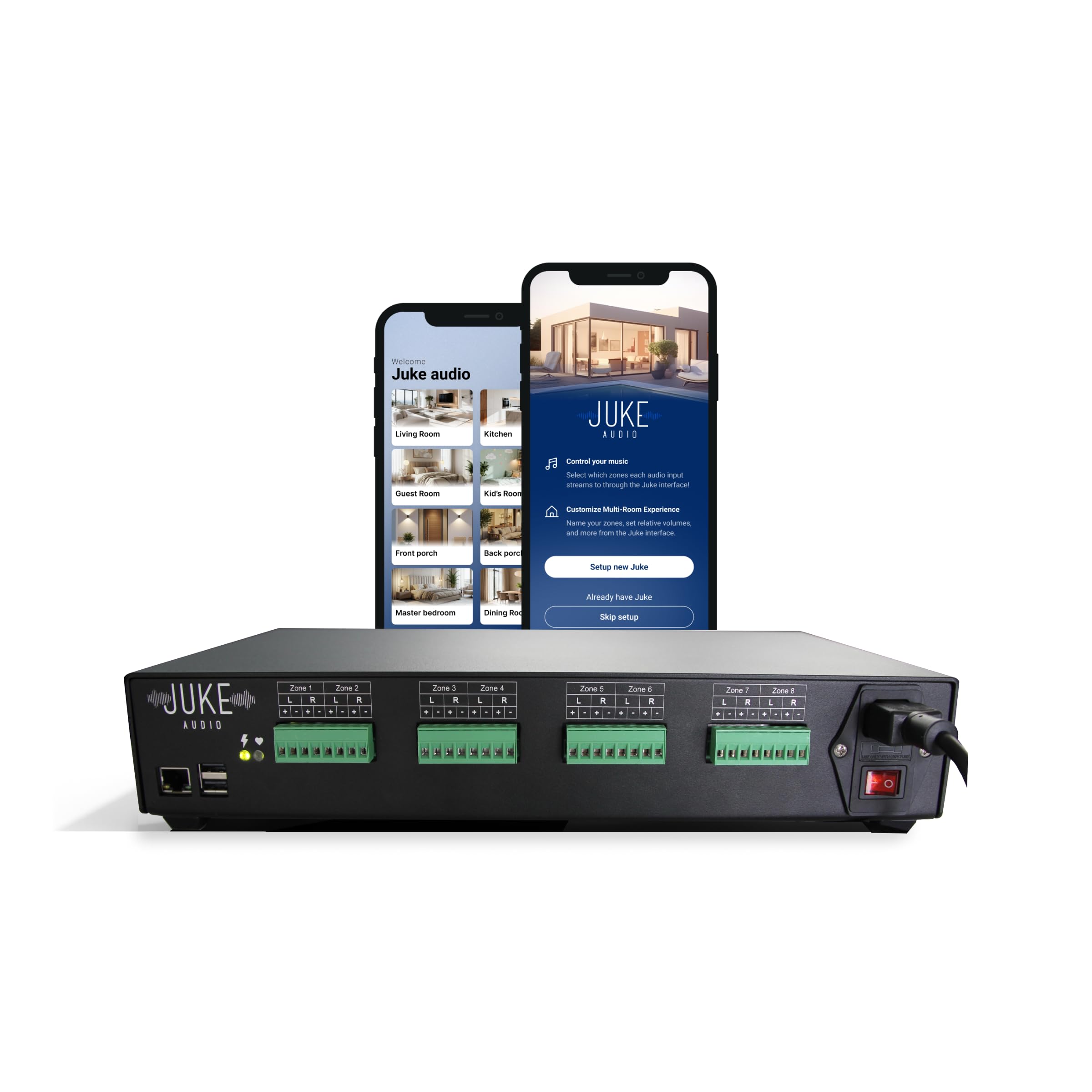
The all-in-one hub that replaces a stack of streamers, amps, and selectors in one sleek box.
The Juke-8 scales the Juke formula up to the whole house. It powers 16 channels across 8 zones, supporting up to eight simultaneous audio sources—meaning different rooms can stream different songs from different apps at the same time. It is engineered to handle everything from hidden in-ceiling and in-wall speakers to sturdy outdoor units, all controlled from your phone.
Setup is the headline feature here. Even a non-technical user got six wired rooms running in under an hour, and the app is genuinely intuitive. It now lets both Android and Apple users sign into music services directly, with support for Pandora, Tidal, and TuneIn (more coming via free firmware updates). The Juke app handles per-zone volume, pre-set multi-room groups, input selection, and speaker-connection checks.
The consistent praise is for ease of setup and configuration—owners call it “impressive” and reliable. Power is the mixed note: at 40 watts per channel, it is adequate for normal indoor volumes but a pro installer noted it felt underpowered for large rooms. Sound quality draws a rare negative from one owner who compared it to “a 1980’s AM radio,” though far more report very good quality. It also favors Apple devices; Android works but needs extra steps.
The takeaway: the easiest path to 8-zone whole-home audio with multi-user streaming, at a fraction of custom-installer cost.
The honest limit: 40 WPC caps its ceiling in big spaces, and Android users need extra steps.
Understanding the Specs
Watts Per Channel (WPC)
This tells you how loud the amp can drive each speaker. Higher wattage generally means more headroom before distortion, but the real match is your speaker’s sensitivity and impedance. In-ceiling speakers are usually efficient and need far less power than big floor-standing towers.
Bridgeable Channels
Bridging combines two channels into one higher-power output. It is great for powering a single large speaker or subwoofer, but it costs you a zone. If you need two full stereo rooms, keep channels unbridged and separate.
Zones vs. Channels
A zone is a listening area; a channel is one speaker output. Since a stereo zone needs two channels, an 8-channel amp typically runs 4 stereo zones, though some amps label mono or bridgeable outputs as zones. Knowing this math helps you translate channel counts into real rooms.
Streaming and App Control
AirPlay 2, Spotify Connect, and Bluetooth determine how you get music into the amp. Matrix amps with apps offer per-zone volume and source routing; simple power amps rely on your existing receiver or streamer for that job.
FAQ
What is the difference between a 2 zone amplifier and a multi-channel amplifier?
Can I play different music in each zone on a 2 zone amplifier?
How many watts per channel do I need for in-ceiling speakers?
What does bridging channels on an amplifier do?
Will a 2 zone amplifier work with my existing receiver?
What is the difference between AirPlay 2 and Bluetooth for multi-zone audio?
Do zone amplifiers have their own apps for control?
Is a 40 watt per channel amplifier loud enough for a whole house?
Final Thoughts: The Verdict
If you want one dependable pick, the 2 zone amplifier winner is the Dayton Audio DAX88 because it combines eight independent sources, eight zones, and app control into one rack unit—the closest thing to a custom-install system you can buy off the shelf. If you want high power on a budget, grab the Rockville Rock Zone 8. And for easy streaming in a compact box, the Juke-8 is the one to reach for.
How We Picked
We do not accept paid placement. Every pick is matched to a real buyer and a real use-case; we do not hands-on test units.
Sources & Methodology
Specifications: manufacturer listings and product documentation. Review insights: verified customer reviews, as of August 2026. Pricing: not shown on this page (it changes often); check the current price via the retailer link.
As an Amazon Associate, Gadgets Feed earns from qualifying purchases. This does not affect which products we feature.