
Your high-end speakers are only as good as the room they live in. Without an accurate measurement microphone, you’re essentially tuning your system blind — applying EQ corrections based on assumptions rather than actual data. A calibration mic captures the real acoustic fingerprint of your space, giving software like REW or Dirac the precise frequency response information it needs to flatten peaks and smooth nulls. It’s the single most important tool in any serious speaker tuner’s kit.
I’m Rikta — the co-founder and writer behind Gadgets Feed. I’ve spent countless hours analyzing the technical specifications and market landscape of measurement microphones, from their electret capsule designs and self-noise floors to their individual calibration file accuracy across various price tiers. (And Homer 🐱 supervised from the speaker grille, occasionally batting at the windscreen).
Whether you are setting up a Dolby Atmos home theater, fine-tuning studio monitors, or performing detailed acoustic analysis with REW, selecting the right tool is critical. This guide breaks down the top contenders on the market to help you find the best calibration microphones for speaker tuning for your specific setup and budget.
How To Choose The Best Calibration Microphones For Speaker Tuning
Navigating the world of measurement microphones can be tricky, but focusing on a few critical specs will steer you toward the right pick for your workflow. The goal is a flat, uncolored response that gives your room correction software an honest picture of your space.
Connectivity: USB vs. XLR
Your choice here is largely dictated by your gear. USB microphones, like the EVERSOLO EM-01 or Superlux ECM999U, offer plug-and-play simplicity with a direct digital connection to your computer, bypassing the need for an audio interface or phantom power. XLR microphones, like the Dayton Audio EMM-6 or PreSonus PRM1, require a preamp or audio interface with 48V phantom power, but they offer a more traditional path for high-end signal chains and are often preferred for multi-mic setups or integration with hardware processors like the dbx DriveRack.
Calibration File: The Non-Negotiable Feature
A measurement microphone is useless for serious speaker tuning without its own individual calibration file. These files, provided by the manufacturer, detail the mic’s minor deviations from a perfectly flat frequency response. Software like REW, Audyssey, or Audiolense uses this data to correct those tiny errors. Look for mics like the Dayton Audio EMM-6 or the Audyssey ACM1-X that come with a unique response graph or serialized digital file. Generic mics without this file are only good for basic level matching, not precise EQ work.
Capsule Size and Max SPL
The capsule size dictates how the microphone handles sound pressure and spatial information. Most calibration mics use a small 1/4-inch or 6mm electret condenser capsule, which provides an excellent omnidirectional pick-up pattern. Pay attention to the maximum SPL rating, measured in dB SPL. A rating of 130 dB SPL or higher, like the Superlux ECM999U’s 133 dB SPL rating, ensures the mic can handle the peaks from a powerful subwoofer or PA system without distorting and giving you false readings.
Quick Comparison
On smaller screens, swipe sideways to see the full table.
| Model | Category | Best For | Key Spec | Amazon |
|---|---|---|---|---|
| IK Multimedia ARC Studio | Complete System | Studio Rooms & Mixing | XLR/USB-C Processor + Mic + Software | Amazon |
| dbx RTA-M | Pro Measurement | Driverack & Live Sound RTA | XLR, 20 Hz–20 kHz Flat Response | Amazon |
| Dayton Audio EMM-6 | Precision XLR | REW & Audiolense Analysis | XLR, Individually Calibrated File | Amazon |
| Audyssey ACM1-X | AVR Calibration | MultEQ-X & Home Theater AVRs | 3.5mm Jack, Serialized Calibration | Amazon |
| EVERSOLO EM-01 | USB-C Streamer | EVERSOLO DMP Streamers & Dirac | USB-C, 47g, -13 dBFS Sensitivity | Amazon |
| Superlux ECM999U | USB Value Set | REW Beginners & Portability | USB-C, Complete Kit w/ Case | Amazon |
| PreSonus PRM1 | Studio Reference | Critical Recording & Measurement | XLR, 1/4″ Capsule | Amazon |
In‑Depth Reviews
1. IK Multimedia ARC Studio
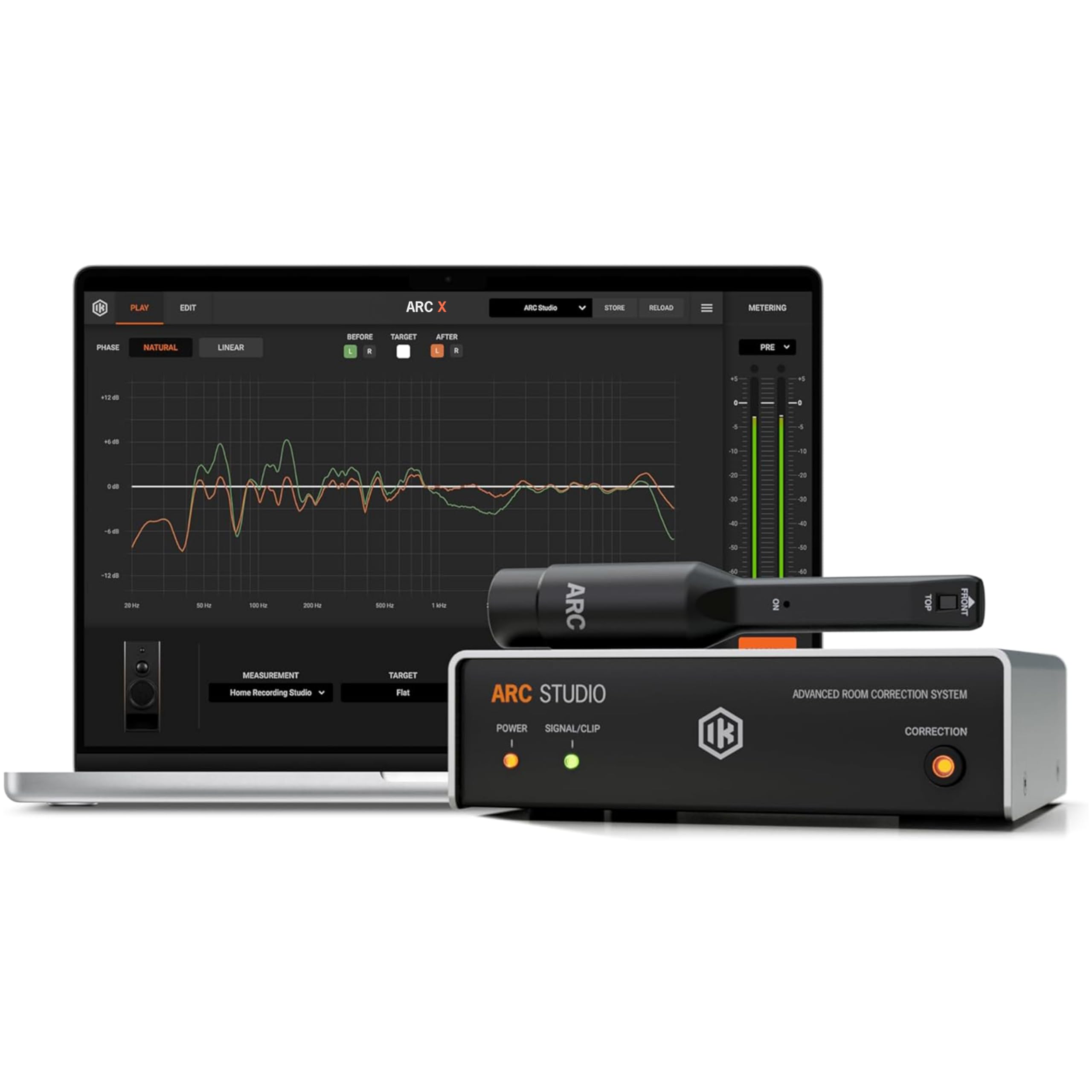
The IK Multimedia ARC Studio is far more than just a microphone — it is a complete room correction ecosystem. It comprises three essential elements: a high-precision omnidirectional measurement mic, a dedicated hardware processor box that sits between your source and monitors, and the ARC 4 software. This all-in-one approach takes the guesswork out of the signal chain, as the correction is applied at the hardware level, meaning it works with any audio source, not just your DAW.
The provided mic requires 48V phantom power from an audio interface, and the system walks you through a multi-point measurement process (up to 21 positions) to build a comprehensive 3D map of your acoustic space. Users report a dramatic improvement in stereo imaging and bass clarity, even in untreated rooms, with the virtual monitoring feature being a standout for checking mixes on emulated high-end speakers. The setup process is thorough but yields professional-grade results.
This is the top-tier investment for anyone serious about mixing accuracy or overcoming poor room acoustics without building extensive physical treatment. While it demands more upfront configuration and a USB audio interface with XLR input, the result is a cohesive, “set-it-and-forget-it” system that transforms your listening environment. It breathes new life into any set of monitors, making them sound like they belong in a treated control room.
Why it’s great
- Hardware-based correction applies to all audio sources, not just a computer.
- Includes a high-precision measurement mic and professional calibration software.
- Excellent virtual monitoring feature for translating mixes to consumer systems.
Good to know
- Requires a USB audio interface with 48V phantom power for the mic.
- Relatively complex initial setup and software registration process.
- Cannot save multiple calibration profiles easily; one correction per setup.
2. dbx RTA-M

The dbx RTA-M is a battle-hardened professional reference microphone, purpose-built for the dbx DriveRack line of loudspeaker management processors. Its primary mission is to provide an ultra-flat, omnidirectional capture for real-time analysis (RTA) and automatic EQ adjustment in live sound and installation environments. The mic’s back-electret condenser design and wide 20 Hz to 20 kHz frequency response ensure accurate “pinking” of a PA system.
Powered exclusively by 48V phantom voltage, the RTA-M integrates seamlessly with DriveRack units, which supply the necessary power directly. Users confirm it works flawlessly with models like the DriveRack PA+ and 360, providing the reference signal needed for the auto-EQ algorithms. The package includes a useful mic clip and a large, high-quality padded carrying case, making it easy to transport for gigging sound engineers.
One unique technical quirk of this mic is that it is wired pin-3 hot (unbalanced to standard pin-2 hot XLR). This is not an issue when used with a DriveRack, but if you plan to use it with a standard audio interface from another brand, you may need to flip the polarity in your measurement software (most support this) to avoid phase cancellation. It is a specialized tool that excels brilliantly in its intended role.
Why it’s great
- Perfectly matched for dbx DriveRack auto-EQ and RTA systems.
- Includes a padded carrying case and standard mic clip.
- Good sensitivity and flat frequency response for measurement work.
Good to know
- Wired pin-3 hot, which may require polarity inversion with non-dbx gear.
- Requires phantom power from a mixer or DriveRack unit.
3. Dayton Audio EMM-6

The Dayton Audio EMM-6 has rightfully earned its reputation as the go-to reference microphone for the DIY and high-end home audio community. Its secret weapon is the individually supplied calibration file, which is a downloadable PDF containing a specific frequency response graph for your exact microphone. This data is crucial for software like REW, Room EQ Wizard, or Audiolense to apply accurate corrections based on your mic’s actual behavior.
Built with a rugged all-metal casing, it feels substantially more durable than many Mylar-diaphragm competition. The low-noise FET input stage helps minimize low-frequency distortion, and the 1/2-inch capsule provides a solidly linear response from 20 Hz to 20 kHz. It includes a stand mount and a foam windscreen, but the inclusion of a sturdy plastic transport case adds significant value for protection. The mic requires standard 48V phantom power.
Multiple user reports confirm that its measurement accuracy is genuinely comparable to microphones costing three to ten times as much, making it a staggering value. The only practical caution is to avoid leaving it in direct sunlight for extended periods, as the Mylar diaphragm can be affected by heat. For anyone getting serious about in-room speaker measurements with REW, the Dayton Audio EMM-6 is the benchmark.
Why it’s great
- Includes individual calibration response graph for accurate corrections.
- All-metal construction feels very durable and well-made.
- Comes with a protective transport case, clip, and windscreen.
Good to know
- Requires an audio interface with 48V phantom power (XLR connection).
- Mylar diaphragm can be permanently damaged by prolonged direct sunlight.
4. Audyssey ACM1-X

The Audyssey ACM1-X is a specialized tool for users of AV receivers equipped with Audyssey MultEQ room correction. It is the official replacement and upgrade microphone for the standard mic that comes in the box. Its critical advantage is that each ACM1-X unit is individually analyzed in the factory and assigned a unique calibration file, which you download using the mic’s serial number and apply within the paid MultEQ-X software for PC.
Connecting via a standard 3.5mm jack, it is designed to plug directly into the included calibration microphone input on Denon, Marantz, and other Audyssey-equipped AVRs. The individually calibrated nature significantly improves measurement accuracy compared to the mass-produced stock mic. Users upgrading from the stock ACM1H report hearing more precise distance calculations, better imaging, and a clearer overall soundstage after running the calibration with the ACM1-X.
This mic is not a standalone product; its value is entirely tied to the Audyssey MultEQ-X software ecosystem, which is a separate in-app purchase. It is not useful for general-purpose software like REW unless you can decode its proprietary calibration file. It is the definitive tool for owners of compatible AVRs who want to extract the absolute best performance from their room correction system, particularly for fixing subwoofer integration and distance errors.
Why it’s great
- Individually analyzed and calibrated for superior accuracy over stock mics.
- Simple plug-and-play connection via 3.5mm jack to compatible AVRs.
- Fixes known distance calculation bugs found in the standard AVR app.
Good to know
- Requires the paid Audyssey MultEQ-X software (PC only).
- Not compatible with standard USB audio interfaces or REW software.
- The calibration file is proprietary and must be downloaded via serial number.
5. EVERSOLO EM-01
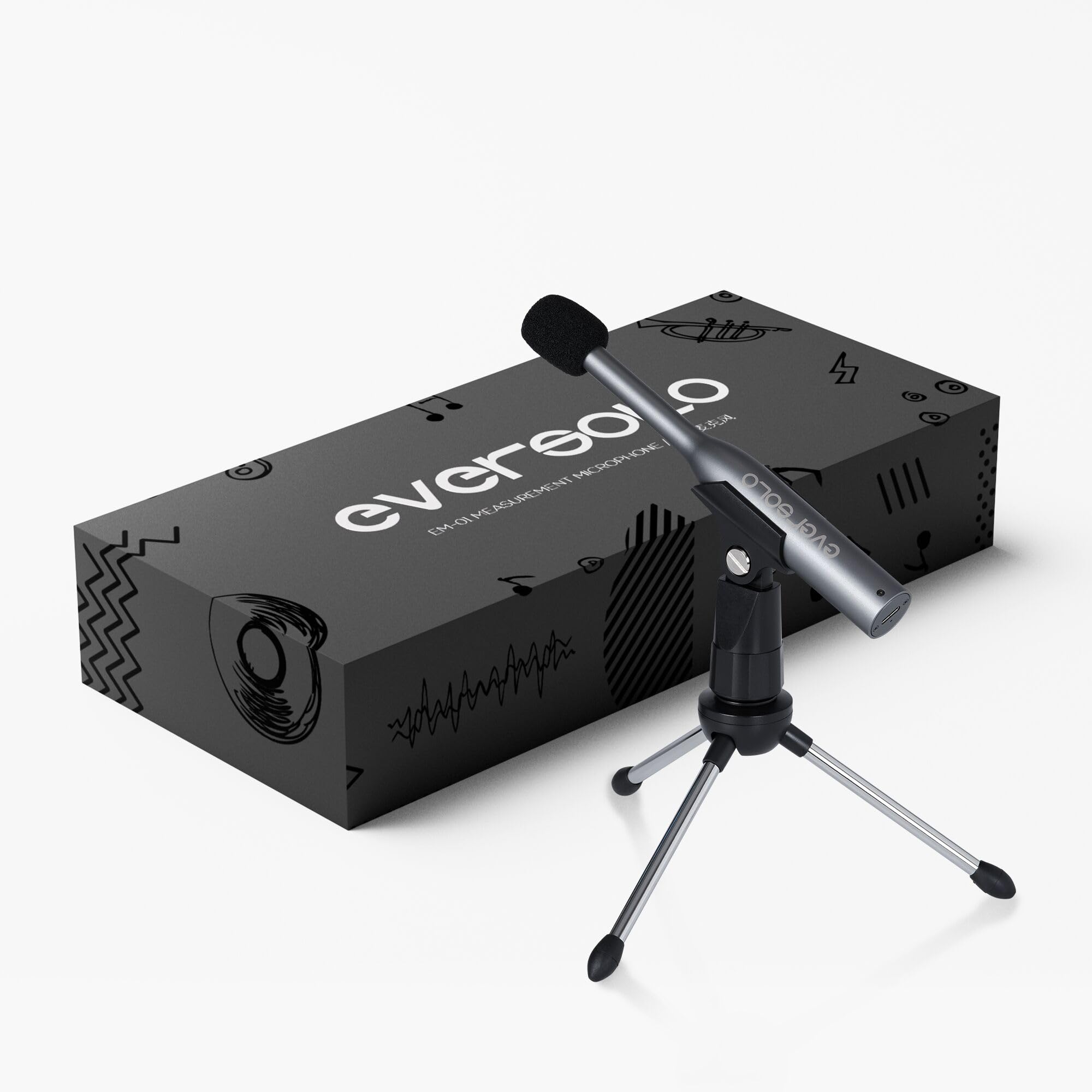
The EVERSOLO EM-01 is a modern, well-engineered USB-C measurement microphone built with the company’s own DMP-A series streamers in mind, yet fully compatible with any PC, Mac, iOS, or Android device. Its 6mm electret capsule provides a wide 20 Hz to 20 kHz response and a high sensitivity of -13 dBFS, which means it captures a strong, detailed signal without needing excessive preamp gain. The built-in ADC samples at 24-bit/48kHz, ensuring clean digital data.
One of its standout technical specs is the noise level of -84 dBFS, which contributes to a very low noise floor and clean measurements. Its 130 dB SPL maximum input ensures it won’t clip during loud subwoofer sweeps. The slim, 47-gram aluminum alloy body makes it highly portable, and the package includes two cables (Type-C to Type-C and Type-C to USB-A), a desktop tripod stand, and a windscreen. Users report instant recognition with Windows, macOS, and specifically with EVERSOLO units.
The main advantage of the EM-01 is its pure plug-and-play convenience, eliminating the need for an audio interface entirely. It is a fantastic choice for anyone who wants a quick, accurate measurement setup for Dirac Live or REW without additional hardware. The only note is that you should check the included packaging slip for the link to download the microphone’s individual calibration file, which is a critical step for precise work.
Why it’s great
- True plug-and-play USB-C with excellent platform compatibility.
- Very low self-noise floor of -84 dBFS for clean measurements.
- Comes with all necessary accessories: cables, stand, and windscreen.
Good to know
- Sampling rate is limited to a maximum of 48kHz.
- Calibration file must be downloaded separately via a link on the packaging.
- Primarily marketed for the EVERSOLO ecosystem, though universally compatible.
6. Superlux ECM999U

The Superlux ECM999U is a USB-based measurement microphone that delivers a complete, out-of-the-box solution for acoustic analysis. It boasts a 10 Hz to 20 kHz frequency response and an impressive maximum SPL of 133 dB, making it robust enough for loudspeaker testing at high volumes without distortion. The 1/4-inch pre-polarized condenser capsule is housed in a metal and plastic body, and the entire package comes in a soft carrying case.
The kit is generous, including the HM10S mic clip, a DS01 table stand, a foam windscreen, and a 2-meter USB-C cable. Its USB-C plug-and-play nature means it works immediately on Windows, Mac, and Linux without drivers. Early users confirm it provides a flat-frequency reference signal that is ideal for room correction tasks in REW and general speaker testing, and it is even functional for high-quality conference calls or basic recording in a pinch.
While it offers great convenience, it shares a common limitation with many USB mics: the 24-bit/48kHz sampling rate is a cap, and its price point is higher than the XLR version of the same mic. The included foam windscreen has been reported to have a tight hole. For a beginner looking to get into speaker tuning with minimal setup complexity and a portable case, the Superlux ECM999U is a solid, accessible entry point.
Why it’s great
- USB-C connectivity with true plug-and-play operation on all major systems.
- Impressive 133 dB SPL limit for high-level speaker testing.
- Complete kit includes a case, stand, clip, windscreen, and cable.
Good to know
- Sampling rate is capped at 48kHz.
- Higher price than Superlux’s XLR variant of the same design.
- Foam windscreen opening is reportedly very tight.
7. PreSonus PRM1

The PreSonus PRM1 is a traditional, no-frills precision reference microphone that relies on a 1/4-inch pre-polarized electret-condenser capsule. It offers a linear frequency response between 20 Hz and 20 kHz and an omnidirectional polar pattern, which is exactly what is required for room analysis and speaker calibration tasks. Its maximum SPL of 132 dB SPL is sufficient for most residential and studio measurement scenarios.
It connects via a standard XLR connector and requires 48V phantom power from an audio interface or mixer. The microphone is housed in a stainless steel enclosure, giving it a durable feel, and it ships in a semi-hard plastic case for safe storage. The unit’s sensitivity is rated at -37 dB/PA, with an equivalent input noise (EIN) of 26 dB and a dynamic range of 106 dB, providing a decent signal-to-noise ratio.
The primary drawback of the PreSonus PRM1 in the context of modern speaker tuning is the lack of an included calibration file. Several user reviews specifically note that the absence of a unique calibration graph makes it less suitable for precise Dolby Atmos or critical room correction work where every dB and frequency deviation matters. It is a capable mic for basic level checking and live measurement, but it falls short of the standard set by competitors for dedicated speaker tuning.
Why it’s great
- Solid stainless steel construction with a protective carrying case.
- Provides a linear 20 Hz to 20 kHz frequency response.
- A familiar XLR form factor for traditional studio setups.
Good to know
- Does not include an individual calibration file for precision tuning.
- Requires a separate audio interface with 48V phantom power.
- Less suitable for critical EQ correction than calibrated alternatives.
FAQ
Can I use a regular karaoke or vocal microphone for speaker tuning?
Why is an individual calibration file so important for REW?
Is a USB measurement mic just as good as an XLR one?
Final Thoughts: The Verdict
For most users, the best calibration microphones for speaker tuning winner is the Dayton Audio EMM-6 because it offers the perfect balance of pro-grade accuracy with its individual calibration file, rugged build quality, and a price point that doesn’t break the bank. If you want the ultimate plug-and-play simplicity for a modern streaming setup, grab the EVERSOLO EM-01. And for the complete, no-compromise studio solution that handles the entire correction process from mic to hardware processor, nothing beats the IK Multimedia ARC Studio.