
Our readers keep the lights on and my morning glass full of iced black tea. As an Amazon Associate, I earn from qualifying purchases.
Specs are compiled from manufacturer listings and verified buyer reviews and can change over time — please confirm the key details on the product page before buying.
Burning through clearcoat, chasing holograms, or fighting a machine that bogs down on the first panel — that’s the real pain of paint correction, and it’s why choosing the right buffing machine matters more than any pad or compound. This guide breaks down the 9 machines that actually earn their place in a garage, from weekend-warrior DAs to pro-grade rotaries.
I’m Min — the founder and writer behind Gadgets Feed. This guide is built by comparing the manufacturers’ published specifications and the patterns across verified customer reviews, so you get each pick’s real strengths and trade-offs instead of marketing spin.
We cut through the spec-sheet noise to match each machine to your skill level, panel size, and budget.
Our Picks at a Glance

How To Choose The Best Buffing Machine
Choosing a buffing machine depends on matching the tool’s action, power, and weight to the size of your projects and your experience level. A heavy rotary with a massive 10-inch pad can strip a floor, but it is a blunt instrument for a car door.
Dual Action vs Rotary: The Safety Threshold
The single biggest decision is the type of motion. A dual-action (DA) polisher moves the pad in a random orbit — it spins and oscillates at the same time — so it’s far harder to burn through the clearcoat. A rotary spins the pad in one fixed direction at high speed; it cuts faster but demands real technique and is far riskier on a daily driver.
Orbit Throw and Panel Coverage
For a DA, the “throw” (the diameter of the orbit) controls speed and finish. A 9mm throw is great for finishing and waxing, while a 15mm long throw covers more area per pass and corrects faster, though it takes a little more skill to control on curves.
Motor Power and Speed Control
Look for the wattage or amperage rating to see if the motor will hold its speed under firm pressure instead of stalling. A variable-speed dial is essential — you need low speeds (around 1500-2000 RPM/OPM) for spreading polish safely, and high speeds past 4000 RPM/OPM for actual defect removal.
Quick Comparison
| Model | Best For | Power | Motion Type | Max Speed | Weight | Amazon |
|---|---|---|---|---|---|---|
| DEWALT DWP849X★ Best Overall | Heavy-Duty Correction | 1440W / 12A | Rotary | 3,500 RPM | 6.7 lbs | Amazon |
| Griot’s Garage G9Top Performer | Beginner-Friendly DA | 1000W / 8.5A | Dual Action (9mm) | 6,400 OPM | 5.3 lbs | Amazon |
| Maxshine M15 ProPro Long Throw | Pro-Level Long Throw | 1000W | Dual Action (15mm) | 5,000 OPM | 5.2 lbs | Amazon |
| Adam’s Polishes 9mm | Smooth Beginner Kit | 1000W | Dual Action (9mm) | 6,500 OPM | 5.5 lbs | Amazon |
| SPTA Rotary Polisher | All-in-One Rotary Kit | 1200W / 1580W | Rotary | 3,000 RPM | 6.6 lbs | Amazon |
| WORKPRO 6″ DA | Versatile Value | 1080W | Dual Action (15mm) | 5,000 RPM | 3.37 kg | Amazon |
| AUTIWOZ DA Polisher | Lightweight Portability | 850W | Dual Action (15mm) | 4,800 RPM | 6.5 lbs | Amazon |
| CRAFTSMAN CMEE100 | Large Flat Surfaces | 1A | Orbital | 2,800 OPM | 3.04 kg | Amazon |
| LDHTHOPI DA Polisher | Budget DIY Kit | 980W | Dual Action (9mm) | 5,800 RPM | 3.4 kg | Amazon |
In‑Depth Reviews
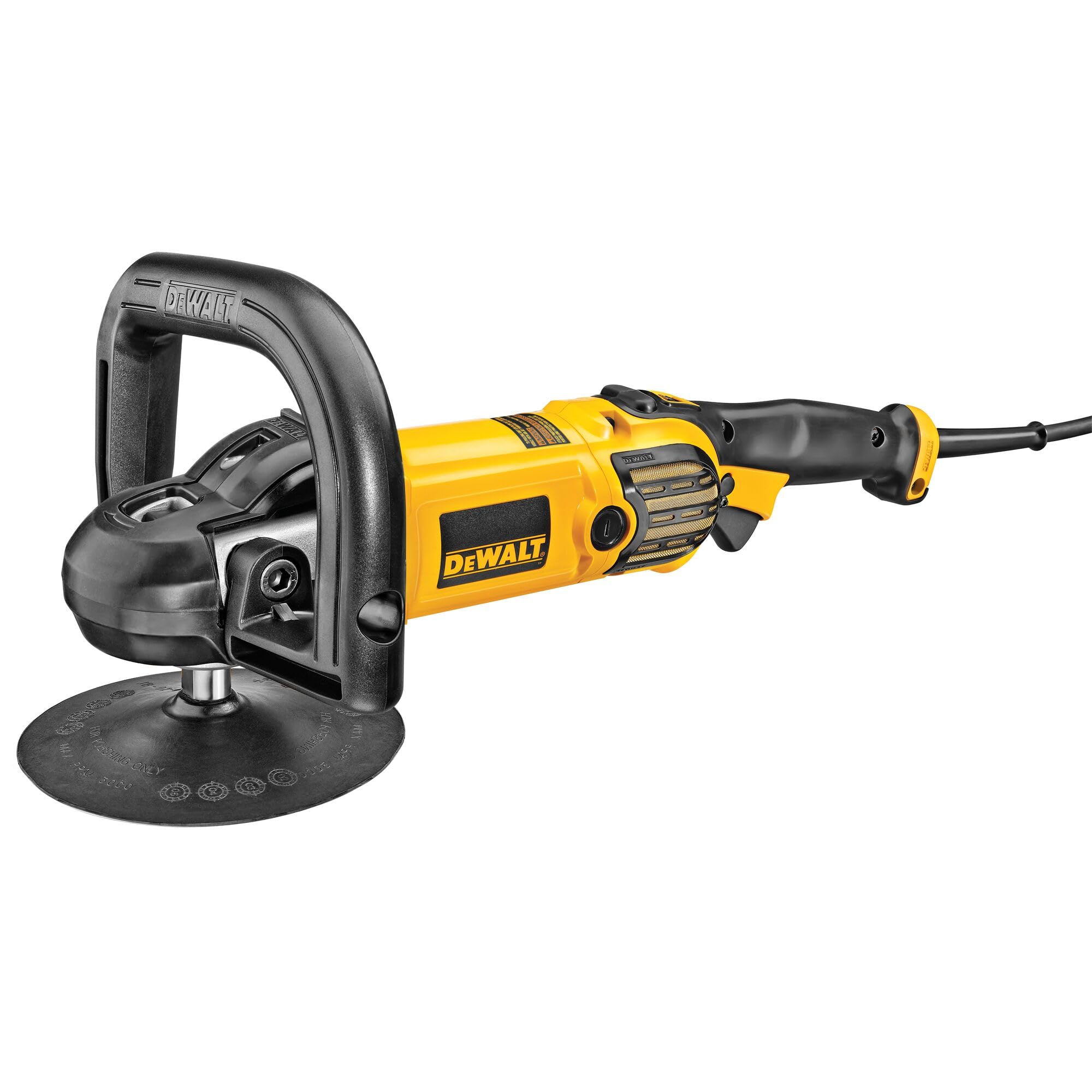
1. DEWALT Buffer Polisher (DWP849X)
Our pick — over 4.5★ from 6,500+ verified ratings; the strongest balance of quality and price.
The brute-force pro pick that holds its speed when you lean in.
If you are chasing serious defect removal on a daily driver or a boat, this DEWALT is the machine pros keep coming back to — and the math explains why. It pulls a massive 12 amps, which is 12 times the current draw of the CRAFTSMAN’s 1 amp, so it simply refuses to bog down under load; buyers report it “Polished two cars (4yr black with scratches, 6mo factory finish)” and held its set RPM exactly where it was dialed.
The 1440-watt motor is the most powerful here, delivering 47% more peak power than the 980-watt LDHTHOPI. That muscle comes with all ball-bearing construction and precision-cut steel gears, plus a soft-start feature that ramps up smoothly if you ease the trigger — though a fast pull can briefly overshoot the RPM you set.
This is a rotary, not a dual-action, so it spins in one fixed direction and can burn paint if you linger. It is also on the heavier side at 6.7 pounds, and the long-throw nose handle sits tight around mirrors. The crowd verdict is clear though: the quality is the thing everyone raves about, far ahead of anything else they mention.
Why Pros Reach For It
- The variable-speed dial and trigger give precise control from 0 to 3,500 RPM for any compound.
- The replaceable wool ingestion shield stops fibers from being sucked into the motor and blocking the tool.
- The no-volt release switch won’t start unexpectedly when you plug it in — a real safety win.
Before You Commit
- The fixed-spin rotary head demands practice to avoid burning thin clearcoat.
- At 6.7 pounds it gets tiring on vertical panels during a full detail.
Grab it if: you want a true commercial-grade rotary with the power and durability to correct paint for years, backed by a 3-year limited warranty.
Think twice if: you are buffing a family car for the first time — a dual-action is far more forgiving for beginners.
2. Griot’s Garage G9 Random Orbital Polisher
The beginner’s safety net with strictly professional correction power.
Here’s a machine that flips the common fear — that polishing will ruin your paint — on its head, and buyers call it safer than hand waxing. The G9 is a 1000-watt dual-action with a 9mm orbit throw, a motion that randomizes the pad’s path so it won’t leave holograms or burn through clearcoat the way a rotary can.
What makes it genuinely easy is the engineering around the motor. The fan-cooled counterbalance and premium bearings keep vibration minimal, and the constant speed control means it refuses to bog down under pressure. The 6 variable speeds run from 2,000 to 6,400 OPM, and the dial is accessible from either side — a detail lefties actually notice.
The 6-inch vented backing plate handles most jobs right from the start, but you can convert it to a 5-inch pad system with an optional plate for tighter sections. The whole unit weighs 5.3 pounds, making it noticeably more manageable during extended sessions than the 6.7-pound DEWALT.
First-timer friendly: owners mention a first-time user had “no issues or complaints” and found it quiet, which is rare in this category.
The honest limit: a 9mm throw corrects more slowly than the Maxshine M15’s 15mm long-throw, so heavy defect removal takes more passes.
Reach for this if: you want a forgiving, low-vibration machine that delivers showroom results without the learning curve of a rotary.
Look elsewhere if: you are a pro knocking out full corrections daily — a long-throw DA like the Maxshine M15 Pro will save you real time.
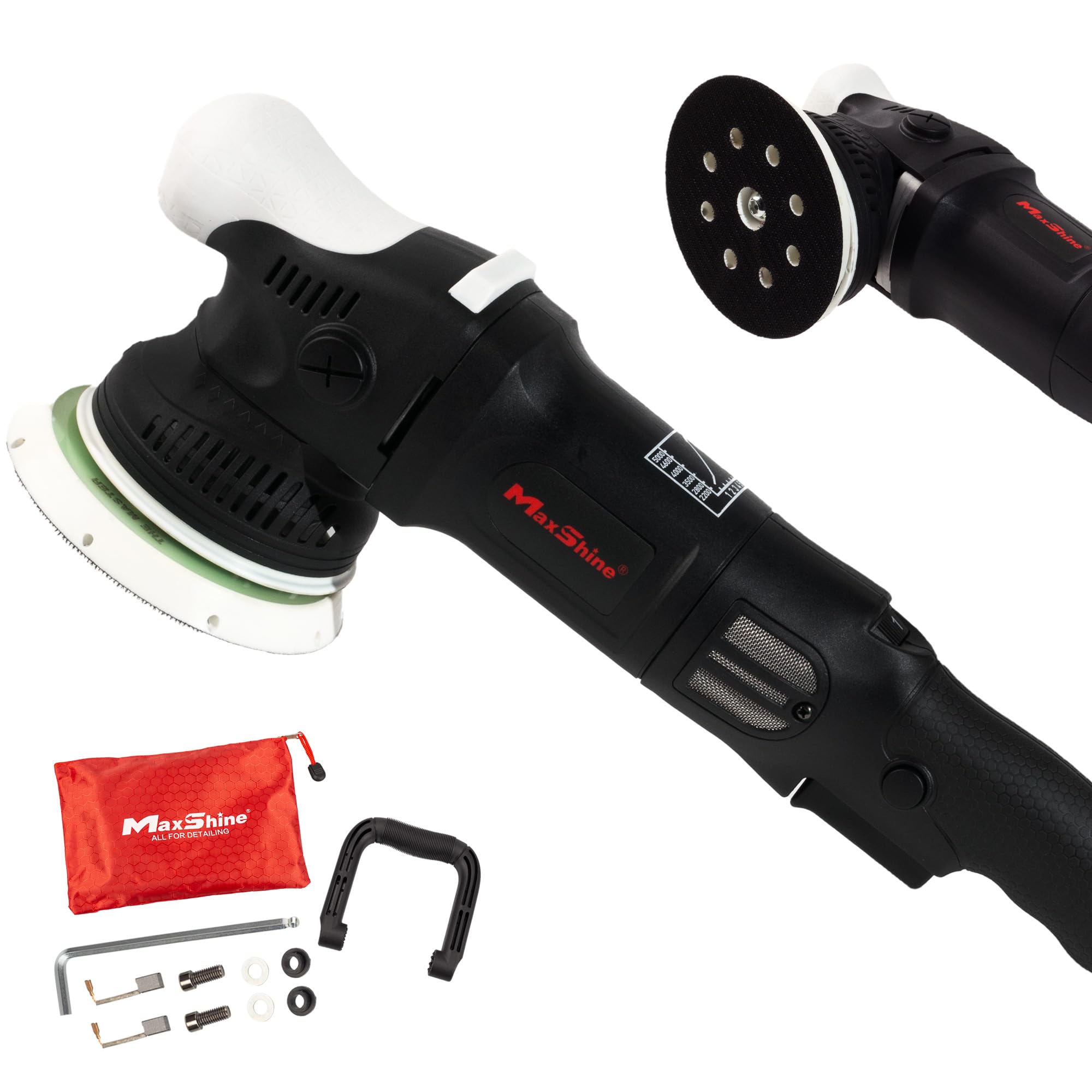
3. Maxshine M15 Pro Dual Action Polisher
The long-throw specialist that pros say matches machines costing twice as much.
For the enthusiast who wants pro-level speed without pro-level prices, the M15 Pro is the machine that keeps coming up in comparisons. Its 15mm long-throw orbit covers more area per pass and corrects faster than the Griot’s G9’s 9mm throw, and customers note a 6-year-old GTI looked factory-new after a full detail.
The 1000-watt motor with a 9-amp draw holds consistent torque, and the variable speed ranges from 2,500 to 5,000 OPM, giving you the full arc from gentle finishing to serious cutting. At 5.2 pounds it is one of the lightest on this list, and buyers consistently note it is less fatiguing and quieter than the tools they upgraded from.
This machine is all about value — buyers directly compare it to the Rupes and Flex units at double the price, calling it “comparable to Rupes at half price.” The caveat is stability on curves: the long-throw design can stall on sharp creases by design, so keep that in mind on heavily sculpted panels.
The value story: reviewers point out 90%+ correction on a 200k-mile vehicle in one step, with no holograms — the safe long-throw benefit.
Watch for: it stalls on tight creases and needs a spacer for some backing plates; it is not built for jeweling (a rotary like the DEWALT is better for final show finish).
Best suited for: the dedicated DIYer or semi-pro who wants long-throw speed and smooth operation without the flagship price tag.
Not for you if: you mostly polish flat, heavily curved truck panels — a 5-inch pad machine might serve you better.
4. Adam’s Polishes 9mm Dual Action Polisher

The gliding beginner machine that makes paint correction feel easy.
Adam’s built this 1000-watt dual-action around a 9mm orbit and a 16-foot cord, and the combination is what makes it so pleasant to use. The long cord means you rarely need an extension lead, and the concave rubber contact points absorb vibration for a comfortable two-hand grip that shoppers say glides well with minimal heat.
At 5.5 pounds, it sits in the middle weight-wise, and the balanced design keeps it comfortable for longer jobs. Buyers report great results on a 20-year-old Lexus prepping for ceramic coating, and a 30-year-old vehicle’s paint was saved with it. The 6,500 OPM max speed gives strong correcting ability, and the 9mm orbit displaces compounds evenly for a swirl-free finish.
The honest caveat: the included compound is very light, only removing the lightest scratches, so heavy defect work needs a more aggressive product. The speed adjustment also draws mixed feedback, with some noting it feels like a single effective speed in practice.
What wins people over: a first-time user on a 2021 Jeep Wrangler finished a full correction in 4.5 hours with great results — that is approachable.
Know before buying: the kit polish is gentle; buy a dedicated medium-cut compound for real scratch removal.
Ideal for: the cautious first-time buyer who wants a smooth, low-vibration machine to learn on, with the brand’s 110% satisfaction guarantee as a safety net.
skip it if: you need aggressive cutting power and fine speed control right from the start.
5. SPTA 7 Inch Rotary Polisher

A heavy-duty rotary that ships with everything but the detailing bay.
If you want one package that covers every job from cutting to finishing, the SPTA rotary is the most complete kit on this list. The 1200-watt motor (peak 1580 watts) powers a 7-inch rotary head, and the digital screen gives you a precise readout as you dial through six speeds from 500 to 3,000 RPM — a feature buyers with detailing businesses actually praise for daily use.
The kit includes 3-, 5-, and 6-inch pads, wool pads in three sizes, four backing plates, 24 sandpaper discs, two compounds, and a wash brush. That means you can tackle paint correction, glass, and even light sanding without buying another accessory.
Being a rotary, it spins at high speed in one direction and demands steady hands — buyers call it “a tank” that is heavier than the 5.2-pound Maxshine M15 Pro, and the fixed-spin action can burn paint if you hold still. The speed control draws mixed feedback in the community, so test on a scrap panel first.
The Bundle Advantage
- The digital speed display removes guesswork when switching between compound and polish.
- A detailing-company owner calls it “very easy to use” and “very sturdy” for commercial wash-and-wax work.
- All ball-bearing construction backs up the heavy-duty feel.
Fair Warning
- The rotary motion is unforgiving for beginners — proper technique is mandatory.
- Mixed reports on long-term reliability and the variable-speed dial mean quality control varies.
Pick this if: you want a professional-grade rotary and a full accessory kit in one box, and you already have some technique.
Reconsider if: you are a total beginner — the dual-action machines above are far more forgiving.
6. WORKPRO 6″ Dual Action Polisher

The 15mm long-throw that brings pro geometry to a budget price.
Here’s the value play that punches well above its weight: a 1080-watt motor driving a 15mm dual-action orbit at a price that makes it a genuine contender for first-time buyers. The long-throw design means it corrects faster than the 9mm Adam’s Polishes machine, and owners mention compounding and polishing a full SUV with zero problems.
The 9-amp motor uses a heat-resistant copper wire design and replaceable carbon brushes, so it runs cooler and lasts longer — a thoughtful touch at this tier. Six variable speeds span 1,400 to 5,000 RPM, letting you swing from spreading wax at low speed to heavy correction at the top end. The 15mm throw gives it efficiency that rivals machines costing more.
The recurring complaint is weight — at 3.37 kg it gets heavy on horizontal surfaces — and the 6-inch plate feels too large for tight areas. Buyers suggest wanting a 5-inch option for precision work. The free-spin can stop if you apply too much pressure, so let the machine do the work.
Real-world win: owners waxed a 40-foot gel-coat trailer in Phoenix heat with “better than factory shine” — a serious stress test passed.
The catch: it is heavy and the big pad struggles in tight spots; plan for arm fatigue on long sessions.
Best for: the budget-conscious DIYer who wants long-throw efficiency and a full kit of 6 foam pads without spending premium money.
Think twice if: you mainly work on small, intricate panels where the 6-inch plate is a liability.
7. AUTIWOZ Car Buffer Polisher

The corded DA that dissolves hours of hand-polishing into minutes.
The AUTIWOZ is built around a simple promise: replace the manual labor. Its 850-watt copper-core motor spins a 6-inch dual-action pad at up to 4,800 RPM, and the six-speed dial lets you dial back to 1,800 RPM for a gentle first pass. Buyers confirm it is well suited to small jobs and carries a sensible price.
Two removable handles (side and D-handle) plus a safety switch lock that holds your speed make it comfortable for long sessions. The soft-start feature ramps up smoothly, which is a huge confidence boost if you are new to power tools.
At 850 watts, it is the least powerful machine here, so heavy defect removal on hard clearcoat takes longer. It also weighs 6.5 pounds, which is on the heavier side for its output — the 5.2-pound Maxshine M15 Pro is a lighter 1000-watt option. For regular waxing, finishing, and light correction, though, it is a perfectly capable machine.
Why it earns a spot: the included kit with sandpaper, foam pads of varying cut, and wool discs covers most detailing scenarios from the start.
The honest limit: the gentler motor means it is best for lighter jobs; pro-level correction demands more watts.
Reach for it if: you want a straightforward, comfortable DA for routine polishing and waxing, and you value a soft-start for confidence.
Pass on it if: you are tackling serious swirl removal on a large vehicle — step up to a 1000-watt machine.
8. CRAFTSMAN 10-Inch Polisher (CMEE100)

The wide-pad workhorse for floors and broad flat stretches.
When the surface is a floor, a countertop, or a boat hull, the CRAFTSMAN’s massive 10-inch pad is exactly what you want — it covers far more ground per pass than the 6-inch WORKPRO. The 2,800 OPM oscillation (the pad’s orbital motion) delivers a large swirl-free finish, and the variable-speed dial lets you tone it down for gentler work.
Long-time Craftsman owners are the most telling endorsement: one buyer ran a 7-inch model for 20 years before it finally broke, and took a “chance” on this 10-inch replacement precisely because the brand had earned his trust. The contoured overmolded grip and the low current draw of just 1 amp make it approachable for extended use.
There are real limits here. This is a surface finisher, not a paint corrector, so treat it as such.
The appeal: a 20-year Craftsman owner says “the speed is adjustable, which is great,” and calls it a worthy replacement for his old favorite.
The reality check: vibration and durability are the recurring complaints — keep expectations realistic for heavy daily use.
Perfect for: polishing large flat areas like floors, countertops, and boat decks where wide coverage beats precision.
Wrong tool for: automotive paint correction — the big orbital pad is too coarse for clearcoat work.
9. LDHTHOPI Dual Action Polisher

The beginner-safe DA that brings the paint back for pocket change.
If you want to learn paint correction without a big investment, the LDHTHOPI is a legitimate starting point. The 980-watt copper-wire motor drives a 9mm random orbital action at six speeds from 2,800 to 5,800 RPM, and the random orbit is exactly what you want as a beginner — it minimizes the risk of burning through clearcoat while you learn.
The kit is generous: a 5-inch and 6-inch setup with wool pads, flat sponges, rounded-corner sponges, sandpaper, two handles, and a cloth carry bag. Customers note it “worked great polishing my boat” and brought paint back to look like new, which is exactly the outcome a budget buyer hopes for.
The most common gripe is the pad backing peeling off when cleaning — one owner fixed it with spray adhesive. There are also mixed durability reports, with some power heads failing. It is lighter than the CRAFTSMAN at 3.4 kg, but slightly heavier than the 3.04 kg CRAFTSMAN, so keep that in mind for extended overhead work.
Why It’s A Steal
- The dual-action motion is safe enough for a true beginner to start immediately.
- Six speeds give genuine control across all polishing stages, from spreading to cutting.
- The included carrying case keeps all pads and tools organized.
Budget Trade-Offs
- The pad backing can peel during cleaning — treat the pads gently.
- Some units run hot and a few power heads have failed, so check it early.
Best for: the first-time buyer on a strict budget who wants a safe, complete kit to learn the craft.
Upgrade soon if: you plan to do this professionally — the durability simply isn’t there for daily commercial use.
Understanding the Specs
Dual Action vs Rotary Motion
The single most important spec is the type of motion. A dual-action (DA) polisher moves the pad in a random orbit — it spins and oscillates at once — making it extremely difficult to burn through paint. A rotary spins the pad in one fixed direction at high speed; it corrects faster but punishes mistakes. Beginners should almost always start with a DA.
Orbit Throw (9mm vs 15mm)
For DA machines, the orbit throw (measured in millimeters) determines both speed and finish. A 9mm throw (like the Griot’s G9 or Adam’s) is great for applying wax and finishing, while a 15mm long throw (the Maxshine M15 or WORKPRO) covers more area per pass and corrects faster, at the cost of slightly more skill needed on curved panels.
FAQ
What is the difference between a dual action and a rotary buffing machine?
What does the orbit throw number mean for a dual action polisher?
Is a higher wattage motor always better?
Can I damage my car’s paint with a buffing machine?
What is the best speed setting for applying wax?
How heavy is a typical buffing machine and will it tire my arms?
What do the different colored pads do?
Can I use a car buffing machine on surfaces other than cars?
Final Thoughts: The Verdict
For most buyers, the buffing machine winner is the DEWALT DWP849X because its 1440-watt motor and