
Our readers keep the lights on and my morning glass full of iced black tea. As an Amazon Associate, I earn from qualifying purchases.
Specs are compiled from manufacturer listings and verified buyer reviews and can change over time — please confirm the key details on the product page before buying.
Camping in summer heat often means tossing and turning in a stuffy tent, waking up drenched by 7 a.m. A dedicated tent air conditioner changes that, but the hard part is picking one that actually cools your space without draining your power station. This guide breaks down the real-world performance of portable AC units so you can sleep through the night, no matter the forecast.
I’m Min — the founder and writer behind Gadgets Feed. This guide is built by comparing the manufacturers’ published specifications and the patterns across verified customer reviews, so you get each pick’s real strengths and trade-offs instead of marketing spin.
Your ac for camping tent should match your power source, tent size, and how much weight you can carry. A quiet unit suits a family tent, while a powerful cooler fits a rooftop tent.
Quick Picks
- BougeRV Portable Air Conditioner PC35 — Best Overall
- Outohome 5200 BTU Portable Tent Air Conditioner — Top Performer
- Outohome Portable Camping Air Conditioner — Best Value
- WISHILO 3400 BTU Portable Air Conditioner — Compact Pick
- Cybertake S1 Pro Portable Camping Air — Energy Star
- Cybertake S2 Pro Portable Camping Air — 4-Season Pick
- EcoFlow WAVE 3 Portable Air Conditioner — Cordless Luxury
How To Choose The Best AC For Camping Tent
Before you click buy, you need to match the machine to your camping style. The biggest mistake is grabbing a unit without checking if your power source can handle it, since most tent ACs need serious wattage to start the compressor.
Match the BTU to your tent size
BTU (British Thermal Units) measures cooling power — the higher the number, the larger the space it can handle. A 2-person tent needs far less juice than a 6-person family dome, so measure your floor area (in square feet) first and pick a unit that covers it with a little margin.
Check the power draw before you leave home
Every camping AC lists its rated wattage per hour, but the startup surge is often triple that — a unit that runs at 400W might need 1500W for the first few seconds. Make sure your power station or generator can handle that peak, or you will trip the inverter the moment you switch it on.
Think about venting and noise
Tent ACs must push hot air outside through an exhaust hose, so consider how you will route it through a zipper or window. Also, check the decibel (dB) rating for sleep mode — anything under 50dB should let you rest without a hum keeping you up.
Quick Comparison
| Model | Best For | Cooling Power | Floor Area | Weight | Amazon |
|---|---|---|---|---|---|
| BougeRV PC35 | App-controlled cooling | 3500 BTU | 35 sq ft | — | Amazon |
| Outohome 5200 BTU | Fast, powerful cooling | 5200 BTU | — | 31 lbs | Amazon |
| Outohome Tent AC | Budget-friendly 5200 BTU | 5200 BTU | — | 31.9 lbs | Amazon |
| WISHILO 3400 BTU | 2-person tents | 3400 BTU | 64 sq ft | 33 lbs | Amazon |
| Cybertake S1 Pro | Energy-efficient vanlife | 4100 BTU | — | 21.6 lbs | Amazon |
| Cybertake S2 Pro | Cooling and heating | 5100 BTU | 130 sq ft | — | Amazon |
| EcoFlow WAVE 3 | Cordless luxury camping | 6100 BTU | 120–180 sq ft | 32 lbs | Amazon |
In‑Depth Reviews
1. BougeRV Portable Air Conditioner PC35
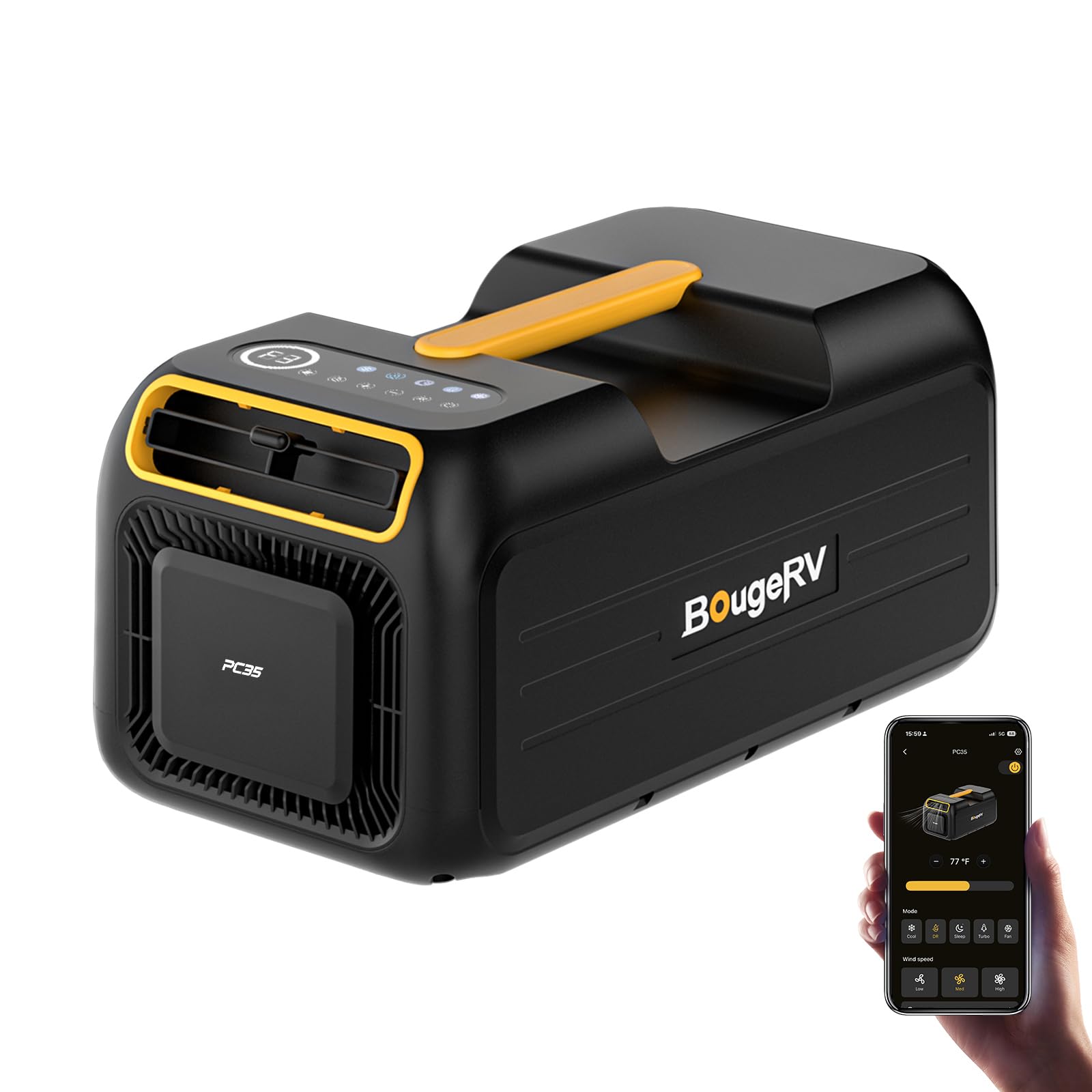
The only tent AC you can adjust without getting out of your sleeping bag.
This BougeRV unit is the pick for campers who want modern convenience with their cool air. Its 3500 BTU output covers up to 64.58 ft², and brand tests show an 18°F temperature drop in 15 minutes in strong mode — plenty for a mid-size tent. The standout feature is the app control, which works up to 33 feet away, so you can chill the space before you even crawl inside.
It offers five functions in one box: Cooling, Dehumidifying, Fan, High Power Mode, and Sleep Mode, plus a 24-hour timer. The adjustable range spans 61°F to 90°F, giving you fine control over the cabin climate. Buyers report it drops a six-person tent to a “bearable temperature,” and it pairs well with a solar generator like the Jackery 3600 for emergency cooling in extreme heat.
Know the trade-off: cooling performance gets mixed feedback, with some units blowing warm, humid air instead of cold. The compressor’s 2 kW startup surge demands a power station with at least 2 kW continuous output, a rare spec for off-grid setups.
What earns the top spot
- App control from up to 33 feet away
- 5-in-1 modes including dehumidify and sleep
- Adjustable temperature from 61°F to 90°F
What to plan around
- Startup surge can hit 2 kW — needs a beefy power station
- Some units arrive with factory defects (E3 error codes)
- Exhaust hose needs proper sealing to avoid leakage
Reach for this if: you want app-enabled cooling you can control from your cot and have a power station that can feed a 2kW startup surge.
Look elsewhere if: you are on a tight power budget — the high startup draw demands a serious battery system.
2. Outohome 5200 BTU Portable Tent Air Conditioner
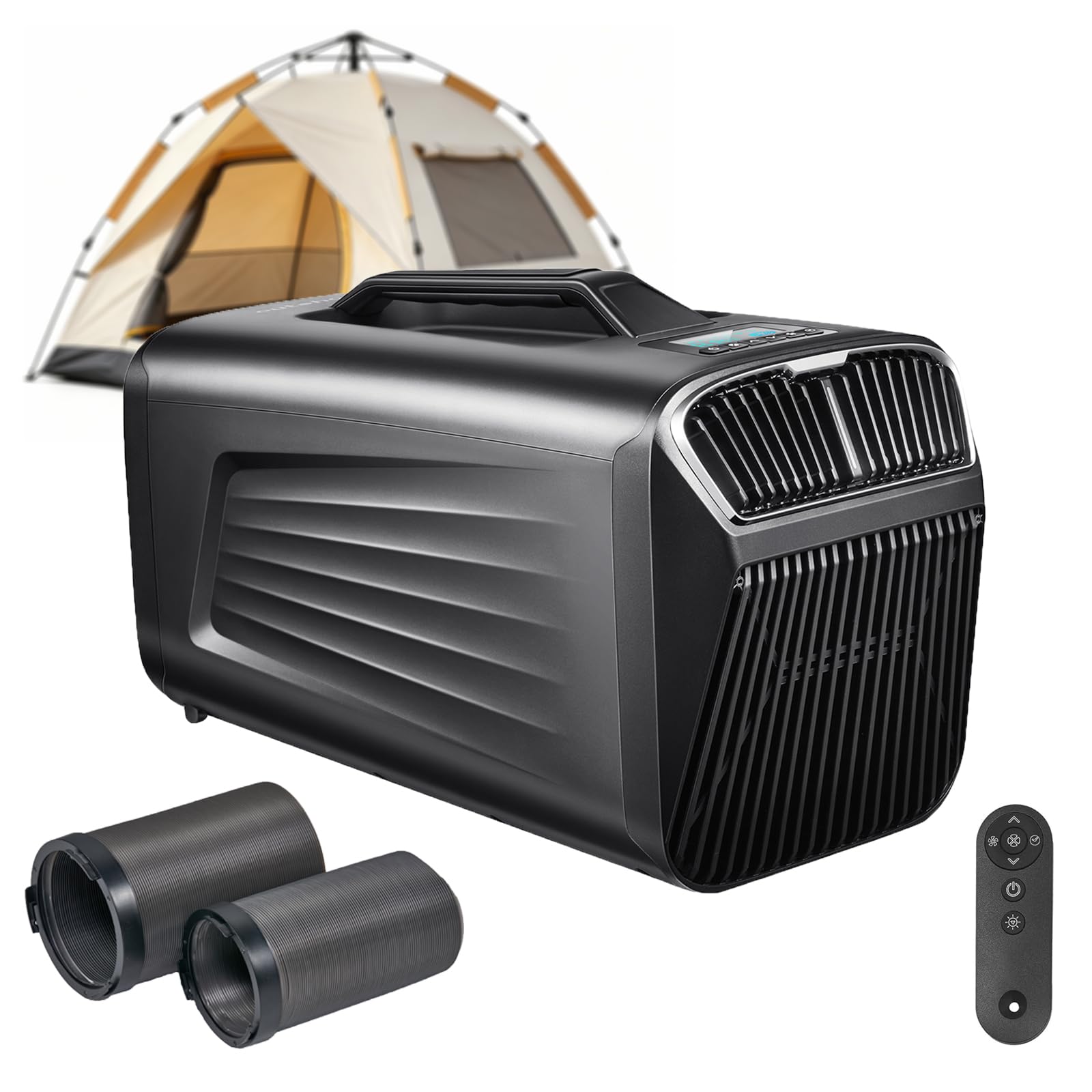
Serious cooling muscle that drops a room 10°F in five minutes flat.
If your priority is raw cooling speed, this Outohome delivers the strongest punch on the list. The built-in GMCC compressor pushes 5200 BTU — a big step up from the BougeRV’s 3500 BTU — and the brand claims an 18°F temperature drop in just 5 minutes. That is enough power to tame a 12×14 room from 80°F to 70°F in 17 minutes, per owner testing.
Despite the muscle, it stays efficient, rated below 400W per hour. Owners measured a max draw of 322W on low fan, so it pairs well with mid-range power stations. It runs four modes (Cooling, Dehumidifying, Sleep, Fan) with remote control, and the sleep mode operates at a quiet 46-50dB so it won’t drown out the crickets.
You will need to handle the venting honestly. The stock window baffle fails to hold the hoses securely, so several owners built a DIY baffle to keep the hot exhaust sealed. At 31 lbs with a single-hand grip, it is carryable, but it is not a backpacking unit — this is car-camping gear through and through.
Why it leads on cooling
- 5200 BTU drops temperature by 18°F in 5 minutes
- Runs below 400W — measured at 322W on low fan
- Drain-free below 70% humidity
Budget for these
- Stock window baffle is weak — plan a DIY seal
- 31 lbs is heavy for long carries
- Ideal for double-digit tents, not backpacking
Best for: car campers with a bigger tent who want fast, powerful cooling without breaking their power budget.
Think twice if: you expect a plug-and-play exhaust — you will likely need to improvise your own baffle.
3. Outohome Portable Camping Air Conditioner
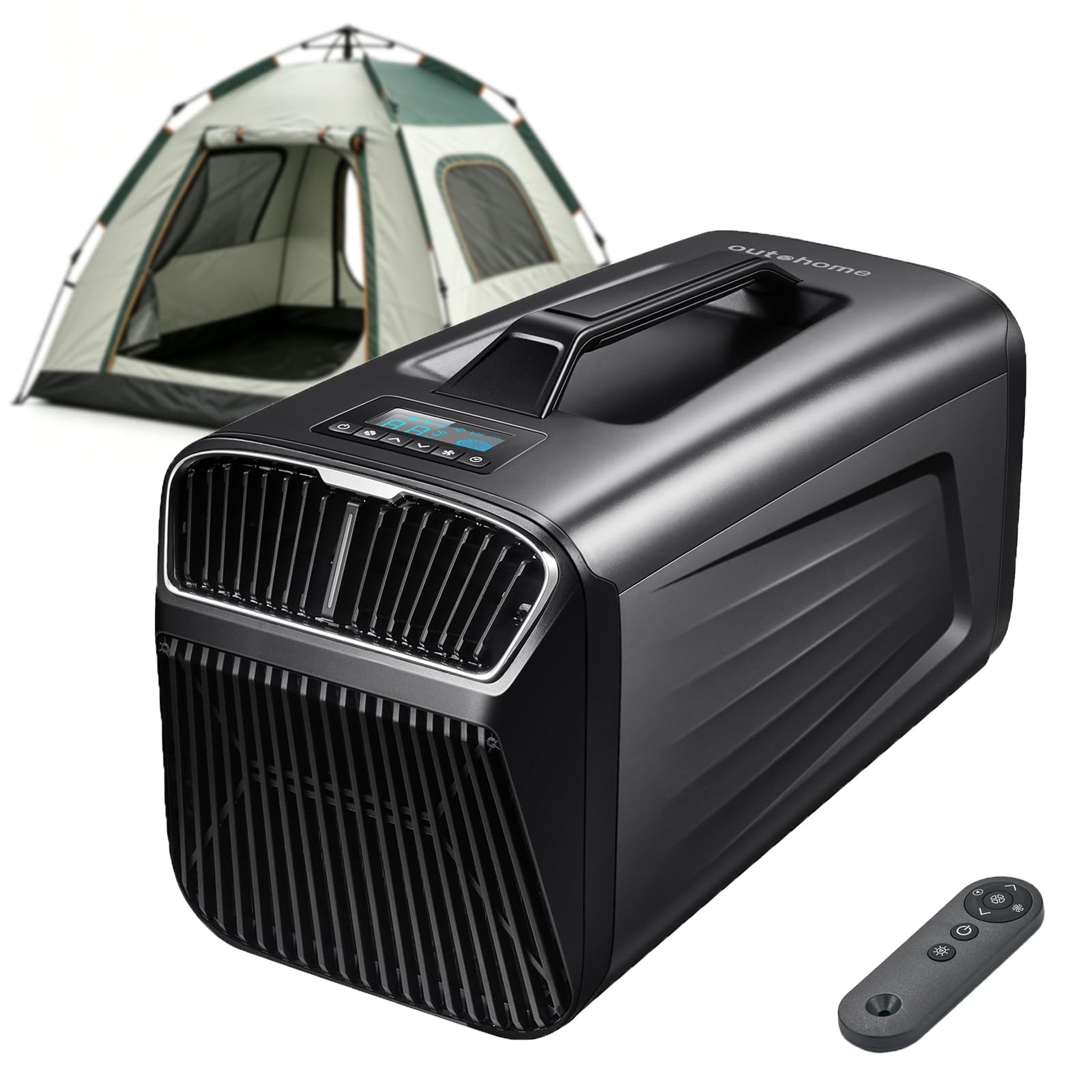
A 5200 BTU workhorse that shines for nighttime tent cooling on a budget.
This Outohome shares the same 5200 BTU GMCC compressor as its sibling above, so the raw cooling power is identical — it lowers ambient temperature by 18°F within 5 minutes. The key difference is positioning: it lands as the budget-forward pick in the Outohome lineup, making serious BTU output more accessible.
Owners confirm it works well in real camping conditions. The review pages sum it up: a six-person tent dropped to a “bearable temperature,” and an HVAC technician uses it in 120°F+ attics to stay cool on the job. It runs four modes with remote control, and sleep mode sits at 46-50dB, so the compressor noise is barely perceptible — just a gentle fan sound.
The honest limit is hot-weather performance. Testing inside a van at 107°F showed minimal cooling, and one owner noted only a 2°F drop in 90°F+ conditions. It also weighs 31.9 lbs, so the “single-handed carry” claim is optimistic for most people. Think of it as a night-cooling specialist, not a midday scorcher solver.
What you get for less
- Full 5200 BTU cooling in a budget-tier package
- Quiet 46-50dB sleep mode
- Drainage-free below 70% humidity
Where it falls short
- Struggles in 90°F+ daytime heat — best for night
- 31.9 lbs is heavy for solo campers
- Smaller tents see the best results
Grab it for: budget-conscious campers who cool a small enclosed space at night and want real compressor power.
skip it if: you camp in extreme afternoon heat — this one is a night owl, not a desert warrior.
4. WISHILO 3400 BTU Portable Air Conditioner
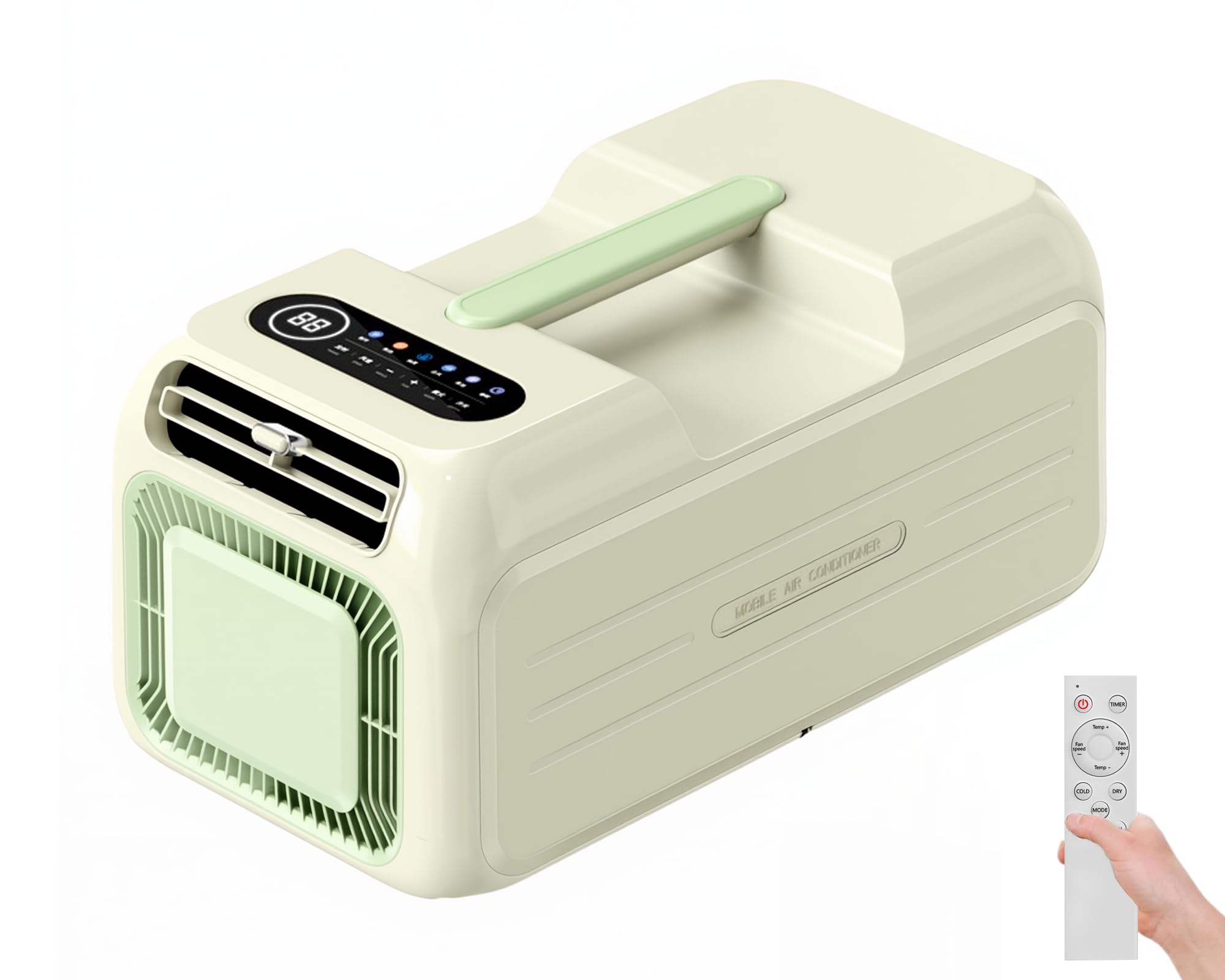
Cold air in three minutes, sized perfectly for a two-person tent.
This WISHILO is built around a Panasonic compressor that starts blowing cold air in just 3 minutes, with no water or ice required. Its 3400 BTU output covers 64-86 sq ft — sized specifically for a 2-person tent — and Turbo Mode drops the temperature by 18°F in 15 minutes. The adjustable range from 60°F to 88°F gives you plenty of room to dial in comfort.
Owner testing shows real-world efficiency: it cooled a 100 sq ft sunny room from 79°F to 74°F in under an hour, then took a tent down to 74°F in 3 hours. The drainless design recycles evaporator moisture through the condenser, so you are not constantly emptying a bucket — just drain manually before moving it. The sleep mode is genuinely quiet at 45dB, and the 24-hour timer handles automatic shutoff.
Power is the planning point. Startup peaks at 1500W, then settles to 400-600W running, with fan-only mode drawing just 25W. The brand says you need a power station with ≥1000W output or an EV discharger (not included) for outdoor use. One owner reported it eventually failed, blowing only hot air, so reliability is not guaranteed across the board.
Compact strengths
- Cold air in 3 minutes with a Panasonic compressor
- Drainless design — no constant bucket emptying
- Whisper-quiet 45dB sleep mode
Compact catches
- 1500W startup surge limits power station options
- Some units fail after weeks of use
- Rigid hose requires careful venting
Best for: couples camping in a 2-person tent who want fast, quiet cooling and don’t mind the startup power demand.
Consider another if: your power station can’t handle a 1500W surge — this one needs real battery headroom.
5. Cybertake S1 Pro Portable Camping Air Conditioner
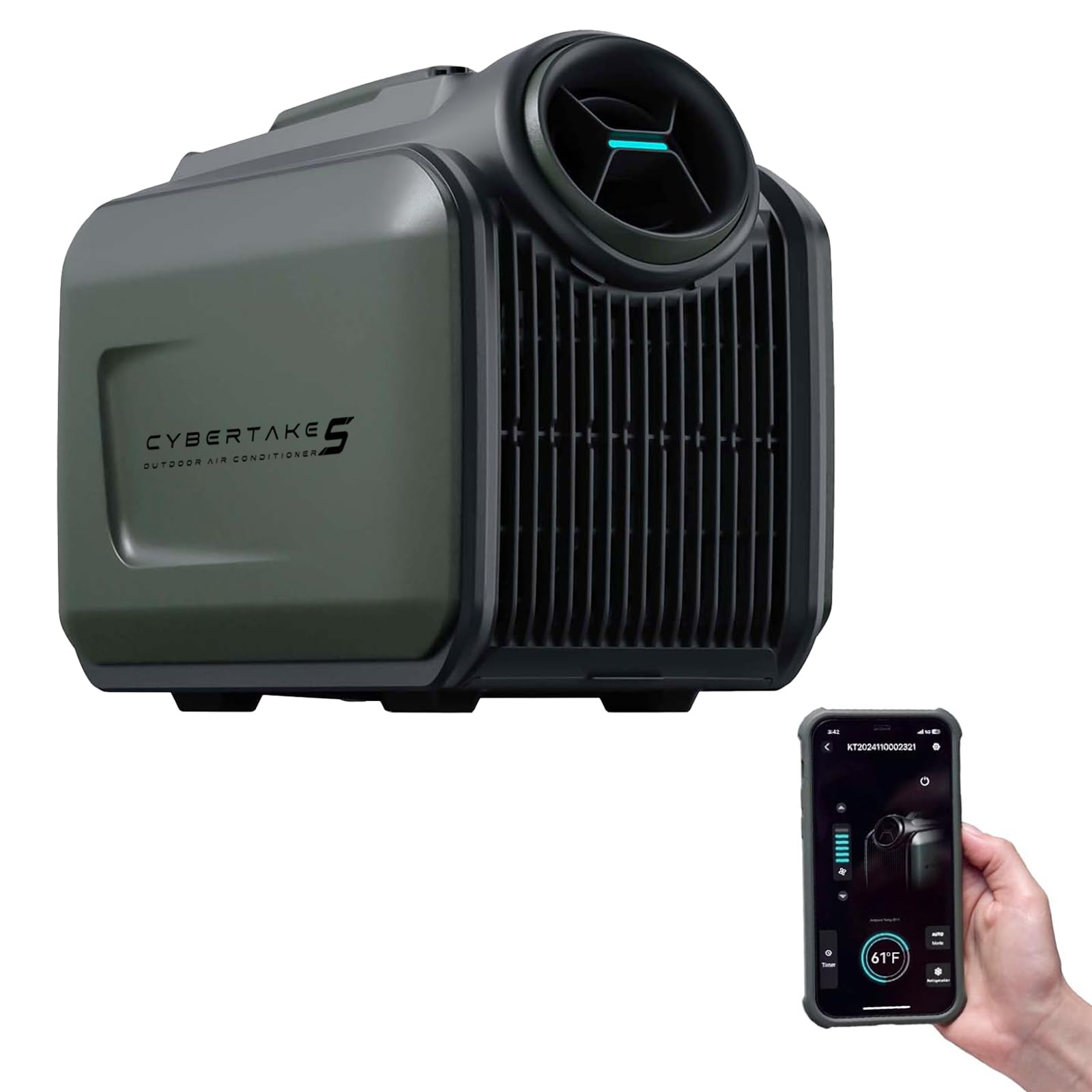
The featherweight of the group, built for vanlife efficiency over raw power.
At just 21.6 lbs, the Cybertake S1 Pro is the lightest unit here, so you can carry it on longer hikes thanks to its aluminum alloy frame and ergonomic handle. Its 4100 BTU output is mid-pack, but the real story is efficiency: the 48V DC system with a smart 3.0 inverter algorithm uses only 100W per hour in sleep mode, giving you 8 hours of cooling on a single kWh.
That efficiency makes it a natural match for solar setups. Owners run it on a 200A battery with 300W solar, achieving up to 7 hours of run time from a 2000W power source. Its 38 dB sleep mode is the quietest here, and the 90-degree adjustable vent directs airflow precisely. It packs five functions — Bluetooth App Control, Cooling, Dehumidifier, Fan, and Eco-Sleep Mode — plus a 12-hour timer.
The trade-off is cooling ambition. Owners mention it works well for small sleep spaces but will not chill an entire cabin. One owner reported a tent temperature rose 15°F in 30 minutes, which underscores that this is a directed-airflow tool, not a whole-cabin chiller. The optional remote is sold separately, and the “fourth space” app is required for advanced control.
Why efficiency wins
- Ultra-light at 21.6 lbs with a carry-friendly handle
- 100W per hour in sleep mode — 8 hours on 1 kWh
- Ultra-quiet 38 dB sleep mode
Efficiency limits
- Best for small sleep spaces, not large tents
- App and remote add setup friction
- Some units struggle to hold cool in extreme heat
Reach for it if: you live the vanlife dream with a solar setup and want maximum cooling hours per watt.
Pass it by if: you need to cool a large family tent — this one is built for focused, personal spaces.
6. Cybertake S2 Pro Portable Camping Air Conditioner
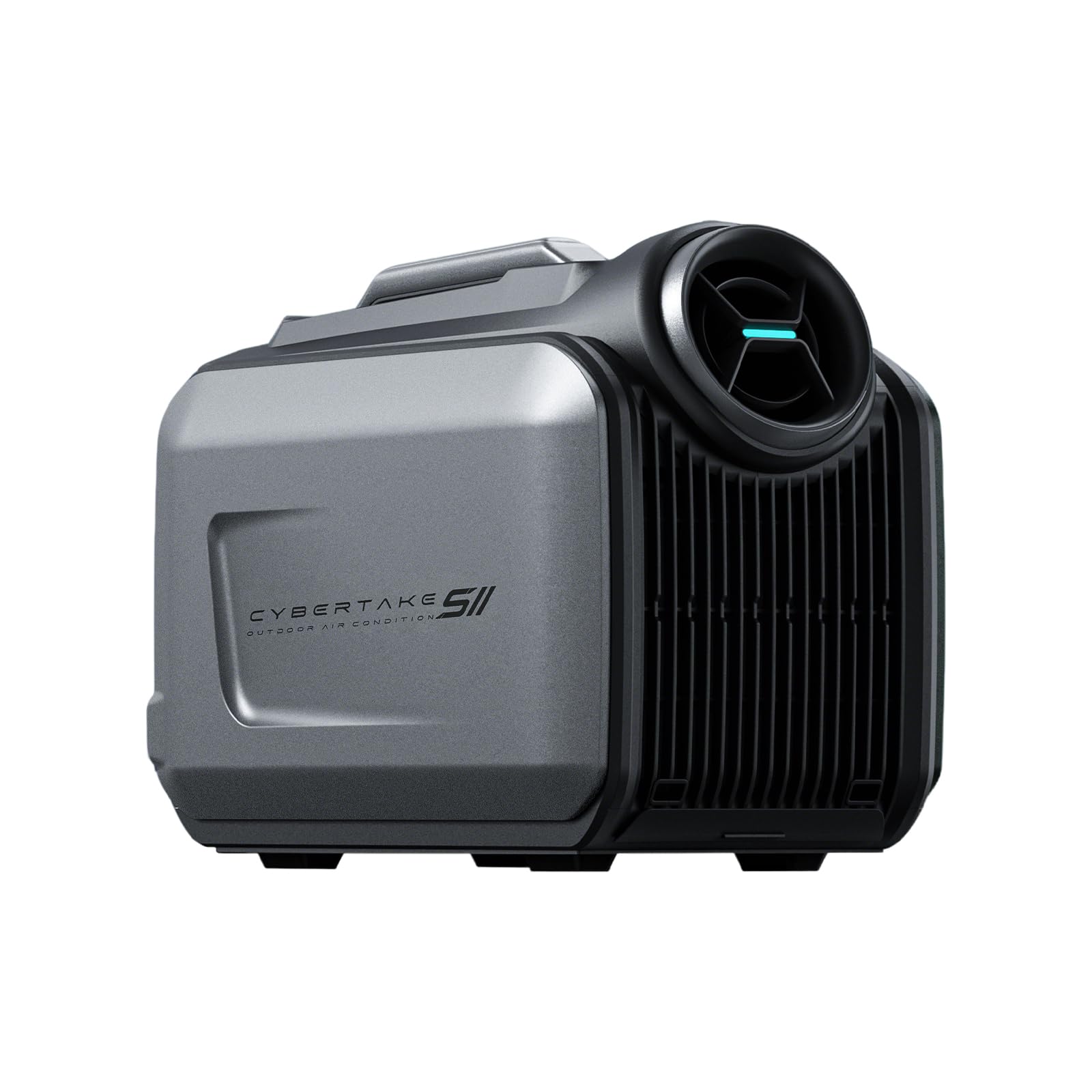
The only unit here that warms you in spring and cools you in summer.
This Cybertake S2 Pro is a true 4-season companion, delivering 5100 BTU of cooling and 6100 BTU of heating for spaces up to 130 sq ft. It cools down to 60°F or warms up to 90°F, and operates across an ambient range of 41°F to 113°F — meaning it works whether you are in a heatwave or a cold snap. The IPX4 water-resistant shell shrugs off splashes and rain, so a surprise shower won’t ruin your setup.
Efficiency is the headline metric here. Eco+ mode draws just 1kWh per 8 hours, verified by owners who run it a month on one charge and keep a truck interior dry. The 40dB operating volume is quieter than a dishwasher, and setup takes under 30 seconds with the included hose and adapter kit. You get 4 distinct modes — Cool, Heat, Dehumidify, and Eco+ — with 3 fan speeds and a 0-12 hour timer.
The catch is power flexibility comes at a cost. It supports AC wall (100-240V), vehicle (12V/24V), and portable power station (DC 48V), but the boost converter for 12V systems is sold separately. Customers note a 550W max draw, draining a 2400Wh station in about 5 hours. The app also has pairing issues, and the remote comes separately. It is also not designed to cool the inside of a small SUV — it works best vented from outside the space.
4-season strengths
- 5100 BTU cooling plus 6100 BTU heating
- Eco+ mode uses 1kWh per 8 hours
- IPX4 water-resistant — rain-safe shell
Power punts
- Boost converter for 12V is an extra purchase
- App pairing issues reported
- Not effective inside a small SUV
Choose this for: year-round adventurers who want one unit that cools summer tents and warms cold-weather camping trips.
Look away if: you want plug-and-play 12V vehicle use without buying extra converters.
7. EcoFlow WAVE 3 Portable Air Conditioner

The do-it-all luxury unit that cools, heats, and runs cordless off its own battery.
The WAVE 3 is the most capable unit here, and the only one with a built-in 1024Wh LFP battery for true cordless freedom. It delivers 1800W of cooling (6100 BTU) and 2000W of heating (6800 BTU), covering 120-180 sq ft — enough for a large tent or small trailer. The HyperSpeed mode drops the temperature by 15°F in 15 minutes under extreme heat, and the heating mode boosts 17°F at the vents in the same timeframe.
what separates it is the integrated battery. The 1024Wh LFP pack provides 8 hours of cordless use, and 1000W fast charging refills it in 75 minutes via AC, car, or solar. That makes it genuinely portable — no external power station required. Owners confirm it works as a mini heat pump, cooling about 20°F below ambient, and the “Better With Every Generation” feedback notes it has more cooling and CFM than the previous WAVE 2 model.
The honest downsides are real. At 32 lbs with the battery, it is heavy, and the battery life claims are optimistic in practice — one owner saw just 2 hours daytime use in a hot trailer. Another described it as “one ac/heat vent of a car in a very heavy large box.” It also refuses to work when surroundings are extremely cold or hot, which is exactly when you want it most. This is a premium investment for serious campers, not a casual purchase.
Luxury highlights
- Built-in 1024Wh battery — 8 hours cordless
- 6100 BTU cooling and 6800 BTU heating
- 1000W fast charging in 75 minutes
Luxury tolls
- 32 lbs — heavy with the battery attached
- Real-world battery life falls short of claims
- Struggles in extreme ambient temperatures
Worth it for: serious overlanders and vanlifers who want a single self-contained unit that cools, heats, and runs off-grid without extra gear.
Not for: budget campers — this is a premium tool with premium weight and price attached.
Understanding the Specs
BTU: The cooling power number
BTU, or British Thermal Units, measures how much heat the unit can remove per hour. Higher BTU means faster, stronger cooling for larger spaces. A 2-person tent with 64-86 sq ft of floor space needs roughly 3400 BTU, while a 130 sq ft trailer needs around 5100 BTU. Match the BTU to your tent’s footprint, not the price tag.
Watts and the startup surge
Wattage tells you how much power the AC will draw per hour, but the number to watch is the startup surge — often triple the running draw. A unit rated at 400W may pull 1500W for the first few seconds of compressor startup. Check that your power station’s inverter can handle the peak, not just the average, or you will trip the breaker.
Decibels: The sleep factor
Decibel (dB) ratings tell you how loud the unit gets. A quiet conversation is around 60dB, while a whisper is 30dB. For tent sleeping, aim for 50dB or lower — units like the Cybertake S1 Pro at 38dB and the WISHILO at 45dB let you rest without a constant hum, while louder units may keep light sleepers awake.
Power source compatibility
Tent ACs draw from one of three sources: AC wall outlets, 12V/24V vehicle systems, or portable power stations with DC output. Some units need a separate boost converter to step up 12V vehicle power to 48V DC. Check the full power chain — AC unit, converter, battery, and solar input — before you leave home.
FAQ
How many BTU do I need for my tent?
Can a tent AC run off a portable power station?
Do tent air conditioners need to be vented?
How long will a tent AC run on battery power?
Is a swamp cooler or a real AC better for a tent?
What is the quietest tent AC for sleeping?
Will a tent AC fit in a rooftop tent?
What maintenance does a tent AC need?
Final Thoughts: The Verdict
If you want one dependable pick, the ac for camping tent winner is the BougeRV PC35 because it blends app-controlled convenience with real 3500 BTU cooling and a flexible 61-90°F range. If you want maximum cooling speed for a larger tent, grab the Outohome 5200 BTU. And for off-grid vanlife efficiency, the Cybertake S1 Pro is the one to reach for.
How We Picked
We do not accept paid placement. Every pick is matched to a real buyer and a real use-case; we do not hands-on test units.
Sources & Methodology
Specifications: manufacturer listings and product documentation. Review insights: verified customer reviews, as of August 2026. Pricing: not shown on this page (it changes often); check the current price via the retailer link.
As an Amazon Associate, Gadgets Feed earns from qualifying purchases. This does not affect which products we feature.