
Choosing a 30 Series Graphics Card today means navigating a minefield of VRAM capacities, power draw trade-offs, and performance tiers that span from 1080p workhorses to 4K powerhouses. The RTX 3060, 3060 Ti, 3070, 3080 Ti, and 3090 each occupy a distinct performance bracket, and picking the wrong one can cost you either frames or future-proofing.
I’m Rikta — the co-founder and writer behind Gadgets Feed. I’ve spent countless hours analyzing silicon benchmarks, VRAM scaling in modern titles, and thermal performance data to help you match the right GPU to your specific resolution and workload. (And Homer 🐱 approved the final picks from his warm perch on the PC case).
Whether you’re targeting silky 1440p gaming or stepping into 4K, this guide breaks down the top contenders so you can confidently choose the best 30 series graphics card for your build without wasting cash on overkill specs or buying into obsolescence.
How To Choose The Best 30 Series Graphics Card
The RTX 30 series spans from the entry-level RTX 3060 to the flagship RTX 3090, each built on the same Ampere architecture but with drastically different core counts, memory buses, and power budgets. Your choice should be governed primarily by your target resolution, refresh rate, and whether you need the card for pure gaming or mixed creative workloads.
VRAM: The New Bottleneck
Modern titles at 1440p with high-resolution texture packs can exceed 8GB of VRAM allocation, making the 12GB on cards like the RTX 3060 a legitimate advantage over the 8GB on the RTX 3070 for certain scenarios. The RTX 3080 Ti and RTX 3090’s larger memory pools (12GB and 24GB GDDR6X respectively) are essential for 4K gaming and professional 3D, video, or AI workloads where dataset size exceeds frame buffer limits.
Power Delivery and Thermal Headroom
The Ampere generation is power-hungry, with the RTX 3090 drawing over 350W under load. A quality power supply with sufficient wattage headroom (minimum 650W for the RTX 3060, 750W for the RTX 3080 Ti, and 850W for the RTX 3090) is non-negotiable. Triple-fan coolers with vapor chambers are standard on premium models and contribute directly to sustained boost clocks and lower noise levels.
Ray Tracing and DLSS: The Ampere Advantage
Second-generation RT Cores and third-generation Tensor Cores on every RTX 30 series card enable hardware-accelerated ray tracing and NVIDIA DLSS. While ray tracing performance scales significantly from the RTX 3060 to the RTX 3080 Ti, DLSS remains a powerful equalizer, allowing lower-tier cards to render at a lower internal resolution and output sharp, high-framerate images at higher display resolutions.
Quick Comparison
On smaller screens, swipe sideways to see the full table.
| Model | Category | Best For | Key Spec | Amazon |
|---|---|---|---|---|
| GIGABYTE RX 9070 XT OC | Premium Alternative | High-FPS 1440p / Entry 4K | 16GB GDDR6, 3060 MHz | Amazon |
| PNY RTX 5070 Ti Epic-X OC | Next-Gen Premium | 1440p Max / Entry 4K RT | 16GB GDDR7, DLSS 4 | Amazon |
| MSI RTX 3080 Ti Gaming X Trio | High-End | 4K Gaming / Streaming | 12GB GDDR6X, 320-bit | Amazon |
| ASUS TUF RTX 3080 Ti OC | Premium Build | Durable 4K / Workstation | 12GB GDDR6X, Axial Fans | Amazon |
| EVGA RTX 3090 FTW3 Ultra | Flagship | Workstation / 8K | 24GB GDDR6X, iCX3 | Amazon |
| NVIDIA RTX 3090 FE | Flagship Reference | Creative Pro / 8K | 24GB GDDR6X, 384-bit | Amazon |
| GIGABYTE RTX 3070 Gaming OC | Mid-Range | 1440p High Refresh | 8GB GDDR6, 256-bit | Amazon |
| MSI RTX 3070 Ventus 3X OC | Mid-Range | 1440p Competitive | 8GB GDDR6, 256-bit | Amazon |
| NVIDIA RTX 3060 Ti FE | Value Pick | 1440p Entry / 1080p | 8GB GDDR6, 256-bit | Amazon |
| GIGABYTE RTX 3060 Gaming OC | Entry-Level | 1080p Maxed Out | 12GB GDDR6, 192-bit | Amazon |
| ASRock Intel Arc B580 Challenger | Budget Alternative | 1080p / Budget 1440p | 12GB GDDR6, 2740 MHz | Amazon |
In‑Depth Reviews
1. GIGABYTE Radeon RX 9070 XT Gaming OC 16G

The GIGABYTE RX 9070 XT Gaming OC is a compelling premium alternative for gamers who prioritize raw rasterization performance and high VRAM capacity over ray tracing pedigree. Its 16GB GDDR6 frame buffer on a 256-bit bus provides ample headroom for 1440p ultra textures and even respectable 4K gaming, with the WINDFORCE cooling system keeping junction temperatures in check under sustained loads.
Real-world benchmarks show this card effortlessly exceeding 240 fps at 1440p in titles like Hogwarts Legacy and Call of Duty when paired with a high-end CPU, thanks to the 3060 MHz boost clock. The Hawk fan design and server-grade thermal gel contribute to a quiet thermal profile, though some users note the card runs slightly hotter than competing 9070 XT models, making undervolting a worthwhile tweak for warm environments.
While not a native RTX 30 series card, the RX 9070 XT offers superior value for pure gaming at this price tier, rivaling the RTX 3080 Ti in raw performance with more VRAM. It is best suited for users who can benefit from FSR upscaling and don’t require NVIDIA-specific features like CUDA for professional workloads.
Why it’s great
- 16GB VRAM offers excellent future-proofing for high-resolution textures.
- Excellent 1440p and solid 4K rasterization performance out of the box.
- WINDFORCE cooling is quiet and effective under most loads.
Good to know
- Runs slightly hotter than other 9070 XT models; undervolting may help.
- Lacks NVIDIA CUDA and OptiX for professional 3D and AI workloads.
- Ray tracing performance is good but trails equivalent NVIDIA cards.
2. PNY GeForce RTX 5070 Ti Epic-X ARGB OC
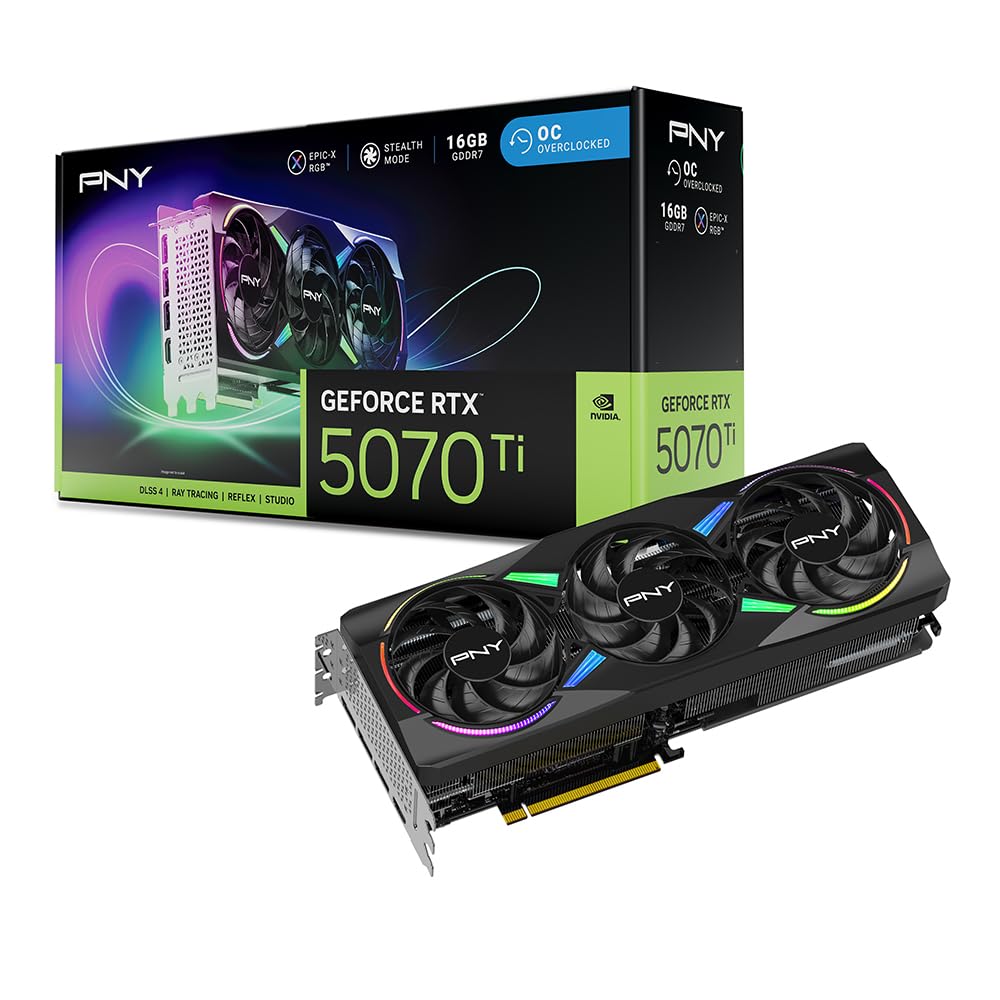
The PNY RTX 5070 Ti Epic-X OC represents a leap beyond the RTX 30 series into Blackwell architecture, offering native support for DLSS 4 with frame generation and fifth-gen Tensor Cores. Its 16GB of GDDR7 memory on a 256-bit interface delivers massive bandwidth headroom, making it a future-proof choice for high-refresh 1440p gaming and competent entry into 4K ray tracing titles.
User reports confirm this card delivers a significant raster uplift over the RTX 3090 in many titles while drawing under 300W, a remarkable efficiency gain. The triple-fan cooler is massive at 12 inches long, yet it runs consistently quiet with no coil whine reported, and the Epic-X design features tasteful ARGB lighting. DLSS 4 frame generation pushes frame rates well beyond 100 fps in Cyberpunk 2077 with ray tracing enabled.
This is a premium investment for users who want the latest AI-driven upscaling technology and efficient performance without jumping to the flagship tier. It excels in both gaming and local LLM workloads thanks to the 16GB VRAM and stable driver support on older platforms.
Why it’s great
- GDDR7 memory provides exceptional bandwidth for high-resolution textures.
- DLSS 4 with frame generation delivers massive fps boosts in supported titles.
- Very quiet and efficient operation under 300W maximum draw.
Good to know
- Large triple-slot design may not fit smaller cases.
- Premium pricing places it above most RTX 30 series cards.
- Requires a modern PCIe 5.0 motherboard for optimal bandwidth.
3. MSI Gaming GeForce RTX 3080 Ti Gaming X Trio 12G

The MSI RTX 3080 Ti Gaming X Trio remains the gold standard for high-end 30 series gaming, pairing 12GB of GDDR6X memory on a 320-bit bus with the robust TRI FROZR 2 thermal design. This card delivers over 100 fps at 4K in demanding titles like Forza Horizon 5 and Horizon Zero Dawn, with the triple-fan cooler keeping temperatures around 78°C under full load while maintaining whisper-quiet acoustics.
Overclocking headroom is plentiful; users have reported stable +500 MHz memory and +100 MHz core overclocks, pushing 3DMark Time Spy scores above 21,000. The card requires three 8-pin power connectors and a quality 750W PSU, but the power delivery is robust enough to handle aggressive voltage curves. The included metal support bracket is necessary given the card’s 32cm length and significant weight.
For the 1440p gamer looking to step into 4K, this card offers the best balance of VRAM capacity, raw compute, and cooling performance in the RTX 30 series lineup. The 12GB frame buffer handles today’s heaviest texture packs without issue, and the 320-bit memory interface ensures no bandwidth bottlenecks.
Why it’s great
- 12GB GDDR6X with 320-bit bus provides excellent bandwidth for 4K gaming.
- TRI FROZR 2 cooler runs very quietly even under sustained loads.
- Significant overclocking headroom for enthusiasts.
Good to know
- Very large card; measure your case clearance carefully.
- Requires three 8-pin power connectors and a 750W PSU minimum.
- MSI software suite is considered bloated by some users.
4. ASUS TUF Gaming RTX 3080 Ti OC Edition

The ASUS TUF Gaming RTX 3080 Ti OC Edition is built for durability, featuring military-grade capacitors, dual ball fan bearings rated for double the lifespan of sleeve designs, and an Axial-Tech fan with reversed center fan rotation for optimized airflow. It delivers the same 12GB GDDR6X performance as the MSI variant but with an emphasis on long-term reliability and out-of-the-box stability at 1785 MHz boost clock.
Thermal performance is outstanding, with users reporting stable 55-60°C under gaming load and virtually silent fan operation. The card’s non-RGB aesthetic with a subtle TUF logo LED appeals to builders who prefer a clean, professional look. The 350W power limit does restrict overclocking headroom compared to the MSI Gaming X Trio, but stock performance is already excellent for 4K60 and high-refresh 1440p gaming.
This card is ideal for users who value build quality and silent operation over maximum overclocking potential. The 3-year warranty and TUF certification provide peace of mind for a long-term investment, and the card takes well to undervolting for lower power consumption without sacrificing frames.
Why it’s great
- Exceptional build quality with military-grade components and dual ball bearings.
- Runs extremely cool and quiet at stock settings.
- Subtle, professional design without excessive RGB.
Good to know
- 350W power limit restricts overclocking potential.
- ASUS software suite is not highly regarded by the community.
- Long card may not fit in smaller mid-tower cases.
5. EVGA GeForce RTX 3090 FTW3 Ultra Gaming

The EVGA RTX 3090 FTW3 Ultra is the definitive workstation-class GPU in the 30 series lineup, packing 24GB of GDDR6X memory on a 384-bit bus for massive datasets in 8K video editing, 3D rendering, and AI model training. The iCX3 cooling system uses nine thermal sensors across the card to dynamically control the triple HDB fans, but the GDDR6X memory is known to run hot (up to 105°C) and benefits significantly from water cooling or an active backplate.
In pure gaming, this card maxes out every title at 4K except for Cyberpunk 2077 with full ray tracing, where DLSS is required for playable frame rates. The dual BIOS feature and adjustable ARGB offer flexibility, and the all-metal backplate adds rigidity to the heavy card. Gamers should be aware that the EVGA 3090 draws over 350W, making a 1200W PSU a sensible investment for headroom and stability.
This card is overkill for pure gaming but indispensable for professionals who need 24GB of VRAM for rendering, simulation, or local AI inference. The FTW3 Ultra’s robust power delivery and cooling make it a top-tier choice for demanding mixed workloads.
Why it’s great
- 24GB GDDR6X VRAM is essential for professional 3D, video, and AI workloads.
- Dual BIOS and extensive overclocking headroom.
- Excellent build quality with all-metal backplate and ARGB.
Good to know
- GDDR6X memory runs very hot; water cooling is recommended.
- Requires a high-wattage PSU (850W-1200W) and three 8-pin connectors.
- Excessive for 1440p gaming; is better suited for workstation use.
6. NVIDIA GeForce RTX 3090 Founders Edition

The NVIDIA GeForce RTX 3090 Founders Edition is the reference implementation of the flagship Ampere GPU, offering the same 24GB GDDR6X VRAM and 384-bit memory interface as custom cards in a slimmer dual-slot form factor. It is a beast for creative professionals, delivering laughably fast rendering speeds in DaVinci Resolve—a 20-minute CPU task can be reduced to 4 minutes—and enabling real-time 6K video editing with multiple nodes.
Gaming performance is equally impressive, maxing out most 4K titles with ease. However, users should be cautious when purchasing third-party units, as some listings have been reported to be used or abused mining cards with degraded thermal performance. The card runs hot, with memory junction temperatures frequently exceeding 105°C under sustained load, necessitating good case airflow and potentially an undervolt.
The Founders Edition is a solid choice for those seeking reference design reliability and a smaller footprint than chunky triple-fan custom cards. It excels in professional environments where 24GB VRAM is non-negotiable, but its thermal characteristics mean it is not the most comfortable pick for a silent gaming build without additional cooling measures.
Why it’s great
- 24GB GDDR6X on a 384-bit bus for uncompromised professional workloads.
- Slimmer dual-slot design fits in more cases than custom triple-fan cards.
- Reference design offers predictable, stable performance.
Good to know
- GDDR6X memory runs very hot; excellent case airflow is mandatory.
- High power draw requires a quality 850W PSU.
- Beware of third-party sellers offering potentially used mining cards.
7. GIGABYTE GeForce RTX 3070 Gaming OC 8G

The GIGABYTE RTX 3070 Gaming OC is a mid-range champion that punches well above its weight class, delivering 1440p high-refresh gaming (100+ fps) on ultra settings in most modern titles. Its WINDFORCE 3X cooling system with alternate spinning fans keeps the 8GB GDDR6 memory and Ampere GPU cool even during extended sessions, while RGB Fusion 2.0 allows for subtle lighting customization.
Users consistently report the card is a “beast” for 1440p, with quiet operation and excellent thermal performance straight out of the box. The protection metal backplate adds rigidity, and the 4-year warranty (with online registration) reflects GIGABYTE’s confidence in the build. Overclocking potential is respectable, though the 8GB VRAM can become a bottleneck in texture-heavy titles at 1440p with ray tracing enabled.
This card is the sweet spot for gamers building a 1440p system who want RTX 3070 performance without paying a premium for the 3080 class. It handles ray tracing and DLSS competently, though users should temper expectations for 4K gaming and prioritize it as a high-refresh 1440p solution.
Why it’s great
- Excellent 1440p high-refresh gaming performance.
- WINDFORCE 3X cooling is quiet and effective.
- 4-year warranty with online registration adds peace of mind.
Good to know
- 8GB VRAM may limit texture quality in some newer titles.
- Some users report it is slightly noisy under heavy load.
- Not suitable for demanding 4K gaming without DLSS.
8. MSI Gaming GeForce RTX 3070 Ventus 3X OC

The MSI RTX 3070 Ventus 3X OC is a no-frills, robust mid-range card that delivers the full Ampere experience without unnecessary extras. Its triple-fan thermal design keeps the 8GB GDDR6 memory and 256-bit bus running smoothly, delivering around 100 fps at 1440p ultra settings and dropping to 60-100+ fps in heavier scenarios. The card is quiet, with fans only spinning above 60°C, making it suitable for silent builds.
Users who upgraded from older GPUs report incredible performance gains, with max temps staying around 63°C even after months of use. The card is large at 12 inches long and requires two 8-pin power connectors; no adapters are included, so ensure your PSU has the necessary cables. There is no RGB, which appeals to builders seeking a clean, understated look.
This card is a straightforward recommendation for anyone building a 1440p gaming rig on a mid-range budget. It lacks the flashy aesthetics of some competitors but compensates with reliable performance, solid cooling, and a proven track record of stability.
Why it’s great
- Solid 1440p high-refresh performance without breaking the bank.
- Triple-fan cooler runs quietly and keeps temps low.
- No RGB design suits minimalist builds.
Good to know
- Large card; check case dimensions and PSU cable configuration.
- No power adapters included in the box.
- 8GB VRAM may become a limitation in future titles.
9. NVIDIA GeForce RTX 3060 Ti Founders Edition

The NVIDIA GeForce RTX 3060 Ti Founders Edition is the value king of the 30 series, offering performance that often rivals the RTX 2080 Super at a significantly lower entry point. Its 8GB GDDR6 memory on a 256-bit bus provides excellent bandwidth for 1440p gaming, and the compact dual-fan design fits easily into most mid-tower cases without requiring elaborate power cabling.
Users coming from older cards like the RTX 2060 Super report a perfect upgrade, with smooth 1440p performance and minimal noise even under heavier loads. The card does get noticeably louder under sustained load, but the core speed of 1.75 GHz ensures frame rates remain high. DLSS and ray tracing are both usable at 1080p and even entry-level 1440p, making this a versatile card for budget-conscious gamers who still want RTX features.
For anyone seeking the best performance-per-watt in the 30 series, the RTX 3060 Ti is the benchmark. It is an ideal partner for a lower-wattage PSU (650W is plenty) and delivers a smooth 1440p experience without the premium price tag of the RTX 3070.
Why it’s great
- Outstanding price-to-performance ratio in the 30 series lineup.
- Compact Founders Edition design fits most builds easily.
- DLSS and ray tracing available at an accessible price point.
Good to know
- Can get loud under heavy gaming loads.
- 8GB VRAM is the minimum acceptable for modern 1440p.
- Not suitable for 4K gaming without significant compromises.
10. Gigabyte GeForce RTX 3060 Gaming OC 12G

The Gigabyte RTX 3060 Gaming OC 12G is the entry-level champion for 1080p gaming, offering a unique proposition: 12GB of GDDR6 memory on its 192-bit bus. While the narrower bus limits bandwidth compared to the 256-bit cards, the extra VRAM allows the card to handle high-resolution texture packs in modern games without swapping, preventing stutter in titles like Call of Duty and Hogwarts Legacy at 1080p ultra.
The WINDFORCE 3X cooling system is overkill for a 170W GPU, resulting in very quiet operation and low temperatures even during extended sessions. Users upgrading from cards like the GTX 1060 report a massive leap in performance, with the RTX 3060 easily delivering 60+ fps at 1080p ultra in most titles. The inclusion of ray tracing cores and DLSS support adds future-proofing for when the user eventually upgrades to a 1440p monitor.
This card is the smart pick for budget builders who want to maximize VRAM capacity for texture-heavy games and light creative work. The 12GB buffer is also useful for entry-level 3D rendering and video editing, giving it an edge over the RTX 3060 Ti for non-gaming tasks despite the lower raw performance.
Why it’s great
- 12GB VRAM provides texture headroom even with a narrow 192-bit bus.
- Overbuilt WINDFORCE 3X cooler runs silent and cool.
- Excellent price for entry-level ray tracing and DLSS capabilities.
Good to know
- 192-bit memory bus limits bandwidth compared to RTX 3060 Ti.
- Not powerful enough for consistent 1440p ultra gaming.
- Ray tracing performance is limited; intended primarily for 1080p.
11. ASRock Intel Arc B580 Challenger 12GB OC

The ASRock Intel Arc B580 Challenger 12GB OC is a budget-friendly alternative to traditional RTX 30 series cards, leveraging Intel’s Xe2-HPG architecture to deliver impressive 1440p performance at an entry-level price point. Its 12GB GDDR6 memory on a 192-bit interface matches the RTX 3060 in capacity, and the 2740 MHz engine clock ensures competitive frame rates in modern titles at 1080p and light 1440p.
Users report excellent 1440p performance when paired with a modern AMD or Intel CPU, with zero crashes or stuttering and stable drivers. The card is very quiet and compact at 249mm, making it ideal for small-form-factor builds. However, it requires Resizable BAR (tied to Intel 10th gen and newer) for good performance; without it, the card underperforms significantly. Power draw is low, often under 150W under full load, making it a cool and efficient option for budget builds.
This card is a strong contender for budget gamers who prioritize VRAM capacity and low power draw over raw rasterization performance. It handles 1080p ultra and 1440p medium-high settings with ease, though users should verify REBAR support and ensure driver updates are applied for optimal stability.
Why it’s great
- 12GB VRAM at a budget-friendly entry point for high-resolution textures.
- Very low power draw (under 150W) keeps thermals and electricity costs down.
- Compact design suits SFF and budget builds.
Good to know
- Requires Resizable BAR support (10th gen Intel or newer) for optimal performance.
- Driver ecosystem is less mature than NVIDIA’s.
- Not recommended for 4K gaming or heavy ray tracing workloads.
FAQ
Is 8GB VRAM enough for 1440p gaming on a 30 series card?
Which 30 series card runs the coolest and quietest?
Can I use an RTX 3090 for AI and machine learning workloads?
What power supply do I need for an RTX 3070 vs RTX 3080 Ti?
Does the RTX 3060 support DLSS 3 frame generation?
Final Thoughts: The Verdict
For most users, the best 30 series graphics card winner is the MSI RTX 3080 Ti Gaming X Trio 12G because it offers the best balance of 4K-capable performance, generous 12GB VRAM on a 320-bit bus, and whisper-quiet cooling at a realistic price point. If you prioritize raw VRAM capacity for creative workloads, grab the EVGA RTX 3090 FTW3 Ultra 24G. And for entry-level 1080p gaming with an eye on future textures, nothing beats the Gigabyte RTX 3060 Gaming OC 12G.