
Choosing the wrong 13-foot ladder means dealing with a shaky platform, awkward storage, and the nagging worry that the next step up might be your last. Whether you’re swapping a ceiling fan in a two-story foyer, cleaning second-story gutters, or painting a vaulted wall, the right ladder turns a risky stretch into a solid, stable reach. This category demands a careful balance of reach height, weight capacity, portability, and the versatility to handle flat ground, stairs, and uneven soil—all while keeping your center of gravity inside the safety zone.
I’m Rikta — the co-founder and writer behind Gadgets Feed. I analyze technical specifications and market data across over 200 product categories, and ladders are among the most safety-critical purchases I evaluate, where inch-by-inch stability specs and material gauge have real consequences. (And Homer 🐱 supervised from the warm laptop, unimpressed by the absence of a box to sleep in).
This guide breaks down nine distinct models, from budget-friendly multi-position units to professional-grade fiberglass platforms, so you know exactly which hinge design, material alloy, and locking mechanism fits your task. Whether you need a ladder for attic access, RV storage, or daily contracting work, the 13 foot ladder you pick determines how confidently you climb and how securely you work.
How To Choose The Best 13 Foot Ladder
Picking a ladder that’s too light for the job or too heavy to carry defeats the purpose of buying one at all. Focus on four decision points that separate a safe, versatile tool from a frustrating compromise.
Duty Rating and Weight Capacity
The duty rating tells you the maximum safe load the ladder can handle—including your body weight plus any tools or materials you carry up. Type IA (300 lbs) is the standard for most home and professional use. Type IAA (375 lbs) ladders are heavier but provide an extra safety margin for larger users or heavy tool belts. Always choose a duty rating at least 50 lbs above your own weight to account for dynamic force when climbing.
Multi-Position Versus Telescoping Design
Multi-position ladders use hinge systems to convert between A-frame, extension, staircase, and scaffold configurations. They are wider, more stable, and typically heavier. Telescoping ladders collapse into a compact bundle for storage but often feel shakier at full extension. If you work on stairs or uneven ground, invest in a multi-position model with flared legs and a dual-pin hinge. If storage space is your primary constraint, a telescoping ladder under 25 lbs is the practical choice.
Material: Aluminum vs. Fiberglass
Aluminum ladders are lightweight, corrosion-resistant, and cost-effective—ideal for general home use and RV travel. Fiberglass ladders are heavier but non-conductive, making them mandatory for electrical work near live wires. Fiberglass also handles temperature extremes better and won’t corrode, but the weight penalty (often 8–10 lbs more) affects portability. For drywall, painting, and gutter work, aluminum is fine. For sparkies and commercial electricians, fiberglass is non-negotiable.
Locking Mechanism Quality
The weak point of any adjustable ladder is the locking mechanism. Look for dual-independent slide latches on telescoping models—each step should lock independently for redundancy. On multi-position ladders, spring-loaded push knobs or dual-pin hinges with clear audible clicks inspire confidence. Avoid cheap plastic pawls that can shear under load. Test reviews for phrases like “locks securely” and “no unexpected collapse” to validate real-world performance.
Quick Comparison
On smaller screens, swipe sideways to see the full table.
| Model | Category | Best For | Key Spec | Amazon |
|---|---|---|---|---|
| Werner MT-13 | Multi-Position | Professional all-in-one versatility | 300 lb Type IA, 13 positions | Amazon |
| Little Giant Velocity M13 | Multi-Position | Stability on stairs and slopes | 300 lb Type IA, dual-pin hinge | Amazon |
| Little Giant Dark Horse 2.0 FG | Fiberglass | Electrical work safety | 300 lb Type IA, non-conductive | Amazon |
| ECOMAX EM4X3L2 | Multi-Position | Budget-friendly A-frame/extension combo | 330 lb capacity, 13 ft max | Amazon |
| VEVOR 7-in-1 Folding Ladder | Multi-Position | 7 configurations at low weight | 330 lbs, 23.3 lbs, 37″ folded | Amazon |
| LUISLADDERS 7-in-1 | Multi-Position | Homeowner with high ceilings | 330 lb, EN131 certified, 25.3 lbs | Amazon |
| LiGuVCY Telescoping 12.5FT | Telescoping | RV/attic compact storage | 330 lbs, 31″ folded, 21 lbs | Amazon |
| POONO Telescoping 12.5FT | Telescoping | Low-budget extension work | 330 lbs, 1.56” wide rungs | Amazon |
| JIASHCHE Telescoping 12.5FT | Telescoping | Portable backup ladder | 330.7 lbs, hooks + stabilizers | Amazon |
In‑Depth Reviews
1. Werner MT-13

The Werner MT-13 is the gold standard for multi-position ladders, offering 13 different working configurations from a 2-person stepladder to an extension ladder and scaffold. Its soft-touch push knobs make tool-free transitions intuitive enough that you won’t need the manual after the first few uses. Double-riveted steps and heavy-duty non-marring rubber feet provide slip resistance on hardwood floors and concrete alike, while the extra-wide flared bottom counters tipping risk when you lean sideways to reach gutters.
At 28 pounds, this is a mid-weight aluminum ladder that balances portability with structural rigidity. The 300-pound Type IA duty rating covers most residential and commercial tasks, and the telescoping sections lock positively with audible clicks. Users consistently highlight the compact folded size—under 8 inches wide—which makes it easy to slide behind a door or stash in a car trunk without sacrificing reach height.
One trade-off: the top platform is relatively narrow compared to dedicated step ladders, so standing at the max 13-foot height for extended periods may feel less roomy than a scaffold platform. The spring locks on some units can stick initially, though they tend to loosen with use. For a homeowner or contractor who wants one ladder to replace three, the MT-13 delivers unmatched flexibility and Werner’s lifetime warranty against materials and workmanship.
Why it’s great
- 13 distinct configurations cover A-frame, extension, scaffold, and staircase modes
- Double-riveted steps and flared base deliver professional-grade stability
- Folds to under 8 inches wide for tight storage
Good to know
- Narrow top step can feel constrained at full height
- Spring locks may require a break-in period to operate smoothly
2. Little Giant Velocity M13

The Little Giant Velocity M13 sets itself apart with a dual-pin hinge design that provides an unmatched feeling of rock-solid stability, especially when configured on stairs or uneven terrain. The hinge locks firmly in place with no wobble, and the wide-flared legs create a broad base that resists lateral tipping. This model converts into A-frame, extension, 90-degree ladder, and scaffold configurations, covering 95 percent of ladder-related safety scenarios without switching tools.
At 25 pounds, the Velocity is lighter than the Werner MT-13 while offering a comparable 300-pound Type IA rating. The aluminum construction resists corrosion, and the spring-loaded locking mechanisms on each extension section engage with a reassuring click. Users report that the ladder feels noticeably more stable than many competitors at max extension, particularly when used as a straight ladder at a 75-degree angle against a roofline or wall.
The main limitation is the maximum A-frame height of about 5 feet, which means you’ll rely on extension or 90-degree modes to reach the full 13-foot vertical. The rungs could be wider for comfortable long-duration standing, and the 13-foot version lacks integrated wheels, making transport across a job site slightly less convenient than the larger models. For anyone who regularly works on staircases or hillsides, the Velocity’s hinge confidence is worth the premium.
Why it’s great
- Dual-pin hinge eliminates wobble on stairs and slopes
- Wide-flared base reduces tipping risk during lateral reach
- Multiple configurations avoid 95% of ladder-related safety hazards
Good to know
- A-frame maxes out at approximately 5 feet, limiting standalone stepladder use
- No wheels on the 13-foot model for easy transport
3. Little Giant Dark Horse 2.0 FG 13′
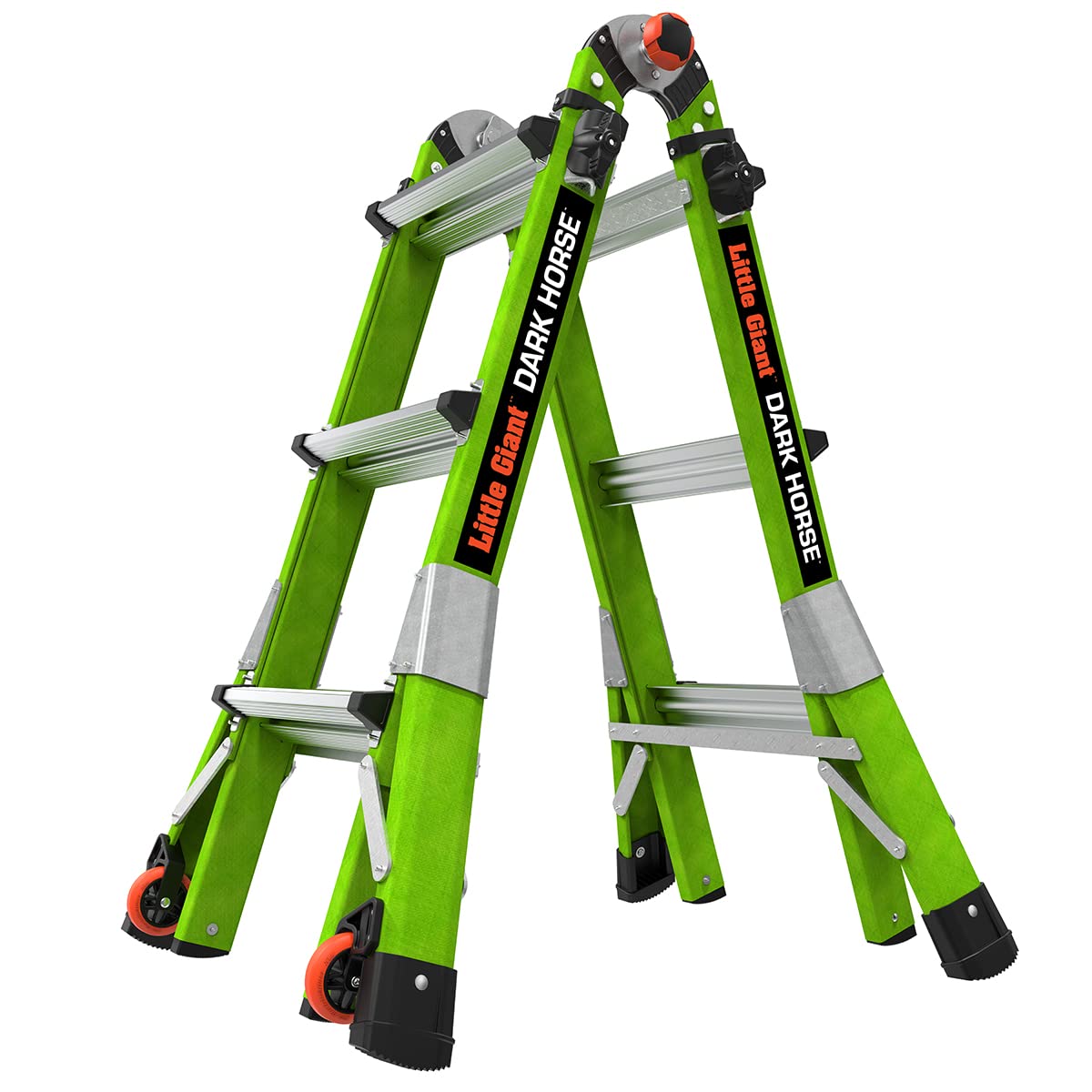
The Little Giant Dark Horse 2.0 FG is the premium fiberglass option for users who require non-conductive safety around live electrical circuits. The bright hi-viz green fiberglass rails provide 360-degree visibility on a job site while resisting corrosion, temperature extremes, and chemical exposure. This ladder meets OSHA and ANSI standards with a 300-pound Type IA rating, and a 375-pound Type IAA variant is available for heavier-duty applications.
Weighing 31.5 pounds, the Dark Horse is the heaviest model in this lineup—a penalty you accept for electrical safety and durability. The multi-position hinge supports A-frame, extension, 90-degree, staircase, and trestle-and-plank configurations, matching the versatility of the aluminum Velocity. The wide-flared base and anti-slip feet keep the ladder planted on smooth garage floors and asphalt driveways. Users consistently describe the locking mechanism as smooth with zero finger-pinching, a clear improvement over older Little Giant designs.
The trade-off is portability. At over 31 pounds, this ladder is less convenient to carry around a house or load into an RV storage compartment. The built-in wheels help, but you’ll feel the weight on every move. If your work never involves live electrical components, the aluminum versions save you 6-8 pounds. For electricians, facility maintenance pros, or anyone working near energized panels, the Dark Horse’s dielectric safety is non-negotiable and justifies the investment.
Why it’s great
- Non-conductive fiberglass rails ensure safety near live electrical circuits
- Smooth, pinch-free locking mechanism across all configurations
- Wide-flared base and anti-slip feet provide excellent ground stability
Good to know
- Heaviest option at 31.5 lbs, reduces portability
- Rungs could be wider for comfortable extended standing
4. ECOMAX EM4X3L2

The ECOMAX EM4X3L2 delivers a 13-foot maximum height with multi-position versatility at an entry-level price point. It converts between A-frame, extension, and 90-degree ladder modes using an embedded buckle system that locks the ladder at each angle. The aluminum alloy frame is corrosion-resistant, and the widened non-slip foot pads increase friction on tile, concrete, and hardwood surfaces.
At 25 pounds, the ECOMAX is competitive with premium models in weight, but the overall build quality reflects its mid-range positioning. The step spacing is standard, and the max load capacity is listed at 330 pounds—though real-world user feedback suggests the ladder feels more secure closer to 250 pounds, especially at full extension on the 90-degree configuration. The fold-down size is reasonable for garage or closet storage, though it doesn’t collapse as compactly as telescoping alternatives.
Users appreciate the ladder’s light weight for moving between rooms and its ability to function as a scaffold platform for painting stairwells. The main caveat is that the locking buckles can be stiff initially, requiring two hands to disengage. For a homeowner who needs an occasional-use 13-foot ladder for changing light fixtures and cleaning high windows, the ECOMAX provides solid function without the premium price tag.
Why it’s great
- Multi-position versatility at a mid-range investment
- Lightweight 25 lb aluminum frame is easy to maneuver
- Non-slip widened foot pads improve grip on smooth floors
Good to know
- Locking buckles may feel stiff during initial use
- Stability at full 13-foot extension is not as solid as premium models
5. VEVOR 7-in-1 Folding Ladder

The VEVOR 7-in-1 folding ladder packs an impressive range of configurations—A-frame, M-frame, straight ladder, L-shape, platform, folded, and scaffold—into a lightweight 23.3-pound frame that collapses to just 37 inches for storage. This is the best option in the mid-range tier for users who need extreme versatility without the weight penalty of premium multi-position models. The thickened aluminum construction supports up to 330 pounds, and the 2mm thick hinges provide strong load-bearing capacity at 35°, 107°, and 180° lock positions.
The step spacing is a comfortable 11 inches, with 1.2-inch square rungs that reduce foot fatigue during long painting sessions. Dual anti-slip rubber feet keep the ladder planted on smooth surfaces, and the overall assembly feels well-constructed for the price. Users report that the ladder is notably narrower than many competitors, which can feel disconcerting on the first climb but doesn’t compromise strength—several verified reviews from heavy users confirm the ladder holds up without flexing.
The primary downside is that the hinge joints are stiff out of the box, making the initial transformation between modes a two-person operation until the mechanism loosens up. A small number of users reported cosmetic damage from shipping, and there’s one verified claim of collapse at 250 pounds during angled use on an RV roof. For flat-surface indoor and outdoor residential tasks, the VEVOR delivers exceptional value and configuration flexibility, but users exceeding 250 pounds should approach extreme angles with caution.
Why it’s great
- 7 distinct configurations cover nearly every residential use case
- Only 23.3 lbs and folds to 37 inches for compact storage
- Thickened 2mm hinges and anti-slip feet provide solid stability
Good to know
- Hinge joints are stiff initially, requiring extra effort to reconfigure
- Some safety concerns reported at extreme angles for users over 250 lbs
6. LUISLADDERS 7-in-1 Folding Ladder
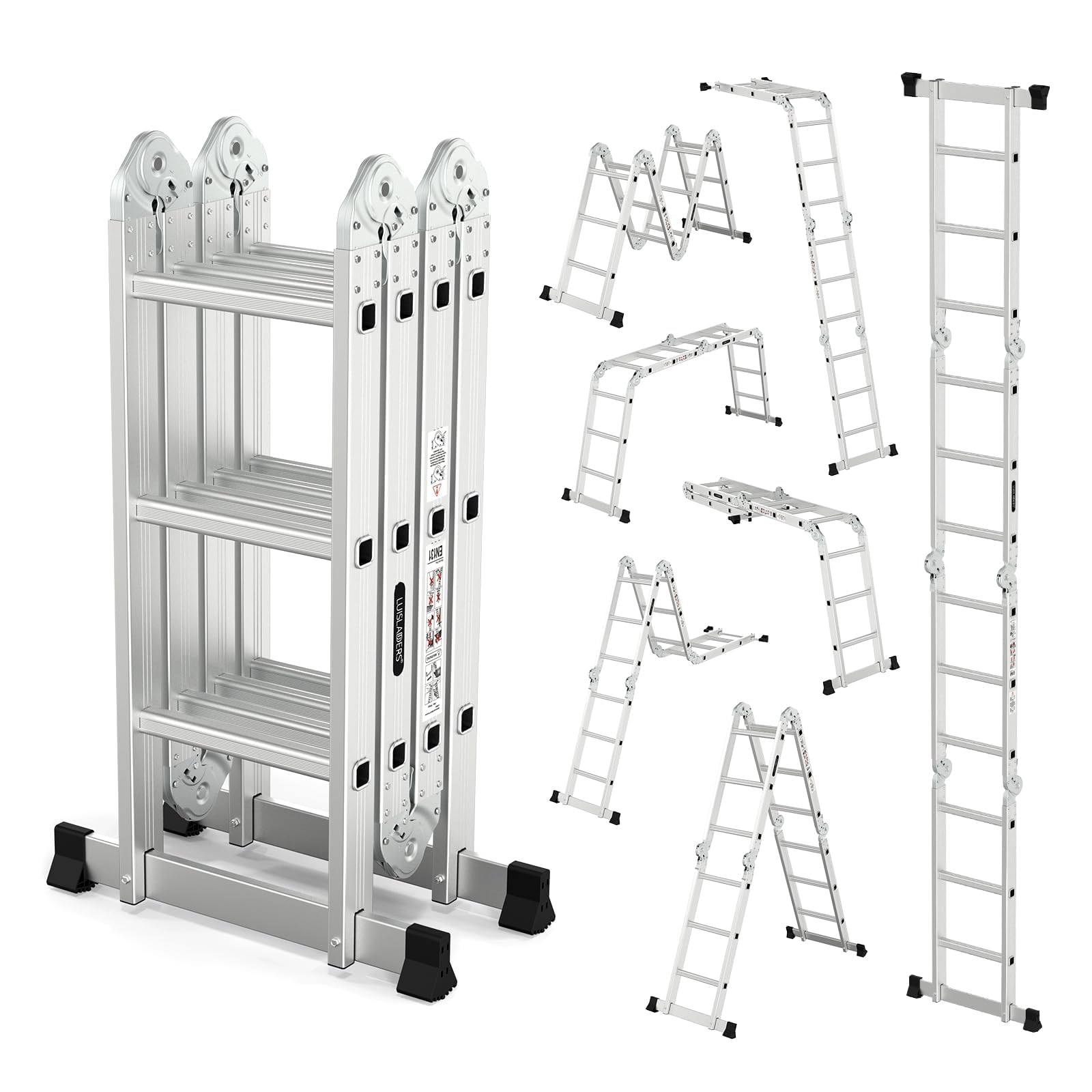
The LUISLADDERS 7-in-1 folding ladder is built to the European EN131 safety standard, a certification that mandates stricter deflection limits and load testing than typical consumer ladders. The aircraft-grade aluminum construction uses square rungs and supporting tubes that resist twisting, and the six security lock system with audible clicks ensures each configuration stays locked. The ladder supports 330 pounds and extends to 12.5 feet, making it ideal for homeowners with high ceilings or vaulted spaces.
At 25.3 pounds, this ladder is manageable for one person to carry between tasks, and it folds down to 40.5 x 23.5 x 11 inches for closet or garage storage. The zigzag anti-slip foot straps and undulating ridge pattern on the square rungs provide excellent grip even when your soles are dusty from attic insulation. Users consistently praise the wide rungs and lightweight feel, with many reporting successful solo installation of ceiling fans and crown molding in rooms with 10-12 foot ceilings.
The learning curve for changing configurations is steeper than premium models—the first few transformations require careful reading of the manual to avoid jamming the locks. The warning label advises that the ladder must be placed on the floor before adjusting, and straight-ladder use requires a 75-degree angle. Some users noted the stabilizer bars are a welcome addition but should be tightened periodically. For the DIY homeowner who wants a ladder that can handle everything from changing a light bulb to painting a stairwell, the LUISLADDERS is a balanced, certified choice.
Why it’s great
- EN131 certification ensures strict safety and deflection standards
- Wide square rungs and anti-slip ridges prevent foot fatigue and slips
- Light weight (25.3 lbs) with six security locks for reliable positioning
Good to know
- Configuration changes require careful attention to manual instructions
- Stabilizer bars need occasional tightening to maintain stability
7. LiGuVCY Telescoping Ladder 12.5FT

At just 21 pounds, it’s the lightest 13-foot-class ladder in this guide. Each of the 12 steps features two independent slide latches, providing redundancy so that if one latch fails, the second still holds the step in place.
The aluminum alloy frame is wear-resistant and corrosion-proof, and the black-and-silver aesthetic blends in with most tool collections. The frame gap between steps has been reduced by half compared to earlier telescoping designs, which noticeably cuts down the lateral wobble that plagues cheap telescoping ladders. The widened rungs offer a stable standing surface, and the non-slip rubber feet grip garage floors and attic trusses effectively.
The trade-off with telescoping design is inherent: they simply don’t feel as solid as multi-position ladders at full extension. Users report minimal sag at 12.5 feet for users around 205 pounds, but the ladder starts to feel less confidence-inspiring above 250 pounds. The closing mechanism requires care—releasing the latches gradually is essential to avoid pinched fingers. For a lightweight, packable ladder that fits in an RV storage bay or behind a door, the LiGuVCY is an excellent specialized tool, but it’s not a replacement for a heavy-duty multi-position ladder for daily contracting work.
Why it’s great
- Collapses to only 31 inches for ultra-compact storage
- Dual independent latches on each step for redundancy
- Lightest option at 21 lbs, easy to carry one-handed
Good to know
- Feels less rigid than multi-position ladders at full extension
- Requires careful latch release to avoid finger pinching
8. POONO Telescoping Ladder 12.5FT
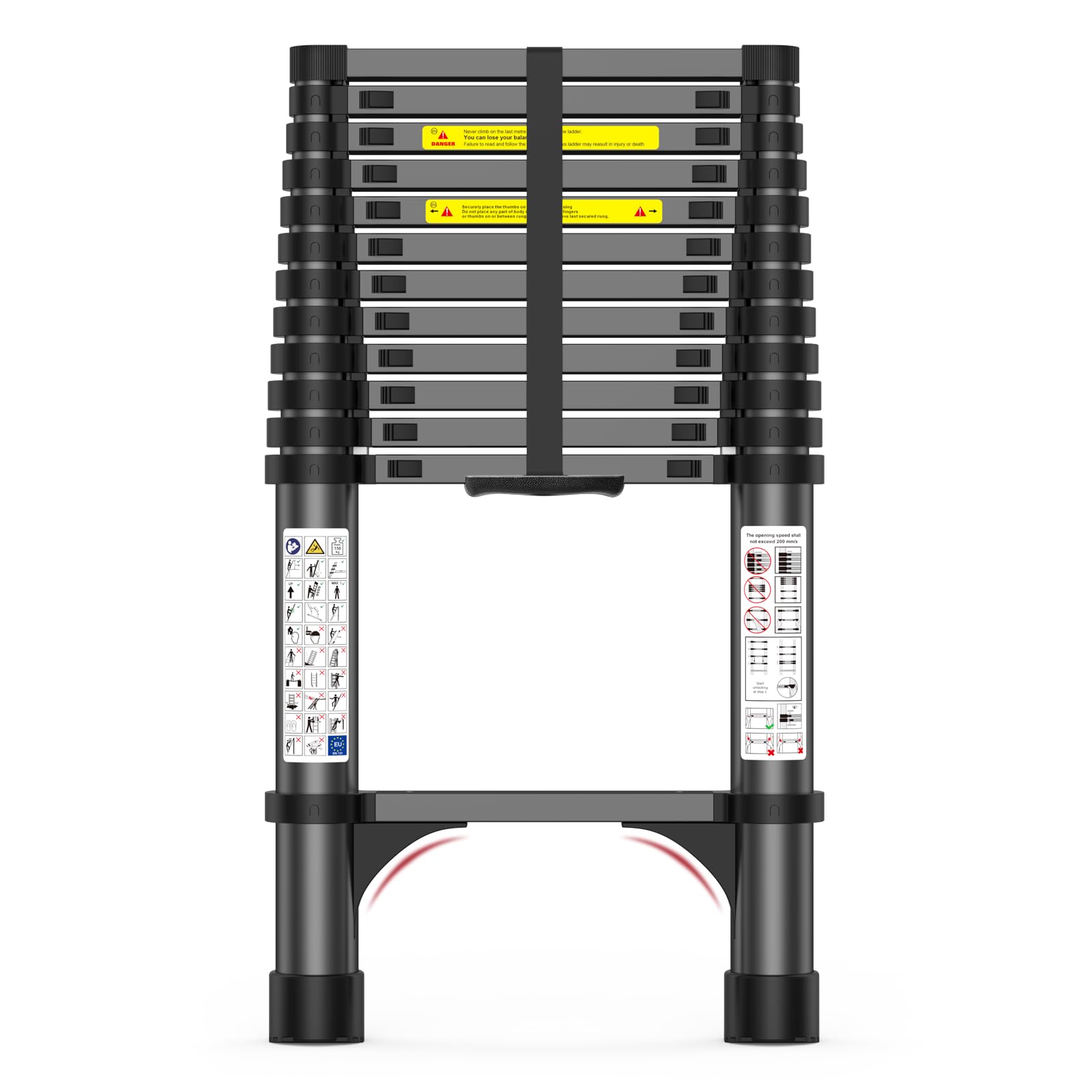
The POONO telescoping ladder aims to address the two biggest complaints about telescoping ladders—narrow rungs and insufficient stability—by widening the steps to 1.56 inches and adding triangle stabilizers at the base. The all-black aluminum frame looks professional and resists corrosion, while the 330-pound load capacity matches the industry standard. The ladder extends to 12.5 feet and collapses to roughly a third of that length for transport.
The non-slip foot pads add friction on dry surfaces, and the locking mechanism produces a clear audible click when each rung is fully seated. The folding process requires pressing independent release pins for each step, which adds time compared to single-lever systems but provides better control during retraction. Users report the ladder feels reasonably stable indoors on flat surfaces, with most concerns arising when used at full extension on soft or uneven ground.
The critical limitation is evident in user feedback: at full 12.5-foot extension, a 240-pound user noted the ladder felt like it might buckle, though it held. This isn’t unusual for telescoping ladders at this price point, but it means the POONO is best suited for light tasks like changing light bulbs, accessing attic hatches, or cleaning windows—not for heavy remodeling or roofing work. The caution about keeping fingers clear during closing is emphasized in multiple reviews. For an occasional-use backup ladder that stores flat, the POONO offers decent value.
Why it’s great
- 1.56-inch wide rungs improve standing comfort versus standard telescoping models
- Triangle stabilizers and non-slip feet increase base stability
- Audible click confirms each latch is fully engaged
Good to know
- Full-extension stability is concerning for users near 250 lbs
- Finger pinching risk during retraction requires careful handling
9. JIASHCHE Telescoping Ladder 12.5FT
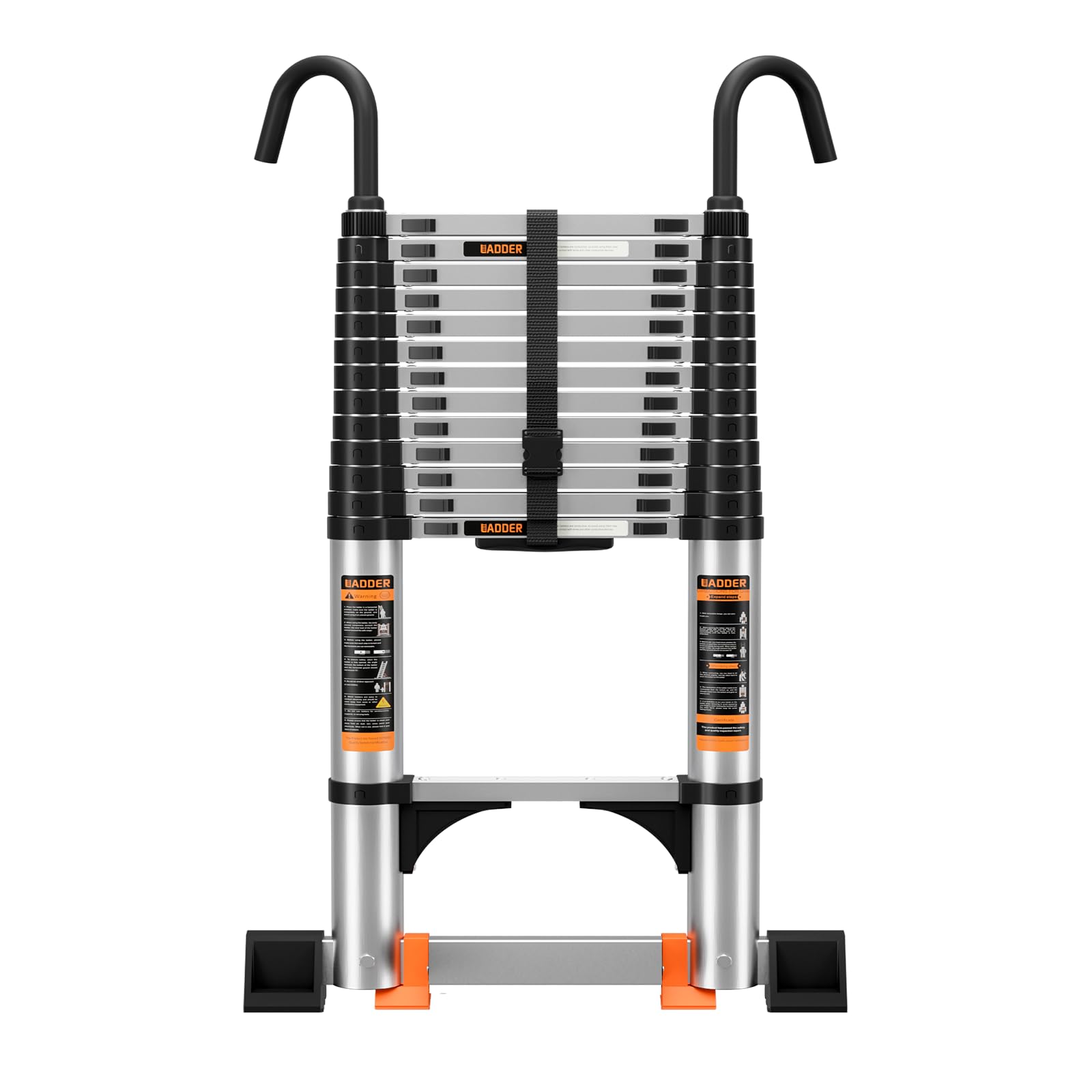
The JIASHCHE telescoping ladder comes with a full accessory package—two triangle stabilizers, large non-slip foot covers, and hooks for securing the top end against a roofline or wall edge. The aluminum alloy construction is thicker than many budget telescoping ladders, and the manufacturer claims 50% improved stability over standard collapsible models. The 330-pound load capacity and 12.5-foot extension match the category baseline, and the fixed storage straps make one-handed carrying practical.
Users appreciate the ladder’s light weight and compact folded size for RV and camper storage, with several reporting it fits easily in a Class C motorhome’s basement compartment. The hooks are a welcome addition for users who need to stabilize the ladder against a gutter or roof edge when accessing a second-story window. The ladder opens smoothly and the locks engage positively, making setup straightforward after a few practice runs.
The quality concerns are significant for a ladder intended for safety. Multiple verified reviews report cracked braces, shaky behavior at full extension, and cosmetic damage on arrival. One user noted the bracket braces were cracked straight out of the box, and another described the ladder as “shaky and unstable” enough to relegate it to backup use only. While customer support proactively offered refunds, the QC inconsistency makes this ladder difficult to recommend as a primary climbing tool. Consider it only as a lightweight, portable backup for situations where your main ladder can’t reach.
Why it’s great
- Includes stabilizers, non-slip feet, and top hooks for enhanced setup options
- Lightweight design fits easily in RV compartments and car trunks
- Thicker aluminum construction than basic telescoping models
Good to know
- Quality control issues reported with cracked braces and shaky extension
- Best suited as a backup or occasional-use ladder, not primary equipment
FAQ
What size ladder do I need to reach a 13-foot ceiling?
Is a 13-foot telescoping ladder safe for full extension use?
Final Thoughts: The Verdict
For most users, the best 13 foot ladder is the Werner MT-13 because it combines 13 configurations, professional-grade stability, and a manageable 28-pound weight in a single tool that replaces three separate ladders. If you need superior stability on stairs and uneven ground, grab the Little Giant Velocity M13 for its confidence-inspiring dual-pin hinge. And for electrical work near live circuits, nothing beats the Little Giant Dark Horse 2.0 FG fiberglass ladder—its non-conductive rails provide peace of mind that aluminum simply cannot offer.