
Our readers keep the lights on and my morning glass full of iced black tea. As an Amazon Associate, I earn from qualifying purchases.
Specs are compiled from manufacturer listings and verified buyer reviews and can change over time — please confirm the key details on the product page before buying.
Straining to hear what actors are saying is the most common home theater frustration, and the fix is almost always the same: your center channel is the weak link. A great center speaker locks dialogue to the screen and makes every whispered line and explosive action scene intelligible, which is why this guide focuses entirely on finding the center channel speaker for dialogue.
I’m Min — the founder and writer behind Gadgets Feed. This guide is built by comparing the manufacturers’ published specifications and the patterns across verified customer reviews, so you get each pick’s real strengths and trade-offs instead of marketing spin.
The crowd favorite here is the Klipsch RP-504C, a dialogue monster praised by hundreds of owners for its wide balance and crisp center presence.
Our Picks at a Glance


How To Choose The Best Center Channel Speaker For Dialogue
Before you compare specs, know this: the center channel handles the vast majority of on-screen dialogue, vocals, and sound effects in a surround mix. Choosing one purely on looks or price often leads to the exact problem you are trying to solve — mumbled conversations and a muddled soundstage.
Match the driver layout to your room
A 2-way design with a tweeter and dual midrange woofers is the classic center layout and works brilliantly in most living rooms. A true 3-way design, like the one in the SVS Prime, adds a dedicated midrange driver, which can deliver smoother vocal transitions and better dispersion, but it typically costs more and needs more cabinet space.
Think about where you sit, not just where the TV is
If your seating is spread out rather than dead-center, off-axis performance is your top priority. A horn-loaded tweeter (like Klipsch’s Tractrix) or a wide-dispersion waveguide widens the “balance” so dialogue stays clear even when you are sitting off to the side.
Size up your space honestly
Large centers with big woofers produce richer, more authoritative sound, but they can block your TV or overwhelm a small room. The Polk ES35 solves this with a slim profile and six smaller woofers, while the Klipsch RP-504C delivers massive presence that needs a substantial TV stand.
Quick Comparison
| Model | Best For | Woofer Configuration | Tweeter Type | Design Type | Amazon |
|---|---|---|---|---|---|
| Klipsch RP-504C★ Best Overall | Big rooms & wide seating | Dual 5.25″ Cerametallic | 1″ Titanium LTS Vented | 2.5-way Bass-Reflex | Amazon |
| Polk ES35Slim Showstopper | Slim spaces & wall mounting | Six 3″ Woofers | 1″ Terylene | Slim Array | Amazon |
| SVS Prime CenterAudiophile Pick | Audiophile-grade 3-way clarity | Dual 5.25″ Woofers | 1″ Aluminum Dome | True 3-way | Amazon |
| Klipsch RP-500C | Reference sound, smaller size | Dual 5.25″ Spun Copper | 1″ Titanium LTS Vented | 2-way Bass-Reflex | Amazon |
| ELAC Debut 2.0 C5.2 | Near-wall placement & warmth | Dual 5.25″ Aramid Fiber | 1″ Cloth Dome | 2-way Bass-Reflex | Amazon |
| Fluance Signature HFC | Value & wall mounting | Dual 5″ Midrange Drivers | Neodymium Tweeter | 2-way | Amazon |
| Polk Monitor XT30 | Compact budget setups | Dual 5.25″ Dynamic Balance | 1″ Tweeter | 2-way | Amazon |
| Yamaha NS-C210 | Tight budgets & small TVs | Dual Aluminum Woofers | 7/8″ Balanced Dome | 2-way Bass-Reflex | Amazon |
| Micca RB42-C | Small rooms on a budget | Dual 4″ Long-Throw | 0.75″ Silk Dome | 2-way | Amazon |
In-Depth Reviews
1. Klipsch RP-504C Reference Premiere Center Channel Speaker
Our pick — over 4.5★ from 950+ verified ratings; the strongest balance of quality and price.
The wide-sweet-spot champion that anchors dialogue to the screen for big home theaters.
The RP-504C earns its top spot by turning a common problem — sitting off-center and missing lines — into a non-issue. Buyers report a “wide balance; excellent off-axis,” meaning you can sit nearly anywhere in the room and still catch every word. The 90° x 90° Tractrix horn and compressed molded silicon face reduce resonance and smooth frequency response for clearer vocals.
Its 2.5-way design with dual crossovers is the technical reason dialogue sounds so distinct. The dual 5.25-inch Cerametallic woofers (a light, rigid material that holds its shape while delivering lower frequencies efficiently) team up with a vented titanium tweeter with Linear Travel Suspension to cut distortion. Owners note it blends smoothly with other Reference Premiere components and call the high frequencies bright without being harsh.
This is a massive speaker. Owners repeatedly flag that it requires substantial space, and many had to raise their TVs or buy a new stand to accommodate it. If your setup has the room, the payoff is the strongest center presence in this lineup — but measure your TV stand before you commit.
What wins people over
- Dialogue clarity leaps out even in intense action scenes, per multiple owner accounts.
- Wide balance keeps vocals locked regardless of seating position.
- Furniture-grade wood cabinet is heavy and built to last.
Plan around these
- Very large footprint demands a big TV stand or wall-mounted TV.
- Considerable weight makes installation a two-person job.
Reach for this if: you have a big room, wide seating, and want the clearest dialogue money can buy here.
Look elsewhere if: your TV stand is small or you want a center that disappears under the screen.
2. Polk Audio Signature Elite ES35
A low-profile center that delivers room-filling dialogue from a slim, wall-mountable frame.
The ES35 solves the biggest objection to a serious center channel: “it’s too big.” Its slim build with six 3-inch woofers and a 1-inch Terylene tweeter fits under a TV without blocking the screen or the IR sensor, and owners praise its perfect fit in tight spots, including under a fireplace mantle. You do not sacrifice clarity for that trim profile — the review pages sum it up: shoppers report “no dead spots in its range.”
Polk’s patented Power Port Technology delivers louder, lower, cleaner bass with dramatic frontal impact. This matters because the center channel carries nearly 75% of a movie’s audio. Owners call the vocal reproduction natural and clear, even at low volumes, making late-night viewing easy on the ears.
Like many Polks, it pairs smoothly with a Yamaha Atmos receiver and other Signature Elite components. Expect to let it run for roughly 20-30 hours of break-in before judging the final sound. If you want audio panache without a bulky cabinet hogging your console, this is the one.
Best for tight spaces: the slim profile and wall-mount versatility make it a rare center that fits almost anywhere without compromising on sound.
The honest trade-off: six small woofers can’t move as much air as dual 5.25-inchers, so in very large rooms the RP-504C has more authority.
3. SVS Prime Center Speaker
A true 3-way design that reveals vocal detail most centers simply gloss over.
Most centers use a 2-way layout, but the SVS Prime goes further with a true 3-way crossover design. That extra midrange driver handles the frequencies where human voices live, and the result is dialogue that sounds crisp, smooth, and natural — several owners describe it as a major upgrade that improved clarity for a hearing-impaired listener. The potent dual 5.25-inch woofers sit on cast ABS-fiberglass composite baskets to keep the frame inert and resonance-free.
The 1-inch aluminum dome tweeter plays crisp at high volumes, giving vocals an “airy” presentation without harshness. Owners praise it for handling loud action scenes while keeping voices balanced and intelligible. It is rear-ported for enhanced bass output, so give it a little breathing room from the wall.
A couple of owners note the midrange sounds bright right from the start and needs some level adjustment, then warms up after roughly 15 movies of break-in. If you feed it quality amplification and give it that break-in time, it rewards you with the most revealing vocal performance in this lineup.
Grab this for: a serious home theater where revealing, natural dialogue and smooth driver transitions are the priority.
Pass if: you want a set-and-forget center that sounds perfect instantly without any receiver tuning.
4. Klipsch RP-500C Reference Premiere
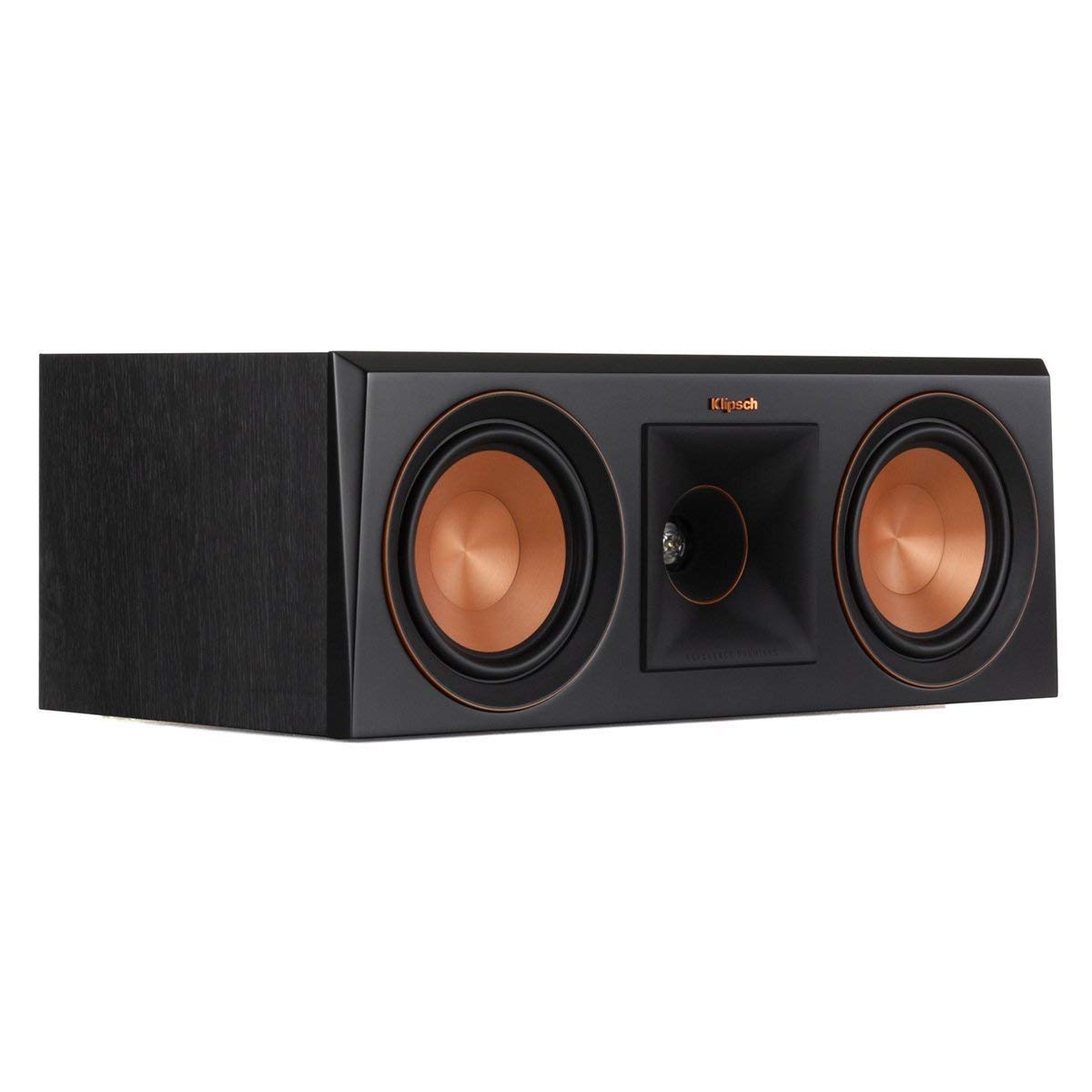
Reference Premiere clarity in a package that’s easier to place than its bigger sibling.
If the RP-504C is too large for your space, the RP-500C delivers much of that signature Klipsch dialogue prowess in a more manageable frame. It pairs a 1-inch Titanium LTS Vented Tweeter with a Hybrid Tractrix Horn and dual 5.25-inch Spun Copper Cerametallic woofers. Owners who upgraded from older Klipsch Icon centers report a massive boost in dialogue clarity and depth, with deeper lows and higher highs.
The bass-reflex design uses a rear-firing Tractrix port, which needs some clearance behind the cabinet to breathe. The removable magnetic grille makes it easy to clean or show off the copper woofers, and the scratch-resistant ebony finish looks sharp on a media console.
Fair warning from the review pages: this thing is bigger and heavier than the photos suggest, and a few buyers had to reconfigure their TV tables. But owners who paired it with larger front speakers found it kept dialogue clear even with pounding subwoofers in the mix — no small feat.
Who it’s for: Klipsch fans who want Reference Premiere voice clarity but lack the floor space for the 504C.
5. ELAC Debut 2.0 C5.2
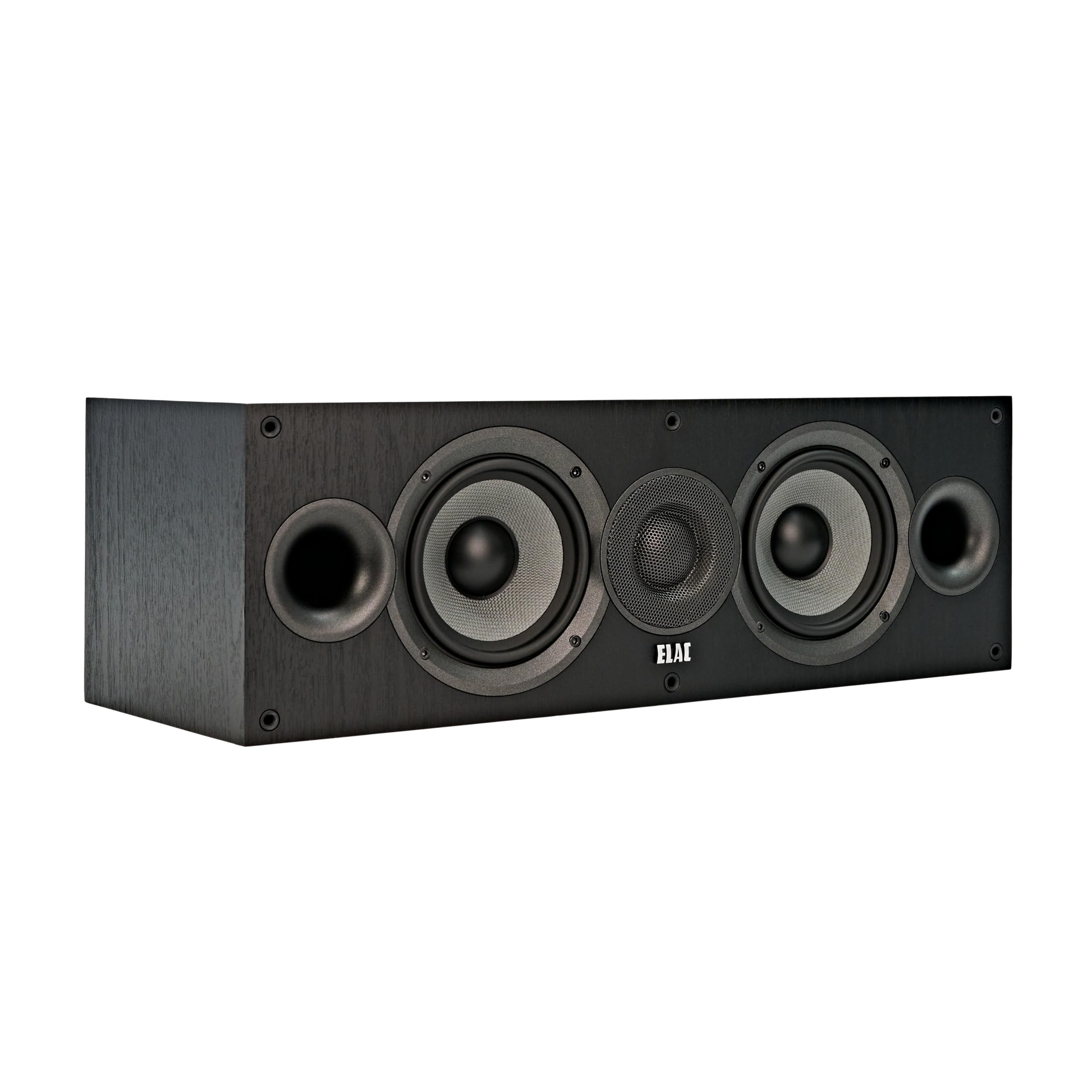
A warm, smooth center that loves bookshelf placement and never sounds harsh.
The C5.2 is the pick for anyone who must slide a speaker into a bookshelf or right against a wall. Its front-firing ports keep performance intact even in tight spots, a feature owners specifically call out as a reason to choose it over rear-ported rivals. The dual 5.25-inch woven Aramid-fiber woofers are stiffer and better damped than polypropylene or paper cones, which translates to smooth, extended low frequencies and lifelike vocals.
The 1-inch cloth dome tweeter’s waveguide improves directivity control and extends response to 35,000 Hz. Owners describe the sound as accurate, smooth, and natural, with some calling it the best dialogue clarity they have heard from a center. It also pairs particularly well with the ELAC B6.2 bookshelf speakers for a unified front stage.
The consistent caveat across owner reviews is size — it is noticeably large and needs a wide surface. If you have the space, it is a fantastic value that punches far above its price tier and holds its own against pricier Klipsch and Polk designs.
Choose this if: your center sits near a wall or in a cabinet and you want smooth, fatigue-free dialogue.
Think twice if: your console is narrow, because this is a big cabinet that demands real estate.
6. Fluance Signature HiFi 2-Way Center Channel

A value-packed center with a 92dB sensitivity that makes voices crisp without straining your receiver.
The Fluance Signature HFC is built around one clever idea: dual 5-inch midrange drivers with a unique pointed dome that lets sound waves travel directly from the center of the woven glass fiber cone. That design widens the soundstage and makes dialogue sound natural and detailed. Owners praise its clarity for female vocals and pianos, and several say it eliminated the “tinny” quality of their old in-ceiling or budget centers.
At 92dB sensitivity, it plays loud and clear without needing a powerhouse amplifier. The acoustically inert cabinet is precision-crafted from engineered wood, and it ships with integrated keyhole wall-mounting slots, sound isolation foot pads, and a magnetic front grill. The lifetime parts and labor warranty adds genuine confidence.
One recurring nitpick: the binding posts are a little hard to tighten, and banana plugs don’t sit perfectly flush. It also needs a receiver with some power behind it. If you plan to wall-mount and want near-audiophile vocal quality without the audiophile price, this is a standout.
Solid value pick: owners repeatedly praise its vocal quality, and the built-in wall hardware separates it.
7. Polk Audio Monitor XT30

An affordable upgrade that fixes mumbled dialogue without overhauling your whole system.
The Monitor XT30 is the sensible mid-range answer for anyone tired of turning up the volume just to hear conversations. It pairs a 1-inch tweeter with dual 5.25-inch Dynamically Balanced woofers for smooth, rich sound. Owners consistently note they can hear dialogue clearly without cranking the surround sound — exactly the outcome you are shopping for.
Its 4- and 8-ohm compatibility means it works with a wide range of receivers, including Dolby Atmos and DTS:X setups. Polk’s timbre-matched design ensures it blends smoothly with other Monitor XT series speakers, making it a smart starting point for a budget home theater. Owners say it pairs beautifully with Polk bookshelf speakers and a Yamaha Atmos receiver.
The honest caveats are minor: the design is basic, and one owner measured the woofers at roughly 4.5 inches despite the 5.25-inch spec. It is also larger than some expect, occasionally requiring you to raise your TV. For the money, though, the clarity-to-cost ratio is hard to argue with.
Best for: building an affordable 5.1 or Atmos setup where clear dialogue is the main goal.
Consider another if: you need a genuinely compact center for a very tight AV cabinet.
8. Yamaha Audio NS-C210BL

A compact Yamaha that slips under almost any TV and makes conversations easier to follow.
The NS-C210 is the practical choice for smaller setups where a giant center simply won’t fit. Its compact design (about 4 1/8 inches tall and 13 3/8 inches wide) slides neatly under most TVs without blocking the screen — a point owners consistently praise. Despite its size, the light aluminum cone woofers deliver fast response, and the 7/8-inch balanced dome tweeter keeps highs smooth.
Owners are surprised by the bass output from its ported enclosure and repeatedly highlight the dialogue clarity as the reason they bought it. One described replacing a larger JBL center with this smaller Yamaha and getting better, more intelligible conversations in a 5.1 setup. It works well with Yamaha receivers and mixes fine with other 8-ohm speakers.
Reasonable gripes exist: the grill is non-removable, and a couple of owners found the voice slightly unnatural at the extremes until they adjusted EQ on the receiver. It is also passive, so you need an amplifier or receiver to drive it. If you want a no-fuss dialogue fix for a modest room, this fits the bill.
The trade-off: you give up deep bass authority for a footprint that fits almost anywhere, and that is a fair swap for many living rooms.
9. Micca RB42-C Reference 2-Way Center

A budget-friendly center that brings surprising transparency and punch to small and medium rooms.
The Micca RB42-C is the entry-level pick that refuses to sound like one. Its dual 4-inch long-throw woofers, built on heavy steel frames with large magnets, deliver sturdy bass and midrange output that belies the modest price. Owners mention it measured down to 40Hz in-room and crossed over cleanly at 80Hz with a subwoofer—a rare find at this price.
The 0.75-inch silk dome tweeter, using a high-efficiency neodymium magnet, produces smooth highs that made several owners call the vocal clarity “clean” and “non-fatiguing” even at loud volumes. The 10-element crossover with film capacitors and air-core coils gives the RB42-C its transparency and strong off-axis performance, so dialogue stays intelligible from slightly off-center seats.
The recurring owner advice is simple: this speaker shines in small to medium rooms and needs an 80Hz crossover with a sub for the best results. Push it very loud in a large room and the port can chuff. Within its intended scope, it is an exceptional value.
Who it’s for: first-time buyers or small-room owners who want genuine hi-fi vocals without spending big.
Its limit: large rooms demand more output than these 4-inch woofers can deliver cleanly at reference volume.
Understanding the Specs
Driver Configuration & Crossover
A 2-way center splits the audio between a tweeter (highs) and woofers (mids and lows). A 3-way design, like the one in the SVS Prime, adds a dedicated midrange driver specifically to handle the human voice band, which often yields smoother, more natural dialogue. A crossover is the internal circuit that divides the signal between drivers, and a steeper slope (like the 18dB/octave in the Micca) can reduce audio “lobing” for better off-axis listening.
Tweeter Material & Horns
Tweeters come in different materials, each with a distinct character. Titanium (Klipsch) is rigid and fast, ideal for crisp highs; silk (Micca) and cloth (ELAC) domes tend to sound warmer and smoother; aluminum (SVS and Yamaha) offers a bright, airy presentation. A horn or waveguide, like Klipsch’s Tractrix, focuses the high-frequency energy into a wider pattern, which widens the balance so dialogue stays clear from multiple seats.
FAQ
Why is my dialogue still muffled even with a new center speaker?
Will the Klipsch RP-504C fit on top of my TV stand?
What does off-axis performance mean for my seating?
Is a 3-way center channel always better than a 2-way?
Can I use a bookshelf speaker as a center channel instead?
Why does my center speaker sound different from my front speakers?
How long does a new center speaker take to sound its best?
What size center speaker should I get for my room?
Final Thoughts: The Verdict
For most people, the center channel speaker for dialogue winner is the Klipsch RP-504C because it pairs a wide, forgiving balance with outstanding vocal clarity that owners rave about in nearly every review. If you are short on space, the Polk ES35 delivers near-identical dialogue focus from a slim, wall-mountable frame. And for the budget-conscious who still want genuine clarity, the Micca RB42-C is the smart first step into better home theater sound.
How We Picked
We do not accept paid placement. Every pick is matched to a real buyer and a real use-case; we do not hands-on test units.
Sources & Methodology
Specifications: manufacturer listings and product documentation. Review insights: verified customer reviews, as of August 2026. Pricing: not shown on this page (it changes often); check the current price via the retailer link.
As an Amazon Associate, Gadgets Feed earns from qualifying purchases. This does not affect which products we feature.