
Choosing the right oak plywood or veneer for a 3/4-inch build is about balancing grain consistency, core stability, and how the face accepts stain. The wrong sheet can warp, delaminate, or reveal ugly grain joints that ruin a furniture-grade finish.
I’m Rikta — the co-founder and writer behind Gadgets Feed. I study sourcing, grading standards, and manufacturing consistency in building materials, analyzing how face grade, backing type, and cut style affect long-term panel stability. (And Homer 🐱 claims the flat shipping box as his new nap spot.)
In this guide, I break down the best options from solid lumber to peel-and-stick veneer, so you find the right panel without costly returns. This is the definitive guide to best 3/4 oak plywood for any project that demands real wood character and structural reliability.
How To Choose The Best 3/4 Oak Plywood
Finding the right 3/4 oak plywood or veneer starts with understanding the core material and the face grade. Solid oak boards offer strength for structural transitions, while veneer sheets give you the same aesthetic at significantly less weight and cost. The key is matching the product to your project’s exposure to moisture, traffic, and finishing expectations.
Face Grade and Grain Consistency
Grade A veneer minimizes knots, color variation, and open grain defects. For furniture visible from all sides, buy multiple sheets from the same lot to ensure grain continuity across panels. Commercial grade lumber, like FAS1 oak, tolerates small defects but works well for flooring transitions and shop projects where minor character is acceptable.
Backing Type: Paper, Peel-and-Stick, or Solid
Paper-backed veneer (10 mil) remains flexible and resists cracking during installation over curved surfaces. Peel-and-stick veneer with 3M adhesive eliminates the need for contact cement but requires a perfectly smooth, sealed substrate for lasting bond strength. Solid oak lumber provides maximum durability but requires more joinery skill and weight management in the final structure.
Cut Style and Dimensional Accuracy
Flat cut veneer shows wide, cathedral grain patterns common in traditional cabinetry. Rift cut veneer produces a linear, modern look with less grain movement. Always check the listed thickness — veneer is typically 0.024 inches while solid lumber is exactly 0.75 inches. Even small deviations in width and flatness can cause alignment issues during assembly.
Quick Comparison
On smaller screens, swipe sideways to see the full table.
| Model | Category | Best For | Key Spec | Amazon |
|---|---|---|---|---|
| Barrington Hardwoods White Oak Lumber | Solid Lumber | Straight grain furniture | 0.75 in thick, kiln dried | Amazon |
| Edge Supply Red Oak Peel and Stick | Peel and Stick Veneer | Cabinet refacing | 0.024 in thick, A Grade | Amazon |
| Edge Supply White Oak Rift Peel and Stick | Rift Cut Veneer | Modern linear grain finish | 24 x 48 in, 3M adhesive | Amazon |
| Edge Supply Red Oak Non-Glued Veneer | Paper Backed Veneer | Furniture restoration | 24 x 96 in, 10 mil back | Amazon |
| Exotic Wood Zone Variety Pack | Hardwood Boards | Small craft and cutting boards | 0.75 x 2 x 24 in, 15 pcs | Amazon |
| Randall Manufacturing Oak Overlap | Floor Transition | Bridging 3/4 inch height gap | 36 x 3.5 in, FAS1 solid oak | Amazon |
| Wood-All Red Oak Veneer Sheet | Paper Backed Veneer | Budget-friendly refacing | 24 x 96 in, A Grade | Amazon |
In‑Depth Reviews
1. Barrington Hardwoods White Oak Lumber Board 3/4 x 6 Inches

Barrington Hardwoods delivers white oak lumber cut to an exact 0.75-inch thickness, kiln dried and sanded on two faces for immediate use in furniture-grade builds. Customers consistently report zero warping or cupping, which is rare for lumber shipped in standard cardboard packaging. The 6-inch width offers generous material for table aprons, shelving, or face frames without needing to edge-join multiple narrow strips.
White oak’s closed grain structure takes stain more evenly than red oak, and the kiln drying process minimizes moisture-related movement after installation. Multiple verified buyers confirm the planks arrived perfectly flat, with sharp, square edges and no visible defects across the length. The board is also rated for commercial use, meaning it meets the grade standard for demanding interior applications.
Packaging includes two pieces per order, each measuring 24 inches long. For larger projects, order multiple sets to allow for grain matching across a wider surface. The wood cuts cleanly on a table saw without tear-out, and pre-sanding at 3/4 inch saves significant preparation time before final finishing.
Why it’s great
- Fully kiln dried with minimal moisture content for stable joinery.
- Flat, square edges with no warping reported across multiple reviews.
- White oak grain provides excellent stain uniformity.
Good to know
- Only two pieces per order; larger projects require multiple purchases.
- One report of a dented plank, likely from handling during shipping.
2. Edge Supply Red Oak 24 x 96 Inch Peel and Stick Veneer
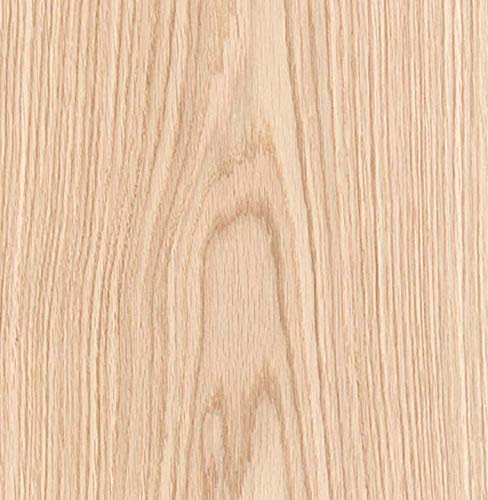
This Edge Supply sheet combines A-grade red oak veneer face with a 3M pressure-sensitive adhesive backing, allowing installation without contact cement. At 0.024 inches thick, the material is flexible enough to conform to slight curves while staying robust enough to resist tearing during trimming. The 24 x 96-inch size covers a full standard cabinet door or countertop surface in a single piece, minimizing seams.
Consistent grain and minimal defects define the face, and multiple reviewers note the adhesive activates fully only after firm pressure with a J-roller. A clean, sealed substrate is essential — any dust or unevenness can create bubbles that are impossible to remove after the bond sets. The veneer stains evenly with oil-based stains, though users recommend a light pre-sanding with 400-grit paper for optimal absorption.
Some early reviewers found the peel-and-stick description misleading, noting it is pressure-sensitive rather than instant-tack. That distinction matters for positioning: you can slide the sheet slightly before applying final roller pressure, but once fully pressed, repositioning is difficult. For beginners, practicing on a scrap surface helps build confidence before tackling the final panel.
Why it’s great
- Large single sheet reduces visible seam lines on wide surfaces.
- Pressure-sensitive adhesive eliminates messy contact cement.
- A-grade face with minimal knots and consistent color.
Good to know
- Requires perfectly smooth, sealed substrate for bubble-free adhesion.
- Some sheets arrived with grain defects or discoloration.
3. Edge Supply White Oak Rift Peel and Stick Veneer 24 x 48 Inches

Rift cut white oak veneer produces a straight, linear grain pattern with minimal flecking, making it ideal for contemporary cabinet doors and modern furniture. Edge Supply backs this A-grade face with the same 3M peel-and-stick system, rated for clean removal from the release paper and strong initial grab on MDF or plywood substrates. The sheet measures 24 x 48 inches, offering a 8-square-foot coverage area suitable for small countertops or a set of upper cabinets.
Customers highlight the material’s thickness and resistance to curling, which allows accurate alignment without the sheet buckling. The white oak face takes stain predictably and sands to a smooth surface without fuzzy grain. Several verified buyers used it to resurface laminate countertops, reporting that the adhesive held well along edges when applied to a primed and sanded surface.
A small number of users experienced adhesive separation where the paper backing did not fully release, leaving the glue layer attached to the release liner rather than the veneer. This appears to be a batch issue rather than a design flaw, and the vendor offered refunds in those cases. For peace of mind, testing a small corner before committing the full sheet is recommended.
Why it’s great
- Rift cut grain provides modern, linear appearance with minimal flecking.
- Thick veneer resists curling during positioning.
- Stains evenly and sands without fuzzy grain.
Good to know
- Occasional batch issues with adhesive transfer to backing.
- Requires careful substrate prep to avoid edge lifting.
4. Edge Supply Red Oak Non-Glued Veneer Sheet 24 x 96 Inches
This Edge Supply sheet uses a 10-mil paper backing to prevent grain splitting during bending, making it the best choice for curved surfaces like rounded table edges or arched cabinet panels. The face is graded A for minimal defects, and the large 24 x 96-inch size covers approximately 16 square feet. Without pre-applied adhesive, you have full control over the bonding method — contact cement, urea formaldehyde glue, or epoxy depending on the substrate.
Real-world users describe the veneer as forgiving for first-time applications because the paper backing reduces tear risk compared to raw wood veneer. The material requires flattening for two days under weight before installation, especially if shipped rolled. After flattening, it cuts cleanly with a straightedge and utility knife, and the paper backing allows easy sanding without exposing the glue line.
Some reviewers note inconsistency in grain patterns between different orders, which matters for projects where multiple sheets must match across a large surface. Ordering all needed sheets at once from the same lot minimizes color and grain variation. The surface also requires fine-grit sanding before staining to remove a slight rough texture from the manufacturing process.
Why it’s great
- Paper backing prevents cracking when applied over curved surfaces.
- Large 96-inch length covers tall panels with a single sheet.
- No adhesive allows choice of bonding method for different substrates.
Good to know
- Requires flattening for 48 hours before installation.
- Grain patterns vary between lots; order all sheets together.
5. Exotic Wood Zone Variety Pack 15 Pieces Walnut Maple Cherry

Exotic Wood Zone’s variety pack delivers 15 hardwood boards (five each of walnut, maple, and cherry) in the 3/4-inch thickness that cutting board makers and craft woodworkers need. Each piece measures 24 inches long by 2 inches wide, providing ample material for small projects like charcuterie boards, knife scales, or inlay strips. The boards are surfaced on all sides, with sharp, square edges ready for glue-up.
Buyers consistently praise the straightness and lack of warpage across all three species, noting that the walnut offers rich chocolate tones while the maple remains pale and consistent for contrast. The cherry boards lean toward a light pinkish-brown that darkens naturally with UV exposure. Some pieces show small planer chips at the edges, but these sand out quickly with 120-grit paper and do not affect panel glue joints.
A minor concern is that the boards measure slightly under the nominal 2-inch width, coming in at about 1 15/16 inches. For precision joinery, this deviation matters when calculating final panel dimensions. Also, one reviewer reported a single slightly bowed board that required jointing before use. Overall, the pack offers strong value for those building small batch items without buying full-length lumber.
Why it’s great
- Three premium species in one pack for contrasting designs.
- Surfaced and squared boards reduce prep work for glue-ups.
- Consistent 0.75-inch thickness across all 15 pieces.
Good to know
- Actual width is slightly under nominal 2 inches.
- Occasional small planer chips or slight bowing in isolated pieces.
6. Randall Manufacturing Oak Overlap 3/4 x 3-1/2 x 36 Inches

Randall Manufacturing’s solid red oak overlap transition is precision-milled to bridge a 3/4-inch height difference between two flooring surfaces. Machined from FAS1-grade northeastern red oak, the strip measures 36 inches long and 3.5 inches wide, with an overlap lip that is 7/16 inch wide and 1/4 inch thick. The product comes unfinished so you can stain it to match existing oak flooring, and multiple buyers confirm it takes stain evenly without blotching.
Installation flexibility is a standout feature — the solid oak strip can be glued, nailed, or screwed depending on the subfloor material. The overlap design tapers the transition gradually, making the height change feel smooth underfoot rather than abrupt. Verified users install it between tile and hardwood or in doorways where new flooring meets an older, thicker surface, and report excellent color match after staining with classic golden oak or dark walnut finishes.
Because the transition is unfinished, you must apply a polyurethane top coat to protect against moisture, especially in kitchens or bathrooms where water exposure occurs. One reviewer noted that water-based polyurethane on raw red oak can cause a golden shift, so testing on a scrap section is advisable. The product is made in the USA by a manufacturer with a long track record in commercial flooring transitions.
Why it’s great
- Designed specifically for a 3/4-inch height difference, no shimming needed.
- Solid oak construction offers durability under foot traffic.
- Multiple installation methods suit different flooring materials.
Good to know
- Requires sealing or staining to protect from moisture.
- Water-based poly can shift raw red oak toward golden tones.
7. Wood-All Red Oak Veneer Sheet 24 x 96 Inches A Grade

Wood-All’s red oak veneer sheet offers an entry-level route into A-grade veneer at a price that suits budget-conscious refacing projects. The 0.024-inch overall thickness includes a 10-mil paper backing, giving enough flexibility to wrap a 1-inch radius without grain splitting. Each sheet measures 24 inches wide by 96 inches long, providing a generous surface for pantry cabinet doors or a single countertop face.
Customers report the veneer is forgiving for novices, with the paper backing minimizing tear risk during cutting and handling. The material requires a two-day flattening period under weight before application, especially if shipped rolled. Once flat, it cuts cleanly and accepts contact cement well. Multiple first-time users achieved professional-looking results on bathroom vanities and small furniture pieces with basic tools and patience.
Grain and color variation is the primary trade-off — as with all natural wood products, colors shift between sheets and even across production lots. Some buyers received pieces with open grain or small splits that required wood filler before staining. The surface also benefits from a light sanding before finishing to remove any rough texture from the manufacturing process. For large continuous surfaces, ordering extra sheets to select the best match is recommended.
Why it’s great
- Affordable A-grade red oak veneer for large-area refacing.
- Paper backing prevents cracking during bending around 1-inch radius.
- Forgiving for beginners, cuts easily with utility knife.
Good to know
- Requires 48 hours of flattening before installation.
- Natural grain and color variation between sheets is expected.
FAQ
Can I use 3/4-inch solid oak lumber for wrapping curved surfaces?
How do I match grain across multiple sheets of veneer for a large project?
Is peel-and-stick veneer strong enough for high-use kitchen cabinets?
Final Thoughts: The Verdict
For most users, the best 3/4 oak plywood winner is the Barrington Hardwoods White Oak Lumber because it delivers flat, kiln-dried boards with furniture-grade grain for structural builds. If you want convenient adhesive application for quick cabinet refacing, grab the Edge Supply Red Oak Peel and Stick Veneer. And for bridging a 3/4-inch floor height difference, nothing beats the Randall Manufacturing Oak Overlap.