
Our readers keep the lights on and my morning glass full of iced black tea. As an Amazon Associate, I earn from qualifying purchases.
Specs are compiled from manufacturer listings and verified buyer reviews and can change over time — please confirm the key details on the product page before buying.
The right active RF isolation distributor stops TVs from freezing or pixelating and prevents internet drops when other devices use the line. A powered distributor with isolated ports keeps each output strong and separate, so one weak device doesn’t drag down the whole system.
I’m Min — the founder and writer behind Gadgets Feed. This guide is built by comparing the manufacturers’ published specifications and the patterns across verified customer reviews, so you get each pick’s real strengths and trade-offs instead of marketing spin.
If your coax wiring is a tangle of splitters and signal drops, an active rf isolation distributor (a powered splitter that keeps each TV or modem’s signal separate and strong) can fix it. This guide names the exact model for your setup, whether you’re juggling multiple TVs or stabilizing your home network.
Our Picks at a Glance

How To Choose The Best Active RF Isolation Distributor
Before you buy, match the box to your wiring. The biggest mistake is grabbing a passive splitter — it divides your signal, so every TV gets a weaker feed. An active distributor adds power to make up for that loss.
Count your actual outputs
Count every TV, modem, and set-top box that needs a connection. A four-output unit covers a typical living room plus bedrooms, while an eight-port box handles a full house with room to spare. Buying too few ports means another splitter downstream, which ruins the isolation you paid for.
Know if you need active return
If you use cable internet, your modem sends an upstream signal back to the provider. An active return path (a powered upstream amplifier) keeps that upload signal healthy. This is the difference between a standard distribution amp and one that fixes slow or dropping internet.
Check the device compatibility rules
Some amps are built for cable TV only — they block satellite dishes and can kill over-the-air antenna signals. Others are made for OTA. And if your cable provider uses MoCA (a way to send internet over coax), you need a MoCA-compatible unit. Read the compatibility list before you click buy.
Quick Comparison
| Model | Best For | Output Ports | Forward Gain | Active Return | Amazon |
|---|---|---|---|---|---|
| 9 Port Bi-Directional Amp Kit★ Best Overall | Whole-home cable TV & internet | 8 amplified | Lossless | Yes | Amazon |
| ClearStream JUICE4Top Performer | OTA antenna to 4 TVs | 4 | 1.2 GHz range | No | Amazon |
| Winegard HDA-100 | Overcoming long cable loss | 1 | 15 dB | 2-way bypass | Amazon |
| Arris BDA-42-4-AR-R | Boosting cable internet uploads | 4 | 5x forward | Yes (2x) | Amazon |
| Reliable LSA48 | Multi-TV OTA or FM distribution | 8 | +4 dB per port | No | Amazon |
| Commscope CSMAPDU5VPI | MoCA home networks | 5 | Unity gain | Yes (unity) | Amazon |
| JXRYWF UHF 5-Way | Wireless mic antenna sharing | 5 receiver | 2200 ft range | No | Amazon |
In‑Depth Reviews
1. 9 Port Bi-Directional Cable TV Splitter Signal Booster/Amplifier Kit
Our pick — over 4.5★ from 250+ verified ratings; the strongest balance of quality and price.
The whole-home fix that ends constant disconnects across every TV on your coax.
This is the box for the cable households where every TV freezes at the same time. It feeds eight amplified output ports and the maker calls every one of them lossless in both directions — meaning the signal coming in and the signal your modem sends back both stay full-strength. It is a true lossless 8-port splitter, not a divided-down passive one.
The active return path is the star here for internet users. Buyers report it replaced an old amp and fixed all Comcast X1 issues — TVs not working and constant disconnects. One owner saw six coax outlets jump in picture quality after a roughly five-minute install, with a green light confirming the unit was powered and working.
Build quality matches the performance. The powder-coated aluminum housing resists salt fog and rust, and every RF port carries 6 kV surge protection with a self-resetting PTC short-circuit protector on the UL-listed adapter. You also get three F59 terminators and a Superflex power cable in the box. The one rule to respect: this is not for OTA antennas and not for satellite, so cable subscribers only.
Why it earns the top spot
- Signal quality is what wins people over — the fix for broken multi-TV setups
- Sturdy aluminum housing built to fight corrosion
- Active return keeps your cable internet uploads healthy
Respect the boundaries
- Not for OTA antennas — passive-return models like the LSA48 suit that job
- Not MoCA capable, so check with your provider first
Reach for this if: you want one sturdy box that stabilizes both TV and internet across a full house.
Look elsewhere if: you run an over-the-air antenna, since this unit blocks that setup.
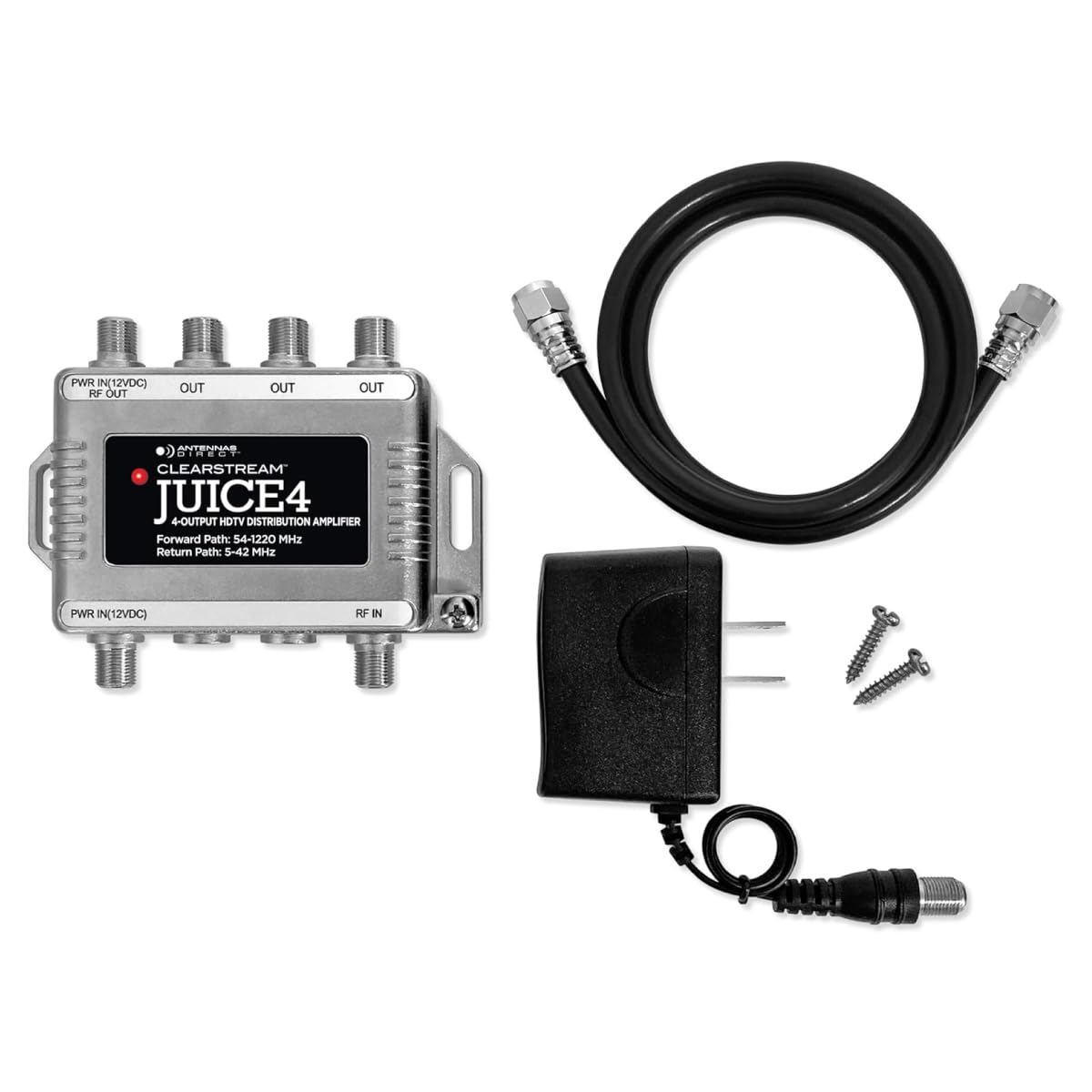
2. Antennas Direct ClearStream JUICE4 Distribution Amplifier
The compact amp that pushes a clean antenna signal past 50 feet of cord.
For cord-cutters running an over-the-air antenna to a few TVs, this four-output box is built for broadcast TV. It supports ATSC 3.0 NEXTGEN TV and is ready for 4K 8K UHD, so it won’t be obsolete when you upgrade your set. The operating frequency extends to 1.2 GHz, which covers both CATV and cable broadband applications.
Owners mention it definitely amplifies the signal and pushes it through at least 50 ft of cord, clearing up skipping and pixelation on uncertain channels. One owner hooked up four smart TVs and the picture freezing stopped entirely. It runs warm to the touch but not hot, which reads as normal operation for a powered unit.
You can keep it indoors or move it outside since the precision machine-sealed zinc diecast housing shrugs off dust and water droplets. Compared to the 9 Port kit above, this one is a 4-output design — a 2.0x gap in capacity — so it suits a smaller setup rather than a whole-home cable network.
Strong compact performer: excellent surge protection on all ports and a 75 ohm impedance that matches standard coax, all in a 9.6 ounce body.
Pick this when: you need a tidy, outdoor-safe amp for up to four antenna TVs.
skip it if: you need active return for cable internet uploads — this unit is forward-only.
3. Winegard HDA-100 Distribution Amplifier
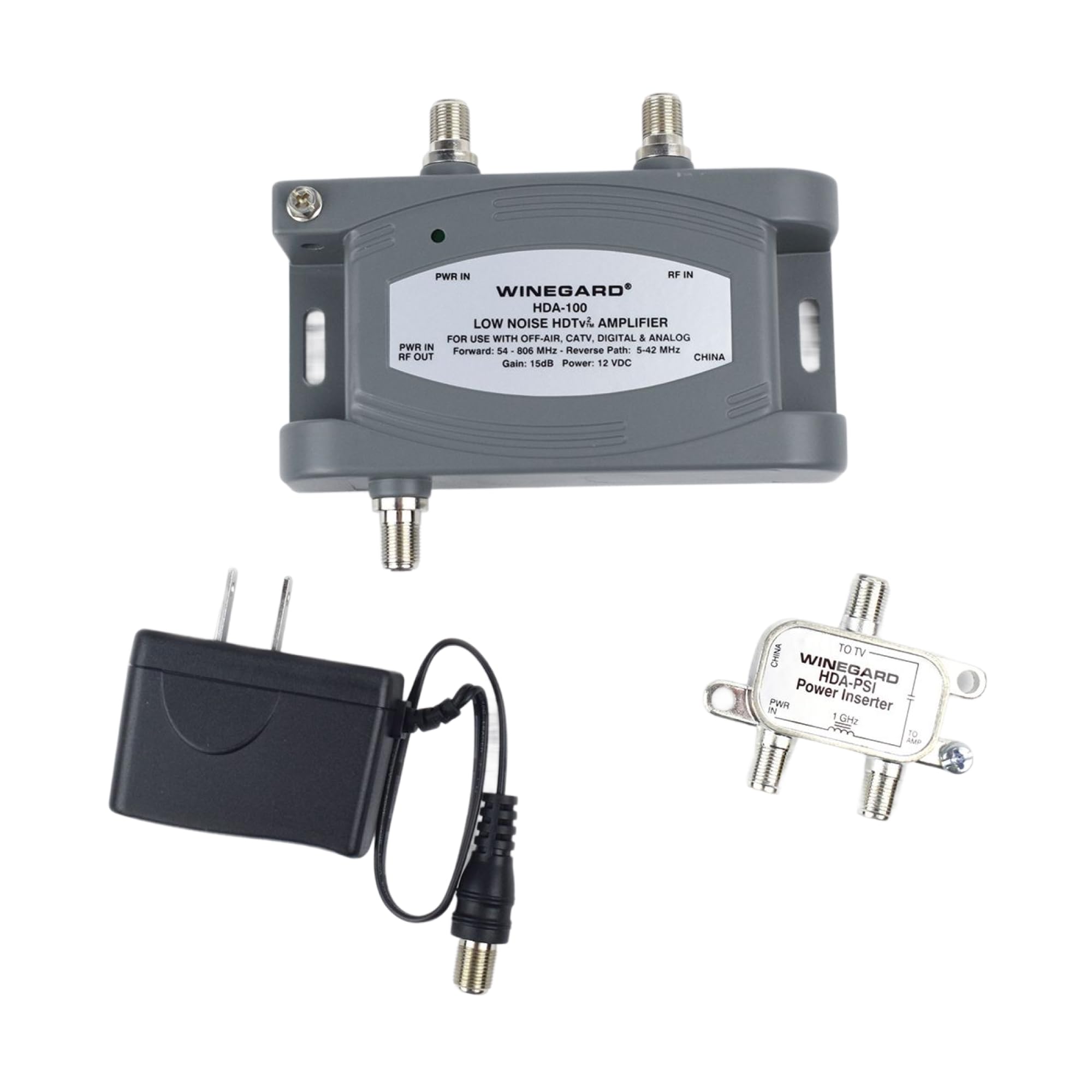
A low-noise amp that restores picture quality when you stack too many splitters.
This single-output Winegard is the specialist for a specific pain: you added a 4-way splitter on top of an existing 8-way and your picture turned to mush. Customers note it solved 100% of that picture degradation with an easy install, and a professional recommended it for exactly that scenario. It amplifies signals from 54-1000 MHz at 15dB gain.
The trade-off shows up on long runs. One owner driving 150-200 feet to three TVs found the signal degrades with more splitters and longer cable, and noted the HDA-200 (24dB) is the stronger sibling for that job. Another saw only a slight picture improvement on long cable runs, so this is a signal-saver, not a miracle worker for a weak antenna feed.
It has a 5-42 MHz 2-way bi-pass at -2 dB loss, and the weather-resistant housing is built for harsh outdoor conditions. Compared with the JUICE4 above, this is a single-output design — you put it before your splitter, not in place of one.
Honest assessment: the cleanest cure for splitter-induced picture loss, with the limits that boosting power fades over time and it won’t create signal that isn’t there.
Choose this if: your picture broke after adding splitters and you want a professional-grade fix.
Consider the bigger model if: you’re pushing signal hundreds of feet to multiple TVs.
4. Arris 4-Port Cable Modem Amplifier with Active Return

The box that rescues a modem losing its upstream signal to old coax.
If your internet drops at random hours, the culprit is often the upstream signal your modem sends back. This Arris boosts signal by 5x forward and 2x reverse — the reverse path being the active return that keeps your upload and your connection alive. One owner with high upstream power at 50-51 dBmV saw levels drop to 38-42 dBmV after install, with no errors for two-plus months.
The speed gains impress. A buyer stuck at 400 Mbps on a gigabit plan saw speeds rise 150-250 Mbps after this unit boosted the incoming cable signal, saving a full rewiring job. Another in an older house with old coaxial cables and old splitters stopped losing internet signal to the modem-router entirely.
Two honest notes: the instructions omit that output #1 must feed the modem, so read carefully. And this amplifier runs hot, needing airflow. The most-discussed trait is mixed — some reviewers point out weak TV signal on certain setups, so it shines brightest for internet-focused homes rather than as a pure TV splitter.
Where it fits: the dedicated upstream booster for cable internet — faster, stable, and it saved at least one owner a costly rewire.
Buy it for: intermittent ISP disconnects and slow downstream speeds on older coax.
Think twice if: your main goal is TV distribution — the 9 Port kit handles that more broadly.
5. Reliable 8-Port TV Antenna Signal Splitter LSA48

A compact 8-way amp that doubles signal strength for OTA and FM alike.
This one earns its keep in unusual places. A radio studio uses it to share a rooftop FM antenna across multiple receivers at roughly 0dB unity gain — no loss versus an unpowered splitter. Another owner cut satellite TV, ran a simple antenna install over existing coax, and now receives 125 channels, many previously available only via satellite.
The core spec is a +4dB boost per port, which doubles your signal strength on each output. Shoppers say it handles up to 8 TVs with no lag or fuzzy images, and it works flawlessly installed outside in an approved enclosure. The ultra-small form factor fits easily in confined spaces.
Respect the compatibility rules. It’s not for amplified antennas or installs with a pre-amp, not for satellite TV, and the power supply is indoor-use only. One owner found it wouldn’t work with their original antenna and needed a different one — so pair it with a compatible passive antenna and it delivers.
What it does best
- Doubles signal strength on all 8 ports at +4dB each
- Flawless multi-TV performance with no picture lag
- Compact enough for tight spaces and outdoor enclosures
What to know first
- Not compatible with satellite or amplified antennas
- Power supply is indoor-use only
Grab this for: a many-TV OTA or FM distribution job where size and channel count matter.
Move on if: you have a pre-amp in your antenna line — this unit won’t play nice.
6. Commscope CSMAPDU5VPI 5-Port MoCA HomeConnect Amplifier
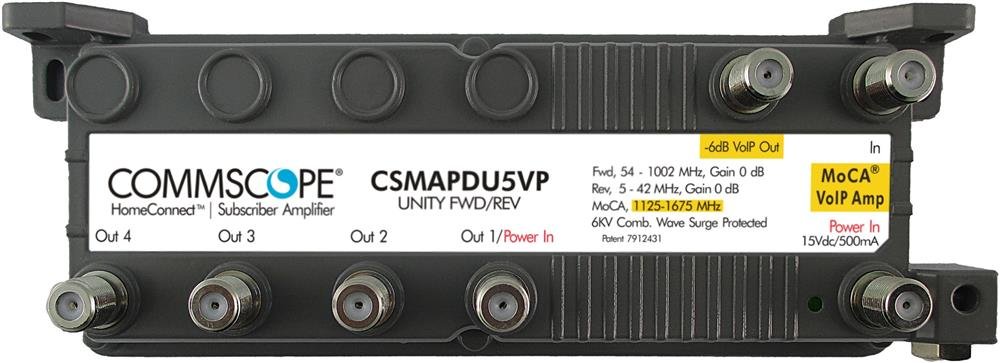
The slim MoCA-friendly amp that calms a Comcast Xfinity home network.
If your provider uses MoCA to send internet over coax, most standard amps will fight that signal. This Commscope is built for it: unity gain on both forward and reverse paths with MoCA signal passthrough, plus a power inserter in the box. One owner replaced their amp and splitters with MoCA-compatible units and got strong video and MoCA signals with zero interference.
The measurable win is upstream power. A buyer saw it reduce upstream from 57 to 50 dBmV, fixing a no-internet issue that stayed stable for four years. Another with three TVs and a gateway reports easy install and flawless operation in a slim frame that fits a utility box with clear connector markings.
The caveat from the review pages: one unit worked great for 100 days then failed after three weeks, with poor warranty support. That’s a durability question, not a design flaw — most owners see years of stable service. At 4 ounces with a 54-1002 MHz range, it’s the lightest, most network-specific option here.
Network specialist: the right call when MoCA compatibility is non-negotiable, with a cheaper-feeling warranty experience as the trade-off.
Reach for this if: you run MoCA or Xfinity and need clean signal split across TVs and a gateway.
Look elsewhere if: you want the broadest warranty coverage — the 9 Port kit’s two-year amp warranty is stronger.
7. JXRYWF UHF Active Directional Antenna Distribution System
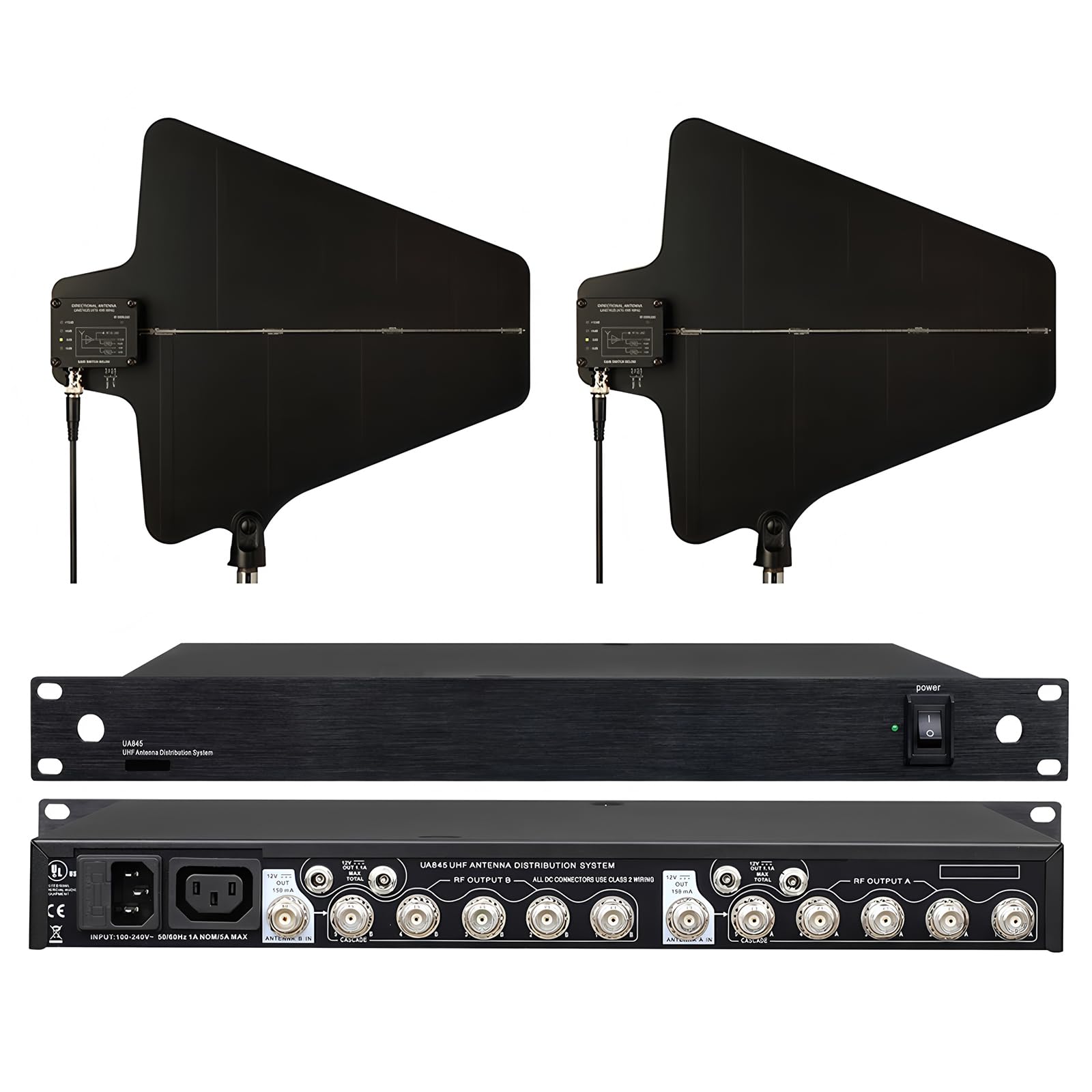
The rack-mount rig that lets five wireless mic receivers share one pair of antennas.
This is a different animal — not a TV splitter but a distribution system for UHF wireless microphones on stage. It covers 400-970 MHz and lets five wireless receivers use two of the same antennas, with a cascade port to add a fifth receiver or a second distribution system. It works with Sennheiser, Shure, AKG, and most brands in that frequency range.
The headline number is a 2200 ft stable signal reception range. But note the real-world limit: it’s restricted to a cable length of 35 feet from your receiver, so plan your rack placement. The built-in power supply accepts AC100-260V and offers four groups of DC 12V power ports, so it can power four wireless mic receivers at once — letting a four-Ulx owner ditch bulky individual power supplies.
Performance in the field is strong once you find a clear channel. One user notes it amplifies all RF greatly, so finding a clear channel takes some hunting — but once locked, the signal is extremely stable. The power-on workflow matters, so read the manual’s turn-on and turn-off order before racking it.
Stage-ready tool: high-gain receiving with aviation-material antenna paddles and multi-receiver power, built for pro performance work.
Buy this for: weddings, speeches, or outdoor broadcasts running multiple wireless mics in one rack.
pass on it if: your needs are TV or internet coax distribution — the cable amps above fit that job.
Understanding the Specs
Forward Gain and dB
Forward gain is the boost the amp adds to the signal coming from your provider or antenna before it splits to your TVs. It’s measured in dB — a 15dB gain is substantial, while +4dB per port doubles the signal on each output. More dB helps overcome long cable runs and splitter loss, but too much on a short run can over-amplify and cause problems.
Active Return Path
The return path is the signal your modem and set-top boxes send back upstream. A passive amp ignores this path, so a weak upload can cause internet drops. An active return amplifier boosts that upstream signal — often by 2x — which stabilizes your connection and can even raise your speeds on older coax.
FAQ
Will an active RF distributor work with my satellite dish?
What is the difference between active return and a standard amplifier?
Can I use a cable amplifier with an over-the-air antenna?
What does MoCA compatible mean and do I need it?
How many output ports do I really need?
Why does my picture still freeze after adding an amplifier?
Can these amplifiers be installed outdoors?
What gain level do I need for a long cable run?
Will an amplifier speed up my cable internet?
What is surge protection on RF ports and why does it matter?
Final Thoughts: The Verdict
If you want one dependable pick, the active rf isolation distributor winner is the 9 Port Bi-Directional Amp Kit because it pairs eight lossless outputs with an active return path that stabilizes both TV and internet. If you need a compact antenna amp for up to four TVs, grab the ClearStream JUICE4. And for MoCA-based Comcast networks, the Commscope CSMAPDU5VPI is the one to reach for.
How We Picked
We do not accept paid placement. Every pick is matched to a real buyer and a real use-case; we do not hands-on test units.
Sources & Methodology
Specifications: manufacturer listings and product documentation. Review insights: verified customer reviews, as of August 2026. Pricing: not shown on this page (it changes often); check the current price via the retailer link.
As an Amazon Associate, Gadgets Feed earns from qualifying purchases. This does not affect which products we feature.